
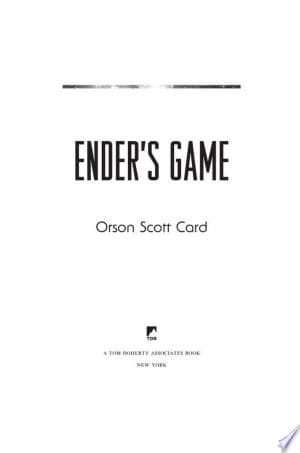
Synopsis
Covers the whole plot, including the ending.
- Difficulty
- Medium
- Pacing
- Fast
- Mood
- Intense, Thought-provoking, Dark, Suspenseful
- Read it if
- You enjoy intense psychological thrillers, military science fiction, or stories about child prodigies grappling with immense moral burdens and the weight of the world.
- Skip it if
- You prefer lighthearted stories, are sensitive to themes of child abuse and psychological manipulation, or dislike military-focused narratives.
Ender's Game Plot Summary
Covers the whole plot, including the ending.
The Third Child and the Monitor
Andrew 'Ender' Wiggin, a smart six-year-old, lives on a future Earth where families can only have two children. He is a rare 'Third' child, allowed because of his exceptional genes. He wears a monitor that lets the International Fleet (IF) watch his thoughts and actions, identifying him as a possible military leader. After a fight with a bully named Stilson, Ender shows his strategic mind and capacity for violence, permanently stopping Stilson's bullying. The monitor is then removed, and Colonel Hyrum Graff recruits Ender for Battle School, a military academy in space.
Arrival at Battle School
Colonel Graff takes Ender to Battle School. Graff immediately separates Ender from other recruits, announcing Ender's supposed genius to make others dislike him. Graff believes good commanders do best under pressure and alone. On the shuttle, Ender faces his first bully, Bernard. Ender cleverly turns the situation against Bernard by hacking the student messaging system. When he arrives, Ender remains an outcast, but his intelligence and unique problem-solving skills quickly make him stand out, especially in the zero-gravity battle room, the main training area for the child soldiers.
Forming Alliances and Facing Rivalry
Ender quickly masters the battle room, surprising instructors and students. He becomes friends with Alai, a respected new student, and they create new battle plans. However, Ender also faces strong dislike from older students, especially Bonzo Madrid, the commander of Rat Army, where Ender is first placed. Bonzo feels threatened by Ender's talent and abuses him physically and verbally. Ender, despite being smaller, uses his intelligence and fierce nature to defend himself, further building his reputation as a tough opponent.
Commanding Salamander and Rat Armies
After his time in Rat Army, Ender transfers to Salamander Army, still under Bonzo Madrid. Bonzo, still angry, forbids Ender from fighting and makes him practice with Petra Arkanian, a skilled female soldier. Ender secretly trains Petra and other disliked soldiers, developing new tactics. He then proves himself in a battle by ignoring Bonzo's orders and winning. Graff keeps changing Ender's environment, moving him to Rat Army and then Phoenix Army. This ensures Ender never gets comfortable and always faces new challenges and enemies, testing his adaptability and leadership.
Dragon Army and Unprecedented Victories
At age nine, Ender becomes commander of the Dragon Army, an army known for losing. His soldiers are a mix of young, new students and older, unhappy ones. Ender, with his friends Alai, Petra, Dink, and Bean as his chosen team leaders, quickly makes Dragon Army an unbeatable force. He breaks all usual rules, using new and often unusual strategies in the battle room. His army wins many battles, often against multiple opposing armies at once. This success further isolates him from his peers, who resent his constant winning.
The Final Confrontation with Bonzo
Ender's many wins and Bonzo Madrid's embarrassment lead to a violent fight in the showers. Bonzo, with some other older students, ambushes Ender, planning to hurt him badly or kill him. Ender, remembering his past with Stilson, realizes he must end the threat for good. He uses his speed and a well-aimed kick to Bonzo's face, followed by another to his groin, stopping him. Ender thinks he only injured Bonzo, but he later learns Bonzo died from his injuries. The IF hides this from him, adding to Ender's pain and guilt.
Advanced Command School and Mind Games
After the shower incident, Ender immediately transfers to Command School on Eros, a former Bugger colony. He trains under Mazer Rackham, the hero who defeated the Buggers in the Second Invasion. Mazer reveals that Ender's battle room training was preparation for leading a fleet in real space combat. Ender goes through increasingly complex and mentally draining simulations, where he must command entire fleets against Bugger forces. His emotional state is fragile, burdened by guilt over Bonzo and Stilson, and the constant pressure of being humanity's last hope.
The Final Exam and the Bugger Genocide
Ender faces what he believes is his final, hardest simulation. He commands a large human fleet against the Bugger homeworld, using a 'Dr. Device' (Molecular Disruption Device). With his team leaders from Battle School, now his sub-commanders, Ender creates a brilliant, risky plan to destroy the Bugger homeworld. After the 'simulation' ends in victory, Mazer Rackham and Graff tell him the terrible truth: the 'simulation' was real. Ender, at age ten, has unknowingly caused the complete destruction of the entire Bugger species, committing genocide.
Aftermath and Political Turmoil
Devastated by learning of his genocide, Ender withdraws, struggling with immense guilt and the realization he was tricked into it. Meanwhile, on Earth, the Bugger threat is gone, and peace among nations quickly breaks down. Ender's siblings, Peter and Valentine, have gained much political power. Peter, as 'Locke,' promotes peace, while Valentine, as 'Demosthenes,' influences public opinion, unknowingly helping Peter's goal of global control. The IF, having used Ender, now fears his power.
The Speaker for the Dead
Ender is prevented from returning to Earth. He is sent with colonists to establish new worlds. On the first colony world, he finds a Bugger queen pupa, hidden in a place the Buggers prepared for him. Through the queen, Ender learns the Buggers' peaceful intentions and their deep regret for the past wars, which were a misunderstanding. He realizes they did not understand individual life and fought without malice. Ender, taking the name 'Speaker for the Dead,' dedicates his life to traveling the stars with the Bugger queen pupa, looking for a new home for her and telling the true story of the Buggers, seeking to make up for his actions.
Principal Figures
Andrew 'Ender' Wiggin
Protagonist
A child prodigy trained to be humanity's ultimate weapon against the Buggers.
Ender is a third child, genetically engineered for strategic brilliance and empathy, traits that make him both a formidable commander and a deeply compassionate individual. He possesses an uncanny ability to understand and manipulate others, a skill he often despises in himself. Throughout his training, he struggles with the moral implications of violence and his role as a weapon, constantly fearing becoming like his sadistic brother, Peter. His defining characteristic is his desire to end conflicts permanently, often leading him to extreme actions.
Relationships: Colonel Graff (mentor and manipulator); Valentine Wiggin (beloved sister and protector); Peter Wiggin (abusive brother and intellectual rival); Alai (best friend and trusted subordinate); Bean (loyal and brilliant subordinate)
Colonel Hyrum Graff
Supporting
The cunning director of Battle School, responsible for Ender's brutal training.
Graff is a high-ranking officer in the International Fleet, dedicated solely to finding and training the commander who will defeat the Buggers. He is a master manipulator, orchestrating Ender's isolation and suffering to forge him into the ultimate leader. Graff believes that Ender's genius can only be honed through extreme pressure and by denying him comfort and friendship. Despite his harsh methods, he genuinely believes Ender is humanity's only hope and carries the heavy burden of his decisions, often feeling a paternal responsibility towards Ender.
Relationships: Ender Wiggin (mentor, manipulator, and surrogate father figure); Mazer Rackham (fellow officer and mentor to Ender)
Valentine Wiggin
Supporting
Ender's empathetic sister, who influences political discourse on Earth.
Valentine is Ender's older sister, possessing a rare combination of compassion and intelligence. She is the only person Ender truly loves and trusts, acting as his emotional anchor and protector from Peter's cruelty. While Ender is at Battle School, Valentine, under the pseudonym 'Demosthenes,' becomes a powerful and influential political writer on Earth, unknowingly being manipulated by Peter to achieve his own ambitions. She deeply regrets Ender's suffering and ultimately helps him find a path to atonement.
Relationships: Ender Wiggin (devoted sister and emotional confidante); Peter Wiggin (brother, intellectual collaborator, and manipulator)
Peter Wiggin
Antagonist
Ender's sadistic older brother, a brilliant but power-hungry sociopath.
Peter is Ender's older brother, a highly intelligent but deeply disturbed individual with sociopathic tendencies. He derives pleasure from tormenting both Ender and Valentine. Peter's ambition is boundless, and he craves power and control over the world. While Ender is away, Peter, using the pseudonym 'Locke,' manipulates global politics alongside Valentine to eventually become the Hegemon of Earth. He represents the dark potential within humanity, a stark contrast to Ender's reluctant use of violence.
Relationships: Ender Wiggin (abusive brother and intellectual rival); Valentine Wiggin (sister, intellectual collaborator, and political tool)
Mazer Rackham
Supporting
The legendary hero of the Second Bugger War, who becomes Ender's final mentor.
Mazer Rackham is a revered figure in human history, credited with single-handedly defeating the Buggers in the Second Invasion. He is a stern, enigmatic, and brilliant tactician who serves as Ender's final instructor at Command School. Rackham reveals the truth about the Bugger mind-set and the previous wars, preparing Ender for the ultimate confrontation. He is instrumental in teaching Ender the nuances of fleet command and reveals the true nature of Ender's 'final exam,' carrying the heavy burden of his own past actions and the manipulation of Ender.
Relationships: Ender Wiggin (mentor and instructor); Colonel Graff (fellow officer and co-conspirator in Ender's training)
Alai
Supporting
Ender's first true friend and most loyal subordinate in Battle School.
Alai is a kind, intelligent, and skilled student in Battle School who quickly becomes Ender's closest friend. He is a respected launchie and a natural leader, admired by his peers. Alai's friendship is crucial for Ender, providing him with much-needed emotional support and validation in an isolating environment. He becomes Ender's second-in-command in Dragon Army and later plays a vital role as a sub-commander during the final Bugger War, demonstrating unwavering loyalty and strategic acumen.
Relationships: Ender Wiggin (best friend and loyal subordinate); Bean (fellow subordinate and friend)
Bean
Supporting
A brilliant and tiny launchie who becomes Ender's most insightful subordinate.
Bean is an exceptionally intelligent and ambitious launchie, even smaller than Ender, who quickly proves himself to be a strategic genius. He challenges Ender's authority initially but soon becomes Ender's most trusted and insightful toon leader, often providing crucial tactical observations. Bean is driven by a desire to prove himself and contribute, and Ender recognizes his brilliance, giving him significant responsibilities. He serves as a mirror to Ender, reflecting similar intellectual prowess and a deep understanding of strategy.
Relationships: Ender Wiggin (commander and intellectual peer); Alai (fellow subordinate and friend)
Petra Arkanian
Supporting
A skilled female soldier who mentors Ender and becomes a trusted subordinate.
Petra is one of the few girls in Battle School, an excellent marksman, and a capable soldier. She initially mentors Ender in the battle room when he is ostracized in Salamander Army. Petra is pragmatic, independent, and strong-willed, earning Ender's respect. She becomes one of his most reliable toon leaders in Dragon Army and later serves as a crucial sub-commander in the final fleet battle, demonstrating her tactical skills and loyalty. Her presence highlights the equality of talent regardless of gender in the IF.
Relationships: Ender Wiggin (commander and trusted subordinate); Dink Meeker (fellow soldier and friend)
Bonzo Madrid
Supporting
An older, abusive army commander who resents Ender's talent.
Bonzo Madrid is the commander of Salamander Army and later Rat Army, an older student who feels threatened by Ender's extraordinary talent. He is proud, arrogant, and relies on traditional battle room tactics. Bonzo sees Ender as a challenger to his authority and a symbol of his own waning relevance, leading him to bully and abuse Ender both physically and psychologically. His resentment escalates into a fatal confrontation with Ender, marking a significant turning point in Ender's development.
Relationships: Ender Wiggin (rival and victim of Ender's violence)
Themes & Insights
Childhood and Trauma
The novel shows the severe mental cost for child soldiers, especially Ender. Children in Battle School face extreme pressure, loneliness, and manipulation. This forces them to grow up fast and make decisions about life and death. Ender's innocence is taken away, replaced by strategic brilliance and deep trauma from the violence he causes and experiences. The story shows the difficult morality of sacrificing childhood for the greater good. It shows how these children are used and then left with deep emotional scars, as seen in Ender's guilt over Stilson and Bonzo.
“'In the moment when I truly understand my enemy, understand him well enough to defeat him, then in that precise moment I also love him.'”
Manipulation and Free Will
Manipulation is a key theme, mainly by Colonel Graff and the International Fleet. Ender's whole life, from his birth as a 'Third' to his training and the final 'simulation,' is a carefully planned series of manipulations. These are designed to turn him into a weapon. Graff purposely isolates Ender, sets him against his peers, and creates impossible situations, all to sharpen his strategic mind. This brings up questions about free will and moral responsibility when someone is so completely controlled. This ends with Ender's unknowing act of genocide, which he was tricked into doing.
“'I am not a killer. I am not Peter. I am not a killer. I am not Peter.'”
Identity and Self-Discovery
Ender constantly struggles with who he is, fearing he will become like his cruel brother, Peter. He deals with his capacity for violence and the person he is forced to become. His journey is about finding himself, not just as a commander, but as a moral person. After the war, he sheds his identity as 'Ender Wiggin, the xenocide.' He becomes 'Speaker for the Dead,' dedicating his life to understanding and telling the truth of others, including the Buggers. This change shows his search for meaning and atonement beyond his military role.
“'He was born to be a killer. But he was also born to be a lover. And the only way to be a lover is to be a speaker.'”
The Nature of War and Empathy
The novel looks at the nature of war, especially the dangers of misunderstanding and seeing the enemy as less than human. The entire conflict with the Buggers comes from a lack of communication and an inability to understand their alien minds. Ender's unique ability to deeply understand his enemies, even to 'love' them in a strategic way, makes him a better commander. But it also leads to his deep guilt when he learns the Buggers' peaceful intentions. The book suggests that real victory might come from understanding, not destruction. It also suggests that empathy, even for an alien species, is important to avoid terrible conflict.
“'Humanity's children had been playing a game, and the Buggers had been dying.'”
Leadership and Authority
Ender's Game explores different kinds of leadership. These include Bonzo Madrid's strict, traditional style and Ender's innovative, empathetic, and often unwilling command. Ender's leadership is marked by his ability to inspire loyalty, encourage teamwork among different people, and adapt to fast-changing situations. The book also examines the morality of leaders like Graff, who have great power and make morally questionable choices for what they believe is the greater good. It shows the heavy burden and ethical compromises that come with wartime leadership.
“'The essence of command is to understand the situation, to decide what to do, to make sure it gets done, and to take responsibility for it.'”
Plot Devices & Literary Techniques
The Monitor
A device used to observe and select gifted children for military training.
The monitor is a small, invasive device surgically implanted in children's necks, allowing the International Fleet to observe their thoughts, emotions, and problem-solving abilities. It serves as an early plot device to introduce Ender's unique qualities and the IF's manipulative tactics. The removal of the monitor marks a significant transition for Ender, signaling his selection for Battle School and the beginning of his military career. It symbolizes the constant surveillance and control exerted over the children, highlighting the theme of manipulation.
The Battle Room
A zero-gravity arena for tactical training and psychological conditioning.
The Battle Room is the primary training ground at Battle School, a large zero-gravity arena where children engage in simulated combat using laser guns. It is a crucial plot device for Ender's development, allowing him to hone his strategic genius and develop innovative tactics. The Battle Room serves not only as a physical training ground but also as a psychological arena, where friendships are forged, rivalries are played out, and commanders like Ender are tested under extreme pressure. Its unique environment forces unconventional thinking and problem-solving.
The Mind Game (Fantasy Game)
A psychological computer game that reveals and shapes Ender's subconscious.
The Mind Game, or Fantasy Game, is a computer simulation designed to psychologically profile and challenge the Battle School students. It adapts to the player's fears and desires, presenting a series of allegorical scenarios. For Ender, the game becomes a deeply personal and disturbing experience, reflecting his inner turmoil, guilt, and fears. The 'Giant's Drink' and the 'End of the World' sequences are particularly significant, foreshadowing his capacity for extreme violence and his ultimate act of xenocide, while also revealing his subconscious desire for peace and understanding.
The 'Dr. Device' (Molecular Disruption Device)
A weapon of mass destruction capable of annihilating entire planets.
The 'Dr. Device' is the ultimate weapon developed by humanity, capable of disrupting molecular bonds and utterly destroying planets. It is the instrument through which Ender unknowingly commits xenocide. As a plot device, it represents the terrifying power of human technology and the ultimate cost of war. Its existence underscores the desperation of humanity and the extreme measures taken to ensure survival, while also serving as the tragic tool that transforms Ender from humanity's savior into a mass murderer, forcing him to confront the moral implications of his actions.
The Pseudonyms 'Locke' and 'Demosthenes'
Online personas used by Peter and Valentine Wiggin to influence global politics.
While Ender is away, Peter and Valentine use the pseudonyms 'Locke' and 'Demosthenes' to write influential political essays and manifestos on the global nets. 'Locke' represents rational, peace-seeking diplomacy, while 'Demosthenes' embodies passionate, often aggressive, populism. This device allows Peter to gain global political power and influence events on Earth, while Valentine, though initially manipulated, finds her own voice. It highlights the power of information and rhetoric in shaping public opinion and the intricate political maneuvering occurring simultaneously with Ender's military training.
Ender's Game Quotes
“Human beings are free except when humanity needs them. Maybe even then. I don't know what I am talking about. I am a child.”
“The enemy's gate is down.”
“There was no such thing as a fair fight. All advantage must be pressed. All weakness exploited.”
“I need to find out if I am a killer or not.”
“Welcome to the human race. Nobody ever gets to see the whole show.”
“He knew that he could not win if he fought them alone. But he could not lose if he fought them all.”
“You can't make a race car out of a pig. But you can make a very fast pig.”
“In the moment when I truly understand my enemy, understand him well enough to defeat him, then in that very moment I also love him.”
“The power to cause pain is the only power that matters, the power to kill and destroy, because if you can't kill then you are always subject to those who can, and nothing else matters.”
“I am not a hero. I'm a killer. I'm a monster.”
“They were giving him a childhood, but not his own.”
“Sometimes good comes from evil. Sometimes evil comes from good.”
“We are the only ones who can save ourselves. And that is a terrible thing.”
“I'll carry you. I'll be your spokesman. I'll be the Speaker for the Dead.”
Quiz
10 questions on the plot and the characters. Each answer comes with a short explanation.
Question 1
What is the primary reason Ender Wiggin is recruited into Battle School?
- He is the only child from a family with three children, an illegal practice.
- His unique psychological profile indicates he possesses a rare blend of empathy and ruthlessness.
- He scored the highest on all standard intelligence and physical aptitude tests.
- His older siblings, Peter and Valentine, were deemed unsuitable for command.
Show answer
B. His unique psychological profile indicates he possesses a rare blend of empathy and ruthlessness. Ender's unique psychological profile, specifically his ability to combine deep empathy with decisive, often brutal, actions when necessary, is what sets him apart and makes him a prime candidate for command in the fight against the Formics. This 'third' quality, beyond Peter's cruelty and Valentine's compassion, is what Graff and the others are looking for.
Question 2
What is the primary purpose of the 'games' played in the Battle Room?
- To identify and eliminate students who cannot cope with zero-gravity combat.
- To provide entertainment and stress relief for the highly disciplined students.
- To train future commanders in tactical thinking, teamwork, and combat under zero-gravity conditions.
- To rank students based on their individual athletic prowess and marksmanship.
Show answer
C. To train future commanders in tactical thinking, teamwork, and combat under zero-gravity conditions. The Battle Room games are the core of Battle School's training. They are designed to simulate combat scenarios in zero gravity, forcing students to develop advanced tactical strategies, learn to lead and follow, and adapt to rapidly changing situations, all crucial skills for fleet command.
Question 3
Who is Mazer Rackham?
- The head psychologist at Battle School responsible for Ender's mental well-being.
- The legendary commander who defeated the Formics in the Second Invasion.
- Ender's first platoon leader who teaches him fundamental combat maneuvers.
- A brilliant but unstable student who becomes Ender's rival in Dragon Army.
Show answer
B. The legendary commander who defeated the Formics in the Second Invasion. Mazer Rackham is a legendary figure in human history, known for his improbable victory against the Formics during the Second Invasion. He later becomes Ender's final instructor, teaching him the advanced strategies needed to command the fleet.
Question 4
What is the significance of the 'Giant's Drink' game in Ender's mind?
- It represents his first true victory over an unfair and impossible challenge.
- It symbolizes his growing frustration with the arbitrary rules of the Battle School games.
- It highlights his willingness to break rules and resort to brutal, unconventional solutions when cornered.
- It is the first time he realizes the game is designed to teach him empathy for his enemies.
Show answer
C. It highlights his willingness to break rules and resort to brutal, unconventional solutions when cornered. The Giant's Drink game is a psychological test within the Mind Game. Ender repeatedly fails until he decides to attack the Giant's eye, a violent and unconventional solution that allows him to 'win' by effectively killing the Giant. This act reveals his capacity for ruthlessness when faced with an impossible situation, a trait the instructors are observing.
Question 5
How do Peter and Valentine Wiggin influence political discourse on Earth while Ender is in Battle School?
- They lead a student protest movement against the war with the Formics.
- They use pseudonyms ('Locke' and 'Demosthenes') to publish influential political essays online.
- They infiltrate the International Fleet's communication network to spread disinformation.
- They organize a grassroots campaign to elect a new Hegemon.
Show answer
B. They use pseudonyms ('Locke' and 'Demosthenes') to publish influential political essays online. While Ender is away, Peter and Valentine establish powerful political personas using the pseudonyms 'Locke' (Peter) and 'Demosthenes' (Valentine). They write influential essays and articles that shape public opinion and international policy, demonstrating their own unique forms of leadership and manipulation.
Question 6
What is the primary tactical innovation Ender introduces to Battle Room combat?
- Using the 'door' as a primary target for freezing opponents.
- Employing highly synchronized, complex formations for offensive maneuvers.
- Freezing opponents' legs to make them immobile, rather than their chests.
- Utilizing the 'feet first' attack formation and freezing the enemy gate.
Show answer
D. Utilizing the 'feet first' attack formation and freezing the enemy gate. Ender revolutionized Battle Room strategy by having his soldiers attack 'feet first' towards the enemy gate, using their frozen bodies as shields. His most crucial innovation, however, was focusing fire on the enemy's gate itself, rather than individual soldiers, to secure a quick victory. This unorthodox approach quickly became legendary.
Question 7
What is the ultimate deception perpetrated against Ender during his final 'simulations'?
- He is told he is fighting against human enemies when he is actually fighting Formics.
- He believes he is playing a game, but he is actually commanding real fleets in a real war.
- His 'teachers' are actually Formic spies trying to learn human weaknesses.
- The 'enemy' in the simulations are actually holograms of his friends and family.
Show answer
B. He believes he is playing a game, but he is actually commanding real fleets in a real war. The most profound deception is that Ender is led to believe his final battles are just advanced simulations. In reality, he is commanding the human fleet in the Third Formic War, and his final 'game' is the actual destruction of the Formic homeworld.
Question 8
What is the primary ethical dilemma explored through Ender's character and experiences?
- The conflict between individual ambition and collective responsibility.
- The justification of extreme violence and deception for the greater good of humanity.
- The struggle to maintain personal identity in a highly controlled environment.
- The balance between technological advancement and its moral implications.
Show answer
B. The justification of extreme violence and deception for the greater good of humanity. A central theme of 'Ender's Game' is the ethical question of whether the ends justify the means. The International Fleet manipulates and traumatizes Ender, using extreme violence and deception, all for the perceived greater good of saving humanity from the Formics. Ender himself grapples with the moral weight of his actions, particularly the genocide he unknowingly commits.
Question 9
What is the 'Dr. Device' (Molecular Detachment Device) and how does Ender use it in the final battle?
- It's a communication device used to establish peace with the Formics, which Ender refuses to use.
- It's a personal shield generator that protects Ender from enemy fire during boarding actions.
- It's a weapon that disintegrates matter, and Ender uses it to destroy the Formic homeworld.
- It's a medical device that can revive fallen soldiers, which Ender uses to save his commanders.
Show answer
C. It's a weapon that disintegrates matter, and Ender uses it to destroy the Formic homeworld. The Dr. Device, or Molecular Detachment Device, is a devastating weapon capable of disintegrating matter at a molecular level. In the final 'simulation' (which is actually the real battle), Ender orders its use against the Formic homeworld, leading to the complete annihilation of their civilization, a fact he only learns after the war is won.
Question 10
Why does Ender ultimately choose to become the 'Speaker for the Dead'?
- To atone for his actions and provide an honest understanding of the Formics' existence.
- To secure a position of political power and influence in the post-war galaxy.
- To fulfill a promise he made to his sister, Valentine, to explore new worlds.
- To escape prosecution for his role in the destruction of the Formic homeworld.
Show answer
A. To atone for his actions and provide an honest understanding of the Formics' existence. After discovering the truth about the Formics and finding the last Formic queen's egg, Ender feels immense guilt and a profound understanding of their species. He dedicates his life to speaking the truth about the dead, both human and Formic, ensuring that their lives and motivations are understood, rather than merely celebrated or condemned. This is his way of seeking atonement and fostering true understanding.
Ender's Game FAQ
What is Ender's Game about?
Ender's Game follows Andrew 'Ender' Wiggin, a child prodigy recruited into Battle School, an orbiting military academy, to be trained as a commander against the alien Formics (also known as 'Buggers'). Ender faces intense physical and psychological manipulation from his instructors, particularly Colonel Graff, who isolates him to forge him into the ultimate leader Earth desperately needs to survive the impending third Formic invasion.
Why should I read Ender's Game?
You should read Ender's Game for its gripping narrative that explores themes of child genius, psychological warfare, moral ambiguity, and the heavy burden of leadership. It offers a thought-provoking look at the ethics of war and the sacrifices demanded for survival, all wrapped in a fast-paced science fiction setting with memorable characters and strategic combat.
What is the background/setting of Ender's Game?
The story is set in Earth's future, after two devastating wars with an insectoid alien race called the Formics nearly annihilated humanity. To prevent a third invasion, humanity has established an International Fleet (IF) and created Battle School, a highly competitive and brutal training ground in orbit, where child prodigies are molded into military commanders. Earth itself is under a unified global government.
What are the most memorable quotes?
Some memorable quotes include, 'Welcome to the human race. No one ever succeeds without the help of others,' spoken by Colonel Graff, highlighting the paradox of Ender's isolation. Another is Ender's realization, 'In the moment when I truly understand my enemy, in that moment I also love him,' which encapsulates the deep empathy and moral conflict at the heart of the story.
What writing style does the author use?
Orson Scott Card employs a clear, direct, and often introspective writing style that delves deeply into Ender's thoughts and psychological state. The narrative is driven by dialogue and internal monologue, with vivid descriptions of the Battle School environment and zero-gravity combat. The pacing is consistently engaging, blending intense action with profound philosophical questions.
What minor details add significant meaning?
The 'Mind Game' on Ender's desk, which he plays obsessively, is a minor detail that offers significant insight into his subconscious and the psychological torment he endures. Its un-winnable nature and the disturbing imagery it presents, particularly the Giant's Drink, symbolize the impossible choices and moral dilemmas Ender faces, subtly foreshadowing the ultimate deception.
What are some subtle foreshadowing moments?
A subtle foreshadowing moment occurs early when Colonel Graff tells Ender that 'war is not a game,' yet the entire training regimen is presented as one. This hints at the profound deception regarding the true nature of Ender's final 'simulation.' Also, the constant emphasis on Ender's empathy and his ability to understand his enemies foreshadows his eventual horror at discovering he destroyed an entire civilization.
What unexpected character connections exist?
An unexpected connection exists between Ender's siblings, Peter and Valentine, and the global political landscape. While Ender is fighting aliens, Peter and Valentine use the online 'nets' to gain political power, adopting the pseudonyms Locke and Demosthenes. Their philosophical and political debates subtly influence Earth's future, demonstrating that influence can extend beyond direct military command.
What are unspoken character motivations?
Colonel Graff's unspoken motivation is his deep, albeit ruthless, patriotism and a profound belief that Ender is humanity's only hope, justifying his extreme psychological manipulation. He truly believes the ends justify the means to save billions of lives, even at the cost of Ender's childhood and innocence, a burden he carries silently.
What psychological complexities do characters exhibit?
Ender exhibits profound psychological complexities, including extreme empathy coexisting with a capacity for brutal violence, a result of his need to completely defeat his enemies to prevent future attacks. He struggles with guilt, isolation, and the burden of command, constantly fearing he is becoming like his cruel brother, Peter, despite his inherent compassion.
What are the major emotional turning points?
A major emotional turning point for Ender is the death of Stilson and later Bonzo Madrid, which forces him to confront the deadly consequences of his actions and his 'pre-emptive' strikes. Another is when he realizes the final 'simulation' was real, leading to a profound sense of betrayal and guilt, fundamentally altering his perception of himself and his role.
How do relationship dynamics evolve?
Ender's relationship dynamics constantly evolve, often under duress. His initial reliance on Shen and Alai transitions to leadership over Dragon Army, where he fosters loyalty and respect, but also experiences betrayal from Bonzo. His dynamic with Graff is one of manipulated trust, where Graff acts as both tormentor and mentor, shaping Ender for a purpose beyond his understanding.
Which parts remain ambiguous or open-ended?
The long-term political consequences of Peter Wiggin's rise to power as Hegemon remain somewhat ambiguous within the scope of this book, though explored in sequels. Also, the full extent of the Formics' societal structure and their true intentions beyond their initial invasions are only hinted at, leaving room for interpretation regarding their complex motivations.
What are controversial scenes or decisions?
A controversial decision is Colonel Graff's systematic isolation and psychological torment of Ender throughout Battle School, including preventing him from forming lasting friendships and forcing him into life-or-death situations. The most controversial scene is the final battle, where Ender unknowingly commits genocide, a decision made by his instructors without his consent or knowledge.
Ender's Game ending explained: how it ends & what it means
Ender's Game ends with Ender discovering that his final 'simulation' against the Formics was, in fact, a real war, and he orchestrated the complete annihilation of the Formic homeworld and its entire species. Devastated by this involuntary genocide, Ender refuses to return to Earth and instead becomes 'Speaker for the Dead,' dedicating his life to understanding the Formics and seeking a new home for their last surviving queen, carrying their fertilized egg with him. This ending signifies his profound moral awakening and his quest for redemption and interspecies understanding.
About the author

Orson Scott Card is an American writer known best for his science fiction works. He is the first and only person to win both a Hugo Award and a Nebula Award in consecutive years, winning both awards for both his novel Ender's Game (1985) and its sequel Speaker for the Dead (1986). A feature film adaptation of Ender's Game, which Card co-produced, was released in 2013. Card also wrote the Locus Fantasy Award-winning series The Tales of Alvin Maker (1987–2003).
Similar books
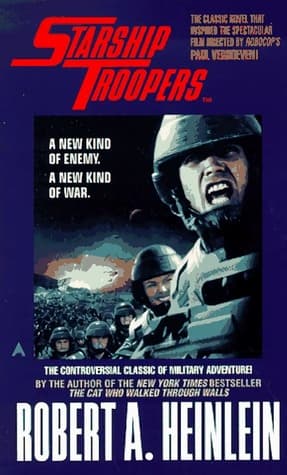
- Starship Troopers
Robert A. Heinlein
4.0 (192k) average on GoodreadsFantasyExplores military training, war against alien species, and the philosophy of duty and sacrifice.
- The Hunger Games
Suzanne Collins
4.3 (6.4M) average on GoodreadsFantasyFeatures a young protagonist forced into a brutal, televised competition with high stakes and moral compromises.
- Dune
Frank Herbert
4.2 (766k) average on GoodreadsFantasyA saga about a gifted young leader navigating complex political and military strategies in a sci-fi setting.
- The Dispossessed
Ursula K. Le Guin
4.2 (88k) average on GoodreadsPoliticsWhile Le Guin's The Dispossessed explores complex societal structures and ethical systems with great depth, Ender's Game offers a more focused, character-driven examination of individual morality and the burden of command within a high-stakes military context, rather than a broad sociological study.
- Harry Potter and the Sorcerer's Stone
J.K. Rowling
4.5 (7M) average on GoodreadsFantasyRescued from a miserable life under the stairs, an orphaned boy discovers he's a wizard destined for a magical school, where he uncovers a dangerous secret tied to the dark wizard who murdered his parents.
- 1984
George Orwell
4.2 (3.1M) average on GoodreadsPoliticsIn a future where surveillance and thought control are absolute, a man's search for truth clashes with the Party, showing that hope can be a form of rebellion.





Enjoyed the summary?
A summary gives you the shape of the book. The book itself has the detail, the examples and the voice.
Find Ender's Game on AmazonAs an Amazon Associate, BookBrief earns from qualifying purchases. How we're funded