
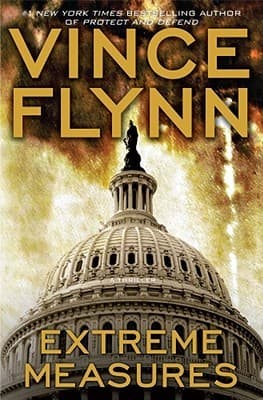
Synopsis
Covers the whole plot, including the ending.
- Difficulty
- Medium
- Pacing
- Fast
- Mood
- Suspenseful, Intense, Gritty, Adrenaline-pumping
- Read it if
- You enjoy fast-paced political thrillers with espionage, government conspiracies, and a resilient protagonist fighting for survival against overwhelming odds.
- Skip it if
- You prefer character-driven dramas over plot-heavy action, or you're sensitive to violence and themes of government corruption.
Extreme Measures Plot Summary
Covers the whole plot, including the ending.
The Betrayal and the Shootout
Mike Nash, a highly skilled CIA operative and protégé of Mitch Rapp, is in Hamburg, Germany, on a mission to surveil an Iranian nuclear scientist. While conducting his surveillance, Nash is ambushed by a team of CIA operatives led by Marcus Dumond. Dumond's team attempts to capture or kill Nash, but Nash, using his extensive training and combat skills, fights back fiercely. He manages to eliminate several of his attackers and escape, though he sustains injuries. This unexpected betrayal by his own agency leaves Nash disoriented and determined to uncover the truth behind the sudden attempt on his life.
A Desperate Call for Help
After his narrow escape in Hamburg, a wounded and paranoid Mike Nash manages to make contact with his mentor, Mitch Rapp, who is currently operating deep within Pakistan. Nash explains the ambush, his confusion, and his belief that he has been targeted by elements within the CIA. Rapp, despite being thousands of miles away and dealing with his own high-stakes mission, immediately recognizes the gravity of the situation and begins to subtly investigate from his remote location, offering Nash guidance and a lifeline while urging extreme caution.
Irene Kennedy's Dilemma
CIA Director Irene Kennedy is presented with a politically charged situation involving Mike Nash. She is informed that Nash has gone rogue and is being hunted by an internal task force. Unbeknownst to her, elements within the government, specifically the powerful Senator Betsy Ross and her allies, are orchestrating a covert operation to eliminate operatives like Nash who they deem 'too extreme' or 'uncontrollable.' Kennedy, a staunch supporter of Rapp and Nash, senses a deeper conspiracy at play and begins her own discreet investigation, trying to protect her agents while navigating treacherous political waters.
Senator Ross's Agenda
Senator Betsy Ross, a powerful and ambitious politician, is revealed to be the architect behind the clandestine 'clean-up' operation targeting operatives like Mike Nash. Believing that certain counterterrorism tactics are unethical and that agents like Nash operate outside the bounds of law, she has formed a secret committee within the government. This committee, without proper oversight or public knowledge, is actively working to eliminate or neutralize a list of highly effective but often brutal operatives, viewing them as liabilities to be purged rather than assets to be protected.
Nash's Fight for Survival
Mike Nash, now a fugitive within his own country, uses his extensive training to stay ahead of his pursuers. He goes deep underground, utilizing safe houses and contacts, while meticulously trying to piece together the puzzle of who is behind the attempts on his life. He realizes the operation is highly coordinated and involves powerful figures. His primary goal shifts from mere survival to uncovering the truth and exposing those responsible, understanding that his life depends on it and that many other operatives might also be targeted.
Rapp's Remote Assistance
Despite being in Pakistan, Mitch Rapp leverages his vast network of contacts and intelligence assets to aid Mike Nash. He feeds Nash crucial information, helps him anticipate his enemies' moves, and even arranges for covert assistance when possible. Rapp's support is vital for Nash's survival and progress, demonstrating the deep loyalty and trust between mentor and protégé. Rapp also begins to apply pressure on key figures within the intelligence community, subtly exposing inconsistencies and forcing the conspirators to react.
The Revelation of the 'Kill List'
Through his relentless investigation and with Rapp's guidance, Mike Nash uncovers evidence of a highly classified 'kill list' or 'purge list' sanctioning the elimination of specific counterterrorism operatives. This revelation confirms his worst fears: he is not the only one targeted, and the conspiracy extends far beyond a simple rogue operation. The list includes other highly effective but unconventional agents, all deemed problematic by Senator Ross and her committee, solidifying Nash's resolve to expose the truth.
Confrontation with Dumond
Mike Nash tracks down Marcus Dumond, the operative who led the ambush in Hamburg. In a tense and brutal confrontation, Nash forces Dumond to reveal details about the conspiracy. Dumond, under duress, confesses that he was acting under orders from Senator Ross's committee and explains the political motivations behind the purge. This encounter provides Nash with concrete evidence and a clearer understanding of the forces arrayed against him, confirming the deep-seated corruption within the government.
The Political Showdown
Armed with growing evidence, Irene Kennedy directly confronts Senator Betsy Ross and her allies. Kennedy exposes the illegal and unconstitutional nature of their secret committee and the 'kill list.' This confrontation escalates into a high-stakes political battle, with Kennedy fighting to protect her agency and her operatives, while Ross attempts to maintain control and bury the scandal. The political maneuvering is intense, with careers and lives hanging in the balance.
Nash's Final Stand
Mike Nash, having gathered irrefutable evidence, prepares to make his final move: exposing the entire conspiracy to the public. He understands the immense risks involved, but believes it's the only way to hold the powerful figures accountable and prevent further harm to dedicated operatives. His actions force the conspirators into a corner, leading to a desperate attempt by them to silence him permanently before he can reveal the truth, setting the stage for a climactic showdown.
The Climax and Resolution
In a climactic sequence, Mike Nash, with the indirect help of Mitch Rapp and the direct support of Irene Kennedy, successfully exposes Senator Ross's clandestine committee and their illegal operations. The evidence Nash meticulously collected, combined with Kennedy's political maneuvering, leads to the downfall of Ross and her co-conspirators. While not all details become public, enough truth emerges to dismantle the rogue committee and ensure accountability. Nash's name is cleared, and he, along with other targeted operatives, is reinstated, though the scars of betrayal remain.
Extreme Measures Characters
Mike Nash
Protagonist
A highly skilled and loyal CIA operative betrayed by his own government.
Mike Nash is a former Marine Corps officer and a seasoned operative in Mitch Rapp's elite counterterrorism team. He is fiercely loyal, highly disciplined, and exceptionally skilled in combat, surveillance, and intelligence gathering. Nash is a family man who has sacrificed much for his country, operating in the shadows and carrying the weight of his secret life. He is driven by a deep sense of patriotism and justice, even when confronted with the darkest forms of betrayal.
Relationships: Mitch Rapp (Mentor and close ally); Irene Kennedy (Director and protector); Marcus Dumond (Former colleague, now antagonist)
Mitch Rapp
Supporting
Legendary CIA counterterrorism operative and Mike Nash's mentor.
Mitch Rapp is the iconic, ruthless, and highly effective counterterrorism operative known for his take-no-prisoners approach to national security. Though on assignment in Pakistan, he acts as Mike Nash's lifeline, providing intelligence, advice, and indirect support. Rapp is fiercely loyal to his team and will go to extreme lengths to protect them, even when it means challenging the highest levels of government. His experience and network are crucial to Nash's survival.
Relationships: Mike Nash (Protégé and trusted operative); Irene Kennedy (Close ally and professional partner)
Irene Kennedy
Supporting
The astute and principled Director of the CIA.
Irene Kennedy is a highly intelligent, politically savvy, and morally grounded leader who serves as the Director of the CIA. She is a strong advocate for her operatives, particularly Mitch Rapp and Mike Nash, and possesses a deep understanding of the complexities of national security. Kennedy faces immense political pressure but remains steadfast in her commitment to justice and protecting her agency from internal corruption. She navigates treacherous political waters with skill and determination.
Relationships: Mitch Rapp (Confidante and trusted operative); Mike Nash (Operative under her protection); Senator Betsy Ross (Political antagonist)
Senator Betsy Ross
Antagonist
A powerful and ambitious senator orchestrating a purge of intelligence operatives.
Senator Betsy Ross is a formidable and politically ambitious figure who believes that certain counterterrorism operatives, like Mike Nash, are liabilities due to their 'extreme measures.' She chairs a secret committee aimed at neutralizing these agents, driven by a desire for control and a belief in a more 'ethical' approach to intelligence, even if it means resorting to illegal and unconstitutional actions. Ross is cunning, ruthless, and wields significant political power to achieve her objectives.
Relationships: Mike Nash (Target of her committee); Irene Kennedy (Political adversary)
Marcus Dumond
Supporting
A CIA operative leading the team hunting Mike Nash.
Marcus Dumond is a CIA operative who, under the direction of Senator Ross's committee, leads the initial ambush against Mike Nash in Hamburg. He is a skilled but morally compromised agent, caught between his duty and the unethical orders he receives. Dumond represents the agents who are pulled into the conspiracy, highlighting the internal divisions and betrayals within the intelligence community. He is driven by a mix of ambition and fear, ultimately cracking under pressure.
Relationships: Mike Nash (Hunter and hunted); Senator Betsy Ross (Superior and manipulator)
Scott Coleman
Supporting
A former Navy SEAL and close ally of Mitch Rapp.
Scott Coleman is a former Navy SEAL commander and a long-time associate and friend of Mitch Rapp. He runs a private security firm but frequently assists Rapp in covert operations. Coleman is highly capable, resourceful, and loyal. While his direct involvement in Nash's immediate survival is limited due to Rapp's remote location, his influence and network are always in the background, ready to be called upon. He represents the trusted outer circle of Rapp's operational support.
Relationships: Mitch Rapp (Close friend and professional associate)
Extreme Measures Themes
Betrayal and Loyalty
The novel explores betrayal, especially when it comes from within one's own government. Mike Nash, a dedicated operative, is targeted by those he swore to protect, making him question everything. This contrasts with the loyalty shown by Mitch Rapp and Irene Kennedy, who risk their careers to protect Nash. The internal conflict highlights the moral questions of intelligence work and the personal cost of such betrayals, as seen when Dumond eventually breaks under Nash's pressure.
“The hardest part wasn’t fighting the enemy. It was realizing the enemy was wearing the same uniform.”
The Price of Patriotism
Extreme Measures looks at the personal sacrifices made by those in covert operations. Mike Nash has lied to his family for years, endured violence, and dedicated his life to protecting his country, only to be deemed a liability and targeted. The story questions what 'patriotism' means and whether the ends justify the means, especially when the 'means' involve actions deemed 'extreme' by political figures like Senator Ross. It shows the psychological cost on operatives who work outside legal boundaries for national security.
“They wanted men to do the dirty work, but they didn’t want to look at the dirt.”
Government Overreach and Accountability
A central theme is the danger of unchecked government power and the need for accountability, even in national security. Senator Betsy Ross's secret committee operates outside constitutional bounds, creating a 'kill list' of operatives without due process. The story criticizes this overreach, showing how good intentions can lead to tyranny. Irene Kennedy's fight to expose the committee highlights the need for transparency and oversight to prevent such abuses of power within democratic institutions, leading to Ross's downfall.
“Power without accountability was a cancer, eating away at the very fabric of democracy.”
The Nature of Justice
The book examines different ideas of justice. Senator Ross believes justice is served by eliminating 'unethical' operatives, even if through illegal means. Mike Nash and Mitch Rapp, however, believe justice is about protecting the nation by any means necessary against its true enemies, and that those who betray their own should be held accountable. The struggle between these viewpoints drives much of the conflict. The story ultimately supports a form of justice that, while sometimes brutal against external threats, upholds fairness and accountability within its own ranks.
“Justice wasn't always clean, but it had to be true.”
Plot Devices & Literary Techniques
The 'Kill List' / Purge List
A clandestine document sanctioning the elimination of specific operatives.
This central plot device serves as the primary macguffin and driver of the conflict. The 'kill list' is a secret document created by Senator Ross's committee, detailing the operatives deemed 'too extreme' or 'uncontrollable' who are to be neutralized. Its discovery by Mike Nash confirms the conspiracy against him and other agents, fueling his fight for survival and justice. It raises the stakes significantly, as Nash realizes he is not just fighting for his own life but for the lives and reputations of his colleagues.
The Mentor-Protégé Relationship
Mitch Rapp's remote guidance of Mike Nash.
This device highlights the deep bond and trust between Mitch Rapp and Mike Nash. Despite Rapp being thousands of miles away in Pakistan, his guidance, intelligence, and moral support are crucial for Nash's survival and success. Rapp's ability to pull strings and provide critical insights from afar demonstrates his vast influence and the strength of his network. This relationship underscores themes of loyalty and the passing of knowledge within the covert operations community, making Nash's journey less solitary.
Internal Conspiracy
The plot to eliminate operatives originating from within the government.
This device creates heightened tension and a sense of betrayal, as the threat comes not from external enemies but from powerful figures within the protagonist's own government. The internal conspiracy, spearheaded by Senator Ross, forces Nash to fight against his own countrymen and agency, blurring the lines between friend and foe. It challenges the conventional 'us vs. them' narrative of thrillers, making the conflict more personal and morally complex for the characters involved.
Extreme Measures Quotes
“Mitch Rapp had always known that good intentions rarely paved the road to anything but more trouble.”
“The problem with absolute power, he thought, was that it always found a way to corrupt absolutely.”
“Sometimes, the only way to save a life was to take another.”
“Fear was a powerful motivator, but it was also a crippling one if you let it control you.”
“He understood the rules of the game, and he knew that sometimes, to win, you had to break every single one of them.”
“In his line of work, trust was a luxury he rarely afforded.”
“The greatest weapon in any war was not a gun or a bomb, but information.”
“Revenge, he knew, was a dish best served cold, but sometimes, a little warmth made it all the more satisfying.”
“There were no easy answers in the world he inhabited, only difficult choices.”
“He didn't seek trouble, but he was always prepared for it.”
“The world was a dangerous place, and someone had to be willing to get their hands dirty to keep it safe.”
“Love, he had learned, was both a strength and a weakness, a shield and an Achilles' heel.”
“Sometimes, the only way to truly understand evil was to stare it directly in the face.”
“He was a ghost in a world of shadows, and that was exactly how he liked it.”
Quiz
10 questions on the plot and the characters. Each answer comes with a short explanation.
Question 1
Which character is the main protagonist in 'Extreme Measures' when Mitch Rapp is away on assignment?
- Irene Kennedy
- Mike Nash
- Mitch Rapp
- Scott Coleman
Show answer
B. Mike Nash The book description clearly states that with Mitch Rapp away, CIA Director Irene Kennedy turns to his protégé Mike Nash, making Nash the central figure.
Question 2
What is Mike Nash's initial professional background before becoming an operative in Mitch Rapp's elite counterterrorism team?
- CIA Analyst
- FBI Agent
- Officer in the Marine Corps
- Navy SEAL
Show answer
C. Officer in the Marine Corps The description specifies Nash served 'first as an officer in the Marine Corps and then as an operative in an elite counterterrorism team'.
Question 3
What shocking betrayal does Mike Nash experience from his own government?
- He is denied a promotion he deserved.
- His family is targeted by terrorists.
- His own government turns on him.
- He is forced into retirement.
Show answer
C. His own government turns on him. The synopsis explicitly states: 'But the one thing he never saw coming was that his own government was about to turn on him.'
Question 4
What is Mitch Rapp's primary location of assignment at the beginning of 'Extreme Measures'?
- Afghanistan
- Iraq
- Pakistan
- Syria
Show answer
C. Pakistan The text states, 'Now, with Rapp away on assignment in Pakistan, CIA Director Irene Kennedy turns to his protegee Mike Nash.'
Question 5
What specific challenge does Mike Nash face regarding his personal life due to his covert work?
- He struggles to maintain friendships outside of work.
- He has been forced to lie to virtually every single person he cares about, including his wife and children.
- His cover identity prevents him from forming any romantic relationships.
- He is unable to return home for holidays.
Show answer
B. He has been forced to lie to virtually every single person he cares about, including his wife and children. The description highlights Nash's personal sacrifice: 'He has been forced to lie to virtually every single person he cares about, including his wife and children'.
Question 6
What is the primary thematic conflict explored through Mike Nash's character in 'Extreme Measures'?
- The struggle between love and duty.
- The conflict between personal ambition and national service.
- A hero who loves his country, even when it betrays itself.
- The moral dilemma of using violence to achieve peace.
Show answer
C. A hero who loves his country, even when it betrays itself. The book introduces Nash as 'a modern-day patriot -- a hero who loves his country, even when it betrays itself,' directly stating the core thematic conflict.
Question 7
How long has Mike Nash served his government honorably?
- Ten years
- Sixteen years
- Twenty years
- Eight years
Show answer
B. Sixteen years The text explicitly states: 'Nash has served his government honorably for sixteen years'.
Question 8
What is the 'covert war' mentioned in the description that men and women like Mike Nash fight?
- A trade war against economic rivals.
- A war against cyberterrorism.
- A covert war they must hide from even their own political leaders.
- A conventional military conflict in a foreign country.
Show answer
C. A covert war they must hide from even their own political leaders. The description mentions 'a covert war they must hide from even their own political leaders,' emphasizing the secretive and independent nature of their operations.
Question 9
What is the primary justification Mike Nash uses to soldier on, despite the personal sacrifices and lies?
- The promise of future accolades and recognition.
- The knowledge that his hard work and lethal tactics has saved thousands of lives.
- His desire to climb the ranks within the CIA.
- The financial compensation he receives for his dangerous work.
Show answer
B. The knowledge that his hard work and lethal tactics has saved thousands of lives. The book states he 'has soldiered on with the knowledge that his hard work and lethal tactics has saved thousands of lives,' indicating his ultimate motivation.
Question 10
The description mentions Vince Flynn's use of 'insider knowledge' to portray the war on terror. What specific aspect of this knowledge is highlighted?
- Detailed medical procedures for treating combat injuries.
- Intelligence agencies and the military.
- International banking and financial espionage.
- The history of political revolutions.
Show answer
B. Intelligence agencies and the military. The text states Flynn uses 'his insider knowledge of intelligence agencies and the military' to create a realistic portrayal.
Extreme Measures FAQ
What is the central conflict in 'Extreme Measures'?
The central conflict revolves around Mike Nash, a dedicated counterterrorism operative, who finds himself targeted by his own government. After years of covertly fighting terrorism, Nash is betrayed and framed, forcing him to go on the run to uncover the truth and clear his name against powerful, shadowy forces within the U.S. establishment.
Who is Mike Nash and what is his background?
Mike Nash is Mitch Rapp's protégé and a seasoned counterterrorism operative with sixteen years of service. He began his career as an officer in the Marine Corps before joining an elite counterterrorism team. Nash is known for his dedication, willingness to use extreme violence against terrorists, and the personal sacrifices he has made, including lying to his family about his true work.
How does Irene Kennedy fit into the plot, especially with Mitch Rapp being absent?
With Mitch Rapp on assignment in Pakistan, CIA Director Irene Kennedy is forced to turn to Mike Nash to handle critical counterterrorism operations. Her initial trust in Nash is a key element, but as events unfold, she finds herself in a difficult position, navigating the political landscape while trying to understand the conspiracy against him.
What kind of 'betrayal' does Mike Nash face from his own government?
Mike Nash faces a profound betrayal where elements within his own government turn against him, framing him for crimes he didn't commit. This likely involves attempts to discredit him, eliminate him, or use him as a scapegoat, forcing him to use his specialized skills to survive and expose the truth about who is orchestrating his downfall.
What role does Nash's family play in the story, considering his secretive life?
Nash's family, specifically his wife and children, are deeply impacted by his secretive life. He has lied to them for years about his dangerous work, and their safety and well-being become a significant concern and motivation for Nash when he is targeted, highlighting the personal cost of his dedication to duty.
Are there any subtle hints about Mitch Rapp's current assignment in Pakistan that might connect to Nash's situation?
While Rapp is explicitly stated to be in Pakistan, the narrative suggests his absence creates a power vacuum or removes a key protector for Nash, allowing the conspiracy to unfold. There might be subtle implications that the threats Rapp is dealing with abroad are indirectly linked to the domestic forces targeting Nash, or that Rapp's methods have created enemies who are now striking at his associates.
What 'insider knowledge' about intelligence agencies does Flynn utilize in the book, and how does it manifest?
Flynn utilizes his deep 'insider knowledge' to portray the intricate, often morally ambiguous, operations of intelligence agencies. This manifests in the detailed depiction of covert tactics, inter-agency rivalries, political infighting, the bureaucratic obstacles operatives face, and the extreme measures taken in the name of national security, making the betrayal against Nash feel chillingly realistic.
Are there any specific historical or contemporary events that 'Extreme Measures' subtly references or draws inspiration from?
While not explicitly stated, 'Extreme Measures' likely draws inspiration from contemporary concerns regarding government overreach, the ethics of covert operations, and the vulnerabilities of intelligence agencies to internal corruption. It taps into public anxieties about 'deep state' conspiracies and the sacrifice of individual liberties in the name of security, reflecting post-9/11 geopolitical realities.
How does Mike Nash's history of 'extreme violence' inform his actions when he is betrayed?
Nash's history of using 'extreme violence' against terrorists means he possesses a unique and dangerous skill set. When betrayed, he doesn't hesitate to apply these same lethal tactics and strategic thinking to survive and fight back against his own government, transforming from a hunter of terrorists to a hunted man capable of extreme self-preservation and counter-attack.
What psychological toll does years of secrecy and 'lying to virtually every single person he cares about' take on Mike Nash?
Years of secrecy and deception have likely created a profound sense of isolation and emotional compartmentalization in Mike Nash. This psychological toll manifests as a hardened resolve but also a deep-seated loneliness, making the betrayal even more devastating as it shatters the last vestiges of trust and the justification for his sacrifices.
How does Nash's patriotism conflict with his government's betrayal, and what psychological impact does this have?
Nash's deep-seated patriotism, his love for his country despite its flaws, is profoundly challenged by his government's betrayal. This creates a severe internal conflict, a psychological crisis where his core identity as a protector is undermined, forcing him to reconcile his duty with the reality that the very entity he serves is now his enemy.
Does Irene Kennedy experience any significant psychological shifts as she navigates the conspiracy against Nash?
Irene Kennedy likely experiences significant psychological strain, caught between her loyalty to operatives like Nash and her responsibilities as CIA Director. She must grapple with suspicion, political pressure, and the moral ambiguity of her position, potentially leading to a crisis of conscience as she uncovers the extent of the corruption within her own organization.
Is 'Extreme Measures' a commentary on the ethics of counterterrorism, specifically the use of 'extreme violence'?
Yes, 'Extreme Measures' serves as a commentary on the ethics of counterterrorism, particularly the justification and consequences of 'extreme violence.' The book explores whether the ends justify the means, and what happens when the very tactics used to protect a nation are turned inward, forcing a re-evaluation of moral boundaries.
How does the book challenge the traditional concept of 'heroism' in a modern, morally ambiguous world?
The book challenges traditional heroism by portraying Mike Nash as a 'modern-day patriot' who operates in a morally ambiguous world. His heroism isn't about clear-cut good versus evil, but about making impossible choices, enduring personal sacrifice, and fighting for his country even when it fails him, redefining heroism as resilience and integrity amidst systemic corruption.
What is the significance of the title 'Extreme Measures' in relation to the plot and themes?
The title 'Extreme Measures' is highly significant, referring both to the lethal tactics Mike Nash employed against terrorists and the equally extreme, ruthless actions taken by his own government to silence him. It also implies the extreme lengths Nash must go to survive and expose the truth, highlighting the desperate stakes and moral compromises on all sides.
Does the book suggest that such a 'betrayal' by one's own government is a plausible reality in intelligence operations?
The book strongly suggests that such a 'betrayal' is a plausible reality within intelligence operations. Flynn's use of 'insider knowledge' and 'all-too-real portrayal' aims to convince readers that political machinations, power struggles, and the desire to control narratives can lead to high-level corruption and the targeting of dedicated operatives.
How does 'Extreme Measures' compare thematically to other Vince Flynn novels featuring Mitch Rapp?
Thematically, 'Extreme Measures' deepens Flynn's exploration of the moral gray areas of counterterrorism, a staple of Mitch Rapp novels. While Rapp often deals with external threats, Nash's story shifts focus to internal corruption and betrayal, examining the fragility of trust within the U.S. government itself, a more introspective look at the cost of power.
About the author

Vince Flynn was an American author known for his political thriller novels. His notable works include "American Assassin," "Transfer of Power," "Memorial Day," "The Third Option," "Pursuit of Honor," and "Protect and Defend," which often feature themes of espionage and counterterrorism. Flynn's writing has garnered a dedicated readership and has contributed significantly to the genre of contemporary thrillers.
Similar books
- American Assassin
Vince Flynn
4.2 (75k) average on GoodreadsThrillerFeatures Mitch Rapp, intense counterterrorism action, and government intrigue.
- The Gray Man
Mark Greaney
4.2 (52k) average on GoodreadsFictionFollows a black ops operative hunted by his own government, with non-stop action.
- Clear and Present Danger
Tom Clancy
4.1 (131k) average on GoodreadsThrillerFlynn's 'Extreme Measures' offers a more personal and visceral fight for survival, focusing less on grand geopolitical strategy and more on individual heroism and desperation. While Clancy provides intricate details of military hardware and strategic planning, Flynn prioritizes immediate, high-octane action and ethical dilemmas faced by operatives.
- The Kill Artist
Daniel Silva
4.0 (58k) average on GoodreadsThrillerWhen juxtaposed with Silva's 'The Kill Artist,' 'Extreme Measures' might be seen as less focused on historical context and artistic nuance. Silva often embeds his thrillers with rich cultural and historical details, adding layers of intellectual engagement that Flynn, while delivering a robust plot, sometimes foregoes in favor of pure adrenaline and direct confrontation.
- Angels & Demons
Dan Brown
3.9 (2.7M) average on GoodreadsThrillerA Harvard symbologist races through Rome's ancient sites, deciphering cryptic clues to unmask the Illuminati and stop a vengeful plot to destroy the Vatican with a stolen antimatter weapon.
- Gone Girl
Gillian Flynn
4.1 (2.3M) average on GoodreadsThrillerA wife's sudden disappearance on her fifth anniversary reveals a web of lies and psychological warfare, exposing the secrets within a seemingly perfect marriage.





Enjoyed the summary?
A summary gives you the shape of the book. The book itself has the detail, the examples and the voice.
Find Extreme Measures on AmazonAs an Amazon Associate, BookBrief earns from qualifying purchases. How we're funded