
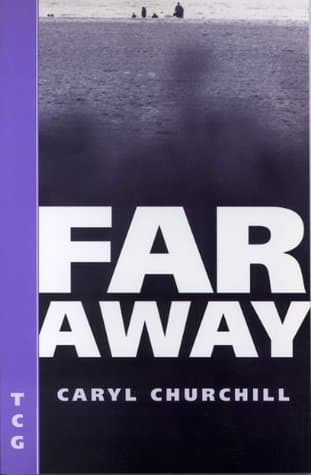
Synopsis
Covers the whole plot, including the ending.
- Difficulty
- Medium
- Pacing
- Fast
- Mood
- Absurdist, Disturbing, Satirical, Bleak
- Read it if
- You appreciate surreal, allegorical plays that critique war and societal breakdown with dark humor and a sense of impending doom.
- Skip it if
- You prefer realistic narratives, clear-cut resolutions, or optimistic themes.
Far Away Plot Summary
Covers the whole plot, including the ending.
Young Joan Witnesses a Disturbing Act
The play opens with young Joan at her Aunt Harper's house late at night. Joan has seen her Uncle Todd hitting people with an iron bar in the shed. She describes seeing 'blood' and 'a lot of people' and asks Harper about what happened. Harper tries to calm Joan with cocoa and avoid her questions, at first saying Todd was just moving things or that the people were 'not well.' As Joan keeps asking, Harper eventually admits to the violence but calls it a necessary act of 'justice' against 'bad people' who were 'plotting' against them, hinting at a larger, unseen conflict. Joan is disturbed but seems to accept her aunt's explanation, or at least stops asking questions, as Harper puts her to bed.
Joan's New Life as a Hat Designer
Years pass, and Joan is now an adult working in a hat factory. She talks with her colleague, Todd, about the increasing global conflict. The war has become everything, with nations, animals, and even inanimate objects taking sides. Joan finds meaning and creativity in her work, designing increasingly elaborate and strange hats for a parade, which she sees as a protest or a statement against the war's absurdity. She discusses the materials and ideas for her hats, which range from 'the dead' to 'fear' to 'hope,' all while the news reports detail the bizarre and horrific nature of the ongoing conflict, where even coffee and pins cause death.
The Absurdity of Global Conflict
Joan and Todd continue their conversation about the war, showing how absurd it is and how all natural order has broken down. They speak of animals and even parts of nature joining the conflict: 'the elephants are on our side' but 'the cats are fighting the dogs.' Even inanimate objects and ideas are fighters, with 'the French' allied with 'the river' and 'the English' with 'the coffee.' This discussion shows the complete collapse of logic and morality, where every entity has been forced to choose a side, and the reasons for allegiance are random and nonsensical. The parade, for which Joan designs hats, becomes a symbolic act of defiance and a grim celebration in the face of universal destruction.
The Parade of Hats and the Impending Doom
Joan and Todd focus on the upcoming parade, where her fantastical hats will be shown. The designs mix beauty and horror, reflecting the state of the world: hats made of 'feathers of all the birds that have died,' 'bones of the animals,' or 'the hair of the mad.' The parade is not just a fashion show but a cultural event, a ritual in a society dealing with constant war. While they discuss the parade, the impending doom of the outside world is always present. Todd worries about the safety of the parade-goers and the increasing violence, suggesting that even their temporary artistic escape is fragile and threatened.
Harper's Revelation and the True Nature of the Conflict
Joan returns to Harper's house, looking for safety from the worsening war. She tells of her difficult journey, describing piles of bodies killed by everyday objects like 'coffee' or 'pins,' and the burning of 'grass that wouldn't serve.' Harper, now older and more resigned, confirms how widespread the conflict is. She describes how the war has taken over everything, that 'everyone' is involved, and that trust has disappeared. Harper reveals that the 'traitors' and 'enemies' are everywhere, even within their own communities. She admits her own involvement and the need for extreme measures, implying that the violence Joan saw as a child was just the start of a total societal collapse into paranoia and brutality.
The Execution of Hat Designers
Harper gives Joan devastating news: all the hat designers, including Todd, have been executed. The reason given is that their hats were called 'subversive' or 'too beautiful,' suggesting that any independent thought or aesthetic expression is now a threat in the conformist and paranoid war-torn society. Harper explains that authorities are now executing people for increasingly small or abstract reasons, such as 'looking too sad' or 'walking too fast.' This news shatters Joan's last connection to a sense of normalcy and creative purpose, showing the arbitrary and all-consuming nature of the regime's brutality.
The Final Act of War: Blaming the Innocent
Harper, with a chilling calm, begins to prepare Joan for her own execution. She explains that Joan's turn has come, not for any specific crime, but because the system demands more and more victims. Harper reveals the ultimate distortion of justice: people are now being executed not for what they did, but for what they 'might have thought' or for simply existing. The 'traitors' are no longer a specific group but anyone chosen by the authorities. Harper details the process, including the specific time and location of Joan's execution, and even suggests how Joan should dress. This scene ends with the complete removal of individual freedom and the horrifying victory of a random, self-perpetuating cycle of violence and death.
Principal Figures
Joan
Protagonist
A young girl who grows into a hat designer amidst a world consumed by war.
Joan is initially a curious and slightly naive young girl who witnesses disturbing violence at her aunt's house. As an adult, she becomes a hat designer, finding a creative outlet and a sense of purpose in making elaborate hats for a parade, even as the world around her descends into total war. She represents an attempt to find beauty and meaning in the face of overwhelming horror and absurdity. Her journey reflects the erosion of innocence and the struggle to maintain humanity in an inhumane world, ultimately succumbing to its arbitrary violence.
Relationships: Harper (Aunt and guardian, later her executioner); Todd (uncle) (Figure of early violence, Harper's partner); Todd (colleague) (Fellow hat designer, creative partner, and friend)
Harper
Supporting/Antagonist
Joan's aunt, a figure who embodies the chilling normalization of violence and paranoia.
Harper is a complex character who initially tries to shield young Joan from the truth of her uncle's violence but later becomes a chilling mouthpiece for the war's logic. She represents the insidious way ordinary people can become complicit in brutality, justifying horrific acts as necessary for 'justice' or survival. As the play progresses, her initial attempts at 'protection' morph into a resigned acceptance, and even active participation, in the arbitrary executions. She embodies the psychological toll of living in a state of total war, where morality is inverted, and empathy is extinguished.
Relationships: Joan (Niece, later victim); Todd (uncle) (Partner in early violence)
Todd (colleague)
Supporting
A fellow hat designer and friend of adult Joan, sharing her artistic and philosophical struggles.
Todd is Joan's colleague and friend in the hat factory. He shares her passion for hat design and her attempts to make sense of the increasingly bizarre and violent world through art. He is more outwardly fearful and pragmatic than Joan, often questioning the safety and purpose of their work. Todd represents the ordinary citizen trying to navigate and survive in an illogical war, finding solace and meaning in creative expression, only to be ultimately consumed by the very forces they tried to subtly resist. His execution underscores the war's indiscriminate nature.
Relationships: Joan (Colleague, friend, creative partner)
Todd (uncle)
Mentioned
Joan's uncle, whose early acts of violence foreshadow the play's dystopian future.
Uncle Todd is only seen indirectly through young Joan's eyes and Harper's descriptions. He is the initial perpetrator of violence that Joan witnesses, hitting people with an iron bar in the shed. He represents the early, more localized acts of brutality that set the stage for the global, generalized violence of the later acts. His actions, justified by Harper as 'justice,' establish the play's theme of the normalization of violence and the idea of 'bad people' deserving punishment, which later expands to encompass everyone.
Relationships: Joan (Uncle, figure of early fear); Harper (Partner in early violence)
Themes & Insights
The Normalization of Violence and Absurdity
The play shows how violence, initially shocking, becomes an accepted, almost normal part of life. From Uncle Todd's beatings justified as 'justice' to the adult world where 'coffee' and 'pins' cause death, the horrific becomes common. The war itself is absurd, with animals and inanimate objects taking sides, yet characters like Harper and Joan discuss it in a chillingly factual way. This theme shows humanity's ability to adapt to, and even join in, the most irrational and brutal situations.
“There were piles of bodies and if you stopped to find out there was one killed by coffee or one killed by pins, they were killed by heroin, petrol, chainsaws, hairspray, bleach, foxgloves, the smell of smoke was where we were burning the grass that wouldn't serve...”
The Erosion of Morality and Empathy
As the war continues, traditional moral rules break down. Harper's justification of violence, first for 'bad people' and later for anyone called 'subversive,' shows this. Empathy slowly disappears, replaced by paranoia and a ruthless focus on survival or compliance. The execution of the hat designers for making 'beautiful' hats and Joan's eventual execution for no clear reason show a world where human life has lost all value, and arbitrary power rules. The characters' detached descriptions of atrocities highlight this moral decay.
“They were too beautiful. They were too sad. They were too slow. They were too fast. They thought too much. They didn't think enough.”
Art as Resistance and Futility
Joan's hat designs are an attempt to create beauty and meaning in a destructive world. Her elaborate, symbolic hats for the parade can be seen as artistic resistance, a way to process the horror and assert a flicker of humanity. However, this resistance ultimately fails. The execution of the hat designers, including Todd, for making 'subversive' or 'too beautiful' hats, shows that even art cannot escape the war's random brutality, highlighting how vulnerable creative expression is in a totalitarian environment.
“I like making hats. I like the way they look. I like the way they make people feel.”
Paranoia and Control
From the initial secrecy around Uncle Todd's actions to the widespread belief that 'everyone' is plotting and 'traitors' are everywhere, paranoia drives events. The state has complete control, not just over actions but over thoughts and emotions. People are executed for 'looking too sad' or 'thinking too much.' This theme explores how fear and suspicion are used as weapons to maintain power, leading to a society where individual freedom does not exist, and self-preservation means conformity.
“It's all decided. You're decided. You're one of the ones who's decided.”
Plot Devices & Literary Techniques
Time Jump and Act Structure
Three distinct acts spanning Joan's life, illustrating the progression of societal decay.
The play is structured in three acts, each separated by significant time jumps. Act One features young Joan, Act Two features adult Joan as a hat designer, and Act Three features Joan returning to Harper. This structure allows the audience to witness the gradual, yet accelerating, descent of society into total war and absurdity. It highlights the normalization of violence over time and shows Joan's personal journey from innocent witness to creative participant, and finally, to victim, mirroring the world's trajectory.
Absurdist Dialogue and Imagery
Characters discuss horrific events with a detached, matter-of-fact tone, emphasizing the surreal nature of the war.
Churchill employs absurdist dialogue where characters describe bizarre and horrifying events (animals fighting, objects as weapons, people killed by coffee) with a calm, almost mundane tone. This disjunction between content and delivery creates a sense of the surreal and underscores the complete breakdown of logic and morality. The imagery, such as hats made from 'bones of the animals' or 'hair of the mad,' further enhances the play's unsettling, dreamlike quality, reflecting the characters' internal and external landscapes.
The Hats
A central symbol of futile resistance, creativity, and the arbitrary nature of beauty and subversion.
Joan's elaborate hats serve as a multifaceted symbol. Initially, they represent a creative outlet and a form of artistic expression in a world devoid of beauty. They symbolize a fragile attempt at resistance or a statement against the war's absurdity. However, their eventual condemnation and the execution of their designers for being 'too beautiful' or 'subversive' transform them into a symbol of the futility of such resistance and the arbitrary nature of what is deemed a threat in a totalitarian regime. They embody the tragic irony of art in a world that has lost all value for it.
The Unseen Enemy / Generalized War
The conflict is pervasive and ill-defined, making it impossible to fight or understand.
The war in 'Far Away' is never clearly defined or localized. It involves 'everyone,' including animals, objects, and concepts, blurring the lines between combatants and non-combatants, and between friend and foe. This ambiguity creates a pervasive sense of paranoia and makes the conflict impossible to comprehend or resist. The 'enemy' is a fluid concept, shifting from 'bad people' to 'traitors' to anyone arbitrarily chosen for execution, highlighting the ultimate powerlessness of individuals against an omnipresent, illogical force.
Far Away Quotes
“I'm not going to be a person who's afraid.”
“They're killing children. That's all. It's a fact.”
“We have to be careful what we say. Even in here.”
“It's not what you think. It's not what anyone thinks.”
“I can't remember when it started. I think it was always like this.”
“We'll be safe if we just keep quiet.”
“They're not people like us. They don't feel things.”
“I saw a bird today. It was red.”
“Everything's broken. Even the things that aren't broken.”
“We have to pretend it's normal. That's how we get through.”
“The sky is the same. That's something.”
“I don't know what's true anymore. Do you?”
“We're all far away from something. Or someone.”
Quiz
10 questions on the plot and the characters. Each answer comes with a short explanation.
Question 1
What does the young girl witness her uncle doing at the beginning of 'Far Away'?
- Hiding people in a shed
- Hitting people with an iron bar
- Burning documents in the yard
- Leading prisoners away in chains
Show answer
B. Hitting people with an iron bar The play opens with the girl questioning her aunt about having seen her uncle hitting people with an iron bar, establishing the initial atmosphere of violence and moral ambiguity.
Question 2
What has expanded to include birds and animals by the time the girl returns to her aunt's house?
- A global environmental movement
- A worldwide war
- A scientific experiment
- A migration pattern
Show answer
B. A worldwide war When the girl returns years later, the entire world is at war, and this conflict has expanded to include birds and animals, reflecting the play's theme of escalating, all-consuming violence.
Question 3
What does the girl describe being burned during her journey back to her aunt's house?
- Books that contained dangerous ideas
- Houses that had been contaminated
- Grass that wouldn't serve
- Bodies of the enemy soldiers
Show answer
C. Grass that wouldn't serve In her monologue describing the journey, the girl mentions 'the smell of smoke was where we were burning the grass that wouldn't serve,' illustrating the surreal, resource-scarce wartime environment.
Question 4
According to the girl's description of bodies on her journey, what were some people killed by?
- Coffee, pins, and heroin
- Guns, knives, and bombs
- Disease, starvation, and exposure
- Animals, birds, and insects
Show answer
A. Coffee, pins, and heroin The girl describes finding bodies 'killed by coffee or one killed by pins, they were killed by heroin, petrol, chainsaws...' showing the absurd and arbitrary nature of violence in this war-torn world.
Question 5
Why does the girl return to her aunt's house later in the play?
- To confront her uncle about his past actions
- To take refuge from the war
- To retrieve childhood belongings
- To warn her aunt about approaching soldiers
Show answer
B. To take refuge from the war The girl returns to her aunt's house to take refuge, as the world has descended into a chaotic war that includes even birds and animals, making her aunt's home a potential sanctuary.
Question 6
What literary device is prominently used in the girl's description of bodies killed by everyday items like coffee and pins?
- Metaphor
- Hyperbole
- Absurdism
- Allegory
Show answer
C. Absurdism The description employs absurdism by presenting violence through mundane, everyday objects (coffee, pins, hairspray), highlighting the irrational and surreal nature of the conflict in the play.
Question 7
What does the progression from the uncle's violence to global war involving animals suggest about the play's themes?
- The inevitability of technological advancement
- The escalation and normalization of violence
- The importance of family loyalty in crises
- The healing power of nature over time
Show answer
B. The escalation and normalization of violence The play shows how violence escalates from individual acts (the uncle with an iron bar) to a worldwide war including animals, suggesting themes of how brutality becomes normalized and all-consuming.
Question 8
In the context of the play, what might the aunt represent when the girl returns to her?
- A remnant of pre-war normalcy and safety
- A leader of the resistance movement
- A symbol of corrupted authority
- A gateway to supernatural realms
Show answer
A. A remnant of pre-war normalcy and safety The aunt's house serves as a refuge, representing a last connection to a safer past and a semblance of normalcy amidst the chaotic war, though this safety is tenuous.
Question 9
How does the girl's description of her journey contribute to the play's exploration of war?
- It provides tactical details of battlefield strategies
- It romanticizes the heroism of soldiers
- It depicts war as a surreal, senseless destruction of all aspects of life
- It focuses on the political causes of the conflict
Show answer
C. It depicts war as a surreal, senseless destruction of all aspects of life Her monologue, with its absurd details (bodies killed by everyday items, burning useless grass), portrays war as irrational and all-encompassing, destroying not just humans but the natural world and logic itself.
Question 10
What is significant about the inclusion of 'birds and animals' in the war?
- It shows the war is a literal fantasy with no basis in reality
- It emphasizes the totalizing nature of the conflict, leaving no aspect of life untouched
- It indicates a scientific experiment gone wrong
- It serves as a metaphor for environmental conservation
Show answer
B. It emphasizes the totalizing nature of the conflict, leaving no aspect of life untouched By extending the war to birds and animals, Churchill illustrates how violence has escalated to consume everything, blurring lines between human and natural worlds and highlighting the play's themes of pervasive destruction.
Far Away FAQ
What is 'Far Away' by Caryl Churchill about?
'Far Away' follows a young girl named Joan who, as a child, witnesses her uncle violently attacking people. Years later, the world has descended into a surreal, all-encompassing war where even animals and natural elements are combatants. Joan returns to her aunt's home as a refuge, recounting a harrowing journey through a landscape filled with bizarre casualties and ecological devastation.
Why should I read 'Far Away'?
You should read 'Far Away' for its chilling exploration of how violence and war become normalized and all-consuming. Churchill uses minimalist, surreal dialogue and escalating absurdity to critique political apathy, environmental destruction, and the erosion of morality in a world where conflict infiltrates every aspect of life, from human actions to nature itself.
What is the background/setting of 'Far Away'?
The play begins in a seemingly ordinary domestic setting at Joan's aunt's house, but it quickly expands into a dystopian world where a global war has escalated to include non-human entities like birds, rivers, and insects. The setting shifts from intimate conversations to a nightmarish, fragmented reality where even mundane objects become weapons.
What are the most memorable quotes from 'Far Away'?
Key quotes include Joan's haunting description: 'There were piles of bodies and if you stopped to find out there was one killed by coffee or one killed by pins, they were killed by heroin, petrol, chainsaws...' and her aunt's earlier line about the uncle: 'He was hitting them with an iron bar.' These lines encapsulate the play's themes of surreal violence and moral decay.
What writing style does Caryl Churchill use in 'Far Away'?
Churchill employs a sparse, elliptical writing style with abrupt time jumps and surreal, fragmented dialogue. The play uses minimal exposition, relying on suggestive imagery and escalating absurdity to convey its dystopian world, creating a sense of disorientation that mirrors the characters' experiences of a collapsing reality.
What minor details add significant meaning in 'Far Away'?
Minor details like the uncle's iron bar and the specific items listed as causes of death (e.g., coffee, pins, hairspray) transform ordinary objects into symbols of pervasive violence. These details subtly show how war corrupts everyday life, turning innocuous elements into lethal threats and blurring the line between the domestic and the catastrophic.
What are some subtle foreshadowing moments in 'Far Away'?
The opening scene, where Joan questions her aunt about the uncle's violence, foreshadows the play's escalation into global conflict. The aunt's evasive responses hint at a broader societal denial of brutality, which later manifests in the surreal war where violence becomes normalized and inescapable, affecting even nature.
What unexpected character connections exist in 'Far Away'?
The connection between Joan's childhood trauma with her uncle and her later experiences in the war suggests a cyclical nature of violence. Joan's journey from a witness of domestic brutality to a survivor in a world at war implies that personal and political violence are intertwined, with her aunt's home serving as a fragile link between these realms.
What are unspoken character motivations in 'Far Away'?
Joan's motivation to return to her aunt likely stems from a desperate search for safety and normalcy in a chaotic world, while the aunt's earlier denial of the uncle's violence suggests a desire to maintain illusions of order. These unspoken drives highlight how characters cope with trauma through avoidance or retreat.
What psychological complexities do characters exhibit in 'Far Away'?
Joan exhibits resilience mixed with trauma, as she navigates a war-torn world while recounting horrific details with unsettling matter-of-factness. The aunt shows cognitive dissonance, initially dismissing violence but later providing refuge, reflecting how people adapt to escalating horrors by compartmentalizing or rationalizing brutality.
What are the major emotional turning points in 'Far Away'?
Key emotional turning points include Joan's childhood realization of her uncle's violence, which shatters her innocence, and her later return to her aunt, where she describes the war's atrocities with detached horror. These moments mark shifts from personal shock to a numbed acceptance of widespread suffering, deepening the play's emotional impact.
How do relationship dynamics evolve in 'Far Away'?
The relationship between Joan and her aunt evolves from one of childhood curiosity and adult evasion to a shared, desperate refuge in the face of apocalyptic war. Their dynamic shifts as the aunt becomes a reluctant protector, and Joan transforms from an inquisitive girl into a traumatized survivor, highlighting how extreme circumstances reshape familial bonds.
Which parts of 'Far Away' remain ambiguous or open-ended?
The play leaves ambiguous the origins of the war, the fate of characters beyond Joan and her aunt, and whether any hope or resolution exists. The surreal nature of the conflict, with animals and elements as combatants, is never fully explained, inviting interpretation about its metaphorical meaning regarding environmental and political crises.
What are controversial scenes or decisions in 'Far Away'?
Controversial elements include the graphic, surreal violence described by Joan, such as deaths caused by mundane items, which some viewers find disturbing or absurd. The play's abrupt shifts in tone and lack of clear narrative resolution have sparked debate about its effectiveness in conveying anti-war messages versus being overly abstract or bleak.
'Far Away' ending explained: how it ends & what it means
The play ends with Joan at her aunt's home, describing the ongoing war in fragmented, horrific detail, with no resolution or escape. This ending suggests a cyclical, inescapable violence where humanity is complicit in its own destruction, emphasizing themes of moral decay, environmental collapse, and the futility of seeking refuge in a world consumed by conflict.
About the author
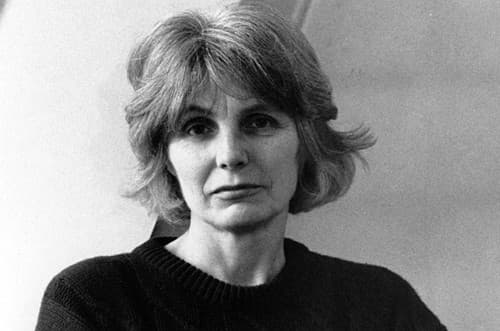
Caryl Churchill is a highly acclaimed contemporary playwright known for her innovative and often politically charged works. Her plays, such as "Far Away," "Top Girls," and "Cloud Nine," explore themes of power, gender, and societal structures with a distinct experimental style. Churchill has received numerous awards, including a Tony Award for Best Play, solidifying her reputation as a leading figure in modern drama.
Similar books
- Waiting for Godot
Samuel Beckett
3.8 (160k) average on GoodreadsPhilosophyExplores themes of existential absurdity and the breakdown of communication amidst a bleak landscape.
- The Handmaid's Tale
Margaret Atwood
4.1 (1.5M) average on GoodreadsFantasyAtwood's novel builds a detailed dystopian world with extensive character arcs and a clearly defined oppressive political structure. Churchill's Far Away, in contrast, focuses on the psychological erosion of morality through fragmented scenes and an undefined, pervasive conflict, offering less narrative detail but a more concentrated punch.
- Angels in America
Tony Kushner
4.3 (16k) average on GoodreadsFantasyKushner's play uses sprawling narratives, historical context, and richly developed characters to address complex socio-political issues with explicit commentary. Churchill's Far Away takes a much more symbolic and allegorical approach, offering a universal message about complicity and violence without the same level of direct political grounding or narrative scope.
- Harry Potter and the Sorcerer's Stone
J.K. Rowling
4.5 (7M) average on GoodreadsFantasyRescued from a miserable life under the stairs, an orphaned boy discovers he's a wizard destined for a magical school, where he uncovers a dangerous secret tied to the dark wizard who murdered his parents.
- The Hunger Games
Suzanne Collins
4.3 (6.4M) average on GoodreadsFantasyIn a future where children fight to the death on live television, Katniss Everdeen volunteers for the arena, turning a death sentence into a fight for survival and a spark of rebellion.
- 1984
George Orwell
4.2 (3.1M) average on GoodreadsPoliticsIn a future where surveillance and thought control are absolute, a man's search for truth clashes with the Party, showing that hope can be a form of rebellion.



Enjoyed the summary?
A summary gives you the shape of the book. The book itself has the detail, the examples and the voice.
Find Far Away on AmazonAs an Amazon Associate, BookBrief earns from qualifying purchases. How we're funded