
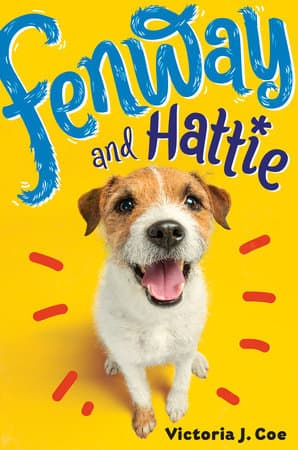
Synopsis
Covers the whole plot, including the ending.
- Difficulty
- Easy
- Pacing
- Moderate
- Mood
- Heartwarming, Humorous, Innocent, Sweet
- Read it if
- You love heartwarming stories told from a dog's perspective, enjoy tales of friendship and adjustment, or are looking for a gentle, humorous read for young children.
- Skip it if
- You dislike animal narrators or prefer complex plots and mature themes.
Fenway and Hattie Plot Summary
Covers the whole plot, including the ending.
A New Home and Unsettling Changes
Fenway, a very excitable Jack Russell terrier, lives a happy, predictable life in the city with his humans: Food Lady, Fetch Man, and his beloved short human, Hattie. His days involve walks, meals, and playing with Hattie. One day, the humans start packing boxes, and Fenway senses a big change. They move to a new house in the suburbs, which Fenway initially finds alarming. The new house has strange smells, a confusing layout, and a particularly slippery 'Wicked Floor' in the Eating Room. Outside, there is a large 'Dog Park' (the backyard) and a fence separating him from other dogs, but also 'Evil Squirrels' in the trees. Fenway wants to keep his routine and his bond with Hattie despite these changes.
Hattie's Distraction and Fenway's Confusion
Fenway tries to get used to his new home, but Hattie, his best friend, seems different. She is spending less time playing 'Chase' and 'Tug' with him. Instead, she is often with a new short human, Angel, whom Fenway views with suspicion. Hattie and Angel spend hours in the 'Dog Park' hitting a red ball with a 'thwack' sound, a game Fenway does not understand. He tries to join, thinking it is a new version of 'Fetch,' but Hattie gets frustrated. This new activity, which Fenway eventually identifies as 'baseball,' takes up Hattie's attention, leaving Fenway feeling neglected and confused about his place in her life.
The Mysterious 'Baseball' and Fenway's Misinterpretations
Fenway watches Hattie and Angel practice baseball in the backyard. He sees Hattie swing and miss the ball, or hit it poorly, and hears her express frustration. From Fenway's perspective, Hattie is making 'mistakes' and failing to 'catch' the ball properly. He believes he needs to help her succeed. When Hattie hits a ball, Fenway enthusiastically chases it, retrieves it, and brings it back to her, expecting praise. Instead, Hattie gets upset, yelling 'No, Fenway!' and 'Bad dog!'. These reactions only confuse Fenway more, as he believes he is helping, yet Hattie's behavior suggests otherwise. He struggles to understand the humans' rules for this new game.
Advice from the Dog Park Neighbors
Feeling confused by Hattie's changing behavior, Fenway talks to his new neighbors in the adjacent 'Dog Park' (another backyard). He communicates with them through the fence: a large golden retriever named Cooper, a small terrier mix named Daisy, and a grumpy bulldog named Brutus. He describes Hattie's new friend, Angel, and the game of 'baseball.' Cooper, the oldest, suggests that Hattie might be 'outgrowing' Fenway. This idea terrifies Fenway. He interprets 'outgrowing' literally, imagining Hattie physically growing too large for him, or leaving him behind. He refuses to accept this, determined to prove that Hattie still needs him.
The Wicked Floor Challenge
The 'Wicked Floor' in the Eating Room, a smooth, slippery surface, has been a problem for Fenway since the move. He usually avoids it, preferring to slide on the rug. However, seeing Hattie spending more time on the other side of this room, often with Angel, Fenway decides he must conquer the floor to reach her. He believes if he can successfully navigate the 'Wicked Floor,' he can somehow prove his worth and closeness to Hattie. He makes several funny attempts, sliding, skidding, and crashing, which amuses the humans. Despite his clumsy efforts, he remains determined to cross it, viewing it as a test of his resolve and a way to lessen the distance he feels between himself and Hattie.
Fenway's Quest to Prove His Worth
Convinced that Hattie's 'mistakes' in baseball mean she needs his help, Fenway tries harder. During one practice session with Angel, Hattie hits a pop-up that lands near Fenway. He proudly retrieves it, expecting a reward, but Hattie again gets upset. Later, he watches Hattie try to catch a ball and miss. He thinks her disappointment means she needs his assistance. He tries to 'herd' the ball towards her, or catch it himself, always with good intentions, but always making Hattie frustrated and shouting 'No, Fenway!' He cannot understand why his helpfulness is met with such negative reactions, increasing his fear that Hattie is indeed slipping away from him.
The Game Day Dilemma
The day of Hattie's first baseball game arrives, with more human activity and excitement. Fenway, sensing something important is happening, looks forward to going with Hattie. However, the humans leave without him, locking him inside the house. Fenway feels immense distress and separation anxiety. He paces, whines, and watches from the window, feeling abandoned and confused. He wants to be with Hattie, believing his presence is important for her success. The house feels empty and quiet without her, and Fenway struggles to understand why he has been excluded from such a significant event in Hattie's life, increasing his feelings of being 'outgrown.'
The Great Escape and Game Intervention
Driven by his overwhelming need to be with Hattie and 'help' her, Fenway finds an open gate and escapes. He follows the scent of his family to the local park where Hattie's baseball game is happening. He runs onto the field just as Hattie is about to score a run, having hit the ball well. In his excitement, Fenway runs directly to the ball, picks it up, and brings it back to Hattie, believing he has successfully assisted her. The game stops, and the humans, including Hattie, are a mixture of exasperated and amused. Fenway is happy to be reunited with Hattie, completely unaware of the chaos he has caused or the importance of the moment he interrupted.
A New Understanding and Reassurance
After the game disruption, Fetch Man takes Fenway home. Later, Hattie comes to Fenway, and instead of being angry, she sits with him and explains 'baseball' simply. She shows him how to hit and run and explains that he cannot be on the field. She makes him understand that retrieving the ball during the game is not 'helping.' More importantly, she reassures him that even though she is playing baseball and has new friends, he is still her best friend and companion. Fenway finally starts to understand that his role in Hattie's life is not about playing baseball with her, but about being her loyal and loving dog, a role he values.
Acceptance and Continued Devotion
With Hattie's clear explanation and reassurance, Fenway's worries about being 'outgrown' begin to fade. He still watches Hattie play baseball, but now he understands the rules and does not try to intervene. He continues to play 'Chase' and 'Tug' with Hattie, and his days are filled with the familiar joys of being her dog. He even becomes more comfortable with the 'Wicked Floor,' sometimes sliding across it with new confidence. Fenway learns to appreciate the new 'Dog Park' (the backyard) and the presence of his canine neighbors. He realizes that while things have changed, his bond with Hattie remains strong and his place in her heart is secure, allowing him to fully embrace his new suburban life.
Principal Figures
Fenway
Protagonist
An excitable and devoted Jack Russell terrier, struggling to adapt to change and Hattie's growing independence.
Fenway is an energetic, loyal, and highly observant Jack Russell terrier. He experiences the world through his senses, interpreting human actions and words in a literal, often humorous, way. His primary motivation is his deep love and devotion to Hattie, his 'short human' and best friend. He thrives on routine and predictability, making the move to the suburbs and Hattie's new interest in baseball deeply unsettling for him. Fenway is prone to anxiety and misinterpretation, often believing he needs to 'fix' Hattie's 'mistakes' or prove his worth. He is a good-hearted dog who only wants to be loved and included.
Relationships: Hattie (Best friend, beloved short human); Food Lady (Caretaker, provider of food); Fetch Man (Caretaker, playmate for fetch); Angel (Hattie's new friend, initially viewed as a rival); Cooper (Wise canine neighbor, offers advice); Daisy (Canine neighbor, sometimes playful); Brutus (Grumpy canine neighbor)
Hattie
Supporting
Fenway's 'short human' and best friend, navigating new friendships and hobbies.
Hattie is Fenway's beloved 'short human' and best friend. She is a young girl, likely in elementary school, who is at an age where her interests are expanding beyond constant play with her dog. She is enthusiastic about baseball and her new friendship with Angel, which sometimes makes her unintentionally neglectful of Fenway. While she loves Fenway deeply, she struggles to understand his canine perspective and often gets frustrated by his well-meaning but disruptive interventions. She eventually demonstrates patience and understanding by explaining her new life to Fenway, reaffirming their bond.
Relationships: Fenway (Best friend, pet); Angel (New short human friend, baseball teammate); Food Lady (Mother); Fetch Man (Father)
Food Lady
Supporting
Fenway's primary caretaker, providing meals and affection.
Food Lady is Fenway's human mother figure, responsible for his meals and much of his daily care. She is generally kind and loving towards Fenway, though sometimes exasperated by his antics. She represents stability and comfort in Fenway's world, always ensuring he is fed and looked after. Her actions, like packing boxes or leaving for the game, are often sources of confusion for Fenway, as he interprets them through his limited canine understanding. She is part of the family unit that provides Fenway's world.
Relationships: Fenway (Pet); Hattie (Daughter); Fetch Man (Husband)
Fetch Man
Supporting
Fenway's human father figure, often involved in play and discipline.
Fetch Man is Fenway's human father figure, known for playing 'Fetch' with Fenway. He is a more active playmate than Food Lady and sometimes the one to enforce rules or take Fenway on walks. He is generally patient with Fenway but can also be firm when Fenway's behavior is disruptive. He is the one who takes Fenway home after his escapade at the baseball game, indicating his role in managing Fenway's more boisterous moments. He contributes to Fenway's sense of routine and security.
Relationships: Fenway (Pet); Hattie (Daughter); Food Lady (Wife)
Angel
Supporting
Hattie's new short human friend and baseball teammate.
Angel is Hattie's new friend in the suburbs. She introduces Hattie to baseball and becomes Hattie's primary playmate for this new activity. From Fenway's perspective, Angel is initially a rival for Hattie's attention, and he views her with suspicion. Fenway struggles to understand their games and the bond they share. Angel is a typical child, focused on her new friendship and the excitement of baseball, largely unaware of Fenway's internal struggles.
Relationships: Hattie (Friend, teammate); Fenway (Hattie's dog, sometimes an inconvenience)
Cooper
Supporting
A wise golden retriever neighbor, offering advice to Fenway.
Cooper is one of Fenway's canine neighbors, a large golden retriever who lives in the adjacent 'Dog Park' (backyard). He is portrayed as the wisest and most experienced of the neighborhood dogs. Fenway often seeks Cooper's advice regarding Hattie's changing behavior. Cooper is the one who suggests that Hattie might be 'outgrowing' Fenway, introducing a central fear for the protagonist. He provides a sounding board and a different canine perspective for Fenway.
Relationships: Fenway (Neighbor, confidant); Daisy (Neighbor); Brutus (Neighbor)
Daisy
Supporting
A playful terrier mix neighbor, part of Fenway's canine support system.
Daisy is another of Fenway's canine neighbors, a terrier mix. She is more playful and less philosophical than Cooper, often joining in the fence-line conversations with Fenway and Brutus. Daisy's reactions and comments provide another perspective on the human world and canine life, sometimes echoing Fenway's confusion or offering simpler, more direct observations. She is part of the small community of dogs Fenway interacts with in his new suburban home.
Relationships: Fenway (Neighbor); Cooper (Neighbor); Brutus (Neighbor)
Brutus
Supporting
A grumpy bulldog neighbor, providing a cynical canine viewpoint.
Brutus is the third canine neighbor Fenway interacts with, a grumpy bulldog. He often offers cynical or dismissive comments during Fenway's discussions with Cooper and Daisy. Brutus represents a more jaded perspective on human-dog relationships and the unpredictability of life. His gruff demeanor provides comic relief and contrasts with Fenway's earnestness and Cooper's wisdom, completing the trio of canine advisors.
Relationships: Fenway (Neighbor); Cooper (Neighbor); Daisy (Neighbor)
Themes & Insights
Change and Adaptation
The main theme is Fenway's struggle to adapt to major changes in his life: moving to a new house, a new environment, and Hattie's changing interests. Fenway's anxieties and misunderstandings come directly from his inability to understand or control these changes. The novel explores the difficulties of adjusting to new routines and the emotional impact of big life transitions, even from a dog's perspective. Ultimately, Fenway learns to accept change and find new ways to be content.
“My world was changing. And not in a good way.”
Friendship and Loyalty
Fenway's deep, steady loyalty to Hattie is the emotional center of the story. His every action comes from his desire to be with her and help her, even when his efforts are misguided. The theme explores the unique bond between a child and their pet, showing the pet's devotion and the child's gradual understanding of that bond. Fenway's fear of being 'outgrown' shows how important this friendship is to his identity and happiness.
“Hattie was my short human. My best friend. My everything.”
Communication and Misunderstanding
Much of the humor and conflict comes from the communication gap between Fenway and his humans. Fenway interprets human language and actions literally, leading to funny misunderstandings about baseball, 'mistakes,' and the idea of 'outgrowing.' The novel shows how humans often fail to communicate clearly with their pets, and how pets, in turn, struggle to understand human intentions. Hattie's clear explanation to Fenway is a turning point, showing the power of good communication.
“Humans were confusing. They said one thing, but they meant another.”
Identity and Belonging
Fenway's journey is also about self-discovery, as he deals with his identity when Hattie's needs change. He first defines his worth by his ability to 'help' Hattie with everything, including baseball. His fear of being 'outgrown' is a fear of losing his purpose and belonging within the family. By the end, he learns that his identity as Hattie's beloved, loyal dog is enough, and that his value does not depend on shared activities but on their lasting bond.
“I was Fenway. Hattie's dog. And that was enough.”
Plot Devices & Literary Techniques
First-Person Canine Narration
The story is told entirely from Fenway's perspective, providing a unique and often humorous viewpoint.
The entire novel is narrated through the eyes and internal monologue of Fenway, the Jack Russell terrier. This device allows readers to experience the world as a dog does, filtered through his senses, instincts, and limited understanding of human customs. It creates both humor (e.g., 'Food Lady,' 'Fetch Man,' 'Wicked Floor,' 'Evil Squirrels,' 'Dog Park' for backyard) and emotional depth, as Fenway's anxieties and unconditional love are vividly conveyed. This perspective is crucial for highlighting the communication gap and Fenway's journey of understanding.
Anthropomorphism
Giving human-like thoughts and emotions to Fenway, while maintaining canine behaviors.
While Fenway behaves very much like a dog, the author imbues him with complex human-like thoughts, anxieties, and emotional responses (fear of being 'outgrown,' confusion, determination, love). This anthropomorphism makes Fenway a relatable and sympathetic character, allowing readers to connect with his struggles. However, the book carefully balances this by grounding his actions in realistic canine instincts and behaviors, such as chasing balls, sniffing, and reacting to sounds, creating a believable blend of dog and character.
Misinterpretation of Human Language and Actions
Fenway's literal understanding of human phrases and activities drives much of the plot's conflict and humor.
A key comedic and plot-driving device is Fenway's consistent misinterpretation of human language and actions. He takes phrases like 'Hattie is outgrowing you' literally, fears the 'Wicked Floor,' and believes Hattie's 'baseball mistakes' require his intervention. This device highlights the communication barrier between species and generates humorous situations as Fenway tries to make sense of a world he doesn't fully grasp. It also underscores his earnest desire to please and help, even when his efforts go awry.
The 'Dog Park' (Backyard)
A recurring setting that serves as both a literal space and a symbol of Fenway's changing world.
The backyard of the new house is consistently referred to by Fenway as the 'Dog Park.' This setting is where much of the action takes place: Hattie's baseball practice, Fenway's interactions with the 'Evil Squirrels,' and his conversations with the neighbor dogs through the fence. It's a place of both frustration and eventual comfort for Fenway. Symbolically, it represents his new, confined world, initially a source of anxiety, but later a place where he learns to find contentment and community, reflecting his adaptation to the suburbs.
Fenway and Hattie Quotes
“Being a dog wasn't just about chasing balls and getting belly rubs. It was about being part of something bigger.”
“A good dog always knows when his human needs him, even if they don't know it themselves.”
“Sometimes the best adventures are the ones you don't even plan for.”
“The world was full of amazing smells, each one a story waiting to be sniffed out.”
“Being brave didn't mean you weren't scared. It meant you did what you had to do even when you were.”
“Humans were strange creatures. They had so many rules, and sometimes they didn't even make sense.”
“A wagging tail could say more than a thousand words.”
“Home wasn't just a place. It was the feeling of being safe and loved.”
“Even the smallest bark could make a big difference if it was the right bark at the right time.”
“Sometimes, all you needed was a good run and a wide-open space to clear your head.”
“The best way to figure things out was to just keep trying, one sniff at a time.”
“Every day was a new chance for a new adventure, if you just knew where to look.”
“Being a good friend meant being there, no matter what.”
Quiz
10 questions on the plot and the characters. Each answer comes with a short explanation.
Question 1
What is Fenway's breed?
- Golden Retriever
- Jack Russell Terrier
- Beagle
- Pug
Show answer
B. Jack Russell Terrier Fenway is explicitly described as an excitable and endlessly energetic Jack Russell terrier at the beginning of the book.
Question 2
What is the primary change Fenway experiences at the beginning of the story?
- His family gets a new pet.
- His beloved Hattie goes away to school.
- His family moves from the city to the suburbs.
- He gets a new 'Food Lady'.
Show answer
C. His family moves from the city to the suburbs. The core plot event that initiates Fenway's challenges is his family's move from the city to the suburbs, introducing him to a new environment and new problems.
Question 3
What does Fenway call the large backyard area behind his new home?
- The Big Play Zone
- The Dog Park
- The Green Field
- The Running Grounds
Show answer
B. The Dog Park Fenway refers to the huge area behind his new home as the 'Dog Park', indicating his initial positive perception of the new space.
Question 4
What new activity is Hattie interested in that makes Fenway feel left out?
- Learning to play the piano
- Collecting stamps
- Learning to play baseball
- Building elaborate forts
Show answer
C. Learning to play baseball Hattie's new interest in learning to play baseball, often with her new friend Angel, is a key factor in Fenway's feeling that she is outgrowing him.
Question 5
Who is Angel in relation to Hattie?
- Her new teacher
- Her new short human friend
- Her cousin who visits
- A new neighbor's pet
Show answer
B. Her new short human friend Angel is introduced as Hattie's new 'short human friend', indicating a shift in Hattie's focus and causing Fenway concern.
Question 6
What does Fenway call the squirrels that bother him in the new yard?
- The Nut Thieves
- The Bush Bandits
- The Evil Squirrels
- The Tree Terrors
Show answer
C. The Evil Squirrels Fenway's perspective on the squirrels is clearly negative, as he refers to them as 'Evil Squirrels' due to their taunting behavior.
Question 7
What is Fenway's main concern about Hattie's changing behavior?
- That she will move away without him.
- That she is getting sick.
- That she is outgrowing him and will no longer be his best friend.
- That she will get a new pet to replace him.
Show answer
C. That she is outgrowing him and will no longer be his best friend. The central conflict for Fenway is his fear that Hattie is 'outgrowing him' as she finds new interests and friends, which threatens their special bond.
Question 8
What is the 'Wicked Floor' Fenway dislikes in his new home?
- A squeaky floorboard in his sleeping area.
- The super-slippery floor in the Eating Room.
- A cold, tiled floor in the bathroom.
- A floor with sharp edges that hurt his paws.
Show answer
B. The super-slippery floor in the Eating Room. Fenway refers to the 'super-slippery Wicked Floor in the Eating Room', highlighting another challenge he faces in adapting to his new environment.
Question 9
What is Fenway's primary motivation for trying to prove Hattie isn't outgrowing him?
- He wants to win a competition against Angel.
- He believes their bond is unbreakable and wants to restore their old routine.
- He hopes to get more treats and attention from Food Lady.
- He is jealous of Hattie's new friends and wants her to ignore them.
Show answer
B. He believes their bond is unbreakable and wants to restore their old routine. Fenway's deep affection for Hattie and his belief in their special connection drives him to try and prove that their bond is still strong, despite the changes.
Question 10
What role do Fenway's friends in the 'Dog Park' (the neighbors' dogs) play in his understanding of Hattie's changes?
- They teach him new tricks to impress Hattie.
- They suggest that Hattie is outgrowing him, fueling his anxiety.
- They help him chase the Evil Squirrels away.
- They introduce him to new games to play with Hattie.
Show answer
B. They suggest that Hattie is outgrowing him, fueling his anxiety. Fenway's friends in the neighboring 'Dog Park' are the ones who voice the idea that Hattie is outgrowing him, directly contributing to his main source of worry and conflict.
Fenway and Hattie FAQ
What is 'Fenway and Hattie' about?
'Fenway and Hattie' is about Fenway, an energetic Jack Russell terrier, whose world is turned upside down when his human family moves from the city to the suburbs. He struggles to adapt to the new environment, dealing with 'Evil Squirrels' and a 'Wicked Floor,' but his biggest challenge is understanding why his best friend, Hattie, seems to be growing apart from him, preferring new friends and baseball.
Why should I read 'Fenway and Hattie'?
You should read 'Fenway and Hattie' for its unique perspective told entirely from a dog's point of view, offering humorous insights into canine logic and anxieties. It's a heartwarming story that explores themes of change, friendship, and growing up, making it relatable for young readers experiencing similar transitions or anyone who loves dogs.
What is the background/setting of 'Fenway and Hattie'?
The story begins in a bustling city apartment, but quickly shifts to a suburban house with a large backyard that Fenway calls the 'Dog Park.' This new setting introduces Fenway to new challenges like trees filled with 'Evil Squirrels,' a slippery kitchen floor, and the unsettling presence of neighbors and other children, all seen through his dog-centric understanding.
What writing style does the author use?
Victoria J. Coe uses a first-person narrative from Fenway's perspective, employing simple, direct language filled with the dog's unique interpretations of human actions and objects. This style is often humorous, with capitalizations for things Fenway finds significant ('Food Lady,' 'Wicked Floor'), making the canine viewpoint incredibly engaging and accessible for early readers.
What minor details add significant meaning?
Fenway's consistent misinterpretations of human language, like thinking 'Good boy!' is his actual name, highlight the communication gap between pets and their owners. His obsession with 'Evil Squirrels' and the 'Wicked Floor' also grounds the story in relatable pet behaviors, showing how small things can be huge obstacles in a dog's world, creating both humor and empathy.
What are some subtle foreshadowing moments?
Early mentions of Hattie spending time with a 'new short human friend' and her increasing interest in a 'round, white thing' and a 'long stick' subtly foreshadow her developing passion for baseball and her growing independence. Fenway's friends in the 'Dog Park' also hint at Hattie 'outgrowing him,' preparing the reader for Fenway's eventual realization.
What unexpected character connections exist?
While not 'unexpected' in a human sense, Fenway's 'connections' with the 'Evil Squirrels' and the 'Wicked Floor' are significant. These inanimate or animal 'antagonists' are as central to his emotional journey as his human family, demonstrating how a dog perceives and reacts to its entire environment, not just its immediate caregivers.
What are unspoken character motivations?
Hattie's unspoken motivation is the natural desire for growth and new experiences, including making new friends like Angel and learning a new sport like baseball. From Fenway's perspective, this seems like a rejection, but Hattie is simply developing her own identity, a common part of childhood that Fenway, as a dog, cannot fully grasp.
What psychological complexities do characters exhibit?
Fenway exhibits anxieties related to change, fear of abandonment, and a strong need for routine and validation, all common canine psychological traits amplified by his inability to understand human reasons. Hattie, though seen through Fenway's eyes, subtly navigates the complexity of balancing old loyalties (Fenway) with new interests and friendships, a classic childhood dilemma.
What are the major emotional turning points?
A major emotional turning point for Fenway is witnessing Hattie playing baseball with Angel, which solidifies his fear that she is 'outgrowing' him. Another key moment is when Fenway, despite his fears, tries to intervene in Hattie's game, showing his unwavering loyalty and love, even if his methods are misguided.
How do relationship dynamics evolve?
The central relationship between Fenway and Hattie evolves from one of constant companionship to one where Hattie begins to explore independence, causing Fenway distress. By the end, the dynamic shifts towards a mutual understanding, where Hattie reassures Fenway of his importance while still pursuing her own interests, teaching Fenway that love can adapt to change.
Which parts remain ambiguous or open-ended?
While the book offers a resolution to Fenway's immediate anxieties, the long-term implications of Hattie's growing independence are left open-ended. Readers can infer that as Hattie continues to grow, Fenway will face new challenges, but the story reassures that their bond, though evolving, will remain strong.
What are controversial scenes or decisions?
There aren't overtly 'controversial' scenes in this children's book. However, Fenway's decision to run onto the baseball field during Hattie's game, while motivated by love, could be seen as a disruptive act. It sparks a moment of tension and potential danger, highlighting the conflict between Fenway's instincts and human rules.
'Fenway and Hattie' ending explained: how it ends & what it means
The book ends with Fenway realizing that Hattie still loves him deeply, even if she has new interests and friends. After his disruptive appearance at her baseball game, Hattie reassures him with affection and playtime. This signifies that growing up and changing interests don't mean an end to cherished relationships; rather, love adapts and finds new ways to express itself, ensuring Fenway's place in Hattie's heart.
Similar books
- A Dog's Purpose
W. Bruce Cameron
4.3 (114k) average on GoodreadsFantasyFeatures a dog's perspective on life and its human companions, exploring themes of love and loyalty.
- Because of Winn-Dixie
Kate DiCamillo
4.0 (206k) average on GoodreadsChildren'sA story about a child and her dog, highlighting the profound impact pets have on our lives and relationships.
- Harry Potter and the Sorcerer's Stone
J.K. Rowling
4.5 (7M) average on GoodreadsFantasyRescued from a miserable life under the stairs, an orphaned boy discovers he's a wizard destined for a magical school, where he uncovers a dangerous secret tied to the dark wizard who murdered his parents.
- The Hunger Games
Suzanne Collins
4.3 (6.4M) average on GoodreadsFantasyIn a future where children fight to the death on live television, Katniss Everdeen volunteers for the arena, turning a death sentence into a fight for survival and a spark of rebellion.
- 1984
George Orwell
4.2 (3.1M) average on GoodreadsPoliticsIn a future where surveillance and thought control are absolute, a man's search for truth clashes with the Party, showing that hope can be a form of rebellion.
- Divergent
Veronica Roth
4.2 (2.9M) average on GoodreadsFantasyIn a society divided by virtues, a sixteen-year-old's difference from the norm starts a rebellion that threatens her world.




Enjoyed the summary?
A summary gives you the shape of the book. The book itself has the detail, the examples and the voice.
Find Fenway and Hattie on AmazonAs an Amazon Associate, BookBrief earns from qualifying purchases. How we're funded