
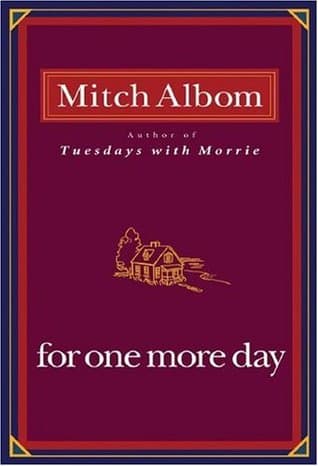
Synopsis
Covers the whole plot, including the ending.
- Difficulty
- Easy
- Pacing
- Moderate
- Mood
- Sentimental, Reflective, Bittersweet, Hopeful
- Read it if
- You enjoy emotionally resonant stories about family, regret, and second chances, or if you're a fan of Mitch Albom's signature blend of magical realism and life lessons.
- Skip it if
- You prefer fast-paced plots with high stakes, or if you're not in the mood for a melancholic and reflective narrative about loss and redemption.
For One More Day Plot Summary
Covers the whole plot, including the ending.
The Breaking Point
Charley 'Chick' Benetto, once a promising baseball pitcher, finds his life in ruins. He is fired from his sales job due to alcoholism and unreliability, a pattern that has pushed his family away. His wife, Lenore, has left him, and his daughter, Maria, is getting married but tells him he is not welcome. Devastated and full of regret, Charley decides to end his life. He drives back to his childhood home of Pepperville, planning to commit suicide by carbon monoxide poisoning in his car. However, he messes up the attempt and crashes, leading him to walk back towards his old, seemingly empty house.
A Miraculous Return Home
After his failed suicide attempt and car crash, Charley walks through the dark streets of Pepperville. He goes to his run-down childhood home, expecting it to be empty. To his surprise, the lights are on, and his mother, Posey Benetto, who died eight years ago, is inside. She greets him warmly, as if he had just been out for a walk, unaware of her own death or the years that have passed. Charley is confused, thinking he might be dreaming or hallucinating, but her presence feels real, offering him a strange yet comforting break from his despair.
The Ordinary Extraordinary Day
Charley spends the day with his mother, Posey, reliving moments he once took for granted. They share breakfast, run errands in town, and visit familiar places. Posey goes about her daily routine, seemingly unaware that she has been dead for years. For Charley, this is a chance to watch her, listen to her stories, and feel her unwavering love again. He struggles to understand her living presence with his memory of her death, constantly questioning the reality, yet he cherishes every second of this impossible reunion.
Unveiling Family Secrets
During their day together, Charley and Posey talk about his father, Leonard Benetto, and their family history. Posey reveals details about Leonard's struggles with alcoholism and his gambling, which caused financial hardship for the family. She explains the sacrifices she made to keep the family going, often working multiple jobs and putting up with Leonard's unpredictable behavior. Charley begins to understand his mother's strength and the burdens she carried, realizing that his childhood idea of his father's 'coolness' often came at his mother's expense.
The Sacrifice of a Mother
Posey recounts how she gave up her dreams of becoming an artist and her love for painting to support her family. After Leonard left, she worked tirelessly, cleaning houses and taking any job to ensure Charley and his sister, Roberta, had what they needed. She describes how she gave up her own happiness and personal fulfillment to be a stable presence for her children, especially after their father left. Charley is deeply moved by these revelations, understanding for the first time the true measure of her love and the quiet strength that defined her life.
A Mother's Unconditional Love
Throughout their day, Posey never criticizes Charley's past mistakes, his alcoholism, or his distance from his family. Instead, she offers him gentle guidance and steady affection. She listens to his regrets and fears without judgment, reminding him of his worth and encouraging him to find his way back to himself. Her presence comforts his wounded soul, showing the lasting power of a mother's love, which goes beyond time and circumstance, and offering him the deep sense of acceptance he needs.
The Dance Hall Revelation
Posey takes Charley to the old dance hall where she and Leonard first met. She shares memories of their early romance, revealing that despite Leonard's failures, she truly loved him. She speaks of his charm and the joy he brought her, acknowledging their complex relationship without bitterness. She tells Charley that she always wanted him to be happy, even if it meant choosing his father over her, showing her understanding and acceptance of his childhood choices.
The Invisible Thread
As the day goes on, Charley remembers various times from his childhood when his mother quietly supported him, even when he thought she was absent or disapproving. He recalls her presence at his baseball games, her encouragement, and her efforts to protect him from his father's instability. He understands that her love was not always obvious but was a constant, underlying force in his life, an 'invisible thread' that connected them, regardless of his awareness or appreciation at the time.
The Farewell and Acceptance
As the sun sets, Charley feels an urgency and a sad understanding that his miraculous day with Posey is ending. He knows he cannot stay in this impossible reality. Posey, still seemingly unaware of her own death, gives him a final, comforting hug. He realizes that this experience was a gift, a chance to heal, understand, and find forgiveness, not just for others, but for himself. He prepares to return to his own time, changed by his mother's lasting love.
A New Beginning
Charley wakes up in a hospital bed, recovering from his suicide attempt and the car crash. The events of the 'one more day' with his mother feel like a vivid dream, yet the lessons and emotional impact are real. He is filled with purpose and a desire to make amends. He starts attending AA meetings, reaches out to his wife, Lenore, and his daughter, Maria, expressing his regret and his commitment to change. With a deeper understanding of his past and his mother's sacrifices, Charley begins the difficult but hopeful journey of rebuilding his life.
Principal Figures
Charley 'Chick' Benetto
Protagonist
A former baseball player haunted by regret and alcoholism, given a chance to reconnect with his deceased mother.
Charley is a deeply flawed man, defined by his past glories as a baseball player and his current struggles with addiction, regret, and estrangement from his family. He chose his 'cool' father over his mother in childhood, a decision that has shadowed his adult life. His alcoholism has cost him his job, his marriage, and his relationship with his daughter. He is at his lowest point when the story begins, contemplating suicide. His journey is one of profound self-reflection, seeking understanding and forgiveness for his failures.
Relationships: Posey Benetto (Son, initially distant but ultimately deeply loving and understanding); Leonard Benetto (Son, idealized in childhood, later understood with more nuance); Lenore (Estranged wife, seeking reconciliation); Maria (Estranged daughter, seeking forgiveness)
Posey Benetto
Supporting (Apparition/Memory)
Charley's deceased mother, who appears to him for 'one more day,' offering unconditional love and hidden truths.
Posey is the embodiment of unconditional maternal love and quiet strength. She is portrayed as a selfless woman who sacrificed her own dreams and worked tirelessly to provide for her children, especially after her husband's abandonment. Despite the hardships, she never harbored bitterness and always showed unwavering support and affection for Charley, even when he chose his father over her. In her 'return,' she acts as a gentle guide, helping Charley understand his past and the true nature of their family history.
Relationships: Charley Benetto (Mother, deeply loving and supportive); Leonard Benetto (Wife, loved him despite his flaws and abandonment); Roberta Benetto (Daughter, loving and protective)
Leonard Benetto
Supporting (Memory)
Charley's charismatic but flawed father, who struggled with alcoholism and gambling.
Leonard is remembered by Charley as the 'cool' parent, a charming and fun-loving man who played baseball. However, Posey's revelations paint a more complex picture: Leonard was also an alcoholic and a gambler who eventually abandoned his family, leaving Posey to shoulder all the responsibilities. He represents the allure of superficial charm versus the steady, reliable love of his mother, and his abandonment deeply impacted Charley's life choices and sense of self-worth.
Relationships: Charley Benetto (Father, initially idolized, later understood with nuance); Posey Benetto (Husband, complex relationship marked by love and hardship)
Lenore
Supporting
Charley's estranged wife, who left him due to his alcoholism.
Lenore is Charley's estranged wife, who, after years of enduring his alcoholism and broken promises, finally leaves him. She represents the consequences of Charley's destructive behavior and the pain he inflicts on those closest to him. Her decision to leave, and her support of Maria's choice to exclude Charley from her wedding, are catalysts for Charley's rock bottom, pushing him towards his desperate suicide attempt. She embodies the hope for reconciliation if Charley truly commits to change.
Relationships: Charley Benetto (Estranged wife, seeking reconciliation); Maria (Mother)
Maria
Supporting
Charley's daughter, who disinvites him from her wedding due to his unreliability.
Maria is Charley's daughter, whose decision to exclude him from her wedding serves as the ultimate catalyst for his despair. Her actions, though painful for Charley, are a clear boundary set against his alcoholism and unreliability. She represents the lost trust and the deep hurt that Charley has caused his family. Her eventual willingness to consider reconciliation is a key motivation for Charley's recovery and his desire to be a better father.
Relationships: Charley Benetto (Daughter, initially estranged, later open to rebuilding connection); Lenore (Daughter)
Roberta Benetto
Mentioned
Charley's older sister, who also bore the brunt of their father's absence.
Roberta is Charley's older sister, mentioned as having also experienced the hardships of their father's abandonment and their mother's sacrifices. While not a direct participant in the 'one more day,' her existence highlights the shared family history and the differing ways siblings cope with trauma. She represents another facet of the family's past and the impact of Leonard's choices on his children.
Relationships: Charley Benetto (Sister); Posey Benetto (Daughter)
Themes & Insights
The Enduring Power of a Mother's Love
The main theme of the novel is the deep, unconditional, and often unseen love of a mother. Posey's character shows this completely; she gives up her own dreams, works tirelessly, and endures hardship without bitterness, all for her children. Even in her 'return,' her love is non-judgmental and accepting, giving Charley the healing he needs. This theme is clear when Charley realizes his mother's support was always there, an 'invisible thread,' even when he didn't see it, and her ultimate wish was always his happiness, regardless of his choices.
“A mother’s love is like a circle. It has no beginning and no ending.”
Regret and Forgiveness
Charley's journey is full of regret over his life choices, especially his neglect of his mother and the pain he caused his family. His 'one more day' directly confronts these regrets, offering him a chance to understand, if not directly apologize, to his mother. The experience allows him to begin forgiving himself and seeking forgiveness from his estranged wife and daughter. The novel suggests that true forgiveness starts with understanding the past and taking responsibility for one's actions, making way for a hopeful future.
“Don’t be so hard on yourself, honey. We all make mistakes. The trick is to learn from them.”
The Nature of Family and Sacrifice
The book explores the complex dynamics within a family, especially the sacrifices parents make for their children. Posey's story reveals the hidden burdens and dreams she gave up to ensure her children's well-being, contrasting with Leonard's more selfish path. It looks at the idea that family bonds, while sometimes strained or broken, are essential to identity and personal growth. Charley's realization of his mother's sacrifices changes his understanding of his family history and his place in it, showing that love often appears through quiet, lasting acts of selflessness.
“You can be a mama’s boy or a daddy’s boy, but you can’t be both.”
Second Chances and Redemption
The entire idea of 'For One More Day' centers on a second chance – a miraculous opportunity for Charley to revisit his past and gain a new perspective. This 'second chance' is not just about seeing his mother again, but about redeeming his own life. It lets him face his problems, understand the source of his pain, and choose a different path forward. The novel argues that even at the lowest point, redemption is possible through understanding, self-awareness, and a renewed commitment to love and responsibility.
“Sometimes, the thing you want most is the one thing you can’t have. And sometimes, the thing you can’t have is the only thing that will make you happy.”
Plot Devices & Literary Techniques
Magical Realism / Supernatural Encounter
Charley experiences a day with his deceased mother, blurring the lines between life and death, reality and illusion.
The central plot device is Charley's seemingly miraculous encounter with his deceased mother, Posey. This supernatural event serves as a catalyst for his emotional and psychological journey. It's presented with a soft magical realism, where the impossibility of the situation is acknowledged but not overly explained, allowing the focus to remain on the emotional impact and the lessons learned. This device provides Charley with a unique 'second chance' to gain perspective and heal, which would be impossible in a purely realistic narrative.
Flashback / Retrospection
Charley's memories and his mother's stories bring the past into the present, revealing hidden truths and shaping his understanding.
Throughout his day with Posey, Charley frequently delves into his memories of childhood, contrasting his initial perceptions with the new information his mother provides. Posey's anecdotes also function as flashbacks, recounting events from her past and her marriage to Leonard. This constant interplay between present experience and past recollection allows for a deeper exploration of family history, character motivations, and the complex layers of regret and love that define Charley's life. It's how the reader, and Charley, piece together the full story.
The 'One More Day' Premise
The narrative structure is built around a single, finite period of time with a lost loved one.
The entire story is framed around the titular 'one more day' that Charley spends with his mother. This finite time limit creates a sense of urgency and poignancy, emphasizing the preciousness of every moment. It forces Charley to confront his deepest regrets and absorb as much as he can from his mother's presence. This device highlights the universal human yearning for a chance to reconnect with lost loved ones and make amends, giving the narrative a powerful emotional core and a clear structural purpose.
For One More Day Quotes
“When you're dying, the only thing you regret is not having spent more time with your loved ones.”
“A child is a person who is going to carry on what you have started.”
“You can't go through life wanting to be someone else.”
“The greatest gift you can give someone is your time. Because when you give your time, you are giving a portion of your life that you will never get back.”
“There are no ordinary moments.”
“You see, a lot of people just go through life, not really connecting with anybody.”
“Love is how you stay alive, even after you are gone.”
“Every parent is at some point a child. And every child is at some point a parent.”
“We all have a few 'if onlys' in our lives.”
“It's never too late to make things right.”
“The things you regret most in life are the risks you didn't take.”
“Sometimes you have to step back to see things clearly.”
“No one is truly gone as long as they are remembered.”
“We are all tied to our past, and we can only be free when we understand it.”
Quiz
10 questions on the plot and the characters. Each answer comes with a short explanation.
Question 1
What choice does young Charley 'Chick' Benetto make regarding his parents after his father tells him he can't be both a 'mama's boy' and a 'daddy's boy'?
- He tries to be both, defying his father.
- He chooses to be a 'mama's boy'.
- He chooses to be a 'daddy's boy'.
- He runs away from home.
Show answer
C. He chooses to be a 'daddy's boy'. The synopsis explicitly states, 'So he chooses his father, only to see the man disappear when Charley is on the verge of adolescence.'
Question 2
What significant event triggers Charley's decision to attempt suicide?
- He loses his house in a gambling debt.
- His only daughter excludes him from her wedding.
- His wife leaves him for another man.
- He is diagnosed with a terminal illness.
Show answer
B. His only daughter excludes him from her wedding. The synopsis states, 'He hits bottom after discovering his only daughter has shut him out of her wedding. And he decides to take his own life.'
Question 3
When Charley returns to his old house after his failed suicide attempt, who does he astonishingly find living there?
- His estranged father.
- His mother, who had died eight years earlier.
- His childhood best friend.
- His ex-wife.
Show answer
B. His mother, who had died eight years earlier. The text clearly states, 'But upon failing even to do that, he staggers back to his old house, only to make an astonishing discovery. His mother, who died eight years earlier, is still living there...'
Question 4
What is the primary emotional state that describes Charley's life before his supernatural encounter?
- Joy and fulfillment.
- Ambition and success.
- Alcoholism and regret.
- Contentment and peace.
Show answer
C. Alcoholism and regret. The synopsis describes Charley as 'a broken man. His life has been crumbled by alcohol and regret.'
Question 5
The central premise of the story revolves around the question: What would you do if you could spend one more day with a lost loved one? Which literary device does this question most directly represent?
- Metaphor
- Foreshadowing
- Hypothetical scenario
- Irony
Show answer
C. Hypothetical scenario The question 'What would you do if you could spend one more day with a lost loved one?' sets up a hypothetical situation that the entire narrative explores.
Question 6
What does Charley learn from his mother during their 'one ordinary day' together?
- How to make a fortune in business.
- The astonishing things he never knew about her and her sacrifices.
- How to win back his wife and daughter.
- The location of a hidden family treasure.
Show answer
B. The astonishing things he never knew about her and her sacrifices. The synopsis states, 'Somewhere between this life and the next, Charley learns the astonishing things he never knew about his mother and her sacrifices.'
Question 7
The book is described as 'a beautiful, haunting novel about the family we love and the chances we miss.' Which theme is most emphasized by 'the chances we miss'?
- The inevitability of fate.
- The importance of seizing opportunities and avoiding regret.
- The joy of unexpected reunions.
- The power of forgiveness from strangers.
Show answer
B. The importance of seizing opportunities and avoiding regret. The phrase 'the chances we miss' directly points to the theme of regret and the importance of making the most of relationships and opportunities while they are present.
Question 8
The book's opening line in the description, 'Every family is a ghost story...' most strongly suggests which thematic element?
- The presence of literal ghosts in every family.
- The lingering impact of past family members and unresolved issues.
- Families are often scary and full of secrets.
- Families often tell stories about spooky events.
Show answer
B. The lingering impact of past family members and unresolved issues. The phrase 'ghost story' in this context is metaphorical, referring to the enduring influence and unresolved feelings associated with deceased or absent family members, which is a core theme of the book.
Question 9
How does Charley's journey with his mother contribute to the 'crumpled pieces of his life' being put back together?
- She helps him win the lottery, solving his financial problems.
- She magically makes his family return to him.
- Through her tender guidance, he gains understanding and a chance to seek forgiveness, leading to personal healing.
- She reveals a hidden will that restores his inheritance.
Show answer
C. Through her tender guidance, he gains understanding and a chance to seek forgiveness, leading to personal healing. The synopsis states he 'tries, with her tender guidance, to put the crumbled pieces of his life back together,' implying emotional and relational healing through understanding and forgiveness, not external solutions.
Question 10
Mitch Albom's previous bestsellers, 'The Five People You Meet in Heaven' and 'Tuesdays with Morrie,' share a common thematic thread with 'For One More Day.' What is this overarching theme?
- The pursuit of fame and fortune.
- The exploration of life, death, and meaningful relationships.
- Adventures in exotic locations.
- Solving intricate mysteries.
Show answer
B. The exploration of life, death, and meaningful relationships. All three books by Mitch Albom are known for their philosophical and emotional exploration of human connections, the meaning of life, and confronting mortality, often through a lens of reflection and remembrance.
For One More Day FAQ
What is the central premise of 'For One More Day'?
The book explores the question of what someone would do if they had one more day with a lost loved one. It centers on Charley 'Chick' Benetto, a man at rock bottom, who gets an unexpected opportunity to spend an 'ordinary' day with his deceased mother, Posey Benetto, eight years after her death.
Who is Charley 'Chick' Benetto and what is his primary struggle?
Charley is the protagonist, a former baseball player whose life spiraled into alcoholism and regret after his father left. He struggles with feelings of abandonment, failure, and the inability to connect with his own family, leading him to contemplate suicide.
What prompts Charley's desperate decision to return to his hometown?
Charley returns to his hometown with the intention of taking his own life after losing his job, alienating his wife and son, and discovering his daughter has excluded him from her wedding. This series of rejections pushes him to his emotional breaking point.
How does Charley encounter his mother again?
After failing in his suicide attempt, Charley stumbles back to his childhood home. To his astonishment, his mother, Posey Benetto, who died eight years prior, is there, alive and well, welcoming him as if no time has passed. This marks the beginning of their 'one more day' together.
What is the significance of the quote, 'You can be a mama's boy or a daddy's boy, but you can't be both'?
This quote, spoken by Charley's father, sets the stage for Charley's lifelong internal conflict and his initial choice to align with his father. It highlights the familial division and the pressure Charley felt, ultimately contributing to his later regrets about his relationship with his mother.
What specific sacrifices did Posey Benetto make for her family?
Posey Benetto made numerous sacrifices, including working tirelessly as a hairdresser, enduring a difficult marriage, and putting her children's needs before her own aspirations. She also gave up her dreams of becoming an artist to support her family after her husband left.
How does the book reveal the true nature of Charley's father, Len Benetto?
Through Posey's recollections and Charley's own rediscovered memories, it's revealed that Len Benetto was a charming but ultimately irresponsible and selfish man who abandoned his family. He often made promises he couldn't keep and left Posey to bear the brunt of raising their children.
What is the significance of the 'wedding' Charley attends with his mother during their day together?
The 'wedding' is not a literal event but a metaphorical representation of Posey's unfulfilled dream of seeing Charley happily married and settled. It also highlights Charley's own missed opportunities and the pain of being excluded from his daughter's actual wedding.
What role does the narrator, an older Charley, play in the story?
The older Charley narrates the story, looking back on this pivotal day with his mother. His perspective as a survivor who has learned from his experiences adds a layer of reflection and wisdom, emphasizing the lasting impact of that one day.
How does Charley's choice between being a 'mama's boy' or 'daddy's boy' impact his psychological development?
This forced choice created a deep rift in Charley's psyche, leading him to suppress his affection for his mother and internalize his father's perceived strength. This contributed to his later emotional detachment and difficulty forming healthy relationships.
What psychological effect does Posey's unconditional love have on Charley during their day?
Posey's unconditional love and gentle guidance act as a powerful therapeutic force for Charley. It allows him to confront his past regrets, process his grief, and begin to heal the emotional wounds that have plagued him for decades, offering a path towards self-forgiveness.
How does Charley's alcoholism serve as a coping mechanism and what does his 'day' with Posey teach him about it?
Charley's alcoholism is a coping mechanism for his feelings of abandonment and failure, allowing him to escape his painful reality. His day with Posey teaches him the true depth of his mother's sacrifices and the importance of facing his problems rather than numbing them, inspiring him to seek sobriety.
In what ways does Charley exhibit arrested development due to his father's early departure?
Charley exhibits arrested development by carrying unresolved childhood trauma into adulthood, manifesting as a lack of emotional maturity, an inability to take responsibility, and a perpetual search for external validation. His father's departure left a void he struggled to fill constructively.
Is the 'one more day' a literal event or a symbolic journey for Charley?
While presented as a seemingly literal day, it is widely interpreted as a symbolic journey within Charley's mind, a profound near-death experience or a spiritual encounter that allows him to process his grief and regrets. It represents a mental space where healing can occur.
What is the book's message about forgiveness, both for oneself and for others?
The book strongly emphasizes the importance of forgiveness: Charley learns to forgive his father for abandoning him, and more importantly, to forgive himself for his past mistakes and his neglect of his mother. It suggests forgiveness is essential for moving forward and finding peace.
How does the author use the theme of 'ghost stories' in relation to families?
Albom uses 'Every family is a ghost story' to imply that the past, especially unresolved emotions and the presence of loved ones who are gone, continues to haunt and influence the living. Family members, even when absent, leave an indelible mark that shapes future generations.
Does Charley's experience with his mother truly change his future actions?
Yes, the narrative strongly suggests that Charley's experience fundamentally changes his future. He gains a newfound appreciation for his mother's sacrifices and a clearer understanding of his own life, empowering him to seek reconciliation with his family and pursue sobriety, ultimately leading to a redemptive path.
What is the book's overarching message about parental love?
The book's overarching message is about the enduring and often unconditional nature of a mother's love. Posey's love for Charley transcends death, offering him a final chance at understanding and healing, highlighting its profound and lasting impact on a child's life.
About the author

Mitch Albom is an American author and journalist known for his poignant storytelling and exploration of life and death themes. His notable works include "Tuesdays with Morrie," a memoir about his relationship with a dying professor, and "The Five People You Meet in Heaven," which delves into the afterlife. Other significant titles include "For One More Day," "The First Phone Call from Heaven," and "The Magic Strings of Frankie Presto."
Similar books
- The Five People You Meet in Heaven
Mitch Albom
3.9 (578k) average on GoodreadsFantasyExplores themes of life, death, and regret through a character's journey of self-discovery after passing on.
- Tuesdays with Morrie
Mitch Albom
4.1 (782k) average on GoodreadsBiographyFeatures a mentor-mentee relationship offering life lessons and reflections on living and dying.
- The Midnight Library
Matt Haig
A character gets a second chance to revisit past choices and find meaning, similar to Charley's magical day.
- The Lovely Bones
Alice Sebold
3.8 (2M) average on GoodreadsFantasyWhile both books explore death and the afterlife through unique narrative lenses, Sebold's work is darker, more complex, and focuses on trauma, justice, and the lingering presence of the deceased in a more haunting manner. Albom's "For One More Day" is primarily concerned with the emotional catharsis and retrospective examination for the living, using the fantastical element for personal redemption rather than a broader exploration of the afterlife's mechanics or consequences.
- One Hundred Years of Solitude
Gabriel García Márquez
4.1 (753k) average on GoodreadsLiterary FictionMárquez's masterpiece is a seminal work of magical realism, building an elaborate, sprawling world rich with symbolism, historical critique, and intricate family sagas. Albom's use of the fantastical in "For One More Day" is much more restrained and serves a singular, emotional purpose: to grant a character a final day with his mother. Albom's focus is on individual emotional healing, whereas Márquez delves into broader societal narratives and the cyclical nature of history.
- Harry Potter and the Sorcerer's Stone
J.K. Rowling
4.5 (7M) average on GoodreadsFantasyRescued from a miserable life under the stairs, an orphaned boy discovers he's a wizard destined for a magical school, where he uncovers a dangerous secret tied to the dark wizard who murdered his parents.





Enjoyed the summary?
A summary gives you the shape of the book. The book itself has the detail, the examples and the voice.
Find For One More Day on AmazonAs an Amazon Associate, BookBrief earns from qualifying purchases. How we're funded