
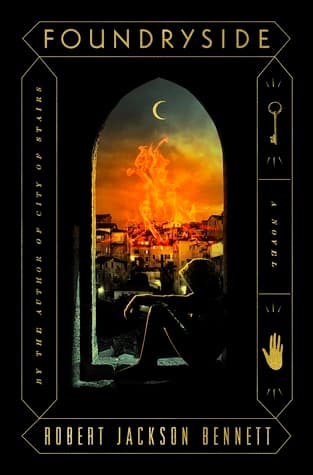
Synopsis
Covers the whole plot, including the ending.
- Difficulty
- Medium
- Pacing
- Fast
- Mood
- Intricate, Action-packed, Mysterious, Revolutionary
- Read it if
- You love intricate magic systems, morally grey protagonists, high-stakes heists, and a blend of fantasy with industrial revolution themes.
- Skip it if
- You prefer simpler magic systems or don't enjoy stories with extensive world-building and political intrigue.
Foundryside Plot Summary
Covers the whole plot, including the ending.
The Heist and the Mysterious Key
Sancia Grado, a thief with the ability to 'scrive' objects by touch, undertakes a heist in Tevanne's docks. Her target is a guarded warehouse belonging to the Merchant House of Crasedes. Using her talent, which lets her alter the 'truths' of objects—making a lock think it's open or a wall think it's air—she bypasses defenses. She retrieves the item: a strange, intricate metal key that resists her scriving. Her employer, Captain Grash, promised a large sum. As Sancia escapes, she realizes the artifact is more powerful and dangerous than she expected, attracting attention from the Merchant Houses and their scriving capabilities. The key, later revealed as a 'keyed' or 'scrived' object itself, begins to communicate with her, showing a basic sentience.
Escape from the Merchant Houses
After the heist, Sancia is pursued by powerful scrivers from House Crasedes, led by Gregor Dandolo. Dandolo, a master scriver-artisan, uses his knowledge of the city's scrived infrastructure to track Sancia. She navigates Tevanne's streets and canals, using her quick thinking and limited scriving to evade capture. The key, which she now knows is important, continues to influence her, whispering and subtly aiding her escape. She realizes Captain Grash betrayed her, setting her up as a pawn in a larger game involving control of this artifact and the city's scriving secrets. She is alone against the Merchant Houses.
Meeting Orso and the History of Scriving
Desperate and injured, Sancia seeks refuge in the workshop of Orso, a disgraced former scriver. Orso, initially suspicious, is intrigued by Sancia's unique, instinctual scriving and the mysterious key. He tells Sancia the history and mechanics of scriving: it is not just magic, but a manipulation of fundamental 'truths' about reality, originally discovered by the scriver-god, Hierophant. Orso explains that scriving alters an object's 'prime truth' by convincing it it's something else, changing its properties. He warns Sancia about the key's power, identifying it as a 'keyed' object—a relic from the Hierophant era, capable of manipulating scriving itself. He also reveals the Hierophant's 'foundry,' a mythical place where prime truths can be rewritten fundamentally.
The Kyra and the Hierophant's Legacy
The key, which Sancia names Kyra, begins to communicate more clearly, revealing itself as a sentient, ancient scrived construct. Kyra explains it was created by the Hierophant to access and manipulate the 'foundry,' a place of ultimate scriving power. Kyra also reveals that Sancia's unique scriving ability—her ability to 'talk' to objects and instinctively understand their truths—is a sign that she is a 'keyed' individual, a person designed or altered by the Hierophant to interact with such powerful artifacts. This revelation deepens Sancia's understanding of her identity and her connection to the ancient, god-like figure. Kyra urges Sancia to find the Hierophant's foundry, believing it holds the key to restoring the world to a more balanced state, free from the Merchant Houses' control.
Meeting Clef and the Betrayal of Grash
Sancia and Orso meet Clef, an advanced scrived construct, a 'keyed' being like Kyra, but designed for combat and information gathering. Clef, initially hostile, reveals he was also created by the Hierophant and protects the foundry's secrets. Through Clef, Sancia learns that Captain Grash, her former employer, is a powerful figure within one of the lesser Merchant Houses. He has been manipulating events to gain control of Kyra and the foundry. Grash intends to use the foundry's power to reshape Tevanne to his own design, becoming a new Hierophant. This betrayal strengthens Sancia's resolve to stop Grash and prevent the foundry's power from falling into the wrong hands, aligning her goals with Orso and Clef.
The Pursuit and the Merchant Houses' Schemes
As Sancia, Orso, and Clef work to find clues to the foundry, they are pursued by Gregor Dandolo and House Crasedes, who want Kyra back. At the same time, Captain Grash, now revealed as Silas Dandolo (Gregor's brother), uses his network and scrived agents to track Sancia. Tevanne's Merchant Houses' political plans become clearer: each House wants to control the Hierophant's legacy for their own gain. Crasedes wants to keep its dominance, while Silas wants to reshape reality. Sancia realizes she is caught between powerful groups, all fighting for control over existence, and her abilities make her a valuable, yet dangerous, asset to both sides.
The Hierophant's Foundry Revealed
Following clues within Kyra and ancient texts deciphered by Orso, Sancia and her allies find the Hierophant's Foundry. It is not a physical place but a vast, ancient, complex scrived chamber hidden deep beneath Tevanne. The Foundry is a machine of immense power, capable of altering the 'prime truths' of objects and concepts on a fundamental, universal level. Its power is far beyond anything current scrivers can achieve. The scale of the Hierophant's work shows a deep understanding of reality. Accessing and controlling the Foundry requires Kyra and a unique individual like Sancia, who can intuitively interface with its complex scrived mechanisms.
Confrontation in the Foundry
The climax happens within the Hierophant's Foundry. Gregor Dandolo, leading House Crasedes's forces, and Silas Dandolo (Grash), with his scrived army, converge on the Foundry, each determined to seize its power. A chaotic battle breaks out, with powerful scriving attacks. Orso uses his knowledge to counter Gregor's scriving, while Clef fights Silas's constructs. Sancia, guided by Kyra, navigates the Foundry's controls, trying to understand how to operate it and prevent either brother from gaining full control. During the struggle, Silas's ambition is revealed: he wants to rewrite Tevanne's prime truths, to eliminate poverty and inequality by simply scriving them out of existence, a dangerous plan that would remove free will.
Sancia's Transformation and the Foundry's Power
Cornered and facing overwhelming odds, Sancia realizes the only way to stop Silas and prevent the catastrophic misuse of the Foundry is to use its power herself. Guided by Kyra, she begins to understand how to interface with the Foundry's core, a process that requires a deep connection to the fundamental truths of reality. In a desperate act, Sancia uses the Foundry's power, not to rewrite the world, but to rewrite her own prime truth, transforming herself into something more than human. She becomes a 'keyed' being, imbued with the Hierophant's power, capable of scriving on an unimaginable scale. This transformation allows her to neutralize Silas's scriving and defend the Foundry, but at a personal cost, changing her perception and interaction with the world forever.
Aftermath and New Beginnings
After the battle, Silas Dandolo is defeated, his plans for a 'perfect' Tevanne stopped. Gregor Dandolo grapples with the Foundry's existence and his brother's actions. Sancia, changed by the Foundry's power, is no longer just a thief. She has an understanding of scriving and the underlying truths of reality, but also feels alienated from her former self. With Orso and Clef, she secures the Foundry, recognizing the responsibility that comes with its existence. The Merchant Houses are shaken. Sancia, Kyra, Orso, and Clef now face the task of deciding how to manage this ultimate power, understanding that the world has been altered by the Hierophant's legacy, and their journey continues.
Foundryside Characters
Sancia Grado
Protagonist
A master thief with a unique, intuitive ability to 'scrive' objects by touch.
Sancia is resourceful, independent, and fiercely determined, driven by a need for survival and a desire to understand her own mysterious past, particularly her unique scriving ability. She grew up in poverty, developing her thieving skills and her unusual talent for manipulating objects' 'truths.' She is pragmatic and initially distrustful, but her experiences with Orso, Clef, and Kyra gradually open her to forming alliances and understanding a greater purpose. She struggles with her identity and the profound sense of being 'broken' or 'different,' which is later revealed to be a key part of her connection to the Hierophant's legacy.
Relationships: Kyra (Symbiotic bond, shared purpose, guide); Orso (Mentor, friend, ally); Clef (Ally, fellow 'keyed' being); Captain Grash (Silas Dandolo) (Employer turned antagonist, betrayer)
Kyra
Supporting
An ancient, sentient 'keyed' artifact—a key to the Hierophant's Foundry.
Kyra is a highly complex, sentient scrived construct, created by the Hierophant. It manifests as an intricate metal key but possesses a vast knowledge of scriving, the Hierophant, and the Foundry. Kyra acts as a guide and a source of information for Sancia, slowly revealing its true nature and purpose. It is driven by its original programming to find its way back to the Foundry and to a 'keyed' individual who can operate it. Kyra's communication is initially cryptic but becomes clearer as its connection with Sancia deepens, displaying a distinct personality and a deep, ancient wisdom.
Relationships: Sancia Grado (Symbiotic bond, user, chosen recipient); Clef (Fellow 'keyed' construct, ancient ally)
Orso
Supporting
A disgraced, reclusive former scriver and scholar.
Orso is a brilliant but cynical former scriver, ostracized by the Merchant Houses for his unorthodox theories about scriving and the Hierophant. He lives in self-imposed exile, surrounded by ancient texts and failed scriving experiments. He possesses a deep, scholarly understanding of scriving's history and mechanics, far beyond practical application. Orso initially views Sancia as a curiosity but quickly becomes her reluctant mentor and ally, his academic curiosity overriding his caution. He is driven by a desire for truth and a belief that the Merchant Houses have corrupted the true nature of scriving.
Relationships: Sancia Grado (Mentor, friend, ally); Clef (Ally, fellow guardian of the Hierophant's legacy)
Clef
Supporting
A powerful, 'keyed' scrived construct designed for combat and information.
Clef is another 'keyed' construct created by the Hierophant, akin to Kyra but designed for more direct action and protection. He is highly intelligent, incredibly durable, and possesses advanced scriving abilities, making him a formidable opponent. Clef is initially wary of Sancia and Orso, focused on his mission to protect the Hierophant's secrets and the Foundry. He is pragmatic and often laconic, but deeply loyal to his original purpose. His existence highlights the advanced capabilities of the Hierophant's scriving and the profound implications of sentient constructs.
Relationships: Sancia Grado (Ally, fellow 'keyed' being); Kyra (Fellow 'keyed' construct, ancient ally); Orso (Ally)
Gregor Dandolo
Antagonist
A master scriver-artisan of House Crasedes, tasked with retrieving Kyra.
Gregor Dandolo is a highly skilled and respected scriver-artisan from House Crasedes, one of Tevanne's most powerful Merchant Houses. He is a meticulous, driven, and ruthless individual, utterly devoted to his House and its interests. Gregor sees scriving as a sacred art and is deeply offended by Sancia's 'unnatural' abilities and the theft of the key. He is a formidable antagonist, using his extensive knowledge of scriving and the city's infrastructure to track Sancia. His primary motivation is to maintain the established order and the dominance of his House, viewing the key as a dangerous disruption.
Relationships: Sancia Grado (Antagonist, pursuer); Silas Dandolo (Captain Grash) (Brother, rival)
Silas Dandolo (Captain Grash)
Antagonist
Sancia's initial employer and the true mastermind behind the key's theft.
Initially known as Captain Grash, a shadowy fence and employer, he is later revealed to be Silas Dandolo, Gregor's estranged brother and a powerful, ambitious figure within a lesser Merchant House. Silas is cunning, manipulative, and visionary, but also dangerously idealistic. He believes the Merchant Houses have failed Tevanne and seeks to use the Hierophant's Foundry to fundamentally reshape the city, eliminating poverty and inequality by literally scriving them out of existence. He views Sancia as a tool and is willing to sacrifice anyone to achieve his utopian, yet totalitarian, vision.
Relationships: Sancia Grado (Employer turned antagonist, manipulator); Gregor Dandolo (Brother, rival)
Hierophant
Mentioned
The legendary, god-like ancient scriver who discovered prime truths and created the Foundry.
The Hierophant is a legendary, almost mythical figure from Tevanne's ancient past, revered as a god-like scriver. He is credited with discovering the concept of 'prime truths' and creating the ultimate scriving machine, the Foundry, along with 'keyed' constructs like Kyra and Clef, and 'keyed' individuals like Sancia. Though long dead, his influence permeates the entire narrative. His motivations and full extent of his power remain largely mysterious, but his legacy drives the entire plot, representing both immense creative potential and terrifying destructive power. He symbolizes the ultimate understanding and manipulation of reality.
Relationships: Sancia Grado (Creator/designer of her unique abilities); Kyra (Creator); Clef (Creator)
Paolo Rime
Supporting
A scriver-artisan from House Crasedes, loyal to Gregor Dandolo.
Paolo Rime is a competent but less experienced scriver-artisan working under Gregor Dandolo in House Crasedes. He is part of the initial pursuit of Sancia and acts as Gregor's loyal subordinate. Paolo represents the typical, highly trained scriver within the established Merchant House system, adhering to its rules and understanding of scriving. He is a foil to Sancia's unconventional abilities and Orso's theoretical knowledge, showcasing the practical, often rigid application of scriving by the Houses. His character helps illustrate the power hierarchy and the extent of the Houses' control.
Relationships: Gregor Dandolo (Superior, mentor)
Foundryside Themes
Identity and Self-Discovery
Sancia's journey is about understanding who she is and where her scriving ability comes from. Her initial self-perception as a 'broken' thief changes to the revelation that she is a 'keyed' individual, linked to the Hierophant's legacy. This forces her to confront her past and her potential to reshape reality. Her transformation in the Foundry is the ultimate expression of this theme, as she literally rewrites her own prime truth, becoming something new and powerful.
“There are things in the world that are true, Sancia. And things that are made true. And then there are things that are made true, but they used to be true, and then they stopped, and then they were made true again.”
Power and Control
The novel explores the nature of power, especially through scriving. The Merchant Houses control Tevanne through their mastery of scrived technology, shaping the city and maintaining a social hierarchy. The discovery of the Hierophant's Foundry is the ultimate power—the ability to rewrite reality. Silas Dandolo's desire to use this power for his 'utopian' vision, and the Houses' desperation to control it, show how absolute power corrupts and the ethical problems it presents. Sancia's struggle is to prevent this power from being taken over or misused.
“Everything in Tevanne is scrived. The bridges, the canals, the very air you breathe. It’s all been twisted to serve the Houses.”
The Nature of Reality and Truth
At its core, Foundryside explores philosophical questions about 'truth.' Scriving is the manipulation of an object's 'prime truth' by convincing it it's something else. This raises questions: If an object can be made to believe it's not what it is, what does that say about objective reality? The Hierophant's Foundry takes this to an extreme, offering the ability to rewrite fundamental truths on a universal scale, blurring the lines between what is, what is perceived, and what can be willed into being. The book constantly asks the reader to consider how fluid reality is.
“Every object has a prime truth, Sancia. A fundamental, unchangeable reality. Scriving is merely persuading that truth to bend.”
Capitalism and Social Inequality
Tevanne is a capitalist machine, where the Merchant Houses, through their control of scriving, maintain a divide between the wealthy and the poor. Scrived objects and infrastructure consolidate power and wealth, creating a city where even basic necessities can be manipulated for profit. Sancia's background as a thief from the lower class shows the oppressive nature of this system. Silas Dandolo's motivations, though extreme, come from a desire to dismantle this inequality, even if through a dangerous method. The novel critiques unchecked corporate power and its impact on society.
“The Houses don’t build. They buy. They buy up the truths of things, and then they sell them back to us.”
Plot Devices & Literary Techniques
Scriving
The magic system that manipulates the 'prime truths' of objects.
Scriving is the foundational magic system of Foundryside. It involves altering an object's 'prime truth' by applying coded commands, essentially convincing the object it is something it's not, thereby changing its physical properties or behavior. For example, a lock can be scrived to 'believe' it's open, or a wall to 'believe' it's air. This system is highly detailed and has specific rules and limitations, making it feel scientific. It is the source of all technology and power in Tevanne, controlled by the Merchant Houses. Sancia's unique ability to instinctively 'talk' to objects is a rare and powerful form of scriving.
The Hierophant's Foundry
An ancient, ultimate scriving machine capable of rewriting fundamental truths.
The Hierophant's Foundry is the central MacGuffin and ultimate plot device. It is an ancient, complex scrived chamber hidden beneath Tevanne, created by the legendary Hierophant. Unlike conventional scriving, which manipulates local truths, the Foundry is capable of altering 'prime truths' on a universal or conceptual level. It represents the ultimate power to reshape reality, making it the coveted prize for all factions. Its existence drives the entire narrative, forcing Sancia to confront its power and the ethical implications of using it. It also serves as the site of the climax and Sancia's transformative experience.
Kyra (The Key)
A sentient 'keyed' artifact that guides Sancia to the Foundry.
Kyra, initially just 'the key,' functions as a crucial plot device, acting as a sentient MacGuffin and a guide. It is a 'keyed' construct, meaning it was specifically designed by the Hierophant to interact with the Foundry and 'keyed' individuals like Sancia. Its sentience allows it to communicate with Sancia, providing exposition about the Hierophant, scriving, and the Foundry's location and function. Kyra's unique nature and its resistance to conventional scriving immediately signal its importance and propel Sancia into the larger conflict, serving as both a physical object and a narrative voice.
The 'Prime Truth'
The fundamental, underlying reality of an object or concept.
The concept of 'prime truth' is a core philosophical and magical plot device. It refers to the fundamental, inherent reality or nature of an object, independent of any scriving. Scriving works by overriding or 'persuading' an object's prime truth to believe it is something else. This concept underpins the entire magic system and the philosophical questions the book raises about reality. The Hierophant's ultimate power, and the Foundry's purpose, is to manipulate these prime truths on a foundational level, not just locally, which has immense implications for the fabric of existence.
Foundryside Quotes
“All things change, my dear. Not always for the better, not always for the worse, but always, always change.”
“A lie is a tool, not a truth. It can be shaped, sharpened, used to cut through the toughest problems.”
“The world is not as it seems, nor as it should be. It is as it is made.”
“Every object has a soul. Or, if not a soul, then a purpose, a nature, a way it wants to be.”
“To truly know something, you must break it apart. See the pieces. Understand how they fit, and how they can be made to fit differently.”
“The greatest prison is the one you build for yourself, brick by brick, lie by lie.”
“Power isn't about having the biggest army or the most money. It's about knowing how the world works, and how to make it work for you.”
“Fear is a useful emotion. It tells you what to avoid, what to prepare for. But it is a terrible master.”
“Every secret comes with a cost. The longer you keep it, the higher the price.”
“The past is a story we tell ourselves. The future is a story we try to write.”
“A true scriver doesn't just change an object; they understand its fundamental nature and then persuade it to be something more.”
“It's not about what you're born with, but what you make of what you're given.”
“The biggest lies are often the ones we tell ourselves to make the world make sense.”
“There are always other ways. Always. The trick is finding them.”
“Sometimes, the only way to save something is to be willing to let it burn.”
Quiz
10 questions on the plot and the characters. Each answer comes with a short explanation.
Question 1
What is the primary magical technology that Sancia Grado and the Merchant Houses utilize in Tevanne?
- Alchemy
- Scriving
- Enchantment
- Runecraft
Show answer
B. Scriving The book explicitly states that 'scriving' is the magical technology used to imbue everyday objects with sentience and is controlled by the Merchant Houses.
Question 2
What is Sancia Grado's profession at the beginning of the story?
- Merchant
- Guard
- Thief
- Scriver
Show answer
C. Thief The first line of the book description introduces Sancia Grado as 'a thief, and a damn good one'.
Question 3
What kind of object is Sancia initially sent to steal from the heavily guarded warehouse?
- A rare gem
- A ledger of secrets
- An artifact of unimaginable power
- A new scriving tool
Show answer
C. An artifact of unimaginable power Sancia's target is described as 'an artifact of unimaginable power' that could revolutionize scriving.
Question 4
How have the Merchant Houses used scriving to transform Tevanne?
- Into a utopian society
- Into a vast, remorseless capitalist machine
- Into a military stronghold
- Into an artistic hub
Show answer
B. Into a vast, remorseless capitalist machine The description states that the Merchant Houses have used scriving to 'transform Tevanne into a vast, remorseless capitalist machine.'
Question 5
What is the primary danger Sancia faces after stealing the artifact?
- Imprisonment by the city watch
- Being exiled from Tevanne
- Someone in the Merchant Houses wants her dead and the artifact for themselves
- The artifact's power overwhelming her
Show answer
C. Someone in the Merchant Houses wants her dead and the artifact for themselves The narrative states, 'Now someone in those Houses wants Sancia dead, and the artifact for themselves.'
Question 6
What kind of 'transformation' is Sancia expected to undergo to survive and stop the deadly changes?
- She must become a Merchant House leader
- She must learn to control the artifact's power and become something new
- She must abandon her thieving ways entirely
- She must join the city's military
Show answer
B. She must learn to control the artifact's power and become something new To survive, Sancia will 'learn to harness the artifact’s power for herself, and undergo her own transformation, one that will turn her into something she could never have imagined.'
Question 7
What is the ultimate goal of the Merchant Houses if they unlock the artifact's secrets?
- To create a new form of currency
- To establish peace among all cities
- To rewrite the world itself to suit their aims
- To dismantle the capitalist system
Show answer
C. To rewrite the world itself to suit their aims The description highlights that 'if they can unlock the artifact’s secrets, they will rewrite the world itself to suit their aims.'
Question 8
What are 'coded commands' used for in the context of scriving?
- To communicate secretly between Merchant Houses
- To imbue everyday objects with sentience
- To encrypt financial transactions
- To control the city's infrastructure
Show answer
B. To imbue everyday objects with sentience Scriving is defined as 'the art of using coded commands to imbue everyday objects with sentience.'
Question 9
What does Sancia need to do to have a chance at surviving and stopping the deadly transformation occurring in Tevanne?
- Escape Tevanne and hide the artifact
- Expose the Merchant Houses' corruption to the public
- Marshal unlikely allies, harness the artifact's power, and undergo a personal transformation
- Return the artifact to its original owners
Show answer
C. Marshal unlikely allies, harness the artifact's power, and undergo a personal transformation The summary states, 'Sancia will have to marshal unlikely allies, learn to harness the artifact’s power for herself, and undergo her own transformation.'
Question 10
What characteristic describes Tevanne due to the Merchant Houses' control of scriving?
- A democratic republic
- A technologically advanced utopia
- A vast, remorseless capitalist machine
- A feudalistic society
Show answer
C. A vast, remorseless capitalist machine The book description explicitly states that scriving has been used to transform Tevanne 'into a vast, remorseless capitalist machine.'
Foundryside FAQ
What is Foundryside about?
Foundryside follows Sancia Grado, a skilled thief in the city of Tevanne, who inadvertently steals an ancient artifact of immense power. This artifact, a 'key' to a deeper form of scriving magic, threatens the established order of the Merchant Houses who control the city through their unique ability to imbue objects with commands, forcing Sancia to confront powerful enemies and unlock her own hidden potential.
Why should I read Foundryside?
You should read Foundryside for its innovative magic system, 'scriving,' which allows objects to be reprogrammed to defy physics, creating a truly unique urban fantasy setting. The book offers a compelling narrative of a resourceful underdog, Sancia, challenging a corrupt, technologically advanced oligarchy, filled with intricate world-building, high-stakes action, and a protagonist undergoing significant personal growth.
What is the background/setting of Foundryside?
Foundryside is set in Tevanne, a sprawling, mercantile city built upon the magical technology of scriving. This magic allows objects to be 'convinced' they are somewhere else or have different properties, enabling feats like floating bridges and self-repairing walls. The city is dominated by powerful Merchant Houses, particularly the Guilds of the Hierophants, who wield scriving to maintain their economic and political control, often at the expense of the lower classes.
What are the most memorable quotes?
One memorable concept is the explanation of scriving: 'You don't break the rules of the world. You just convince the world that the rules are different for you.' Another is related to Sancia's growing power: 'She was not a weapon. She was a key.' These quotes encapsulate the core themes of the magic system and Sancia's journey.
What writing style does the author use?
Robert Jackson Bennett employs a vivid and detailed writing style, particularly when describing the intricate mechanics of scriving and the fantastical architecture of Tevanne. His prose is often fast-paced and action-oriented during chase and combat sequences, balanced with moments of deeper character introspection, especially as Sancia grapples with her identity and newfound abilities.
What minor details add significant meaning?
The subtle hints about Sancia's past and her unusual resilience, particularly her ability to 'hear' the scrived commands on objects, foreshadow her true nature as a 'key' and her connection to the ancient scriving traditions. Also, the meticulous descriptions of how scriving works, like a wall thinking it's falling uphill to stay upright, deepen the understanding of its philosophical implications.
What are some subtle foreshadowing moments?
Early in the book, Sancia's unique sensitivity to scriving, perceiving it as a 'hum' or 'song,' subtly foreshadows her inherent connection to the artifact and her true identity as a construct designed to interact with it. Similarly, the descriptions of the oppressive perfection of the scrived city hint at the deeper, darker truth of how the Merchant Houses maintain their power.
What unexpected character connections exist?
The most significant unexpected connection is between Sancia and the artifact itself, revealing that she is not merely a wielder but a living 'key' designed to activate its full potential. Also, the true nature of Clef, the sentient scrived construct Sancia befriends, and his origins with the ancient scrivers, ties him directly to the artifact's purpose and Sancia's destiny.
What are unspoken character motivations?
While explicitly stated, the full depth of Orso Houman's motivation to unlock the artifact's power goes beyond mere greed; it's a desire to restore a perceived 'natural order' and wrest control from the current Merchant Houses, believing he is the rightful heir to ancient power. Sancia's unspoken drive is to find her place and purpose, having always felt like an outsider and a tool.
What psychological complexities do characters exhibit?
Sancia grapples with a profound identity crisis as she learns she is not entirely human but a scrived construct, challenging her sense of self and autonomy. Gregor, a captain of the Merchant House guards, struggles with his loyalty to a corrupt system versus his sense of justice and duty, exhibiting a complex moral compass.
What are the major emotional turning points?
A major emotional turning point for Sancia is when she fully embraces her nature as a 'key' and begins to actively manipulate scriving herself, moving beyond being a mere thief to a wielder of immense power. Another is her realization that Clef, the scrived construct, is more than just a tool, fostering a genuine emotional bond and highlighting her capacity for empathy despite her own identity struggles.
How do relationship dynamics evolve?
Sancia's relationship with Clef evolves from one of convenience and utility (a speaking object) to a deep, trusting partnership, where Clef becomes her confidant and mentor in understanding scriving. Her interactions with Gregor shift from adversaries to reluctant allies, based on mutual respect and a shared goal of stopping Orso, despite their opposing affiliations.
Which parts remain ambiguous or open-ended?
The full extent of the ancient scrivers' civilization and the true purpose of the 'keys' like Sancia remain somewhat ambiguous, setting up future revelations in the series. The implications of Sancia's new abilities and her role in reshaping the world are also left open-ended, hinting at a much larger conflict to come beyond Tevanne.
What are controversial scenes or decisions?
Sancia's decision to fully embrace her identity as a construct and wield the immense, potentially world-altering power of the artifact could be seen as controversial. It raises questions about the nature of humanity, free will, and whether such power can truly be wielded responsibly without succumbing to the same corruption as the Merchant Houses.
Foundryside ending explained: how it ends & what it means
Foundryside ends with Sancia fully embracing her identity as a 'key' and using her newfound powers to defeat Orso Houman and prevent him from unleashing the full destructive potential of the artifact. She escapes Tevanne, now a powerful scriver herself, accompanied by Clef and her allies. The ending signifies Sancia's transformation from a petty thief to a force capable of challenging the world's established order, but also leaves her with the burden of immense power and the unknown path ahead, setting the stage for the wider implications of her existence.
About the author
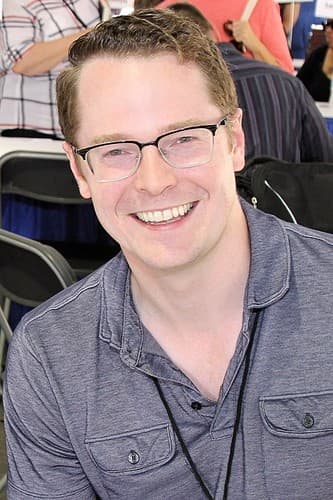
Robert Jackson Bennett is an American author known for his works of speculative fiction. His notable books include "City of Stairs," which explores themes of power and divinity in a richly built world, and "Foundryside," a tale of magic and technology set in a vibrant city. Bennett's writing often blends elements of mystery, fantasy, and adventure.
Similar books
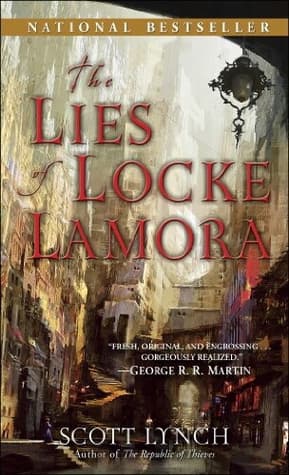
- The Lies of Locke Lamora
Scott Lynch
4.3 (222k) average on GoodreadsFantasyCenters around a clever thief in a richly imagined city with intricate schemes and betrayals.
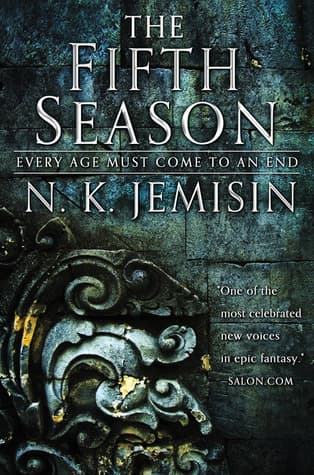
- The Fifth Season
N.K. Jemisin
Both explore unique magic systems, oppression, and societal power. Jemisin's 'orogenes' face direct societal prejudice, similar to the controlled scriving in 'Foundryside'. However, Jemisin's narrative is more experimental and her thematic exploration of trauma and systemic racism is more explicit and emotionally devastating, while 'Foundryside' focuses on the mechanics of power and rebellion within a capitalist-like framework.
- Harry Potter and the Sorcerer's Stone
J.K. Rowling
4.5 (7M) average on GoodreadsFantasyRescued from a miserable life under the stairs, an orphaned boy discovers he's a wizard destined for a magical school, where he uncovers a dangerous secret tied to the dark wizard who murdered his parents.
- The Hunger Games
Suzanne Collins
4.3 (6.4M) average on GoodreadsFantasyIn a future where children fight to the death on live television, Katniss Everdeen volunteers for the arena, turning a death sentence into a fight for survival and a spark of rebellion.
- 1984
George Orwell
4.2 (3.1M) average on GoodreadsPoliticsIn a future where surveillance and thought control are absolute, a man's search for truth clashes with the Party, showing that hope can be a form of rebellion.
- Divergent
Veronica Roth
4.2 (2.9M) average on GoodreadsFantasyIn a society divided by virtues, a sixteen-year-old's difference from the norm starts a rebellion that threatens her world.




Enjoyed the summary?
A summary gives you the shape of the book. The book itself has the detail, the examples and the voice.
Find Foundryside on AmazonAs an Amazon Associate, BookBrief earns from qualifying purchases. How we're funded