
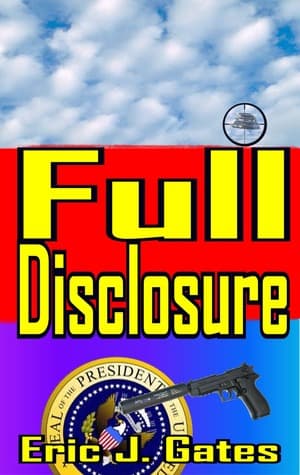
Synopsis
Covers the whole plot, including the ending.
- Difficulty
- Medium
- Pacing
- Fast
- Mood
- Suspenseful, Intense, Conspiratorial, Apocalyptic
- Read it if
- You enjoy high-stakes thrillers with government conspiracies, alien secrets, and a race against time.
- Skip it if
- You prefer character-driven dramas over plot-heavy action, or you're not a fan of alien invasion/first contact themes.
Full Disclosure Plot Summary
Covers the whole plot, including the ending.
The President's Ultimatum
President Thompson gathers his closest advisors, including Secretary of Defense General Maxwell and NSA Director Sarah Jensen, to inform them of his intention to make a full disclosure about the existence of extraterrestrial life. This revelation, kept secret for over sixty years, is based on evidence recovered from a crashed UFO near Roswell, New Mexico, in 1947. Thompson believes the public has a right to know, despite severe warnings from his advisors about potential global panic, economic collapse, and the destabilization of religious and political institutions. He has already set a timeline for the announcement, unsettling those around him who have spent their careers maintaining the secrecy.
Whispers in Copper Creek
In the remote, economically depressed town of Copper Creek, Arizona, Sheriff Ben Carter struggles to maintain order. The town, once a thriving mining community, is now slowly dying. Unbeknownst to its residents, their town sits atop a secret, long-abandoned military facility connected to the Roswell incident. Strange occurrences begin to surface in the area, including unusual electromagnetic interference and mysterious lights in the sky. Ben initially dismisses these as local oddities, but they are signs of the covert war about to erupt around them.
The Shadow Group's Awakening
News of President Thompson's impending announcement reaches 'The Directorate,' a deeply entrenched shadow government organization that has been guarding the alien secret for decades. Led by the enigmatic and ruthless 'Director,' they view Thompson's decision as an existential threat to global order and their own power. They immediately activate their vast network of operatives, both within and outside the government, to neutralize Thompson and anyone else who might aid in the disclosure. Their primary objective is to discredit the President, suppress all evidence, and maintain the status quo, setting the stage for a deadly confrontation.
Dr. Aris Thorne's Return
Dr. Aris Thorne, a reclusive astrophysicist ostracized from the scientific community years ago for his theories on extraterrestrial life, is suddenly approached by agents working for President Thompson. They reveal to him the true nature of the Roswell crash and the alien artifact, a device known as 'The Key,' which he had theorized about in his discredited papers. Thorne is brought into the fold to help interpret the alien technology and prepare the world for the disclosure, given his insights. He sees this as a chance for redemption, but also understands the immense danger involved in challenging the long-held secrecy.
The Attack on the White House
As President Thompson finalizes his plans for the disclosure, The Directorate launches a sophisticated and brutal attack on the White House. This is not just an assassination attempt but a coordinated effort to seize critical data and silence key personnel. Secret Service agents and military personnel loyal to Thompson engage in a fierce firefight, suffering heavy casualties. Thompson narrowly escapes the assault thanks to his security detail, but the attack sends a clear message: The Directorate will stop at nothing. This event escalates the conflict, turning a political struggle into an open, albeit covert, war.
Ben Carter's Discovery
Back in Copper Creek, Sheriff Ben Carter investigates a series of strange seismic tremors and unusual power fluctuations near the old mine. His investigation leads him to a long-sealed entrance to the abandoned military facility beneath the town. Inside, he discovers not just a relic of the Cold War, but evidence of advanced, non-terrestrial technology. He finds old files, photographs, and even a small, inert alien device, confirming the rumors and local legends. This discovery places him, and by extension Copper Creek, directly in the crosshairs of The Directorate, who are now aware of his intrusion.
The Key's Activation
Working under immense pressure in a highly secured, undisclosed location, Dr. Aris Thorne makes significant progress in understanding 'The Key,' the alien artifact from Roswell. He hypothesizes that it is not merely a communication device but a beacon or a key to activating a larger network or system. Through painstaking effort, he manages to activate a dormant function within the device. This activation sends out a powerful, unique signal, one that is not only detected by President Thompson's team but also immediately by The Directorate, and, more ominously, by something else far out in space.
Copper Creek Under Siege
The Directorate, having tracked the activated signal and learned of Ben Carter's discoveries, dispatches a highly trained paramilitary force to Copper Creek. Their mission is to secure the underground facility, eliminate any witnesses, and retrieve or destroy any alien technology. Ben Carter, realizing the gravity of his situation, rallies the town's residents, many of whom are ex-miners and veterans, to defend their home. What begins as a local sheriff's investigation quickly becomes a desperate battle for survival against a superior, ruthless enemy, with the fate of the alien secret hanging in the balance.
The President's Broadcast
With The Directorate's forces clashing with Ben Carter and the Copper Creek residents, and the world on the brink of chaos, President Thompson refuses to back down. He prepares for his global broadcast, determined to make the full disclosure regardless of the personal cost. He records his message, detailing the history of the secret, the evidence, and the implications for humanity. His team works tirelessly to ensure the broadcast will go out, knowing that The Directorate will do everything in its power to prevent it. The world waits, unaware of the battles raging behind the scenes.
The Arrival
As President Thompson's broadcast begins to air, and the battle in Copper Creek reaches its climax, the signal from Dr. Thorne's activated 'Key' reaches its intended destination. The response is swift and undeniable. A massive, previously undetected alien spacecraft appears in Earth's orbit, visible to everyone on the planet. Its arrival silences all conflict, all doubt, and all political maneuvering. The full disclosure is no longer just words from a President; it is an undeniable reality. Humanity's place in the universe is irrevocably changed by this visual confirmation of extraterrestrial intelligence, forever altering the course of history.
Principal Figures
President Thompson
Protagonist
The President determined to reveal the truth about alien life.
President Thompson is a principled and courageous leader, driven by a deep conviction that the public has a right to know the truth about extraterrestrial life. He is willing to risk his presidency, his life, and global stability to make the full disclosure. He possesses a strong moral compass and an unwavering resolve, often clashing with his more pragmatic and fearful advisors. His belief in humanity's capacity to adapt and grow underpins his controversial decision.
Relationships: General Maxwell (Advisor, initially opposed to disclosure); Sarah Jensen (Advisor, initially opposed to disclosure); Dr. Aris Thorne (Recruited for expertise, trusted ally)
Sheriff Ben Carter
Protagonist
A small-town sheriff who uncovers a global secret.
Ben Carter is the weary but resilient sheriff of Copper Creek, a dying town in Arizona. He is a man of integrity, deeply committed to his community and its few remaining residents. Initially focused on local issues, he is thrust into a global conspiracy when he stumbles upon evidence of alien technology beneath his town. He is resourceful, brave, and fiercely protective, embodying the spirit of the common person caught in extraordinary circumstances.
Relationships: Copper Creek Residents (Community leader and protector)
Dr. Aris Thorne
Supporting
A brilliant astrophysicist with unique insights into alien technology.
Dr. Aris Thorne is a highly intelligent but socially awkward astrophysicist, once disgraced for his unconventional theories on extraterrestrial life. He possesses a profound understanding of theoretical physics and alien technology, making him indispensable to President Thompson's disclosure efforts. Thorne is driven by intellectual curiosity and a desire for scientific validation, and he views the alien artifact as the ultimate proof of his life's work. He is courageous in his pursuit of knowledge, despite the personal risks.
Relationships: President Thompson (Recruiter and patron); General Maxwell (Colleague, often at odds over methods)
The Director
Antagonist
The enigmatic and ruthless head of The Directorate.
The Director is the shadowy, powerful leader of The Directorate, a clandestine organization dedicated to maintaining the alien secret at all costs. He is a master strategist, utterly ruthless, and believes that humanity is not ready for the truth, or perhaps that the truth would undermine his own power structure. His motivations are complex, rooted in a twisted sense of duty and control. He commands vast resources and operatives, operating outside the bounds of conventional law and morality.
Relationships: The Directorate Operatives (Commander)
General Maxwell
Supporting
Secretary of Defense, initially opposed to disclosure but ultimately loyal.
General Maxwell is the Secretary of Defense, a seasoned military man with a deep understanding of geopolitical stability. He is initially one of President Thompson's strongest opponents regarding the disclosure, fearing the catastrophic consequences of global panic and warfare. Despite his reservations, he is fiercely loyal to the President and the Constitution. He is pragmatic and strategic, offering crucial military and security advice throughout the crisis, even as his personal beliefs are challenged.
Relationships: President Thompson (Advisor and subordinate); Sarah Jensen (Colleague)
Sarah Jensen
Supporting
NSA Director, a brilliant analyst and Thompson's trusted advisor.
Sarah Jensen is the Director of the NSA, a brilliant intelligence analyst with a keen understanding of global information networks and threats. Like General Maxwell, she initially advises against President Thompson's disclosure, citing the immense security risks and potential for widespread chaos. However, she is also deeply loyal to the President and brings her vast intelligence resources to bear in protecting him and his mission. She is pragmatic, detail-oriented, and capable of quickly adapting to rapidly changing circumstances.
Relationships: President Thompson (Advisor and subordinate); General Maxwell (Colleague)
The Directorate Operatives
Antagonist
Highly trained agents working for The Directorate.
These operatives are the foot soldiers and enforcers of The Directorate. They are highly trained, disciplined, and utterly ruthless, operating with extreme prejudice to achieve their organization's goals. They are often former military or intelligence personnel, skilled in espionage, combat, and sabotage. Their loyalty is absolute, and they represent the physical threat against President Thompson, Dr. Thorne, Sheriff Carter, and anyone else who might expose the alien secret. They are largely anonymous, embodying the faceless power of the shadow government.
Relationships: The Director (Commander)
Copper Creek Residents
Supporting
The resilient community members of a dying Arizona town.
The residents of Copper Creek are a small, tight-knit community, hardened by economic hardship and the slow decline of their town. Many are former miners, veterans, or individuals who have chosen to live off the grid. They are initially skeptical of outsiders but fiercely loyal to each other and to Sheriff Ben Carter. When their town is threatened by The Directorate, they rise to the occasion, using their local knowledge and resourcefulness to defend their home and unknowingly, a global secret.
Relationships: Sheriff Ben Carter (Community members, loyal to their sheriff)
Themes & Insights
Truth vs. Secrecy
This is the central theme of 'Full Disclosure,' exploring the moral and ethical implications of withholding truths from the public. President Thompson's belief that humanity deserves to know about extraterrestrial life directly contrasts with The Directorate's conviction that the secret must be maintained for global stability, or for their own power. The narrative questions whether ignorance is bliss or a dangerous form of control, shown in the desperate struggle between Thompson's disclosure efforts and The Directorate's suppression tactics, such as the attack on the White House and the siege of Copper Creek.
“For over sixty years they kept a secret. The biggest secret in the history of Mankind.”
Humanity's Readiness for Change
The novel explores humanity's capacity to adapt to radical shifts in understanding its place in the universe. President Thompson believes humanity is ready, while The Directorate fears panic, religious upheaval, and societal collapse. The reactions of various characters, from the initial shock of Thompson's advisors to the resilience of the Copper Creek residents, illustrate different facets of this theme. The arrival of the alien spacecraft tests this readiness, forcing humanity to confront a new reality, regardless of prior preparations or fears.
“Should the public be told?”
Power and Control
The struggle for power and control is a pervasive theme, shown in the clandestine operations of The Directorate. This shadowy organization represents a deep-seated fear of losing control over information and, consequently, over global affairs. Their ruthless pursuit of President Thompson and their efforts to suppress the truth show how power can be used to manipulate societal narratives and maintain an established order, even if it means resorting to violence and deception. The conflict is not just about aliens, but about who decides what humanity knows and believes.
“He knew that the Directorate would stop at nothing to silence him.”
The Resilience of the Human Spirit
Despite the overwhelming odds and the power of The Directorate, characters like Sheriff Ben Carter and the residents of Copper Creek show remarkable resilience. Faced with a global conspiracy and a direct military threat, they rise to the occasion, fighting for their lives and their community. This theme is also evident in President Thompson's determination and Dr. Thorne's persistent pursuit of scientific truth, showing humanity's capacity for courage, self-sacrifice, and adaptation in the face of existential challenges. Their fight against a superior force emphasizes the strength found in unity and conviction.
“A dying town finds itself on the front lines of a covert war...”
Plot Devices & Literary Techniques
The MacGuffin: The Key
An alien artifact that serves as the central object of desire and conflict.
The Key is the alien artifact recovered from the Roswell crash, initially a dormant device whose true purpose is unknown. It serves as the primary MacGuffin, driving much of the plot. President Thompson needs it interpreted for his disclosure, Dr. Thorne is the only one who can activate it, and The Directorate wants to secure or destroy it to maintain secrecy. Its activation is a critical turning point, not only confirming alien existence but also directly leading to the dramatic arrival of the alien spacecraft, making it more than just a simple MacGuffin but also a catalyst for the climax.
The Shadow Government: The Directorate
A powerful, clandestine organization that operates outside official channels.
The Directorate functions as the primary antagonist, a classic shadow government trope. This organization has secretly controlled the alien narrative for decades, operating with immense resources and influence within global institutions. It provides a tangible, human antagonist against President Thompson's efforts, personifying the forces of secrecy and control. Its existence creates a constant sense of paranoia and high stakes, as its operatives can appear anywhere and its reach is seemingly limitless, making the covert war truly global.
The Unlikely Hero
An ordinary individual thrust into extraordinary circumstances.
Sheriff Ben Carter embodies the 'unlikely hero' trope. He is a small-town sheriff, initially concerned with local issues, who stumbles upon a secret far beyond his understanding. His character provides a relatable human element to the vast, global conspiracy. His transformation from a local lawman to a key defender of the truth, rallying his community against a powerful enemy, highlights the idea that heroism can emerge from unexpected places, reinforcing the theme of the resilience of the human spirit against overwhelming odds.
The Countdown
A ticking clock creating suspense and urgency.
The plot is driven by a clear countdown: President Thompson's set deadline for the full disclosure. This creates immense suspense and urgency, as every action taken by Thompson's team is against a ticking clock, and every counter-move by The Directorate is aimed at stopping the clock or disrupting the announcement before it can happen. This device ratchets up the tension, ensuring that the reader is constantly aware of the impending, irreversible event and the limited time available to both sides.
Full Disclosure Quotes
“The truth, like a good wine, needs time to breathe before it can be truly appreciated.”
“Every secret kept is a shadow cast, and shadows, no matter how small, can hide the biggest monsters.”
“You can't outrun your past, not when it's buried in the very ground you walk on.”
“Justice isn't always about what's legal; sometimes it's about what feels right, even if it breaks a few rules.”
“The most dangerous lies are the ones we tell ourselves, for they blind us to the truth that stares us in the face.”
“A perfect alibi is often the first sign of a very imperfect crime.”
“Sometimes, the quietest people hold the loudest secrets.”
“The past isn't just history; it's a living, breathing entity that can reach out and strangle the present.”
“In the game of truth, everyone eventually shows their hand, willingly or not.”
“Fear can make people do terrible things, but it can also make them confess to even worse.”
“The small details are never small when you're trying to piece together a shattered reality.”
“Every family has its skeletons, but some houses are built entirely on bone.”
“The greatest trick the devil ever pulled was convincing the world he didn't exist. The greatest trick a killer pulls is convincing you they're just like everyone else.”
“Closure isn't always a neat bow on a perfectly wrapped package; sometimes it's just learning to live with the knots.”
Quiz
10 questions on the plot and the characters. Each answer comes with a short explanation.
Question 1
What is the central 'secret' that has been kept for over sixty years in 'Full Disclosure'?
- The existence of a secret society controlling world governments.
- Proof of extraterrestrial life and contact.
- The true cause of World War II.
- A revolutionary energy source hidden from the public.
Show answer
B. Proof of extraterrestrial life and contact. The core premise of 'Full Disclosure' revolves around the President's decision to reveal the long-held secret of extraterrestrial life and contact, leading to global repercussions.
Question 2
What event prompts the President to consider making the 'Full Disclosure'?
- A sudden alien invasion.
- The discovery of new alien artifacts.
- A dying town finding itself on the front lines of a covert war.
- The revelation of a whistleblower.
Show answer
C. A dying town finding itself on the front lines of a covert war. The synopsis mentions that 'Now a dying town finds itself on the front lines of a covert war, when the President makes a Full Disclosure,' implying this escalating conflict is a catalyst for the President's decision.
Question 3
What kind of conflict does the dying town find itself embroiled in prior to the disclosure?
- An internal political struggle.
- A local gang war.
- A covert war.
- An environmental disaster.
Show answer
C. A covert war. The synopsis explicitly states, 'Now a dying town finds itself on the front lines of a covert war,' indicating the nature of the conflict.
Question 4
What is the primary ethical question explored by the thriller 'Full Disclosure'?
- Should governments be allowed to conduct secret experiments?
- Should the public be told the truth, no matter the consequences?
- Is it right to conceal advanced technology from the world?
- Are elected officials truly representative of their constituents?
Show answer
B. Should the public be told the truth, no matter the consequences? The book's description directly asks the question: 'Should the public be told?', highlighting the central ethical dilemma.
Question 5
How long has the 'biggest secret in the history of Mankind' been kept?
- Over one hundred years.
- Over sixty years.
- Over thirty years.
- Since the end of the Cold War.
Show answer
B. Over sixty years. The synopsis clearly states, 'For over sixty years they kept a secret. The biggest secret in the history of Mankind.'
Question 6
What genre is 'Full Disclosure' classified as?
- Science Fiction.
- Historical Fiction.
- Mystery/Thriller.
- Romance.
Show answer
C. Mystery/Thriller. The provided information explicitly states 'Mystery' and describes it as a 'nail-biting thriller.'
Question 7
What is the likely immediate global reaction to the President's 'Full Disclosure'?
- Universal celebration and scientific collaboration.
- A period of calm followed by slow integration.
- Widespread panic, societal breakdown, and geopolitical instability.
- Initial disbelief quickly overcome by rational acceptance.
Show answer
C. Widespread panic, societal breakdown, and geopolitical instability. Given the description as a 'nail-biting thriller' and the context of a 'covert war' preceding the disclosure, the revelation of such a monumental secret would most likely lead to chaos and instability, rather than peaceful acceptance.
Question 8
What role does the 'dying town' play in the narrative, based on the synopsis?
- It is the origin point of the sixty-year-old secret.
- It serves as the primary setting for the covert war that precedes the disclosure.
- Its population holds key information about the secret.
- It is a metaphor for humanity's declining state before the truth.
Show answer
B. It serves as the primary setting for the covert war that precedes the disclosure. The synopsis states, 'Now a dying town finds itself on the front lines of a covert war, when the President makes a Full Disclosure,' positioning the town as a central location for the conflict directly linked to the disclosure.
Question 9
How does the President's action of 'Full Disclosure' relate to the preceding 'covert war'?
- The disclosure is a tactic to win the covert war.
- The covert war is a direct result of the disclosure.
- The two events are completely unrelated.
- The covert war is an attempt to prevent the disclosure.
Show answer
A. The disclosure is a tactic to win the covert war. The phrasing 'when the President makes a Full Disclosure' immediately after describing the town on the front lines of a covert war suggests the disclosure is a response or strategic move within that conflict, rather than the cause of it.
Question 10
What is implied about the nature of the 'covert war' based on the secret being revealed?
- It is a struggle over natural resources.
- It is a conflict between factions related to the alien presence or the secret itself.
- It is a regional civil dispute.
- It is a war against a terrorist organization.
Show answer
B. It is a conflict between factions related to the alien presence or the secret itself. If the President's disclosure is about extraterrestrial life, and a covert war is happening concurrently, it strongly implies that the war is directly connected to the secret—perhaps between those who want to keep it and those who want to reveal it, or factions aligned with different alien interests.
Full Disclosure FAQ
What is the central premise of 'Full Disclosure'?
The core premise revolves around the President's decision to reveal a secret kept for over sixty years, the biggest in human history, to a dying town. This 'Full Disclosure' thrusts the small community onto the front lines of a covert war, forcing them to grapple with the implications of this monumental truth and the ensuing conflict.
Which town becomes the focal point for the President's disclosure, and why is it significant?
A dying, unnamed town finds itself at the center of the President's momentous announcement. Its significance lies in its seemingly unremarkable nature, making it an unexpected battleground for a covert war that erupts following the disclosure, highlighting how even isolated communities can be impacted by global events.
What kind of 'secret' is being disclosed, and what are its immediate consequences?
The secret is described as 'the biggest secret in the history of Mankind,' implying a revelation of profound, potentially alien or suppressed historical truth. Its immediate consequences are a covert war and a societal upheaval as the public grapples with the truth, challenging established norms and power structures.
Who are the primary factions involved in the 'covert war' that ensues after the disclosure?
While specific character names are not provided in the synopsis, the 'covert war' likely involves those who wish to suppress the truth and those who support the President's disclosure. This could include government agencies, shadowy organizations, and potentially even elements of the newly informed public.
What is the overarching moral question posed by the book?
The book directly asks: 'Should the public be told?' This central ethical dilemma explores the responsibilities of leadership, the public's right to know, and the potential societal chaos that could result from revealing a long-held, monumental truth, even if it's for the greater good.
How does the 'dying town' metaphorically connect to the secret being revealed?
The 'dying town' might symbolize a society or a way of life that is also 'dying' or unsustainable due to the weight of the hidden truth. The disclosure could be an attempt to revive or radically transform this dying societal structure, even if it means confronting harsh realities and facing significant challenges.
Are there any clues in the title 'Full Disclosure' about the nature of the secret?
The title 'Full Disclosure' strongly suggests that the secret is something that has been deliberately concealed and that the President's action is an intentional, complete reveal. It implies that the truth, whatever its nature, has been suppressed and is now being laid bare without reservation, even with potential risks.
How does the sixty-year duration of the secret impact its revelation?
The sixty-year duration implies that multiple generations have lived under a false pretense, and that the secret has been meticulously maintained across various administrations or power structures. This longevity would make its revelation incredibly disruptive, as it would challenge deeply ingrained beliefs and rewrite historical narratives for many people.
Does the book explore the psychological impact of living with such a massive secret for those who knew it?
Yes, it is highly probable the book delves into the psychological toll on those who were privy to the secret for decades. The burden of such a monumental lie, the fear of exposure, and the moral compromises made to maintain it would undoubtedly create immense internal conflict and stress for these characters.
How might the townspeople react psychologically to suddenly being at the center of a global conflict?
The townspeople would likely experience a range of intense psychological reactions, from disbelief and fear to anger and a sense of betrayal. Their prior sense of safety and insignificance would be shattered, replaced by paranoia, a struggle for survival, and potentially a rapid evolution of their worldview as they confront unprecedented realities.
What psychological factors might drive the President to make such a controversial disclosure?
The President's decision likely stems from a complex mix of moral conviction, a belief in the public's right to truth, or perhaps an assessment that the secret's continued concealment poses a greater long-term threat. It could also be driven by a desire for historical legacy or a profound sense of duty to rectify a historical wrong, despite the immense personal and political risks.
How does the book explore the psychology of belief and disbelief in the face of extraordinary evidence?
The narrative would likely feature characters who struggle to accept the disclosed truth, even with compelling evidence, due to cognitive dissonance or deeply ingrained worldviews. Conversely, others might readily embrace it, finding validation for long-held suspicions. This dynamic explores how individuals process and internalize information that fundamentally challenges their understanding of reality.
Is the 'covert war' primarily physical, or does it also involve a battle for public perception and truth?
Given the nature of a 'disclosure,' the covert war is almost certainly multifaceted. While physical conflict and espionage would be present, a significant portion would be a battle for public perception, a war of information and misinformation, as different factions attempt to control the narrative and influence public opinion regarding the revealed truth.
Does the book suggest that some truths are too dangerous for the public to handle?
The book's central question, 'Should the public be told?', directly invites this debate. It likely explores the arguments for and against withholding information, presenting scenarios where the truth might lead to chaos or, conversely, where continued deception is ultimately more damaging. The narrative will probably avoid a simple answer, allowing readers to ponder the implications.
Could the 'biggest secret in the history of Mankind' be interpreted metaphorically rather than literally?
While the synopsis implies a literal, monumental secret, it's possible to interpret 'biggest secret' metaphorically. It could represent a profound truth about human nature, societal structures, or even a suppressed historical event that, if revealed, would fundamentally alter humanity's self-perception, much like a literal alien contact or a hidden historical event.
How does the book's setting in a 'dying town' contribute to its themes?
The 'dying town' setting likely amplifies themes of vulnerability, forgotten communities, and the idea that even the most isolated places can be profoundly impacted by global events. It could also symbolize a society on the brink of collapse or radical change, making it a potent backdrop for a world-altering disclosure.
Does the book offer a definitive stance on whether the President's full disclosure was the right decision?
As a 'nail-biting thriller' that asks a deep question, it's improbable the book offers a simple, definitive answer. Instead, it likely presents the complex consequences of the President's actions, allowing readers to weigh the short-term chaos against the long-term implications of truth versus deception, thus fostering ongoing debate.
What role do individual ethical choices play in the narrative after the disclosure?
Individual ethical choices become paramount. Characters will be forced to decide whether to protect the truth, fight against it, exploit it, or simply survive its consequences. These choices will drive much of the personal conflict and moral dilemmas within the story, highlighting the impact of a global secret on personal integrity.
Similar books
- The Andromeda Strain
Michael Crichton
3.9 (223k) average on GoodreadsThrillerA scientific thriller about a covert government response to an unknown threat.
- Debt of Honor
Tom Clancy
4.0 (45k) average on GoodreadsThrillerCompared to Clancy's Debt of Honor, Full Disclosure focuses on a more intimate, character-driven conspiracy rather than a sprawling military-industrial complex. While Clancy excels in technical detail and large-scale geopolitical maneuvers, Gates prioritizes personal stakes and the uncovering of deeply buried secrets, making the narrative feel more immediate and character-oriented.
- The Bourne Identity
Robert Ludlum
4.0 (397k) average on GoodreadsThrillerSimilar to Ludlum's The Bourne Identity, Full Disclosure features a character (Dr. Aris Thorne) returning from a mysterious past to confront a shadowy organization. However, Full Disclosure distinguishes itself by positioning the conspiracy as a present and evolving threat rather than primarily a journey of self-discovery, emphasizing immediate danger and a more direct confrontation with the antagonists.
- Angels & Demons
Dan Brown
3.9 (2.7M) average on GoodreadsThrillerA Harvard symbologist races through Rome's ancient sites, deciphering cryptic clues to unmask the Illuminati and stop a vengeful plot to destroy the Vatican with a stolen antimatter weapon.
- Gone Girl
Gillian Flynn
4.1 (2.3M) average on GoodreadsThrillerA wife's sudden disappearance on her fifth anniversary reveals a web of lies and psychological warfare, exposing the secrets within a seemingly perfect marriage.
- The Girl on the Train
Paula Hawkins
3.9 (2.1M) average on GoodreadsThrillerA woman’s fascination with a seemingly perfect couple she watches from her daily train commute leads her into a dark investigation when she witnesses something that shatters their idyllic image.



Enjoyed the summary?
A summary gives you the shape of the book. The book itself has the detail, the examples and the voice.
Find Full Disclosure on AmazonAs an Amazon Associate, BookBrief earns from qualifying purchases. How we're funded