
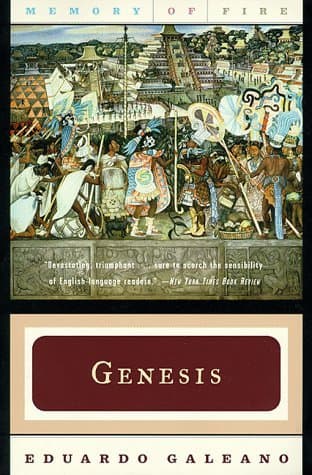
Synopsis
Covers the whole plot, including the ending.
- Difficulty
- Medium
- Pacing
- Variable
- Mood
- Thought-provoking, Poetic, Confrontational, Melancholy, Resilient
- Read it if
- You want a non-traditional, poetic, and politically engaged history of the Americas from a Latin American perspective, told through a series of captivating vignettes.
- Skip it if
- You are looking for a conventional narrative thriller, science fiction, or a strictly academic historical text with a linear plot and detailed analysis.
Genesis Plot Summary
Covers the whole plot, including the ending.
The First Morning
Galeano begins 'Genesis' by sharing many creation stories from different indigenous cultures across the Americas. These stories include the Mayan Popol Vuh, which describes humans made from corn, and myths from the Inuit, Aztec, and other tribes. Each offers a view on how the world, humanity, and the universe began. These stories often feature deities, animal spirits, and natural elements as key figures in shaping existence. A common theme is a deep respect for nature and a cyclical view of time, setting the stage for the rich cultures that existed before Europeans arrived. Galeano presents these myths as historical documents, highlighting the spiritual and philosophical depth of pre-Columbian societies.
The Arrival of the Strangers
The story changes sharply with Christopher Columbus's arrival in the Caribbean in 1492. Galeano details the first meetings between European explorers and the indigenous Taíno people. Columbus, seeking gold and to spread Christianity, misinterprets the Taíno's generosity as naivety and their lack of material wealth as a sign they are ready for control. European weapons were both a source of wonder and fear for the natives. This section shows the deep cultural clash and the damaging effect of European diseases, which quickly began to kill the indigenous population. This set a harsh pattern for centuries across the continent.
The Conquest of Tenochtitlán
Galeano describes Hernán Cortés's bold and brutal conquest of the Aztec Empire, led by Moctezuma II. The narrative details Cortés's alliances with unhappy indigenous tribes, his clever use of Malinche as an interpreter and advisor, and the eventual siege of Tenochtitlán. The clash of civilizations is clear: the advanced city planning and social structures of the Aztecs against the European desire for gold and religious fervor. The section ends with the destruction of Tenochtitlán, the killing of its people, and the systematic dismantling of a powerful empire. This marked a turning point in the history of Mesoamerica and the wider continent.
Potosí: The Mountain That Eats Men
The discovery of large silver deposits in Potosí, in what is now Bolivia, becomes a main focus. Galeano shows how this mountain of silver funded the Spanish Empire's wealth at a huge human cost. Indigenous workers, forced into the mita system, worked in terrible conditions in the mines, dying from disease, accidents, and exhaustion. The demand for silver led to forced community relocations and the exploitation of indigenous people. Potosí, once a busy and rich city, is presented as a symbol of colonial greed and the destructive power of resource extraction, draining the continent of its wealth and its people.
The Transatlantic Slave Trade
As indigenous populations decreased due to disease and forced labor, Europeans looked to Africa for enslaved labor. Galeano tells the story of the transatlantic slave trade, from the journey across the Middle Passage to the inhumane conditions on plantations in the Caribbean and Brazil. The narrative stresses the dehumanization of enslaved Africans, the destruction of their cultures, and the suffering they faced. Despite the oppression, stories of resistance, rebellions, and the lasting spirit of African traditions are also shared, showing the resilience of those subjected to this system.
The Jesuit Reductions
Galeano explores the experiment of the Jesuit Reductions in Paraguay. These missions, set up by Jesuit priests, aimed to create self-sufficient, communal societies for the Guaraní people, protecting them from Spanish and Portuguese slave raiders. The Reductions developed their own economies, education, and cultural mix, combining Christian teachings with Guaraní traditions. However, the narrative also touches on the paternalistic aspects of Jesuit rule and the destruction of these communities when the Jesuits were expelled from the Americas, leaving the Guaraní vulnerable again to colonial exploitation.
Revolts and Resistance
Throughout colonial rule, Galeano highlights many acts of resistance and rebellion. These include indigenous uprisings like Tupac Amaru II's in Peru, who led a rebellion against Spanish oppression, and many revolts by enslaved Africans. The narrative shows the courage and determination of those who fought back, often facing harsh retaliation. While many rebellions were put down, they represent a continuous fight for freedom and self-determination, showing that the spirit of resistance never fully died despite overwhelming odds.
The Birth of New Nations
The book moves into the era of independence, detailing the struggles of figures like Simón Bolívar and José de San Martín to free South America from Spanish rule, and the Mexican War of Independence. Galeano notes that these movements, while achieving political independence, often continued social and economic structures that oppressed indigenous peoples, Afro-descendants, and the poor. The narrative points out the irony that the new ruling elites, often criollos (descendants of Europeans born in the Americas), largely kept the colonial power dynamics. They simply replaced European monarchs with local strongmen and oligarchies, failing to bring true liberation for all.
The Scramble for Resources
After independence, Latin American nations became open to new foreign intervention, especially from Great Britain and later the United States. Galeano shows how these powers sought to control the region's natural resources – guano, nitrates, rubber, bananas, oil – through economic pressure, political manipulation, and military action. The narrative describes the creation of 'banana republics' and unfair trade agreements, ensuring that Latin America remained a supplier of raw materials to the industrialized world. This continued a cycle of dependence and slowed real development. This period shows the shift from direct colonial rule to neocolonialism.
The Age of Dictators
Galeano chronicles the frequent rise of authoritarian regimes and military dictatorships across Latin America throughout the 19th and 20th centuries. These strongmen, often backed by foreign interests or local elites, suppressed opposition, violated human rights, and held power through violence and corruption. The narrative exposes the devastating effect of these regimes on citizens, the silencing of opposition, and the lasting legacy of fear and instability. While specific dictators and their actions are mentioned, the broader theme is the cyclical nature of political oppression and the struggle for democracy in a continent marked by outside interference and internal power struggles.
Principal Figures
Eduardo Galeano (Narrator)
Narrator/Implied Author
The voice weaving together diverse historical narratives and myths.
Galeano himself is a pervasive presence in 'Genesis,' acting as the implicit narrator and compiler of histories. He is driven by a profound desire to reclaim and reframe the history of the Americas from an indigenous and Latin American perspective, challenging Eurocentric narratives. His voice is critical, empathetic, and poetic, seeking to give voice to the voiceless and expose the injustices of conquest and exploitation. He is a passionate advocate for historical memory and social justice.
Indigenous Peoples of the Americas
Collective Protagonist/Victim/Resistor
The diverse native inhabitants whose lands, cultures, and lives were irrevocably altered.
This collective 'character' represents the myriad of pre-Columbian societies, including the Taíno, Aztec, Inca, Maya, Guaraní, and countless others. They are portrayed as having rich cultures, complex social structures, and deep spiritual connections to their land. Initially depicted as generous and curious, they become the primary victims of European conquest, disease, and exploitation. Despite immense suffering, they are also shown as resilient, maintaining their traditions, and continually resisting oppression through various forms of rebellion and cultural preservation.
Relationships: European Colonizers (Victims of conquest and exploitation); Enslaved Africans (Shared experience of oppression and occasional solidarity)
Christopher Columbus
Antagonist/Catalyst
The European explorer whose arrival initiated the conquest of the Americas.
Columbus is depicted not as a heroic discoverer but as a harbinger of destruction. Driven by a blend of religious fervor, greed for gold, and ambition, he misinterprets the indigenous cultures he encounters, viewing them as ripe for subjugation and conversion. His actions set in motion the transatlantic slave trade, the decimation of indigenous populations, and the systematic exploitation of the continent. Galeano portrays him as a figure blinded by his own desires, incapable of understanding the profound humanity of the people he encountered.
Relationships: Indigenous Peoples of the Americas (Oppressor and exploiter)
Hernán Cortés
Antagonist
The Spanish conquistador responsible for the brutal fall of the Aztec Empire.
Cortés is portrayed as a cunning, ruthless, and ambitious military leader. He masterfully exploits divisions among indigenous groups, forms strategic alliances, and employs brutal tactics to achieve his goals. His conquest of Tenochtitlán is presented as a calculated act of destruction, driven by a thirst for power and wealth. He symbolizes the destructive force of European imperialism, demonstrating how military superiority, combined with political maneuvering, led to the overthrow of advanced indigenous civilizations.
Relationships: Moctezuma II (Conqueror of the Aztec emperor); Malinche (User of her linguistic and cultural knowledge); Indigenous Peoples of the Americas (Military conqueror and oppressor)
Moctezuma II
Supporting/Tragic Figure
The Aztec emperor who faced the impossible challenge of Cortés's invasion.
Moctezuma II is depicted as a complex and ultimately tragic figure. As the ruler of the powerful Aztec Empire, he initially attempts diplomacy with Cortés, perhaps viewing the Spaniards through the lens of Aztec prophecy. His indecision and attempts to appease the invaders ultimately prove fatal for his empire and his people. He embodies the shock and confusion experienced by indigenous leaders confronting an entirely alien and technologically superior force, struggling to comprehend their motives and intentions.
Relationships: Hernán Cortés (Opponent in conquest, ultimately betrayed and defeated)
Malinche (Malintzin)
Supporting/Ambiguous Figure
The indigenous woman who served as interpreter and advisor to Cortés.
Malinche is presented as a pivotal, yet ambiguous, figure in the conquest of Mexico. Sold into slavery as a child, her linguistic talents (Nahuatl and Mayan) and quick intellect made her indispensable to Cortés, as she learned Spanish and translated for him. Galeano acknowledges her agency in a difficult situation, but also highlights her role in facilitating the conquest, making her a controversial figure in Mexican history – seen by some as a traitor, by others as a survivor. She represents the complex choices and compromises forced upon indigenous individuals during the colonial era.
Relationships: Hernán Cortés (Interpreter, advisor, and mistress); Indigenous Peoples of the Americas (Bridge between cultures, but also implicated in their downfall)
Enslaved Africans
Collective Protagonist/Victim/Resistor
Millions of Africans forcibly transported to the Americas as forced labor.
This collective 'character' represents the immense population of Africans subjected to the transatlantic slave trade. They are portrayed as victims of unimaginable brutality, stripped of their freedom, culture, and humanity. Galeano details their suffering during the Middle Passage and on the plantations, emphasizing the systematic dehumanization they endured. Crucially, he also highlights their resilience, their preservation of cultural traditions, and their frequent acts of resistance, from individual defiance to organized rebellions, showing their unwavering struggle for dignity and freedom.
Relationships: European Colonizers (Victims of slavery and exploitation); Indigenous Peoples of the Americas (Shared experience of oppression and occasional solidarity)
Simón Bolívar
Supporting/Revolutionary
The 'Liberator' who led independence movements across South America.
Bolívar is presented as a key figure in the struggle for Latin American independence from Spain. A charismatic and visionary leader, he championed the ideal of a unified Gran Colombia. Galeano acknowledges his revolutionary spirit and military prowess but also hints at the complexities and limitations of the independence movements, which often failed to fundamentally alter the social hierarchies that oppressed indigenous peoples and Afro-descendants. Bolívar represents the ambition for self-determination but also the challenges of forging truly equitable post-colonial societies.
Relationships: Spanish Empire (Military opponent and liberator from colonial rule); Criollo Elites (Leader of a movement that largely benefited them)
The Land Itself (Pachamama)
Supporting/Symbolic
The natural environment of the Americas, worshipped and exploited.
The land, often referred to with indigenous reverence as Pachamama (Mother Earth), is a profound character in 'Genesis.' It is initially depicted as a source of life, spirituality, and sustenance for indigenous peoples, integral to their creation myths and way of life. With the arrival of Europeans, the land becomes a victim of insatiable exploitation – its gold, silver, timber, and fertile soil plundered. It symbolizes the immense wealth of the continent and the devastating cost of its extraction, serving as a silent witness to centuries of violence and environmental degradation.
Relationships: Indigenous Peoples of the Americas (Sacred provider and spiritual connection); European Colonizers (Object of exploitation and destruction)
Themes & Insights
The Violence of Conquest and Colonialism
This is the main theme, appearing in every chapter. Galeano details the physical, cultural, and spiritual harm done to indigenous peoples and enslaved Africans by European colonizers. From initial killings and forced labor in mines and plantations to the destruction of cultures and languages, the book shows the high cost of 'discovery.' The violence is not just physical; it also erases indigenous histories and replaces them with Eurocentric stories. Continued exploitation by neocolonial powers after independence highlights how this violence lasts.
“'The conquistadors, like the plague, were everywhere. The disease they brought was not just smallpox, but greed.'”
The Persistence of Indigenous Culture and Resistance
Despite great oppression and genocide, Galeano emphasizes the resilience and enduring spirit of indigenous cultures. He begins with their rich creation myths, establishing their spiritual and intellectual heritage. Throughout the narrative, he highlights acts of resistance – from individual defiance to large-scale rebellions like Tupac Amaru II's revolt. Even when outwardly suppressed, cultural traditions, languages, and spiritual beliefs continue, often subtly integrated or practiced in secret. This theme offers a different story to the common history of victimhood, celebrating the agency and survival of native peoples.
“'They tried to bury us, but they didn't know we were seeds.'”
The Betrayal of Independence and Neocolonialism
While Latin American nations gained political independence from Spain and Portugal, Galeano argues that true freedom remained out of reach. The theme explores how the new criollo elites often continued the same social and economic inequalities of the colonial era. It also details the rise of neocolonialism, where foreign powers (first Britain, then the United States) kept control over Latin America's resources and political systems through economic influence, military action, and support for authoritarian regimes. This cycle of dependence and exploitation meant the continent remained 'open' to the world, losing its wealth and potential.
“'The independence that was bought with blood was sold for gold.'”
The Interconnectedness of History and Memory
Galeano's project is an act of historical recovery, showing how past events shape the present. He combines myths, historical documents, personal accounts, and poetic observations to create a picture of memory. The book suggests that understanding the origins of exploitation, racism, and inequality in the Americas is necessary for addressing current injustices. By presenting a fragmented yet connected narrative, he shows that history is not a straight line but a cyclical process, with past events echoing in the present. This theme stresses the importance of remembering the 'other' history.
“'History never says goodbye. History says, 'See you later.''”
Plot Devices & Literary Techniques
Mosaic Narrative Structure
A fragmented, non-linear collection of short vignettes and historical accounts.
Galeano employs a mosaic narrative structure, presenting history not as a continuous, linear timeline but as a collection of hundreds of short, self-contained vignettes, anecdotes, myths, and historical facts. These fragments, often only a paragraph or a few sentences long, jump across time periods, geographical locations, and cultural perspectives. This device allows Galeano to cover vast stretches of history and numerous cultures without adhering to a single overarching plot. It mirrors the fragmented nature of memory and the diverse voices that make up the history of the Americas, encouraging the reader to connect the dots and draw their own conclusions about the patterns of power and oppression.
Poetic Prose and Lyrical Language
The use of evocative, metaphorical, and often emotionally charged language.
Galeano's writing is characterized by its highly poetic and lyrical quality, blurring the lines between history and literature. He uses vivid imagery, metaphors, and a rhythmic cadence to bring historical events and figures to life. This device allows him to convey the emotional weight of historical suffering and injustice, making the facts more impactful and memorable. Instead of dry historical recounting, the poetic prose infuses the narrative with a sense of wonder, tragedy, and outrage, engaging the reader on an emotional as well as intellectual level and distinguishing 'Genesis' from conventional historical texts.
Counter-History/Revisionist History
Presenting history from the perspective of the marginalized and oppressed.
'Genesis' fundamentally functions as a counter-history or revisionist history. Instead of adhering to the dominant, Eurocentric narratives of 'discovery' and 'progress,' Galeano deliberately reclaims and foregrounds the perspectives of indigenous peoples, enslaved Africans, and the impoverished masses. This device challenges conventional heroes and villains, re-evaluating figures like Columbus and Cortés through the lens of their victims. By centering the voices and experiences of the marginalized, Galeano exposes the biases inherent in mainstream historical accounts and offers a radical reinterpretation of the making of the Americas, highlighting the suffering and resistance often omitted.
Irony and Juxtaposition
The use of stark contrasts and ironic observations to highlight historical injustices.
Galeano frequently employs irony and juxtaposition to underscore the absurdities and cruelties of history. He often places a lofty claim by a colonizer or conqueror immediately beside a brutal reality, or contrasts the beauty of indigenous cultures with the barbarity of their invaders. For example, he might describe the 'civilizing mission' of Europeans alongside their acts of torture and genocide. This device serves to expose hypocrisy, critique the justifications for conquest, and create a powerful emotional impact, forcing the reader to confront the inherent contradictions and moral failings within the historical record.
Genesis Quotes
“The gods play dice with the universe, but they also play blind man's bluff with our destinies.”
“Memory is a beast that devours the present, leaving only the ghosts of what was.”
“In the labyrinth of power, the only true guide is betrayal.”
“The future is not written; it is whispered into existence by the choices we make today.”
“Silence can be the loudest scream, if you know how to listen.”
“Every secret kept is a chain forged, binding us to the darkness we try to hide.”
“The line between madness and genius is often just a matter of perspective, or success.”
“We build our prisons with the bricks of our fears, and the keys are always within reach.”
“The truth is a weapon, and like all weapons, it can wound the wielder as much as the target.”
“Hope is a fragile seed, easily crushed, but capable of blooming in the harshest deserts.”
“To truly know a monster, you must first acknowledge the monster within yourself.”
“Technology promises liberation, but often delivers only more sophisticated chains.”
“The past is not dead; it is merely sleeping, waiting for the right moment to awaken and demand its due.”
“Love, even in its most twisted forms, is the engine that drives us to creation or destruction.”
Quiz
10 questions on the plot and the characters. Each answer comes with a short explanation.
Question 1
Which of the following best describes the primary focus of 'Genesis,' the first volume of Eduardo Galeano's 'Memory of Fire' trilogy?
- The industrialization and modernization of Latin American nations in the 20th century.
- Pre-Columbian creation myths and the initial European encounters with the Americas.
- The struggles for independence in various South American countries during the 19th century.
- The social and political impact of the Cold War on Central America.
Show answer
B. Pre-Columbian creation myths and the initial European encounters with the Americas. 'Genesis' primarily covers the period from pre-Columbian creation myths through the initial European voyages of discovery and conquest, setting the stage for the subsequent volumes.
Question 2
Galeano's 'Memory of Fire' trilogy is described as providing a unique historical perspective. From whose viewpoint is this history primarily recounted?
- A Eurocentric perspective, focusing on the achievements of European explorers.
- A Latin American eye view, challenging traditional narratives.
- An indigenous perspective, solely relying on oral traditions.
- An objective, academic perspective, devoid of personal interpretation.
Show answer
B. A Latin American eye view, challenging traditional narratives. The provided text explicitly states that the trilogy offers 'an outstanding Latin American eye view of the making of the New World,' distinguishing it from conventional histories.
Question 3
Which prominent literary figure is mentioned in a review alongside Galeano, highlighting his qualities as a satirist, realist, and historian?
- Jorge Luis Borges
- Isabel Allende
- Gabriel Garcia Marquez
- Carlos Fuentes
Show answer
C. Gabriel Garcia Marquez The Los Angeles Times review states that Galeano 'deserves mention alongside John Dos Passos, Bernard DeVoto, and Gabriel Garcia Marquez,' recognizing his diverse literary talents.
Question 4
The 'Memory of Fire' trilogy is characterized by its 'literary form' and 'political engagement.' How does 'Genesis' specifically embody this engagement in its treatment of early American history?
- By presenting a neutral, chronological account of events without bias.
- By emphasizing the scientific advancements made by European explorers.
- By reinterpreting historical events from the perspective of the colonized and marginalized.
- By focusing on the economic motivations behind the European conquest.
Show answer
C. By reinterpreting historical events from the perspective of the colonized and marginalized. Galeano's work, particularly 'Genesis,' is known for its political engagement by giving voice to the often-silenced perspectives of indigenous peoples and those affected by conquest, rather than a neutral or Eurocentric view.
Question 5
According to the provided description, what makes 'Genesis' (and the trilogy) an 'epic work of literary creation' as noted by the Washington Post?
- Its detailed analysis of architectural styles in pre-Columbian civilizations.
- Its comprehensive and imaginative retelling of the history of the Western Hemisphere.
- Its focus on the biographical details of every major historical figure.
- Its use of fictional characters to drive the narrative.
Show answer
B. Its comprehensive and imaginative retelling of the history of the Western Hemisphere. The Washington Post review describes it as 'an epic work of literary creation' that serves as a 'vindication of the wonders of the lands and people of Latin America,' suggesting a broad, imaginative, and comprehensive scope of history.
Question 6
The New York Times review states that 'Memory of Fire is devastating, triumphant... sure to scorch the sensibility of English-language readers.' What aspect of 'Genesis' would likely contribute to this 'scorching' effect?
- Its dry, academic tone and extensive use of footnotes.
- Its unvarnished portrayal of the violence and exploitation inherent in conquest.
- Its intricate scientific explanations of ancient astronomical observations.
- Its celebration of European technological superiority.
Show answer
B. Its unvarnished portrayal of the violence and exploitation inherent in conquest. Given the description of Galeano's work as politically engaged and offering a Latin American perspective, the 'scorching' effect likely comes from its unflinching depiction of the brutal realities of colonization and its impact, challenging comfortable narratives.
Question 7
Although the book description mentions 'pre-Columbian creation myths' and 'first European voyages,' it also briefly references the 'Age of Reagan.' How does the inclusion of the 'Age of Reagan' in the trilogy's overall scope inform our understanding of 'Genesis'?
- It suggests that 'Genesis' itself contains sections on 20th-century politics.
- It implies that the trilogy aims to connect historical origins to contemporary issues.
- It indicates a sharp shift in narrative style within 'Genesis' itself.
- It is a misstatement, as 'Genesis' only covers ancient history.
Show answer
B. It implies that the trilogy aims to connect historical origins to contemporary issues. While 'Genesis' covers the earliest period, the mention of the 'Age of Reagan' for the entire trilogy suggests a broader thematic goal: to trace the historical roots of Latin America's present-day realities, implying that even the earliest events in 'Genesis' are presented with this long view in mind.
Question 8
The Boston Globe states that 'Memory of Fire' 'will reveal to you the meaning of the New World as it was, and of the world as we have it now.' What core theme of 'Genesis' is highlighted by this statement?
- The triumph of technological progress over natural obstacles.
- The enduring legacy of foundational historical events on current societal structures.
- The cyclical nature of human conflict and resolution.
- The inevitable decline of ancient cultures in the face of modernity.
Show answer
B. The enduring legacy of foundational historical events on current societal structures. This quote emphasizes the trilogy's ability to connect the past ('the New World as it was') with the present ('the world as we have it now'), highlighting the theme of how initial conquests and cultural clashes explored in 'Genesis' continue to shape the contemporary world.
Question 9
Given the description of 'Genesis' as covering 'pre-Columbian creation myths,' which of the following types of narratives would most likely be found in its early chapters?
- Detailed accounts of early European colonial administration.
- Stories explaining the origins of the world and humanity from indigenous cultures.
- Biographies of the first European missionaries in the Americas.
- Economic analyses of trade routes before European arrival.
Show answer
B. Stories explaining the origins of the world and humanity from indigenous cultures. The explicit mention of 'pre-Columbian creation myths' indicates that the book would begin by exploring the foundational stories and worldviews of the indigenous peoples before the arrival of Europeans.
Question 10
The summary states 'here is 'nothing less than a unified history of the Western Hemisphere... recounted in vivid prose.'' Considering this, what challenge might Galeano have faced in crafting 'Genesis' that a conventional historian might avoid?
- Adhering strictly to a single, undisputed chronological timeline for all events.
- Synthesizing diverse and often conflicting indigenous and colonial accounts into a cohesive, narrative-driven history.
- Limiting the scope to only politically neutral events to avoid controversy.
- Focusing exclusively on economic data to provide an empirical foundation.
Show answer
B. Synthesizing diverse and often conflicting indigenous and colonial accounts into a cohesive, narrative-driven history. Crafting a 'unified history' from a 'Latin American eye view' and in 'vivid prose' means Galeano had to integrate a multitude of perspectives, including oral traditions, colonial records, and indigenous narratives, which often contradict each other, into a compelling and coherent story, a task often avoided by historians who prioritize strict empirical data over narrative synthesis.
Genesis FAQ
What is the overarching theme of 'Genesis' within the 'Memory of Fire' trilogy?
'Genesis' primarily explores the creation myths and early histories of the Americas, juxtaposing indigenous perspectives with the arrival and initial impact of European conquerors. It establishes the foundational narratives of both pre-Columbian civilizations and the violent birth of the colonial era, setting the stage for the subsequent volumes.
How does Galeano present the pre-Columbian creation myths?
Galeano weaves together various indigenous creation stories, from the Maya Popol Vuh to Andean cosmogonies, presenting them with reverence and detail. He highlights their poetic beauty, spiritual depth, and the intricate relationship between humans, nature, and the gods, often without Western filters or interpretations.
What key historical events are covered in 'Genesis' regarding the European arrival?
'Genesis' meticulously documents Christopher Columbus's voyages, the initial encounters with indigenous peoples, and the early stages of conquest by figures like Hernán Cortés and Francisco Pizarro. It focuses on the clash of cultures, the devastating impact of European diseases, and the brutal exploitation of resources and labor.
Who are some of the prominent indigenous figures whose stories are told?
The book features figures like Hatuey, a Taíno cacique who resisted the Spanish in Cuba, and Moctezuma II, the Aztec emperor who confronted Cortés. Galeano gives voice to these individuals, often through their own reported words or actions, portraying their resistance, wisdom, and tragic fates.
How does 'Genesis' challenge traditional Eurocentric historical narratives?
Galeano fundamentally reorients the historical lens, placing indigenous perspectives and experiences at the forefront. He critiques the 'discovery' narrative, exposing the violence and ethnocide inherent in the conquest, and emphasizes the rich, complex civilizations that existed long before European arrival, often through brief, poignant vignettes.
What is the significance of the 'floating islands' metaphor used in relation to Columbus's ships?
The 'floating islands' metaphor, often attributed to indigenous observations, encapsulates the profound otherness and alien nature of the European ships and their inhabitants. It highlights the vast cultural and technological gap, and the sense of wonder, fear, and misunderstanding from the perspective of the native peoples encountering something entirely new and inexplicable.
How does Galeano use 'micro-histories' or vignettes to build his narrative?
Galeano constructs the book as a mosaic of short, often paragraph-long, entries, each a self-contained story, quote, or observation. This fragmented style allows him to present multiple perspectives, voices, and events in quick succession, creating a kaleidoscopic and non-linear historical tapestry that resists a single dominant narrative.
Are there recurring symbols or motifs in 'Genesis' that connect different historical moments?
Yes, recurring motifs include the symbolism of gold (as a sacred element for indigenous cultures versus European greed), the image of the 'other' (how different groups perceive each other), and the omnipresent theme of fire, representing both creation and destruction. These threads subtly link seemingly disparate events and cultures throughout the narrative.
How does the book portray the psychological impact of conquest on both the conquerors and the conquered?
For the conquered, Galeano depicts profound trauma, loss of identity, spiritual devastation, and the psychological burden of slavery and cultural annihilation. For the conquerors, he subtly reveals the corrosive effects of unchecked greed, paranoia, and the moral compromises required to justify their atrocities, often through their own recorded words.
What psychological defense mechanisms are evident in the European chroniclers' accounts?
European chroniclers often employed rationalization, dehumanization, and projection to justify their actions. They frequently described indigenous peoples as 'savages' or 'pagans' to legitimize their enslavement and conversion, thereby alleviating their own guilt and reinforcing a perceived moral superiority.
How does 'Genesis' explore the concept of collective memory and trauma?
The book illustrates how historical events, particularly those of immense violence and injustice, are etched into the collective memory of a people, shaping their identity and worldview for generations. Galeano suggests that the trauma of conquest continues to resonate in Latin American societies, influencing contemporary realities.
What is the psychological effect of Galeano's non-linear, fragmented narrative style on the reader?
The fragmented style can evoke a sense of disorientation, mirroring the chaotic nature of the historical period. It forces the reader to actively synthesize information and perspectives, preventing passive consumption and encouraging a more empathetic and critical engagement with the complex and often brutal events described.
Is 'Genesis' considered historical fiction or a work of historical non-fiction?
It blurs the lines. While meticulously researched and based on historical documents, Galeano's poetic language, subjective selection of details, and narrative structure elevate it beyond traditional non-fiction. It's often described as a 'literary history' or 'epic poem of history,' blending factual rigor with artistic interpretation.
How does Galeano's use of direct quotes from historical figures contribute to his overall message?
By quoting directly from Columbus, Cortés, indigenous leaders, and various chroniclers, Galeano allows the historical actors to speak for themselves, often revealing their biases, intentions, and psychological states without explicit authorial commentary. This technique underscores the stark contrast between different worldviews and highlights the inherent contradictions of the conquest.
What is the implied argument about 'progress' in 'Genesis'?
Galeano implicitly challenges the Western notion of linear progress, suggesting that the European 'advancement' came at an immense cost: the destruction of vibrant cultures, ecological devastation, and the perpetuation of systemic injustice. He questions whether the 'New World' truly represented progress for its original inhabitants.
How does 'Genesis' lay the groundwork for understanding the later volumes of the 'Memory of Fire' trilogy?
'Genesis' establishes the fundamental themes of exploitation, resistance, cultural clash, and the enduring legacy of colonial violence that permeate the entire trilogy. It creates the historical and psychological foundation, allowing subsequent volumes to explore how these initial seeds of conflict and identity continue to shape the Americas through centuries.
To what extent does Galeano romanticize indigenous cultures in 'Genesis'?
While Galeano clearly sympathizes with indigenous peoples and celebrates their rich cultures, he generally avoids outright romanticization. He acknowledges their internal conflicts and complexities, but his primary focus is on restoring their humanity and dignity in the face of dehumanizing colonial narratives, rather than presenting them as utopian.
What is the significance of the book's title, 'Genesis'?
The title 'Genesis' is multifaceted. It refers to the origin stories of both the indigenous peoples and the 'New World' as conceived by Europeans. It also ironically alludes to a new beginning that, for many, was instead an ending, marking the violent genesis of a new, often brutal, continental history.
About the author
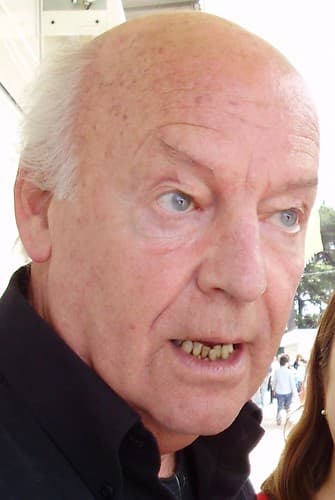
Eduardo Galeano was a Uruguayan writer and journalist known for his works that explore themes of history, politics, and identity in Latin America. His notable books include "Open Veins of Latin America," which examines colonialism and exploitation, "The Book of Embraces," a collection of reflections and stories, "Soccer in Sun and Shadow," which delves into the cultural significance of soccer, and "Genesis," a narrative that intertwines myth and history.
Similar books
- Open Veins of Latin America
Eduardo Galeano
4.3 (15k) average on GoodreadsPoliticsShares Galeano's critical perspective on Latin American history and exploitation.
- One Hundred Years of Solitude
Gabriel García Márquez
4.1 (753k) average on GoodreadsLiterary FictionFeatures a sweeping, multi-generational narrative style with magical realism, though 'Genesis' is non-fiction.
- A People's History of the United States
Howard Zinn
4.1 (192k) average on GoodreadsPoliticsOffers a counter-narrative to official histories, focusing on the marginalized and oppressed.
- Angels & Demons
Dan Brown
3.9 (2.7M) average on GoodreadsThrillerA Harvard symbologist races through Rome's ancient sites, deciphering cryptic clues to unmask the Illuminati and stop a vengeful plot to destroy the Vatican with a stolen antimatter weapon.
- Gone Girl
Gillian Flynn
4.1 (2.3M) average on GoodreadsThrillerA wife's sudden disappearance on her fifth anniversary reveals a web of lies and psychological warfare, exposing the secrets within a seemingly perfect marriage.
- The Girl on the Train
Paula Hawkins
3.9 (2.1M) average on GoodreadsThrillerA woman’s fascination with a seemingly perfect couple she watches from her daily train commute leads her into a dark investigation when she witnesses something that shatters their idyllic image.





Enjoyed the summary?
A summary gives you the shape of the book. The book itself has the detail, the examples and the voice.
Find Genesis on AmazonAs an Amazon Associate, BookBrief earns from qualifying purchases. How we're funded