
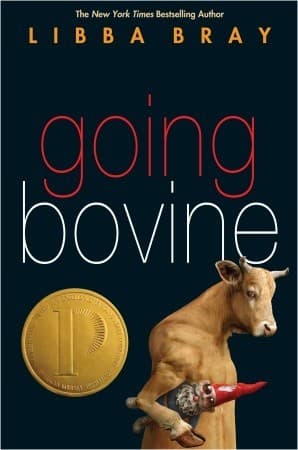
Synopsis
Covers the whole plot, including the ending.
- Difficulty
- Medium
- Pacing
- Variable
- Mood
- Surreal, Humorous, Philosophical, Quirky, Darkly Comic
- Read it if
- You enjoy quirky, philosophical road trips, absurd humor, and stories that challenge perceptions of reality and meaning.
- Skip it if
- You prefer realistic fiction, straightforward plots, or dislike surrealism and dark humor mixed with existential themes.
Going Bovine Plot Summary
Covers the whole plot, including the ending.
Cameron's Mundane Existence and Dire Diagnosis
Sixteen-year-old Cameron Smith goes through his suburban high school life in Texas, mostly unnoticed and unmotivated. His biggest concerns are avoiding his parents, dealing with his job at Burger Barn, and trying to impress Sarah. His world changes when he starts having strange hallucinations, including a talking yard gnome. He is then diagnosed with Bovine Spongiform Encephalopathy (BSE), or 'mad cow disease.' The doctors tell his parents it's a rare, untreatable human type, and he has only a short time to live. Cameron first denies it, then feels overwhelmed by the reality of his coming death, which ends his apathy.
Dulcie's Arrival and the Quest for a Cure
As Cameron deals with his diagnosis, he meets Dulcie, a whimsical, sugar-addicted punk angel with pink hair and old-fashioned clothes, who may or may not be a hallucination. Dulcie says Cameron's disease is a form of 'mad cow' but also a spiritual problem. She tells him there is a cure, but he must go on a quest to find 'The Wizard,' a mysterious figure who lives in the 'land of the dead.' The cure, she explains, is not a physical medicine but an understanding that will keep him from turning into a cow. Dulcie gives him a cryptic map and a 'magic' coffee cup, telling him to leave his ordinary life behind.
The Escape and the Alliance with Gonzo
Cameron, believing Dulcie's promise of a cure, escapes from the hospital where he's been watched. He steals his father's credit card and, with Dulcie's help, goes to a bus station. There, he meets Gonzo, a cynical, death-obsessed dwarf who plays an online role-playing game called 'The World of Warcraft.' Gonzo, at first suspicious, becomes interested in Cameron's story and Dulcie's presence (which he can also see, though he thinks she's Cameron's imagination). Gonzo agrees to go with Cameron on his quest, thinking it will be an interesting break from his own life and perhaps lead to some 'epic loot' or a good story for his game.
The Road Trip Begins: Surreal Encounters
Cameron and Gonzo start their road trip, hitchhiking and taking buses across a surreal, distorted version of America. Their journey is filled with strange encounters and challenges that test Cameron's sanity and determination. They meet conspiracy theorists who think cows secretly run the government, a cult that worships a giant hamburger, and an old man named Ted who thinks he is a chicken. These encounters, often started by Dulcie's unclear clues, confuse Cameron more, blurring the lines between reality and hallucination. Gonzo, always practical, tries to understand the chaos through his video game.
The Oracle of the Internet and the Yard Gnome's Return
Following Dulcie's vague directions, Cameron and Gonzo look for an 'Oracle' who can give them more help. They find the Oracle as a heavily tattooed, tech-savvy woman who runs a strange internet café. She gives them unclear advice through internet searches and a clue about a 'fire-breathing dragon.' During this part, the talking yard gnome, which Cameron first saw at home, appears again, giving humorous and often unhelpful comments. The gnome, named Gnome, becomes a regular, though unreliable, companion, making Cameron's journey more surreal and challenging his view of reality.
The Fire-Breathing Dragon and the Museum of the Dead
The search for the 'fire-breathing dragon' leads Cameron and Gonzo to a desolate, abandoned amusement park, which Dulcie says is important. They find that the 'dragon' is not a real beast, but a unique, art installation-like museum about death. Inside, they find exhibits exploring different cultural views on mortality. This experience makes Cameron face his own fear of dying and the meaning of his existence. The museum, though dark, offers a moment of reflection among their chaotic journey, hinting that the cure might be more philosophical than physical.
Dulcie's True Nature and the Approaching Destination
As they travel deeper into the 'land of the dead,' which looks like increasingly desolate and strange places, Dulcie starts to say more about herself. She hints at her own past failures and her role in guiding lost souls. Cameron begins to realize that Dulcie, though quirky, cares about his quest, and her presence is more than just a hallucination. Their bond grows, and Cameron starts to trust her more, despite her odd ways. The coming arrival at their final destination fills Cameron with both hope and fear, as the meaning of 'The Wizard' and the 'cure' remains unclear.
The Encounter with the Wizard
Cameron, Gonzo, and Dulcie finally reach the 'Land of the Dead,' which is a surreal, run-down carnival. There, they find 'The Wizard,' who is not a magical being but an ordinary, elderly man named Phil. Phil says he is a former scientist who experimented with consciousness and reality, accidentally creating the 'mad cow' spiritual problem. He explains that the 'cure' is not to stop the disease, but to choose to live fully and consciously, instead of just going through life. He offers Cameron a choice: to return to his ordinary life with a new perspective, or to embrace a higher form of existence, which may involve leaving his physical body.
The Choice and the Aftermath
Faced with Phil's choice, Cameron thinks about his journey, his past apathy, and his new understanding of life and death. He realizes that the quest was not about finding a magical cure for a physical disease, but about realizing how precious existence is. Cameron chooses to embrace the 'higher form of existence,' which is a spiritual change rather than a physical healing. In a moving moment, he leaves his physical body, becoming part of a larger consciousness. Gonzo, seeing this, is deeply affected, and Dulcie, having finished her mission, gently guides Cameron into his new state, leaving Gonzo to process the events.
Gonzo's New Path and Cameron's Legacy
After Cameron's transformation, Gonzo is left alone, changed by his journey with Cameron. He no longer sees the world only through his video game; he has experienced real adventure, friendship, and witnessed a spiritual change. Gonzo, carrying his experience, decides to keep traveling, perhaps looking for his own 'Wizard' or simply embracing life's unpredictable nature. The story ends with Gonzo thinking about Cameron's legacy, understanding that while Cameron's physical body may be gone, his spirit and the lessons learned live on, inspiring Gonzo to live a more meaningful life.
Going Bovine Characters
Cameron Smith
Protagonist
Apathetic teenager diagnosed with 'mad cow disease,' who embarks on a spiritual quest.
Cameron begins as a typical, unmotivated 16-year-old, drifting through life with a profound sense of apathy. He's an observer, not a participant, plagued by anxieties about his mundane future and a lack of connection. His terminal diagnosis of Bovine Spongiform Encephalopathy (BSE) forces him out of his complacency, initiating a journey of self-discovery. He is initially skeptical and often overwhelmed by the surreal events around him, but gradually develops courage, empathy, and a deeper understanding of life's meaning. His internal struggle between cynicism and hope is central to the narrative.
Relationships: Dulcie (spiritual guide and companion); Gonzo (unlikely road trip companion and friend); Sarah (unrequited crush, representing his former mundane desires)
Dulcie
Supporting
A punk rock angel (or hallucination) who guides Cameron on his quest for a cure.
Dulcie is a whimsical, sugar-addicted, pink-haired punk angel who appears to Cameron after his diagnosis. She is an enigmatic figure, possibly a hallucination, but her presence is consistent and impactful. Dulcie speaks in riddles, offers cryptic clues, and has a penchant for anachronistic fashion. She acts as Cameron's spiritual guide, pushing him out of his comfort zone and forcing him to confront deeper truths. Despite her lighthearted demeanor, she possesses ancient wisdom and a deep understanding of the spiritual nature of Cameron's affliction, having a mission to help lost souls find their way.
Relationships: Cameron Smith (spiritual guide to Cameron); Gonzo (fellow traveler, though she often teases him)
Gonzo
Supporting
A death-obsessed, video-gaming dwarf who becomes Cameron's road trip companion.
Gonzo is a cynical, pragmatic dwarf with a deep fascination for death and a passion for online role-playing games, particularly 'The World of Warcraft.' He initially joins Cameron's quest out of boredom and a desire for adventure, viewing the surreal journey through the lens of a video game. Despite his gruff exterior and morbid humor, Gonzo is fiercely loyal and surprisingly resourceful. He provides a grounded, albeit unconventional, counterpoint to Cameron's existential angst and Dulcie's spiritual pronouncements. His journey with Cameron profoundly changes his perspective on life and death.
Relationships: Cameron Smith (road trip companion and friend); Dulcie (fellow traveler, often the target of her playful jabs)
The Yard Gnome (Gnome)
Supporting
A talking, philosophical yard gnome who provides cryptic commentary.
The yard gnome, simply called Gnome, is one of Cameron's earliest and most persistent hallucinations. He is a small, ceramic garden gnome that comes to life, offering philosophical musings, sarcastic remarks, and often confusing insights. Gnome acts as a manifestation of Cameron's subconscious thoughts and anxieties, sometimes offering genuine wisdom, other times merely adding to the absurdity of the situation. He represents the blurring lines between reality and imagination in Cameron's deteriorating mental state, yet also serves as a quirky, constant companion.
Relationships: Cameron Smith (hallucination and internal commentator)
The Wizard (Phil)
Supporting
The enigmatic former scientist who holds the key to Cameron's 'cure.'
Phil, known as 'The Wizard,' is the ultimate destination of Cameron's quest. He is revealed to be an elderly, seemingly ordinary man, a former scientist who, through his experiments with consciousness, inadvertently created the spiritual 'mad cow disease.' He explains that the 'cure' is not a physical remedy but an understanding: a choice to live consciously and embrace life rather than merely exist. Phil serves as the wise mentor figure, providing the final piece of the puzzle for Cameron's spiritual transformation.
Relationships: Cameron Smith (enlightened guide and mentor)
Cameron's Parents
Mentioned
Well-meaning but overbearing and largely absent figures in Cameron's life.
Cameron's parents are typical suburban figures who are largely detached from his inner life. His mother is overly protective and prone to dramatic outbursts, while his father is often emotionally distant, focused on work. They represent the mundane, conventional world Cameron feels trapped in. Their reaction to his diagnosis is one of panic and helplessness, leading them to hospitalize him, which Cameron perceives as another form of confinement. They are symbols of the ordinary life Cameron must escape to find his true self.
Relationships: Cameron Smith (overbearing and somewhat distant parents)
Sarah
Mentioned
Cameron's unattainable crush, representing his former desires.
Sarah is a popular girl at Cameron's high school whom he has a crush on. She represents Cameron's prior, superficial desires and his longing for acceptance within the social hierarchy he disdains. After his diagnosis, his thoughts of Sarah dwindle, symbolizing his shift in priorities from mundane adolescent concerns to existential questions. She is more of a symbol than a character, highlighting Cameron's initial apathy and what he eventually leaves behind.
Relationships: Cameron Smith (unrequited crush)
Ted
Supporting
A confused old man who thinks he is a chicken.
Ted is a minor character Cameron and Gonzo encounter during their journey. He is an elderly man who genuinely believes he is a chicken and exhibits chicken-like behaviors. Ted is a manifestation of the absurdity and surrealism of Cameron's quest, highlighting the theme of identity and perception. He is a humorous, yet somewhat tragic, figure who further blurs the lines between reality and delusion for Cameron.
Relationships: Cameron Smith (brief, surreal encounter)
Going Bovine Themes
Identity and Self-Discovery
Cameron's journey is about finding out who he is beyond his ordinary life. His 'mad cow disease' is not just a physical problem but a metaphor for his spiritual apathy, his 'bovine' existence. Through his surreal quest, he leaves his old, unmotivated self and faces his fears and desires, choosing a conscious, engaged identity. This is clear in his change from a boy who just wants to 'get through life' to one who actively looks for meaning, ending with his choice to leave his physical form.
“The cure wasn't really a cure at all, not in the way I'd imagined. It was a choice. A choice to truly live, not just exist.”
Reality vs. Illusion
The novel often blurs the lines between what is real and what is a hallucination. Dulcie, the yard gnome, and many of the strange encounters could all be from Cameron's diseased brain. This uncertainty makes Cameron, and the reader, question the nature of reality itself. The 'Land of the Dead' and 'The Wizard' are not what they seem, challenging common ideas. This theme suggests that 'reality' is often subjective and that deep truths can be found even in what appears to be delusion, as Cameron's 'hallucinations' guide him to a cure.
“Was Dulcie real? Was Gonzo? Was any of it? Or was I just a kid with a brain disease, slowly losing my mind? And what was the difference, anyway, if it all led to the same place?”
Life, Death, and Meaning
Cameron's terminal diagnosis makes him face his own death, which he first avoids. The whole quest is a search for meaning when facing death. The encounters, from the death-obsessed Gonzo to the Museum of the Dead, make Cameron deal with life's temporary nature. The 'cure' from The Wizard is not an escape from death, but an understanding that gives life purpose, suggesting that truly living means accepting death and making conscious choices about how one spends their time.
“Death wasn't the end, but a door. And the cure wasn't to avoid the door, but to know how to walk through it.”
The Absurdity of Existence
Libba Bray fills the story with surrealism and dark humor, showing life's inherent absurdity, especially when dealing with something as illogical as 'mad cow disease' in a teenager. The strange characters (chicken-man Ted, the hamburger cult), the illogical plot, and Dulcie's whimsical nature all add to a sense of the absurd. This theme suggests that life doesn't always make rational sense, and sometimes the only way to navigate it is to embrace its strangeness and find meaning within the chaos, rather than trying to force logic onto it.
“The world was a broken toy, and I was just one of its many mismatched pieces, rattling around.”
Spiritual Awakening vs. Materialism
Cameron's journey rejects the materialistic and superficial parts of his suburban life. His parents' concerns are mostly practical (hospital bills, school), while Cameron's quest is spiritual. Dulcie and The Wizard guide him to understand that true fulfillment is beyond physical possessions or social status. The 'cure' is not a pill but a change in consciousness, stressing the importance of inner growth over external achievements. This theme critiques modern society's focus on the tangible, supporting a deeper, more spiritual connection to existence.
“You're not dying, Cameron. You're waking up. And sometimes, waking up is more terrifying than anything else.”
Plot Devices & Literary Techniques
The Road Trip Narrative
A traditional journey structure used to facilitate character development and surreal encounters.
The novel employs a classic road trip structure, where Cameron and Gonzo travel across America. This device allows for a series of episodic encounters with eccentric characters and bizarre situations, each contributing to Cameron's disorientation and eventual growth. The physical journey mirrors Cameron's internal transformation, with each 'stop' representing a step in his self-discovery. It provides a flexible framework for the narrative's blend of realism and surrealism, allowing the characters to move through various landscapes that symbolize different stages of Cameron's psychological and spiritual journey.
Magical Realism/Surrealism
The blending of realistic settings with fantastical and dreamlike elements.
Libba Bray heavily uses magical realism, where fantastical elements (talking yard gnomes, punk angels, a 'mad cow' spiritual affliction) are presented as normal within the realistic setting of contemporary America. This device blurs the lines between reality and hallucination, reflecting Cameron's deteriorating mental state while also suggesting that there's a deeper, more magical truth underlying the mundane world. It creates a dreamlike atmosphere that allows for profound philosophical exploration without being strictly fantasy, making the reader question what is truly 'real' alongside Cameron.
Metaphor of Bovine Spongiform Encephalopathy (BSE)
The disease as a symbol for apathy and unexamined existence.
Cameron's diagnosis of 'mad cow disease' is a central metaphor. It's not just a physical illness but a spiritual one, representing his past 'bovine' existence – passively drifting through life without thought or purpose. The 'cure' is not a physical remedy but an awakening, a choice to become 'un-cow-like' and live consciously. This device allows the author to explore themes of identity, free will, and the dangers of apathy, giving a literal illness a profound symbolic meaning that drives the entire plot and Cameron's character arc.
The Wise Fool/Trickster Archetype (Dulcie)
A seemingly illogical character who imparts profound wisdom.
Dulcie embodies the wise fool or trickster archetype. Despite her eccentricities, sugar addiction, and often nonsensical pronouncements, she is Cameron's primary guide and the source of crucial, albeit cryptic, wisdom. Her non-linear logic and playful demeanor mask a deep understanding of spiritual truths, allowing her to challenge Cameron's conventional thinking. This device prevents the spiritual guidance from becoming preachy, instead delivering profound insights through humor and absurdity, making the journey both entertaining and thought-provoking.
The Quest/Hero's Journey
A classic narrative structure where the protagonist embarks on a transformative journey.
The novel follows the archetypal Hero's Journey. Cameron, an ordinary teenager, receives a 'call to adventure' (his diagnosis and Dulcie's appearance), crosses the 'threshold' (escaping the hospital), and embarks on a perilous journey filled with trials, allies (Gonzo), and mentors (Dulcie, The Wizard). He ultimately undergoes a profound transformation ('resurrection' into a new state of being) and returns (or ascends) with a 'boon' (wisdom and enlightenment) for humanity. This structure provides a universal framework for Cameron's personal growth and spiritual awakening.
Going Bovine Quotes
“The best day of your life is the one on which you decide your life is your own. No apologies or excuses. No one to lean on, rely on, or blame. The gift is yours—it is an amazing journey—and you alone are responsible for the quality of it. This is the day your life really begins.”
“Maybe there aren't any such things as good friends or bad friends—maybe there are just friends, people who stand by you when you're hurt and who help you feel not so lonely. Maybe they're always worth being scared for, and hoping for, and living for.”
“Sometimes you have to be willing to die to live.”
“We're all just stories in the end. Make yours a good one.”
“The universe is a big place, and we're all just trying to find our way home.”
“You can't save the world if you can't save yourself.”
“Madness is a lot like gravity: all it takes is a little push.”
“Hope is the thing with feathers that perches in the soul and sings the tune without the words and never stops at all.”
“The only way to deal with an unfree world is to become so absolutely free that your very existence is an act of rebellion.”
“Life is a journey, not a destination.”
“We are all made of starstuff.”
“The world is full of magic things, patiently waiting for our senses to grow sharper.”
“You don't get to choose if you get hurt in this world, but you do have some say in who hurts you.”
“Sometimes the questions are complicated and the answers are simple.”
Quiz
10 questions on the plot and the characters. Each answer comes with a short explanation.
Question 1
What is the name of the punk angel who appears to Cameron and tells him about a possible cure?
- Gloria
- Dulcie
- Seraphina
- Ariel
Show answer
B. Dulcie Dulcie is the loopy punk angel who appears to Cameron after his diagnosis, claiming to be his guardian angel and telling him about a cure that requires him to embark on a quest.
Question 2
What disease is Cameron diagnosed with at the beginning of the book?
- Creutzfeldt-Jakob disease
- Leukemia
- Multiple sclerosis
- ALS
Show answer
A. Creutzfeldt-Jakob disease Cameron is diagnosed with Creutzfeldt-Jakob disease, a rare and fatal neurodegenerative disorder often referred to as 'mad cow disease' in humans, which ties into the book's title 'Going Bovine'.
Question 3
What is the name of the video-gaming dwarf who joins Cameron on his road trip?
- Balder
- Gonzo
- Ragnar
- Loki
Show answer
B. Gonzo Gonzo is a death-obsessed, video-gaming dwarf who becomes Cameron's loyal companion on the quest, providing both comic relief and emotional support throughout their journey.
Question 4
What object does Cameron's yard gnome companion turn out to be in reality?
- A Norse god trapped in gnome form
- A former scientist turned into a gnome
- A magical creature from another dimension
- Cameron's childhood toy come to life
Show answer
A. A Norse god trapped in gnome form The yard gnome, who Cameron names Balder, is actually the Norse god Balder who has been trapped in gnome form and joins the quest to regain his true form.
Question 5
What is the name of the mysterious corporation that Cameron believes is behind his illness and the destruction of the universe?
- Wizard Inc.
- The Powers That Be
- Dark Star Enterprises
- The Illuminati
Show answer
B. The Powers That Be The Powers That Be is the shadowy corporation that Cameron and his companions believe is responsible for spreading the disease and threatening reality itself, serving as the main antagonist force in their quest.
Question 6
What musical act does Cameron become obsessed with during his journey, believing their music holds clues to saving the universe?
- The Beatles
- Doctor X
- Radiohead
- The Rolling Stones
Show answer
B. Doctor X Cameron becomes fixated on the mysterious musician Doctor X, whose music he believes contains hidden messages about how to stop the destruction of the universe, leading the group to search for him.
Question 7
What recurring symbol appears throughout Cameron's journey that represents both his illness and the quest's purpose?
- A spiral
- A cross
- A circle
- A triangle
Show answer
A. A spiral The spiral appears repeatedly as a symbol throughout the book - in Cameron's visions, in Doctor X's music, and in various locations - representing both the degenerative nature of his disease and the winding path of his quest for meaning.
Question 8
What is the ultimate revelation about the nature of Cameron's journey and experiences?
- He was actually in a coma the entire time
- The entire quest was a hallucination during his final days
- He traveled to a parallel universe
- He was part of a government experiment
Show answer
B. The entire quest was a hallucination during his final days The book's ambiguous ending suggests that Cameron's entire epic quest - including Dulcie, Gonzo, Balder, and the fight against The Powers That Be - may have been an elaborate hallucination or dream sequence as he lay dying in the hospital, though this interpretation is left open to the reader.
Question 9
What philosophical concept is explored through Cameron's journey that questions the nature of reality and existence?
- Solipsism
- Nihilism
- Simulation theory
- The brain in a vat thought experiment
Show answer
D. The brain in a vat thought experiment The book engages with the 'brain in a vat' philosophical thought experiment, which questions whether we can know if our experiences correspond to reality or if they're artificially generated - mirroring the ambiguity about whether Cameron's journey is real or a dying brain's creation.
Question 10
What does Cameron ultimately realize he was searching for throughout his quest, beyond just a physical cure?
- Fame and recognition
- Romantic love
- Meaning, connection, and a reason to live
- Revenge against those who wronged him
Show answer
C. Meaning, connection, and a reason to live While the quest begins as a search for a physical cure, Cameron gradually realizes he's actually searching for meaning in his life, genuine human connection, and reasons to value existence - themes that develop through his relationships with Gonzo, Dulcie, and the people he meets.
Going Bovine FAQ
What is 'Going Bovine' about?
'Going Bovine' follows 16-year-old Cameron Smith, who is diagnosed with Creutzfeldt-Jakob disease (mad cow disease) and given a terminal prognosis. After a punk angel named Dulcie appears to him, he embarks on a surreal cross-country road trip with a hypochondriac dwarf named Gonzo and a yard gnome who claims to be the Norse god Balder, searching for a cure while confronting existential questions about life, death, and meaning.
Why should I read 'Going Bovine'?
This novel blends dark humor, philosophical depth, and fantastical adventure in a unique coming-of-age story. It tackles heavy themes like mortality and purpose through Cameron's irreverent voice and absurdist journey, offering both laugh-out-loud moments and poignant reflections on what makes life worth living.
What is the background/setting of 'Going Bovine'?
The story begins in Cameron's mundane suburban Texas life but quickly expands into a surreal, twisted version of America as he travels from Texas to Florida. Settings include a corrupt theme park, a New Orleans jazz club, a cult compound, and the mysterious 'CESSNAB' headquarters, all reflecting the novel's blend of reality and hallucination.
What are the most memorable quotes from 'Going Bovine'?
Key quotes include Cameron's cynical 'The best way to stay out of trouble is to not give a shit' and Dulcie's advice 'Sometimes you have to go through the dark to get to the light.' The novel's closing line, 'I am a part of all that I have met,' from Tennyson's 'Ulysses,' underscores its themes of connection and legacy.
What writing style does Libba Bray use in 'Going Bovine'?
Bray employs a first-person narrative from Cameron's perspective, mixing sarcastic, teenaged humor with lyrical introspection. The style shifts between realistic teen drama and absurdist fantasy, incorporating pop culture references, philosophical musings, and surreal imagery to mirror Cameron's mental and physical decline.
What minor details add significant meaning in 'Going Bovine'?
Small details like Cameron's obsession with 'The Starfighter' video game foreshadow his quest for heroism, while recurring references to Don Quixote highlight themes of delusion and idealism. The constant appearance of fire giants and smooth jazz music ties into the novel's critique of consumerism and conformity.
What are some subtle foreshadowing moments in 'Going Bovine'?
Early scenes where Cameron experiences muscle spasms and confusion hint at his Creutzfeldt-Jakob disease diagnosis. Dulcie's initial appearance as a possible hallucination sets up the ambiguity of the entire journey, and Gonzo's death-obsessed chatter foreshadows the novel's exploration of mortality and sacrifice.
What unexpected character connections exist in 'Going Bovine'?
The yard gnome, Balder, is revealed to be connected to Cameron's childhood memories and represents lost innocence. Gonzo's hypochondria mirrors Cameron's real illness, emphasizing their shared fears. Dulcie's true nature ties to Cameron's sister, Jenna, suggesting she may be a manifestation of his subconscious or a guardian angel.
What are unspoken character motivations in 'Going Bovine'?
Cameron's apathy masks a deep fear of insignificance and desire for connection, driving his quest for a cure. Gonjo's video-gaming and hypochondria stem from a need to control his anxiety about death. Dulcie's guidance may reflect Cameron's inner hope or a genuine supernatural intervention, left ambiguous.
What psychological complexities do characters exhibit in 'Going Bovine'?
Cameron grapples with denial, anger, and acceptance regarding his terminal illness, shown through his sarcastic humor and moments of vulnerability. Gonzo's obsessive behaviors reveal a coping mechanism for mortality fears, while Balder's delusions of godhood contrast with his role as a comic sidekick, highlighting themes of identity and reality.
What are the major emotional turning points in 'Going Bovine'?
Key moments include Cameron's diagnosis shattering his apathy, his bonding with Gonzo during their escape from the cult, the loss of Balder symbolizing sacrifice, and the final confrontation at the 'CESSNAB' headquarters where Cameron chooses to save others rather than solely seek a cure for himself.
How do relationship dynamics evolve in 'Going Bovine'?
Cameron and Gonzo start as reluctant allies but develop a deep friendship based on shared vulnerability. Cameron's strained relationship with his family, particularly his sister Jenna, gains warmth through flashbacks and Dulcie's connections. His interactions with Dulcie shift from skepticism to trust, mirroring his growth in embracing hope.
Which parts of 'Going Bovine' remain ambiguous or open-ended?
The reality of Dulcie and the entire road trip is left ambiguous—it could be a hallucination from Cameron's disease, a dream before death, or a genuine supernatural journey. The fate of characters like Gonzo and the true nature of the cure are also open to interpretation, emphasizing themes of perception and meaning.
What are controversial scenes or decisions in 'Going Bovine'?
Cameron's initial apathy and reckless behavior may frustrate readers, while the surreal, often absurdist plot elements (like talking gnomes and fire giants) divide opinions on their effectiveness. The ending's ambiguity about what is real challenges readers seeking clear resolutions, sparking debate over its message about life and death.
'Going Bovine' ending explained: how it ends & what it means
The novel ends with Cameron apparently dying in his hospital bed, but the epilogue suggests his journey had real impact through Gonzo's changed life and a message from Dulcie. This implies that whether the trip was real or imagined, it gave Cameron purpose and connection, symbolizing that meaning is found in experiences and relationships, not just survival.
About the author

Libba Bray is an American author known for her works of fiction, particularly in the young adult genre. Her notable books include "A Great and Terrible Beauty," "Rebel Angels," "Beauty Queens," "Going Bovine," and "Lair of Dreams," which often blend elements of fantasy, adventure, and social commentary. Bray's writing has garnered attention for its unique storytelling and engaging characters.
Similar books
- The Phantom Tollbooth
Norton Juster
4.2 (242k) average on GoodreadsFantasyExplores a fantastical world with wordplay and a quest that teaches life lessons, albeit for a younger audience.
- Looking for Alaska
John Green
4.0 (1.1M) average on GoodreadsMysteryGreen's novel, while also exploring adolescent angst, loss, and the search for meaning, is firmly rooted in realism. Unlike Going Bovine's fantastical journey, Looking for Alaska focuses on intellectual and emotional turmoil within a conventional high school setting, without any supernatural elements. Bray's work is more experimental in its narrative structure and use of genre.
- It's Kind of a Funny Story
Ned Vizzini
4.1 (211k) average on GoodreadsPsychologyVizzini's book offers a more direct and realistic portrayal of adolescent depression and the experience of being hospitalized in a psychiatric ward. While both books address mental health, It's Kind of a Funny Story is a grounded, often raw account of recovery, whereas Going Bovine uses an allegorical, fantastical quest to explore the internal landscape of a deteriorating mind, making Bray's approach far more abstract and less clinical.
- Harry Potter and the Sorcerer's Stone
J.K. Rowling
4.5 (7M) average on GoodreadsFantasyRescued from a miserable life under the stairs, an orphaned boy discovers he's a wizard destined for a magical school, where he uncovers a dangerous secret tied to the dark wizard who murdered his parents.
- The Hunger Games
Suzanne Collins
4.3 (6.4M) average on GoodreadsFantasyIn a future where children fight to the death on live television, Katniss Everdeen volunteers for the arena, turning a death sentence into a fight for survival and a spark of rebellion.
- 1984
George Orwell
4.2 (3.1M) average on GoodreadsPoliticsIn a future where surveillance and thought control are absolute, a man's search for truth clashes with the Party, showing that hope can be a form of rebellion.





Enjoyed the summary?
A summary gives you the shape of the book. The book itself has the detail, the examples and the voice.
Find Going Bovine on AmazonAs an Amazon Associate, BookBrief earns from qualifying purchases. How we're funded