
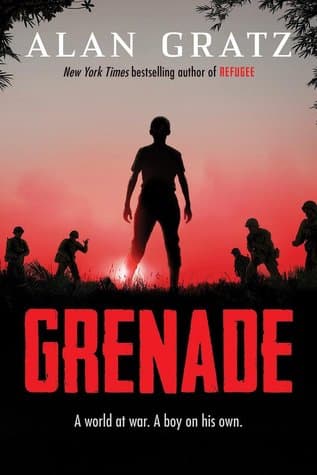
Synopsis
Covers the whole plot, including the ending.
- Difficulty
- Medium
- Pacing
- Fast
- Mood
- Intense, Gritty, Somber, Hopeful
- Read it if
- You enjoy intense, dual-perspective historical fiction that explores the human cost of war through the eyes of young combatants, particularly during WWII's Pacific theater.
- Skip it if
- You prefer less violent or emotionally challenging stories, or are looking for a lighthearted read.
Grenade Plot Summary
Covers the whole plot, including the ending.
Hideki's Ordinary Life Ends with a Call to Arms
In April 1945, twelve-year-old Hideki Kaneshiro lives a simple life in Okinawa, tending to his family's farm and caring for his younger sister, Kimiko. Life is relatively peaceful despite the distant rumble of war. This peace ends when American ships appear offshore, signaling an imminent invasion. The Japanese Imperial Army, already on the island, begins conscripting local Okinawan boys, including Hideki, into the 'Blood and Iron Student Corps.' He is given a uniform, a basic rifle, and two grenades, with strict orders to fight to the death and never surrender. His family, including his father and pregnant mother, are forced into a cave for shelter, leaving Hideki with a heavy heart and the terrifying burden of defending his homeland.
Ray's Arrival on Okinawa and the Horrors of War
Across the island, eighteen-year-old Private Ray Miller, an American Marine from Nebraska, lands on Okinawa with his unit. The initial landing is quiet, making Ray believe the Japanese have retreated. This illusion is quickly shattered by intense shelling and sniper fire. Ray sees the immediate, horrifying reality of war as his comrades are killed and wounded around him. He struggles with fear and the overwhelming chaos, trying to follow orders amidst the constant threat of death. His unit's objective is to push inland, clearing out Japanese resistance, but the terrain is difficult, and the enemy, though unseen, is everywhere.
Hideki's First Mission and the Weight of His Orders
Hideki, along with other conscripted Okinawan boys, is sent on a mission to find water for the Japanese soldiers. They are constantly threatened by American patrols and air raids. During this mission, Hideki has his first terrifying encounter with American soldiers. He is ordered to use one of his grenades to kill an enemy, but his fear and inexperience prevent him from acting. He sees his friend, Yoshio, bravely sacrifice himself with a grenade. This traumatizes Hideki and reinforces the Japanese military's brutal 'no surrender' ideology. The weight of his orders and the expectation to die for the Emperor press heavily on him, making him question his ability to fulfill his duty.
Ray's Unit Pushes Inland and Encounters Fierce Resistance
Ray's Marine unit pushes deeper into Okinawa, encountering increasingly fierce resistance. They face well-fortified Japanese positions, including hidden bunkers and caves. The fighting is brutal and hand-to-hand at times, with the Japanese soldiers often launching desperate Banzai charges and suicide attacks. Ray sees the psychological toll of the war on his fellow Marines, as exhaustion, fear, and trauma begin to wear them down. He struggles with seeing the enemy as less than human, trying to reconcile the orders to kill with the glimpses of humanity he sometimes sees in the Okinawan civilians caught in the crossfire.
Hideki's Search for His Family Amidst the Chaos
Overwhelmed by the horrors of war and the Japanese army's disregard for Okinawan lives, Hideki decides to abandon his assigned post and search for his family. He believes they are still sheltering in the cave where he left them. His journey across the island is dangerous, as he dodges both American and Japanese soldiers, who view him with suspicion or as unimportant. He sees the widespread devastation of his home island, with villages destroyed and civilians suffering greatly. This journey is a desperate race against time and the advancing American forces, as he tries to reunite with his loved ones, particularly his pregnant mother and young sister, Kimiko.
Ray's Desperate Search for Water and a Ceasefire
Ray's unit is pinned down by heavy Japanese fire, running critically low on water. The heat and constant combat take a severe toll, and dehydration is as dangerous as enemy bullets. Ray, along with his squad leader, is sent on a desperate mission to find a water source. During this search, they encounter a group of Okinawan civilians, including women and children, hiding in a cave. The encounter is tense, as both sides are wary, but the immediate need for water temporarily overrides the combat. Ray struggles with the moral ambiguity of the situation, recognizing the civilians' suffering even as they are caught between two warring armies.
Hideki's Discovery of His Family's Fate
After a dangerous journey, Hideki finally reaches the cave where he had left his family. His hope turns to despair when he finds the cave has been shelled. Inside, he discovers the bodies of his family members, including his father and his mother, who died during childbirth, holding her stillborn baby. His younger sister, Kimiko, is missing. Overcome with grief and a deep sense of loss, Hideki's resolve to fight for Japan shatters. His only remaining purpose is to find Kimiko, believing she might still be alive, and to somehow get revenge for his family, though the path to revenge is unclear.
The Fateful Encounter: Ray and Hideki Collide
Driven by grief and a desperate need for revenge after discovering his family's fate, Hideki, armed with his last grenade, stalks American soldiers. He sees Ray and his squad near a cave, believing them responsible for his family's death. Hideki ambushes them, throwing his grenade. The explosion injures Ray and kills some of his comrades. In the ensuing chaos, Ray, wounded and disoriented, manages to fire back, hitting Hideki. The two boys, one an American Marine and the other an Okinawan boy soldier, find themselves face-to-face, locked in a deadly struggle born of war and misunderstanding. The encounter is brutal and personal, a culmination of their separate journeys.
A Shared Moment of Humanity and a Difficult Choice
Wounded and disoriented from the grenade blast and subsequent gunfire, Ray and Hideki lie near each other. As Ray prepares to deliver a final, fatal blow, he notices a small, familiar object clutched in Hideki's hand: a hand-carved wooden horse, identical to one Ray had seen given to a child by an Okinawan woman earlier. This small detail, a symbol of childhood innocence and shared humanity, breaks through Ray's combat-hardened mindset. He sees Hideki not just as an enemy soldier, but as a boy, a victim of the same war. This realization forces Ray to hesitate, questioning the very nature of his mission and the enemy he has been trained to kill.
Survival and the Lingering Scars of War
In a moment of deep moral conflict, Ray chooses not to kill Hideki. He leaves Hideki wounded but alive, retreating as other Marines approach. Hideki, though gravely injured, manages to crawl away, his life spared. The war eventually ends, and both boys survive the Battle of Okinawa, though deeply scarred by their experiences. Ray returns home, haunted by the atrocities he witnessed and the choices he made. Hideki, having lost everything, rebuilds his life on a devastated Okinawa. Their brief, brutal encounter leaves an indelible mark on both. It shows the personal cost of war and the fragile thread of humanity that can persist even in the darkest of times.
Grenade Characters
Hideki Kaneshiro
Protagonist
A twelve-year-old Okinawan boy conscripted into the Japanese army.
Hideki is a gentle, introverted twelve-year-old Okinawan boy who loves his family and his island home. Before the war, he is focused on helping his father farm and caring for his younger sister, Kimiko. Conscripted into the 'Blood and Iron Student Corps,' he is forced to confront the horrors of war, given a rifle and grenades, and ordered to fight to the death. He struggles with fear, the brutality of the Japanese army, and the moral weight of killing. His primary motivation shifts from defending his homeland to finding and protecting his family, especially his missing sister, after he discovers his parents' tragic fate.
Relationships: Kimiko Kaneshiro (Younger sister, whom he deeply loves and searches for); Father (Respected patriarch, teaches him farming); Mother (Caring, pregnant mother); Yoshio (Friend and fellow student soldier, whose sacrifice deeply affects him); Ray Miller (American Marine he confronts in battle)
Ray Miller
Protagonist
An eighteen-year-old American Marine from Nebraska fighting on Okinawa.
Ray is an eighteen-year-old American Marine, initially idealistic and eager to serve, but quickly disillusioned by the brutal realities of war on Okinawa. He is a 'green' soldier, struggling with fear, the constant threat of death, and the moral complexities of combat. He comes from a farming background in Nebraska, a detail that subtly connects him to Hideki. Throughout the invasion, Ray witnesses immense suffering and the dehumanization of the enemy, which challenges his perceptions. He is driven by a desire to survive and protect his fellow Marines, but ultimately makes a choice that reflects his underlying humanity.
Relationships: Corporal (His squad leader, provides guidance and commands); Fellow Marines (Comrades in arms, shares the dangers of combat with them); Hideki Kaneshiro (Okinawan boy soldier he confronts in battle)
Kimiko Kaneshiro
Supporting
Hideki's younger sister, a symbol of innocence and hope.
Kimiko is Hideki's beloved younger sister. She is a small, playful child who represents the innocence and normal life that Hideki is fighting to protect. Her hand-carved wooden horse, a gift from Hideki, becomes a crucial symbol in the story, ultimately bridging the divide between Hideki and Ray. Her disappearance after the shelling of their family's cave drives Hideki's desperate search and gives him a purpose beyond the Japanese army's orders. She embodies the civilian victims of war and the hope for a future beyond the conflict.
Relationships: Hideki Kaneshiro (Older brother, her primary protector and caregiver); Father (Father); Mother (Mother)
Hideki's Father
Supporting
A traditional Okinawan farmer, Hideki's guide and provider.
Hideki's father is a hardworking Okinawan farmer, deeply connected to his land and family. He embodies traditional Okinawan values and tries to protect his family from the encroaching war. He teaches Hideki about farming and resilience. His death in the cave, along with Hideki's mother, is a significant turning point for Hideki, shattering his world and fueling his grief and desire for revenge. He represents the civilian population caught in the crossfire of the larger conflict.
Relationships: Hideki Kaneshiro (Son, whom he teaches and protects); Hideki's Mother (Wife); Kimiko Kaneshiro (Daughter)
Hideki's Mother
Supporting
Hideki's pregnant mother, a symbol of vulnerability and loss.
Hideki's mother is a caring and loving figure, pregnant with another child as the war descends upon Okinawa. She represents the extreme vulnerability of civilians, especially women and children, during wartime. Her tragic death in the cave, along with her stillborn baby, is a devastating blow to Hideki and a stark illustration of the war's indiscriminate cruelty. Her loss reinforces the novel's theme of the profound human cost of conflict.
Relationships: Hideki Kaneshiro (Son); Hideki's Father (Husband); Kimiko Kaneshiro (Daughter)
Yoshio
Supporting
A fellow Okinawan student soldier and Hideki's friend.
Yoshio is one of the Okinawan boys conscripted alongside Hideki into the Blood and Iron Student Corps. He is slightly older and perhaps more resigned to the Japanese military's indoctrination. Yoshio's act of self-sacrifice, using his grenade to attack American soldiers and dying in the process, deeply impacts Hideki. His death highlights the brutal 'no surrender' policy of the Japanese army and the tragic fate of many young Okinawan conscripts, forcing Hideki to confront the reality of dying for a cause.
Relationships: Hideki Kaneshiro (Friend and fellow student soldier)
Corporal (Ray's Squad Leader)
Supporting
Ray's experienced and pragmatic Marine squad leader.
The Corporal is Ray's direct superior in the Marine unit. He is a more experienced and hardened soldier, responsible for leading Ray's squad through the brutal fighting on Okinawa. He is pragmatic, focused on survival and completing the mission, and often gives Ray direct orders and guidance. While he embodies the tough, resilient nature of a combat veteran, he also shows moments of concern for his men. He represents the military authority and the immediate chain of command that Ray operates under.
Relationships: Ray Miller (His subordinate and a member of his squad)
Japanese Lieutenant
Supporting
A harsh Japanese officer who indoctrinates Hideki and other student soldiers.
The Japanese Lieutenant is a stern and unyielding officer in the Imperial Army. He is responsible for indoctrinating the Okinawan student soldiers, including Hideki, into the 'Blood and Iron Student Corps.' He instills the 'no surrender' philosophy and demands absolute loyalty and sacrifice for the Emperor. He views the Okinawans as expendable resources in the war effort, prioritizing military objectives over their lives. He represents the brutal and fanatical aspects of the Japanese military command during the Battle of Okinawa.
Relationships: Hideki Kaneshiro (His subordinate student soldier)
Grenade Themes
The Dehumanizing Nature of War
The novel clearly shows how war strips away individuality and creates hatred between combatants. Both Hideki and Ray are taught to see the 'other' as an enemy to be killed, not as fellow human beings. Hideki is called 'devil' by the Japanese soldiers for being Okinawan, and Ray is told the Japanese are 'animals.' This theme is strongly shown in the initial encounters, where both boys are ready to kill without knowing anything about each other, driven solely by propaganda and survival instinct. The climax, where Ray recognizes Hideki's humanity through the wooden horse, directly challenges this dehumanization.
“'Kill the devils!' the Japanese soldiers would shout, meaning the Americans. 'Kill the animals!' the Americans would shout back, meaning the Japanese. But Hideki knew, deep down, that they were all just people.”
Loss of Innocence and Childhood
Both Hideki and Ray, despite their age difference, are forced to grow up too quickly due to the war. Hideki, a twelve-year-old farm boy, is thrust into combat with a grenade and orders to die. His childhood is stolen by the harsh realities of fighting, seeing death, and losing his entire family. Ray, an eighteen-year-old, quickly loses his naive idealism about serving his country as he experiences the horrors of combat, the death of comrades, and the moral compromises required for survival. The novel shows how war robs children and young adults of their formative years and leaves them with deep psychological scars.
“Hideki was twelve, but he felt like he was a hundred. He'd seen things no one should ever see, done things no one should ever do.”
The Search for Family and Belonging
For Hideki, the quest to find his family, particularly his younger sister Kimiko, becomes his central driving force after the initial conscription. His love for his family goes beyond his forced loyalty to the Japanese army. This theme highlights the universal human need for connection and the devastating impact of war on familial bonds. Even for Ray, a sense of belonging to his unit and the desire to return to his family in Nebraska provides motivation amidst the chaos. The wooden horse, a gift from Hideki to Kimiko, symbolizes these deep familial ties and ultimately creates a moment of connection between the two protagonists.
“He wasn't fighting for the Emperor anymore. He was fighting for Kimiko. He was fighting to find his family.”
Moral Ambiguity and Difficult Choices
The novel consistently presents characters, particularly Ray, with morally complex situations where there are no easy answers. Ray struggles with the orders to kill an unseen enemy while encountering Okinawan civilians, including children. The climax, where Ray chooses not to kill a wounded Hideki, is the main example of this theme. Similarly, Hideki grapples with the Japanese army's 'no surrender' policy versus his innate desire to live and protect his family. The book avoids clear-cut heroes and villains, instead focusing on the difficult choices individuals make under extreme pressure.
“He had to kill this boy. It was his job. It was what he was here for. But as he looked at Hideki's face, he saw not an enemy, but just... a boy.”
Resilience and Survival
Despite the overwhelming odds and the constant threat of death, both Hideki and Ray show great resilience. Hideki endures starvation, fear, and the deep grief of losing his family, yet he continues to push forward in his search for Kimiko and ultimately chooses to survive. Ray, facing constant combat, dehydration, and the psychological toll of war, also perseveres. This theme shows the human will to live and adapt even in the most brutal circumstances, displaying the strength of the human spirit to endure and rebuild after devastation.
“He was just a boy, but he was still alive. And as long as he was alive, there was hope.”
Plot Devices & Literary Techniques
Dual Perspective Narrative
Alternating chapters between Hideki and Ray to offer contrasting viewpoints.
The novel employs a dual perspective, alternating chapters between Hideki, a twelve-year-old Okinawan boy conscripted into the Japanese army, and Ray, an eighteen-year-old American Marine. This device allows readers to experience the Battle of Okinawa from two opposing sides, fostering empathy for both protagonists. It highlights the shared fear, suffering, and dehumanization inherent in war, while also showcasing the cultural and personal motivations driving each character. This narrative structure builds tension towards their inevitable confrontation and provides a holistic view of the conflict's impact.
The Wooden Horse
A small, hand-carved toy symbolizing innocence and shared humanity.
The wooden horse is a significant symbolic object in the novel. Carved by Hideki for his younger sister, Kimiko, it represents family, childhood innocence, and the life that war is destroying. Ray first encounters a similar wooden horse given to an Okinawan child by a local woman, momentarily connecting him to the civilian population. When Ray later sees the identical horse clutched in a wounded Hideki's hand during their final confrontation, it acts as a powerful catalyst, allowing Ray to see Hideki not as an 'enemy' but as a boy, a brother, and a fellow human being, leading to his pivotal decision not to kill him.
The Grenade
A literal and symbolic object representing destruction, duty, and moral choice.
The grenade is central to the novel's title and its thematic core. For Hideki, it represents the brutal orders of the Japanese army – a tool for suicide attacks and a symbol of his forced duty to die for the Emperor. He carries two, one for the enemy, one for himself, embodying the 'no surrender' policy. For Ray, grenades are a weapon of the enemy, a constant threat. The final grenade thrown by Hideki, which wounds Ray, leads to their face-to-face confrontation. Ultimately, the grenade symbolizes the destructive power of war, but also the moral weight of using such power and the choices made in its presence.
The 'No Surrender' Doctrine
A pervasive Japanese military ideology driving Okinawan soldiers to fight to the death.
The 'no surrender' doctrine is a crucial plot device that shapes Hideki's actions and the overall brutality of the Battle of Okinawa. Imposed by the Japanese Imperial Army, it forces Okinawan conscripts and civilians to fight to the last man, commit suicide rather than be captured, and view surrender as a profound dishonor. This ideology leads to immense suffering for the Okinawan people and creates an intractable enemy for the American forces. It directly influences Hideki's initial reluctance to use his grenade and his eventual desertion when he realizes the futility and cruelty of this command, forcing him to choose survival over blind obedience.
Grenade Quotes
“War is a grenade. It doesn't care who it kills.”
“I am not a soldier. I am a boy with a gun.”
“Two grenades. One for the Americans, one for myself.”
“Sometimes the bravest thing you can do is not fight.”
“We are all just trying to survive.”
“The world had gone mad, and I was just a boy caught in the middle.”
“Every life has weight. Every death has meaning.”
“I didn't want to kill anyone. I just wanted to go home.”
“War makes monsters of us all.”
“There are no winners in war. Only survivors.”
“My grenade was my shame, and my salvation.”
“In the end, we are all just children of the same earth.”
“The hardest battles are fought inside.”
“I carried the weight of Okinawa on my shoulders.”
Quiz
10 questions on the plot and the characters. Each answer comes with a short explanation.
Question 1
What is Hideki given when he is drafted into the Blood and Iron Student Corps?
- A rifle and a helmet
- A grenade and instructions to kill an American soldier
- A map of Okinawa and a radio
- A sword and a Japanese flag
Show answer
B. A grenade and instructions to kill an American soldier When Hideki is conscripted into the Blood and Iron Student Corps, he is handed a grenade and told not to return until he has killed an American soldier, setting up his desperate mission.
Question 2
Where is Ray from and what is his role in the war?
- He is a British pilot fighting in Europe
- He is a Japanese soldier defending Okinawa
- He is an American Marine landing on Okinawa
- He is a civilian medic helping wounded soldiers
Show answer
C. He is an American Marine landing on Okinawa Ray is a young American Marine who has just landed on Okinawa as part of the U.S. invasion force, providing the American perspective in the battle.
Question 3
What major theme does the book explore through Hideki and Ray's experiences?
- The importance of military strategy in winning wars
- How fear can tear people apart and hope can bring them together
- The technological advancements of World War II
- The political causes of the Pacific War
Show answer
B. How fear can tear people apart and hope can bring them together The book's description emphasizes how fear divides people during war, while hope can unite them, a central theme illustrated through the parallel journeys of Hideki and Ray.
Question 4
What happens when Hideki and Ray finally encounter each other?
- They immediately fight to the death without hesitation
- Ray captures Hideki and takes him as a prisoner of war
- They make choices in that instant that change everything
- Hideki successfully uses his grenade to kill Ray
Show answer
C. They make choices in that instant that change everything The book's description states that when Hideki and Ray collide in battle, the choices they make in that moment will change everything, suggesting a pivotal, transformative encounter.
Question 5
Why is Hideki's mission particularly desperate and tragic?
- He is only a student with minimal training handed a grenade
- He is secretly working as a spy for the Americans
- He has a family waiting for him back in mainland Japan
- He is injured and cannot walk properly
Show answer
A. He is only a student with minimal training handed a grenade Hideki is just a student drafted into the Blood and Iron Student Corps, given a grenade with orders to kill an American—highlighting the desperation and tragedy of using children in war.
Question 6
What historical event serves as the backdrop for the novel?
- The attack on Pearl Harbor in 1941
- The Battle of Okinawa in 1945
- The D-Day invasion in Normandy
- The bombing of Hiroshima
Show answer
B. The Battle of Okinawa in 1945 The story is set in 1945 on Okinawa during the Battle of Okinawa, a major World War II campaign between American and Japanese forces.
Question 7
How does the author structure the narrative to build tension?
- By using flashbacks to before the war
- By alternating between Hideki and Ray's perspectives as they fight across the island
- By telling the story entirely from Ray's point of view
- By including letters from soldiers' families
Show answer
B. By alternating between Hideki and Ray's perspectives as they fight across the island The description mentions that Hideki and Ray each fight their way across the island, implying parallel narratives that converge, a common technique to build suspense and show both sides of the conflict.
Question 8
What does the title 'Grenade' symbolize in the context of the story?
- The explosive power of modern warfare
- The destructive choices forced upon young people in war
- A specific type of weapon used only by Japanese forces
- The grenade that Hideki uses to save his family
Show answer
B. The destructive choices forced upon young people in war The grenade Hideki is given represents the lethal burden and moral dilemma imposed on him as a child soldier, symbolizing how war forces devastating decisions onto the young.
Question 9
In what way does the book likely challenge simplistic views of 'enemy' soldiers?
- By showing that American soldiers are always heroic and Japanese soldiers are always villainous
- By depicting both Hideki and Ray as scared, young individuals caught in a war beyond their control
- By focusing only on the military tactics without character development
- By suggesting that Okinawans supported the Japanese army without question
Show answer
B. By depicting both Hideki and Ray as scared, young individuals caught in a war beyond their control By presenting dual perspectives of a Japanese student soldier and an American Marine, both portrayed as vulnerable and human, the book complicates black-and-white notions of enemies in war.
Question 10
Based on the description, what might be a key moment of irony or tragedy in the story?
- Hideki and Ray realizing they are both following orders that pit them against each other unnecessarily
- Ray discovering hidden treasure on Okinawa
- Hideki becoming a high-ranking officer in the Japanese army
- The war ending before any fighting occurs on Okinawa
Show answer
A. Hideki and Ray realizing they are both following orders that pit them against each other unnecessarily The setup of two young men forced into lethal conflict by their nations' orders, only to potentially recognize their shared humanity, underscores the tragic irony of war where individuals are pawns in larger conflicts.
Grenade FAQ
What is 'Grenade' by Alan Gratz about?
'Grenade' follows two teenage soldiers on opposite sides of the Battle of Okinawa in 1945. Hideki, a Japanese Okinawan boy, is forced into the Blood and Iron Student Corps with orders to kill an American soldier using a grenade. Ray, an American Marine, lands on Okinawa facing constant danger. Their parallel journeys culminate in a fateful encounter that forces them to confront the humanity of their enemy.
Why should I read 'Grenade'?
This book offers a gripping, dual-perspective look at the brutal Battle of Okinawa through the eyes of young soldiers, making complex historical events accessible and emotionally resonant. It explores themes of fear, hope, and moral choice in war, showing how ordinary people are caught in extraordinary circumstances. Alan Gratz's fast-paced storytelling keeps readers engaged while delivering powerful messages about the costs of conflict.
What is the background/setting of 'Grenade'?
The story is set during the Battle of Okinawa in 1945, one of WWII's bloodiest conflicts, which occurred on the Japanese island of Okinawa. This setting is crucial as Okinawans were caught between Japanese military forces and invading American troops, facing immense suffering and cultural tension. The island's terrain—with its caves, villages, and battlefields—becomes a character itself, shaping the characters' survival and decisions.
What are the most memorable quotes from 'Grenade'?
Key quotes include Hideki's internal conflict: 'The grenade was heavy in my hand. Not just the weight of the metal, but the weight of what I was supposed to do with it,' highlighting the moral burden of war. Another is Ray's realization: 'I came here to kill the enemy, but the enemy was just a kid like me,' underscoring the shared humanity between soldiers. These lines encapsulate the book's themes of fear, choice, and empathy.
What writing style does Alan Gratz use in 'Grenade'?
Gratz employs a fast-paced, alternating first-person narrative between Hideki and Ray, creating immediate tension and emotional depth. His prose is accessible yet vivid, blending historical detail with heart-pounding action scenes, such as ambushes and traps. This style mirrors the chaos of war while keeping the focus on the characters' inner struggles, making it engaging for young adult and adult readers alike.
What minor details add significant meaning in 'Grenade'?
Small details like the weight of Hideki's grenade symbolize the heavy moral choice he carries, while Ray's family photos remind him of the life he's fighting for. The Okinawan cultural elements, such as local traditions and language, highlight the island's unique identity caught in the war. These nuances enrich the story, showing how personal and cultural stakes amplify the conflict's impact.
What are some subtle foreshadowing moments in 'Grenade'?
Early scenes foreshadow the climax, such as Hideki's hesitation with his grenade hinting at his eventual refusal to kill. Ray's reflections on the 'enemy' being human subtly prepare for his encounter with Hideki. The recurring imagery of broken objects, like shattered homes, foreshadows the characters' fractured lives and the potential for rebuilding through empathy.
What unexpected character connections exist in 'Grenade'?
Beyond Hideki and Ray's direct collision, connections emerge through shared experiences of fear and loss, such as both characters witnessing civilian suffering. Minor characters, like Okinawan villagers or fellow soldiers, often mirror each other's struggles across sides, emphasizing that war affects everyone similarly. These links underscore the book's message that enemies are not so different after all.
What are unspoken character motivations in 'Grenade'?
Hideki is driven by a deep-seated fear of dishonoring his family and culture, not just following orders. Ray fights not out of hatred but from a desire to protect his comrades and return home, masking his own terror. Both characters are motivated by survival and a hidden hope for peace, which fuels their actions beyond the surface-level conflict.
What psychological complexities do characters exhibit in 'Grenade'?
Hideki grapples with loyalty to Japan versus his Okinawan identity, causing internal conflict as he questions violence. Ray experiences cognitive dissonance, seeing the 'enemy' as human while being trained to dehumanize them. These complexities show how war forces young soldiers into moral dilemmas, stripping away innocence and forcing rapid emotional maturation.
What are the major emotional turning points in 'Grenade'?
Key turning points include Hideki's decision not to use his grenade on Ray, marking a shift from fear to empathy. Ray's moment of recognizing Hideki as a scared kid, not just a target, transforms his perspective on the war. The aftermath of their encounter, where they part ways without violence, serves as a climax of hope amidst devastation.
How do relationship dynamics evolve in 'Grenade'?
Hideki's relationship with authority evolves from blind obedience to critical defiance, especially toward Japanese military figures. Ray's bond with his fellow Marines deepens through shared trauma, but his view of the 'enemy' shifts from hostility to understanding. The fleeting connection between Hideki and Ray, though brief, redefines both characters' approaches to conflict and humanity.
Which parts of 'Grenade' remain ambiguous or open-ended?
The fates of secondary characters, such as other students in the Blood and Iron Corps or Ray's Marine friends, are often left uncertain, reflecting war's randomness. The long-term impact of Hideki and Ray's encounter is implied but not detailed, leaving readers to ponder how this moment might shape their future lives. The broader resolution of the Battle of Okinawa is historical, but the personal endings are left nuanced.
What are controversial scenes or decisions in 'Grenade'?
Hideki's initial willingness to follow orders to kill an American sparks debate about coercion versus moral agency. Ray's internal conflict over killing 'the enemy' raises questions about the ethics of war and dehumanization. Some readers might find the portrayal of Japanese military actions or American invasion tactics contentious, as Gratz doesn't shy from showing brutality on both sides.
'Grenade' ending explained: how it ends & what it means
The story ends with Hideki and Ray choosing not to kill each other during their confrontation, instead parting ways alive. This symbolizes a rejection of violence and an affirmation of shared humanity, suggesting that hope can prevail even in war's darkest moments. It implies that personal choices can defy larger narratives of conflict, leaving a message about empathy and the possibility of peace.
About the author

Alan Gratz is a critically acclaimed author known for his gripping historical fiction for young readers. His notable works, including "Refugee," "Code of Honor," and "Grenade," often explore themes of resilience and survival against the backdrop of significant historical events. Gratz's engaging storytelling and meticulous research have earned him a dedicated readership and numerous accolades within the children's literature community.
Similar books
- Refugee
Alan Gratz
4.4 (84k) average on GoodreadsShares the same author and explores difficult historical events through multiple young protagonists' perspectives.
- Code Name Verity
Elizabeth Wein
4.0 (97k) average on GoodreadsHistorical FictionWhile both are WWII historical fiction for young adults, Wein's 'Code Name Verity' offers significantly more complex character development, a non-linear narrative, and a deeper exploration of psychological trauma and moral dilemmas. 'Grenade' is more direct and action-oriented, whereas 'Code Name Verity' delves into profound emotional and ethical ambiguities, making it suitable for a slightly older or more mature YA audience. Gratz prioritizes broad accessibility; Wein prioritizes intricate emotional and intellectual engagement.
- The Boy in the Striped Pajamas
John Boyne
4.2 (518k) average on GoodreadsChildren'sBoth novels use young protagonists to explore WWII atrocities. However, Boyne's 'The Boy in the Striped Pajamas' focuses on the Holocaust through a more allegorical and naive lens, often criticized for historical inaccuracies and an overly simplistic portrayal of such a complex horror. 'Grenade' provides a more direct and historically grounded, albeit still simplified, account of a specific battle. Gratz aims for factual engagement, while Boyne uses a more fable-like approach to explore themes of innocence and ignorance.
- Harry Potter and the Sorcerer's Stone
J.K. Rowling
4.5 (7M) average on GoodreadsFantasyRescued from a miserable life under the stairs, an orphaned boy discovers he's a wizard destined for a magical school, where he uncovers a dangerous secret tied to the dark wizard who murdered his parents.
- The Hobbit, or There and Back Again
J.R.R. Tolkien
4.3 (2.9M) average on GoodreadsFantasyA comfort-loving hobbit named Bilbo Baggins is whisked away by a mischievous wizard and a band of dwarves on an unexpected journey to reclaim stolen treasure from a fearsome dragon, discovering courage and a magical ring along the way.
- Harry Potter and the Goblet of Fire
J.K. Rowling
4.6 (2.6M) average on GoodreadsFantasyA bewildered Harry Potter, underage and thrust into a deadly Triwizard Tournament, must brave dragons, mermaids, and a resurgent dark magic to survive a year that will forever alter the wizarding world.





Enjoyed the summary?
A summary gives you the shape of the book. The book itself has the detail, the examples and the voice.
Find Grenade on AmazonAs an Amazon Associate, BookBrief earns from qualifying purchases. How we're funded