
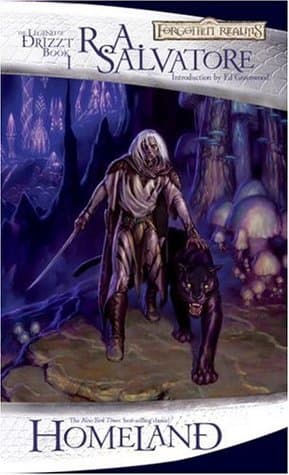
Synopsis
Covers the whole plot, including the ending.
- Difficulty
- Medium
- Pacing
- Moderate
- Mood
- Dark, Adventurous, Reflective, Action-packed
- Read it if
- You love classic fantasy origin stories, morally complex heroes, and detailed world-building in a dark setting.
- Skip it if
- You dislike lengthy descriptions of combat, morally gray characters, or dark fantasy themes.
Homeland Plot Summary
Covers the whole plot, including the ending.
Birth and the First Betrayal
Drizzt Do'Urden is born the third son of Matron Malice Do'Urden of House Do'Urden during a raid on House DeVir. His birth, at the same time his brother Dinin kills the House DeVir patriarch, means he should be sacrificed to Lolth as the third son. However, his eldest brother, Nalfein, dies in a magical fight with the House DeVir Matron, making Drizzt the second son. This saves Drizzt from sacrifice. His father, Zaknafein, a master weapons-master, takes an immediate interest in the child.
Early Years and Zaknafein's Influence
Drizzt spends his first sixteen years in the women's quarters, learning about drow society and Lolth worship. His mother, Matron Malice, and his sisters, Briza and Vierna, teach him. But his father, Zaknafein, truly shapes him, secretly teaching him combat and sharing his dislike for drow cruelty. Zaknafein sees Drizzt's goodness and encourages it, often challenging his son's views on drow life, hinting at a world beyond Menzoberranzan's rules. This secret teaching helps Drizzt develop his moral sense.
The Academy of Melee-Magthere
At sixteen, Drizzt begins training at Melee-Magthere, the academy for male drow warriors. He quickly proves to be an amazing fighter, better than his peers, including his brother Dinin. Despite his skill, Drizzt dislikes the academy's brutal lessons, which praise torture, lies, and violence. He argues with instructors and other students about their cruelty, especially when he refuses to torture surface elves during a training exercise. His actions anger the academy and his family, who see his compassion as weakness and a betrayal of drow ideals.
The Tainted Raid
During a raid on a surface elf village, a required part of Melee-Magthere training, Drizzt cannot kill an innocent elf child. He pretends to kill the child, leaving it alive. This act of mercy strengthens his inner conflict and his decision to reject his society's evil. His actions are questioned, but his skill keeps him from immediate exposure. The event troubles him deeply, making him question his place in a world that demands such barbarity and increasing his feeling of being an outsider from his family and culture.
Zaknafein's Sacrifice
Matron Malice, suspecting Drizzt's compassion and the threat he poses to the house's standing with Lolth, plans to sacrifice him. Zaknafein, seeing Drizzt's strong morals and knowing he cannot survive in drow society, steps in. To save Drizzt from his mother's anger and certain sacrifice, Zaknafein publicly challenges Malice's power and offers himself as a sacrifice to Lolth instead. This selfless act is a deep show of love. It further isolates Drizzt, giving him great guilt and a strong will to honor his father's memory by living with integrity.
The Wandering in the Underdark
Devastated by his father's sacrifice and unable to accept the drow way of life, Drizzt decides to leave Menzoberranzan. He goes into the dangerous Underdark, seeking a life free from Lolth's tyranny and his family's evil. His first journey is full of danger and loneliness, as he moves through the tunnels, meeting monsters and hostile drow patrols. During this time, he struggles with his identity, letting go of what he was expected to be and making his own path, guided by the morals his father taught him.
Encounter with Guenhwyvar
While wandering alone, Drizzt finds a figurine that summons Guenhwyvar, a magical black panther from the Astral Plane. Guenhwyvar becomes his constant companion and protector, a strong ally in the harsh Underdark. Their bond is instant and deep, giving Drizzt much-needed company and a sense of belonging. Guenhwyvar's presence shows Drizzt's connection to nature and his rejection of the drow's artificial, cruel world. It contrasts sharply with the betrayal and manipulation he experienced in Menzoberranzan.
The Pursuit of House Do'Urden
Drizzt's leaving is a serious insult to House Do'Urden, threatening their standing with Lolth. Matron Malice, angry at his betrayal, sends Dinin and Vierna to hunt him down and either bring him back or kill him. The chase is relentless, forcing Drizzt to constantly avoid his former family, who know the Underdark's dangers and his fighting style. These meetings are emotional, as Drizzt faces his family's twisted loyalty and evil. This further solidifies his decision to cut all ties with Menzoberranzan and fully embrace his individuality.
The Confrontation with Dinin
In a final fight, Drizzt faces his brother Dinin. Dinin, driven by Malice's orders and his own jealousy, tries to capture Drizzt. The battle is fierce, showing Drizzt's superior skill and his deep understanding of drow combat. Despite not wanting to hurt his own family, Drizzt must defend himself. He defeats Dinin but chooses not to kill him, leaving him wounded and shamed. This act of mercy further separates Drizzt from his drow heritage and shows his commitment to a moral code beyond Menzoberranzan's brutal laws.
Leaving the Underdark
After years of wandering and avoiding his family, Drizzt decides to leave the Underdark entirely and seek the surface world. He realizes that true freedom and a chance for a good life cannot be found in the oppressive darkness of his birthright. This decision ends his inner struggle with his drow heritage and starts a new chapter. With Guenhwyvar, Drizzt begins a dangerous ascent, leaving behind the only world he has known to find light and acceptance, an outcast but now truly free.
Homeland Characters
Drizzt Do'Urden
Protagonist
A drow ranger who rejects the evil of his society.
Drizzt is a drow, or dark elf, born into the cruel, matriarchal society of Menzoberranzan. Uniquely among his kin, Drizzt possesses an innate sense of morality, compassion, and justice, which clashes severely with the inherent evil of drow culture. He is a master swordsman, trained by his father, Zaknafein, and at the Melee-Magthere academy. His defining characteristic is his unwavering commitment to goodness, even when it means defying his family, his society, and risking his own life. He is introspective, thoughtful, and deeply sensitive, constantly questioning the world around him.
Relationships: Zaknafein Do'Urden (Father and mentor, shared moral compass, deep bond.); Matron Malice Do'Urden (Mother, tyrannical and manipulative, source of fear and conflict.); Dinin Do'Urden (Brother, jealous and cruel, rival and pursuer.); Vierna Do'Urden (Sister, devout and fanatical, initially a teacher, later a pursuer.); Guenhwyvar (Loyal magical panther companion and familiar.)
Zaknafein Do'Urden
Supporting
Drizzt's father and a master weapons-master, secretly a moral rebel.
Zaknafein is the Weapons Master of House Do'Urden and Drizzt's biological father. Though outwardly conforming to drow society, he secretly despises its cruelty and injustice. He is a brilliant and skilled fighter, but his true strength lies in his moral integrity and his ability to see beyond the dogma of Lolth. He becomes Drizzt's secret mentor, nurturing his son's unique goodness and teaching him not only combat skills but also a sense of honor and empathy. His ultimate act of self-sacrifice to save Drizzt defines his character and profoundly impacts Drizzt's journey.
Relationships: Drizzt Do'Urden (Son and protégé, deep bond, shared moral compass.); Matron Malice Do'Urden (Consort, abusive relationship, source of resentment.)
Matron Malice Do'Urden
Antagonist
The cruel and ambitious Matron Mother of House Do'Urden.
Matron Malice is the ruthless and cunning Matron Mother of House Do'Urden. She is a devout worshipper of Lolth, the Spider Queen, and embodies the worst aspects of drow society: ambition, cruelty, manipulation, and a hunger for power. She rules her house with an iron fist, constantly seeking to elevate its status through any means necessary, including murder and betrayal. She views Drizzt's compassion as a weakness and a threat to her house's standing, leading her to plot his sacrifice. Her unwavering devotion to Lolth and her cold pragmatism make her a formidable and terrifying antagonist.
Relationships: Drizzt Do'Urden (Son, viewed as a disappointment and a threat, target for sacrifice.); Zaknafein Do'Urden (Consort, used for his fighting prowess, sacrificed by her.); Dinin Do'Urden (Son, used as an enforcer and agent of her will.); Vierna Do'Urden (Daughter, devout follower, used to maintain house status.)
Dinin Do'Urden
Supporting
Drizzt's jealous and cruel elder brother.
Dinin is the second (later first) son of House Do'Urden, a skilled warrior but lacking Drizzt's innate talent. He is jealous of Drizzt's abilities and constantly seeks to prove his superiority. Dinin embodies the typical drow male: cruel, opportunistic, and subservient to the matrons. He delights in torture and violence, finding pleasure in the suffering of others. He actively participates in the pursuit of Drizzt after his defection, driven by both Malice's orders and his own personal vendetta against his younger brother.
Relationships: Drizzt Do'Urden (Brother, rival, and enemy.); Matron Malice Do'Urden (Mother, subservient to her will.); Zaknafein Do'Urden (Father, disrespected.)
Vierna Do'Urden
Supporting
Drizzt's older sister and a devout priestess of Lolth.
Vierna is one of Drizzt's elder sisters and a priestess of Lolth, deeply devoted to the Spider Queen's tenets. She initially serves as one of Drizzt's instructors in the ways of drow society, but her fanaticism and cruelty become increasingly apparent. While she possesses some affection for Drizzt, her loyalty to Lolth and House Do'Urden always takes precedence. She participates in the hunt for Drizzt, torn between her family duty and a lingering, albeit twisted, sense of sibling connection. Her character highlights the insidious hold of Lolth's religion on drow females.
Relationships: Drizzt Do'Urden (Brother, initially an instructor, later a hunter.); Matron Malice Do'Urden (Mother, devoutly loyal.)
Guenhwyvar
Supporting
A magical black panther familiar and Drizzt's loyal companion.
Guenhwyvar is a magical black panther from the Astral Plane, summoned by Drizzt's figurine of wondrous power. She is fiercely loyal, intelligent, and a powerful combatant, serving as Drizzt's constant companion and protector in the treacherous Underdark. Guenhwyvar represents Drizzt's connection to nature and his rejection of the drow's artificial, cruel world. Her presence provides Drizzt with much-needed companionship and unconditional acceptance, a stark contrast to the betrayal he experiences from his own kin. She is a silent but powerful force, a symbol of Drizzt's growing independence.
Relationships: Drizzt Do'Urden (Master and loyal companion, deep empathetic bond.)
Homeland Themes
Individuality vs. Society
This theme is central to Drizzt's journey, as he fights against the evil of drow society. His goodness and compassion go against the drow's worship of Lolth and their culture of cruelty, lies, and ambition. Drizzt's refusal to torture surface elves during his academy training, and his decision to leave Menzoberranzan, show his struggle to keep his own moral sense against pressure to conform. The entire story shows how one person can reject their destiny.
“For Drizzt Do'Urden, it was a world of black and white, and he was alone in the gray.”
Good vs. Evil
The conflict between good and evil is the main theme of 'Homeland.' Drizzt represents goodness, a clear contrast to the drow's evil and their goddess, Lolth. Every action Drizzt takes, from sparing the elf child to leaving Menzoberranzan, is a choice for good. Drow society, with its sacrifices, torture, and constant backstabbing, represents evil. Zaknafein's character also explores this, showing that even in an evil society, some can secretly hold goodness and sacrifice themselves for it. Drizzt's journey is about finding and accepting his own good nature.
“His world was not a world of light and shadow, but of good and evil, and the lines were drawn in blood.”
Family and Betrayal
Drizzt's family, House Do'Urden, shows the treachery and ambition of drow society. His birth itself involves a family coup and his eldest brother's death. Growing up, Drizzt faces betrayal from his mother, Matron Malice, who plots against him and sacrifices his father. His siblings, Dinin and Vierna, also betray him, hunting him to kill him. Only Zaknafein, Drizzt's father, shows true family love and loyalty through his self-sacrifice, making the other betrayals even more painful.
“A house of lies, built upon the bones of trust.”
Identity and Self-Discovery
Drizzt's journey is one of self-discovery. Born into a society that says he is an evil drow, he spends the novel figuring out who he really is. His inner conflict comes from the difference between his compassion and the cruelty expected of him. Through his training, his moral choices (like sparing the child), and his father's teaching, Drizzt slowly sheds the drow identity forced upon him. His decision to leave the Underdark is the ultimate act of self-definition. He chooses to create his own identity based on his values rather than his birthright, becoming the ranger he was meant to be.
“He was a drow, yes, but he was also Drizzt, and that was a difference he would not ignore.”
Plot Devices & Literary Techniques
Figurine of Wondrous Power (Onyx Panther)
A magical item that summons Guenhwyvar, Drizzt's panther companion.
This magical figurine serves as a crucial plot device, providing Drizzt with his most enduring companion, Guenhwyvar. When Drizzt is at his most isolated and vulnerable in the Underdark, the figurine allows him to summon a powerful and loyal ally. It symbolizes Drizzt's connection to a different, more natural world, contrasting with the artificiality and cruelty of drow magic. The figurine not only gives Drizzt a powerful combat partner but also a source of emotional support and unconditional acceptance, which is vital for his psychological survival.
Zaknafein's Sacrifice
The pivotal event where Drizzt's father sacrifices himself to save his son.
Zaknafein's sacrifice is the central turning point in Drizzt's life. It directly saves Drizzt from being sacrificed to Lolth by Matron Malice, but more importantly, it deeply solidifies Drizzt's resolve to reject drow society. This act of selfless love and moral integrity provides Drizzt with both immense guilt and a powerful motivation to honor his father's memory by living a life of goodness. It effectively severs Drizzt's last emotional tie to Menzoberranzan, making his eventual departure inevitable and providing the impetus for his long journey of self-discovery.
The Third Son Rule
A drow custom dictating the sacrifice of the third male child.
The 'third son rule' is introduced at the very beginning of the novel, immediately establishing the brutal and arbitrary nature of drow society. Drizzt's birth as a third son initially marks him for sacrifice, but the timely death of his eldest brother, Nalfein, elevates Drizzt to the second son, saving his life. This rule serves as an early example of the inherent cruelty of drow culture and establishes Drizzt's unique, almost fated, existence. It also highlights the precariousness of life in Menzoberranzan and foreshadows the constant threats Drizzt will face from his own family.
Homeland Quotes
“The greatest battles of life are fought within the mind.”
“Survival is not a matter of a single choice, but a series of choices.”
“Evil is not born, it is made.”
“A true warrior fights not because he hates what is in front of him, but because he loves what is behind him.”
“The darkness of the Underdark is not merely the absence of light, but a presence unto itself.”
“Prejudice is a disease of the mind, and it is a disease that can be cured.”
“Honor is not a gift, but a choice.”
“Sometimes, the only way to find your true path is to get lost.”
“The greatest strength of a people is not in their numbers, but in their unity.”
“A lie can travel halfway around the world while the truth is still putting on its shoes.”
“Fear is a powerful weapon, but it is also a double-edged sword.”
“To deny one's nature is to deny oneself.”
“The path of least resistance is often the path of regret.”
“Even in the deepest darkness, a single spark of light can ignite a fire.”
Quiz
10 questions on the plot and the characters. Each answer comes with a short explanation.
Question 1
What is the name of Drizzt Do'Urden's mother?
- Briza Do'Urden
- Malice Do'Urden
- Vierna Do'Urden
- Dinin Do'Urden
Show answer
B. Malice Do'Urden Malice Do'Urden is the Matron Mother of House Do'Urden and Drizzt's biological mother.
Question 2
Which House is House Do'Urden's primary rival at the beginning of 'Homeland'?
- House Oblodra
- House Baenre
- House DeVir
- House Hun'Ett
Show answer
C. House DeVir The novel opens with the battle between House Do'Urden and House DeVir, which leads to Drizzt's birth.
Question 3
Who is Drizzt's primary weapon master and instructor in the Melee-Magthere?
- Dinin Do'Urden
- Zaknafein Do'Urden
- Rizzen
- Alton DeVir
Show answer
B. Zaknafein Do'Urden Zaknafein is Drizzt's father and the weapon master of House Do'Urden, teaching Drizzt much of his combat skill.
Question 4
What is the name of the prestigious academy where male drow are trained in weapon craft and martial arts?
- Sorcere
- Arach-Tinilith
- Melee-Magthere
- Underdark Academy
Show answer
C. Melee-Magthere The Melee-Magthere is where all male drow nobles train to become warriors.
Question 5
Why is Drizzt initially spared from the traditional drow sacrifice of the third-born male?
- His father, Zaknafein, intervened directly.
- House Do'Urden's successful raid on House DeVir led to a different sacrifice.
- Matron Malice had a prophetic dream about him.
- He was mistakenly believed to be a female.
Show answer
B. House Do'Urden's successful raid on House DeVir led to a different sacrifice. Due to the raid on House DeVir being successful, the captured weapon master Alton DeVir was sacrificed to Lolth instead of Drizzt.
Question 6
What unique characteristic does Drizzt possess that sets him apart from most other drow, even as a child?
- He has a natural affinity for arcane magic.
- He can perfectly mimic the voices of others.
- He possesses a strong moral compass and compassion.
- He has unusually light-colored skin for a drow.
Show answer
C. He possesses a strong moral compass and compassion. From a young age, Drizzt displays an innate sense of justice and empathy, which is highly unusual and dangerous for a drow in Menzoberranzan.
Question 7
What is the name of the deep gnome (svirfneblin) community that Drizzt encounters and defends?
- Blindenstone
- Menzoberranzan
- Mithral Hall
- Blingdenstone
Show answer
D. Blingdenstone During his time in the Underdark after leaving Menzoberranzan, Drizzt encounters and aids the deep gnomes of Blingdenstone.
Question 8
What is the ultimate fate of Zaknafein Do'Urden in 'Homeland'?
- He escapes Menzoberranzan with Drizzt.
- He is sacrificed to Lolth by Matron Malice.
- He becomes the new weapon master of House Baenre.
- He is killed in a duel with Dinin Do'Urden.
Show answer
B. He is sacrificed to Lolth by Matron Malice. To appease Lolth after Drizzt's perceived transgression, and to maintain her house's favor, Matron Malice sacrifices Zaknafein.
Question 9
What is the primary reason Drizzt ultimately decides to leave Menzoberranzan?
- He is banished by Matron Malice for insubordination.
- He seeks to find a cure for a drow disease.
- He can no longer tolerate the evil and hypocrisy of drow society.
- He is ordered by Lolth in a vision to explore the surface world.
Show answer
C. He can no longer tolerate the evil and hypocrisy of drow society. Drizzt's moral compass constantly clashes with the inherent evil of drow society, leading him to choose exile rather than compromise his principles.
Question 10
Which of Drizzt's siblings is initially most tolerant and even somewhat protective of him, despite their drow nature?
- Briza Do'Urden
- Dinin Do'Urden
- Vierna Do'Urden
- Maya Do'Urden
Show answer
C. Vierna Do'Urden Vierna, Drizzt's older sister, shows moments of conflicted affection and protection towards him, especially during his early childhood and training.
Homeland FAQ
What is the primary setting and social structure of Menzoberranzan, where Drizzt is born?
Menzoberranzan is a vast underground city, home to the drow elves, a race of dark-skinned, white-haired elves devoted to the spider goddess Lolth. Its society is a ruthless matriarchy, where power is held by noble Houses, each vying for supremacy through assassination, intrigue, and ritual sacrifice, all under the watchful eye of Lolth's priestesses.
Who are Drizzt's immediate family members and what are their roles within House Do'Urden?
Drizzt's mother is Matron Malice Do'Urden, the ruthless head of the House and a high priestess of Lolth. His father is Zaknafein Do'Urden, the House's Weapon Master, a skilled warrior with a hidden disdain for drow society. He also has several older siblings, including the manipulative Dinin and the powerful Briza, both of whom hold significant positions within the House's hierarchy.
What unusual circumstances surround Drizzt's birth and how does it affect his early life?
Drizzt is born during the raid on House DeVir, an event that results in the sacrifice of his older brother, Nalfein, to Lolth. Due to this, Drizzt is technically the third son and should have been sacrificed himself, but his life is spared by Matron Malice, a secret kept from many. This early twist of fate sets him apart, even if he is unaware of it for some time.
How does Zaknafein influence Drizzt's development, particularly his fighting style and moral compass?
Zaknafein secretly trains Drizzt in the art of combat, teaching him an elegant, disciplined, and efficient fighting style that differs from the brutal drow norm. More importantly, Zaknafein instills in Drizzt a sense of honor, self-reflection, and a questioning of drow values, subtly guiding him towards a path of goodness despite his surroundings.
What is the significance of the Academy of Menzoberranzan and Drizzt's experiences there?
The Academy, specifically Melee-Magthere, is where drow males are trained in combat and drow ideology. Drizzt excels beyond his peers, often outperforming even his instructors due to Zaknafein's prior training. His time there further exposes him to the cruelty and corruption of drow society, solidifying his internal conflict and growing disillusionment.
What hidden detail about Zaknafein's past is hinted at, suggesting his true nature long before Drizzt discovers it?
Zaknafein's exceptional skill and his deep-seated cynicism about drow society hint at a past where he has seen or experienced the futility of drow evil firsthand. His disinterest in power and his mentorship of Drizzt suggest a long-standing internal rebellion against Lolth's dictates, a rebellion that he could not openly express.
How does Lolth's direct intervention manifest in the novel, and what does it reveal about her power and influence?
Lolth's influence is seen through the priestesses' magic and the fear she instills, but her most direct intervention is when she allows Zaknafein's spirit to be reanimated as a hideous Yochlol, or a drider, as punishment for his transgressions and to torment Drizzt. This act showcases her absolute control and her vengeful nature.
What is the subtle role of Guenhwyvar in Drizzt's early life, even before their formal bond?
Guenhwyvar, the magical panther, is initially a trophy of House Do'Urden, used by various drow for hunting or as a symbol of status. Even before Drizzt forms his bond with her, her presence as a creature of the surface world, albeit magically controlled, represents a connection to something wild and untamed, a foreshadowing of Drizzt's own destiny.
How do the events surrounding the surface elf raid and Dinin's actions serve as a turning point for Drizzt?
During a surface elf raid, Drizzt intentionally saves a young elven girl from Dinin's brutal attack, knowing it will expose his compassion and defy drow tenets. This act of mercy, witnessed by Zaknafein, confirms Drizzt's divergent path and ultimately leads to Zaknafein's self-sacrifice to protect Drizzt from Matron Malice's wrath.
Analyze Matron Malice's psychological state. Is she purely evil, or is there a hint of complex motivation beneath her cruelty?
Matron Malice embodies drow evil, driven by ambition and devotion to Lolth, but her actions are also rooted in a deep fear of losing her House's standing and her own power. Her constant paranoia and the extreme measures she takes to maintain control suggest a psychological burden, a constant struggle to prove her worth to a capricious goddess and a cutthroat society.
How does Drizzt's internal monologue reflect his developing moral conscience in a society that lacks one?
Drizzt's internal monologues are crucial, revealing his constant questioning of drow customs, his disgust at their cruelty, and his struggle to reconcile his innate goodness with his upbringing. He grapples with concepts of honor, mercy, and justice, often feeling isolated in his thoughts and beliefs, which sets him apart from every other drow.
Explore the psychological impact of Zaknafein's self-sacrifice on Drizzt's decision to leave Menzoberranzan.
Zaknafein's sacrifice profoundly traumatizes Drizzt, confirming the ultimate price of goodness in drow society and solidifying his conviction that he cannot remain. It fuels his grief, but also his resolve, becoming a driving force for him to escape the Underdark and honor his father's legacy by living a life of true purpose and morality, even if it means solitude.
How does the concept of 'destiny' vs. 'free will' play out in Drizzt's narrative, particularly regarding Lolth's influence?
Lolth's influence represents a form of dark destiny for all drow, dictating their evil nature. However, Drizzt's journey is a profound exercise in free will, as he actively chooses to defy this destiny, forging his own moral path despite immense societal and divine pressure. His struggle highlights the power of individual choice over predetermined evil.
To what extent is Drizzt's inherent goodness a product of nature vs. nurture in the context of Menzoberranzan?
While Drizzt's inherent goodness seems almost innate, a 'nature' that defies his race, Zaknafein's 'nurturing' through his teachings and example is critical. Without Zaknafein's guidance and validation, Drizzt might have succumbed to the overwhelming evil of drow society, suggesting a powerful interplay between his internal predisposition and external influence.
Is Zaknafein a truly good character, or is his goodness a relative concept within the context of drow society?
Zaknafein is presented as genuinely good, not merely 'less evil' than other drow. His actions, such as saving Drizzt from sacrifice and ultimately sacrificing himself, demonstrate a deep moral core that transcends drow relativism. His goodness is absolute, making him a true anomaly and a beacon for Drizzt in the darkness of Menzoberranzan.
Discuss the symbolism of the Underdark itself in 'Homeland.' What does it represent beyond a physical setting?
The Underdark, particularly Menzoberranzan, symbolizes moral and spiritual darkness, a place where light and goodness struggle to survive. It represents the oppressive nature of evil, the corrupting influence of power, and the profound isolation faced by those who dare to defy its norms. Its labyrinthine nature also reflects the tangled web of drow intrigue.
How does 'Homeland' challenge typical fantasy tropes about 'evil races' through Drizzt's character?
'Homeland' directly challenges the trope of monolithic evil races by presenting Drizzt, a drow, as a beacon of goodness and a protagonist. It argues that even within a race deemed inherently evil, individuals can choose a different path, highlighting the complexity of morality and the power of individual will over racial stereotypes.
What is the lingering impact of Drizzt's traumatic upbringing in Menzoberranzan on his character in later books?
Drizzt's upbringing leaves him with deep-seated trust issues, a constant struggle against prejudice, and a profound loneliness stemming from his rejection of his own kind. He carries the psychological scars of drow society, including a fear of succumbing to their ways, which continues to shape his decisions and relationships throughout his long life.
Could Drizzt have found happiness or acceptance if he had chosen to stay and try to change Menzoberranzan from within?
It is highly improbable Drizzt could have found happiness or successfully changed Menzoberranzan from within. The city's evil is systemic, divinely sanctioned by Lolth, and deeply ingrained in every aspect of its society. Any attempt to reform it would have resulted in his swift demise, as seen with Zaknafein, or his forced assimilation into its corrupt ways.
About the author

R.A. Salvatore is an American author primarily known for his fantasy novels. His notable works include "Homeland," "The Crystal Shard," "The Two Swords," and "The Highwayman," which often explore themes of adventure and heroism within richly developed worlds. Salvatore's writing is particularly associated with the Dungeons & Dragons universe and the Forgotten Realms setting.
Similar books
- The Hobbit, or There and Back Again
J.R.R. Tolkien
4.3 (2.9M) average on GoodreadsFantasyClassic fantasy origin story with a hero's journey against a dark world.
- A Wizard of Earthsea
Ursula K. Le Guin
4.0 (241k) average on GoodreadsFantasyWhile both are coming-of-age stories, Le Guin's work focuses more on internal growth through self-discovery and balance, with a more poetic and philosophical prose style, contrasting with Salvatore's direct, action-oriented approach and focus on societal corruption.
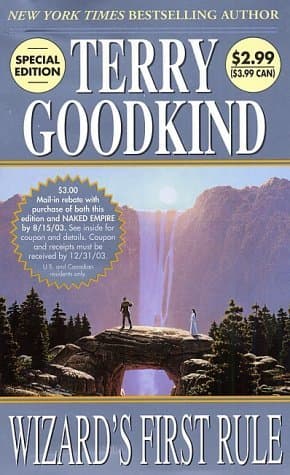
- Wizard's First Rule
Terry Goodkind
4.1 (229k) average on GoodreadsFantasyGoodkind also explores good vs. evil and individual choice, but often with a more overt philosophical lens, epic scope, and political intrigue. "Homeland" remains more tightly focused on Drizzt's personal rebellion against his heritage, rather than a broad political or world-saving quest.
- Harry Potter and the Sorcerer's Stone
J.K. Rowling
4.5 (7M) average on GoodreadsFantasyRescued from a miserable life under the stairs, an orphaned boy discovers he's a wizard destined for a magical school, where he uncovers a dangerous secret tied to the dark wizard who murdered his parents.
- The Hunger Games
Suzanne Collins
4.3 (6.4M) average on GoodreadsFantasyIn a future where children fight to the death on live television, Katniss Everdeen volunteers for the arena, turning a death sentence into a fight for survival and a spark of rebellion.
- 1984
George Orwell
4.2 (3.1M) average on GoodreadsPoliticsIn a future where surveillance and thought control are absolute, a man's search for truth clashes with the Party, showing that hope can be a form of rebellion.





Enjoyed the summary?
A summary gives you the shape of the book. The book itself has the detail, the examples and the voice.
Find Homeland on AmazonAs an Amazon Associate, BookBrief earns from qualifying purchases. How we're funded