
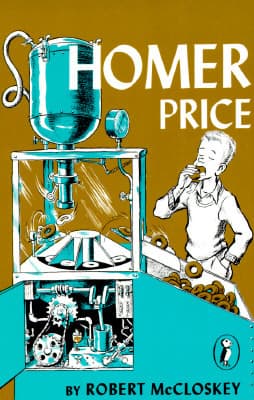
Synopsis
Covers the whole plot, including the ending.
- Difficulty
- Easy
- Pacing
- Moderate
- Mood
- Whimsical, Humorous, Nostalgic, Charming
- Read it if
- You enjoy classic, episodic children's stories filled with gentle humor, small-town charm, and quirky characters, perfect for reading aloud or independent reading.
- Skip it if
- You prefer fast-paced, plot-driven narratives with deep character development or complex themes.
Homer Price Plot Summary
Covers the whole plot, including the ending.
The Sensational Donut Machine Mishap
Homer Price helps his parents run their diner in Centerburg. They get a new donut machine, a modern device meant to make perfect donuts automatically. But during its first public use, a small fly lands on the 'stop' button, jamming it. The machine then makes donuts non-stop, faster than anyone can eat them. The diner quickly fills with piles of donuts, threatening to cover the whole town. Homer quickly suggests calling the local sheriff, but even the sheriff is puzzled. The townspeople eventually decide to sell the donuts to tourists, turning the accident into a profitable, though messy, business.
The Case of the Stolen Necklace
While the donut machine is making too many donuts, a rich socialite, Mrs. Penelope Lapin, stops at the diner. She is known for her expensive pearl necklace. While she is watching the donut show, four famous jewel thieves, dressed as regular customers, try to steal her necklace. Homer, with his pet skunk Aroma's sharp senses, notices something wrong. Aroma, known for her strong smell, helps track the thieves as they try to escape through the growing piles of donuts. Her distinct smell leads Homer and the sheriff right to the criminals, who are caught among the sweet-smelling mess, and the necklace is found.
The Mystery of the Missing Ball of String
Mr. Gabby, a rich man who lives outside Centerburg, is famous for owning the world's largest ball of string. One day, the huge ball, which he keeps in his barn, disappears. Mr. Gabby is upset and offers a reward for its return. Homer Price, known for being smart, takes on the case. He checks the barn and the area around it for clues. Homer eventually finds that the ball of string wasn't stolen; it rolled away down a hill during a storm and got stuck in a valley. With help from the townspeople, they get the giant ball of string back, and Mr. Gabby is very happy, giving Homer a generous reward.
The Search for the Super-Duper
Homer and his friends love collecting comic books, and their main goal is to find a rare issue of 'The Super-Duper,' a comic that promises a prize to anyone who solves its puzzle. They spend their money and free time looking through every store and attic in Centerburg. Their search leads them to an old junk shop run by an unusual man. After much looking, they finally find a dusty copy of 'The Super-Duper.' However, the puzzle is very hard. Homer and his friends work together, using their knowledge and effort, and eventually solve the puzzle. The prize, to their surprise, is not a big fortune but a simple, heartfelt message about the value of friendship and hard work.
The Doughnuts and the Sheriff's New Suit
After the donut machine problem, the machine is fixed and keeps making donuts, but with more oversight. One day, Sheriff Bidwell, a proud man, arrives at the diner wearing a brand-new suit, eager to show it off. Homer, still helping, is glazing the fresh donuts. By accident, Homer slips, sending donut glaze directly onto the sheriff's clean new suit. The sheriff is embarrassed and at first very angry. But Homer's honest apology and offer to help clean it, along with the townspeople's good humor, eventually make the sheriff laugh it off, though his suit stays a sticky, sweet mess.
The Musical Mousetrap
Centerburg has a local invention competition, and Homer Price, always full of ideas, decides to enter. He sees that Mrs. Limburger, a local baker, constantly has mice in her shop. Homer sets out to invent a kind and new mousetrap. His invention is a 'musical mousetrap' that, instead of snapping, plays a catchy tune when a mouse enters, luring it into a cage with cheese. The trap is made to be harmless and fun. At the competition, Homer's invention is a success, not just for its cleverness but also for its fun nature. He wins the competition, and Mrs. Limburger is happy to have a musical, mouse-catching solution for her bakery.
Principal Figures
Homer Price
Protagonist
A clever and resourceful young boy living in Centerburg.
Homer is the central character, a young boy with a knack for problem-solving and an observant nature. He helps his parents run their diner and often finds himself involved in the town's various eccentric happenings. He is practical, calm under pressure, and possesses a strong sense of community. His curiosity and willingness to help others drive many of the stories, whether he's catching bandits, finding lost items, or inventing new contraptions. He is often accompanied by his pet skunk, Aroma.
Relationships: Aroma (Pet skunk and loyal companion); Mr. and Mrs. Price (Parents, owners of the diner); Sheriff Bidwell (Local law enforcement, often aided by Homer); Freddy (Friend)
Aroma
Supporting
Homer's intelligent and famously fragrant pet skunk.
Aroma is Homer's pet skunk, known for her remarkable intelligence and, of course, her distinctive scent. Far from being a nuisance, Aroma is a crucial companion to Homer, often playing a key role in solving mysteries or apprehending criminals. Her unique abilities, particularly her sense of smell and her ability to deter wrongdoers, make her an invaluable asset. She is loyal to Homer and a beloved, if pungent, member of the Price household and the Centerburg community.
Relationships: Homer Price (Owner and best friend)
Mr. Price
Supporting
Homer's father and co-owner of the Centerburg diner.
Mr. Price is Homer's father and runs the local diner with his wife. He is a hardworking man, generally good-natured, but sometimes overwhelmed by the eccentric events that unfold in Centerburg. He is practical and often tries to find logical solutions to problems, though he sometimes needs Homer's ingenuity to truly resolve a situation. He represents the everyday adult perspective in the town, often reacting with a mix of exasperation and amusement to the strange occurrences.
Relationships: Homer Price (Son); Mrs. Price (Wife)
Mrs. Price
Supporting
Homer's mother and co-owner of the Centerburg diner.
Mrs. Price is Homer's mother, a kind and supportive figure. She helps run the diner and is often the more calm and collected parent, though she can be just as surprised by Centerburg's antics as anyone else. She embodies a nurturing presence in Homer's life and within the diner, often providing comfort and a steady hand amidst the chaos. Her practical nature complements her husband's and son's more adventurous spirits.
Relationships: Homer Price (Son); Mr. Price (Husband)
Sheriff Bidwell
Supporting
The local law enforcement officer in Centerburg.
Sheriff Bidwell is the well-meaning but often flustered sheriff of Centerburg. He takes his job seriously but is frequently outwitted or overwhelmed by the unusual problems that arise in the town, such as an endless donut machine or cunning jewel thieves. He often relies on Homer's quick thinking and observation skills to help solve cases. Despite his occasional blunders, he is a respected figure in the community and a good-hearted individual.
Relationships: Homer Price (Often collaborates with him on cases)
Mrs. Penelope Lapin
Supporting
A wealthy socialite who visits Centerburg.
Mrs. Penelope Lapin is a glamorous and wealthy woman known for her expensive tastes, particularly her valuable pearl necklace. She visits Centerburg during the donut machine incident and becomes an unwitting target for jewel thieves. Her presence highlights the contrast between the quiet, rural town and the outside world, bringing a touch of high society drama to Centerburg. She is initially distraught by the theft but grateful for Homer and Aroma's help.
Mr. Gabby
Supporting
A reclusive millionaire known for his giant ball of string.
Mr. Gabby is an eccentric millionaire living outside Centerburg, famous for his peculiar hobby of collecting the world's largest ball of string. He is a somewhat reclusive but kind-hearted individual who becomes distraught when his prized possession goes missing. His character adds a touch of whimsical oddity to the town, and his unique problem provides Homer with another opportunity to showcase his detective skills.
Freddy
Supporting
One of Homer's friends and fellow comic book enthusiasts.
Freddy is one of Homer's friends, sharing his enthusiasm for comic books and adventures. He is a loyal companion and participates in the search for 'The Super-Duper.' Freddy represents the typical small-town kid, eager for excitement and discovery. His presence emphasizes Homer's social life and the collaborative spirit among the children of Centerburg.
Relationships: Homer Price (Friend)
Themes & Insights
Ingenuity and Problem-Solving
A main theme is the strength of cleverness and practical thinking in solving unexpected problems. Homer Price always shows he can think creatively, whether finding a way to stop an endless donut machine, tracking jewel thieves with his skunk, or getting back a giant ball of string. The book celebrates how ordinary people can be resourceful in unusual situations, often showing that simple, creative solutions work better than complicated ones. This is clear in Homer's musical mousetrap, a kind and effective invention.
“There’s a perfectly good way to do everything, if you just stop and think about it.”
The Charm of Small-Town Life
The book clearly shows Centerburg's unique nature and close community. Despite the strange events, there is a comforting feeling of neighborliness and support. The townspeople work together to handle the donut overflow, search for Mr. Gabby's string, and join local competitions. The odd qualities of characters like Mr. Gabby and Sheriff Bidwell add to the town's charm, making Centerburg a place where normal and magical things happen together, creating a strong sense of identity and belonging for its residents.
“Centerburg was just like any other town, except for a few things, and those few things made all the difference.”
The Unpredictability of Technology
The 'Sensational Donut Machine' chapter is a good example of this theme. It shows how modern technology, meant for efficiency, can fail in surprising and overwhelming ways. The machine's endless donut production, caused by a simple fly, shows the funny and sometimes messy results of relying too much on machines. This theme suggests a warning about progress, showing that human creativity and ability to adapt are still important, even with advanced machines.
“The machine hummed and whirred and made donuts at a terrific speed, but it couldn't be stopped!”
The Value of Friendship and Community
Homer's adventures often involve working with and getting help from his friends and the Centerburg community. Whether it's his bond with his pet skunk, Aroma, or his joint efforts with friends to find a rare comic book, the stories show the strength that comes from working together. The townspeople's combined effort to deal with the donut crisis or get back Mr. Gabby's string shows how a community can unite to solve problems, reinforcing that shared experiences and helping each other are very valuable.
“It takes a whole town to find a ball of string that big.”
Plot Devices & Literary Techniques
Episodic Structure
Each chapter functions as a self-contained short story.
The book is structured as a series of independent, yet interconnected, episodes in Homer Price's life. Each chapter presents a new problem or adventure that Homer must solve, with its own beginning, middle, and end. While characters like Homer and Aroma are consistent, the plots of each episode are distinct. This allows for varied scenarios, keeps the narrative fresh, and makes the book highly accessible for young readers, as they can enjoy individual stories without needing to recall complex overarching plots.
Humor through Exaggeration (Hyperbole)
Using extreme situations for comedic effect.
McCloskey frequently employs exaggeration to create humorous situations. The most prominent example is the donut machine endlessly producing donuts until they threaten to bury the town. Other instances include Mr. Gabby's impossibly large ball of string and the dramatic chase involving Aroma and the jewel thieves. This device amplifies the absurdity of the situations, making them more memorable and entertaining for the reader, and highlights the resilient and often comical reactions of the Centerburg residents to these over-the-top events.
The Eccentric Town of Centerburg
The setting itself functions as a character, fostering peculiar events.
Centerburg is more than just a backdrop; it's a character in its own right, a magnet for odd occurrences and home to quirky individuals. The town's unique atmosphere and its residents' particular habits (like collecting giant balls of string or being unusually susceptible to donut overproduction) are integral to the plot. The town's inherent eccentricity provides the fertile ground for the unusual problems Homer encounters, making the improbable seem plausible within its charmingly strange confines.
Animal Companion (Aroma)
A pet with a unique skill that aids the protagonist.
Aroma, Homer's pet skunk, serves as a classic animal companion, but with a distinctive twist. Her powerful scent, typically a deterrent, becomes a crucial plot device in solving the jewel theft. Her intelligence and loyalty make her more than just a pet; she is an active participant in Homer's adventures, often providing the critical element needed to resolve a conflict. She adds a layer of charm and humor, while also demonstrating the unexpected usefulness of unusual traits.
Homer Price Quotes
“Homer was a boy who lived in Centerburg where his father ran the tourist camp and his mother made doughnuts.”
“The doughnut machine was a wonderful invention, but it had one little fault: it wouldn't stop making doughnuts.”
“It's a very simple thing to make a million doughnuts if you have a doughnut machine.”
“Homer had a way with animals, and he could usually get them to do what he wanted.”
“The sheriff was a very important man in Centerburg, and he liked to keep things quiet and peaceful.”
“Sometimes the simplest things can cause the biggest problems.”
“Homer thought it was a fine thing to have a uncle who could invent such a machine.”
“In Centerburg, everyone knew everyone else's business, but they were all friends anyway.”
“The robbers didn't count on Homer being so clever.”
“A boy with a good idea can sometimes solve a problem that stumps the grown-ups.”
“It's not every day that a skunk decides to help catch a thief.”
“Homer's mother said, 'If you can't fix it with doughnuts, it probably can't be fixed.'”
“The town celebrated with a parade, and Homer was the hero of the day.”
“Sometimes the best plans are the ones you make up as you go along.”
Quiz
10 questions on the plot and the characters. Each answer comes with a short explanation.
Question 1
What is the name of Homer's pet skunk?
- Stinky
- Aroma
- Scent
- Aroma
Show answer
D. Aroma Homer's pet skunk is named Aroma, which plays a key role in capturing the bandits in one of the episodes.
Question 2
In the donut machine episode, what causes the machine to go on a rampage?
- A power surge
- Homer accidentally setting it to continuous mode
- A mechanical failure
- Someone tampering with it
Show answer
B. Homer accidentally setting it to continuous mode Homer accidentally sets the donut machine to continuous mode, leading to it producing donuts uncontrollably, which is a humorous highlight of the book.
Question 3
What is the name of the town where Homer lives?
- Centerburg
- Springfield
- Riverdale
- Maplewood
Show answer
A. Centerburg Homer lives in the small town of Centerburg, which is the setting for all his adventures in the book.
Question 4
How many bandits do Homer and Aroma capture in the episode 'The Case of the Sensational Scent'?
- Two
- Three
- Four
- Five
Show answer
C. Four Homer and his skunk Aroma capture four bandits, using Aroma's scent to subdue them, as described in the book's summary.
Question 5
What is Homer's primary role or interest that often leads to his adventures?
- He is a detective
- He is an inventor and tinkerer
- He is a farmer
- He is a student
Show answer
B. He is an inventor and tinkerer Homer is portrayed as an inventive and curious boy who enjoys tinkering with machines and gadgets, which drives many of the episodes, such as the donut machine incident.
Question 6
In the episode about the donut machine, what do the townspeople do with the excess donuts?
- They throw them away
- They sell them at a discount
- They use them to feed animals
- They hold a donut-eating contest
Show answer
D. They hold a donut-eating contest To deal with the overflow of donuts from the rampage, the townspeople organize a donut-eating contest, adding to the comedic chaos of the episode.
Question 7
Which theme is prominently explored through Homer's adventures in 'Homer Price'?
- The importance of formal education
- The value of ingenuity and resourcefulness
- The dangers of technology
- The struggles of urban life
Show answer
B. The value of ingenuity and resourcefulness The book emphasizes themes of ingenuity and resourcefulness, as Homer uses his wits and skills to solve problems, such as capturing bandits or managing the donut machine.
Question 8
What unusual method do Homer and Aroma use to capture the bandits?
- They set a trap with food
- They use Aroma's scent to overwhelm them
- They call the police immediately
- They lock them in a shed
Show answer
B. They use Aroma's scent to overwhelm them Homer cleverly uses his pet skunk Aroma's potent scent to subdue and capture the bandits, showcasing his creative problem-solving.
Question 9
How many episodes or stories are included in 'Homer Price'?
- Four
- Five
- Six
- Seven
Show answer
C. Six The book consists of six episodic stories about Homer's life and adventures, as mentioned in the summary provided.
Question 10
In the context of the book, what does Homer's character symbolize about small-town American life?
- The boredom and lack of opportunity
- The simplicity and charm of rural communities
- The need for modernization
- The isolation from the wider world
Show answer
B. The simplicity and charm of rural communities Homer's adventures reflect the simplicity, community spirit, and charm of small-town American life in the mid-20th century, often with a humorous and wholesome tone.
Homer Price FAQ
What is 'Homer Price' about?
'Homer Price' is a collection of six humorous episodes in the life of a resourceful young boy named Homer Price in the small town of Centerburg. Key stories include Homer and his pet skunk Aroma helping capture four bandits who are robbing a local hotel, and Homer dealing with a runaway donut machine that floods his uncle's lunchroom with donuts.
Why should I read 'Homer Price'?
The book offers charming, lighthearted adventures that celebrate small-town American life, ingenuity, and humor. It's perfect for young readers who enjoy episodic stories with memorable characters like Homer, his pet skunk Aroma, and quirky townspeople, all brought to life with Robert McCloskey's witty writing and illustrations.
What is the background/setting of 'Homer Price'?
The stories are set in the fictional small town of Centerburg, USA, during the mid-20th century, reflecting a nostalgic, post-war American setting. Homer lives with his family and often helps at his uncle's lunchroom, where many of the adventures, like the donut machine incident, take place.
What are the most memorable quotes?
Memorable quotes include Homer's uncle Ulysses exclaiming 'Doughnuts! Doughnuts! Doughnuts!' during the donut machine chaos, and Homer's pragmatic observation 'A skunk is a very useful animal to have around' when Aroma helps capture the bandits. These lines highlight the book's playful tone and Homer's cleverness.
What writing style does the author use?
Robert McCloskey uses a straightforward, humorous, and episodic narrative style with vivid descriptions and gentle satire. The prose is accessible for young readers, enriched by McCloskey's own detailed illustrations that complement the whimsical, small-town adventures.
What minor details add significant meaning?
Minor details like Homer's pet skunk Aroma being named for its scent, which ironically helps catch bandits, add humor and irony. The donut machine's mechanical quirks, such as producing donuts non-stop, symbolize the chaos of unchecked technology in a simple setting.
What are some subtle foreshadowing moments?
In the donut story, early mentions of the machine's 'automatic' features foreshadow its eventual rampage. Homer's calm demeanor and resourcefulness in small tasks, like fixing radios, subtly hint at his ability to handle larger crises like the bandit capture.
What unexpected character connections exist?
Unexpected connections include the bandits being linked to a larger crime ring that Homer inadvertently disrupts, and townspeople like Miss Terwilliger, who initially seems ordinary but plays a key role in resolving the donut crisis through community effort.
What are unspoken character motivations?
Homer's unspoken motivation is a desire for adventure and to prove his usefulness in his small town, driving him to take initiative in crises. The bandits are motivated by greed, but their bumbling nature suggests they're more comical than sinister, adding to the story's light tone.
What psychological complexities do characters exhibit?
Homer exhibits a blend of childhood curiosity and mature problem-solving, showing resilience without arrogance. Uncle Ulysses displays a mix of entrepreneurial ambition and comical panic, reflecting adult foibles in a gentle, humorous way that young readers can relate to.
What are the major emotional turning points?
Major emotional turning points include Homer's pride when Aroma helps capture the bandits, boosting his confidence, and the relief and community bonding when the donut crisis is resolved with everyone sharing donuts. These moments highlight themes of teamwork and small triumphs.
How do relationship dynamics evolve?
Homer's relationship with his uncle Ulysses evolves from helper to problem-solver as Homer takes charge during the donut machine incident. The town's dynamics shift from individual concerns to collective action, emphasizing community support in solving problems together.
Which parts remain ambiguous or open-ended?
The fate of the bandits after capture is left ambiguous, with no detailed consequences shown, leaving room for imagination. The donut machine's ultimate disposal or repair is not fully explained, adding to the whimsical, unresolved nature of the adventures.
What are controversial scenes or decisions?
Some readers might find the use of a skunk's scent to subdue bandits controversial for its unconventional, non-violent method, but it's portrayed humorously. The donut machine's wastefulness could be seen as a critique of consumerism, though it's handled lightly.
'Homer Price' ending explained: how it ends & what it means
The book ends with Homer and the town returning to normalcy after each adventure, emphasizing that life in Centerburg goes on with its simple charms. This cyclical structure suggests that childhood is about learning from small adventures, not grand conclusions, reinforcing themes of resilience and community.
About the author

Robert McCloskey was an American author and illustrator known for his children's books. His notable works include "Make Way for Ducklings," "Blueberries for Sal," "Homer Price," and "One Morning in Maine," which often feature themes of nature and childhood adventures. McCloskey's storytelling and illustrations have made a lasting impact on children's literature.
Similar books
- Pippi Longstocking
Astrid Lindgren
4.1 (168k) average on GoodreadsFantasyFeatures a resourceful, imaginative child protagonist in episodic, humorous adventures.
- Harry Potter and the Sorcerer's Stone
J.K. Rowling
4.5 (7M) average on GoodreadsFantasyRescued from a miserable life under the stairs, an orphaned boy discovers he's a wizard destined for a magical school, where he uncovers a dangerous secret tied to the dark wizard who murdered his parents.
- The Hobbit, or There and Back Again
J.R.R. Tolkien
4.3 (2.9M) average on GoodreadsFantasyA comfort-loving hobbit named Bilbo Baggins is whisked away by a mischievous wizard and a band of dwarves on an unexpected journey to reclaim stolen treasure from a fearsome dragon, discovering courage and a magical ring along the way.
- Harry Potter and the Goblet of Fire
J.K. Rowling
4.6 (2.6M) average on GoodreadsFantasyA bewildered Harry Potter, underage and thrust into a deadly Triwizard Tournament, must brave dragons, mermaids, and a resurgent dark magic to survive a year that will forever alter the wizarding world.
- Harry Potter and the Order of the Phoenix
J.K. Rowling
4.5 (2.5M) average on GoodreadsFantasyIn a year of oppressive secrets and the threat of Voldemort, Harry Potter and Dumbledore's Army secretly train for war, shown through Jim Kay and Neil Packer's dark illustrations.
- The Lightning Thief
Rick Riordan
4.3 (2M) average on GoodreadsFantasyThrust into a world of mythological monsters and divine treachery, an ordinary boy discovers he's the son of Poseidon and must embark on a perilous quest across modern America to prevent an Olympian war.





Enjoyed the summary?
A summary gives you the shape of the book. The book itself has the detail, the examples and the voice.
Find Homer Price on AmazonAs an Amazon Associate, BookBrief earns from qualifying purchases. How we're funded