
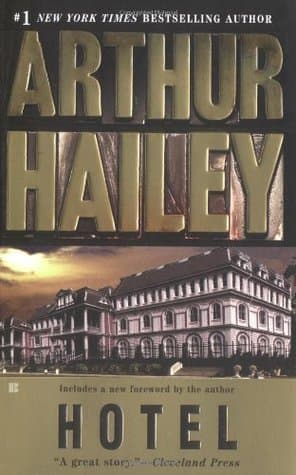
Synopsis
Covers the whole plot, including the ending.
- Difficulty
- Medium
- Pacing
- Variable
- Mood
- Suspenseful, Dramatic, Immersive, Intense
- Read it if
- You enjoy complex, character-driven thrillers set in a bustling, high-stakes environment with multiple intertwining plotlines.
- Skip it if
- You prefer fast-paced, action-focused thrillers without much emphasis on character development or detailed operational insights.
Hotel Plot Summary
Covers the whole plot, including the ending.
The St. Gregory Faces a Crisis
The St. Gregory Hotel, a grand but aging New Orleans institution, is in financial trouble. General Manager Peter McDermott is under pressure from its owner, Warren Trent, to cut costs and improve profits. The hotel faces a possible takeover by the O'Keefe chain, represented by a negotiator. Adding to the tension, a young black man, Curtis O'Keefe, is struck by a car outside the hotel, sparking racial unrest and a potential riot. Peter must handle these immediate crises while also dealing with daily operational challenges and the diverse personalities within the hotel, including the Duke of Croydon and his secretary, Jeanne Rochefort.
The Duke's Secret and the Theft
The Duke of Croydon, a guest staying in the hotel's penthouse suite, secretly plans a real estate deal that could save the St. Gregory. However, his private secretary, Jeanne Rochefort, discovers he is a known jewel thief, using his aristocratic facade to scout targets. He has already stolen a diamond necklace from a wealthy socialite, Mrs. Aloysius Schultz, who is also a guest. The theft is reported, and the hotel's security chief, Albert Wells, begins an investigation, putting pressure on Peter to resolve the situation discreetly and prevent further damage to the hotel's reputation.
Racial Tensions Escalate
The hit-and-run incident involving Curtis O'Keefe outside the St. Gregory increases racial tensions in New Orleans. Reverend John M. Evans, a civil rights leader, arrives at the hotel, demanding justice and threatening a demonstration. Peter McDermott, along with hotel detective Albert Wells, tries to calm the situation, understanding that a riot could harm the hotel and the city. The police are on high alert, and the hotel becomes a focal point for both the protesters and the authorities, with violence possible over the establishment.
Jeanne's Dilemma and the Duke's Escape
Jeanne Rochefort, realizing the Duke of Croydon is a jewel thief, is torn between her loyalty and her conscience. She confronts him, leading to a standoff. The Duke, trying to escape with the stolen necklace, flees through the hotel's service areas. Peter McDermott and Albert Wells, alerted to the Duke's behavior, pursue him through the corridors and back alleys of the St. Gregory. Jeanne must decide if she will expose the Duke and risk her own safety, or remain involved in his crimes.
The Chase and the Confession
The pursuit of the Duke of Croydon ends in a chase through the hotel's departments. Peter McDermott, using his knowledge of the St. Gregory, eventually corners the Duke. During the confrontation, the Duke confesses to the theft of Mrs. Schultz's necklace and reveals his broader scheme. The stolen jewels are recovered, and the Duke is apprehended. This resolution brings a calm to one of the hotel's major crises, but the larger issues of financial instability and racial unrest continue to affect Peter and the St. Gregory.
The O'Keefe Takeover Bid
The O'Keefe hotel chain, represented by a negotiator, increases its efforts to acquire the St. Gregory. Peter McDermott works with Warren Trent to find alternative solutions and stop the takeover. The O'Keefe chain points out the hotel's declining profits, aging infrastructure, and debts, making a case for its acquisition. Peter, however, believes in the St. Gregory's potential and its character, determined to preserve its independence and Warren Trent's legacy, even when the odds are against them.
Racial Tensions Boil Over
Despite Peter's efforts, the racial tensions outside the St. Gregory reach a breaking point. Protesters, fueled by the hit-and-run incident and years of injustice, clash with the police. The hotel, in the middle of the unrest, becomes a target. Windows are broken, and the safety of the guests and staff is at risk. Peter, along with Albert Wells and other hotel employees, works to protect the hotel and its occupants, while also trying to understand and address the causes of the anger and frustration.
The Resolution of the Racial Crisis
In the chaos, Peter McDermott talks with Reverend John M. Evans. They discuss racial inequality and the need for understanding and change. Peter, showing empathy and a willingness to listen, manages to calm the situation. Reverend Evans, seeing Peter's concern, helps to calm the protesters, bringing a fragile peace to the immediate crisis. This interaction shows Peter's leadership qualities beyond just hotel management, showing his ability to connect with people.
Love and Betrayal
Amidst the professional turmoil, Peter McDermott's personal life is complicated. He has a relationship with Christine Francis, the hotel's assistant manager, and is drawn to Jeanne Rochefort. Jeanne, having escaped the Duke, seeks a new beginning. Peter's loyalty to the St. Gregory and his professional responsibilities often clash with his personal desires. He must navigate these emotional entanglements while focusing on saving the hotel, leading to moments of intimacy and difficult decisions about his future.
A New Beginning for the St. Gregory
In a turn of events, Peter McDermott, through negotiation and an alliance with Curtis O'Keefe's family (who are wealthy and not connected to the O'Keefe chain), secures a loan that saves the St. Gregory from the O'Keefe takeover. This financial lifeline allows the hotel to begin its modernization. Peter, having proved his worth and commitment, is offered a promotion and a stake in the hotel's future, solidifying his position as the leader of the St. Gregory. The future, while still challenging, looks brighter for the historic hotel.
Hotel Characters
Peter McDermott
Protagonist
The dedicated General Manager fighting to save the St. Gregory.
Peter McDermott is the intelligent, hardworking, and deeply committed General Manager of the St. Gregory Hotel. He is a man of integrity, fiercely loyal to the hotel and its owner, Warren Trent. Throughout the novel, Peter demonstrates exceptional leadership under pressure, balancing the hotel's financial woes, racial tensions, and criminal investigations. He is adept at problem-solving, empathetic towards his staff and guests, and possesses a strong moral compass. His ambition is not personal gain, but the preservation and success of the St. Gregory.
Relationships: Warren Trent (Owner and mentor); Christine Francis (Assistant Manager and romantic interest); Jeanne Rochefort (Romantic interest and confidante); Albert Wells (Head of Security and trusted colleague)
Warren Trent
Supporting
The aging, proud owner of the St. Gregory Hotel.
Warren Trent is the proud, somewhat old-fashioned owner of the St. Gregory, a man deeply attached to the hotel's history and grandeur. He struggles with the financial realities of modern hotel management but is fiercely resistant to selling his beloved establishment. Trent places immense trust in Peter McDermott, relying on his judgment and leadership to navigate the crises. He represents the old guard of hospitality, valuing tradition and personal service above all else, often clashing with the more pragmatic approaches required for survival.
Relationships: Peter McDermott (General Manager and trusted successor); O'Keefe Chain Representative (Antagonistic business rival)
Jeanne Rochefort
Supporting
The Duke of Croydon's beautiful and conflicted secretary.
Jeanne Rochefort is the elegant and intelligent private secretary to the Duke of Croydon. She is initially presented as somewhat mysterious, but her character deepens as she discovers the Duke's criminal activities. Jeanne is torn between her loyalty to her employer and her growing moral conscience. She is attracted to Peter McDermott and seeks a path to redemption and a new, honest life. Her journey involves confronting betrayal and making difficult choices, ultimately leading her to a new beginning.
Relationships: Duke of Croydon (Employer and betrayer); Peter McDermott (Romantic interest)
Duke of Croydon
Antagonist
A charming but cunning international jewel thief.
The Duke of Croydon is a sophisticated, aristocratic, and utterly ruthless international jewel thief. He uses his noble title and impeccable manners as a cover for his criminal enterprises, meticulously planning his thefts while staying in luxury hotels. He is intelligent and manipulative, capable of charming anyone while harboring a predatory nature. His presence in the St. Gregory is the catalyst for the jewel theft subplot, adding a layer of suspense and danger to the hotel's already troubled week.
Relationships: Jeanne Rochefort (Secretary and eventual accuser); Peter McDermott (Adversary)
Albert Wells
Supporting
The pragmatic and experienced Head of Security for the St. Gregory.
Albert Wells is the St. Gregory's seasoned and no-nonsense Head of Security. A former police officer, he brings a practical, grounded approach to the hotel's security challenges. Wells is loyal to Peter McDermott and an invaluable asset in investigating the jewel theft and managing the racial unrest. He is a man of few words but sharp observations, often providing Peter with critical information and a realistic perspective on dangerous situations. He represents the operational backbone of the hotel's safety protocols.
Relationships: Peter McDermott (Colleague and superior); Duke of Croydon (Criminal suspect)
Christine Francis
Supporting
The efficient and ambitious Assistant Manager of the St. Gregory.
Christine Francis is the highly competent and ambitious Assistant Manager of the St. Gregory. She is dedicated to her career and the hotel, often working closely with Peter McDermott. Christine represents the modern, professional woman in the hospitality industry, focused on efficiency and guest satisfaction. She has a complex personal relationship with Peter, marked by both professional respect and romantic tension, adding a layer of personal drama to his already stressful professional life. She is a capable manager, committed to the hotel's success.
Relationships: Peter McDermott (Colleague and romantic interest)
Reverend John M. Evans
Supporting
A powerful civil rights leader advocating for justice.
Reverend John M. Evans is a charismatic and influential civil rights leader who comes to the St. Gregory to address the racial injustice stemming from the hit-and-run incident involving Curtis O'Keefe. He is a man of conviction, demanding equality and justice for the black community. While initially confrontational, he is also reasonable and willing to engage in dialogue, ultimately playing a crucial role in de-escalating the potentially violent racial tensions outside the hotel. He represents the moral conscience of the community.
Relationships: Peter McDermott (Adversary turned collaborator)
Curtis O'Keefe
Mentioned
The young black man whose accident sparks racial unrest.
Curtis O'Keefe is a young black man who is hit by a car outside the St. Gregory Hotel. While he does not have a speaking role, his accident is the catalyst for the major racial unrest and protests that engulf the hotel and the surrounding area. His condition and the circumstances of the accident highlight the deep-seated racial tensions and injustices prevalent in the city, serving as a powerful symbol around which the community mobilizes. His wealthy and influential family eventually plays a crucial role in the hotel's financial salvation.
Relationships: Reverend John M. Evans (Advocate for his cause)
Mrs. Aloysius Schultz
Supporting
A wealthy socialite whose priceless necklace is stolen.
Mrs. Aloysius Schultz is a flamboyant and wealthy socialite staying at the St. Gregory. Her priceless diamond necklace becomes the target of the Duke of Croydon's theft. Her character adds a touch of glamour and vulnerability to the hotel's guest roster, and the theft of her necklace initiates a significant portion of the plot, forcing Peter and Albert Wells to investigate and recover the stolen item, further complicating the hotel's already precarious situation. She is a symbol of the wealth and prestige the St. Gregory caters to.
Relationships: Duke of Croydon (Thief of her necklace)
Hotel Themes
Survival and Adaptation
The St. Gregory, a grand but aging hotel, constantly fights for its survival against financial ruin, modern competition (the O'Keefe chain), and societal changes. Peter McDermott shows this theme, working to adapt the hotel's operations, cut costs, and innovate while preserving its legacy. This is clear in his efforts to get new funding and modernize facilities, recognizing that clinging to the past without adapting will lead to the hotel's demise. The hotel itself must evolve or perish.
“He was the hotel, and the hotel was him; its problems, its crises, its small triumphs were his own.”
Social Class and Racial Inequality
The novel contrasts the lives of the wealthy guests and the hotel staff with the struggles of the less privileged outside its doors. The racial tensions from Curtis O'Keefe's accident show the inequalities in society. The St. Gregory, while a place of luxury, cannot escape the city's racial divide. Peter McDermott's interactions with Reverend Evans and the riot show the need for understanding and bridging these social and racial gaps, affecting the hotel directly.
“The hotel, like a microcosm, reflected the larger world outside: its passions, its prejudices, its occasional nobility.”
Integrity vs. Corruption
This theme is in several characters. Peter McDermott consistently shows integrity, prioritizing honesty and ethical management, even under pressure. In contrast, the Duke of Croydon represents corruption, using his charm and status to commit crimes. The choice Jeanne Rochefort faces between being involved and exposing the Duke further highlights this theme. The possible takeover by the O'Keefe chain also presents a morally ambiguous corporate world, contrasting with Warren Trent's more traditional, principled approach.
“Integrity was not a luxury in the hotel business; it was a necessity, a foundation.”
The Illusion of Grandeur
The St. Gregory, despite its opulent facade and history, is an aging structure with hidden problems: leaky pipes, outdated systems, and financial instability. The Duke of Croydon also shows this theme, presenting a facade of nobility and respectability to hide his true identity as a thief. The novel suggests that appearances can be deceiving, and what lies beneath the surface, whether in a grand hotel or a charismatic individual, often reveals a complex, sometimes decaying, reality that requires constant maintenance and vigilance.
“Beneath the glittering chandeliers and polished marble, the St. Gregory was an old woman, sagging in places, in need of a facelift.”
Leadership and Responsibility
Peter McDermott's character is central to this theme. He carries the responsibility of managing the hotel, its staff, its guests, and its reputation. His leadership is tested by many crises—financial, criminal, and social. He makes tough decisions, delegates well, and inspires loyalty, showing what it takes to lead a complex organization through adversity. Warren Trent also shows leadership, from a different perspective, entrusting the hotel's future to Peter, acknowledging the need for new vision.
“A general manager's job, Peter knew, was not merely to solve problems, but to anticipate them, to be everywhere at once.”
Plot Devices & Literary Techniques
The Hotel as a Microcosm
The St. Gregory serves as a miniature representation of society.
The St. Gregory Hotel functions as a microcosm of the larger world and society. Within its walls, various social classes, races, and professions interact, mirroring the external community. The crises faced by the hotel—financial instability, crime, racial tensions, and labor disputes—reflect broader societal issues. This device allows Hailey to explore complex themes like class struggle, racial prejudice, and the pressures of modern business within a confined, dramatic setting, making the hotel a character in itself that experiences and reacts to these forces.
Multiple Interweaving Storylines
Several concurrent plots unfold, creating a sense of constant crisis.
The novel employs multiple interweaving storylines that unfold simultaneously over a compressed period (five days). These include the hotel's financial struggle and potential takeover, the jewel theft, the racial unrest following the hit-and-run, and Peter McDermott's personal romantic entanglements. This narrative technique creates a dynamic, fast-paced, and suspenseful reading experience, as each subplot contributes to the overall tension and pressure on Peter, demonstrating the multifaceted challenges of managing a large, complex institution.
Ticking Clock
The five-day timeframe creates urgency and heightened tension.
The entire narrative of 'Hotel' takes place over a mere five days, creating a strong 'ticking clock' effect. This compressed timeframe intensifies the urgency of every crisis Peter McDermott faces, from the impending O'Keefe takeover bid to the escalating racial tensions and the hunt for the jewel thief. The short duration forces rapid decision-making and heightens the stakes for all characters, making every moment critical and contributing significantly to the thriller and mystery aspects of the novel.
Character Archetypes
Characters represent specific societal roles and personality types.
Hailey utilizes distinct character archetypes to populate the St. Gregory, allowing for a broad exploration of human nature and societal roles within the hotel setting. Examples include the dedicated, ethical manager (Peter McDermott), the proud but aging owner (Warren Trent), the cunning villain (Duke of Croydon), the conflicted professional (Jeanne Rochefort), and the righteous social activist (Reverend Evans). These archetypes help to quickly establish character motivations and conflicts, driving the plot forward and illustrating various facets of the human condition under pressure.
Hotel Quotes
“There are some things you can't buy, even in a hotel.”
“A hotel is a world within a world, a microcosm of life itself.”
“The secret of good service is to make the guest feel important, but not patronized.”
“Panic is a luxury no one can afford in a crisis.”
“Every guest has a story, and sometimes, the hotel becomes part of it.”
“Money can open many doors, but it can't always buy happiness or peace of mind.”
“The greatest danger is not in failing, but in ceasing to try.”
“A good hotelier knows his hotel better than he knows his own wife.”
“Security is not just about locks and guards; it's about anticipation and prevention.”
“Sometimes the most important things are found in the quiet corners, not in the grand pronouncements.”
“The truth, like a good wine, improves with age, but it can also turn sour if kept too long.”
“In a hotel, you learn to expect the unexpected, and then some.”
“The real luxury isn't in what you have, but in the freedom to choose.”
“Every decision, no matter how small, can ripple through the entire establishment.”
Quiz
10 questions on the plot and the characters. Each answer comes with a short explanation.
Question 1
Which major event threatens the St. Gregory Hotel's reputation and financial stability at the beginning of the book?
- A high-profile murder in the penthouse suite.
- A racial incident involving a prominent guest and a bellboy.
- A major plumbing failure flooding several floors.
- The sudden departure of the hotel's long-time head chef.
Show answer
B. A racial incident involving a prominent guest and a bellboy. The book opens with Peter McDermott dealing with the fallout from the racial incident between the Duke of Orleans and the bellboy, Ogden, which significantly jeopardizes the hotel's standing.
Question 2
Who is the general manager of the St. Gregory Hotel, responsible for its day-to-day operations?
- Warren Trent
- Curtis O'Keefe
- Peter McDermott
- Albert Wells
Show answer
C. Peter McDermott Peter McDermott is the ambitious and capable general manager who strives to keep the St. Gregory running smoothly amidst various crises.
Question 3
What is the primary motive behind Curtis O'Keefe's interest in the St. Gregory Hotel?
- To restore it to its former glory as a historical landmark.
- To convert it into a residential apartment complex.
- To acquire it for his chain of modern, efficient hotels, potentially tearing it down.
- To use it as a base for his political campaign.
Show answer
C. To acquire it for his chain of modern, efficient hotels, potentially tearing it down. Curtis O'Keefe represents modern corporate ambition, aiming to acquire the St. Gregory for his O'Keefe chain, which prioritizes efficiency over the old-world charm and tradition the St. Gregory embodies.
Question 4
Which character is involved in a secret, illicit affair with a hotel employee?
- Peter McDermott
- The Duke of Orleans
- Warren Trent
- Albert Wells
Show answer
B. The Duke of Orleans The Duke of Orleans is having a secret affair with his secretary, who is also a hotel employee, adding to the layers of scandal within the St. Gregory.
Question 5
What significant personal secret does Peter McDermott harbor regarding his past?
- He once embezzled funds from a previous employer.
- He was involved in a car accident that led to a fatality.
- He is secretly married to another woman.
- He faked his credentials to get his current job.
Show answer
B. He was involved in a car accident that led to a fatality. Peter McDermott carries the burden of a past car accident where he was driving and a passenger died, a secret that makes him vulnerable to blackmail.
Question 6
How does the St. Gregory Hotel ultimately avoid being sold to Curtis O'Keefe by the book's end?
- Peter McDermott secures a last-minute loan from a benevolent investor.
- Warren Trent's family decides to keep the hotel in the family.
- A fire breaks out, making the hotel undesirable for acquisition.
- An elderly, wealthy guest, Albert Wells, steps in to buy the controlling interest.
Show answer
D. An elderly, wealthy guest, Albert Wells, steps in to buy the controlling interest. Albert Wells, the seemingly unassuming, long-term resident, reveals himself to be a very wealthy man who purchases the controlling interest in the St. Gregory, saving it from O'Keefe's plans.
Question 7
What is the primary role of Albert Wells within the hotel for most of the story?
- The head of security.
- A seemingly harmless, long-term resident.
- The hotel's financial auditor.
- A rival hotel owner investigating the St. Gregory.
Show answer
B. A seemingly harmless, long-term resident. Albert Wells is initially portrayed as an eccentric, long-term resident who seems to simply enjoy living at the St. Gregory, making his eventual reveal as the hotel's savior a significant twist.
Question 8
Which theme is most prominently explored through the contrast between the St. Gregory and Curtis O'Keefe's business philosophy?
- The corruption of political power.
- The clash between tradition/personal service and modern efficiency/corporate greed.
- The struggle for racial equality in the workplace.
- The dangers of illicit romantic affairs.
Show answer
B. The clash between tradition/personal service and modern efficiency/corporate greed. The St. Gregory, with its old-world charm and emphasis on personal service, stands in stark contrast to O'Keefe's desire for sterile, standardized, and highly profitable hotel chains, highlighting the conflict between tradition and modern corporate approaches.
Question 9
What specific incident involving a convention at the St. Gregory highlights the hotel's vulnerability to external pressures and criminal activity?
- A food poisoning outbreak among the delegates.
- A high-stakes poker game that turns violent.
- A jewel theft from a delegate's room during the convention.
- A protest outside the hotel disrupting the convention.
Show answer
C. A jewel theft from a delegate's room during the convention. During the Surgeons' Convention, a significant jewel theft occurs in the room of Mrs. David Miller, adding another layer of crisis for Peter McDermott and the hotel staff to manage.
Question 10
What is the primary motivation for Warren Trent, the owner of the St. Gregory, in considering selling the hotel?
- He wants to retire and travel the world.
- The hotel is facing severe financial difficulties and needs a buyer to survive.
- He has a better business opportunity elsewhere.
- His children no longer wish to inherit the business.
Show answer
B. The hotel is facing severe financial difficulties and needs a buyer to survive. Warren Trent, despite his deep affection for the St. Gregory, is forced to consider selling due to the hotel's mounting financial problems and overdue mortgages.
Hotel FAQ
What is "Hotel" by Arthur Hailey about?
"Hotel" is a thrilling five-day deep dive into the chaotic and intricate operations of the luxurious St. Gregory Hotel in New Orleans, Louisiana. It follows Peter McDermott, the ambitious assistant general manager, as he navigates a series of crises including a major hotel acquisition bid, a dangerous elevator malfunction, racial tensions, and a high-profile robbery, all while managing the demanding guests and staff.
Why should I read "Hotel"?
You should read "Hotel" for its masterful blend of suspense, intricate character development, and behind-the-scenes look at the high-stakes world of a grand luxury hotel. Hailey expertly weaves multiple plotlines—from a murder investigation to racial discrimination and corporate intrigue—keeping readers engaged with its fast pace and detailed operational insights.
What is the background/setting of "Hotel"?
The story is set entirely within the opulent, yet aging, St. Gregory Hotel in New Orleans during a sweltering Louisiana summer. The hotel itself, a character in its own right, is a grand institution facing modernization challenges and financial pressures, providing a rich backdrop for the intersecting dramas of its staff, guests, and owners.
What are the most memorable quotes?
While Hailey's strength lies in plot and detail rather than quotable lines, memorable sentiments include Peter McDermott's constant internal struggle with ethics versus ambition, and the cynical observations of characters like Albert Wells about the demanding nature of the hotel business. The narrative itself often highlights the transient nature of luxury and the constant grind beneath the polished surface.
What writing style does the author use?
Arthur Hailey employs a meticulous, highly detailed, and procedural writing style, characteristic of his 'documentary novels.' He provides extensive insight into the inner workings of the St. Gregory Hotel, from plumbing to finance, while maintaining a brisk, suspenseful pace through multiple intersecting plotlines and a large cast of characters. His prose is clear, direct, and focused on action and operational realism.
What minor details add significant meaning?
The detailed descriptions of the hotel's aging infrastructure, like the problematic elevators and the old-fashioned switchboard, aren't just background; they underscore the St. Gregory's struggle to compete in a modern world and directly contribute to critical plot points, such as the elevator accident that injures Christine Francis. These details highlight the tension between tradition and progress.
What are some subtle foreshadowing moments?
Early mentions of the hotel's maintenance issues, particularly the elevators, subtly foreshadow the major mechanical failure that later traps guests, including the Duke and Duchess of Croydon. Similarly, the initial tensions between Peter McDermott and Curtis O'Keefe hint at the corporate battle for control that will dominate the book's climax.
What unexpected character connections exist?
A significant unexpected connection is the relationship between the powerful Duke of Croydon and Christine Francis, a guest who becomes involved in the elevator accident. Their shared trauma and her subsequent care under his protection create an unlikely bond that transcends their social statuses, revealing deeper layers to both characters beyond their initial presentations.
What are unspoken character motivations?
Peter McDermott's unspoken motivation is not just career advancement, but a deep-seated desire to prove himself and uphold the integrity of the St. Gregory against corporate greed, often stemming from his working-class background. Warren Trent, the hotel's owner, subtly battles his own pride and attachment to the hotel, making it difficult for him to accept necessary changes or relinquish control, despite the financial strain.
What psychological complexities do characters exhibit?
The Duke of Croydon, initially appearing as a stoic and entitled aristocrat, reveals profound vulnerability and humanity after the elevator accident, demonstrating his capacity for genuine concern and even fear. This complexity challenges initial reader perceptions and highlights the leveling effect of shared trauma.
What are the major emotional turning points?
A major emotional turning point is the elevator accident, which not only causes physical harm but forces characters like Christine Francis and the Duke of Croydon to confront their mortality and biases. Another is Peter McDermott's decision to expose the unethical practices of Curtis O'Keefe, risking his career to protect the hotel's reputation and his own moral compass.
How do relationship dynamics evolve?
The relationship between Peter McDermott and Christine Francis evolves from a professional acquaintance into a deeper, more personal connection as they navigate the crises together, particularly after her injury. Similarly, the dynamic between Peter and Warren Trent shifts from a subordinate-boss relationship to one of mutual respect and partnership as they face the threats to the St. Gregory.
Which parts remain ambiguous or open-ended?
While the main plotlines are resolved, the long-term future of the St. Gregory Hotel under new management, and the full extent of the challenges Peter McDermott will face in his new role, are left somewhat open-ended. The personal lives of some minor characters also conclude without absolute finality, inviting readers to imagine their continued journeys.
What are controversial scenes or decisions?
The scene involving the attempted sexual assault of a young black bellboy by a white guest, followed by the hotel's delicate handling of the incident to avoid scandal, is controversial due to its depiction of racial injustice and the complex ethical dilemmas faced by hotel management in the 1960s. Peter McDermott's decision to use information about Curtis O'Keefe's past to sway the hotel's sale can also be seen as ethically gray.
Hotel ending explained: how it ends & what it means
The book ends with the St. Gregory Hotel being acquired by the financially sound and ethically responsible management of the Queen Elizabeth Hotel chain, largely thanks to Peter McDermott's strategic maneuvering against Curtis O'Keefe. Peter is promoted to General Manager, signifying a triumph of integrity and diligent service over ruthless corporate ambition. It means a new era for the St. Gregory, preserving its legacy while embracing necessary modernization, under leadership that understands its true value.
About the author

Arthur Hailey was a British-Canadian novelist renowned for his meticulously researched, fast-paced thrillers often set in specific industries. His major works, including 'Airport,' 'Hotel,' and 'Strong Medicine,' became international bestsellers, captivating readers with their detailed portrayals of complex professional environments and gripping narratives.
Similar books
- Airport
Arthur Hailey
4.0 (37k) average on GoodreadsThrillerAnother Hailey novel with multiple interwoven plots set within a single, high-pressure location.
- The Lincoln Lawyer
Michael Connelly
4.2 (193k) average on GoodreadsThrillerFeatures a complex, character-driven plot with moral dilemmas and a detailed look at a professional world.
- And Then There Were None
Agatha Christie
4.3 (822k) average on GoodreadsThrillerChristie's work offers unparalleled suspense and intricate 'whodunit' plotting, but lacks the detailed occupational immersion and focus on industry mechanics that defines Hailey's 'Hotel.' Christie prioritizes psychological tension and mystery over the procedural aspects of a specific setting.
- Angels & Demons
Dan Brown
3.9 (2.7M) average on GoodreadsThrillerA Harvard symbologist races through Rome's ancient sites, deciphering cryptic clues to unmask the Illuminati and stop a vengeful plot to destroy the Vatican with a stolen antimatter weapon.
- Gone Girl
Gillian Flynn
4.1 (2.3M) average on GoodreadsThrillerA wife's sudden disappearance on her fifth anniversary reveals a web of lies and psychological warfare, exposing the secrets within a seemingly perfect marriage.
- The Girl on the Train
Paula Hawkins
3.9 (2.1M) average on GoodreadsThrillerA woman’s fascination with a seemingly perfect couple she watches from her daily train commute leads her into a dark investigation when she witnesses something that shatters their idyllic image.






Enjoyed the summary?
A summary gives you the shape of the book. The book itself has the detail, the examples and the voice.
Find Hotel on AmazonAs an Amazon Associate, BookBrief earns from qualifying purchases. How we're funded