
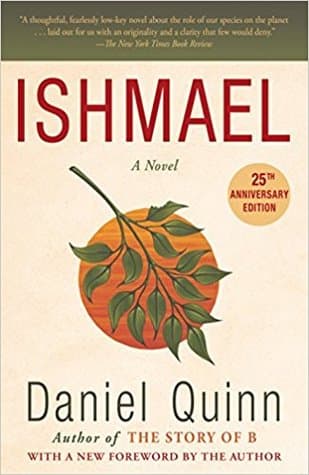
Synopsis
Covers the whole plot, including the ending.
- Difficulty
- Medium
- Pacing
- Slow
- Mood
- Philosophical, Thought-provoking, Reflective, Challenging
- Read it if
- You are interested in philosophical discussions about humanity's role on Earth, environmentalism, and a Socratic teaching method delivered through a unique premise.
- Skip it if
- You prefer fast-paced, plot-driven narratives, or are not open to deeply challenging established societal paradigms.
Ishmael Plot Summary
Covers the whole plot, including the ending.
The Advertisement and the Seeker
The unnamed narrator, a writer feeling lost and unhappy with modern society, finds a strange advertisement: 'Teacher seeks pupil. Must have an earnest desire to save the world. Apply in person.' Curious about the unusual words and his own sense of emptiness, he decides to investigate. He goes to the address, an old office building, and finds the room. The ad promises a chance for intellectual and spiritual awakening, appealing to his desire for meaning and understanding in a world he sees as destructive.
Encountering the Teacher
Inside the room, the narrator is shocked to find not a human teacher, but a large, intelligent gorilla named Ishmael. Ishmael communicates telepathically, explaining he is the teacher. This meeting challenges all the narrator's ideas about intelligence, communication, and teaching. Ishmael explains he has long searched for a pupil willing to listen and question human civilization's basic assumptions. The narrator, despite his shock, is drawn to Ishmael and agrees to begin lessons.
The Captivity of Culture
Ishmael starts by explaining that humanity divides into two groups: 'Takers' and 'Leavers.' Takers are modern, agricultural, and industrial civilizations that believe they will conquer and control the world. Leavers are indigenous cultures that live in harmony with nature, taking only what they need. Ishmael argues that Taker culture is a form of captivity, a 'cage' of ideas and myths that stops humans from seeing their true relationship with the planet. He stresses that this captivity is not physical, but ideological, enforced by a cultural story.
The Story of Genesis and the Fall
Ishmael discusses the Taker origin story, reinterpreting the biblical Genesis account. He explains that the story of Adam and Eve, the Tree of Knowledge, and their expulsion from Eden is a core myth for Taker culture. In Ishmael's view, the Tree of Knowledge represents the Takers' belief that they have a unique, divine right to decide who lives and who dies, to control nature, and to determine good and evil for the world. The 'Fall' from Eden symbolizes the moment Takers left the Leaver way of life—living within natural laws—for a path of control and expansion.
The Law of Life
Ishmael introduces the 'Law of Life,' a universal principle that guides how all species, except Takers, interact with their environment. This law states that species may compete, but they must not wage war on their competitors' food supply or block access to it. No species is allowed to systematically destroy another's sustenance. Takers, however, violate this law through their agriculture and expansion, which destroy the habitats and food sources of other species, including other humans who live as Leavers.
The Great Forgetting
Ishmael describes the 'Great Forgetting,' the process by which Taker culture suppressed and erased the knowledge of Leaver cultures. As Takers expanded their agricultural empires, they saw Leavers as primitive, failing to recognize the ecological balance and sustainable practices in their way of life. This forgetting led Takers to believe their civilization was the peak of evolution, destined to rule the world, while also cutting their connection to nature and its basic laws. This amnesia keeps the Taker myth of human exceptionalism alive.
The Mother Culture's Story
Through his talks with Ishmael, the narrator understands the 'Mother Culture.' This is the dominant cultural story that shapes the worldview of Takers, dictating their values, beliefs, and behaviors. It is the unquestioned assumption that humanity is separate from nature, destined to conquer and control it. The Mother Culture promotes the idea that Takers are the 'chosen' people, and their way of life is the only correct and progressive path. The narrator realizes this story is so deeply ingrained that it is almost invisible, taken for granted by everyone within the Taker system.
The Path to Freedom
As lessons continue, Ishmael refuses to give direct answers or solutions. Instead, he guides the narrator to discover truths himself, stressing that understanding must come from within. Ishmael challenges the narrator's ingrained assumptions, prompting him to examine the narratives that shaped his life and society. The 'path to freedom,' as Ishmael sees it, is not about adopting a new dogma, but about questioning the existing one and recognizing the possibility of living by the Law of Life, moving beyond the destructive Taker paradigm.
Ishmael's History and Fate
Ishmael shares his personal history, revealing he was captured from Africa as an infant and brought to America. He was used in a traveling show, where he learned to communicate with humans. Later, Walter Sokolow, a wealthy and eccentric Jewish businessman, took him in, recognizing Ishmael's intelligence and becoming his first pupil. Sokolow taught Ishmael human history and philosophy; together they developed the Taker and Leaver framework. Ishmael also reveals he is old and his health is failing, meaning their lessons must end soon.
The Final Lesson and Departure
In their final lessons, Ishmael stresses that humanity's future depends on recognizing and abandoning the destructive Taker myth. He emphasizes that change must come from individuals choosing to live differently and to spread understanding of the Law of Life. Ishmael does not offer a blueprint for a new society, but rather a basic change in perception. The narrator, transformed by Ishmael's teachings, understands his role is to be a messenger, to share Ishmael's wisdom with others. He leaves the office with a new purpose, ready to challenge the Mother Culture.
Ishmael's Death and Legacy
Some time after their last meeting, the narrator learns Ishmael died in an accident. A truck carrying him overturned, and Ishmael perished. The news is a blow, but it strengthens the narrator's commitment to Ishmael's legacy. He realizes that Ishmael's physical absence does not lessen his teachings. The narrator understands that the responsibility now falls to him and others who heard Ishmael's message to continue challenging the destructive Taker paradigm and promoting a new understanding of humanity's place in the world.
Principal Figures
The Narrator
Protagonist
A disillusioned writer seeking meaning in a world he perceives as broken.
The unnamed narrator is an intelligent, introspective, and initially cynical individual who feels a deep sense of unease and dissatisfaction with modern civilization. He is a writer, but his work feels meaningless within the larger context of a society he sees as self-destructive. His journey with Ishmael transforms him from a passive observer into an active participant in understanding and challenging humanity's dominant cultural myths. He represents the reader's entry point into Ishmael's teachings, asking the questions and grappling with the concepts.
Relationships: Ishmael (student-teacher relationship, evolving into a profound intellectual and spiritual partnership)
Ishmael
Teacher/Supporting
A telepathic gorilla of immense wisdom who teaches a human student about humanity's destructive path.
Ishmael is an extraordinary, highly intelligent gorilla with the ability to communicate telepathically. He is the central teacher figure, possessing a profound understanding of human history, philosophy, and ecology. Captured from the wild, he was educated by a human, Walter Sokolow, and developed a unique perspective on humanity's place in the world. His teaching method is Socratic, guiding his pupils to discover truths for themselves rather than simply imparting information. He is patient, wise, and deeply concerned about the future of life on Earth.
Relationships: The Narrator (teacher-student relationship); Walter Sokolow (mentor and first human partner)
Walter Sokolow
Mentioned
Ishmael's first human mentor and the man who taught him human history and philosophy.
Walter Sokolow was a wealthy, eccentric, and intelligent Jewish businessman who recognized Ishmael's extraordinary intelligence and became his first human mentor. He rescued Ishmael from a traveling show and educated him in human history, philosophy, and language. Sokolow and Ishmael collaborated in developing the fundamental framework of 'Takers' and 'Leavers' that forms the core of Ishmael's teachings. Though he never appears directly in the story, his influence is profound, as he laid the groundwork for Ishmael's ability to teach the narrator.
Relationships: Ishmael (mentor and intellectual partner)
Art
Minor/Mentioned
Ishmael's final caretaker, who assists in his transportation.
Art is Ishmael's final caretaker, a man who takes over the responsibility of looking after Ishmael after Walter Sokolow's death. He is a pragmatic and seemingly ordinary individual who is unaware of Ishmael's profound intellectual capabilities or his mission. Art represents the everyday human who is enmeshed in the 'Taker' culture without realizing it, simply carrying out his duties. His role is primarily functional, facilitating Ishmael's movements, and it is under his care that Ishmael ultimately meets his tragic end.
Relationships: Ishmael (caretaker-charge relationship)
Themes & Insights
Cultural Mythology and Its Power
A main theme is that humanity is trapped by a powerful, unquestioned cultural story – the 'Mother Culture' – that shapes its relationship with the world. Ishmael argues that this myth, especially the Taker belief in human exceptionalism and destiny to rule, causes environmental destruction and societal unhappiness. The book shows how this story, often based on reinterpreted origin myths like Genesis, shapes our view of reality and prevents us from seeing other ways of living. The narrator's journey involves breaking down this ingrained mythology.
“When you're captives of a story, you don't even know that you're captives.”
The Law of Life and Ecological Balance
This theme explores the idea of a universal 'Law of Life' that guides all species in nature, except for modern humans. This law states that no species may systematically destroy another's food supply or block access to it. Ishmael argues that Taker civilization, through its agriculture and industry, violates this law, leading to ecological imbalance and the planet's destruction. The book suggests that sustainable living, as practiced by 'Leaver' cultures, means following this natural law and recognizing humanity's place within the web of life, not above it.
“The world was not made for you to conquer and rule it. It was made for you to live in it.”
The Taker vs. Leaver Paradigm
This opposition is key to the book's argument. 'Takers' represent modern, agricultural, and industrial civilizations that believe in endless growth, technological progress, and humanity's right to control nature. 'Leavers' represent indigenous cultures that live in harmony with the environment, taking only what they need and respecting the interconnectedness of all life. The theme highlights the historical conflict and philosophical differences between these two ways of life, arguing that the Taker way is unsustainable and destructive, while the Leaver way offers a path to survival and peace.
“There's nothing fundamentally wrong with people. By and large, they're decent and they're good. The trouble is, they're in a trap. They're in a cultural trap.”
The Quest for Meaning and Truth
The narrator's initial disillusionment and search for purpose drive the story. He represents readers who feel a similar emptiness or unease with modern society. Ishmael's teachings offer not just intellectual understanding, but a spiritual and existential reorientation. The quest is not for a simple answer, but for a deeper truth about humanity's place in the cosmos and its responsibility to life. The book suggests that true meaning comes from aligning oneself with the natural order, rather than trying to dominate it.
“The gods made man to be an observer, not a ruler.”
Plot Devices & Literary Techniques
Socratic Method
Ishmael's teaching style, guiding the pupil to discover answers through questioning.
Ishmael employs a rigorous Socratic method throughout his lessons. He rarely provides direct answers, instead prompting the narrator with questions that force him to critically examine his own assumptions, cultural biases, and ingrained beliefs. This device actively engages the reader in the intellectual process, as they, like the narrator, are encouraged to think through the concepts rather than passively receive information. It emphasizes that true understanding must come from within and be earned through critical thought, rather than being handed down as dogma.
The Anthropomorphic Teacher
A talking gorilla serving as a wise, non-human mentor.
The choice of Ishmael as a gorilla teacher is a powerful plot device. It immediately challenges human anthropocentric biases and forces the reader to consider intelligence and wisdom outside of human form. As a non-human, Ishmael offers an objective, outsider's perspective on human civilization, free from the cultural conditioning that blinds humans to their own destructive patterns. His telepathic communication further emphasizes his unique status, allowing for direct intellectual exchange while maintaining his distinct, non-human identity, making his critique of humanity even more impactful.
The Taker/Leaver Dichotomy
A binary classification of human cultures to explain historical and ecological conflict.
This conceptual framework is the primary analytical tool used by Ishmael to explain human history and ecological problems. By dividing humanity into 'Takers' (modern, agricultural, industrial) and 'Leavers' (indigenous, sustainable), the book simplifies complex historical processes into a clear moral and ecological conflict. This dichotomy allows for a sharp contrast between two fundamental worldviews and their consequences. It serves as a powerful device to highlight the destructive nature of the dominant Taker paradigm and to suggest an alternative, more sustainable way of living.
Reinterpretation of Mythology
Using existing cultural myths (like Genesis) to illustrate new philosophical concepts.
Ishmael frequently reinterprets well-known cultural myths, most notably the biblical story of Genesis, to illustrate his points about the Taker worldview. By taking a familiar narrative and giving it a new, ecological interpretation, the book effectively demonstrates how foundational stories shape cultural understanding and behavior. This device allows the author to critique deeply ingrained beliefs by showing how they can be understood in a way that supports the 'Taker' myth, and then offering an alternative reading that challenges it, making the abstract concepts more accessible and impactful.
Ishmael Quotes
“With man on board, the ship of life is sailing for the rocks.”
“The world was not made for you, you were made for the world.”
“If you want to save the world, you have to change the way people think about it.”
“There's nothing fundamentally wrong with people. By and large, they're decent and they're good. The problem is the system.”
“Every time you eat a potato, you're taking a risk.”
“We're not here to be the masters of the world, we're here to be part of the world.”
“The story of your people is that you were given the world to conquer and rule.”
“What is the story your culture is enacting?”
“You are a member of a community, not a master of it.”
“Life must be lived forward, but can only be understood backward.”
“The premise of the Taker culture is that the world was made for man.”
“You can't go home again, but you can go forward.”
“To be a Taker means to take from the world without putting anything back.”
“We're not meant to live in a world where everything is provided for us. We're meant to live in a world where we provide for ourselves.”
Quiz
10 questions on the plot and the characters. Each answer comes with a short explanation.
Question 1
What is the initial reaction of the narrator when he first encounters Ishmael?
- He is frightened and attempts to flee.
- He is amused and laughs at the situation.
- He is incredulous and asks if the gorilla is the teacher.
- He is immediately accepting and curious.
Show answer
C. He is incredulous and asks if the gorilla is the teacher. The narrator's initial reaction upon seeing a gorilla as the advertised teacher is one of disbelief, leading him to ask, 'You are the teacher?'
Question 2
What kind of ad does the narrator answer that leads him to Ishmael?
- An ad for a research assistant.
- An ad from a teacher looking for serious pupils.
- An ad seeking volunteers for an environmental project.
- An ad for a creative writing workshop.
Show answer
B. An ad from a teacher looking for serious pupils. The narrator finds Ishmael by answering a local newspaper ad from a teacher seeking serious pupils.
Question 3
What is Ishmael's primary method of teaching, according to the description?
- He provides easy answers and direct solutions.
- He demands the final illumination to come from within ourselves.
- He uses strict lectures and memorization.
- He employs physical challenges and tests.
Show answer
B. He demands the final illumination to come from within ourselves. The description states that Ishmael, 'Like all great teachers, refuses to make the lesson easy; he demands the final illumination to come from within ourselves.'
Question 4
In what kind of setting does the narrator first find Ishmael?
- A bustling public library.
- A remote jungle clearing.
- An abandoned office.
- A university lecture hall.
Show answer
C. An abandoned office. The narrator finds himself 'alone in an abandoned office' with Ishmael.
Question 5
What is Ishmael doing when the narrator first sees him?
- Reading a book.
- Writing on a blackboard.
- Nibbling delicately on a slender branch.
- Meditating silently.
Show answer
C. Nibbling delicately on a slender branch. Upon entering the abandoned office, the narrator sees Ishmael 'nibbling delicately on a slender branch.'
Question 6
What overarching question does Ishmael's story aim to address regarding humanity's place in the world?
- Is it man's destiny to explore other planets?
- Is it man's destiny to rule the world, or is a higher destiny possible?
- Is it man's destiny to achieve technological singularity?
- Is it man's destiny to live in perfect harmony with animals?
Show answer
B. Is it man's destiny to rule the world, or is a higher destiny possible? The description poses the central thematic question: 'Is it man's destiny to rule the world? Or is it a higher destiny possible for him-- one more wonderful than he has ever imagined?'
Question 7
How is Ishmael described in terms of his intellect and the nature of his story?
- He is a creature of immense physical strength, with a simple, personal tale.
- He is a creature of immense wisdom, with a story extending over the lifespan of the earth.
- He is a creature of cunning, with a story of ancient human conflicts.
- He is a creature of scientific genius, with a story about future technological advancements.
Show answer
B. He is a creature of immense wisdom, with a story extending over the lifespan of the earth. Ishmael is described as 'a creature of immense wisdom and he has a story to tell... a story that extends backward and forward over the lifespan of the earth.'
Question 8
What is the implied urgency or potential outcome associated with Ishmael's story?
- It details a past that is unchangeable and fixed.
- It describes a future that is already predetermined.
- It involves a future there is still time to save.
- It outlines a destiny that humanity must inevitably accept.
Show answer
C. It involves a future there is still time to save. The description states Ishmael's story extends 'to a future there is still time to save,' implying an urgent message and potential for change.
Question 9
The description categorizes 'Ishmael' as which genres?
- Mystery, Romance, Thriller
- Fantasy, Historical Fiction, Science Fiction
- Biography, Autobiography, Memoir
- Horror, Comedy, Western
Show answer
B. Fantasy, Historical Fiction, Science Fiction The provided text explicitly states the genres: 'Fantasy, Historical Fiction, Science Fiction.'
Question 10
What unique characteristic makes Ishmael's story particularly impactful, according to the description?
- It is a story filled with ancient prophecies and magic.
- It is a story that no other human being has ever heard.
- It is a story told entirely through telepathy.
- It is a story documented in forgotten ancient texts.
Show answer
B. It is a story that no other human being has ever heard. The description emphasizes the uniqueness of Ishmael's narrative, stating it is 'a story to tell, one that no other human being has ever heard.'
Ishmael FAQ
What is the core premise of 'Ishmael' and who is the titular character?
'Ishmael' introduces a disillusioned narrator who seeks wisdom from an unexpected source: a telepathic gorilla named Ishmael. Ishmael acts as a Socratic teacher, guiding the narrator through a profound philosophical inquiry into humanity's place in the world and the origins of its destructive behavior.
What is the 'story that no other human being has ever heard' that Ishmael promises to tell?
The 'story' Ishmael shares is not a literal narrative, but a reinterpretation of human history and mythology. He reveals a dichotomy between 'Takers' and 'Leavers,' arguing that the Takers' belief in human exceptionalism and their right to conquer nature is the root cause of environmental destruction and societal ills, a story largely overlooked by conventional history.
Who are the 'Takers' and 'Leavers' in Ishmael's framework, and how do they differ?
The 'Takers' represent modern agricultural and industrial civilizations, characterized by their belief that humanity is separate from and superior to nature, destined to rule the world. The 'Leavers' are pre-agricultural, tribal societies, who lived in harmony with their ecosystems, taking only what they needed and seeing themselves as part of the natural community.
What is the 'Mother Culture' and how does Ishmael argue it perpetuates the Taker worldview?
The 'Mother Culture' refers to the dominant, unquestioned assumptions and myths that underpin Taker society. Ishmael argues that it constantly reinforces the idea that humans are meant to conquer and control the world, making it difficult for individuals within it to perceive or adopt alternative ways of living.
What is the 'Law of Limited Competition' and why is it crucial to Ishmael's teaching?
The 'Law of Limited Competition' states that no species may exterminate its competitors or destroy its community to support its own population growth indefinitely. Ishmael presents this as a fundamental, unwritten law of nature that the Takers have continuously violated, leading to ecological imbalance and their impending collapse.
What is the significance of Ishmael's origin as a captured gorilla who learned English from a Jewish man named Walter?
Ishmael's background as a gorilla who learned language and philosophy from Walter, a man named after a German philosopher, emphasizes that wisdom can come from unexpected sources and transcending species boundaries. His captivity also mirrors humanity's self-imposed philosophical 'cage,' making him a unique outsider observer of human civilization.
How does the book subtly critique anthropocentrism beyond direct philosophical arguments?
The book critiques anthropocentrism by presenting a non-human teacher as the ultimate source of wisdom, immediately challenging the human-centric view of intelligence and insight. Ishmael's very existence as a philosophical guide forces the reader to consider intelligence and morality outside of human constructs.
Are there any allusions to specific historical or mythological events that deepen the Taker/Leaver dichotomy?
Ishmael frequently reinterprets biblical stories, like the Cain and Abel myth, to illustrate the Taker/Leaver conflict. He posits Cain (the farmer/Taker) as the one who kills Abel (the shepherd/Leaver), symbolizing the violent displacement of Leaver cultures by agricultural societies, thus providing a foundational myth for Taker dominance.
How does the narrator's initial skepticism and eventual transformation contribute to the book's message?
The narrator's journey from skepticism to understanding mirrors the reader's potential intellectual transformation. His initial incredulity and subsequent grappling with Ishmael's ideas make the philosophical concepts more accessible, demonstrating that even deeply ingrained Taker assumptions can be challenged and overcome, leading to personal growth.
What psychological barriers does Ishmael identify that prevent humans from recognizing the flaws in the Taker culture?
Ishmael identifies that the 'Mother Culture' creates a powerful psychological 'cage' through pervasive myths and unquestioned assumptions. Humans are taught from birth that their way of life is the only way, making it incredibly difficult to even perceive alternative worldviews or to question the fundamental premise of human dominion.
How does the book address the psychological impact of living in a Taker society on individual well-being?
The book implicitly suggests that living within the Taker framework, with its endless competition, consumerism, and alienation from nature, leads to widespread dissatisfaction and existential unease. The narrator's initial disillusionment is a symptom of this, highlighting how the Taker worldview fails to provide genuine fulfillment.
What role does 'mythology' play in shaping human psychology and collective behavior, according to Ishmael?
Ishmael argues that mythology, particularly the Taker's creation myth of human dominion, profoundly shapes collective psychology and behavior. These myths provide the unquestioned framework through which individuals understand the world and their place in it, dictating their actions and perpetuating the Taker way of life across generations.
Is 'Ishmael' advocating for a return to a primitive, pre-agricultural lifestyle for all humanity?
No, Ishmael is not advocating for a literal return to a primitive lifestyle. Instead, he proposes a fundamental shift in worldview and values. He wants humanity to adopt the 'Leaver' mindset of living in harmony with the natural world, respecting its laws, and abandoning the Taker's destructive myth of dominion, regardless of technological advancement.
How does the book's ending, particularly Ishmael's fate, reinforce or complicate its message?
Ishmael's death near the end, a consequence of his capture and the narrator's delayed action, serves as a poignant and tragic reinforcement of the Taker's destructive power. It underscores the urgency of his message and the real-world consequences of humanity's actions, even as his teachings live on through the narrator.
What is the 'future there is still time to save' that the synopsis mentions, and how can it be achieved?
The 'future there is still time to save' refers to a future where humanity avoids ecological collapse and continues to thrive by embracing a Leaver worldview. It can be achieved by a critical mass of individuals recognizing and rejecting the Taker myths, consciously choosing to live in accordance with natural laws, and fostering a new, sustainable culture.
How does 'Ishmael' challenge conventional notions of progress and civilization?
'Ishmael' fundamentally challenges the idea that Taker civilization represents true 'progress.' It argues that what is often celebrated as progress (e.g., technological advancement, population growth, control over nature) is, in fact, a destructive path leading to environmental degradation and societal unsustainability, questioning the very definition of civilization.
What is the significance of the question posed in the synopsis: 'Is it man's destiny to rule the world? Or is it a higher destiny possible for him?'
This question encapsulates the central dilemma of the book. Ishmael argues that ruling the world is a destructive, false destiny based on a flawed myth. The 'higher destiny' is to live as one species among many, in harmony with the earth, fulfilling humanity's true potential as part of the global community of life, rather than its master.
About the author

Daniel Quinn was an American author best known for his philosophical novels exploring civilization and its impact on humanity. His breakout work, 'Ishmael' (1992), a philosophical novel framed as a dialogue between a man and a gorilla, won the Turner Tomorrow Fellowship Award. Other notable works include 'My Ishmael' and 'The Story of B'.
Similar books
- Sapiens: A Brief History of Humankind
Yuval Noah Harari
4.4 (502k) average on GoodreadsPsychologyExplores humanity's history and impact on Earth from a broad, critical perspective.
- Zen and the Art of Motorcycle Maintenance: An Inquiry Into Values
Robert M. Pirsig
3.8 (200k) average on GoodreadsPsychologyFeatures a philosophical journey disguised as a narrative, exploring deep questions through dialogue.
- A Language Older Than Words
Derrick Jensen
4.3 (2k) average on GoodreadsBiographyJensen's book shares Quinn's fundamental critique of civilization's destructive nature and the need to challenge dominant narratives. However, Jensen's approach is often more direct, confrontational, and deeply personal, focusing on the psychological and emotional impacts of civilization's 'war against the natural world.' While Quinn uses a Socratic dialogue, Jensen employs a more polemical and memoir-like style to convey similar themes of ecological degradation and cultural blindness.
- Harry Potter and the Sorcerer's Stone
J.K. Rowling
4.5 (7M) average on GoodreadsFantasyRescued from a miserable life under the stairs, an orphaned boy discovers he's a wizard destined for a magical school, where he uncovers a dangerous secret tied to the dark wizard who murdered his parents.
- The Hunger Games
Suzanne Collins
4.3 (6.4M) average on GoodreadsFantasyIn a future where children fight to the death on live television, Katniss Everdeen volunteers for the arena, turning a death sentence into a fight for survival and a spark of rebellion.
- 1984
George Orwell
4.2 (3.1M) average on GoodreadsPoliticsIn a future where surveillance and thought control are absolute, a man's search for truth clashes with the Party, showing that hope can be a form of rebellion.





Enjoyed the summary?
A summary gives you the shape of the book. The book itself has the detail, the examples and the voice.
Find Ishmael on AmazonAs an Amazon Associate, BookBrief earns from qualifying purchases. How we're funded