
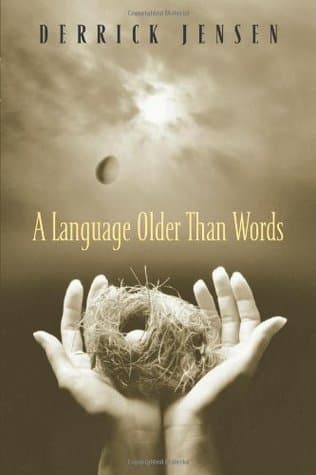
Core Idea
- Difficulty
- Hard
- Read it if
- You are grappling with the systemic roots of violence, feel a deep concern for the environment, and are open to an intense, challenging exploration of personal and societal disconnection, and the nature of oppression.
- Skip it if
- You prefer light reading, are uncomfortable with confrontational prose, or are seeking a purely academic or optimistic self-help guide without deep dives into trauma, history, and the darker aspects of civilization.
Key Takeaways from A Language Older Than Words
The Root of Violence: Disconnection
Violence stems from a profound severance from the natural world and our authentic selves.
Jensen argues that violence, both personal and systemic, is not an inherent human trait but a result of our deep separation from the living world and our true, intuitive selves. He believes that modern society actively encourages this separation, teaching us to value abstract ideas, industrial systems, and intellectualizing over direct experience, emotional understanding, and ecological connection. This separation creates a spiritual emptiness that makes us prone to exploiting others and the environment, as we no longer see their intrinsic value or our connection to them. The book suggests this alienation is a learned problem, passed down through generations, showing up as a widespread numbness to suffering and an inability to recognize our place in the larger web of life.
“The problem is not simply that we forget who we are, but that we are never taught. We are taught to be disconnected.”
In the book: Jensen frequently references indigenous cultures' deep reverence for nature and community as a stark contrast to Western industrialized societies, where the exploitation of resources and people is normalized. He points to the systematic destruction of ecosystems and the prevalence of domestic abuse as symptoms of this underlying disconnection.
Try this: Cultivate daily practices that foster reconnection with nature (e.g., walking barefoot, observing local wildlife, gardening). Prioritize direct experience and sensory input over screen time and abstract thought. Engage in practices that help you feel your emotions fully, rather than intellectualizing or suppressing them.
Related ideas: ecological-disconnection, systemic-violence, spiritual-alienation
The Language of the Living World
Beyond human words, the natural world communicates through a profound, embodied language we've forgotten.
Jensen introduces the idea of a 'language older than words' – an intuitive, non-verbal communication system common to all living beings. This language is about direct knowing, empathy, instinct, and the felt experience of being connected. He suggests that humans, especially in modern Western cultures, have suppressed this innate ability, favoring verbal language and rational thought. To relearn this older language means tuning into our senses, our bodies, and subtle environmental cues, allowing us to see the world not as objects but as a communicating network. This reawakening is important for understanding the true costs of our actions and for developing genuine compassion.
“There is a language older than words, and it is the language of the living world. It is the language of feeling, of instinct, of being.”
In the book: Jensen's personal anecdotes often describe moments of profound connection with animals or landscapes where he feels a direct, non-verbal understanding. He also draws parallels to indigenous knowledge systems that emphasize listening to the land and its creatures.
Try this: Spend time in nature without distraction, focusing on sensory input: the sounds, smells, textures. Practice mindfulness and meditation to quiet the rational mind and open to intuitive perception. Pay attention to your gut feelings and bodily sensations as sources of information.
Related ideas: non-verbal-communication, ecological-intelligence, intuitive-knowing
Internalized Oppression and Self-Hatred
The violence we experience often becomes internalized, leading to self-destructive patterns and complicity.
Jensen connects the experience of domestic abuse to broader societal violence and oppression. He argues that those who suffer abuse often internalize the abuser's logic, leading to self-blame, self-hatred, and a reduced sense of worth. This internalized oppression can appear as a belief that one deserves the abuse or is flawed. On a societal level, this translates into going along with destructive systems: we internalize the idea that endless growth is good, that nature is a resource to be exploited, and that violence is sometimes necessary. This self-hatred and complicity stop us from resisting effectively, as we become agents of our own subjugation, mirroring the very violence we speak against.
“The structure of our society is such that it forces us to internalize our own oppression, to hate ourselves for not being able to conform to its demands.”
In the book: Jensen's own memoir details his struggle with internalized shame and self-hatred following childhood abuse, and how this made him initially complicit in destructive behaviors and thought patterns. He extends this to how society internalizes the 'right' of corporations to destroy forests or pollute rivers.
Try this: Identify and challenge internalized narratives of self-blame or inadequacy. Seek therapy or support groups to process past trauma. Critically examine societal narratives that normalize exploitation or violence, and actively resist internalizing them.
Related ideas: internalized-trauma, self-blame, societal-complicity
The Personal is Planetary
Individual trauma and global ecological destruction are deeply intertwined, mirroring each other.
A main idea in Jensen's work is the link between personal violence and planetary destruction. He states that the mindset allowing a person to abuse another—seeing them as an object, denying their feelings, asserting dominance—is the same mindset allowing industrial society to exploit the natural world. Both situations involve a lack of empathy, a disregard for the other's inherent value, and a belief in the right to control and consume. The book argues that addressing one without addressing the other is pointless; true healing requires recognizing the shared roots of these problems. Our external world reflects our internal one, and vice versa. Violence against our bodies and spirits reflects violence against the Earth.
“The same pathology that allows a man to beat his wife is what allows us to destroy the planet.”
In the book: Jensen draws direct parallels between the psychological mechanisms of an abuser (dehumanization, control, denial) and the actions of corporations or governments destroying ecosystems (viewing nature as a 'resource,' externalizing costs, denying consequences). His personal story of abuse is a microcosm of global exploitation.
Try this: Approach environmental activism with an understanding of its psychological and emotional dimensions. Recognize how personal healing can inform and strengthen your commitment to ecological justice. See the fight for personal autonomy and planetary health as one unified struggle.
Related ideas: ecopsychology, interconnectedness, trauma-and-ecology
The Sickness of Civilization
Modern industrial civilization itself is a pathological system that perpetuates violence and disconnection.
Jensen does not just critique individual acts of violence but calls modern industrial civilization pathological. He argues that this civilization is built on ideas of separation, progress, and human exceptionalism that lead to exploitation and destruction. Its institutions—economic, political, and social—are designed to extract, control, and dominate, both people and nature. This system discourages empathy, promotes consumption, and punishes those who resist its destructive path. He states that to truly address violence, we must confront the systemic nature of this 'sickness' and question the basic ideas our societies are built on, rather than just fixing symptoms. It is not about a few bad apples, but the entire system.
“This culture, this civilization, is not merely flawed; it is insane. It is designed to destroy.”
In the book: Jensen points to the relentless expansion of industrial capitalism, the historical colonization of lands and peoples, and the ongoing ecological collapse as evidence of civilization's destructive core. He contrasts this with pre-civilized or indigenous societies that lived in relative harmony with their environments.
Try this: Question the fundamental assumptions of progress and growth in modern society. Engage in forms of resistance that challenge systemic structures, not just individual behaviors. Support and learn from alternative, more sustainable ways of living outside the dominant paradigm.
Related ideas: civilizational-critique, industrial-pathology, systemic-destruction
The Power of Bearing Witness
To truly see and acknowledge suffering is the first, crucial step towards healing and resistance.
Jensen stresses the importance of bearing witness—not just observing, but truly seeing, feeling, and acknowledging the pain and destruction around us, both personal and planetary. He argues that much societal violence relies on denial; if we refuse to see, we cannot act. Bearing witness is an act of courage and empathy that breaks through numbness and allows for genuine connection and responsibility. It means allowing ourselves to feel the grief, rage, and despair that come from facing harsh realities, rather than turning away or intellectualizing the problem. This act of seeing is necessary for any meaningful resistance or healing, as it reconnects us to the suffering world.
“To bear witness is to make a commitment. It is to say, 'I see you, and your suffering is real, and I will not look away.'”
In the book: Jensen's memoir is a testament to bearing witness to his own past trauma and the ongoing destruction of the natural world. He describes the emotional toll and transformative power of allowing himself to feel the pain rather than suppress it.
Try this: Consciously practice acknowledging difficult truths, both personal and global, without immediately seeking solutions or distractions. Allow yourself to feel emotions like grief or anger in response to suffering. Engage in direct observation of damaged ecosystems or communities to foster empathy.
Related ideas: empathy, acknowledgment, ecological-grief
Beyond Hope and Despair
True action stems not from naive hope or paralyzing despair, but from love and fierce commitment.
Jensen critiques traditional ideas of hope and despair, arguing that both can stop us from acting. Naive hope can lead to passivity, waiting for an external savior or a miracle. Despair, conversely, can lead to paralysis and a feeling of futility. He suggests moving beyond this, advocating instead for action rooted in a deep love for the living world and a strong commitment to defending it. This commitment comes from a clear assessment of the situation, an acceptance of grief, and a determination to act regardless of the chances of 'success.' It is about doing what is right because it is right, not because it guarantees a specific outcome. This is a more mature and resilient way to engage.
“Hope is a crutch. It makes us wait for someone else to save us. Despair paralyzes. What we need is love, and courage.”
In the book: Jensen's writing often challenges environmentalists to move beyond feel-good narratives and confront the severity of ecological collapse. He advocates for direct action and resistance, even when the odds seem insurmountable, drawing strength from a deep connection to what is being defended.
Try this: Identify what you genuinely love and are committed to protecting, rather than focusing solely on 'solving' problems. Engage in actions that align with your values, even if they feel small or don't promise immediate victory. Cultivate resilience by accepting uncertainty and focusing on the process of engagement.
Related ideas: active-engagement, fierce-love, ecological-resistance
Reclaiming Our Wildness
Healing involves reconnecting with our intrinsic, untamed, and intuitive nature.
Jensen argues that modern civilization has 'domesticated' humans, separating us from our wildness, instincts, and deep connection to the Earth. This domestication makes us compliant, controllable, and numb to the destruction around us. Reclaiming our wildness means shedding the societal conditioning that has made us afraid of our emotions, our bodies, and our intuitive knowledge. It involves embracing our innate capacity for fierce love, protective rage, and untamed creativity. This process is not about returning to a primitive state, but about integrating our rational minds with our primal selves, allowing us to respond authentically and powerfully to current challenges. It is about being fully alive, fully human, and fully part of the living world.
“We are not meant to be domesticated. We are meant to be wild, to be free, to be part of the living world.”
In the book: Jensen's personal journey of healing from abuse involves reconnecting with his own primal responses and instincts, often through direct engagement with nature. He contrasts this with the societal pressure to be 'civilized' and suppress strong emotions.
Try this: Engage in activities that allow for spontaneous, non-structured movement and expression. Spend time in genuinely wild places. Challenge societal norms that shame or suppress natural emotions. Trust your intuition and gut feelings more often.
Related ideas: wildness, instinctual-self, de-domestication
The Necessity of Actionable Love
Love for the world requires defending it, even through confrontational and disruptive means.
For Jensen, love is not a sentimental or passive feeling, but a powerful force that demands action. If we truly love something—our children, our community, a forest, a river—we will defend it when it is threatened. This 'actionable love' often requires moving beyond polite discussion or typical activism and engaging in more direct, even confrontational, forms of resistance. He suggests that those who truly love the Earth cannot stand by while it is systematically destroyed. This might involve civil disobedience, direct intervention, or other disruptive actions aimed at stopping destructive systems. It is a call to show our love through courageous and sometimes unpopular acts of defense.
“Love is not a passive emotion. It is a verb. It demands action. And sometimes, that action is resistance.”
In the book: Jensen frequently discusses the need for militant defense of the Earth, drawing parallels to how one would defend a loved one from an attacker. He critiques the effectiveness of purely symbolic or legalistic forms of environmentalism that fail to halt destruction.
Try this: Identify what you are willing to actively defend. Research and consider participating in forms of direct action or civil disobedience that align with your values. Support organizations that engage in confrontational resistance against ecological destruction. Understand that love sometimes requires disruption.
Related ideas: ecological-defense, direct-action, radical-love
A Language Older Than Words Quotes
“The problem is not that we are using the wrong means to achieve the right ends. The problem is that we are using the wrong ends.”
“Love does not require you to give up your boundaries. Love requires you to know them.”
“If we are going to make a garden, we must take the side of the soil, not the side of the weed.”
“Civilization, in short, is not a thing, but a process: the process of making people safe from the natural world.”
“The primary cause of violence is the belief that violence is a legitimate response to suffering.”
“If you don't know the names of the plants and animals, you don't know the place. And if you don't know the place, you can't love it. And if you don't love it, you won't save it.”
“The greatest gift we can give to the future is to live as if it matters.”
“One of the primary functions of privilege is to allow us to be oblivious to the suffering of others.”
“The truth is not a thing to be found, but a thing to be made.”
“We are all born into a world that is already broken. Our task is not to fix it, but to mend it.”
“What happens to the land happens to the people.”
“Despair is not an option; it is a choice. And it is a choice that leads to inaction.”
“The ability to speak does not mean that you have something to say. It means that you can make sounds.”
“The first step toward freedom is to recognize that you are not free.”
“To be truly alive is to feel everything, even the pain, even the sorrow, even the rage.”
Quiz
10 questions on the main ideas. Each answer comes with a short explanation.
Question 1
What primary concept does Jensen introduce early in the book to describe the pervasive, destructive force that impacts individuals and the planet, often stemming from early life experiences?
- Ecological Disconnect
- The Culture of Empire
- The Pathology of Violence
- Species Alienation
Show answer
C. The Pathology of Violence Jensen fundamentally argues that violence is a pathology, a disease that permeates all levels of society and the natural world, originating from learned behaviors and systems of control.
Question 2
Jensen frequently uses the metaphor of 'the river' in the book. What does 'the river' primarily represent in his philosophical framework?
- The flow of human progress and technological advancement.
- The inherent wisdom and interconnectedness of the natural world, often contrasted with human alienation.
- The unstoppable force of societal collapse.
- The subconscious mind and its hidden traumas.
Show answer
B. The inherent wisdom and interconnectedness of the natural world, often contrasted with human alienation. The river symbolizes the ancient, deep, and intuitive knowledge of the Earth and our place within it, a 'language older than words' that humans have largely forgotten or suppressed.
Question 3
What personal experience is central to Jensen's memoir and serves as a foundational example of the violence he critiques?
- His experiences as a frontline environmental activist.
- His struggles with addiction and recovery.
- His childhood experiences of domestic abuse.
- His time serving in the military.
Show answer
C. His childhood experiences of domestic abuse. The book is a deeply personal memoir, with Jensen's own experiences of domestic abuse in childhood forming the core narrative through which he explores broader societal violence.
Question 4
Jensen argues that modern industrial civilization disconnects us from what essential aspect of existence?
- The pursuit of individual happiness.
- Our inherent capacity for technological innovation.
- Our direct, physical, and spiritual connection to the natural world and its cycles.
- The importance of economic growth.
Show answer
C. Our direct, physical, and spiritual connection to the natural world and its cycles. A central theme is the profound alienation caused by industrial civilization, severing our direct, embodied connection to the land, the non-human world, and the ancient wisdom it holds.
Question 5
Jensen frequently criticizes the concept of 'hope' as it is commonly understood in activist circles. Why does he view conventional hope as potentially problematic or even paralyzing?
- He believes hope is antithetical to spiritual awakening.
- He argues that hope often implies waiting for external forces to save us, rather than taking decisive action ourselves.
- He thinks hope is a capitalist construct designed to pacify dissent.
- He sees hope as a sign of weakness and lack of conviction.
Show answer
B. He argues that hope often implies waiting for external forces to save us, rather than taking decisive action ourselves. Jensen often distinguishes between 'hope' as passive expectation and 'resolve' or 'courage.' He suggests that conventional hope can lead to inaction, as people wait for a positive outcome rather than committing to the difficult work required, regardless of the perceived chances of success.
Question 6
Which of the following best describes Jensen's view on the relationship between personal trauma and ecological destruction?
- They are unrelated phenomena, best understood separately.
- Personal trauma is a metaphor for ecological destruction, but not directly linked.
- The patterns of violence and control experienced in domestic abuse are mirrored and amplified in humanity's treatment of the natural world.
- Ecological destruction is primarily caused by individual psychological failings, not systemic issues.
Show answer
C. The patterns of violence and control experienced in domestic abuse are mirrored and amplified in humanity's treatment of the natural world. A core argument of the book is that the same pathologies of violence, control, and objectification that manifest in personal abuse are extended to and reflected in the systematic destruction of the planet.
Question 7
Jensen frequently uses the term 'civilization' in a critical sense. What is his primary critique of 'civilization' in 'A Language Older Than Words'?
- Its lack of advanced technology.
- Its inherent tendency towards hierarchy, control, and disconnection from the living world, leading to violence.
- Its overemphasis on individual freedom at the expense of community.
- Its inability to produce great art or literature.
Show answer
B. Its inherent tendency towards hierarchy, control, and disconnection from the living world, leading to violence. For Jensen, 'civilization' (as he defines it) is not merely a stage of human development but a specific social structure characterized by control, exploitation, and a fundamental separation from the natural world, which he sees as the root of much violence.
Question 8
What does Jensen imply is the role of 'rationality' and 'logic' in perpetuating the pathological violence he describes?
- They are the only tools capable of solving the crisis.
- They are inherently flawed and should be abandoned entirely.
- They are often used to justify and rationalize destructive behaviors, divorcing us from intuitive and emotional responses to suffering.
- They are crucial for understanding the natural world, but not human society.
Show answer
C. They are often used to justify and rationalize destructive behaviors, divorcing us from intuitive and emotional responses to suffering. Jensen argues that an over-reliance on detached rationality and logic can allow us to intellectualize away suffering, both human and ecological, making it easier to accept or participate in violence without emotional consequence.
Question 9
How does Jensen suggest individuals can begin to heal from the pervasive violence and disconnection, even in a world steeped in it?
- By accumulating wealth and political power to influence policy.
- By withdrawing from society and living in complete isolation.
- By re-establishing deep, visceral connections to the natural world and refusing to participate in destructive systems where possible.
- By focusing solely on individual therapy and ignoring societal issues.
Show answer
C. By re-establishing deep, visceral connections to the natural world and refusing to participate in destructive systems where possible. Jensen advocates for a return to embodied, intuitive connection with the living world, recognizing our place within it, and actively resisting the systems that perpetuate violence and disconnection, even if the 'solution' isn't immediately apparent or easy.
Question 10
Jensen uses the analogy of a 'house on fire' when discussing the state of the planet and the urgency of action. What is the core implication of this analogy?
- That we should calmly assess the situation and develop long-term sustainable plans.
- That the situation is dire and requires immediate, often unconventional, and forceful action, rather than polite debate or incremental change.
- That we should call the authorities and let them handle the problem.
- That the fire is a natural process and we should not interfere.
Show answer
B. That the situation is dire and requires immediate, often unconventional, and forceful action, rather than polite debate or incremental change. The 'house on fire' analogy is a powerful call to action, emphasizing that when faced with immediate, existential threat, one doesn't debate or wait for consensus; one acts decisively and urgently to put out the fire, regardless of the cost or social norms.
A Language Older Than Words FAQ
What is 'A Language Older Than Words' about?
Derrick Jensen's 'A Language Older Than Words' is a powerful memoir that intertwines his personal experiences with domestic abuse with a broader philosophical exploration of violence in society and its impact on the natural world. It delves into the roots of violence and offers insights into fostering healthier communities.
Does 'A Language Older Than Words' offer solutions to violence?
While the book doesn't provide a simple step-by-step guide, it challenges readers to re-examine their understanding of community, power, and connection to the Earth. It encourages a shift in perspective that can lead to more compassionate and sustainable ways of living, thereby addressing the underlying causes of violence.
What is the 'language older than words' that the book refers to?
The 'language older than words' refers to the intuitive, non-verbal communication and understanding that exists between humans and the natural world, as well as the deep, often unacknowledged, patterns and consequences of human actions. It speaks to a primal connection and awareness that precedes spoken language.
How does this book differ from typical self-help books on trauma?
'A Language Older Than Words' transcends typical self-help by connecting personal trauma to systemic societal violence and ecological destruction, rather than focusing solely on individual healing techniques. It offers a much broader, philosophical, and ecological context for understanding and responding to abuse.
Is 'A Language Older Than Words' a difficult read due to its subject matter?
The book deals with sensitive and challenging themes of violence and abuse, which can be emotionally demanding. However, Jensen's poetic prose and profound insights make it a deeply engaging and ultimately transformative read for those willing to confront these difficult truths.
What role does nature play in Derrick Jensen's 'A Language Older Than Words'?
Nature plays a pivotal role, serving as both a source of healing and a metaphor for understanding the destructive patterns of human society. Jensen draws parallels between the abuse of individuals and the abuse of the environment, suggesting that a disconnect from nature contributes to violence.
Is 'A Language Older Than Words' suitable for readers interested in environmental philosophy?
Absolutely. The book deeply explores the interconnectedness of human violence and ecological degradation, making it highly relevant for readers interested in environmental philosophy, deep ecology, and the ethical dimensions of our relationship with the natural world.
Does 'A Language Older Than Words' offer hope despite its dark themes?
Yes, while unflinching in its portrayal of violence, the book ultimately offers a powerful message of hope through understanding and connection. By identifying the roots of pathology, it illuminates pathways toward building more just, compassionate, and sustainable communities.
About the author

Derrick Jensen is an American author and environmental, social, and political activist. He is best known for his books "A Language Older Than Words" and "The Culture of Make Believe," which explore themes of environmental destruction and societal control. Jensen's work is characterized by its critical examination of modern civilization and its impact on the natural world.
Similar books
- Ishmael
Daniel Quinn
3.9 (2k) average on GoodreadsFantasyExplores the destructive myths of civilization and humanity's relationship with the natural world through philosophical dialogue.
- The Diary of a Young Girl
Anne Frank
4.2 (2.7M) average on GoodreadsBiographyDuring the Nazi occupation, a teenage girl's diary, written from a secret annex, shares observations on humanity, hope, and the wait for freedom.
- Eat, Pray, Love
Elizabeth Gilbert
3.6 (1.5M) average on GoodreadsLifestyleA heartbroken writer leaves her conventional life for a year-long global search for pleasure in Italy, spiritual devotion in India, and unexpected love and balance in Bali.
- Night
Elie Wiesel
4.3 (970k) average on GoodreadsBiographyIn the darkness of Auschwitz and Buchenwald, a teenage Elie Wiesel faces the extermination of his family, the loss of his faith, and the lasting scars of humanity's deepest cruelty.
- Steve Jobs
Walter Isaacson
4.1 (957k) average on GoodreadsBusinessSteve Jobs was a visionary who fused creativity and technology to revolutionize six industries and shape our digital world.
- The Glass Castle
Jeannette Walls
4.3 (903k) average on GoodreadsBiographyJeannette Walls's memoir describes her unusual childhood with brilliant, free-spirited parents whose poverty-stricken life shaped her independence and love despite family problems.





Enjoyed the summary?
A summary gives you the shape of the book. The book itself has the detail, the examples and the voice.
Find A Language Older Than Words on AmazonAs an Amazon Associate, BookBrief earns from qualifying purchases. How we're funded