
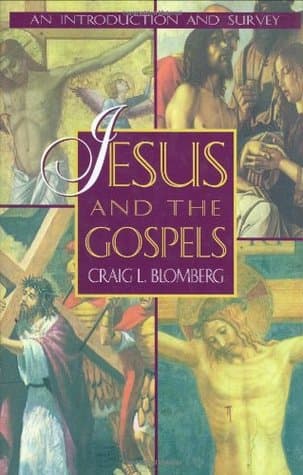
Core Idea
- Difficulty
- Hard
- Read it if
- You are a serious student of the New Testament, pastor, or layperson seeking a robust academic defense of the Gospels' historical reliability from an evangelical viewpoint, or if you want to delve deeply into source criticism, the Synoptic Problem, and the unique contributions of each Gospel author.
- Skip it if
- You are looking for a devotional read, a highly simplified introduction to Jesus' life, or a book that avoids detailed academic discussions of textual criticism and historical methodology. Also, if you are firmly convinced the Gospels are historically unreliable and are not open to a scholarly defense of their credibility.
Key Takeaways from Jesus and the Gospels
Historical Reliability of the Gospels
The Gospels are not mere theological treatises but historically grounded documents.
Blomberg argues for the historical reliability of the Gospels, challenging the idea that they are only faith-based stories without factual basis. He uses historical-critical methods common for other ancient texts, showing that the Gospels' accounts fit with what we know about first-century Palestine. This includes looking at archaeological finds, non-biblical historical sources (like Tacitus, Pliny the Younger, and Josephus), and the internal consistency of the narratives. He notes that small differences between accounts do not undermine their credibility. Instead, they are typical of independent eyewitness testimonies and often show different perspectives rather than contradictions. This approach makes a strong case for treating the Gospels as serious historical sources, not just theological ones.
“The Gospels present themselves as history, and they stand up remarkably well to historical scrutiny when compared to other ancient biographies.”
In the book: Blomberg cites the consistency of the Gospels with archaeological findings concerning cities, customs, and political figures of the era, alongside corroborating references to Jesus in secular historical writings by Josephus and Tacitus.
Try this: Approach the Gospels with an open mind to their historical claims, recognizing that their ancient context and literary genre differ from modern historical writing but still offer reliable information. Engage with scholarly resources that address apparent discrepancies rather than dismissing the texts outright.
Related ideas: historical-criticism, eyewitness-testimony, ancient-biography
Synoptic Problem and Source Criticism
Understanding the literary relationships between Matthew, Mark, and Luke unlocks deeper insights.
The 'Synoptic Problem' refers to explaining the similarities and differences among Matthew, Mark, and Luke. Blomberg explores the main scholarly idea: Markan priority (Mark was written first) and the existence of a hypothetical 'Q' source (a collection of Jesus' sayings shared by Matthew and Luke, but not Mark). He also discusses 'M' and 'L' sources, which are unique to Matthew and Luke. Understanding these literary relationships helps explain why passages are similar or different, and how each evangelist shaped their narrative for their specific audience and theological purpose. This clarifies the authors' intentions and skill, rather than diminishing the Gospels' inspiration.
“The Synoptic Problem, while complex, is not an insurmountable obstacle but a fascinating puzzle that, when addressed, enhances our appreciation for the distinct contributions of each Gospel writer.”
In the book: Blomberg details the 'two-source hypothesis' (Mark and Q), citing examples of verbal agreements and disagreements, as well as the order of events in the Synoptics, to support the proposed literary dependency.
Try this: When reading Matthew, Mark, and Luke, pay attention to parallel passages. Consider how each author might be emphasizing different aspects of an event or teaching, understanding that their choices are often informed by their sources and intended audience.
Related ideas: markan-priority, q-source, synoptic-gospels, source-criticism
John's Unique Contribution
The Fourth Gospel offers a distinct theological lens and supplemental narratives.
Blomberg focuses on the Gospel of John, pointing out its unique features compared to the Synoptics. John contains much material not in Matthew, Mark, or Luke, including longer speeches, different miracle accounts, and a distinct timeline for Jesus' ministry (e.g., multiple Passovers). While some scholars see a conflict, Blomberg argues that John's goal is not to rewrite history. Instead, it offers a theological interpretation of Jesus' identity as the divine Son of God, using carefully chosen events and teachings. He sees John as giving extra information and deeper theological reflection, rather than a contradictory account. This often fills gaps or offers a more direct statement of Jesus' divinity. This understanding allows for a richer appreciation of both John's theological depth and its historical basis.
“John's Gospel, while stylistically and structurally distinct from the Synoptics, does not contradict them but rather complements and illuminates Jesus' identity and mission with a profound theological depth.”
In the book: Blomberg points to John's unique 'I Am' statements, the absence of parables, and the focus on Jerusalem ministry early in Jesus' public life, contrasting these with the Synoptics but arguing for complementarity.
Try this: Read John's Gospel not as a replacement for the Synoptics, but as a profound theological meditation that unveils different facets of Jesus' identity and purpose. Look for how John's unique narratives and discourses illuminate or expand upon themes found elsewhere.
Related ideas: johnnine-gospel, theological-interpretation, i-am-statements
The Portrait of Jesus: Messiah, Son of God, Human
The Gospels collectively present a multifaceted, yet coherent, image of Jesus' identity.
Blomberg analyzes how each Gospel contributes to the overall picture of Jesus. Matthew presents Jesus as the Jewish Messiah fulfilling Old Testament prophecy. Mark portrays him as the suffering servant and powerful Son of God. Luke highlights his universal role as savior and compassion for the marginalized. John clearly states his divine nature and pre-existence. Despite these different focuses, Blomberg shows that the Gospels together present a consistent, non-contradictory image of Jesus as both fully divine and fully human. He explores how Jesus' miracles, teachings, and interactions consistently reveal this dual nature, inviting readers to consider the implications of his identity. This integrated view is important for a complete understanding of Christology.
“Across all four Gospels, a consistent and compelling portrait emerges: Jesus is the promised Messiah, the divine Son of God, yet fully human, experiencing life's realities.”
In the book: Blomberg compares the genealogies in Matthew (tracing through Abraham and David) and Luke (tracing through Adam), showing how they emphasize Jesus' messianic and universal humanity respectively, alongside John's opening declaration of Jesus' pre-existence and divinity.
Try this: When studying the Gospels, intentionally consider how each author's unique perspective contributes to your overall understanding of Jesus' identity as Messiah, Son of God, and human. Synthesize these perspectives to form a richer, more complete picture.
Related ideas: christology, messiah, son-of-god, divinity-of-christ
Jesus' Teachings and Parables
The Kingdom of God is the central theme, communicated through relatable yet challenging parables.
Blomberg examines the content and purpose of Jesus' teachings, especially the parables and the Kingdom of God. He explains that the Kingdom of God is not just a future heavenly realm but a present reality that Jesus started, requiring a new way of life. The parables, often misunderstood as simple moral lessons, are literary tools designed to both reveal and hide truth, challenging listeners to think and choose a response. Blomberg highlights their socio-cultural context, showing how understanding first-century Jewish life clarifies their meaning and relevance today. He argues that Jesus' ethical teachings, particularly in the Sermon on the Mount, are not impossible ideals but basic principles for living within this Kingdom.
“Jesus' parables were not merely illustrative stories; they were provocative calls to decision, revealing the nature of the Kingdom of God and challenging his hearers to respond.”
In the book: Blomberg analyzes specific parables like the Sower, the Prodigal Son, and the Good Samaritan, explaining their original context and how they subvert expectations while revealing truths about God's character and the Kingdom.
Try this: When encountering Jesus' parables, move beyond surface-level interpretation. Research their first-century context and consider the challenging, transformative message they convey about the Kingdom of God and your own life.
Related ideas: kingdom-of-god, parables-of-jesus, sermon-on-the-mount, ethical-teachings
Miracles as Signs and Demonstrations
Jesus' miracles were not arbitrary displays of power but purposeful signs of God's Kingdom.
Blomberg treats Jesus' miracles as key parts of his ministry, not just isolated events to be debated. He argues that the Gospels present miracles as 'signs' (especially in John) that point to Jesus' identity and God's active presence. They are demonstrations of God's power over sickness, nature, and death, validating Jesus' claims and showing the Kingdom of God entering human history. Blomberg addresses common skeptical arguments, suggesting that the volume, variety, and public nature of Jesus' miracles, attested by both supporters and opponents, make them hard to dismiss. He frames them as a core part of Jesus' mission to restore creation and offer hope, rather than just magical acts.
“Jesus' miracles are not merely proof-texts for his divinity; they are integral to his message, demonstrating the inbreaking of God's Kingdom and offering a foretaste of its ultimate restoration.”
In the book: Blomberg discusses the healing of the paralytic, the feeding of the five thousand, and the raising of Lazarus, highlighting how these specific miracles connect to Old Testament prophecies and Jesus' claims about himself and the Kingdom.
Try this: When reading about Jesus' miracles, consider not only the 'what' but the 'why.' Reflect on how each miracle serves as a sign or demonstration of God's character, Jesus' identity, and the nature of the Kingdom of God.
Related ideas: miracles-of-jesus, signs-and-wonders, kingdom-inauguration, supernatural
The Passion and Resurrection
The climax of the Gospel narrative, foundational to Christian faith and historically attested.
Blomberg states that Jesus' Passion (suffering and death) and Resurrection are the clear climax of all four Gospel narratives and the core of Christian faith. He examines the Gospel accounts of Jesus' trial, crucifixion, and post-resurrection appearances. He notes their internal consistency while acknowledging small variations that support, rather than diminish, their credibility as independent testimonies. He presents the empty tomb and the many eyewitness accounts of the risen Jesus as strong historical evidence, challenging other theories (e.g., swoon theory, hallucination theory) for their lack of explanatory power. Blomberg stresses that the disciples' transformation and willingness to die for their belief in the risen Christ show their conviction.
“The death and resurrection of Jesus are not merely the conclusion of his earthly ministry, but the pivotal events upon which the entire Christian message stands or falls, attested by a surprising array of evidence.”
In the book: Blomberg details the accounts of the women at the tomb, the appearances to the disciples, and Paul's early creedal statement in 1 Corinthians 15, arguing these provide strong cumulative evidence for the historicity of the resurrection.
Try this: Engage deeply with the Passion and Resurrection narratives, recognizing their theological and historical weight. Consider the implications of these events for your understanding of life, death, and hope, and how they transformed the early disciples.
Related ideas: passion-narrative, resurrection-of-jesus, empty-tomb, eyewitness-accounts
Theological Diversity within Unity
Each Gospel writer presents a unique theological perspective, contributing to a unified message.
Blomberg argues against seeing the Gospels as all the same or contradictory. Instead, he supports 'theological diversity within unity.' Each evangelist—Matthew, Mark, Luke, and John—had a specific audience, purpose, and literary strategy, leading to distinct theological focuses. Matthew focuses on Jesus as the Jewish Messiah. Mark focuses on Jesus as the suffering Son of God. Luke focuses on Jesus as the universal Savior. John focuses on Jesus as the divine Word incarnate. Blomberg shows that these differences are not flaws but intentional choices that deepen our understanding of Jesus. They provide a multifaceted picture that no single Gospel could achieve alone. This approach helps readers appreciate each Gospel's unique contribution while recognizing their overall agreement on Jesus' identity and mission.
“The four Gospels, though distinct in their emphases and literary styles, are not competing narratives but complementary voices, each offering an indispensable perspective on the singular reality of Jesus Christ.”
In the book: Blomberg illustrates this by comparing the opening chapters of each Gospel: Matthew's genealogy from Abraham, Mark's abrupt beginning with John the Baptist, Luke's birth narrative focusing on Mary, and John's cosmic prologue.
Try this: When studying the Gospels, consciously identify the unique theological themes and literary styles of each author. Read them comparatively to gain a richer, more nuanced understanding of Jesus and his significance.
Related ideas: gospel-authorship, theological-themes, literary-style, gospel-harmonization
Jesus' Jewish Context
Understanding first-century Judaism is crucial for interpreting Jesus and the Gospels accurately.
Blomberg consistently emphasizes the importance of understanding Jesus within his first-century Jewish context. He explains various Jewish groups (Pharisees, Sadducees, Essenes, Zealots), their beliefs, and their relationship with Roman occupation. He clarifies how Jesus' teachings and actions—such as his interpretation of the Law, his use of parables, and his claims about the Kingdom of God—would have been understood (and often misunderstood) by his Jewish contemporaries. Blomberg shows that Jesus was not introducing a completely new religion in a vacuum. Instead, he was fulfilling and reinterpreting the promises and expectations of the Old Testament. This contextual understanding prevents misinterpretations and reveals the implications of Jesus' ministry for both Jewish and Gentile audiences.
“To truly understand Jesus, one must understand the rich tapestry of first-century Judaism within which he lived, taught, and was ultimately rejected and embraced.”
In the book: Blomberg explains the significance of concepts like 'Son of Man,' 'Messiah,' and 'Kingdom of Heaven' within Jewish eschatological expectations, and how Jesus both fulfilled and subverted these expectations.
Try this: Actively seek to learn about first-century Jewish culture, customs, and religious beliefs when reading the Gospels. This will illuminate the nuances of Jesus' teachings and the reactions of his audience.
Related ideas: first-century-judaism, pharisees, sadducees, old-testament-fulfillment
Application for Contemporary Readers
The Gospels remain profoundly relevant, offering timeless wisdom for faith and life.
Beyond historical analysis, Blomberg guides the reader toward the contemporary relevance of the Gospels. He argues that understanding their historical and literary context is not an end in itself, but a way to a deeper, more informed faith and practical application. Jesus' teachings on ethics, relationships, justice, and the Kingdom of God remain challenging and transformative. The story of Jesus' life, death, and resurrection offers hope, purpose, and a model for discipleship. Blomberg encourages readers to move beyond intellectual agreement to active engagement, allowing the Gospels to shape their worldview, values, and actions today. He stresses that the Gospels call for a personal response and ongoing spiritual growth.
“The Gospels are not dusty ancient texts but living documents that continue to challenge, inspire, and transform those who engage with them thoughtfully and prayerfully.”
In the book: While not a specific 'study,' Blomberg's entire approach throughout the book is to bridge the gap between ancient text and modern reader, consistently drawing out the implications of his scholarly findings for faith and practice.
Try this: After studying the historical and theological aspects of a Gospel passage, intentionally reflect on its personal implications: How does this challenge my assumptions? How can I apply this teaching to my life today? What does it reveal about God and myself?
Related ideas: discipleship, spiritual-formation, biblical-application, contemporary-relevance
Jesus and the Gospels Quotes
“The Gospels are not biographies in the modern sense, but ancient biographies designed to persuade their readers of the truth about Jesus.”
“Miracles in the Gospels are not merely displays of power, but intentional acts that reveal God's character and purposes.”
“To interpret the parables correctly, one must first understand their original historical and cultural context.”
“The Sermon on the Mount presents an ethic that is radical, demanding, and ultimately achievable only through divine empowerment.”
“The resurrection is the linchpin of Christian faith; without it, the entire edifice collapses.”
“While there are differences in the Gospel accounts, these are best understood as complementary perspectives rather than irreconcilable contradictions.”
“Jesus's 'I Am' statements in John's Gospel are profound claims to divinity, echoing Yahweh's self-revelation in the Old Testament.”
“The kingdom of God is both a present reality to be experienced and a future hope to be anticipated.”
“The Synoptic Problem, while complex, has yielded significant insights into the literary relationships among Matthew, Mark, and Luke.”
“Jesus's compassion for the marginalized and outcast is a consistent theme across all four Gospels.”
“The passion narratives are not merely historical reports but theological interpretations of the saving significance of Jesus's death.”
“Understanding the Jewish background of Jesus and the Gospels is indispensable for proper interpretation.”
“The Great Commission is not just for a select few, but a mandate for all followers of Jesus to participate in spreading the Gospel.”
Quiz
10 questions on the main ideas. Each answer comes with a short explanation.
Question 1
According to Blomberg, what is the primary reason the Gospels are considered reliable historical sources for Jesus' life?
- They were written by highly educated Roman historians.
- They are the largest source of eyewitness information about Jesus.
- They contain numerous prophecies that were later fulfilled.
- They were discovered in archaeological digs alongside other historical documents.
Show answer
B. They are the largest source of eyewitness information about Jesus. Blomberg emphasizes that the Gospels' strength lies in their being the most extensive collection of eyewitness accounts from those who directly interacted with Jesus, making them crucial for understanding his life and ministry.
Question 2
Blomberg addresses the 'Synoptic Problem,' which primarily concerns the literary relationship between which three Gospels?
- Matthew, Mark, and John
- Mark, Luke, and John
- Matthew, Mark, and Luke
- Luke, John, and Acts
Show answer
C. Matthew, Mark, and Luke The Synoptic Problem investigates the similarities and differences among Matthew, Mark, and Luke, often proposing theories like Markan priority and the existence of a 'Q' source to explain their literary interdependence.
Question 3
Which Gospel, according to Blomberg, is often considered to have been written for a primarily Jewish audience, emphasizing Jesus as the Messiah who fulfills Old Testament prophecy?
- Mark
- Luke
- Matthew
- John
Show answer
C. Matthew Blomberg highlights Matthew's frequent use of Old Testament citations and its structural parallels to Jewish literary forms, indicating a primary audience familiar with Jewish traditions and expectations of the Messiah.
Question 4
Blomberg discusses the concept of 'form criticism' as applied to the Gospels. What is the primary goal of form criticism?
- To identify the original historical context of Jesus's ministry.
- To reconstruct the oral traditions behind the written Gospels.
- To analyze the theological themes unique to each Gospel writer.
- To determine the precise chronological order of events in Jesus's life.
Show answer
B. To reconstruct the oral traditions behind the written Gospels. Form criticism attempts to classify the various 'forms' (parables, miracles, pronouncement stories) found in the Gospels and trace them back to their oral pre-literary stages, shedding light on the early church's transmission of Jesus's teachings and deeds.
Question 5
According to Blomberg, what is a significant argument for the early dating of the Gospels, particularly Mark?
- The lack of mention of the destruction of the Jerusalem Temple in AD 70.
- The highly developed Christology present in all four Gospels.
- References to Roman emperors who reigned after AD 100.
- The use of sophisticated Greek literary devices.
Show answer
A. The lack of mention of the destruction of the Jerusalem Temple in AD 70. Blomberg, among others, argues that the absence of any explicit mention of the destruction of the Jerusalem Temple in AD 70 in Mark (and implicitly in Matthew and Luke) suggests these Gospels were likely written before this pivotal event, as it would have been a significant fulfillment of Jesus's prophecies.
Question 6
Which Gospel writer, according to Blomberg, is often portrayed as emphasizing Jesus's compassion for the marginalized, women, and the poor, and includes unique parables like the Good Samaritan and the Prodigal Son?
- Matthew
- Mark
- Luke
- John
Show answer
C. Luke Blomberg consistently points out Luke's distinctive focus on social justice and Jesus's ministry to those on the fringes of society, a theme evident in many of his unique narratives and parables.
Question 7
When discussing the historical reliability of the Gospels, Blomberg often compares them to other ancient biographical works. What is a key conclusion he draws from this comparison regarding the Gospels' historical accuracy?
- The Gospels are less reliable than most ancient biographies due to their theological agenda.
- The Gospels meet or exceed the standards of historical reliability for ancient biographies.
- The Gospels are entirely unique and cannot be compared to other ancient literature.
- The Gospels are primarily mythological and should not be treated as historical documents.
Show answer
B. The Gospels meet or exceed the standards of historical reliability for ancient biographies. Blomberg argues that when evaluated by the same historical-critical standards applied to other ancient biographies, the Gospels stand up remarkably well, often surpassing them in terms of manuscript evidence and proximity to events.
Question 8
Blomberg discusses the concept of 'redaction criticism.' What is the primary focus of this critical approach when applied to the Gospels?
- Identifying the sources used by the Gospel writers.
- Analyzing the theological perspectives and unique emphases of each evangelist.
- Reconstructing the original sayings of Jesus.
- Determining the cultural background of the early Christian communities.
Show answer
B. Analyzing the theological perspectives and unique emphases of each evangelist. Redaction criticism focuses on how the evangelists (redactors) edited, arranged, and shaped their source material to convey their specific theological messages and address the needs of their respective communities.
Question 9
In his discussion of the Gospel of John, Blomberg highlights its distinctiveness compared to the Synoptics. Which of the following is NOT a characteristic Blomberg attributes to John?
- Emphasis on long discourses and theological dialogues.
- Focus on a shorter, primarily Galilean ministry of Jesus.
- High Christology, presenting Jesus as the divine Logos.
- Inclusion of unique 'I Am' statements by Jesus.
Show answer
B. Focus on a shorter, primarily Galilean ministry of Jesus. Blomberg notes that John portrays a longer, multi-year ministry of Jesus, with several trips to Jerusalem, in contrast to the Synoptics' more focused, often Galilean, narrative of Jesus's public ministry leading to a single trip to Jerusalem.
Question 10
Blomberg addresses the issue of apparent discrepancies between the Gospels. What is his general approach to understanding these differences?
- He concludes that the Gospels are fundamentally contradictory and unreliable.
- He argues that most discrepancies can be explained by different perspectives, selection of material, or summaries rather than outright contradiction.
- He suggests that later scribal errors are solely responsible for all differences.
- He dismisses any differences as irrelevant to the core message of Jesus.
Show answer
B. He argues that most discrepancies can be explained by different perspectives, selection of material, or summaries rather than outright contradiction. Blomberg consistently advocates for a nuanced approach, suggesting that differences often stem from the authors' distinct purposes, audiences, and literary conventions, allowing for complementary rather than contradictory accounts.
Jesus and the Gospels FAQ
What is the primary focus of 'Jesus and the Gospels' by Craig L. Blomberg?
'Jesus and the Gospels' offers an intensive guide to the four Gospels, surveying them as the most significant source of eyewitness information regarding Jesus' life and ministry. It delves into the accounts of the apostles who directly interacted with Jesus during his earthly time.
Does 'Jesus and the Gospels' affirm the historical reliability of the Gospel accounts?
Yes, Blomberg's work generally approaches the Gospels with an assumption of their historical reliability, examining them as credible eyewitness testimonies to the life and teachings of Jesus. He engages with critical scholarship while upholding the foundational truthfulness of the biblical narratives.
What are the synoptic Gospels, and how does Blomberg address their relationship?
The synoptic Gospels are Matthew, Mark, and Luke, so named because they share many similar stories and sayings, allowing them to be 'seen together.' Blomberg discusses the synoptic problem, exploring theories about their literary interdependence and how they complement each other in presenting Jesus' story.
How does this book differ from other introductions to the Gospels?
Blomberg's 'Jesus and the Gospels' is distinguished by its comprehensive yet accessible approach, combining scholarly rigor with a clear focus on the Gospels' theological and historical significance. It often provides more depth on textual criticism and historical context than many introductory texts, while remaining highly readable for students and laypersons alike.
Does 'Jesus and the Gospels' include archaeological or historical evidence outside the Bible?
Yes, Blomberg often integrates relevant archaeological discoveries, historical context from ancient Jewish and Roman sources, and insights from non-biblical texts to illuminate the world of Jesus and the early church. This helps to corroborate and enrich the understanding of the Gospel narratives.
What is 'Form Criticism,' and how does Blomberg engage with it?
Form Criticism is a method of biblical study that analyzes the literary forms or 'genres' within the Gospels to understand their development and transmission in early Christian communities. Blomberg addresses Form Criticism critically, acknowledging its insights into genre while often challenging its more skeptical conclusions regarding the historicity of the Gospel material.
Is this book suitable for both academic study and personal spiritual growth?
Absolutely. While academically robust, 'Jesus and the Gospels' is written with clarity that makes it highly beneficial for personal study, spiritual formation, and deeper understanding of Jesus. It serves as an excellent resource for pastors, students, and anyone seeking a thorough engagement with the Gospels.
How does Blomberg handle apparent discrepancies between the Gospel accounts?
Blomberg carefully examines apparent discrepancies, offering thoughtful explanations that often highlight the unique perspectives and theological emphases of each Gospel writer. He typically argues that these variations are complementary rather than contradictory, reflecting different eyewitness angles and literary purposes.
Similar books
- The Jesus I Never Knew
Philip Yancey
4.2 (19k) average on GoodreadsSpiritualityExplores the portrait of Jesus in the Gospels, though from a more thematic and less academic-critical perspective.
- The Story of Art
E.H. Gombrich
3.9 (311k) average on GoodreadsReferenceExplore thousands of years of human creativity, from ancient cave art to modern masterpieces, with Gombrich's classic account, updated with new insights into art's changing story.
- The New Drawing on the Right Side of the Brain
Betty Edwards
3.9 (297k) average on GoodreadsPsychologyLearn to draw by using the often-ignored visual side of your brain, changing how you see the world.
- Go Ask Alice
Anonymous
3.7 (293k) average on GoodreadsReferenceA teenage girl's diary chronicles her swift decline into 1970s drug culture, from an innocent game to addiction, ending in her tragic death.
- Their Eyes Were Watching God
Zora Neale Hurston
3.9 (266k) average on GoodreadsReferenceIn early 20th-century Florida, Janie Crawford searches for identity, love, and independence, defying social norms to find her voice.
- On Writing: A Memoir of the Craft
Stephen King
4.3 (222k) average on GoodreadsBiography





Enjoyed the summary?
A summary gives you the shape of the book. The book itself has the detail, the examples and the voice.
Find Jesus and the Gospels on AmazonAs an Amazon Associate, BookBrief earns from qualifying purchases. How we're funded