
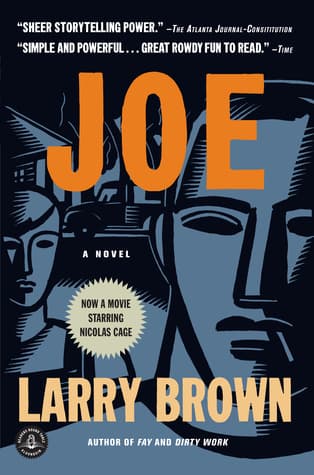
Synopsis
Covers the whole plot, including the ending.
- Difficulty
- Medium
- Pacing
- Moderate
- Mood
- Gritty, Bleak, Intense, Realistic, Tragic
- Read it if
- You appreciate raw, unflinching literary fiction about the struggles of the working class, redemption, and the harsh realities of life in the American South, with complex, morally ambiguous characters.
- Skip it if
- You prefer lighthearted stories, shy away from violence or dark themes, or dislike narratives with morally complex protagonists and tragic elements.
Joe Plot Summary
Covers the whole plot, including the ending.
A Chance Meeting and a Job Offer
Joe Ransom, a gruff, ex-con foreman of an illegal tree-poisoning crew in rural Mississippi, meets Gary Jones, a homeless, malnourished fifteen-year-old seeking work. Gary's family, led by his abusive alcoholic father, Wade, is destitute and constantly moving. Impressed by Gary's determination, Joe offers him a job poisoning trees on land he is clearing for a developer. Gary quickly proves capable, earning money for his family, though much of it is squandered by Wade. This initial meeting establishes the unlikely bond forming between the hardened older man and the desperate teenager.
Wade's Recklessness Escalates
Wade Jones's alcoholism and meanness continue to plague his family. He often drinks away Gary's earnings, leaving them without food or shelter. His abuse extends to Gary's mother and younger sister, often resulting in brutal beatings. Gary, despite his youth, tries to protect his family, but Wade's unpredictable violence makes their lives a constant struggle. These incidents highlight Gary's desperate need for a stable figure and a way out of his oppressive home environment, further cementing his reliance on the opportunity Joe has provided him.
Joe's Troubled Past and Present
Joe Ransom's life is complicated. He frequently visits his ex-wife, Sue, with whom he shares a complex, often volatile, relationship. Despite their separation, there is lingering affection and concern between them, often expressed through arguments. Joe also has a contentious relationship with local law enforcement, especially Sheriff Hayes, who watches Joe closely due to his past criminal record and his current illegal tree-poisoning operation. Joe's interactions with Sue and the authorities reveal his deep-seated issues with control, loyalty, and his own moral code.
The Growing Bond
As Gary continues to work for Joe, their relationship deepens. Joe, seeing much of his own past struggles and potential in Gary, takes the boy under his wing. He offers Gary advice, protection from Wade, and even practical assistance like food and a place to stay when Wade's violence escalates. Joe's gruff exterior hides a growing paternal affection for Gary, who, in turn, looks up to Joe as the only stable, positive male influence in his life. This bond becomes a central part of the story, contrasting sharply with Gary's relationship with his biological father.
Confrontation and Escalation
The escalating violence from Wade Jones eventually draws Joe's direct intervention. After Gary's sister is severely beaten, Gary seeks Joe's help. Joe confronts Wade, physically assaulting him to protect the family. This act solidifies Joe's role as Gary's protector but also marks a dangerous escalation in the conflict between Joe and Wade. The confrontation highlights Joe's moral compass, despite his criminal past, and his willingness to risk his own freedom for those he cares about. This event sets the stage for the tragic climax.
Tragedy Strikes Gary's Family
In a horrific turn of events, Wade Jones, fueled by alcohol and resentment, murders Gary's mother and sister. This brutal act shatters Gary's already fragile world, leaving him an orphan and intensifying his feelings of helplessness and rage. The murders underscore the devastating consequences of Wade's unchecked cruelty and the systemic failures that allowed his abuse to escalate. This profound loss further isolates Gary and strengthens his reliance on Joe as his last remaining hope and surrogate family.
The Aftermath and Gary's Despair
Following the murders, Gary is consumed by grief and a burning desire for revenge against Wade. He is taken in by Joe, who offers him solace and a temporary home, further cementing their bond. Gary struggles to reconcile his anger with his sense of powerlessness, constantly seeking a way to avenge his family. Joe tries to guide Gary, understanding the dangerous path revenge can lead to, but also empathizes with the boy's suffering. This period shows Gary's emotional devastation and Joe's deepening responsibility for him.
Joe's Final Confrontation
Knowing that Gary is consumed by the need for revenge, Joe takes matters into his own hands. He tracks down Wade Jones, leading to a final, violent confrontation. Joe, acting to protect Gary from becoming a murderer himself and to exact justice for the atrocities Wade committed, kills Wade. This act is a culmination of Joe's protective instincts and his own sense of justice, even if it means sacrificing his own freedom and future. The scene is brutal and definitive, closing the chapter on Wade's reign of terror.
The Consequences of Vengeance
Joe's decision to kill Wade has immediate and severe consequences. He is arrested, and his life, already on the fringes of legality, is now irrevocably altered. The act, while bringing a form of justice, forces Joe to confront the ultimate price of his protective instincts and his own violent nature. This section explores the aftermath of the climax, showing the ripple effects of Joe's actions on himself and those around him, particularly Gary, who is now left without either his biological father or his surrogate father figure.
Gary's New Beginning
With Joe imprisoned, Gary is left to forge his own path. Despite the trauma and loss, he is not broken. He carries the lessons and strength Joe imparted. Gary finds work, demonstrating the work ethic and resilience Joe helped cultivate. He starts building a life for himself, free from the shadow of Wade's abuse and Joe's dangerous world, yet forever marked by their influence. The ending suggests a hopeful, if bittersweet, future for Gary, symbolizing a broken cycle and a chance for redemption through hard work and self-reliance, a testament to Joe's impact.
Joe Characters
Joe Ransom
Protagonist
A hard-drinking, ex-con foreman with a hidden moral code.
Joe Ransom is a complex character: a gruff, middle-aged ex-convict who runs an illegal tree-poisoning crew. He's a man of routine, with a love for whiskey and a volatile temper, but beneath his hardened exterior lies a strong sense of justice and a surprising capacity for compassion. He's fiercely independent, deeply loyal to those he deems worthy, and carries the weight of past mistakes. His moral compass is unconventional, operating outside the law but guided by a personal code of right and wrong, especially when it comes to protecting the innocent.
Relationships: Gary Jones (Mentor and surrogate father figure); Wade Jones (Antagonist, a source of conflict and Joe's ultimate victim); Sue (Ex-wife, a complicated on-again, off-again romantic and emotional connection)
Gary Jones
Protagonist
A resilient, hopeful teenager seeking escape from his abusive family.
Gary Jones is a fifteen-year-old boy burdened by extreme poverty and the constant abuse of his alcoholic father, Wade. Despite his dire circumstances—homelessness, malnutrition, and a lack of education—Gary possesses an innate resilience, a strong work ethic, and a deep desire to protect his mother and younger sister. He is observant, quiet, and demonstrates a remarkable capacity for endurance and hope. His innocence is constantly threatened by his environment, but he clings to any opportunity for a better life, finding a glimmer of hope in Joe Ransom.
Relationships: Joe Ransom (Protege and surrogate son, finding guidance and protection); Wade Jones (Abusive biological father, a source of terror and despair); Mother (Victim of abuse, Gary's desperate attempt to protect her); Sister (Victim of abuse, Gary's desperate attempt to protect her)
Wade Jones
Antagonist
Gary's abusive, alcoholic father and the embodiment of depravity.
Wade Jones is the primary antagonist, a profoundly destructive and irredeemable character. He is Gary's biological father, but acts as a tormentor rather than a protector. Wade is a chronic alcoholic, prone to extreme violence, and utterly devoid of empathy or ambition. He squanders any money earned by his family, abuses his wife and children relentlessly, and lives a life of complete moral decay. He represents the oppressive forces Gary is trying to escape and serves as a catalyst for much of the novel's conflict and tragedy.
Relationships: Gary Jones (Abusive father figure); Joe Ransom (Rival and ultimate executioner); Mother (Victim of abuse and murder); Sister (Victim of abuse and murder)
Sue
Supporting
Joe's ex-wife, a woman who understands and cares for him despite their history.
Sue is Joe Ransom's ex-wife, a woman who, despite their separation and Joe's rough edges, still cares deeply for him. Their relationship is complex, marked by a history of shared experiences, lingering affection, and mutual understanding. She serves as a grounding force for Joe, a reminder of a different life, and a confidante with whom he can be vulnerable. Her presence highlights Joe's capacity for connection and his underlying desire for a stable life, even if his actions often contradict it.
Relationships: Joe Ransom (Ex-wife, a complicated and enduring emotional bond)
Sheriff Hayes
Supporting
Local law enforcement, keeping a watchful eye on Joe.
Sheriff Hayes represents the official law and order in the rural community. He has a long-standing awareness of Joe Ransom's past and his current activities, maintaining a wary and often antagonistic relationship with him. Hayes is not necessarily corrupt, but he is pragmatic and bound by the rules, often finding himself in conflict with Joe's more unconventional methods of justice. He embodies the societal structures that Joe operates outside of, providing a counterpoint to Joe's personal moral code.
Relationships: Joe Ransom (Antagonistic, law enforcement figure)
Gary's Mother
Supporting
A long-suffering victim of Wade's abuse.
Gary's Mother is a silent, often unseen, but profoundly impactful character. She is a perpetual victim of Wade's brutal physical and emotional abuse, embodying the extreme helplessness and despair of her family's situation. Her attempts to protect her children are futile, and her suffering underscores the urgency of Gary's need for escape. Her eventual murder by Wade is a pivotal, tragic event that propels the narrative towards its violent climax.
Relationships: Gary Jones (Mother, a figure of profound sorrow and a reason for Gary's protective instincts); Wade Jones (Abusive husband and murderer)
Gary's Sister
Supporting
A young, innocent victim of Wade's violence.
Gary's Sister is a minor but significant character, representing the ultimate innocence and vulnerability within the Jones family. Her youth and helplessness amplify the horror of Wade's abuse, particularly when she is severely beaten. Her suffering deeply affects both Gary and Joe, serving as a powerful motivator for their actions. Her tragic murder alongside her mother solidifies Wade's evil and hardens the resolve of both protagonists.
Relationships: Gary Jones (Younger sister, a source of Gary's protective instincts); Wade Jones (Abusive father and murderer)
Willis
Supporting
One of Joe's loyal crew members.
Willis is a member of Joe's tree-poisoning crew. He is generally loyal and reliable, representing the working-class men who depend on Joe for their livelihood. Willis often provides a sounding board for Joe, and his presence helps to flesh out the dynamics of Joe's operation. He is a pragmatic character, focused on the job and maintaining the status quo, and he reflects the difficult economic realities of their community.
Relationships: Joe Ransom (Employee and loyal subordinate)
Joe Themes
Redemption and Second Chances
The novel explores the possibility of redemption for flawed individuals and the impact of offering second chances. Joe, an ex-con, finds a form of redemption not through conventional means, but by becoming a protector and mentor to Gary. His decision to help Gary, and ultimately to sacrifice his own freedom, shows his evolving moral compass. Gary, in turn, is given a second chance at life, pulled from the brink of destitution and abuse by Joe's intervention. Their relationship highlights how acts of kindness and mentorship can lead to personal salvation, even in the bleakest circumstances, as when Joe offers Gary a job and later protection, changing the trajectory of Gary's life.
“Some things you just can't walk away from, no matter how hard you try.”
The Cycle of Violence and Poverty
The pervasive cycle of violence, poverty, and addiction is a central theme, especially evident in the life of the Jones family. Wade Jones embodies this destructive cycle, perpetuating abuse and neglect on his family, who are trapped in a seemingly inescapable spiral of homelessness and despair. The novel unflinchingly portrays the devastating effects of this cycle, showing how it strips away dignity, hope, and even life. Gary's struggle to break free from his father's destructive influence, and Joe's efforts to intervene, underscore the immense difficulty of escaping such deeply entrenched patterns. The murders of Gary's mother and sister are a stark representation of the ultimate cost of this unchecked violence.
“They lived like animals, not even knowing it was possible to live any other way.”
Paternal Figures and Mentorship
The dynamic between Joe and Gary forms the emotional core of the novel, showing the impact of a surrogate paternal figure. Joe, despite his own troubled past and violent tendencies, steps into a role of mentor and protector for Gary, offering guidance, work, and ultimately, a safer future. This contrasts sharply with Gary's biological father, Wade, who is the opposite of a paternal figure. Joe teaches Gary resilience, work ethic, and a sense of self-worth, filling a void left by Wade's abuse. The strength of this bond highlights the human need for positive guidance and the transformative power of a caring relationship, particularly evident in how Gary looks up to Joe and follows his advice.
“You got good hands, boy. You learn fast.”
Justice vs. Law
The novel explores the tension between legal justice and a more personal, often violent, form of justice. Joe Ransom operates outside the law, engaging in illegal tree-poisoning and ultimately taking the law into his own hands to protect Gary and avenge his family. While Sheriff Hayes represents official law enforcement, the narrative often suggests that the official system is inadequate to address the deep-seated injustices and brutal realities faced by characters like the Jones family. Joe's final act of killing Wade, though criminal, is presented as an act of moral justice from his perspective, raising questions about what constitutes 'right' when the legal system fails to provide adequate protection or retribution for extreme wrongs.
“Sometimes a man just gotta do what he gotta do.”
Plot Devices & Literary Techniques
Foil Characters
Joe and Wade serve as direct contrasts.
Joe Ransom and Wade Jones act as direct foil characters, highlighting each other's traits through stark contrast. Joe, despite his criminal past, possesses a moral code and ultimately acts as a protector, embodying a flawed but ultimately good paternal figure. Wade, in contrast, is utterly devoid of morality, a purely destructive force who represents unchecked evil and abuse. This device effectively underscores the themes of good vs. evil, redemption vs. depravity, and the two very different paths a man can take in difficult circumstances, particularly in their interactions with Gary.
Symbolism of the Woods/Nature
The natural environment reflects the characters' struggles and the harshness of life.
The rural, often harsh natural environment—the woods being cleared, the isolated roads, the dilapidated shacks—serves as a powerful symbol throughout the novel. It reflects the characters' raw, often brutal existence, their struggle for survival, and the unforgiving nature of their lives. The act of clearing the land itself can be seen as a metaphor for Joe's attempt to clear a path for Gary, or for the characters' efforts to escape the wilderness of their circumstances. The natural world is both a source of livelihood (for Joe's crew) and a backdrop for violence and despair, emphasizing the primal struggle for existence.
Foreshadowing
Hints of impending violence and tragedy build tension.
The novel employs significant foreshadowing, particularly regarding Wade's escalating violence and the inevitable confrontation between Joe and Wade. Early descriptions of Wade's brutality towards his family, Gary's fear, and Joe's simmering anger all hint at the tragic events to come. This device builds intense dramatic tension, making the reader anticipate the climax and understand its inevitability. For example, every time Wade squanders Gary's money or abuses his family, it implicitly warns of a greater catastrophe on the horizon, preparing the reader for the murders and Joe's subsequent revenge.
Joe Quotes
“The trees were silent witnesses, the air still and heavy, smelling of pine needles and damp earth.”
“There was a lot of pain in the world. He knew that. He saw it every day.”
“Sometimes you just had to do what you had to do, even if you didn't want to.”
“The kind of thirst that could only be quenched by cheap beer and bad decisions.”
“He knew what it was to be hungry, really hungry, the kind that ate at your insides.”
“The world was a hard place, and it didn't care much about you.”
“There was a certain kind of freedom in having nothing left to lose.”
“He could feel the weight of all the dead things in the world, pressing down on him.”
“Some men were just meant to fight, and some were meant to run.”
“The silence in the woods was never truly silent; it was full of tiny, hidden noises.”
“He had seen enough bad things in his life to know what real evil looked like.”
“The smell of cheap whiskey and regret hung heavy in the air.”
“A man could only take so much before he broke, and some men broke harder than others.”
“He learned early on that nobody was coming to save you. You had to save yourself.”
“The sun was a hot, indifferent eye in the sky, watching everything unfold.”
Quiz
10 questions on the plot and the characters. Each answer comes with a short explanation.
Question 1
What kind of work does Joe Ransom primarily offer Gary Jones when they first meet?
- Construction work
- Logging and tree-poisoning
- Automotive repair
- Farm labor
Show answer
B. Logging and tree-poisoning Joe employs Gary to help him with his tree-poisoning business, clearing land for a new project.
Question 2
What is the primary vice of Gary's father, Wade, that drives the family's destitution?
- Gambling
- Womanizing
- Alcoholism
- Drug addiction
Show answer
C. Alcoholism Wade's severe alcoholism prevents him from holding a job and constantly puts his family in danger and poverty.
Question 3
What animal does Joe Ransom keep as a pet that is frequently mentioned?
- A hunting dog
- A cat
- A parrot
- A pig
Show answer
A. A hunting dog Joe has a loyal hunting dog that often accompanies him and is a source of comfort.
Question 4
What is the primary reason Joe gets into repeated conflicts with the local sheriff's department?
- He's involved in illegal drug dealing.
- He's constantly getting into bar fights and disturbing the peace.
- He refuses to pay his taxes.
- He's illegally poaching deer.
Show answer
B. He's constantly getting into bar fights and disturbing the peace. Joe's aggressive nature and heavy drinking often lead him into altercations, resulting in frequent run-ins with the law.
Question 5
What symbolic role does the 'poisoning' of trees play for Joe and Gary?
- It represents their destruction of nature.
- It symbolizes a necessary but violent act of clearing the old for the new.
- It is a metaphor for the toxic relationships in their lives.
- It's a commentary on environmental degradation.
Show answer
B. It symbolizes a necessary but violent act of clearing the old for the new. The act of poisoning trees to clear land for development reflects the harsh realities and often violent means by which new opportunities are forged, mirroring their own struggles for a new life.
Question 6
How does Gary attempt to protect his sister from their abusive father, Wade?
- He tries to get her a job in town.
- He physically confronts Wade on multiple occasions.
- He reports Wade to child protective services.
- He tries to convince Joe to adopt her.
Show answer
B. He physically confronts Wade on multiple occasions. Gary, despite his young age, repeatedly stands up to his father, often physically, to protect his younger sister from Wade's abuse.
Question 7
What ultimately happens to Gary's father, Wade?
- He abandons the family and leaves town.
- He is arrested and imprisoned for his crimes.
- He is killed by Joe Ransom in a confrontation.
- He dies from alcohol-related illness.
Show answer
C. He is killed by Joe Ransom in a confrontation. Joe confronts Wade after Wade severely harms Gary and his sister, leading to a violent altercation in which Joe kills Wade.
Question 8
The novel explores the theme of 'redemption' for both Joe and Gary. In what way is Joe's potential redemption primarily linked to Gary?
- Gary reminds Joe of his own estranged son.
- By protecting and guiding Gary, Joe finds a purpose beyond his own self-destructive tendencies.
- Gary helps Joe reconcile with his past mistakes.
- Gary introduces Joe to a new, more peaceful way of life.
Show answer
B. By protecting and guiding Gary, Joe finds a purpose beyond his own self-destructive tendencies. Joe, an ex-con with a troubled past, finds a chance at redemption by becoming a protector and mentor to Gary, offering him a path out of his dire circumstances.
Question 9
How does the author, Larry Brown, use the setting of rural Mississippi to enhance the novel's themes?
- The isolation of the setting highlights the characters' internal struggles and their limited options.
- The natural beauty of the landscape offers a stark contrast to the characters' violent lives.
- The small-town community provides a strong support system for the protagonists.
- The setting emphasizes the importance of traditional values and family.
Show answer
A. The isolation of the setting highlights the characters' internal struggles and their limited options. The rural, often impoverished setting of Mississippi underscores the desperation, lack of resources, and limited opportunities faced by characters like Gary, amplifying their struggles and making Joe's intervention even more critical.
Question 10
What is the ultimate fate of Joe Ransom at the end of the novel?
- He escapes the law and starts a new life elsewhere.
- He is arrested and sent back to prison.
- He is killed while protecting Gary from Wade's associates.
- He finds peace and settles down with a woman.
Show answer
C. He is killed while protecting Gary from Wade's associates. In a final act of protection, Joe confronts the men who were associated with Wade and were threatening Gary, resulting in his own death.
Joe FAQ
What is the central conflict that drives the narrative between Joe Ransom and Gary Jones?
The central conflict revolves around Joe's declining health and increasing weariness with his violent past, juxtaposed with Gary's desperate need for a protector and a father figure to escape his abusive, impoverished family. Joe offers Gary a chance at honest work and a semblance of stability, while Gary's presence forces Joe to confront his own moral compass and consider the legacy he leaves behind.
Describe Joe Ransom's primary occupation and how it reflects his character.
Joe Ransom runs a crew that poisons trees on private land for a timber company, a job that is physically demanding and morally ambiguous, as it involves destroying nature for profit. This occupation perfectly mirrors Joe's character: he is a man of the earth, rugged and capable, yet his work, like his life, is often about destruction and making difficult, sometimes ethically compromised, choices to survive.
Who is Gary Jones, and what is his family situation like at the beginning of the story?
Gary Jones is a resilient, quiet boy, approximately fifteen, who comes from a family living in abject poverty and homelessness in rural Mississippi. His father, Wade, is a brutal alcoholic who regularly beats Gary and his mother, making Gary desperate for any opportunity to earn money and escape his dire circumstances.
How does the relationship between Joe and Gary evolve throughout the novel?
Initially, Joe hires Gary for his tree-poisoning crew, seeing him as a hardworking but unfortunate kid. Their relationship deepens as Joe becomes a reluctant mentor and protector, offering Gary advice, food, and a sense of belonging that he lacks at home. Gary, in turn, looks up to Joe as a father figure, finding in him the strength and moral guidance his own father never provided.
What significant event forces Joe to make a life-altering decision regarding Gary's family?
The brutal murder of Gary's mother and sister by his father, Wade, after Wade repeatedly torments Gary and his family, is the catalyst. This horrific act pushes Joe beyond his limits, compelling him to take decisive, violent action against Wade to protect Gary and avenge the innocent, cementing his role as Gary's ultimate protector.
What is the significance of the dog, Jack, in Joe's life?
Jack, Joe's loyal pit bull, symbolizes unconditional loyalty and the few pure relationships Joe maintains. Jack is a constant, comforting presence, often sitting beside Joe in his truck or at home. The dog's presence highlights Joe's capacity for tenderness and companionship, a stark contrast to the violence and isolation he often experiences.
Are there any subtle indications of Joe's declining health before the climactic events?
Yes, Joe frequently experiences chest pains and a general weariness that he attributes to his hard living and age, often dismissing them with a swig of whiskey. These subtle physical complaints hint at his deteriorating health, foreshadowing his ultimate fate and adding a layer of urgency to his actions with Gary.
What role does the natural environment of rural Mississippi play in the story?
The dense, often oppressive woods and the impoverished, dilapidated rural landscape serve as both a backdrop and a character in themselves, reflecting the harsh realities and limited opportunities faced by the characters. The natural setting emphasizes themes of survival, decay, and the raw, untamed aspects of human nature, particularly in the face of poverty.
How does Joe's past as an ex-con influence his interactions and decisions throughout the novel?
Joe's past as an ex-con makes him wary of authority and prone to solving problems with violence, but it also gives him a deep understanding of desperation and survival. This background explains his initial reluctance to get too involved with Gary, yet ultimately fuels his fierce loyalty and protective instincts when he sees Gary's innocence threatened by similar harsh realities.
Analyze Gary's psychological resilience in the face of constant abuse and trauma.
Gary exhibits remarkable psychological resilience, characterized by his quiet determination, strong work ethic, and ability to compartmentalize the trauma inflicted by his father. He doesn't outwardly lash out but instead channels his desperation into a relentless pursuit of work and a better life, demonstrating an internal fortitude that belies his young age and difficult circumstances.
What motivates Joe's decision to protect Gary, even at great personal cost?
Joe is motivated by a complex mix of guilt, a desire for redemption, and a paternal instinct he likely never fully expressed. He sees in Gary a reflection of his own younger self, a boy without a fair chance, and recognizes the potential for good in him. Protecting Gary becomes a way for Joe to atone for past mistakes and find a sense of purpose beyond his own self-destructive tendencies.
How does Wade Jones's character serve as a foil to Joe Ransom?
Wade Jones serves as a stark foil to Joe Ransom by embodying pure, unadulterated evil and self-interest, devoid of any redeeming qualities, whereas Joe, despite his flaws, possesses a strong moral code and a capacity for compassion. Wade's abusive nature highlights Joe's protective instincts and his eventual heroic sacrifice, emphasizing the contrast between destructive and redemptive masculinity.
Is Joe's ultimate fate a tragedy or a form of redemption?
Joe's ultimate fate is open to interpretation, but it can be seen as both a tragedy and a profound act of redemption. It's tragic because he loses his life, but redemptive because his sacrifice ensures Gary's survival and a chance at a better future, allowing Joe to find a meaningful purpose in his final act, effectively breaking a cycle of violence and despair for someone else.
Does the novel suggest that violence is sometimes a necessary evil?
The novel strongly suggests that in certain extreme circumstances, particularly when law and order fail the most vulnerable, violence can become a necessary, albeit tragic, means of protection and justice. Joe's actions against Wade are presented not as gratuitous but as a desperate response to intolerable evil, implying that some evils can only be met with force.
What is the broader commentary on poverty and social injustice presented in 'Joe'?
'Joe' offers a bleak but unflinching look at the devastating effects of extreme poverty and social injustice in rural America, where families like the Joneses are trapped in a cycle of destitution, abuse, and neglect with little hope of escape. The novel highlights the systemic failures that leave individuals without resources or protection, forcing them into desperate circumstances.
How does the ending of the novel impact Gary's future, and what does it symbolize?
The ending, with Joe's sacrifice, grants Gary a definitive escape from his abusive past and the opportunity for a new life, free from the shadow of his father. It symbolizes the breaking of a generational curse and the possibility of hope and a fresh start, albeit one bought at a terrible price, suggesting that even in the darkest circumstances, redemption is possible through human connection and sacrifice.
Could Gary have escaped his family without Joe's intervention?
It is highly unlikely Gary could have escaped his family without Joe's intervention. Gary's youth, lack of resources, and his father's relentless abuse and control made independent escape virtually impossible. Joe provided not only the means of employment but also the crucial physical protection and moral support that Gary desperately needed to break free from his dire circumstances.
What does the phrase 'redemption or ruin' in the synopsis mean for Joe?
For Joe, 'redemption or ruin' refers to the high stakes of his involvement with Gary. His past is marked by violence and self-destruction, and helping Gary offers a path to redeem himself by doing something truly good. However, this path also risks further ruin, as it inevitably draws him into more conflict and ultimately leads to his death, making his redemption inextricably linked with his personal ruin.
About the author

Larry Brown was an American author known for his works of fiction that often explore themes of family and struggle. His notable books include "Joe," which delves into the complexities of father-son relationships, and "Father and Son," which examines the dynamics of familial bonds. Brown's writing is characterized by its raw emotional depth and vivid portrayal of Southern life.
Similar books
- Suttree
Cormac McCarthy
4.2 (18k) average on GoodreadsLiterary FictionExplores the lives of marginalized men in the American South with a focus on poverty, despair, and a search for meaning.
- Winter's Bone
Daniel Woodrell
3.9 (29k) average on GoodreadsLiterary FictionFeatures a young protagonist navigating a harsh, impoverished rural environment and themes of family, survival, and justice.
- Blood Meridian
Cormac McCarthy
4.2 (227k) average on GoodreadsFictionWhile different in setting, shares a similar raw, violent, and unflinching examination of human nature and the darker aspects of society.
- A Good Scent from a Strange Mountain
Robert Olen Butler
4.0 (8k) average on GoodreadsLiterary FictionWhile both Brown and Butler explore the underbelly of Southern life, Butler's collection of short stories, set in Louisiana, often focuses on the lingering psychological effects of the Vietnam War on Vietnamese immigrants. Butler's prose is more lyrical and introspective, delving into cultural displacement and memory, whereas Brown's 'Joe' is more direct, visceral, and focused on immediate, often brutal, socio-economic realities and the struggle for survival within a deeply entrenched Southern landscape. Brown's characters are often defined by their physical actions and immediate environment, while Butler's are shaped by their past and internal cultural conflicts.
- The Old Man and the Sea
Ernest Hemingway
3.8 (831k) average on GoodreadsLiterary FictionA Cuban fisherman's long struggle with a giant marlin becomes a story of endurance and dignity, now retold for young adults with illustrations, phonetic guides, and writing prompts in Traditional Chinese.
- One Hundred Years of Solitude
Gabriel García Márquez
4.1 (753k) average on GoodreadsLiterary FictionThrough the multi-generational story of the Buendía family, a mythical town deals with the repeating patterns of time, love, and solitude, as the extraordinary mixes with the ordinary.



Enjoyed the summary?
A summary gives you the shape of the book. The book itself has the detail, the examples and the voice.
Find Joe on AmazonAs an Amazon Associate, BookBrief earns from qualifying purchases. How we're funded