
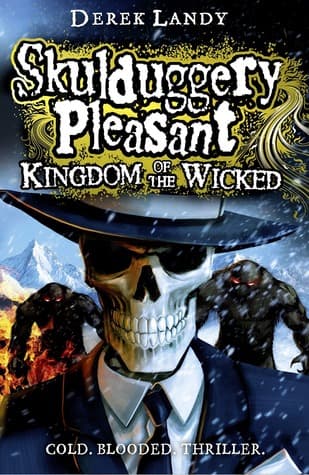
Synopsis
Covers the whole plot, including the ending.
- Difficulty
- Medium
- Pacing
- Fast
- Mood
- Action-packed, Suspenseful, Dark, Humorous, Thrilling
- Read it if
- You enjoy fast-paced urban fantasy with a blend of dark humor, mystery, and high stakes, featuring a dynamic duo and a large cast of characters.
- Skip it if
- You prefer standalone novels or stories with lighthearted themes; this book is part of a long series and deals with serious, often dark, consequences.
Kingdom of the Wicked Plot Summary
Covers the whole plot, including the ending.
The Rise of the Infected
The story begins with a mysterious plague affecting ordinary humans, giving them unstable and often destructive magical powers. These 'Infected' are a danger to themselves and others, causing widespread panic. Skulduggery Pleasant and Valkyrie Cain investigate an incident where a young girl spontaneously combusts. They soon realize this is not isolated, but a rapidly spreading problem. The Sanctuary, led by Grand Mage Ravel, tries to contain the crisis, setting up quarantine zones and trying to understand the 'magical disease.' Public fear grows as more cases appear, straining the magical community's resources.
Kitana and the God-Killers
Among the newly Infected are Kitana, Doran, and their friends, normal teenagers who suddenly develop incredible, god-like powers. Kitana, in particular, shows immense destructive abilities. They quickly embrace their new powers, forming a dangerous group that believes they are superior to humans and mages. Calling themselves 'God-Killers,' they begin attacking the magical community, seeing them as obstacles. Their actions are violent and driven by a thirst for power, making them one of the biggest threats Skulduggery and Valkyrie have faced. Their disregard for life and radical beliefs put them on a collision course with the Sanctuary.
The Search for a Cure
Skulduggery and Valkyrie, with their allies, desperately search for answers about the magical plague. They investigate various theories, from ancient curses to rogue magical experiments. Their search leads them to consult experts, decipher old texts, and study magic's history. Meanwhile, the number of Infected grows, and the God-Killers become bolder in their attacks. The duo realizes that containing the Infected is not enough; they must find a way to reverse the process or stop further infection, or the magical world, and possibly the human world, faces collapse.
The Introduction of the Faceless Ones' Power
As Skulduggery and Valkyrie investigate, they find disturbing links between the plague and the ancient, destructive power of the Faceless Ones. They learn that the 'magical disease' is not new, but a return of a dormant, corrupting energy. This revelation increases the mission's urgency, as the Faceless Ones are a threat to all life. The heroes understand that if the Faceless Ones' power is the source, the stakes are much higher, and failure could mean the return of these evil entities.
The Sanctuary's Desperation
Under immense pressure, Grand Mage Ravel and the other Grand Mages of the Irish Sanctuary find themselves in a desperate situation. The God-Killers are a formidable and unpredictable enemy, and the Infected population continues to grow. Ravel, known for his practical and often ruthless approach, considers extreme measures, including using powerful, morally ambiguous artifacts or spells. This internal conflict within the Sanctuary shows the ethical problems leaders face when their world is at risk, and the lines between right and wrong blur in the fight for survival.
Valkyrie's Inner Struggle
Valkyrie Cain feels increasingly conflicted during the crisis. The God-Killers are, at heart, just teenagers, though incredibly powerful and dangerous. Valkyrie struggles with the morality of fighting and possibly killing people who were once normal and are now victims of a magical plague. She also questions the nature of magic, wondering if her own power could become destructive. This inner conflict adds depth to her character, forcing her to confront power's dark side and the difficult choices of being a hero.
Confrontation with the God-Killers
Throughout the book, Skulduggery and Valkyrie have several intense and brutal fights with Kitana and the God-Killers. These battles are not just physical but also psychological, as the God-Killers' powers are immense and their ideology is chillingly nihilistic. The heroes are pushed to their limits, suffering injuries and witnessing widespread destruction. One harrowing encounter involves the God-Killers destroying a large part of a city, forcing Skulduggery and Valkyrie to make difficult tactical decisions to minimize casualties and try to contain the rampaging teenagers.
The Betrayal of Ravel
In a shocking turn, it is revealed that Grand Mage Ravel has been secretly working against the Sanctuary. He is loyal to the Faceless Ones and orchestrated the magical plague to weaken the magical world and help their return. This betrayal is a devastating blow to Skulduggery, who considered Ravel a close friend, and to Valkyrie, who trusted him completely. Ravel's manipulation and cold actions unravel the Sanctuary, leaving its members questioning everything they thought about their leadership.
The God-Killers' Sacrifice
The true horror of Ravel's plan becomes clear: the God-Killers, including Kitana, were not just powerful Infected, but specifically chosen and empowered vessels. Their god-like abilities were a deliberate manifestation to gather enough raw magical energy to open a portal for the Faceless Ones or to power a ritual for their return. They were, in essence, sacrifices, their destructive rampages serving a darker purpose than mere chaos. This revelation adds a tragic layer to the God-Killers' story, making them unwitting victims of Ravel's grand, evil scheme.
The Activation of the God-Killer Powers
Ravel, having shown his true nature, manipulates Kitana and the remaining God-Killers into activating a powerful device or ritual. This device is meant to harness their immense, unstable magic, not to cure them, but to channel it for his own evil purposes – specifically, to further the return of the Faceless Ones. The God-Killers, still believing they are in control or serving a higher purpose, unleash their full power. They unknowingly become instruments of their own destruction and the world's destruction. This climax sees an outpouring of raw, uncontrolled magic that threatens to tear reality apart.
Skulduggery's Desperate Act
Faced with the imminent return of the Faceless Ones, Skulduggery Pleasant must make a terrible decision. To stop the ritual powered by the God-Killers and orchestrated by Ravel, he must take a drastic and irreversible action. This involves using a powerful, forbidden magical artifact or performing a spell with severe consequences. The act is morally compromising and deeply personal, leaving him scarred physically and emotionally. It is a moment of great sacrifice, showing how far Skulduggery will go to protect the world, even if it means betraying his own principles or sacrificing a part of himself.
Valkyrie's Confrontation with Ravel
Valkyrie Cain, reeling from Ravel's betrayal and his plan's horrific scope, confronts him directly. This is not just a battle of magic but a deeply personal clash, as Valkyrie feels the sting of his deception. She unleashes her full power, fueled by anger and a fierce determination to stop him. The fight is intense and unforgiving, pushing Valkyrie to her limits. She must overcome Ravel's formidable magical abilities and her own emotional turmoil to prevent him from succeeding in his goal of bringing back the Faceless Ones.
The Aftermath of the Ritual
Though Ravel's plan is stopped, the aftermath is devastating. The world is scarred by the magical plague, the God-Killers' destruction, and the revelation of Ravel's treachery. The Sanctuary is in disarray, its leadership compromised, and its trust shattered. Skulduggery and Valkyrie must deal with the emotional and physical toll of their actions, especially Skulduggery's desperate choice. The magical community must now rebuild, not just physically, but also in terms of trust and governance, facing a future where the threat of the Faceless Ones remains, and internal betrayals have left deep wounds.
The Lingering Threat
Even with Ravel defeated and the immediate crisis over, the novel ends with a clear understanding that the Faceless Ones' threat is far from gone. Ravel's failed attempt showed how close their return was. The nature of the magic that caused the plague also remains a mystery, suggesting this corrupting influence could reappear. Skulduggery and Valkyrie realize their fight is ongoing, and the victory is only a break. The experience has changed them, making them more wary and aware of the dangers lurking beneath their world's surface.
Valkyrie's New Path
The events of 'Kingdom of the Wicked' deeply affect Valkyrie Cain. She has faced power's dark side, seen immense suffering, and been betrayed by someone she trusted. This experience forces her to rethink her identity, her connection to her magic, and her role in the ongoing fight against evil. The line between hero and monster has blurred, and she must come to terms with the difficult choices made. The ending suggests Valkyrie is on a new path of self-discovery, perhaps more jaded but also more determined, as she prepares for future battles, carrying the weight of what she has seen and done.
Kingdom of the Wicked Characters
Skulduggery Pleasant
Protagonist
A wise-cracking, magically powerful skeleton detective.
Skulduggery Pleasant is a living skeleton detective with a sharp wit and formidable elemental magic. He is fiercely loyal to Valkyrie and dedicated to protecting the world from magical threats. Despite his often sarcastic demeanor, he carries the heavy burden of past losses and is willing to make difficult, even morally compromising, decisions for the greater good. His extensive knowledge of magic and history makes him an invaluable asset in solving complex magical mysteries. He often hides his deeper emotions behind a facade of humor and nonchalance.
Relationships: Valkyrie Cain (Mentor, partner, best friend); Grand Mage Ravel (Former trusted friend and ally, now betrayed by); Tanith Low (Fellow agent and friend)
Valkyrie Cain (Stephanie Edgley)
Protagonist
A powerful teenage sorceress, Skulduggery's partner, and the last of the Ancients.
Valkyrie Cain is a courageous and increasingly powerful teenage sorceress. She wields both elemental magic and the dark, mysterious magic of her true name, Darquesse. Throughout the novel, she grapples with the moral complexities of fighting the Infected, who are often just ordinary teenagers. She is fiercely independent but deeply reliant on Skulduggery's guidance. Her compassion often clashes with the harsh realities of their world, forcing her to confront the darker aspects of her own power and the difficult choices heroism demands. She struggles with the weight of responsibility and the potential for her own destructive nature.
Relationships: Skulduggery Pleasant (Protégé, partner, best friend); Kitana (Antagonist, but also a figure of pity and moral conflict); Grand Mage Ravel (Trusted leader, then betrayed by)
Grand Mage Ravel
Antagonist
The seemingly benevolent Grand Mage of the Irish Sanctuary, revealed to be a traitor.
Initially presented as a wise, pragmatic, and trusted leader of the Irish Sanctuary, Ravel is revealed to be the true antagonist. He is a master manipulator, orchestrating the magical plague and the rise of the God-Killers to further his own agenda: the return of the Faceless Ones. His calm demeanor and strategic mind hide a ruthless, calculating nature. He is willing to sacrifice countless lives, including those of innocent teenagers, to achieve his goals. His betrayal is particularly devastating due to his long-standing friendship with Skulduggery and his position of authority.
Relationships: Skulduggery Pleasant (False friend, betrayer); Valkyrie Cain (Manipulator, target); Faceless Ones (Follower, servant)
Kitana
Supporting Antagonist
A normal teenager who becomes a powerful, corrupted leader of the God-Killers.
Kitana is one of the central 'Infected' teenagers who develops immense, god-like magical abilities. She quickly embraces her new power, becoming the charismatic and ruthless leader of the 'God-Killers.' She represents the terrifying potential for ordinary people to be corrupted by unchecked power, losing their humanity and empathy. Her actions are driven by a sense of superiority and a desire for dominance, but ultimately, she is a pawn in Ravel's larger scheme. Her journey is tragic, as she transforms from a normal girl into a destructive force, only to be used and discarded.
Relationships: Doran (Friend and fellow God-Killer); Valkyrie Cain (Antagonist, moral challenge); Grand Mage Ravel (Manipulated by)
Doran
Supporting Antagonist
Kitana's friend and a key member of the God-Killers, possessing significant magical power.
Doran is another one of the Infected teenagers and a close associate of Kitana, often acting as her second-in-command among the God-Killers. He is powerful and fiercely loyal to Kitana, sharing her radical ideology of superiority over humans and mages. While not as charismatic as Kitana, he is equally ruthless and contributes significantly to the God-Killers' destructive rampages. He embodies the collective corruption that afflicts the Infected, showcasing how quickly ordinary individuals can descend into violence when granted immense, uncontrollable power.
Relationships: Kitana (Friend, follower); Skulduggery Pleasant (Antagonist); Valkyrie Cain (Antagonist)
Tanith Low
Supporting
A skilled sorceress and fighter, ally to Skulduggery and Valkyrie.
Tanith Low is a highly skilled fighter and sorceress, known for her proficiency with swords and her acrobatic combat style. She is a loyal friend and ally to Skulduggery and Valkyrie, often providing crucial support in their battles against the God-Killers. Despite her past struggles with possession and her own dark side, she remains a steadfast force for good. Her practicality and combat expertise are essential in navigating the chaos caused by the Infected, offering a grounded perspective amidst the magical turmoil.
Relationships: Skulduggery Pleasant (Friend, fellow agent); Valkyrie Cain (Friend, fellow agent)
Ghastly Bespoke
Supporting
A powerful tailor and sorcerer, renowned for his strength and craftsmanship.
Ghastly Bespoke is a formidable sorcerer with enhanced strength and a calm, stoic demeanor. He is a master tailor and a loyal member of the Sanctuary, often acting as a voice of reason and strength. His combat abilities are invaluable in the fight against the Infected and the God-Killers. Ghastly's steadfastness and unwavering moral compass provide a grounding presence for Skulduggery and Valkyrie, especially when faced with the difficult ethical dilemmas presented by the magical plague.
Relationships: Skulduggery Pleasant (Friend, fellow agent); Valkyrie Cain (Friend, fellow agent)
Fletcher Renn
Supporting
A powerful teleporter and former love interest of Valkyrie.
Fletcher Renn is a powerful teleporter, capable of moving himself and others across vast distances instantly. He provides crucial logistical support to Skulduggery and Valkyrie, often transporting them to critical locations during battles and investigations. Despite his sometimes flippant attitude, he is a dedicated ally. His relationship with Valkyrie adds a layer of personal complexity, as they navigate their past and present feelings while facing world-ending threats. His unique abilities are indispensable in a world ravaged by unpredictable magic.
Relationships: Valkyrie Cain (Former love interest, friend, ally); Skulduggery Pleasant (Ally)
The Faceless Ones
Mentioned Antagonist
Ancient, malevolent entities whose return is sought by Ravel.
The Faceless Ones are ancient, cosmic beings of immense power and malevolence, worshipped by certain cults and feared by the magical community. They were banished from this dimension long ago but constantly seek a way to return and reclaim dominance, which would lead to the destruction of all life as known. While not physically present, their influence is the driving force behind the magical plague and Ravel's actions. Their looming threat casts a dark shadow over the entire narrative, serving as the ultimate evil that Skulduggery and Valkyrie are fighting to prevent.
Relationships: Grand Mage Ravel (Worshipped by, sought to be returned by)
Kingdom of the Wicked Themes
The Corrupting Nature of Power
This theme is central to the novel, seen most clearly through the 'Infected' and the God-Killers. Ordinary teenagers like Kitana and Doran, after receiving immense, uncontrollable power, quickly become arrogant, violent, and feel superior. Their descent into villainy shows how easily power can corrupt, especially when unchecked. Ravel's betrayal further highlights this, as his desire to bring back the Faceless Ones comes from a twisted vision of power and control. It shows that even those in authority can be corrupted by ambition. The moral ambiguity of fighting these corrupted individuals also forces Valkyrie to confront the destructive potential of her own abilities.
“Magic is a disease. Across the land, normal people are suddenly developing wild and unstable powers. Infected by a rare strain of magic, they are unwittingly endangering their own lives and the lives of the people around them.”
Betrayal and Trust
Betrayal is a devastating force in 'Kingdom of the Wicked,' mainly through the shocking revelation of Grand Mage Ravel's true allegiance. Ravel, a long-time friend and trusted leader, secretly orchestrated the entire crisis, shattering the trust of Skulduggery, Valkyrie, and the Sanctuary. This betrayal not only drives the plot but also deeply affects the characters' emotions, forcing them to question their judgment and the basis of their alliances. It emphasizes how personal and destructive betrayal can be, especially from within one's trusted circle, leaving lasting wounds and deep disillusionment.
“There are some wounds that never truly heal, and his betrayal was one of them.”
Moral Ambiguity and Difficult Choices
The novel constantly pushes its characters into morally ambiguous areas, forcing them to make difficult, often agonizing, choices. Valkyrie struggles with the ethics of fighting and possibly killing the Infected, who are, in many ways, victims. Skulduggery ultimately must make a terrible, irreversible decision to stop Ravel's ritual, a choice that leaves him deeply scarred. The line between hero and villain blurs, especially when dealing with individuals like Kitana, who are both dangerous and manipulated. This theme explores the high cost of heroism and the compromises sometimes needed against overwhelming evil, challenging traditional ideas of good and evil.
“Sometimes, to save the world, you have to do things you'll never forgive yourself for.”
The Nature of Identity and Humanity
This theme is explored through the transformation of the 'Infected' teenagers and Valkyrie's own inner struggles. The Infected lose their humanity as they gain power, becoming unrecognizable versions of their former selves. This raises questions about what defines a person. Valkyrie, as she deals with her own immense power and its destructive potential, constantly questions her identity and whether she is destined to become like the very beings she fights. The theme explores how power, external forces, and internal struggles can shape or distort one's sense of self, and the ongoing battle to retain one's humanity when facing overwhelming circumstances.
“She saw herself reflected in their eyes, and it was terrifying. How much of her was still Stephanie, and how much was Darquesse?”
The Cost of War and Survival
The narrative clearly shows the devastating costs of the magical plague and the conflict that follows. Cities are destroyed, lives are lost, and the magical community is pushed to its breaking point. The theme emphasizes that survival often comes at a high price, both physically and psychologically. The Sanctuary is left in disarray, its resources depleted, and its members traumatized. The personal toll on Skulduggery and Valkyrie is immense, as they witness great suffering and are forced to make sacrifices that will forever haunt them. This theme highlights that even in victory, there are lasting consequences, and peace is never truly absolute.
“The world was broken. And sometimes, even the heroes had to break a little to fix it.”
Plot Devices & Literary Techniques
The Magical Plague (Infection)
A mysterious illness granting unstable, destructive powers to ordinary humans.
The magical plague serves as the primary catalyst for the entire plot. It introduces a new, unpredictable threat that challenges the established order of the magical world. This device creates widespread panic, forces the Sanctuary into crisis mode, and generates the main antagonists (the God-Killers). Its seemingly random nature and escalating severity drive Skulduggery and Valkyrie's investigation, leading them to uncover deeper, more insidious plots. The plague also acts as a moral dilemma, as its victims are both dangerous and, in a sense, innocent, complicating the heroes' mission.
The Faceless Ones' Influence
The unseen, ancient evil whose impending return drives the antagonist's actions.
While not physically present, the Faceless Ones' influence acts as a powerful overarching threat. Their history and destructive potential provide the ultimate motivation for Ravel's betrayal and his plan to unleash the magical plague. This device raises the stakes significantly, transforming a contained crisis into a world-ending event. It also connects the current narrative to the broader mythology of the series, reminding readers of the persistent, existential danger that lurks just beyond the veil of reality, ensuring that even after Ravel's defeat, the sense of dread remains.
The Traitor Within (Grand Mage Ravel)
The revelation of a trusted leader as the true antagonist.
The betrayal by Grand Mage Ravel is a classic 'traitor within' plot device that creates a shocking twist and profound emotional impact. It shatters the sense of security and trust within the Sanctuary, escalating the conflict from an external threat to an internal, deeply personal one. This device forces the protagonists to re-evaluate their alliances and question their judgment, adding layers of psychological complexity to their fight. It also highlights the theme of how easily power can corrupt, even those in positions of authority, and how appearances can be deceiving.
The God-Killers as Tools
Teenage antagonists whose immense powers are unknowingly harnessed for a larger, darker purpose.
The God-Killers, while formidable antagonists in their own right, function as a crucial plot device by being unwitting pawns in Ravel's grand scheme. Their raw, unstable power is not merely a consequence of the plague but a deliberate manifestation designed to fuel a ritual for the Faceless Ones' return. This device adds a tragic dimension to their characters, transforming them from simple villains into manipulated victims, and intensifies the moral dilemma for Valkyrie. It underscores the ruthlessness of the true antagonist and the scale of his manipulative genius.
Kingdom of the Wicked Quotes
“There’s a difference between not caring and having nothing left to lose.”
“The world doesn't end. It just changes. And sometimes, that's worse.”
“Being a hero doesn't mean you're invincible. It just means you're brave enough to stand up and do what's needed.”
“Sometimes, the only way to save someone is to let them go.”
“Fear is a tool. You can let it control you, or you can use it.”
“Every secret has a cost. And the bigger the secret, the higher the price.”
“You can't always choose your battles, but you can choose how you fight them.”
“We all have darkness inside us. It’s what we do with it that matters.”
“Some monsters aren't born. They're made.”
“Hope is a dangerous thing. It can keep you going, or it can break you when it runs out.”
“The past is a stubborn thing. It doesn't just go away.”
“Even the strongest walls can crumble. It just takes the right kind of force.”
“Magic isn't about what you can do. It's about what you *will* do.”
“Sometimes, the biggest battles are fought within yourself.”
Quiz
10 questions on the plot and the characters. Each answer comes with a short explanation.
Question 1
What is the primary danger introduced in 'Kingdom of the Wicked' that affects normal people?
- A new strain of vampirism.
- The return of ancient magical beasts.
- A rare strain of magic that causes wild and unstable powers.
- A plague that eliminates magical abilities.
Show answer
C. A rare strain of magic that causes wild and unstable powers. The book introduces a new threat where normal people are infected by a rare strain of magic, causing them to develop dangerous, unstable powers.
Question 2
Which organization is described as the 'only hope' for those infected by the new magical strain?
- The Elders' Council
- The Sanctuary
- The Magical Academy
- The Necromancer Order
Show answer
B. The Sanctuary The synopsis explicitly states that for those terrified and confused by their new powers, 'their only hope lies with the Sanctuary'.
Question 3
Who are the two main protagonists called upon to deal with the new magical crisis?
- Ghastly Bespoke and Tanith Low
- Skulduggery Pleasant and Valkyrie Cain
- Fletcher Renn and Omen Darkly
- Saracen Rue and Dexter Vex
Show answer
B. Skulduggery Pleasant and Valkyrie Cain As in the rest of the series, Skulduggery Pleasant and Valkyrie Cain are the primary duo tasked with handling the supernatural threats, and they are specifically mentioned as being 'needed now more than ever'.
Question 4
What is the name of the normal teenage girl who becomes powerful and corrupted after being infected by magic?
- Alice
- Kitana
- Sarah
- Emily
Show answer
B. Kitana The synopsis clearly states, 'And then there's the small matter of Kitana. A normal teenage girl who, along with her normal teenage friends, becomes infected.'
Question 5
What is the nature of the magic wielded by Kitana and her friends after their infection?
- Ancient elemental magic
- Sorcerous dark magic
- Magic of gods
- Basic magical disciplines
Show answer
C. Magic of gods The description states that Kitana and her friends are 'Wielding the magic of gods', indicating a very powerful and dangerous form of magic.
Question 6
How is the magic affecting normal people described in the book's premise?
- A blessing
- A gift
- A disease
- A natural evolution
Show answer
C. A disease The very first line of the synopsis states, 'Magic is a disease,' setting the tone for how this new magical phenomenon is perceived.
Question 7
What is the ultimate threat posed by Kitana and her friends' corrupted magic?
- They plan to overthrow the Sanctuary.
- They intend to unleash an ancient evil.
- They are set to tear the city apart.
- They want to enslave all magic-users.
Show answer
C. They are set to tear the city apart. The synopsis warns that Kitana and her friends, 'Wielding the magic of gods, they're set to tear the city apart unless someone stands up against them.'
Question 8
Considering the previous books in the series, what does the phrase 'Looks like it's going to be another one of those days…' imply about the protagonists' situation?
- They are looking forward to a peaceful, uneventful day.
- They anticipate a routine day of paperwork and meetings.
- They expect another day filled with dangerous and chaotic magical threats.
- They are preparing for a celebratory event.
Show answer
C. They expect another day filled with dangerous and chaotic magical threats. This phrase is a characteristic understatement in the Skulduggery Pleasant series, typically used after describing a major, city-threatening magical crisis, implying that dangerous and chaotic events are a regular occurrence for the protagonists.
Question 9
How does the 'rare strain of magic' differ from typical magical abilities within the Skulduggery Pleasant universe, based on the description?
- It grants users control over ancient prophecies.
- It bestows stable, predictable powers to normal people.
- It causes wild and unstable powers in normal, previously non-magical people.
- It only affects existing magic-users, enhancing their abilities.
Show answer
C. It causes wild and unstable powers in normal, previously non-magical people. The key distinction is that this strain 'infects' 'normal people' (implying non-magical) and causes 'wild and unstable powers', unlike the more controlled, inherent magic of sorcerers.
Question 10
The book is described as the 'seventh installment' and a follow-up to 'Death Bringer'. What does this imply about the expected knowledge of the reader?
- It is a standalone story requiring no prior knowledge of the series.
- It is designed as an entry point for new readers to the series.
- It assumes the reader has followed the ongoing plot and character developments from previous books.
- It contains a full summary of all preceding events for context.
Show answer
C. It assumes the reader has followed the ongoing plot and character developments from previous books. Being the seventh installment and a direct follow-up strongly suggests that the book continues an overarching narrative, and therefore assumes the reader is familiar with the established characters, world, and previous plot points.
Kingdom of the Wicked FAQ
What is the central conflict introduced at the beginning of 'Kingdom of the Wicked'?
The central conflict revolves around a mysterious magical plague, known as the 'Wicked', which infects normal humans, granting them unstable and dangerous magical abilities. These newly empowered individuals, often losing control, pose a significant threat to public safety and the secrecy of the magical world, forcing the Sanctuary to intervene.
Who is Kitana and what role does she play in the story?
Kitana is a seemingly normal teenage girl who, along with her friends, becomes infected by the Wicked and develops immense magical power. She quickly becomes a central antagonist, leading a group of corrupted, super-powered teenagers who use their newfound abilities to cause chaos and challenge the established magical order, particularly the Sanctuary.
How do Skulduggery Pleasant and Valkyrie Cain get involved with the Wicked outbreak?
Skulduggery and Valkyrie are called upon by the Sanctuary to investigate and contain the Wicked outbreak, as their unique skills and experience make them ideal for handling such a widespread and dangerous threat. They are tasked with tracking down the infected, understanding the source of the plague, and ultimately neutralizing its most dangerous manifestations, including Kitana and her group.
What is the immediate danger posed by the 'Wicked' infection to both magical and non-magical communities?
The immediate danger is two-fold: for the non-magical community, it's the uncontrolled destruction and violence caused by infected individuals, often resulting in severe injuries or fatalities. For the magical community, it's the risk of exposure, as the widespread and public nature of the infections threatens to shatter the secrecy of their world, potentially leading to mass panic and persecution.
What is the significance of the title 'Kingdom of the Wicked' in relation to the plot?
The title refers to the state of chaos and the emergence of empowered, corrupted individuals who begin to dominate and terrorize parts of the world, effectively creating their own 'kingdoms' of destruction. It also hints at the struggle for control and the moral ambiguity surrounding those infected, blurring the lines between victim and villain.
Are there any subtle clues early in the book that hint at the true origin or nature of the Wicked infection?
Yes, there are subtle hints, such as the specific way the magic manifests in the infected, often mirroring ancient or primal forms of power, suggesting a source beyond typical modern magic. Additionally, certain characters or historical texts mentioned might subtly allude to forgotten entities or dormant powers that could be responsible for the outbreak, rather than a simple magical disease.
Does the book reveal any deeper connections between Kitana's powers and existing magical lore or entities in the Skulduggery Pleasant universe?
Kitana's powers are revealed to be derived from an ancient and incredibly powerful source, far beyond normal sorcery, hinting at a connection to the Faceless Ones or other primordial beings. This suggests that the 'Wicked' isn't just a random disease but a deliberate awakening or manipulation of god-like magic that has been dormant or sealed away.
How does the outbreak of the Wicked subtly affect the political landscape or power dynamics within the Sanctuary?
The Wicked outbreak places immense strain on the Sanctuary's resources and authority, exposing weaknesses in their ability to maintain secrecy and control. This crisis often leads to internal disagreements, power struggles, and a re-evaluation of leadership, as different factions propose radical solutions to the unprecedented threat, potentially empowering more extreme elements.
Are there any characters from previous books who return in unexpected roles or with altered allegiances due to the Wicked?
Yes, some minor characters or even seemingly neutral parties from previous installments find themselves caught up in the Wicked outbreak, either becoming infected themselves and turning antagonistic, or being forced to ally with unexpected groups to survive. This often forces Skulduggery and Valkyrie to confront familiar faces in entirely new and dangerous contexts.
How does Valkyrie Cain's experience with Darquesse influence her approach to the magically corrupted individuals in 'Kingdom of the Wicked'?
Valkyrie's past as Darquesse gives her a unique, albeit disturbing, insight into immense, uncontrolled power and the allure of corruption. This experience makes her both more empathetic to the infected, understanding the struggle against their own abilities, but also more ruthless when necessary, recognizing the point of no return for those who embrace their destructive tendencies.
What psychological impact does witnessing normal people gain and lose control of such devastating powers have on Skulduggery Pleasant?
Witnessing the Wicked outbreak forces Skulduggery to confront the fragile line between humanity and monstrous power, echoing his own past struggles and the dangers of unchecked magic. It likely reinforces his cynicism about human nature while simultaneously solidifying his resolve to protect the innocent, even if it means making difficult, morally ambiguous choices.
Explore the psychological motivations behind Kitana's actions once she gains power. Is it pure malice, or something more complex?
Kitana's motivations are complex, stemming from a cocktail of fear, exhilaration, and a sense of empowerment after feeling ordinary and overlooked. Her initial actions might be driven by a desire for control and recognition, but as the power corrupts her, it likely amplifies underlying resentments and a nihilistic impulse, leading to increasingly destructive and seemingly malicious behavior.
How does the theme of 'magic as a disease' reflect on the characters' perceptions of their own magical abilities?
The 'magic as a disease' theme forces magical characters, particularly sorcerers, to re-evaluate their own powers. It introduces a sense of vulnerability and contamination, making them question if their inherent abilities are a gift or a potential affliction, and potentially increasing their caution or even fear regarding their own magical nature and its uncontrolled aspects.
Is the 'Wicked' a metaphor for something in the real world, such as addiction, societal unrest, or unchecked power?
The 'Wicked' can be interpreted as a potent metaphor for unchecked power and its corrupting influence, akin to addiction or radicalization. It reflects how individuals, given immense, sudden power, can quickly succumb to its darker impulses, leading to societal unrest and a breakdown of order, mirroring real-world struggles with authority and the consequences of sudden, overwhelming change.
The book states 'magic is a disease.' Is this meant to be taken literally within the lore, or is it a more philosophical statement about the nature of power?
While the 'Wicked' infection is a literal magical disease within the book's narrative, the statement 'magic is a disease' also functions as a deeper philosophical commentary. It suggests that even inherent magical abilities, when uncontrolled or abused, can be destructive and corrupting, much like a chronic illness, highlighting the inherent dangers and moral responsibilities that come with wielding such power.
How does 'Kingdom of the Wicked' challenge or reinforce previous notions about the inherent good or evil of magic in the Skulduggery Pleasant universe?
'Kingdom of the Wicked' significantly challenges previous notions by presenting magic itself as a potential source of corruption and chaos, rather than merely a tool wielded by good or evil individuals. It reinforces the idea that immense power, regardless of its origin, carries an inherent risk of turning its wielder 'wicked,' blurring the lines of moral alignment based solely on magical affiliation.
Does the book suggest that those infected by the Wicked are truly irredeemable, or is there a possibility for recovery or atonement?
The book presents a nuanced view, suggesting that while many succumb entirely to the Wicked's corruption, there might be a slim possibility for recovery or atonement, especially for those who show signs of resisting its influence early on. However, for those like Kitana who fully embrace and revel in their destructive powers, redemption becomes an increasingly distant and challenging prospect, often requiring extreme measures.
What broader implications does the existence of the Wicked have for the future of the magical world as depicted in the series?
The Wicked's existence has profound implications, permanently altering the magical world's perception of its own power and security. It introduces a new, unpredictable threat that can emerge from anywhere, forcing the magical community to adapt its strategies for secrecy and defense. It also raises questions about the true origins of magic and the potential for even greater, unknown dangers lurking beneath the surface.
About the author

Derek Landy is a celebrated Irish author best known for the Skulduggery Pleasant series, a dark fantasy adventure that has garnered international acclaim. His writing often blends humor, action, and a touch of the macabre, appealing to young adult and adult readers alike. Landy has also penned other notable works, including the Kingdom of the Wicked series, further solidifying his reputation as a master storyteller in the fantasy genre.
Similar books
- Neverwhere
Neil Gaiman
4.2 (430k) average on GoodreadsFantasyFeatures hidden magical worlds coexisting with our own, dark fantasy elements, and unique characters.
- Artemis Fowl
Eoin Colfer
3.9 (496k) average on GoodreadsFantasyOffers a blend of fantasy, action, and humor, often with a mischievous protagonist navigating a secret magical world.
- The Golden Compass
Philip Pullman
4.0 (1.3M) average on GoodreadsFantasyKingdom of the Wicked shares with The Golden Compass a willingness to explore complex theological and philosophical questions within a fantasy setting, particularly regarding the nature of power and the role of higher beings ('God-Killers' vs. 'The Authority'). However, Pullman's work is often lauded for its profound allegorical depth and philosophical underpinnings (as discussed by Dr. Maria Nikolajeva in The Rhetoric of Character in Children's Literature, 2002), which Landy's series, while engaging with serious themes, prioritizes fast-paced action and character-driven drama over extensive philosophical exposition. Landy's world-building, while imaginative, is less overtly symbolic than Pullman's.
- Harry Potter and the Sorcerer's Stone
J.K. Rowling
4.5 (7M) average on GoodreadsFantasyRescued from a miserable life under the stairs, an orphaned boy discovers he's a wizard destined for a magical school, where he uncovers a dangerous secret tied to the dark wizard who murdered his parents.
- The Hunger Games
Suzanne Collins
4.3 (6.4M) average on GoodreadsFantasyIn a future where children fight to the death on live television, Katniss Everdeen volunteers for the arena, turning a death sentence into a fight for survival and a spark of rebellion.
- 1984
George Orwell
4.2 (3.1M) average on GoodreadsPoliticsIn a future where surveillance and thought control are absolute, a man's search for truth clashes with the Party, showing that hope can be a form of rebellion.





Enjoyed the summary?
A summary gives you the shape of the book. The book itself has the detail, the examples and the voice.
Find Kingdom of the Wicked on AmazonAs an Amazon Associate, BookBrief earns from qualifying purchases. How we're funded