
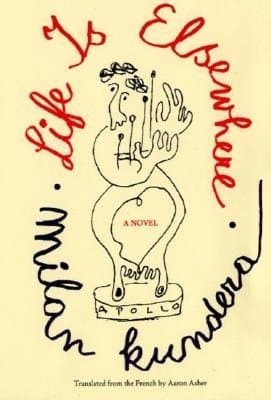
Synopsis
Covers the whole plot, including the ending.
- Difficulty
- Hard
- Read it if
- You are fascinated by the intersection of art, politics, and personal identity, and enjoy philosophical novels that critique the dangers of idealism and the 'lyrical' approach to life.
- Skip it if
- You prefer straightforward narratives with clear moral arcs, or find extensive philosophical digressions and literary analysis within a novel to be tedious.
Life is Elsewhere Quotes
“The only reason why man has two ears and one mouth is that he may listen the more and speak the less.”
“Youth is a terrible thing, it is a crime.”
“Poetry is not a form of expression but a form of existence.”
“Life is elsewhere.”
“A man's worth is measured by the number of things he can do without.”
“Every man has a right to be a poet, but not every poet has a right to be a man.”
“The past is a foreign country; they do things differently there.”
“The history of mankind is the history of its poetry.”
“To live means to love, to love means to suffer, to suffer means to die.”
“He understood that the world was not made for poets, but for engineers, for doctors, for soldiers.”
“The greatest joy for a mother is to see her son become a poet.”
“Humanity's true history is not in its battles or its politics, but in its dreams, its poems, its songs.”
“Every revolution begins with a poem, and ends with a gendarme.”
“He who wants to make a revolution must first be a good poet.”
Quiz
10 questions on the plot and the characters. Each answer comes with a short explanation.
Question 1
What was Milan Kundera's initial intended title for 'Life is Elsewhere'?
- The Poet's Journey
- The Lyrical Age
- Jaromil's Epic
- Innocence with a Bloody Smile
Show answer
B. The Lyrical Age Kundera initially intended to call the novel 'The Lyrical Age,' which he defines as youth.
Question 2
According to Kundera, what does 'the lyrical age' primarily represent in the context of the novel?
- Old age and wisdom
- Adulthood and responsibility
- Youth and adolescence
- A period of political revolution
Show answer
C. Youth and adolescence The text states that 'The lyrical age, according to Kundera, is youth, and this novel, above all, is an epic of adolescence.'
Question 3
Which of the following values does 'Life is Elsewhere' specifically erode with irony, according to the description?
- Justice and freedom
- Childhood, motherhood, revolution, and poetry
- Friendship and loyalty
- Art and beauty
Show answer
B. Childhood, motherhood, revolution, and poetry The novel is described as 'an ironic epic that tenderly erodes sacrosanct values: childhood, motherhood, revolution, and even poetry.'
Question 4
What is the primary profession or identity of the character Jaromil?
- A revolutionary leader
- A painter
- A poet
- A philosopher
Show answer
C. A poet The text explicitly states, 'Jaromil is in fact a poet.'
Question 5
How does Jaromil's mother influence his poetic identity and life path?
- She discouraged his artistic ambitions, pushing him towards politics.
- She made him a poet and is depicted as being intimately involved in his life events.
- She wrote his poems for him, claiming them as her own.
- She was absent from his life, forcing him to find his own artistic path.
Show answer
B. She made him a poet and is depicted as being intimately involved in his life events. The text states, 'His mother made him a poet and accompanies him (figuratively) to his love bed, and (literally) to his deathbed,' indicating her deep involvement.
Question 6
The description characterizes Jaromil with a specific contradictory phrase. What is it?
- A cunning manipulator with a gentle smile
- Innocence with its bloody smile
- A revolutionary trapped by his own ideals
- A tragic hero of the lyrical age
Show answer
B. Innocence with its bloody smile Jaromil is described as 'horrifying and totally innocent ('innocence with its bloody smile'!).'
Question 7
How does Kundera compare Jaromil to the poet Rimbaud?
- Jaromil is a failed poet, unlike Rimbaud.
- Jaromil is a true poet, similar to Rimbaud, but entrapped by the communist revolution.
- Jaromil is a critic of poetry, while Rimbaud was a practitioner.
- Jaromil represents the antithesis of everything Rimbaud stood for.
Show answer
B. Jaromil is a true poet, similar to Rimbaud, but entrapped by the communist revolution. The text states, 'He's no creep, he's Rimbaud. Rimbaud entrapped by the communist revolution, entrapped in a sombre farce,' drawing a direct comparison of Jaromil as a true poet like Rimbaud, but under different circumstances.
Question 8
The novel is described as an 'ironic epic of adolescence.' What does this imply about its portrayal of youth?
- It presents a straightforward, idealized view of youth.
- It critically examines and perhaps mocks the typical romanticized notions of adolescence.
- It is a historical account of adolescence during a specific era.
- It suggests that adolescence is a period devoid of any significant challenges.
Show answer
B. It critically examines and perhaps mocks the typical romanticized notions of adolescence. An 'ironic epic' suggests a portrayal that, while grand in scope ('epic'), also employs irony to subvert or critically examine its subject matter, in this case, adolescence and its associated 'sacrosanct values.'
Question 9
What is the significance of Jaromil being 'entrapped by the communist revolution' in the comparison to Rimbaud?
- It highlights Jaromil's political activism as his defining characteristic.
- It contrasts Rimbaud's freedom as a poet with Jaromil's constrained circumstances, adding a layer of tragic irony to Jaromil's poetic existence.
- It implies that the communist revolution fostered a new era of poetry.
- It suggests that Jaromil willingly embraced the revolution to further his art.
Show answer
B. It contrasts Rimbaud's freedom as a poet with Jaromil's constrained circumstances, adding a layer of tragic irony to Jaromil's poetic existence. The phrase 'Rimbaud entrapped by the communist revolution, entrapped in a sombre farce' implies that Jaromil, despite his poetic genius like Rimbaud, is caught in a restrictive and perhaps absurd political reality, which is a key aspect of his character's tragedy.
Question 10
Given the description, how does Kundera likely approach the concept of 'innocence' through Jaromil?
- As a pure and unblemished state, untainted by the world.
- As a complex, potentially dangerous quality that can lead to horrifying outcomes, as suggested by 'innocence with its bloody smile'.
- As a state that is quickly lost and never regained in adulthood.
- As a virtue that ultimately triumphs over all adversity.
Show answer
B. As a complex, potentially dangerous quality that can lead to horrifying outcomes, as suggested by 'innocence with its bloody smile'. The phrase 'horrifying and totally innocent ('innocence with its bloody smile'!)' strongly suggests that Kundera presents innocence not as purely good, but as a complex, potentially destructive force, especially when combined with Jaromil's other traits and circumstances.
Life is Elsewhere FAQ
What is the main theme of 'Life is Elsewhere'?
'Life is Elsewhere' primarily explores the 'lyrical age' of youth and the development of the poet Jaromil. It's an ironic epic that examines and often erodes sacrosanct values like childhood, motherhood, revolution, and the very nature of poetry itself through Jaromil's experiences.
Who is Jaromil in 'Life is Elsewhere'?
Jaromil is the central character of the novel, a poet whose life and artistic development are chronicled. He is portrayed as a complex figure—ridiculous yet touching, horrifying yet innocent—who embodies the youthful poetic spirit, akin to Rimbaud, but is ultimately ensnared by external forces.
Does 'Life is Elsewhere' criticize the communist revolution?
Yes, the novel uses Jaromil's story to critique the communist revolution, portraying it as a force that entraps and distorts artistic expression and individual lives. Jaromil, as a poet, finds himself caught in a 'sombre farce' under its influence.
What does Kundera mean by 'the lyrical age'?
Kundera defines 'the lyrical age' as youth, a period characterized by intense emotionality, idealism, and the pursuit of artistic expression, particularly poetry. This concept is central to understanding Jaromil's journey and the novel's exploration of adolescence.
How does 'Life is Elsewhere' differ from Kundera's other works like 'The Unbearable Lightness of Being'?
While both novels share Kundera's philosophical depth and ironic tone, 'Life is Elsewhere' specifically zeroes in on the phenomenon of youth and the poet's psyche, whereas 'The Unbearable Lightness of Being' explores themes of love, freedom, and fate within a broader political context. 'Life is Elsewhere' has a more singular focus on the developmental arc of an artist.
What role does Jaromil's mother play in the book?
Jaromil's mother plays a highly significant, almost oppressive, role in his life, particularly in shaping his identity as a poet. Her influence is pervasive, metaphorically accompanying him through his romantic experiences and literally to his deathbed, highlighting a complex and often suffocating maternal bond.
Is 'Life is Elsewhere' a tragic or comedic novel?
The novel is best described as an ironic epic, blending elements of both tragedy and comedy. It tenderly erodes sacrosanct values with a humorous touch, yet Jaromil's ultimate fate and the entrapment he experiences lend a tragic dimension to his story, creating a 'sombre farce'.
Does the book offer a positive view of poetry and poets?
The book presents an ambivalent view of poetry. While Jaromil is depicted as a 'true poet' akin to Rimbaud, his poetic journey is also intertwined with naivety, self-deception, and political manipulation. It explores the power and vulnerability of the poetic spirit rather than offering a simple endorsement.
About the author
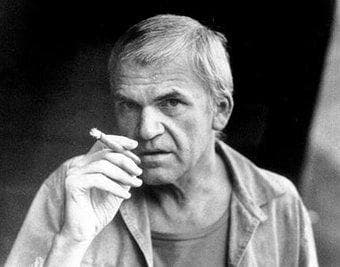
Milan Kundera is a Czech-born French writer. Kundera went into exile in France in 1975, acquiring citizenship in 1981. His Czech citizenship was revoked in 1979 and restored in 2019. He "sees himself as a French writer and insists his work should be studied as French literature and classified as such in book stores".
Similar books
- The Unbearable Lightness of Being
Milan Kundera
4.1 (342k) average on GoodreadsLiterary FictionExplores philosophical themes of existence, freedom, and identity with a similar narrative style and intellectual depth.
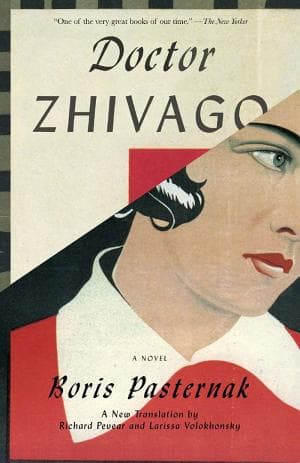
- Doctor Zhivago
Boris Pasternak
4.0 (82k) average on GoodreadsHistorical FictionFeatures a poet protagonist navigating personal life amidst revolutionary political upheaval, reflecting on the role of art.
- The Master And Margarita
Mikhail Bulgakov
4.3 (243k) average on GoodreadsFantasyCritiques totalitarian society and explores the power of art and imagination, often with satirical and philosophical undertones.
- The Rebel
Albert Camus
4.2 (12k) average on GoodreadsPoliticsWhile Camus's The Rebel offers a profound philosophical examination of rebellion and its historical manifestations, Life is Elsewhere provides a more personal, narrative-driven exploration of these themes, showing the dangers of revolutionary zeal through the intimate tragedy of a single poet. Kundera roots the abstract ideas in a concrete, character-driven story, making the philosophical arguments more visceral and relatable.
- Nineteen Eighty-Four
George Orwell
4.2 (5.5M) average on GoodreadsFictionOrwell's Nineteen Eighty-Four primarily depicts external totalitarian control and its crushing effect on individual freedom. In contrast, Kundera's Life is Elsewhere delves more deeply into the internal mechanisms of complicity, self-deception, and the seductive power of ideology that leads individuals, particularly artists, to collaborate with oppressive regimes, even from within their own romanticized worldviews. Kundera explores the 'totalitarianism of the soul,' rather than just the state.
- Brave New World
Aldous Huxley
4.0 (1.4M) average on GoodreadsFantasyIn a future where happiness comes from chemicals and individuality is gone, one man's desire for real experience threatens the calm, controlled society.



Enjoyed the summary?
A summary gives you the shape of the book. The book itself has the detail, the examples and the voice.
Find Life is Elsewhere on AmazonAs an Amazon Associate, BookBrief earns from qualifying purchases. How we're funded