
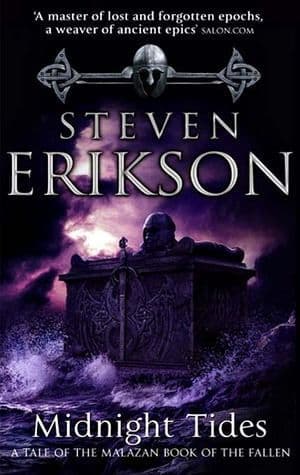
Synopsis
Covers the whole plot, including the ending.
- Difficulty
- Hard
- Pacing
- Variable
- Mood
- Epic, Tragic, Philosophical, Dark, Introspective
- Read it if
- You love complex, multi-layered epic fantasy with deep world-building, morally grey characters, and a significant emotional investment.
- Skip it if
- You prefer straightforward narratives, lighthearted fantasy, or struggle with a large cast of characters and intricate political/magical systems.
Midnight Tides Plot Summary
Covers the whole plot, including the ending.
The Unification of the Edur
The Tiste Edur, an old race, have been split into five warring tribes for centuries. Trull Sengar, a warrior, returns to find his family, especially his younger brother Rhulad, involved in a desperate grab for power. Rhulad, ambitious and reckless, challenges the Hiroth chieftain, Hannan Mosag, but is defeated and killed. However, Hannan Mosag, the Warlock King and a strong sorcerer, brings Rhulad back to life using a cursed sword, the 'Sword of Despair.' This act ties Rhulad to the sword and its dark will, giving him immortality in battle and forcing other tribes to accept Hannan Mosag's rule through Rhulad's power.
The Sengar Family's Burden
Trull Sengar, troubled by Rhulad's return and the dark power controlling him, feels a strong sense of responsibility and sadness. His older brother, Fear Sengar, also struggles with this, seeing the change in Rhulad and the evil force behind it. The Sengar family, once proud, becomes isolated and burdened by Rhulad's actions and Hannan Mosag's plans. Trull tries to understand the cursed sword and its link to the Crippled God, a deity known for suffering and destructive influence, sensing a deeper, old plot that threatens the Edur and the world.
Letheras: A City of Commerce and Intrigue
In the busy, capitalist city of Letheras, Tehol Beddict, from a once-powerful merchant family, lives in poverty, seemingly having wasted his family's money. His servant, Bugg, who seems simple, manages their small home well. Their days are full of witty talk and observations about Letheri society. Unknown to most, Tehol is a smart financial manipulator, and his 'ruin' is a plan to break down Letheras's corrupt financial system from the inside. Bugg, meanwhile, holds a secret much older and grander than anyone thinks, quietly helping Tehol's plans.
The Letheri Invasion and Rhulad's Wars
The aggressive Letheri Empire, led by its smart Emperor, starts an invasion of the Tiste Edur lands. Rhulad Sengar, now the Warlock King's immortal champion, rises to fight this threat. With the Sword of Despair, he is unbeatable on the battlefield, killing many Letheri soldiers. However, each win comes at a cost to his mind and the Edur people, as the sword's power grows, demanding more bloodshed. The war becomes a horrible, endless cycle, with Rhulad dying and coming back to life repeatedly, his mind breaking with each return, turning him into a living weapon.
The Awkward Alliance
Bryss Beddict, Tehol's ambitious and political brother, serves in the Letheri army and deals with the empire's court. He, along with other Letheri figures like the resourceful Triban Gnol and General Kuru Qan, faces the growing war against the Edur and the seemingly unstoppable Rhulad. Power struggles and political maneuvering are common, as different groups fight for influence and resources, often hurting the war effort. Bryss, despite his loyalty to the empire, starts to question the real reasons for the conflict and its cost to his people.
The Crippled God's Influence
The Sword of Despair, and Rhulad's immortality, is a direct link to the Crippled God, an Elder God enslaved by other deities. Hannan Mosag, the Warlock King, made a pact with the Crippled God, offering the Edur as a tool for the god's revenge and eventual freedom. This pact gives the Edur great power but also ties them to a terrible fate. The Crippled God's influence slowly corrupts Rhulad, making him a puppet of suffering and destruction. His repeated deaths and resurrections fuel the god's growing power and anger, making him a cosmic weapon aimed at the world's foundations.
Tehol's Grand Scheme Unfolds
Tehol Beddict's financial plans, carefully made over years, begin to work. He uses his poor status and Bugg's help to control the Letheri economy, causing instability and collapse among the strong merchant houses. His goal is not just personal gain but to break down the corrupt system that has enriched a few at the expense of many, and to stop the funding of the endless war. The financial shocks he starts spread through Letheras, getting the attention of powerful figures who first dismiss him as harmless, only to realize his genius too late.
The Edur Retreat and Internal Strife
Despite Rhulad's endless wins against the Letheri, the Tiste Edur suffer great losses. The constant war reduces their numbers, and the mental toll of Rhulad's madness and the Warlock King's rule weighs heavily on the people. Disagreement starts to grow, especially among those who question Hannan Mosag's leadership and the real cost of their 'unity.' Fear Sengar, increasingly unhappy, tries to protect his family and his people from the growing madness, while Trull, always observant, sees the tragic path of his brother and the Edur, knowing a terrible reckoning is coming.
Bugg's True Identity Revealed
In a key moment, Bugg is revealed as Mael, the Elder God of the Seas, who had long ago chosen to give up his divine power and live among mortals as a simple man. He made this choice because he was tired of the gods' endless conflicts and wanted to understand humanity. He has been subtly influencing events, especially guiding Tehol's plans, to bring about a fairer world and to fight the Crippled God's destructive influence. His reawakened power is a turning point, as he prepares to act directly in the conflict, balancing the scales against the dark forces.
The Fall of Letheras and the Crippled God's Ascent
Tehol's financial actions reach their peak, leading to the complete collapse of the Letheri economy and the Emperor's fall. Letheras falls into chaos, its foundations broken. At the same time, the Crippled God, fueled by Rhulad's endless deaths and the suffering of the Edur and Letheri, becomes very powerful. His influence begins to twist reality, and his desire for revenge threatens to consume the world. The stage is set for a final fight, with destruction and a desperate hope for justice coming together as the book ends, leaving the fate of both empires and the world uncertain.
Midnight Tides Characters
Rhulad Sengar
Antagonist/Tragic Figure
A young Edur warrior cursed with immortality and driven to madness.
Rhulad begins as an ambitious but somewhat naive younger brother in the Sengar family. His desire for glory leads him to challenge the Warlock King, Hannan Mosag, resulting in his death and subsequent resurrection by the 'Sword of Despair.' This cursed weapon grants him immortality on the battlefield, but at a terrible price: each death fragments his mind, slowly driving him to madness and turning him into a puppet of the Crippled God. He becomes the Warlock King's champion and a symbol of the Edur's destructive pact, constantly fighting, dying, and resurrecting, losing more of himself with each cycle. His arc is one of tragic transformation from a proud warrior to a weapon of pure, tormented destruction.
Relationships: Trull Sengar (Brother, object of Trull's sorrow and responsibility); Fear Sengar (Brother, object of Fear's concern and protection); Hannan Mosag (Master/Puppet, champion of the Warlock King); The Crippled God (Vessel/Tool, bound by the Sword of Despair)
Trull Sengar
Protagonist/Observer
A thoughtful Tiste Edur warrior burdened by his family's fate.
Trull Sengar is a contemplative and honorable Tiste Edur warrior, deeply troubled by the path his people and his family have taken. He returns from a long absence to find his younger brother, Rhulad, cursed and his people united under the sinister Warlock King, Hannan Mosag. Trull possesses a strong moral compass and a keen intellect, constantly questioning the motives behind the war and the nature of the powers at play. He feels a profound sense of responsibility for Rhulad and struggles with the implications of the Crippled God's influence. His role is often one of a tragic observer, bearing witness to the destruction while trying to find a way to mitigate it.
Relationships: Rhulad Sengar (Brother, source of Trull's sorrow and responsibility); Fear Sengar (Brother, ally and confidante); Hannan Mosag (Opponent, distrusts his leadership); Shurq Elalle (Brief encounter, provides insight)
Fear Sengar
Supporting/Protector
The eldest Sengar brother, trying to protect his family and people.
Fear Sengar is the eldest of the Sengar brothers, a formidable warrior and a more pragmatic figure than Trull. He deeply loves his family and attempts to protect them from the consequences of Rhulad's curse and Hannan Mosag's tyranny. Fear is less philosophical than Trull but possesses a strong sense of duty and loyalty to his people. He struggles with the growing madness of his brother and the seemingly endless war, often taking on the role of a direct defender and leader in the face of overwhelming odds. His actions are driven by a desperate hope to preserve what remains of the Edur and his kin.
Relationships: Rhulad Sengar (Brother, object of his protection and grief); Trull Sengar (Brother, ally and fellow burdened sibling); Hannan Mosag (Distrusts his leadership, but bound by his power)
Tehol Beddict
Protagonist/Mastermind
A brilliant, seemingly destitute financial genius of Letheras.
Tehol Beddict is one of the most intelligent and eccentric characters in the novel. He appears to be a ruined noble, living in squalor with only his enigmatic servant, Bugg. However, this is a carefully constructed facade. Tehol is a financial mastermind, orchestrating a complex scheme to dismantle the corrupt economic system of Letheras from within. His wit, sarcasm, and profound understanding of human nature and economics make him a formidable, if unconventional, force. He is driven by a desire for justice and to undermine the exploitative practices of the Letheri elite, using his intellect as his primary weapon.
Relationships: Bugg (Master/Servant (true nature is much deeper), closest confidant); Bryss Beddict (Brother, often exasperated by Tehol's antics); Janath Anar (Acquaintance/Ally, provides information)
Bugg
Supporting/Deus ex Machina
Tehol's unassuming servant, secretly an Elder God.
Bugg initially appears as Tehol Beddict's loyal, long-suffering, and somewhat simple servant, managing their meager household with surprising efficiency and a dry wit. He often provides the perfect foil for Tehol's grand pronouncements. However, Bugg is secretly Mael, the Elder God of the Seas, who chose to divest himself of his divine power to live among mortals and understand their ways. He quietly aids Tehol's schemes, offering subtle guidance and, when necessary, direct divine intervention. His true nature is revealed later, highlighting his immense power and his deep, ancient wisdom, making him a pivotal figure in the unfolding cosmic drama.
Relationships: Tehol Beddict (Servant/Confidant, true nature is ancient ally and friend); Mael (His true identity, Elder God of the Seas); Crippled God (Ancient adversary, opposes his influence)
Hannan Mosag
Antagonist
The Warlock King of the Tiste Edur, a powerful sorcerer with a dark agenda.
Hannan Mosag is the cunning and ruthless chieftain of the Hiroth tribe, who, through dark sorcery and a pact with the Crippled God, becomes the Warlock King and unites the Tiste Edur. He is a powerful sorcerer, driven by a desire for vengeance against the Letheri and a deeper, more sinister agenda tied to the Crippled God's release. He manipulates Rhulad Sengar, using him as an immortal weapon, and ruthlessly suppresses any dissent among the Edur. Hannan Mosag is a master of political intrigue and dark magic, embodying the corrupting influence of power and the devastating consequences of making pacts with malevolent deities.
Relationships: Rhulad Sengar (Master/Puppet, uses him as an immortal champion); The Crippled God (Ally/Pact-maker, serves his agenda); Tiste Edur (Ruler, feared and obeyed)
Bryss Beddict
Supporting
Tehol's ambitious and pragmatic brother, serving the Letheri Empire.
Bryss Beddict is Tehol's older brother, a capable military officer and a more conventional figure within Letheri society. Unlike Tehol, Bryss strives for success within the established system, serving the Emperor and navigating the political intrigues of the court. He is pragmatic and ambitious but also possesses a sense of honor and loyalty. Bryss is often exasperated by Tehol's eccentricities but remains protective of him. He is a witness to the corruption and inefficiencies of the Letheri Empire, and his experiences during the war with the Edur force him to question the true cost of imperial expansion and the decisions of his leaders.
Relationships: Tehol Beddict (Brother, often exasperated but protective); General Kuru Qan (Commander, respects his military prowess); Triban Gnol (Political rival/ally)
Shurq Elalle
Supporting
A perpetually unlucky, but surprisingly resilient, former noblewoman turned scavenger.
Shurq Elalle is a recurring character, a former noblewoman of Letheras who has fallen on hard times and now makes a living as a scavenger and guide in the city's depths. She is characterized by her extraordinary bad luck, which often leads her into bizarre and dangerous situations, yet she always seems to survive. Despite her misfortunes, Shurq is sharp-witted, resourceful, and possesses a surprising resilience. She provides a unique perspective on the underbelly of Letheras and often encounters characters from both sides of the conflict, inadvertently becoming a minor player in the larger events. Her cynicism is balanced by a pragmatic will to survive.
Relationships: Tehol Beddict (Acquaintance, provides information); Trull Sengar (Brief encounter, provides a perspective on the Edur)
Midnight Tides Themes
The Corrupting Nature of Power
The novel shows how power, whether political, military, or divine, corrupts individuals and societies. Hannan Mosag's rise to Warlock King through a pact with the Crippled God shows this, as his pursuit of power leads to the enslavement and destruction of his people. Rhulad Sengar's change by the Sword of Despair illustrates the personal cost of too much power, as his immortality in battle costs him his mind and humanity. Even the Emperor of Letheras, driven by expansion, oversees a corrupt system. The theme highlights that wanting control often leads to moral decay and suffering, seen in the endless war and the manipulation of people for larger, often destructive, goals.
“Power is a hungry beast. It feeds on the ambitions of men, and leaves only ashes in its wake.”
The Price of Progress and Civilization
*Midnight Tides* compares the 'civilized,' capitalist society of Letheras with the 'primitive' but old Tiste Edur. The Letheri, despite their advancements, are shown as corrupt, driven by greed and expansion. Their 'progress' comes at the cost of inequality, exploitation, and endless war. In contrast, the Edur, forced to unite under the Warlock King, give up their old ways and freedoms for strength, leading to their own destruction. The novel questions if 'progress' is always good, suggesting that uncontrolled ambition and the pursuit of money can lead to spiritual and societal decay, no matter the level of civilization.
“Civilization, it seemed, was merely a more efficient way to inflict suffering.”
The Burden of Family and Loyalty
The Sengar family is central to the Edur story, showing the strong bonds and burdens of family. Trull and Fear Sengar are troubled by Rhulad's curse, feeling responsibility and sorrow for their brother, even as he becomes a monster. Their loyalty to each other and their people drives many of their actions, even when those actions seem pointless. Similarly, Tehol and Bryss Beddict, despite their different paths, share a family connection that affects their interactions. This theme looks at the sacrifices made for family, the grief of watching loved ones suffer, and the lasting, often painful, nature of family duty in a world consumed by conflict.
“A brother's blood, once spilled, can never be washed clean. It stains the soul of all who share it.”
The Folly of War and Vengeance
The entire story is filled with the results of war and the destructive cycle of revenge. The conflict between the Tiste Edur and the Letheri Empire is shown as pointless and unending, fueled by old grudges and the ambitions of powerful people. Rhulad Sengar's immortality turns war into a grotesque, never-ending slaughter, showing its futility. The Warlock King's desire for revenge against the Letheri blinds him to his people's suffering, while the Crippled God's cosmic quest for revenge threatens to break reality. The novel repeatedly shows that war, far from solving conflicts, causes suffering and leads only to more destruction, making all wins empty.
“The only thing war ever settles is who is left to mourn.”
Plot Devices & Literary Techniques
The Sword of Despair
A cursed sword that grants immortality at the cost of sanity.
The Sword of Despair is a pivotal magical artifact that binds Rhulad Sengar to the Crippled God. When Rhulad is killed, the sword resurrects him, making him immortal in battle. However, each resurrection comes with a cost: a piece of Rhulad's sanity. The sword acts as a conduit for the Crippled God's power and influence, slowly transforming Rhulad into a mindless weapon of destruction, fueling the god's suffering and vengeance. It is a symbol of the destructive pact made by Hannan Mosag and the ultimate price of unchecked power.
Tehol's Financial Scheme
A complex, long-term plan to dismantle the Letheri economy from within.
Tehol Beddict's financial scheme is a masterful example of a long con. He deliberately orchestrates his own ruin, living in squalor, to appear harmless and beneath the notice of the powerful Letheri merchant houses. This facade allows him to subtly manipulate the economy, leveraging hidden assets and insider knowledge to destabilize the market and bring down the corrupt financial system. This device serves as a counterpoint to the military conflict, demonstrating that power can be wielded through intellect and economic disruption as effectively as through brute force, leading to a systemic collapse rather than a direct battle.
Bugg's True Identity (Mael)
The revelation that Tehol's humble servant is an Elder God.
The gradual reveal of Bugg as Mael, the Elder God of the Seas, serves as a significant plot twist and a form of *deus ex machina* (though carefully foreshadowed). Bugg's seemingly mundane presence masks immense power and ancient wisdom, allowing him to subtly influence events and provide crucial support to Tehol's plans. His eventual reawakening of his divine powers introduces a cosmic element to the narrative, providing a powerful force to counter the destructive influence of the Crippled God and offering a glimmer of hope amidst the despair. This device elevates the stakes and expands the scope of the conflict beyond mortal empires.
Midnight Tides Quotes
“It is not the truth that matters, but the story.”
“All that is left to us is to choose how we shall love.”
“The past is a weapon, and it is in the hands of the living.”
“What is honour? A word. What is loyalty? A lie.”
“There are no easy answers. Only choices, and consequences.”
“Sometimes, the only way to save a thing is to let it break.”
“We are all prisoners of our own making, until we choose to walk free.”
“Grief is a landscape, and we are its reluctant cartographers.”
“Compassion is a burden. It is the weight of another's suffering on your own soul.”
“The only true victory is to survive. Everything else is just a story we tell ourselves.”
“Power is a cage. The more you have, the smaller your world becomes.”
“We build our lives on lies, and then wonder why they crumble.”
“To be truly free, one must first be willing to lose everything.”
“The heart does not forget, even when the mind tries to deny.”
Quiz
10 questions on the plot and the characters. Each answer comes with a short explanation.
Question 1
Which Tiste Edur tribe holds the Warlock King of the Hiroth, who unites the five tribes?
- Tiste Liosan
- Tiste Andii
- Tiste Edur
- Tiste Hiroth
Show answer
D. Tiste Hiroth The Warlock King is specifically identified as 'of the Hiroth', indicating his tribal affiliation.
Question 2
What is the primary motivation for the Tiste Edur's unification under the Warlock King?
- To conquer the neighboring kingdom of Lether.
- To achieve internal peace after decades of warfare among the tribes.
- To form an alliance with the Malazan Empire.
- To explore new lands to the west.
Show answer
B. To achieve internal peace after decades of warfare among the tribes. The synopsis explicitly states, 'After decades of warfare, the five tribes of the Tiste Edur are united under the implacable rule of the Warlock King of the Hiroth. But the price of peace is a pact with a hidden power whose motives may be deadly.'
Question 3
What is the name of the expansionist kingdom to the south of the Tiste Edur?
- Malazan Empire
- Lether
- Seven Cities
- Genabackis
Show answer
B. Lether The synopsis clearly states, 'To the south, the expansionist kingdom of Lether has devoured all lesser neighbors - except the Tiste Edur.'
Question 4
The unification of the Tiste Edur tribes comes at a price involving a 'pact with a hidden power'. What is implied about this hidden power?
- It is a benevolent force seeking to aid the Edur.
- Its motives are potentially dangerous or deadly.
- It is a neutral party with no interest in the Edur's fate.
- It is a known ally of the Letheras.
Show answer
B. Its motives are potentially dangerous or deadly. The synopsis directly states, 'But the price of peace is a pact with a hidden power whose motives may be deadly.'
Question 5
How does the kingdom of Lether typically interact with its smaller neighbors, according to the synopsis?
- It forms trade alliances and partnerships.
- It offers military protection in exchange for tribute.
- It conquers and absorbs them.
- It maintains a policy of non-interference.
Show answer
C. It conquers and absorbs them. The text states that Lether 'has devoured all lesser neighbors', which implies conquest and absorption rather than peaceful relations.
Question 6
What is the Warlock King's defining characteristic in his rule over the united Tiste Edur tribes?
- His compassionate and democratic leadership.
- His hesitant and indecisive nature.
- His implacable and unyielding rule.
- His reliance on diplomacy and negotiation.
Show answer
C. His implacable and unyielding rule. The synopsis describes his rule as 'implacable', meaning unyielding or unstoppable, highlighting his firm and decisive leadership.
Question 7
The synopsis highlights a dynamic between the Tiste Edur and Lether. What kind of conflict does this setup primarily suggest?
- An internal ideological struggle within the Tiste Edur.
- A direct military confrontation between two powerful, opposing entities.
- A diplomatic race to secure alliances with other kingdoms.
- A competition for economic dominance through trade.
Show answer
B. A direct military confrontation between two powerful, opposing entities. Lether is described as expansionist and having 'devoured all lesser neighbors - except the Tiste Edur', while the Edur are newly united. This strongly suggests an impending military conflict.
Question 8
Considering the 'pact with a hidden power whose motives may be deadly', what is a likely thematic concern of the novel?
- The triumph of good over evil through pure intentions.
- The inherent dangers and moral compromises of seeking power or peace at any cost.
- The simplicity of achieving lasting peace through diplomacy.
- The irrelevance of external forces in internal tribal affairs.
Show answer
B. The inherent dangers and moral compromises of seeking power or peace at any cost. The phrase 'price of peace' and 'motives may be deadly' strongly hints at a theme of moral compromise and the dangerous consequences of deals made for power or stability.
Question 9
The synopsis mentions 'decades of warfare' among the Tiste Edur tribes. What does this imply about their society before unification?
- They were a highly centralized and stable empire.
- They were fragmented and prone to internal conflict.
- They were a peaceful, agrarian society.
- They were primarily focused on trade and cultural exchange.
Show answer
B. They were fragmented and prone to internal conflict. 'Decades of warfare' among tribes directly indicates a history of internal strife and fragmentation before their forced unification.
Question 10
Given the description of Lether as having 'devoured all lesser neighbors' but not the Tiste Edur, what is the most likely immediate future for the Tiste Edur-Lether relationship?
- Lether will offer the Tiste Edur a non-aggression pact.
- The Tiste Edur will peacefully integrate into the Letheras empire.
- A significant conflict or confrontation between the two powers is inevitable.
- Both sides will ignore each other and focus on internal development.
Show answer
C. A significant conflict or confrontation between the two powers is inevitable. Lether's expansionist nature and the fact that the Edur are the only remaining 'un-devoured' neighbor strongly suggests that they are next on Lether's agenda, leading to inevitable conflict.
Midnight Tides FAQ
What is the central conflict driving the plot of 'Midnight Tides'?
The central conflict revolves around the Tiste Edur's desperate quest for power and unity, achieved through a pact with the Crippled God, to resist the imperialistic expansion of the Letherii Empire. This pact, however, comes with a terrible price, slowly corrupting the Edur and their Warlock King, Hannan Mosag.
Who are the main protagonists from the Tiste Edur perspective?
The main protagonists from the Tiste Edur are the Sengar brothers: Trull, Fear, and Rhulad. Trull Sengar, though initially disgraced, is a warrior of principle; Fear Sengar is a loyal and skilled fighter; and Rhulad Sengar, initially weak, becomes the Warlock King through repeated resurrections and the power of the Crippled God.
Who are the key characters representing the Letherii Empire?
The key Letherii characters include Brys Beddict, the Emperor's Blade and a master swordsman; Tehol Beddict, Brys's eccentric and seemingly impoverished brother who is secretly a financial genius; and Janath Anar, Tehol's quick-witted and pragmatic assistant. Emperor Ezgara Diskanar and Prince Quik are also significant figures.
What is the significance of the Crippled God in the narrative?
The Crippled God is the hidden power behind the Tiste Edur's rise, granting Rhulad immortality and immense power in exchange for their devotion and their souls. His influence is insidious, manipulating events to sow chaos and ultimately gain freedom or revenge against the other gods.
What role does the Elder God Mael play in the story?
Mael, the Elder God of the Seas, is a largely benevolent but ancient entity who eventually sides with Tehol Beddict and Brys to disrupt the Letherii's economic and military dominance. He also has a vested interest in the balance of power and the fate of the Edur, particularly their connection to the Forkrul Assail.
How do the events of 'Midnight Tides' connect to the broader Malazan Book of the Fallen series?
'Midnight Tides' introduces the continent of Lether and the Tiste Edur, expanding the world's scope significantly. It establishes the Crippled God's direct involvement in mortal affairs on a new front, and characters like Trull Sengar and the Crippled God's influence become crucial to later books, particularly 'The Bonehunters' and 'Reaper's Gale'.
What is the true nature of Tehol Beddict's poverty and his relationship with Bugg?
Tehol's poverty is an elaborate ruse to hide his immense wealth and his strategic manipulation of the Letherii economy. Bugg is actually Mael, the Elder God of the Seas, in disguise. Their relationship is a complex one of master and servant, friend, and ultimately, a powerful alliance working to undermine the corrupt Letherii system.
What is the significance of the Forkrul Assail and their presence in the Edur lands?
The Forkrul Assail are an ancient race dedicated to 'justice,' which often manifests as extreme, destructive acts. Their presence in the Edur lands, particularly the temple of Tremorlor, hints at their awakening and their eventual role as a major antagonistic force. They are the original creators of the sword that empowers Rhulad.
How does Rhulad Sengar's repeated resurrections impact his psychological state?
Rhulad's resurrections profoundly warp his mind, stripping away his humanity and replacing it with increasing madness, paranoia, and an insatiable desire for conquest. Each death and rebirth makes him more powerful but less sane, isolating him from his family and turning him into a puppet of the Crippled God's will.
Analyze Trull Sengar's internal conflict and his concept of honor.
Trull Sengar grapples with profound internal conflict, torn between his loyalty to his family and tribe, and his personal sense of honor and justice. He defies the Edur's pact with the Crippled God, seeing its corruption, and ultimately chooses a path of integrity, even when it leads to his ostracization and punishment by his own people.
What psychological themes are explored through the Letherii society, particularly its obsession with wealth?
Letherii society exemplifies the corrupting influence of unchecked capitalism and materialism, leading to widespread inequality, moral decay, and a disregard for human life. The characters like Tehol and Brys offer a critique of this system, highlighting how the pursuit of wealth can hollow out a civilization and its people.
How does the novel explore the concept of brotherhood through the Sengar siblings?
The Sengar brothers' relationship is a tragic exploration of brotherhood, showcasing loyalty, jealousy, sacrifice, and ultimately, profound loss. Trull's burden of honor, Fear's unwavering devotion, and Rhulad's descent into madness create a complex dynamic where their bonds are tested and ultimately shattered by external forces and their own choices.
Is the Tiste Edur's pact with the Crippled God an act of desperation or hubris?
It is arguably both. The Edur are desperate to unite and resist the Letherii, making the pact a necessity in their eyes. However, their willingness to embrace such a dark power, and Hannan Mosag's ambition, also speaks to a degree of hubris, believing they can control a force far beyond their understanding, leading to their downfall.
To what extent is Rhulad Sengar a tragic figure, and to what extent is he a villain?
Rhulad is a deeply tragic figure, initially a weak individual thrust into an unimaginable role and driven mad by an external power. However, his actions as the Warlock King, his relentless wars, and his cruelty, make him undeniably villainous. His tragedy lies in the loss of his former self, consumed by the power he was given.
What is the ultimate message regarding imperialism and conquest presented by the clash between the Letherii and the Tiste Edur?
The novel portrays imperialism as a destructive force, whether driven by Letherii economic expansion or Edur military might. Both sides suffer immense losses and moral compromises. It suggests that conquest, regardless of the initial motivation, leads to cycles of violence, corruption, and the erosion of cultural identity and individual freedom.
How does the narrative challenge traditional notions of heroes and villains?
'Midnight Tides' blurs the lines between heroes and villains significantly. Characters like Trull, though honorable, are ostracized by their own people. Rhulad, a villain, is also a victim. Even the seemingly benevolent Tehol and Bugg employ morally ambiguous tactics. The book emphasizes that good intentions can have disastrous outcomes, and evil can arise from desperation.
Discuss the significance of the character of Feather Witch and her visions.
Feather Witch serves as a tragic oracle, burdened with fragmented, often terrifying visions of the future. Her visions, though initially dismissed, provide crucial insights into the Crippled God's manipulations and the impending doom for the Edur. She represents the cost of foresight and the futility of warning those consumed by ambition.
What is the nature of the relationship between Hannan Mosag and the Crippled God?
Hannan Mosag is the Warlock King who initially brokers the pact with the Crippled God, believing he can control the power. However, he becomes increasingly subservient and fearful, realizing too late that he is merely a pawn. The Crippled God uses Mosag's ambition and fear to solidify his hold over the Tiste Edur.
About the author
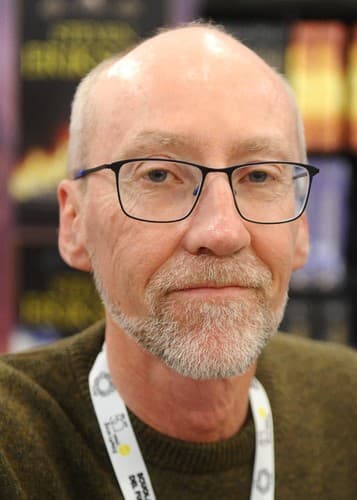
Steven Erikson is a Canadian author known for his epic fantasy series, "Malazan Book of the Fallen." His notable works include "Deadhouse Gates," "House of Chains," "Midnight Tides," "The Bonehunters," "Toll the Hounds," and "Dust of Dreams." Erikson's writing is characterized by its complex narratives and extensive world-building.
Similar books
- The Way of Kings
Brandon Sanderson
4.6 (305k) average on GoodreadsFantasyFeatures a vast world, epic scope, and multiple intertwining plotlines, though with a different narrative approach.
- A Game of Thrones
George R.R. Martin
4.5 (2M) average on GoodreadsFantasyDeals with complex political intrigue, morally ambiguous characters, and the brutal consequences of war and ambition.
- Harry Potter and the Sorcerer's Stone
J.K. Rowling
4.5 (7M) average on GoodreadsFantasyRescued from a miserable life under the stairs, an orphaned boy discovers he's a wizard destined for a magical school, where he uncovers a dangerous secret tied to the dark wizard who murdered his parents.
- The Hunger Games
Suzanne Collins
4.3 (6.4M) average on GoodreadsFantasyIn a future where children fight to the death on live television, Katniss Everdeen volunteers for the arena, turning a death sentence into a fight for survival and a spark of rebellion.
- 1984
George Orwell
4.2 (3.1M) average on GoodreadsPoliticsIn a future where surveillance and thought control are absolute, a man's search for truth clashes with the Party, showing that hope can be a form of rebellion.
- Divergent
Veronica Roth
4.2 (2.9M) average on GoodreadsFantasyIn a society divided by virtues, a sixteen-year-old's difference from the norm starts a rebellion that threatens her world.





Enjoyed the summary?
A summary gives you the shape of the book. The book itself has the detail, the examples and the voice.
Find Midnight Tides on AmazonAs an Amazon Associate, BookBrief earns from qualifying purchases. How we're funded