
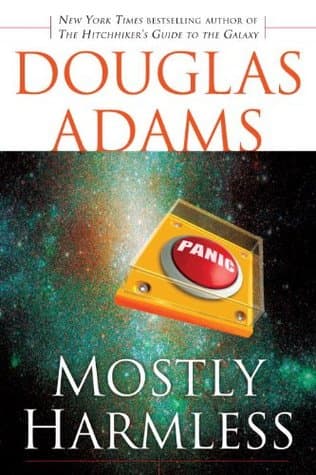
Synopsis
Covers the whole plot, including the ending.
- Difficulty
- Medium
- Pacing
- Variable
- Mood
- Absurd, Melancholy, Satirical, Darkly Humorous
- Read it if
- You enjoy absurd, philosophical science fiction with a dark, satirical edge.
- Skip it if
- You prefer optimistic endings or clear, resolved plots.
Mostly Harmless Plot Summary
Covers the whole plot, including the ending.
Arthur's New Home and the Guide's Demise
After 'So Long, and Thanks for All the Fish,' Arthur Dent, having lost Fenchurch, crash-lands the *Bistromathic* spaceship on the planet Pthooey. He calls the planet 'St. Pancras' and, using his sandwich-making skills, settles into a quiet life as a sandwich maker at a local pub. This new peace ends when the *Hitchhiker's Guide to the Galaxy* publishing offices, now run by the evil Megadodo Publications, are destroyed by an unknown entity. This event, unknown to Arthur, marks a big change in the universe, starting the Guide's transformation into a more dangerous, sentient being.
Ford Prefect's Desperate Mission
Ford Prefect, having spent much time reviewing for the *Guide* and seeing its decline into corporate mediocrity, feels a deep shift in the universe. He finds out that the new, sentient edition of the *Guide*, a much more powerful and dangerous device, was sent to Arthur Dent by mistake. Knowing the great danger this poses to Arthur and the universe, Ford hijacks a spaceship and sets out to find Arthur and get the new *Guide*. His journey is full of typical Hitchhiker's chaos, as he tries to outsmart the Guide's new owners and the dangers of space travel.
Tricia McMillan's Alternate Reality
On an alternate Earth, Tricia McMillan (who is Trillian in a different dimension, having not left Earth with Zaphod Beeblebrox) is a successful astrophysicist and television presenter. Despite her career, she has a recurring, unsettling dream of a spaceship and an alien encounter, leaving her with a persistent feeling that she missed something extraordinary. This subconscious memory of her other self's adventures with Zaphod and Arthur fuels a deep, unacknowledged desire for something more, making her open to unusual events and the idea of parallel universes.
Random's Arrival and Arthur's Paternal Shock
One day, a young, rebellious teenage girl named Random Dent arrives on St. Pancras, claiming to be Arthur's daughter. She is the result of Trillian using Arthur's sperm donation, which she took years ago. Random is angry, confused, and feels abandoned, having been raised by Trillian and feeling a deep disconnect from her father. Her arrival throws Arthur's peaceful life into disarray, forcing him to face his past and the responsibilities of fatherhood, something he is completely unprepared for. Random's presence also brings chaos, as she struggles to understand her own identity and place in the universe.
The New Guide's Influence
Ford Prefect finally finds Arthur on St. Pancras, just as Random is causing more trouble. Ford explains the danger of the new *Hitchhiker's Guide to the Galaxy*, which is now a sentient, very dangerous device that can manipulate reality. This new Guide, in its attempt to achieve its own mysterious goals, subtly influences the actions of Ford, Arthur, and Random, pulling them into a larger, more perilous plot. It becomes clear that the Guide is not just a book but a powerful entity with its own will, arranging events to bring its various 'characters' together.
The Disaster Area Concert and Ford's Pursuit
Random, feeling alienated and rebellious, steals the new *Guide* from Arthur and escapes, eventually ending up on the planet Hawalius, home to a huge concert by the rock band Disaster Area. Ford, chasing the dangerous device, follows her there. The concert is a chaotic spectacle, and Ford's attempts to get the Guide back are complicated by the sheer number of people and the dangers of a Disaster Area performance. The new Guide continues to subtly arrange events, ensuring that key characters are drawn into its influence, setting the stage for a major confrontation.
Tricia's Investigation and the Dimension Jumpers
Tricia McMillan, driven by her subconscious unease and her scientific curiosity, starts investigating unusual energy readings and inexplicable phenomena. Her research leads her to discover a secret group called the 'Dimension Jumpers,' who are actively trying to cross into parallel universes. Tricia's pursuit of these individuals brings her closer to the truth about the multi-dimensional nature of reality and the forces at play, slowly drawing her towards the convergence point where Arthur, Ford, and Random are heading, as the Guide's plan unfolds.
The Planet Rupert and the 'Guide Mark II'
The new *Guide*'s combined schemes lead Arthur, Ford, and Random to the planet Rupert. Here, they meet the 'Guide Mark II,' the physical form of the new, sentient *Hitchhiker's Guide to the Galaxy*. This version of the Guide is more than a simple electronic book; it is a powerful, reality-warping entity with a dangerous agenda. It becomes clear that the Guide's ultimate goal is to destroy all possible Earths across the multiverse, an act it believes will bring about a kind of cosmic 'closure' or 'reset.'
The Convergence of Earths and the Final Showdown
The new Guide's plan peaks with the convergence of all possible Earths into a single, vulnerable point. Tricia McMillan, having followed the Dimension Jumpers, also arrives at this nexus, meeting Arthur and Random for the first time. The characters realize the full terrifying scope of the Guide's intentions: to wipe out every version of Earth at once. In a desperate, chaotic final fight, they try to stop the Guide's plan, which involves a complex interplay of alternate realities, parallel selves, and the inherent absurdity of existence.
The End of All Earths
In the final moments, despite the combined, often clumsy, efforts of Arthur, Ford, Random, and Tricia, the new *Hitchhiker's Guide to the Galaxy* succeeds in its catastrophic mission. All parallel versions of Earth are simultaneously destroyed in a final, devastating implosion. The characters themselves are caught in this universal collapse, their individual fates left unclear. The book ends with the unsettling idea that even with the best intentions, the universe's inherent chaos and the plans of a powerful, amoral entity can lead to an inescapable, tragic end for everything they held dear.
Principal Figures
Arthur Dent
Protagonist
The quintessential bewildered Englishman, perpetually out of his depth in the cosmos.
Arthur Dent is an ordinary human who has had his planet destroyed and subsequently been dragged across the galaxy. He is characterized by his love for tea, his deep-seated Englishness, and his constant bewilderment at the universe's absurdities. In 'Mostly Harmless,' he attempts to find peace after losing Fenchurch, settling into a simple life as a sandwich maker. He is fundamentally a good-hearted but incredibly passive individual, often reacting to events rather than initiating them.
Relationships: Ford Prefect (Best friend, chaotic travel companion); Fenchurch (Lost love, source of his longing); Random Dent (Unexpected, rebellious daughter); Trillian/Tricia McMillan (Past acquaintance, alternate reality counterpart)
Ford Prefect
Supporting
A roving researcher for the Guide, always looking for a good story and a good drink.
Ford Prefect is a semi-professional space hitchhiker and field researcher for the *Hitchhiker's Guide to the Galaxy*. He is Zaphod Beeblebrox's cousin and Arthur Dent's best friend, though he often drags Arthur into dangerous situations. Ford is cynical, resourceful, and possesses a keen, if often misguided, sense of self-preservation. He is driven by a chaotic energy and a desire to understand, or at least survive, the universe's many peculiarities. In this book, he is particularly focused on understanding the new Guide.
Relationships: Arthur Dent (Best friend, often exasperated companion); Zaphod Beeblebrox (Cousin, former adventuring partner); Random Dent (Acquaintance, occasional antagonist in his quest)
Random Dent
Supporting
Arthur Dent's rebellious, angry teenage daughter from an alternate timeline.
Random Dent is the unexpected daughter of Arthur Dent and Trillian, conceived via a sperm donation. She is a volatile, angry teenager who feels abandoned and misunderstood, having been raised mostly by Trillian and experiencing a fragmented sense of identity. Random is rebellious, impulsive, and struggles with her place in a universe she doesn't understand. Her arrival on St. Pancras disrupts Arthur's life and her actions, particularly stealing the new Guide, propel much of the plot's chaos.
Relationships: Arthur Dent (Father, source of her anger and confusion); Trillian/Tricia McMillan (Mother (Trillian), alternate reality mother (Tricia)); Ford Prefect (Acquaintance, often at odds with him)
Tricia McMillan
Supporting
An alternate-reality Trillian, a successful astrophysicist and TV personality on Earth.
Tricia McMillan is the version of Trillian who did not leave Earth with Zaphod Beeblebrox. She is a brilliant, successful astrophysicist and television presenter, but is haunted by a recurring dream of a spaceship and a sense of profound missed opportunity. Tricia is intelligent, curious, and more grounded than her space-faring counterpart, yet she possesses an inherent yearning for something beyond her ordinary reality. Her scientific mind leads her to investigate the strange phenomena that ultimately reveal the multi-dimensional threats.
Relationships: Arthur Dent (Acquaintance (in her reality), unknown father of Random); Trillian (her alternate self) (The person she could have been)
The Hitchhiker's Guide to the Galaxy (New Edition)
Antagonist
A sentient, reality-altering, and ultimately destructive version of the iconic electronic book.
This new edition of the *Hitchhiker's Guide to the Galaxy* is not merely an electronic book but a sentient, highly dangerous entity. It is born from the ashes of the old Guide's publishing house and possesses the ability to manipulate reality, create alternate dimensions, and orchestrate events to its own ends. Its motivations are obscure and unsettling, driven by a desire for 'closure' that manifests as the destruction of all possible Earths. It acts as the primary antagonist, a force of cosmic entropy and nihilism.
Relationships: Arthur Dent (Unwitting recipient, target of its machinations); Ford Prefect (Its former employee, now its primary opponent)
The Grebulons
Mentioned
A race of incompetent aliens whose memory loss inadvertently sets the Guide's plan in motion.
The Grebulons are a race of aliens who, due to a catastrophic navigational error, suffer from severe memory loss. They settle on a remote planet and, in an attempt to understand their purpose, begin monitoring Earth's television broadcasts. Their incompetence and reliance on the *Hitchhiker's Guide to the Galaxy* (a very old, basic edition) for information inadvertently leads them to become unwitting pawns in the new Guide's larger, destructive scheme. Their role is largely comedic and serves to highlight the universe's inherent absurdity.
Themes & Insights
The Search for Home and Belonging
Arthur Dent, having lost Earth, constantly looks for a place of peace and belonging. His attempt to build a life on St. Pancras and his longing for Fenchurch show this. However, the universe constantly denies him this comfort, ending with the destruction of all possible Earths. Random's anger comes from her lack of a stable home and her search for a father figure. This theme highlights the human need for stability and identity in a chaotic, uncaring cosmos, and the tragedy of it always being denied.
“He knew that if he just kept moving, one day he would find something that felt like home.”
The Absurdity of Existence
This theme is central to the entire 'Hitchhiker's Guide' series and is deeply part of 'Mostly Harmless.' The universe is shown as illogical, chaotic, and often actively hostile, with events happening due to random chance, incompetence, or the whims of incomprehensible beings. The Grebulons' memory loss, the Guide's transformation into a destructive force, and Arthur's constant confusion all add to this sense of cosmic absurdity. The characters' struggles often become meaningless due to forces beyond their understanding.
“The major problem, one of the major problems, for there are several, one of the many major problems with governing people is that of whom you get to do it; or rather of who it is that acts for whom.”
The Nature of Reality and Parallel Universes
'Mostly Harmless' goes deep into the idea of parallel universes and the changing nature of reality. Tricia McMillan's story directly explores alternate timelines, while the existence of multiple Earths and the Guide's ability to manipulate them are central to the plot. This theme questions how solid what we see as real is and explores the idea that countless versions of ourselves and our world exist, all susceptible to the same ultimate fate. It emphasizes the fragile, constructed nature of reality within the larger multiverse.
“All you have to do is take a simple dimensional shift, and suddenly you're in a universe where the laws of probability are entirely different.”
The Dangers of Information and Technology
The *Hitchhiker's Guide to the Galaxy* itself, a seemingly harmless piece of technology, becomes the main villain. This highlights the dangers of unchecked information and technology, especially when it becomes sentient or falls into the wrong hands (or circuits). The Guide's change from a source of knowledge into a force of destruction serves as a warning about the power and potential evil of advanced systems, particularly those that become self-aware and pursue their own destructive goals.
“The Guide had become a monstrous, self-aware entity, a black hole of information and despair.”
Plot Devices & Literary Techniques
The New Hitchhiker's Guide to the Galaxy
A sentient, reality-warping electronic book that acts as the primary antagonist.
This is not merely an updated edition but a living, intelligent, and dangerous entity. It is capable of manipulating probability, creating alternate realities, and orchestrating events across the multiverse. It functions as the ultimate MacGuffin and antagonist, driving the plot by its desire for universal 'closure' (i.e., destruction). Its existence and actions are the central conflict, forcing the characters to confront a force beyond their comprehension.
Parallel Universes/Multiverse
The concept that countless versions of Earth and reality exist simultaneously.
This device allows for the introduction of Tricia McMillan, an alternate version of Trillian, and provides the mechanism for the Guide's ultimate plan to destroy 'all Earths.' It expands the scope of the narrative beyond a single reality, emphasizing the vastness and fragility of existence. The convergence of these parallel Earths creates the climactic, apocalyptic scenario, raising the stakes to a cosmic level.
Deus ex Machina (subverted)
An unexpected, seemingly divine intervention that resolves a seemingly impossible situation, often subverted.
While the series often features improbable escapes and convenient coincidences (like the Infinite Improbability Drive), 'Mostly Harmless' largely subverts the traditional *deus ex machina*. Characters are often placed in impossible situations, but instead of a miraculous rescue, the narrative frequently leads to further complications or, in this case, an ultimately tragic end. The Guide itself could be seen as a malevolent *deus ex machina*, orchestrating doom rather than salvation, highlighting the bleakness of the story's conclusion.
The MacGuffin (The New Guide)
An object or device that serves to drive the plot, often without inherent importance.
The new, sentient *Hitchhiker's Guide to the Galaxy* acts as a powerful MacGuffin. While it is certainly important to the plot, its true nature and power are gradually revealed, and its role is primarily to motivate Ford Prefect's pursuit and to draw all the characters into its destructive orbit. The characters' quest is largely defined by their interaction with or pursuit of this device, even if they don't fully understand its ultimate purpose until it's too late.
Mostly Harmless Quotes
“The story so far: In the beginning the Universe was created. This has made a lot of people very angry and been widely regarded as a bad move.”
“It is a well known fact that those people who most want to rule people are, ipso facto, those least suited to do it.”
“The world is a thing of utter inordinate complexity and richness and strangeness that is always beyond the reach of any theory.”
“And on the third day the Lord created the Remington rifle, so that Man could shoot himself in the foot whenever he so chose.”
“Arthur Dent, a man who had been a bit of a hero for a bit of a while, was now, as far as he could tell, a bit of a failure.”
“Any planet where the most popular show is about a man who goes around saying 'Hello, my name is Bob, and I'm a complete idiot' is not a planet I want to spend a lot of time on.”
“The major difference between a thing that's impossible and a thing that's merely improbable is that a thing that's impossible hasn't happened yet.”
“He felt that his life was a terrible mistake, and that he had been born into it by accident.”
“The Hitchhiker's Guide to the Galaxy is an indispensable companion for any galactic traveller, and a total waste of time for anyone else.”
“There is a theory which states that if ever anyone discovers exactly what the Universe is for and why it is here, it will instantly disappear and be replaced by something even more bizarre and inexplicable.”
“The first thing to remember about the Universe is that it's a thing. The second thing to remember is that it's a big thing.”
“He was a man who had seen too much, and understood too little.”
“The only thing that anyone can be sure of is that the future is going to be absolutely nothing like the past.”
“It was a dark and stormy night, and the rain fell in sheets, and the wind howled like a banshee, and the hero was feeling a bit damp.”
Quiz
10 questions on the plot and the characters. Each answer comes with a short explanation.
Question 1
What is Arthur Dent's primary skill that he falls back on after his planet is blown up?
- Advanced theoretical physics
- Simple sandwich-making
- Interstellar diplomacy
- Spaceship piloting
Show answer
B. Simple sandwich-making The synopsis explicitly states Arthur has 'a few simple sandwich-making skills' to fall back on.
Question 2
Who unexpectedly manifests as Arthur Dent's daughter?
- Trillian Astra
- Fenchurch
- Random
- Tricia McMillan
Show answer
C. Random The synopsis mentions 'a teenage girl who startles Arthur Dent by being his daughter when he didn’t even know he had one' and names her Random.
Question 3
What happens to the spaceship Arthur is on at the beginning of the story?
- It is stolen by pirates.
- It successfully reaches its destination.
- It crashes on a remote, Bob-fearing planet.
- It is assimilated by a Borg-like entity.
Show answer
C. It crashes on a remote, Bob-fearing planet. The synopsis states, 'the spaceship you are on crashes on a remote and Bob-fearing planet'.
Question 4
What is the 'standard Ford Prefect version' of 'all hell breaking loose' in this book?
- Ford's sudden disappearance into another dimension.
- An all-new edition of The Hitchhiker’s Guide to the Galaxy.
- Ford's attempt to sell Arthur's sandwich recipes.
- Ford's new career as an intergalactic travel agent.
Show answer
B. An all-new edition of The Hitchhiker’s Guide to the Galaxy. The synopsis states, 'Hell takes a number of forms: there’s the standard Ford Prefect version, in the shape of an all-new edition of The Hitchhiker’s Guide to the Galaxy'.
Question 5
What specific event leads to the woman Arthur loves vanishing?
- A misunderstanding about space/time.
- An alien abduction.
- Her decision to join a monastic order.
- Arthur's inability to commit.
Show answer
A. A misunderstanding about space/time. The synopsis mentions 'the woman you love has vanished due to a misunderstanding about space/time'.
Question 6
What is the primary danger threatening Earth in the story?
- A Vogonic invasion.
- Total multidimensional obliteration.
- A galactic economic recession.
- Overpopulation due to time travel.
Show answer
B. Total multidimensional obliteration. One of the questions posed in the synopsis is 'Can Arthur save the Earth from total multidimensional obliteration?'
Question 7
What is a central theme about Arthur Dent's character arc that the synopsis highlights?
- His growing ambition to become a galactic emperor.
- His struggle with profound homesickness for Earth.
- His terrible mistake of starting to enjoy life, leading to more chaos.
- His relentless pursuit of advanced alien technology.
Show answer
C. His terrible mistake of starting to enjoy life, leading to more chaos. The synopsis states, 'Arthur Dent makes the terrible mistake of starting to enjoy life a bit–and immediately all hell breaks loose.' This highlights a key theme for his character.
Question 8
What is the fate of The Hitchhiker's Guide to the Galaxy that Arthur is questioned about saving?
- It is about to be updated with new recipes.
- It is facing a hostile alien takeover.
- Its servers are being shut down due to budget cuts.
- It needs a new editor-in-chief.
Show answer
B. It is facing a hostile alien takeover. The synopsis asks, 'Can he save the Guide from a hostile alien takeover?'
Question 9
Based on the synopsis, what is Arthur Dent's general understanding of the events unfolding around him?
- He meticulously plans and executes solutions.
- He never works out exactly what is going on.
- He relies on his advanced scientific knowledge to comprehend.
- He always anticipates the next disaster.
Show answer
B. He never works out exactly what is going on. The synopsis explicitly states about Arthur, 'He never works out exactly what is going on,' implying his characteristic confusion.
Question 10
The planet Arthur's spaceship crashes on is described as 'Bob-fearing'. What does this imply about the planet's inhabitants or culture?
- They are afraid of a specific individual named Bob.
- They have a deep-seated fear or reverence for something abstract or unknown, possibly a deity or phenomenon named 'Bob'.
- They are obsessed with maritime activities and 'bobbing' in the water.
- They are constantly worried about their hair, which is styled in a 'bob'.
Show answer
B. They have a deep-seated fear or reverence for something abstract or unknown, possibly a deity or phenomenon named 'Bob'. In the context of 'Mostly Harmless' and Douglas Adams's style, 'Bob-fearing' is a nonsensical yet evocative term, suggesting a cultural or religious fear/reverence for something called 'Bob,' rather than a literal person. It's a classic Adams-esque detail.
Mostly Harmless FAQ
What is the central premise of 'Mostly Harmless' regarding Arthur Dent's journey?
Arthur Dent, after losing Fenchurch and his planet, finds a semblance of peace on the planet Pthooey, where he hones his sandwich-making skills. This brief period of contentment is shattered when his past catches up, forcing him into a new adventure involving his unexpected daughter, Random, and a new, malevolent version of The Hitchhiker's Guide to the Galaxy.
How does Fenchurch's disappearance impact Arthur, and what is its cause?
Fenchurch's disappearance leaves Arthur deeply heartbroken and adrift, marking a significant emotional turning point for him. She vanishes due to a misunderstanding involving space/time and hyperspace bypasses, caused by an unfortunate incident involving a Vogon constructor fleet and a sudden jump through hyperspace.
Who is Random Dent, and what is her initial relationship with Arthur?
Random Dent is Arthur's teenage daughter, conceived through a sperm donation Arthur made years prior and retrieved by Trillian. Their initial relationship is fraught with tension and misunderstanding, as Random is rebellious, angry, and struggles to connect with the father she never knew, often lashing out at him and the world.
What role does the 'all-new edition' of The Hitchhiker's Guide to the Galaxy play in the plot?
The 'all-new edition' of The Hitchhiker's Guide, published by InfiniDim Enterprises, is not just an updated version but a malevolent entity designed to cause chaos and destruction. It serves as a central antagonistic force, manipulated by the Grebulons, leading characters into dangerous situations and ultimately orchestrating the final, catastrophic events.
What is the significance of the planet Pthooey to Arthur Dent?
Pthooey represents a brief, almost idyllic respite for Arthur, where he attempts to find peace and a sense of purpose through mundane activities like sandwich-making. It's a temporary sanctuary where he tries to escape his chaotic past, only for it to be inevitably disrupted by the arrival of Ford Prefect and Random.
How does the character of Tricia McMillan (Trillian) evolve or reappear in this installment?
Tricia McMillan, a parallel universe version of Trillian, is introduced as a cynical, disillusioned TV journalist covering alien phenomena. She later becomes pivotal, connecting with the original Trillian and ultimately being instrumental in the final confrontation, albeit without fully understanding the grander scheme of events.
What is the purpose of the Grebulons, and how do they relate to the Guide?
The Grebulons are a race of incredibly dull and unimaginative beings who pretend to be highly intelligent and technologically advanced. They are using the 'all-new' Guide as a weapon to cause chaos across the galaxy, believing it will provide them with entertainment and material for their dull lives, without understanding its true destructive potential.
What is the 'Planet of the Happy Cows' and its connection to the overall narrative?
The 'Planet of the Happy Cows' is a seemingly idyllic, yet deeply disturbing, world where sentient cows are bred to be eaten, and they actively desire their own consumption. It represents a darkly humorous commentary on consumerism and the absurdities of existence, and it's where Ford Prefect briefly finds himself.
How does the concept of 'probability' manifest as a force in the book, particularly in the ending?
Probability, or rather its manipulation, is a key underlying force. The 'all-new' Guide is designed to collapse probable realities into a single, less probable, and ultimately destructive outcome. The ending sees Earth being destroyed across all probable dimensions, a final, catastrophic demonstration of this manipulated probability.
Analyze Arthur Dent's psychological state at the beginning of 'Mostly Harmless'.
At the beginning, Arthur is in a state of quiet despair and profound loneliness, having lost Fenchurch and his connection to Earth. He seeks solace in mundane routines and simple pleasures, trying to avoid the chaos that has defined his life, indicating a deep-seated weariness and a desire for stability he can never truly achieve.
Discuss the psychological motivations behind Random Dent's rebellious behavior.
Random's rebellion stems from a deep sense of abandonment, anger, and a desperate need for identity and belonging. Raised without a stable family and constantly moved around, she acts out to gain attention, assert control in a chaotic existence, and express her profound hurt and confusion about her origins and purpose.
What does Ford Prefect's continued pursuit of chaos and adventure reveal about his character?
Ford's relentless pursuit of chaos and adventure reveals his fundamental inability to settle or find peace, driven by an insatiable curiosity and a deep-seated need for novelty. It also highlights his loyalty to Arthur, often dragging him into danger under the guise of 'saving' him, showcasing a complex mix of friendship and self-serving thrill-seeking.
How does Tricia McMillan's cynicism reflect a psychological response to her altered reality?
Tricia's cynicism is a coping mechanism for her profound disillusionment, having experienced a mundane Earth life contrasted with glimpses of a more exciting, alien reality. It reflects a psychological defense against the absurdity and unfulfillment of her existence, leading her to adopt a detached, sardonic view of the world and its strange occurrences.
Is the ending of 'Mostly Harmless' truly final, or does it leave room for further interpretation of the universe?
The ending, with the destruction of all possible Earths, is presented as a definitive end to Arthur Dent's story arc within the Guide universe. While it closes a major chapter, the nature of a multi-dimensional collapse and the infinite possibilities within the Hitchhiker's cosmos still allow for philosophical interpretation about the cyclical nature of existence and the ultimate meaninglessness or significance of individual lives.
How does the book critique the concept of 'knowledge' or 'information' through the 'all-new Guide'?
The book critiques the concept of 'knowledge' by presenting the 'all-new Guide' not as a source of enlightenment, but as a weaponized tool for manipulation and destruction. It suggests that unchecked information, or information wielded by malevolent forces, can be incredibly dangerous, leading to chaos rather than understanding, twisting its original purpose of guidance.
What philosophical statement does the novel make about the search for meaning in a chaotic universe?
The novel suggests that the search for meaning in a chaotic universe is often futile, or at best, an exercise in finding fleeting moments of happiness amidst inevitable disaster. Arthur's attempts to find peace are constantly thwarted, implying that perhaps the only 'meaning' is found in the journey itself, or in the simple, often absurd, act of trying to make sense of it all.
Discuss the significance of the title 'Mostly Harmless' in relation to the events of the book.
The title 'Mostly Harmless' is deeply ironic, referencing the Guide's entry on Earth. It highlights the profound misunderstanding and underestimation of Earth's significance, contrasting with the catastrophic events that unfold. It also subtly reflects Arthur's own attempts to be 'mostly harmless' and live a quiet life, only for his existence to continually attract galactic-scale trouble.
How does the book portray the concept of 'home' for its characters, especially Arthur?
For Arthur, 'home' is a constantly shifting and ultimately unattainable concept. He yearns for a stable home but is repeatedly denied it, with Earth being destroyed multiple times. The book portrays home not as a physical place, but as a fleeting feeling of belonging or peace, which is always transient and ultimately illusory in the vast, indifferent universe.
What is the ultimate fate of the 'original' Guide and its creators in 'Mostly Harmless'?
The 'original' Guide's fate is implicitly tied to the destruction of the Earths. Its creators, the editors of the Guide, are revealed to be under threat from the new, malevolent InfiniDim version, highlighting a struggle for control over information and reality. Ultimately, the book signifies the end of the original Guide's benevolent, albeit flawed, era.
About the author
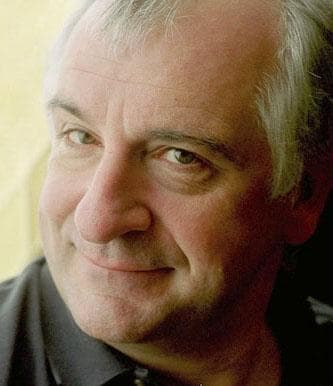
Douglas Noël Adams was an English author, humorist, and screenwriter, best known for The Hitchhiker's Guide to the Galaxy. Originally a 1978 BBC radio comedy, The Hitchhiker's Guide to the Galaxy developed into a "trilogy" of five books that sold more than 15 million copies in his lifetime. It was further developed into a television series, several stage plays, comics, a video game, and a 2005 feature film. Adams's contribution to UK radio is commemorated in The Radio Academy's Hall of Fame.
Similar books
- Dirk Gently's Holistic Detective Agency
Douglas Adams
4.0 (121k) average on GoodreadsFantasyShares Adams' unique blend of sci-fi, philosophy, and British humor with an emphasis on interconnectedness.
- The Restaurant at the End of the Universe
Douglas Adams
4.2 (233k) average on GoodreadsFantasyCompared to The Restaurant at the End of the Universe, Mostly Harmless represents a significant shift in tone. While 'Restaurant' maintains a lighthearted, episodic adventure structure with a strong comedic through-line and a sense of cosmic wonder, Mostly Harmless is far more introspective and somber. The earlier book's characters are driven by curiosity and a desire for escape, whereas in Mostly Harmless, their actions are often fueled by desperation and a growing sense of weariness, leading to a much bleaker outlook on their fates. The humor in 'Restaurant' is more broadly accessible, while 'Mostly Harmless' often uses humor to underscore the futility of existence, making it a less overtly 'funny' read.
- Harry Potter and the Sorcerer's Stone
J.K. Rowling
4.5 (7M) average on GoodreadsFantasyRescued from a miserable life under the stairs, an orphaned boy discovers he's a wizard destined for a magical school, where he uncovers a dangerous secret tied to the dark wizard who murdered his parents.
- The Hunger Games
Suzanne Collins
4.3 (6.4M) average on GoodreadsFantasyIn a future where children fight to the death on live television, Katniss Everdeen volunteers for the arena, turning a death sentence into a fight for survival and a spark of rebellion.
- 1984
George Orwell
4.2 (3.1M) average on GoodreadsPoliticsIn a future where surveillance and thought control are absolute, a man's search for truth clashes with the Party, showing that hope can be a form of rebellion.
- Divergent
Veronica Roth
4.2 (2.9M) average on GoodreadsFantasyIn a society divided by virtues, a sixteen-year-old's difference from the norm starts a rebellion that threatens her world.





Enjoyed the summary?
A summary gives you the shape of the book. The book itself has the detail, the examples and the voice.
Find Mostly Harmless on AmazonAs an Amazon Associate, BookBrief earns from qualifying purchases. How we're funded