
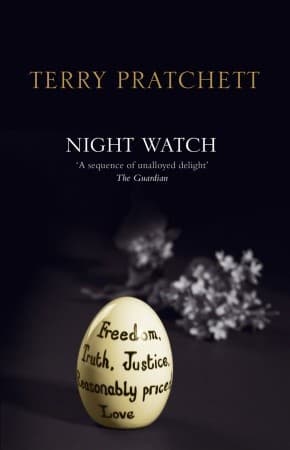
Synopsis
Covers the whole plot, including the ending.
- Difficulty
- Medium
- Pacing
- Moderate
- Mood
- Witty, Philosophical, Suspenseful, Darkly Humorous, Reflective
- Read it if
- You enjoy thought-provoking fantasy that blends humor with profound social commentary, police procedurals, and time travel paradoxes.
- Skip it if
- You prefer straightforward fantasy without satirical elements or complex philosophical undertones.
Night Watch Plot Summary
Covers the whole plot, including the ending.
The Patrician's Birthday and a Chase
The story begins on the eve of the Glorious Revolution, the 30th anniversary of the day Commander Sam Vimes almost died. On Lord Vetinari's birthday, Vimes relentlessly pursues Carcer, a murderer and former Unmentionable, through Ankh-Morpork's streets. Carcer, responsible for several Watchmen's deaths, is brutally efficient. The chase ends at Unseen University, where Carcer tries to escape using a magical artifact. The struggle with Vimes causes a powerful magical discharge, tearing a hole in reality and sending both Vimes and Carcer through time.
Arrival in the Past
Vimes awakens in the past, on May 25th, 1968 (Ankh-Morpork calendar), the day the Glorious Revolution starts. He quickly realizes he is thirty years in the past, when he was a young recruit to the Night Watch. Disoriented but practical, Vimes sees the murder of Sergeant-at-Arms John Keel, his mentor from that time. To prevent a paradox and keep the timeline, Vimes must assume Keel's identity, using the 'Sergeant-at-Arms' sash he finds. This puts him directly in the city's revolutionary fervor, with the added pressure of knowing his younger self is also there.
Assuming Keel's Role and Shaping the Young Watchmen
As Sergeant-at-Arms John Keel, Vimes immediately takes charge of the Night Watch at Treacle Mine Road. He meets his younger, naive self, Corporal Vimes, along with other future Watch members like Nobby Nobbs and Fred Colon. Recognizing the period's historical importance, Vimes begins to teach his past colleagues policing wisdom and a sense of duty. He instructs them on proper investigation, evidence collection, and protecting the innocent, regardless of their social standing or revolutionary alignment. He also subtly guides his younger self, instilling the principles that will define Commander Vimes in the future, all while dealing with the city's rising tensions.
Carcer's Destructive Influence
Meanwhile, Carcer, also in the past, quickly adapts to the chaos. He uses his psychopathic tendencies and tactical skill to infiltrate and manipulate various revolutionary factions. He incites violence, plants false evidence, and creates distrust between revolutionaries and the existing authorities, the Unmentionables. Carcer's actions are driven by a desire for power and chaos, and he enjoys shaping history in a more brutal way. His presence worsens the already unstable situation, turning discontent into bloody conflict, creating a more dangerous past for Vimes.
The Barricades Rise
The discontent in Ankh-Morpork finally erupts into full revolution. Barricades go up across the city, dividing districts and creating zones for various revolutionary factions. The Palace Guard and the Unmentionables, representing the Patrician's rule, use brutal suppression tactics, causing more civilian casualties. The Night Watch, under 'Keel's' guidance, finds itself in a difficult position, trying to keep order and protect the innocent amid the rising violence. Vimes, as Keel, struggles to uphold the law and prevent more bloodshed, knowing the historical outcome of these events and trying to lessen the suffering.
Confronting the Unmentionables
Vimes, as Sergeant Keel, opposes the brutal and corrupt Unmentionables, the Patrician's secret police. He sees their atrocities and, using his future knowledge and resolve, protects citizens from their arbitrary violence. This defiance puts him in direct conflict with figures like the sadistic Reg Shoe and other Unmentionables. His actions inspire the younger Watchmen and earn him the respect of common people, who see him as a symbol of justice in a time of tyranny. This defiance also sets the stage for the confrontation that will decide the revolution's outcome.
The Truth About the Revolution
As 'Keel,' Vimes looks closer at the revolution's workings, realizing the 'Glorious Revolution' he remembers is not entirely as it seems. He finds evidence of manipulation and opportunism, particularly by figures like the lawyer, Roberts, who exploit people's grievances for their own gain. Vimes learns that the revolution was not a clean uprising but a complex, messy event with many shades of grey, and that history's 'heroes' were often flawed. This revelation challenges his understanding of his own past and the foundation of modern Ankh-Morpork.
The Battle of Cable Street
The revolution's climax sees 'Keel' leading a small group of Night Watchmen and civilian volunteers in a stand at Cable Street. They face overwhelming odds against the Unmentionables and the Palace Guard, who want to crush the rebellion. Vimes, using his future experience and tactical skill, organizes a defense, prioritizing the protection of innocent lives over any political agenda. This battle shapes the young Watchmen into true officers and shows the power of principled policing even against tyranny.
Confronting Carcer and the Time Paradox
During the revolution's chaos, Vimes, as 'Keel,' finally confronts Carcer. Their encounter is brutal and personal, with Vimes knowing he must eliminate Carcer to prevent him from changing history and to ensure his own future. The fight is intense, ending in Carcer's defeat and implied death by 'Keel's' hands, fulfilling the historical record. This confrontation is important for the timeline and for Vimes's emotional journey, as he deals with the morality of his actions and the need to ensure the past unfolds as it should, even if it means personal sacrifice.
The Patrician's Fall and the New Order
After the revolution, the tyrannical Patrician, Lord Winder, is overthrown, leading to instability before Lord Vetinari's eventual rise. 'Keel' plays a subtle but important role in this transition, ensuring that key figures and events match the history Vimes knows. While the revolution does not immediately bring the stable Ankh-Morpork of his time, Vimes ensures the groundwork for future progress and a more just society is laid. He observes the immediate aftermath, knowing his mission to preserve the timeline is almost complete.
A Final Goodbye and Return
With historical events secured, Vimes, as 'Keel,' has a final, emotional meeting with his younger self, Corporal Vimes. He offers wisdom and encouragement, subtly shaping the young officer's destiny and reinforcing the values that will define the future Commander. This interaction is a powerful moment of self-reflection and mentorship. Soon after, the magical anomaly that brought him to the past reactivates, pulling him back to his own time. He leaves the past knowing he has done his duty, preserving the timeline and ensuring the Ankh-Morpork he knows.
Back to the Present
Vimes returns to the present, reappearing on the rooftop of Unseen University. He faces Carcer, who has also returned, disoriented and weakened by the temporal journey. The past has deeply affected Vimes; he is now more resolute, his understanding of justice and policing deepened by living through the events that shaped his city. The chase continues, but Vimes is no longer just pursuing a killer; he is completing a cycle, bringing the full weight of his past and present experience to bear on his enemy. He apprehends Carcer, bringing him to justice in his own time.
Principal Figures
Commander Samuel Vimes
Protagonist
The cynical, yet deeply principled, commander of the Ankh-Morpork City Watch.
Samuel Vimes is the Duke of Ankh, Commander of the City Watch, and a man perpetually battling his inner 'beast' – a primal urge for violence and justice. He is a staunch defender of the law, driven by a deep-seated belief in fairness and the protection of the innocent, especially the downtrodden. Despite his gruff exterior and cynical worldview, he possesses an unwavering moral compass and an almost obsessive dedication to his duty. His past as a street copper shaped his understanding of the city's underbelly and the complexities of human nature, making him a formidable, if world-weary, force for good.
Relationships: Lady Sybil Ramkin (Wife, his anchor and moral compass); Young Sam Vimes (past) (His past self, whom he mentors); John Keel (His past mentor, whose identity he assumes); Carcer (His archenemy, a psychopathic killer)
Carcer
Antagonist
A psychopathic murderer and former Unmentionable, Vimes's nemesis.
Carcer is a chillingly effective and utterly remorseless killer, characterized by his lack of empathy and a perverse enjoyment of cruelty. He was a member of the Unmentionables, the Patrician's secret police in the past, and uses his skills for manipulation and violence to sow chaos wherever he goes. Carcer represents the antithesis of Vimes's principles, embodying pure, destructive evil. He delights in psychological torment as much as physical, and his presence in the past threatens to unravel the fabric of history, making him a formidable and truly dangerous foe for Vimes.
Relationships: Samuel Vimes (His arch-rival, constantly pursued by Vimes); The Unmentionables (past) (His former colleagues/allies in the past)
John Keel
Supporting/Mentioned
Vimes's original mentor, whose identity Vimes assumes in the past.
Sergeant-at-Arms John Keel is the legendary figure Vimes remembers as his first mentor in the Night Watch. In the past, he is a seasoned, principled, and courageous Watchman who embodies the ideals of justice and duty, even in a corrupt city. Keel is the man who instilled in young Vimes the core values of policing and the importance of standing up for what's right. His untimely death is the catalyst for Vimes assuming his identity, and his memory serves as a constant inspiration and standard for Vimes throughout his temporal displacement. He represents the purity of purpose that Vimes strives to maintain.
Relationships: Samuel Vimes (His protégé, whom he inspires); Night Watch (past) (His colleagues and subordinates)
Young Sam Vimes
Supporting
The naive, idealistic, and somewhat hot-headed younger version of Commander Vimes.
Young Sam Vimes is a corporal in the Night Watch, full of raw idealism and a burning desire for justice, but lacking the experience and cynicism of his future self. He is earnest, sometimes impulsive, and deeply affected by the injustices he witnesses in Ankh-Morpork. Under the tutelage of 'Sergeant Keel' (his future self), he begins to develop the pragmatic and principled approach to policing that will define his later career. His journey in the past is crucial for understanding the foundational experiences that shaped the Commander Vimes of the present.
Relationships: Samuel Vimes (as Keel) (His mentor, unbeknownst to him, his future self); Fred Colon (past) (His colleague); Nobby Nobbs (past) (His colleague)
Fred Colon (past)
Supporting
A younger, more cynical, but still essentially good-hearted Watchman.
In the past, Fred Colon is a younger, less jaded version of the future Sergeant Colon, though still possessing his characteristic caution and desire to avoid trouble. He is a pragmatic Watchman, more concerned with survival than heroics, but capable of surprising loyalty and bravery when pushed. Under 'Keel's' influence, he begins to see the value in active policing and standing up for the innocent. His presence highlights the continuity of characters and shows how even the most ordinary individuals can rise to the occasion during extraordinary times.
Relationships: Samuel Vimes (as Keel) (His superior and mentor); Young Sam Vimes (past) (His colleague); Nobby Nobbs (past) (His colleague)
Nobby Nobbs (past)
Supporting
The notoriously scruffy and opportunistic, but loyal, Watchman.
Nobby Nobbs, even in his younger days, is recognizable by his general scruffiness and his keen eye for anything he can 'acquire.' Despite his questionable hygiene and petty thievery, he possesses a certain street-wise cunning and a surprising loyalty to those he considers his own. In the past, he is still finding his place but shows flashes of the resourcefulness that will make him a valuable, if unconventional, member of the Watch. His interactions provide comic relief and a grounded perspective on the chaos of the revolution.
Relationships: Samuel Vimes (as Keel) (His superior); Young Sam Vimes (past) (His colleague); Fred Colon (past) (His colleague)
Lord Winder
Antagonist/Mentioned
The tyrannical and incompetent Patrician of Ankh-Morpork in the past.
Lord Winder is the oppressive and largely ineffectual Patrician who rules Ankh-Morpork thirty years in the past. He is characterized by his paranoia, his reliance on the brutal Unmentionables, and his inability to grasp the true suffering of his people. His misrule and indifference are the primary catalysts for the Glorious Revolution. Winder represents the corrupt and tyrannical power structure that Vimes, as 'Keel,' must dismantle or at least navigate around to ensure the survival of the city and its future. His eventual downfall is a historical inevitability that Vimes must ensure.
Relationships: The Unmentionables (His secret police and enforcers)
Lady Sybil Ramkin (past)
Supporting
The younger, still formidable version of Vimes's future wife.
In the past, Lady Sybil Ramkin is a younger, but no less formidable, presence. She is a compassionate and strong-willed woman, already showing her concern for the welfare of the city's dragons and its less fortunate citizens. She runs a shelter for damaged dragons and is actively involved in philanthropic endeavors, demonstrating her inherent goodness and courage. Her brief interactions with 'Keel' hint at the strong, independent woman she will become and subtly plant the seeds for her future relationship with Vimes, adding a layer of personal poignancy to Vimes's mission.
Relationships: Samuel Vimes (as Keel) (Brief, respectful interaction)
Reg Shoe (past)
Supporting/Antagonist
A revolutionary leader in the past, later a zombie activist.
Reg Shoe in the past is a passionate, albeit somewhat naive, revolutionary leader. He is genuinely committed to fighting for the rights of the common people and overthrowing the oppressive regime. His idealism, however, can sometimes make him susceptible to manipulation. He is a key figure in organizing the barricades and galvanizing the populace. His role in the past highlights the genuine, if sometimes misguided, aspirations of the revolutionaries and serves as a reminder of the human cost of political upheaval. He will later become a prominent zombie activist in Vimes's present.
Relationships: The Revolutionaries (Leader and figurehead)
Themes & Insights
The Nature of Justice and Law
The novel explores what justice truly means, especially during revolution and lawlessness. Vimes, as 'Keel,' struggles with upholding a tyrannical regime's 'law' versus protecting the innocent and doing what is right. He teaches his young self and other Watchmen that true justice involves principled action, empathy, and defending the vulnerable, even if it means defying authority. The theme questions whether law serves justice, or if justice must sometimes go beyond law. This is clear in Vimes's insistence on proper procedure even when facing revolutionaries or the corrupt Unmentionables, as he demands evidence and fair treatment for all.
“One day, all this will be history, and you'll remember it as the good old days. Or not. It'll be history, anyway.”
Identity and Self-Discovery
Vimes's journey into his past forces him into deep self-reflection. By taking on his mentor John Keel's identity, Vimes mentors his younger self, shaping who he will become. He sees his own youthful idealism and confronts the historical events that formed his cynicism and moral code. The experience strengthens his understanding of who he is and why he fights for justice, showing that his present self is a result of his past experiences and choices. This is clear in his struggle with his 'beast' and his understanding of how Keel's teachings shaped him.
“He knew that he was Keel. He also knew he was Vimes. And the one thing he knew absolutely was that they were the same man.”
The Cycle of Revolution and Change
The novel examines revolutions, questioning if they bring lasting change or just replace one oppression with another. Vimes's cynical view that 'revolutions always come round again' is explored as he sees the messy, often brutal, realities of the Glorious Revolution. He sees how idealism can be corrupted, how power vacuums are filled, and how people's genuine grievances can be exploited. While the revolution does lead to Lord Winder's downfall, Vimes knows it is only a temporary step towards the more stable, yet flawed, Ankh-Morpork of his future, showing the cyclical nature of political upheaval.
“Don't put your trust in revolutions. They always come round again. That's why they're called revolutions. People die, and nothing changes.”
Memory, History, and Truth
Night Watch looks at how unreliable memory is and how history is made. Vimes, having lived through his past, realizes that the 'Glorious Revolution' as remembered is a clean and simple version of events. He faces the truth that heroes are often flawed, and that important moments are messier than history books suggest. His presence in the past actively shapes the historical narrative, blurring the lines between observer and participant. This theme questions what 'truth' means in historical events and personal memory, as Vimes must ensure the past he remembers is the one that happens.
“History was a story, after all, and the people who told the story were the ones who had won.”
The Banality of Evil
While Carcer is a psychopath, the novel also touches on the more ordinary, bureaucratic evil of the Unmentionables and Lord Winder's regime. The casual cruelty, indifference to suffering, and systematic oppression are presented as equally, if not more, harmful than Carcer's overt violence. Vimes confronts the chilling reality that many atrocities are committed by people just following orders or upholding a corrupt system. This theme shows how ordinary people can become involved in evil, and how fighting for justice often means challenging institutional abuses of power, not just individual villains.
“It was not evil that won the day, but the indifference of good men.”
Plot Devices & Literary Techniques
Time Travel / Temporal Displacement
The primary mechanism for sending Vimes and Carcer into the past.
The magical discharge during the chase between Vimes and Carcer at Unseen University serves as the catalyst for their temporal displacement. This device is crucial for setting up the entire narrative, allowing Vimes to revisit and subtly influence his own past. It's not a precise, controlled form of time travel, but rather a chaotic, accidental jump that places the characters directly into the pivotal events of the Glorious Revolution. The temporal displacement creates the central conflict and the paradoxes Vimes must navigate, forcing him to become the very mentor he remembers.
Assumed Identity
Vimes takes on the role of his deceased mentor, John Keel.
Upon arriving in the past and witnessing the murder of John Keel, Vimes immediately assumes Keel's identity. This device is vital for several reasons: it prevents a historical paradox (as Keel must be present for young Vimes), it allows Vimes to operate within the Night Watch without revealing his true identity, and it places him directly in a position of authority and influence over his past self and colleagues. The assumed identity forces Vimes to embody the legend of Keel, making him confront his own memories and the expectations placed upon his mentor, further shaping his character.
Paradox Avoidance
Vimes's conscious effort to ensure history unfolds as it 'should'.
Throughout his time in the past, Vimes is acutely aware of the need to preserve the timeline, even if it means making difficult choices. This device drives many of his actions, as he subtly guides events and individuals to ensure that the Glorious Revolution, and his own formative experiences, unfold in a way that leads to the present he knows. He must ensure Keel's legend is upheld, that certain characters live or die at their appointed times, and that the revolution's outcome aligns with history, despite his personal desires to intervene more drastically. This creates tension and moral dilemmas for Vimes.
The 'Beast'
Vimes's internal struggle with his primal, violent urges for justice.
The 'Beast' is an internal plot device representing the raw, violent, and often vengeful side of Vimes's nature, a primal instinct for justice that he constantly struggles to control. In the past, this 'beast' is more untamed in his younger self, and Vimes (as Keel) must confront and manage both his own latent urges and the burgeoning beast within young Vimes. It highlights his constant battle to maintain his humanity and adhere to the rule of law, rather than succumbing to pure retribution. The beast is a manifestation of his deep-seated desire for justice, often pushing him to the brink.
Historical Revisionism (in-universe)
The contrast between remembered history and lived experience.
This device is central to the novel's exploration of memory and truth. Vimes's experience in the past reveals that the 'Glorious Revolution' as recorded and remembered in his present is a simplified, almost mythical version of the complex, brutal reality. The historical narrative has been streamlined and certain inconvenient truths or messy details have been omitted. This device allows Pratchett to comment on how history is written by the victors and how collective memory can gloss over the harsh realities of the past, challenging both Vimes's and the reader's preconceived notions.
Night Watch Quotes
“The past was not a country that had been lived in. It was a country that had been invented. And then, and only then, could it be lived in.”
“All that was necessary for evil to triumph was for good men to do nothing. And then he'd added, 'And for bad men to do a whole hell of a lot.'”
“He'd always been a copper, through and through. The kind who knew that the world was a dark and dangerous place, and that the only way to make it less so was to stand in the darkness yourself.”
“The point of a revolution wasn't to get rid of a bad government. It was to get rid of a good one that had gone bad.”
“No one is actually dead until the ripples they cause in the world die away...”
“You can't go around arresting people just for thinking. Not unless you want to live in a world where thinking is against the law.”
“A man's a man. You can't change that. But you can change what a man thinks. And what he thinks can change the world.”
“The uniform was just a symbol. The man inside it... he was the Watch.”
“He was a good man. Not a nice man, but a good man. And there was a difference.”
“Sometimes it was better to light a flamethrower than curse the darkness.”
“He knew about the rules. He just knew that some of them had to be broken, sometimes, for the greater good.”
“The past was a foreign country, but it wasn't just different, it was dangerous.”
“It was a dark and stormy night. Which was just fine, because it made the shadows longer and the villains more shadowy.”
“He'd learned that the trick to being a copper was to make sure you were the only one who didn't know you were a copper.”
Quiz
10 questions on the plot and the characters. Each answer comes with a short explanation.
Question 1
What is the name of the serial killer targeting watchmen in Ankh-Morpork in 'Night Watch'?
- Carcer
- Moist von Lipwig
- Rufus Drumknott
- Nobby Nobbs
Show answer
A. Carcer The serial killer targeting watchmen and inciting the revolution is Carcer, a former member of the Watch.
Question 2
How does Sam Vimes end up in the past during the events of 'Night Watch'?
- He uses a magical time-turner provided by the Unseen University.
- He falls through a temporal anomaly created by a magical accident.
- He is transported by the Disc's resident Death.
- He is sent back by Lord Vetinari for a special mission.
Show answer
B. He falls through a temporal anomaly created by a magical accident. Vimes is transported to the past after a magical explosion during a pursuit of Carcer, caused by Doctor Lawn and his temporal experiments.
Question 3
What alias does Sam Vimes use while in the past to avoid altering history too much?
- Corporal Carrot
- Sergeant-at-Arms
- John Keel
- Sir Samuel
Show answer
C. John Keel Vimes takes on the identity of John Keel, the sergeant who was supposed to train the young Sam Vimes, after Keel is killed.
Question 4
Which historical event in Ankh-Morpork's past does Sam Vimes find himself caught up in?
- The Glorious Revolution of the 25th of May
- The Battle of Pseudopolis Yard
- The Siege of the Palace
- The Assassination of Lord Snapcase
Show answer
A. The Glorious Revolution of the 25th of May Vimes arrives in the past just before the Glorious Revolution of the 25th of May, a pivotal moment in Ankh-Morpork's history.
Question 5
What is the primary theme explored through Sam Vimes's experiences with the younger version of himself and the city's past?
- The inevitability of fate and predestination.
- The cyclical nature of history and the enduring struggle for justice.
- The corrupting influence of power on individuals.
- The importance of individual choice in shaping destiny.
Show answer
B. The cyclical nature of history and the enduring struggle for justice. The novel heavily emphasizes the idea that 'revolutions always come round again' and that the struggle for what is right (the 'Watchman's Code') is constant, regardless of the era.
Question 6
Who is the young, naive constable Vimes encounters in the past who reminds him of his younger self?
- Fred Colon
- Nobby Nobbs
- Reg Shoe
- Young Sam
Show answer
D. Young Sam Vimes meets his younger self, referred to as 'Young Sam' throughout the book, and becomes his mentor under the guise of John Keel.
Question 7
What is the significance of the '25th of May' for Sam Vimes, both in the present and the past?
- It's the day he got married to Lady Sybil.
- It's his birthday and the day of the revolution.
- It's the day he first joined the Watch.
- It's the day he arrested his first serial killer.
Show answer
B. It's his birthday and the day of the revolution. The 25th of May is Sam Vimes's birthday, and it's also the date of the Glorious Revolution, a day he has always remembered with mixed feelings and which becomes central to the plot.
Question 8
Who is the character in the past who holds the position equivalent to the current Patrician, and what is his ultimate fate?
- Lord Vetinari, he is overthrown and exiled.
- Lord Snapcase, he is killed by Carcer during the revolution.
- Lord Rust, he escapes the city before the revolution.
- Lord Venturi, he becomes a hero of the people.
Show answer
B. Lord Snapcase, he is killed by Carcer during the revolution. The Patrician of the past is Lord Snapcase, a cruel and ineffective ruler who is ultimately killed by Carcer, setting the stage for the revolution.
Question 9
What is the 'Watchman's Code' that Sam Vimes instills in the young recruits, and what does it represent?
- A set of rules for maintaining public order and loyalty to the Patrician.
- A simple moral imperative to 'protect the innocent' and 'do the job', regardless of politics.
- A secret handshake and password for members of the Night Watch.
- A legal document outlining the powers and limitations of the Watch.
Show answer
B. A simple moral imperative to 'protect the innocent' and 'do the job', regardless of politics. The Watchman's Code, epitomized by 'They can't order me not to be a policeman', is Vimes's deeply held belief in justice and protecting the ordinary people, independent of any political regime or revolution.
Question 10
What important detail does Vimes learn about the future Patrician, Havelock Vetinari, during his time in the past?
- Vetinari was a member of the Assassin's Guild from a young age.
- Vetinari was a close ally of Carcer during the revolution.
- Vetinari was a simple baker before rising to power.
- Vetinari was a highly decorated officer in the City Watch.
Show answer
A. Vetinari was a member of the Assassin's Guild from a young age. Vimes observes a young Havelock Vetinari, then a student at the Assassin's Guild, demonstrating his characteristic cunning and pragmatism even at a young age.
Night Watch FAQ
What is the central premise of 'Night Watch'?
The central premise involves Commander Sam Vimes being thrown back in time 30 years to a younger Ankh-Morpork on the eve of a violent revolution. He must impersonate his own former mentor, Sergeant-at-Arms John Keel, to train a younger version of himself and prevent a disastrous future, all while a serial killer targets policemen.
Who is Sam Vimes, and how does he end up in the past?
Sam Vimes is the cynical, world-weary Commander of the Ankh-Morpork City Watch. He is flung into the past by a magical storm caused by a temporal anomaly, specifically a magical 'thunderbolt' hitting the Patrician's palace during the chase of the assassin Carcer.
Who is Carcer, and what is his significance to the plot?
Carcer, also known as Psychopomp, is a dangerous and sociopathic assassin responsible for the death of many Watchmen, including John Keel. His escape and subsequent pursuit by Vimes trigger the temporal displacement, and his actions in the past are pivotal to the unfolding revolution and Vimes's desperate attempts to mitigate its horror.
What role does the revolution play in the story?
The revolution is the backdrop and a key plot driver. It's a violent uprising of the common people against the tyrannical rule of the then-Patrician, Lord Winder. Vimes, as 'Keel,' finds himself caught between upholding the law and understanding the people's legitimate grievances, trying to guide the rebellion towards a less bloody outcome.
Who is John Keel, and why does Vimes impersonate him?
John Keel was Sam Vimes's original mentor, a respected and legendary Sergeant-at-Arms who taught Vimes everything he knew about policing and integrity. Vimes impersonates him because he arrives in the past shortly after the real Keel is murdered by Carcer, and Vimes realizes he must fill Keel's shoes to ensure his own past self survives and the timeline is preserved.
What specific historical event from Ankh-Morpork's past is Vimes reliving?
Vimes is reliving the Glorious Revolution of the 25th of May, an event that shaped the modern Ankh-Morpork and led to the eventual rise of Lord Vetinari. The book meticulously details the events leading up to and during this pivotal day, including the establishment of the barricades and the final confrontation at the Palace.
How does Vimes, as Keel, influence his younger self?
As Keel, Vimes teaches his younger, idealistic self crucial lessons about policing, justice, and the complexities of human nature. He instills the philosophy of 'the law is the law' but also demonstrates the importance of compassion and understanding, shaping the Vimes we know in the present day.
What is the significance of the phrase 'The 25th of May'?
The 25th of May becomes a rallying cry and a symbol of remembrance for fallen Watchmen and those who fought for freedom during the revolution. It marks the day the revolution reached its climax and where Vimes, as Keel, made critical stands. In the present, it's the day Watchmen wear a sprig of lilac.
How does 'Night Watch' comment on the nature of history and memory?
The novel suggests that history is often written by the victors and that personal memories can be unreliable or altered. Vimes's presence in the past shows how even small changes can have profound effects, and how certain events or figures might be remembered differently than they truly were, or forgotten entirely.
What is the psychological impact of Vimes reliving his past and mentoring himself?
The experience deeply affects Vimes, forcing him to confront his own origins, his idealism, and the trauma of the revolution firsthand. It solidifies his commitment to the Watch and his understanding of justice, while also deepening his cynicism and awareness of humanity's darker side. It's a profound journey of self-discovery and validation.
How does Vimes's relationship with Lady Sybil Ramkin evolve through this experience?
Although Sybil is not present in the past, Vimes's love for her in the present is a constant anchor and motivation. His desire to return to her and their unborn son, Young Sam, fuels his determination to survive and ensure a stable future, reinforcing his commitment to family and the world he wants to protect.
Discuss the morality of Vimes's actions in changing the past.
Vimes struggles with the morality of his actions, knowing he is altering history by saving lives and influencing events. He justifies it by aiming for a less bloody outcome and ensuring the survival of key individuals (like his younger self) necessary for the future he knows. His intent is to improve, not destroy, the timeline, making hard choices along the way.
What is the significance of the lilac worn by Watchmen?
The lilac is a symbol of remembrance for the fallen Watchmen and civilians of the Glorious Revolution. In the past, it was a secret sign of defiance and solidarity among those against Lord Winder, particularly on the 25th of May. Vimes, as 'Keel,' helps establish this tradition, giving it its enduring meaning.
How does the book explore the themes of revolution and social change?
'Night Watch' critically examines revolutions, showing their initial idealism, the brutal realities of violence, and the often-unforeseen consequences. It suggests that while change is necessary, true progress comes from evolving institutions and laws, not just overthrowing rulers, echoing the quote 'revolutions always come round again'.
What is the 'good man' theory as presented by Vimes?
Vimes, as Keel, tells young Vimes that a 'good man' is someone who keeps trying, even when things are difficult, and who understands that the law is not just about rules but about protecting people. It's about maintaining order and justice, even when it's unpopular, and always striving to be better.
What role does Havelock Vetinari play in the past timeline?
A young Havelock Vetinari appears as a mysterious, observant student of the Unseen University, quietly gathering information and subtly influencing events. He is present at key moments, demonstrating his nascent political acumen and his ability to manipulate situations, foreshadowing his future role as Patrician.
How does the book challenge the notion of heroism?
The book portrays heroism not as grand, flashy acts, but as the quiet, persistent dedication of individuals like Vimes and the ordinary Watchmen who simply do their duty. It highlights the often thankless, dirty work of maintaining peace and justice, suggesting true heroism lies in enduring commitment to principles.
What is the significance of the Watch's motto, 'Fabricati Diem, Pvnc'?
The motto, meaning 'Make My Day, Punk,' is a humorous yet profound statement. It reflects Vimes's practical, no-nonsense approach to justice, daring criminals to challenge the law. It encapsulates his readiness to confront evil directly and his unwavering commitment to protecting the city, even if it means getting his hands dirty.
About the author
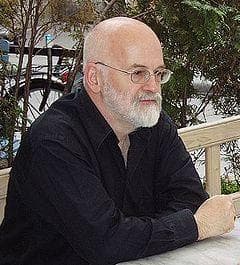
Sir Terence David John Pratchett was an English humorist, satirist, and author of fantasy novels, especially comical works. He is best known for his Discworld series of 41 novels.
Similar books
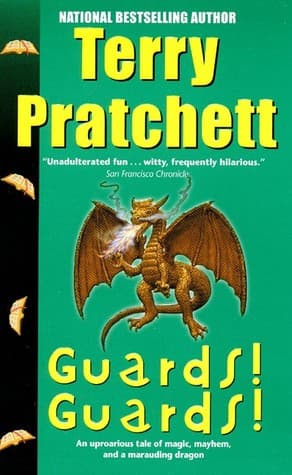
- Guards! Guards!
Terry Pratchett
4.3 (165k) average on GoodreadsFantasyAnother excellent Ankh-Morpork City Watch novel, focusing on the formation and early struggles of the Watch.
- The Hitchhiker's Guide to the Galaxy
Douglas Adams
4.2 (1.4M) average on GoodreadsFantasyShares a similar British comedic sensibility and satirical approach to genre conventions, though in sci-fi.
- 1984
George Orwell
4.2 (3.1M) average on GoodreadsPoliticsExplores themes of revolution, state control, and individual agency against a powerful system, albeit in a much darker tone.
- Jonathan Strange & Mr Norrell
Susanna Clarke
3.8 (198k) average on GoodreadsFantasySusanna Clarke's Jonathan Strange & Mr Norrell (2004) is another highly acclaimed fantasy novel that, like Night Watch, engages with historical settings and the impact of extraordinary individuals on societal change. Both books blend fantasy elements with a meticulously crafted historical backdrop (Napoleonic Wars for Clarke, revolutionary Ankh-Morpork for Pratchett). However, Clarke's novel focuses on the re-emergence of magic and its effect on English society and the individual magicians, often with a more melancholic and grand-historical tone. Pratchett, conversely, uses time travel to directly insert his protagonist into a pivotal historical moment, exploring themes of individual agency, the cyclical nature of history, and the moral ambiguities of revolution with a more direct, character-driven focus and a satirical edge.
- Harry Potter and the Sorcerer's Stone
J.K. Rowling
4.5 (7M) average on GoodreadsFantasyRescued from a miserable life under the stairs, an orphaned boy discovers he's a wizard destined for a magical school, where he uncovers a dangerous secret tied to the dark wizard who murdered his parents.
- The Hunger Games
Suzanne Collins
4.3 (6.4M) average on GoodreadsFantasyIn a future where children fight to the death on live television, Katniss Everdeen volunteers for the arena, turning a death sentence into a fight for survival and a spark of rebellion.





Enjoyed the summary?
A summary gives you the shape of the book. The book itself has the detail, the examples and the voice.
Find Night Watch on AmazonAs an Amazon Associate, BookBrief earns from qualifying purchases. How we're funded