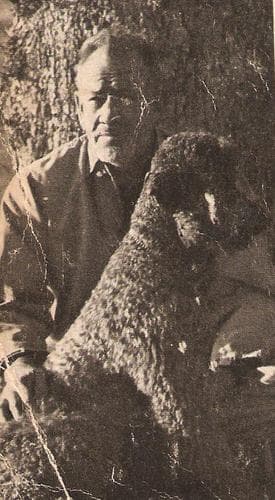
John Ernst Steinbeck was an American writer. He won the 1962 Nobel Prize in Literature "for his realistic and imaginative writings, combining as they do sympathetic humor and keen social perception". He has been called "a giant of American letters."

Sign in to track this book
In the dusty heart of California's Salinas Valley, John Steinbeck's "Omnibus" brings together the lives of farmers, laborers, and dreamers, showing the raw beauty and brutal hardships of the American working class with honesty.
Ask anything about Omnibus and get instant answers grounded in the summary.
Elisa Allen, a strong woman on a ranch with her husband, Henry, finds peace in her chrysanthemum garden. She has a raw energy stifled by her domestic life. When a tinker arrives seeking work, Elisa is drawn to his wandering life and his apparent understanding of her love for flowers. She offers him chrysanthemums to mend, sharing her inner world. After a brief, intense talk where she almost reveals her deeper desires, the tinker leaves. Later, driving with Henry, Elisa sees her discarded chrysanthemums on the road. She realizes the tinker's superficiality and their connection's briefness. This brings a deep feeling of loneliness and unfulfilled desire.
Ten-year-old Jody Tiflin, living on his family's ranch in the Salinas Valley, receives a red pony named Gabilan from his father, Carl. Jody is thrilled and cares for the pony, learning about responsibility. Billy Buck, the ranch hand, promises Jody the pony will not get sick. But Gabilan falls ill with strangles. Despite Billy's efforts and Jody's desperate prayers, the pony worsens. Jody sees the harshness of nature and the limits of human help. The pony dies, leaving Jody heartbroken and disappointed, his first major experience with loss and a broken promise.
Gitano, an old, quiet paisano who once lived on the ranch, returns to die in the mountains where he was born. Carl Tiflin, Jody's father, first wants to send him away, but Gitano's quiet resolve to return to his homeland is firm. Jody is curious about Gitano and the mysterious 'great mountains' in the distance. He senses a link between Gitano and the wild mountains, a world beyond his father's practical view. Gitano eventually takes an old horse, Easter, and vanishes into the mountains. This leaves Jody with a lasting sense of wonder and a deeper understanding of life's cycle and the pull of one's origins.
Jody is promised a new colt if his mare, Nellie, can deliver it safely. Billy Buck, feeling responsible for Gabilan's death, wants Nellie to foal successfully. But the birth becomes difficult, and Billy decides to save the colt by sacrificing Nellie. Jody sees this brutal act, witnessing the raw process of birth and death together. He is horrified and fascinated by the blood and struggle, and the stark reality of ranch life. The colt's birth, though through a violent sacrifice, shows life continuing, but it also confirms Jody's understanding of life's harshness and inevitable loss.
Jody's maternal grandfather, a former wagon master who led people across the plains, visits. Grandfather often tells stories of leading people west, a journey that defined his life. Carl Tiflin, Jody's father, grows tired of these repeated tales, seeing them as old and irrelevant. Jody, however, listens carefully, sensing the importance of his grandfather's past. He begins to understand the generational difference and America's changing landscape, where the era of great adventures is fading. Grandfather's stories, though tedious to Carl, link to a past era and a different kind of heroism.
Pepé, a naive young man, lives with his mother and siblings in a remote California valley. His mother gives him a new saddle, a sign of his coming of age. Impulsively, Pepé goes to a nearby town, drinks too much, and kills a man in a drunken fight. He flees into the wilderness, pursued. His journey is a desperate flight for survival, marked by hunger, thirst, and constant pressure from his pursuers. He loses his horse, then his rifle, and eventually his dog, shedding the symbols of his former life and becoming more vulnerable. He is eventually cornered and killed, a tragic result of his youthful impulsiveness and the wild's unforgiving nature.
Dr. Phillips, a scientist, visits a ranch to buy a snake for his research. He is methodical and objective, focused only on his scientific work. But Mrs. Blanca, the rancher's wife, reacts to the snake with an intense, almost primitive fear. Her reaction is emotional, a strong contrast to Dr. Phillips's scientific view. The scene highlights the basic difference between intellectual understanding and instinctual response, and how fear can be deeply ingrained and irrational. The snake, a symbol of both scientific curiosity and ancient dread, shows the gap between their two worlds.
Peter Randall, a hardworking and outwardly respectable farmer, secretly desires prostitutes. He maintains an ordered life, working hard and caring for his wife, Emma. But when Emma becomes ill, Peter cannot keep up his facade. He confesses his secret life to a friend, revealing his internal struggle between his public image and his private desires. The 'harness' represents the limits of society and the burden of keeping a false identity. His confession, though painful, offers a look into human nature's complexities and the hidden lives people lead.
Johnny Bear, a man with a mental disability and a talent for mimicking sounds, is used by a tavern owner for the entertainment of his customers. The owner has Johnny Bear imitate the private talks of the townspeople, making a show of their secrets. The story explores exploitation, the vulnerability of the mentally disabled, and human curiosity. Johnny Bear, seemingly unaware of his actions' implications, becomes a tool for others' amusement, showing the moral ambiguities and darker aspects of community life.
Two young labor organizers, traveling through a rural area, try to get migrant workers to strike. They face hostility and suspicion from the local community, which resists their message of unionization. The organizers receive threats and violence, ending in a brutal attack. The story shows the realities faced by labor activists in the 1930s, the deep fear of social change, and the power imbalance between landowners and workers. It highlights the courage and idealism of those fighting for social justice, even against great opposition and personal danger.
Katy, a known prostitute, changes completely after a chance meeting with a pig. She becomes a religious woman, eventually becoming a saint. The story is a satirical look at religious conversion, sainthood, and the human tendency to worship figures, regardless of their past. It questions the nature of holiness and the often-unconventional paths to spiritual understanding. Katy's journey from sinner to saint, though humorous, also explores redemption and the power of belief, however strange the cause.
Mary Teller is obsessed with keeping her garden perfect, especially a rare white quail she believes embodies this perfection. Her husband, Harry, finds her meticulousness suffocating and her attachment to the quail unsettling. Mary's need for control extends to all parts of her life, making her rigid and emotionally distant. The white quail becomes a symbol of her ideal and her inability to accept life's messy realities. When the quail dies by accident, Mary's carefully built world shatters, showing her emotional fragility and the destructive nature of her obsessive pursuit of perfection.
The Protagonist
Elisa experiences a fleeting moment of connection and vulnerability, only to be disillusioned, reinforcing her sense of loneliness and unexpressed desires.
The Protagonist
Jody matures from an innocent boy to one who understands the harsh realities of life, death, and the limits of human control on the ranch.
The Supporting
Billy tries to make amends for a past failure, demonstrating both his dedication and the limits of his control over nature.
The Supporting
Carl remains largely static, representing the grounded, pragmatic adult perspective in contrast to Jody's evolving innocence.
The Protagonist
Pepé's journey is a rapid descent from a carefree youth to a hunted, desperate man, culminating in his tragic death.
The Protagonist
Peter's carefully constructed double life is revealed, forcing him to confront his true nature and the burden of his secrets.
The Protagonist
Mary's obsessive pursuit of perfection leads to emotional isolation and ultimately crumbles when her idealized world is disrupted.
The Supporting
Grandfather remains steadfast in his identity, representing the enduring spirit of the past despite the changing times.
This theme is clear, especially in 'The Red Pony' stories. Steinbeck shows life and death not as opposites, but as parts of a continuous cycle in nature. Jody sees a colt born and his beloved mare die, and his pony die. This theme emphasizes the natural order, where growth and decay are inseparable, and highlights the certainty of loss and life's resilience.
“The high part of the mountain was dark against the sky. Gitano disappeared into the mountains. Jody knew that Gitano was going to die in the mountains.”
Many characters deal with loneliness, often from unfulfilled desires or a lack of real connection. Elisa Allen's inner world is largely private, leading to isolation despite her marriage. Peter Randall lives a double life, separating him from true intimacy. This theme explores the human condition of being alone, even with others, and the struggle to communicate one's inner self.
“She stood up and walked toward the house, thinking about the tinker, and about the chrysanthemums she had given him. She was crying now, and she didn't know why.”
Steinbeck often contrasts nature's raw power with human attempts to control or understand it. The wilderness is often both beautiful and harsh. Pepé's flight into the mountains ('Flight') shows nature's indifference, while the Tiflin ranch highlights the constant struggle to manage the natural world. This theme also touches on instinct versus intellect, as seen in 'The Snake'.
“The wind was rising, and the air was cold. There was no sound but the movement of the brush, and the occasional whir of a bird. Pepé was alone.”
This theme is strongest in 'The Red Pony,' as Jody experiences ranch life's harshness. His initial innocence and trust are broken by Gabilan's death and Nellie's sacrifice. He learns that promises can be broken, and life is often cruel. This theme explores the painful but necessary process of growing up, where one faces the world's imperfections and gains a more realistic understanding of existence.
“Jody looked at the colt. It was a beautiful colt, but it had cost too much. He didn't want it.”
Several stories look at the internal conflicts and social pressures that make characters hide parts of themselves. Peter Randall's secret desires ('The Harness') and the townspeople's private affairs revealed by Johnny Bear ('Johnny Bear') are examples. The theme explores the psychological cost of keeping up a facade, the hypocrisy that can exist in people and communities, and the often-darker parts of human nature that remain hidden.
“He lived a good life, a clean, honest life, but he had this one thing that was not good, not clean, not honest, and it was a part of him.”
Objects representing deeper meanings.
Steinbeck frequently uses objects to represent complex ideas or emotions. The chrysanthemums in 'The Chrysanthemums' symbolize Elisa's repressed passion and creativity. The red pony, Gabilan, in 'The Red Pony' represents Jody's innocence, joy, and ultimately, his first encounter with loss. The new saddle in 'Flight' symbolizes Pepé's coming of age and responsibility. These symbols enrich the narratives, providing layers of meaning beyond the literal plot.
Hints of future events.
Steinbeck subtly incorporates hints and clues that suggest future developments, building tension and a sense of inevitability. Billy Buck's confident promise that Gabilan won't get sick foreshadows the pony's illness and death. The description of Pepé's impulsiveness and lack of judgment hints at his tragic downfall. This device creates dramatic irony and prepares the reader for the story's outcomes, making the events feel predestined rather than random.
The distinct flavor of the Salinas Valley.
Steinbeck's writing is deeply rooted in the specific setting of the Salinas Valley, California. He meticulously describes the landscape, the climate, the dialect, and the customs of the people who live there. This device not only creates a strong sense of place but also makes the characters and their struggles feel authentic and deeply connected to their environment. The struggles of farmers, ranch hands, and migrant workers are inextricably linked to this particular region.
Ready to see how well you understood this book? Take our interactive quiz with 10 questions.
John Ernst Steinbeck was an American writer. He won the 1962 Nobel Prize in Literature "for his realistic and imaginative writings, combining as they do sympathetic humor and keen social perception". He has been called "a giant of American letters."

Ashley Antoinette
4.6

Mark McDonald
4.4

Luo Guanzhong
4.4
Mia McKenzie
4.3
Dorothy Parker
4.3

Joaquim Maria Machado de Assis
4.3
James Thurber
4.2
Terry Kay
4.2
Support the author — grab the full book.
As an Amazon Associate, BookBrief earns from qualifying purchases, at no extra cost to you. How we're funded.