
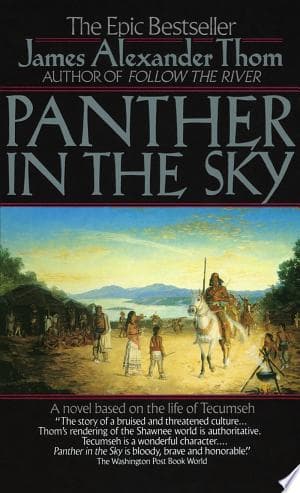
Synopsis
Covers the whole plot, including the ending.
- Difficulty
- Medium
- Pacing
- Moderate
- Mood
- Epic, Historical, Tragic, Resilient, Cultural
- Read it if
- You enjoy epic historical biographies, stories of strong leaders, Native American history, or narratives about resistance and cultural preservation.
- Skip it if
- You prefer fast-paced thrillers, lighthearted reads, or narratives without significant historical detail and conflict.
Panther in the Sky Plot Summary
Covers the whole plot, including the ending.
A Star's Birth and Early Loss
In 1768, a Shawnee woman named Turtle Mother gives birth to a boy, Tecumseh, under a streaking green-yellow comet, an 'unsoma' seen as a powerful omen. His father, Pucksinwah, a respected warrior, raises him with traditional Shawnee values. Tragedy strikes early when Pucksinwah is killed during an ambush by white settlers in the Battle of Point Pleasant. This event deeply affects young Tecumseh and fuels his growing anger towards the Americans. This loss, along with continued pressure on Shawnee lands, plants the seeds for his future dedication to resistance.
Brotherhood and the Vision of Unity
Tecumseh grows up with his younger brother, Lalawethika, later known as Tenskwatawa, 'The Prophet.' While Tecumseh focuses on hunting, warfare, and leadership, Lalawethika struggles with alcohol and a lack of purpose. Tecumseh, seeing the endless expansion of American settlers and the division among Native American tribes, begins to form his idea for a unified Native American confederacy. He believes that only by putting aside tribal differences and standing together can they resist American expansion and preserve their way of life. This idea becomes the main goal of his life.
The Prophet's Rise
Lalawethika has a spiritual vision after collapsing from drinking. He wakes up changed, claiming to have visited the Master of Life and received divine instructions to lead his people back to traditional ways, rejecting white goods, alcohol, and customs. He renames himself Tenskwatawa, 'The Open Door,' and preaches purification and spiritual renewal. His powerful sermons attract many followers, and he establishes Prophetstown on the Tippecanoe River. While Tecumseh supports his brother's spiritual revival to strengthen their people, he remains focused on the political and military parts of their resistance.
Building the Confederacy
With Tenskwatawa's spiritual movement providing a basis for unity, Tecumseh travels across vast territories, visiting many Native American tribes, including the Wyandot, Ottawa, Potawatomi, Kickapoo, and Creek. He argues against individual land sales, stating that the land belongs to all Native Americans in common, and no single tribe has the right to sell it. He appeals to their shared history and the common threat from American expansion. His speeches and presence win over many, slowly building a fragile but growing confederacy dedicated to resisting further encroachment.
Tensions with Harrison and the Treaty of Fort Wayne
Tecumseh often confronts William Henry Harrison, the Governor of the Indiana Territory, accusing him of illegally acquiring large amounts of land through treaties signed with unrepresentative chiefs. The Treaty of Fort Wayne in 1809 especially angers Tecumseh, as it gave away three million acres of land without the consent of the broader Native American population. During a meeting at Vincennes, Tecumseh directly challenges Harrison's authority, stating his right to speak for all tribes and declaring the treaties invalid. Harrison, while impressed by Tecumseh's intelligence and resolve, remains committed to American expansion, setting the stage for conflict.
The Battle of Tippecanoe
As Tecumseh is away on another mission to recruit southern tribes, Governor Harrison marches a force of over 1,000 men towards Prophetstown. Despite Tecumseh's strict orders to avoid fighting, Tenskwatawa, driven by spiritual fervor and a false prophecy of invincibility, orders an attack on Harrison's camp at dawn. The Battle of Tippecanoe is a disaster for the Native Americans. While the battle is fierce, Harrison's forces repel the attack, then burn Prophetstown. This defeat shatters the spiritual momentum of Tenskwatawa's movement and severely weakens Tecumseh's efforts at unity, causing many to question his leadership.
Alliance with the British
After the disaster at Tippecanoe, and with the War of 1812 starting between the United States and Great Britain, Tecumseh sees an opportunity. He travels to Amherstburg, Canada, and forms an alliance with Major General Isaac Brock, the British commander. Tecumseh and his warriors agree to fight with the British against the Americans, believing that a British victory would secure Native American lands and stop American expansion. This alliance gives Tecumseh needed military support and resources, revitalizing his confederacy, though it also puts him in a complex political position.
Victories and Leadership in War
Tecumseh quickly proves himself a valuable ally to the British. His strategic skill, knowledge of the land, and ability to inspire his warriors are important in early British-Native American victories. He plays a key role in the Siege of Detroit, where his clever tactics, including having his warriors repeatedly march through a gap in the woods to make it seem like a much larger force, contribute significantly to General Brock's capture of the fort without bloodshed. Tecumseh's leadership during this time solidifies his reputation as a formidable warrior and respected commander, earning him Brock's admiration.
Brock's Death and Growing Disillusionment
The alliance suffers a severe blow with the death of General Isaac Brock at the Battle of Queenston Heights. Brock's successor, Major General Henry Procter, lacks Brock's respect for Native American allies and his strategic insight. Procter's cautious and often retreating tactics frustrate Tecumseh, who believes in aggressive defense of their lands. Tecumseh often argues with Procter, urging him to stand and fight rather than abandon territory. This growing disappointment with British leadership, along with dwindling supplies and the American advance, begins to wear on Tecumseh and his remaining warriors.
The Battle of the Thames and Tecumseh's End
As American forces under William Henry Harrison advance, Procter orders a retreat up the Thames River. Tecumseh strongly protests this decision, arguing for a decisive stand. He eventually convinces Procter to make a final defense near the Moravian town. On October 5, 1813, the Battle of the Thames begins. Tecumseh, knowing his time is short, reportedly dresses in traditional Shawnee war paint and leads his warriors with fierce courage. During the intense fighting, Tecumseh is killed, though the exact circumstances and the identity of his killer are still debated. His death marks the end of his confederacy and the dream of a united Native American resistance.
Principal Figures
Tecumseh
Protagonist
The Shawnee chief who sought to unite all Native American tribes.
Tecumseh, meaning 'Panther in the Sky,' is a highly intelligent, charismatic, and visionary Shawnee war chief. He is driven by a profound love for his people and their traditional way of life, and an unyielding determination to resist the encroachment of white settlers. He is a skilled orator, a brilliant military strategist, and a man of unwavering integrity. Despite experiencing personal loss and numerous setbacks, he remains committed to his grand vision of a unified Native American confederacy, believing that only through collective action can they preserve their lands and culture.
Relationships: Tenskwatawa (Younger brother, spiritual leader of his movement); Pucksinwah (Father, whose death inspires Tecumseh's resistance); William Henry Harrison (Primary American adversary and political rival); Isaac Brock (Respected British ally and military commander); Henry Procter (Disliked British commander after Brock's death)
Tenskwatawa (The Prophet)
Supporting
Tecumseh's younger brother, a spiritual visionary and religious leader.
Born Lalawethika, Tenskwatawa is Tecumseh's younger brother. Initially an outcast due to alcoholism and a lack of purpose, he undergoes a dramatic spiritual transformation after a near-death experience. He emerges as 'The Prophet,' advocating for a return to traditional Native American ways, rejecting white culture, and preaching spiritual purification. His charismatic religious movement provides a vital spiritual and social foundation for Tecumseh's political confederacy. However, his impetuousness and reliance on prophecies, particularly at Tippecanoe, often undermine Tecumseh's more pragmatic strategies.
Relationships: Tecumseh (Older brother, political leader of the confederacy)
William Henry Harrison
Antagonist
Governor of the Indiana Territory and Tecumseh's primary American adversary.
William Henry Harrison is a ambitious and determined American military officer and politician, serving as the Governor of the Indiana Territory. He is a central figure in the expansion of American territory, constantly seeking to acquire Native American lands through treaties, often exploiting divisions among tribes or negotiating with unrepresentative chiefs. While he harbors a grudging respect for Tecumseh's intelligence and leadership, he views Native Americans as obstacles to American progress and is committed to their removal or assimilation. He represents the relentless force of American westward expansion.
Relationships: Tecumseh (Primary adversary and military opponent)
Major General Isaac Brock
Supporting
British military commander and Tecumseh's respected ally.
General Brock is a highly capable and intelligent British military commander in Canada during the War of 1812. Unlike many British officers, he holds genuine respect for Tecumseh's military genius and leadership, recognizing the vital role Native American warriors play in the defense of Canada. He forms a strong and trusting alliance with Tecumseh, listening to his counsel and effectively integrating Native American tactics into British strategy. His death is a significant blow to the British-Native American alliance and a personal loss for Tecumseh.
Relationships: Tecumseh (Respected military ally)
Major General Henry Procter
Supporting
British commander who succeeded Brock, often at odds with Tecumseh.
Major General Henry Procter is the British commander who takes over after Brock's death. In stark contrast to Brock, Procter is portrayed as cautious, often indecisive, and lacking in respect for his Native American allies. He prioritizes British interests and frequently retreats from American advances, much to Tecumseh's frustration. His poor leadership and reluctance to engage in decisive battles lead to growing tensions with Tecumseh and ultimately contribute to the collapse of the British-Native American alliance in the western theater.
Relationships: Tecumseh (Uneasy and often contentious military alliance)
Pucksinwah
Mentioned
Tecumseh's father, a respected Shawnee warrior.
Pucksinwah is Tecumseh's father, a respected Shawnee warrior and leader. His death at the hands of white settlers in the Battle of Point Pleasant when Tecumseh is a young boy deeply impacts his son, instilling in him a strong sense of grievance and a lifelong commitment to protecting his people's land and way of life. Though his presence in the narrative is brief, his legacy profoundly shapes Tecumseh's character and motivations.
Relationships: Tecumseh (Father)
Turtle Mother
Mentioned
Tecumseh's mother.
Turtle Mother is Tecumseh's mother, who gives birth to him under the auspicious sign of a shooting star. She represents the maternal strength and traditional Shawnee family values that shaped Tecumseh's early life. While her role in the narrative is not extensive, her presence underscores the cultural context of Tecumseh's upbringing and the importance of family in Shawnee society.
Relationships: Tecumseh (Mother)
Hard Striker
Mentioned
The Shawnee elder who interprets Tecumseh's birth omen.
Hard Striker is the Shawnee elder who observes the green-yellow comet during Tecumseh's birth and interprets it as an 'unsoma,' a powerful birth sign, giving him the name Tecumseh, 'Panther in the Sky.' He represents the spiritual and cultural traditions of the Shawnee people, highlighting the significance of omens and prophecies in their worldview. His interpretation sets the stage for Tecumseh's destined path as a great leader.
Themes & Insights
Resistance Against Injustice
The central theme of the novel is the courageous and ongoing resistance of Native American peoples against the encroachment and injustices by white settlers and the American government. Tecumseh's entire life is an example of this struggle, from his father's death to his efforts to unite tribes against land cessions. The theme appears in Tecumseh's speeches to Harrison, his tireless journeys to rally tribes, and his ultimate sacrifice at the Battle of the Thames, all driven by the belief that his people have a right to their land and way of life.
“The Great Spirit gave this land to all the red men, and no tribe has the right to sell it, not even to each other, much less to the white man!”
The Power of Unity and Confederacy
Tecumseh's main idea and the driving force of his political actions is the belief that unity among Native American tribes is necessary. He understands that individual tribes are too weak to resist American expansion alone and that only a pan-tribal confederacy can present a strong challenge. This theme is clear in his difficult travels to recruit diverse tribes, his arguments against fragmented land sales, and his attempts to bridge cultural differences. The novel shows both the potential of such unity and the difficulties in achieving and maintaining it.
“A single twig breaks, but a bundle of twigs is strong.”
Cultural Clash and Loss
The novel clearly shows the devastating impact of the clash between Native American and Euro-American cultures. It presents the Shawnee's traditional, communal way of life, connected to the land and spiritual beliefs, against the individualistic, expansionist, and technologically advanced culture of the white settlers. The theme appears in the loss of land, the introduction of destructive forces like alcohol, the erosion of traditional customs, and the basic misunderstanding between the two peoples. Tecumseh's struggle is not just for land, but for the preservation of a way of life facing extinction.
“The white man's ways are like a great flood, washing away our traditions, our lands, our very souls.”
Leadership and Sacrifice
Tecumseh shows the theme of strong leadership and personal sacrifice. He is a leader who inspires loyalty, commands respect, and dedicates his entire life, including his personal comfort and safety, to his people's cause. His leadership is marked by strategic skill, moral integrity, and a firm commitment to his vision. The ultimate sacrifice he makes at the Battle of the Thames, knowing the odds are against him, highlights the depth of his devotion and the tragic weight of his responsibility. His life is an example of the burdens and nobility of true leadership.
“When a man's time comes, he must meet it. I shall not flee.”
Plot Devices & Literary Techniques
Prophecy and Omen
Celestial events and spiritual visions guiding characters' destinies.
The novel frequently employs prophecies and omens to foreshadow events and deepen the spiritual context of the narrative. Tecumseh's birth under a shooting star, interpreted as an 'unsoma,' immediately marks him as a destined leader. Tenskwatawa's spiritual vision, leading to his transformation into 'The Prophet,' is another key instance. These devices not only add a mystical element to the story but also reinforce the Native American worldview, where the spiritual and natural worlds are deeply intertwined and often dictate human affairs, influencing choices and reactions to unfolding events.
Historical Figures as Characters
Real historical individuals acting as central characters in a fictionalized narrative.
The novel centers its narrative around well-known historical figures like Tecumseh, Tenskwatawa, and William Henry Harrison. By portraying these individuals as fully fleshed-out characters with motivations, flaws, and personal relationships, Thom breathes life into historical events. This device allows for a deeper exploration of the psychological and emotional dimensions behind historical conflicts, making the complex political and military struggles more relatable and impactful. It grounds the fiction in verifiable fact while allowing for imaginative interpretation of their inner lives and dialogues.
The Journey/Quest Motif
Tecumseh's extensive travels to unite tribes.
Tecumseh's repeated and arduous journeys across vast territories to visit and persuade numerous Native American tribes serve as a significant plot device. This 'quest' motif highlights his dedication, the immense geographic scope of his vision, and the physical challenges he faces. Each journey represents a stage in the confederacy's formation, allowing the narrative to introduce different tribal perspectives and regional conflicts. It visually and metaphorically underscores the fragmentation Tecumseh strives to overcome and the sheer effort required to build unity against overwhelming odds.
Dramatic Confrontations
Intense face-to-face meetings between Tecumseh and his adversaries.
The novel frequently features dramatic confrontations, particularly between Tecumseh and William Henry Harrison. These face-to-face meetings, such as the one at Vincennes, serve as pivotal moments of direct ideological and political clash. They allow for the articulation of opposing viewpoints, showcase Tecumseh's oratorical skills and unwavering resolve, and heighten the tension as the inevitable conflict draws nearer. These scenes are not just arguments; they are symbolic battles of wills and worldviews, driving the plot forward by clarifying stakes and solidifying character motivations.
Panther in the Sky Quotes
“The wind is my brother, the sun my father, the earth my mother, and the stars my sisters. I am a child of them all, and they are a part of me.”
“A man's worth is not in how much he has, but in how much he gives.”
“We are all born free, and we should live free. No man has the right to enslave another, or to take his land.”
“Unity is strength. A single twig can be broken, but a bundle of twigs is strong.”
“The white man comes with a smile and a gift, but his heart is full of lies and his hands are full of greed.”
“My heart is a drum, beating for my people, for our land, for our way of life.”
“A true warrior fights not because he hates what is in front of him, but because he loves what is behind him.”
“The Great Spirit gave us this land, and it is ours to protect, not to sell or give away.”
“Hope is a fire that must never be allowed to die, even in the darkest night.”
“To walk the path of peace, one must first understand the path of war.”
“The future belongs to those who believe in the beauty of their dreams.”
“My voice may be small, but it carries the echoes of many who have come before me, and many who will come after.”
“The only good treaty is the one that is kept by both sides.”
“Death is not the end, but a journey to the spirit world, where we will be reunited with our ancestors.”
Quiz
10 questions on the plot and the characters. Each answer comes with a short explanation.
Question 1
What celestial event marked Tecumseh's birth, leading to his name 'Panther in the Sky'?
- A brilliant comet streaked across the dawn sky.
- A green-yellow shooting star streaked across the heavens.
- The moon appeared as a glowing red orb.
- A rare solar eclipse occurred at midday.
Show answer
B. A green-yellow shooting star streaked across the heavens. According to the book's description, 'a green-yellow shooting star streaked across the heavens' at Tecumseh's birth, which Hard Striker interpreted as the unsoma, or birth sign, leading to his name Tecumseh, meaning Panther in the Sky.
Question 2
What was Tecumseh's primary goal and 'magnificent destiny' as described in the novel's synopsis?
- To lead his people in a peaceful migration to new lands.
- To establish trade agreements with the white settlers.
- To unite his people in the struggle to save their land and way of life.
- To master the spiritual practices of his ancestors.
Show answer
C. To unite his people in the struggle to save their land and way of life. The synopsis explicitly states Tecumseh's 'magnificent destiny—to unite his people in the struggle to save their land and their way of life from the relentless press of the white settlers.'
Question 3
Who was Tecumseh's mother?
- Moon Flower
- Turtle Mother
- Sky Woman
- River Song
Show answer
B. Turtle Mother The description states, 'In 1768, when Turtle Mother gave birth to a strong baby boy in the heart of the Shawnee nation...'
Question 4
What does the name 'Tecumseh' mean, according to the book's context?
- Brave Warrior
- Rising Sun
- Panther in the Sky
- Forest Spirit
Show answer
C. Panther in the Sky The title of the book itself is 'Panther in the Sky', and the description clarifies that Hard Striker 'named his son Tecumseh, meaning Panther in the Sky'.
Question 5
What is the primary conflict driving the narrative of 'Panther in the Sky'?
- Internal tribal disputes over leadership.
- The struggle to preserve the Shawnee way of life against white settlers.
- A quest for spiritual enlightenment and ancient prophecies.
- Competition between different Native American nations for hunting grounds.
Show answer
B. The struggle to preserve the Shawnee way of life against white settlers. The book's description highlights 'the struggle to save their land and their way of life from the relentless press of the white settlers' as the central conflict.
Question 6
Who was 'Hard Striker' in relation to Tecumseh?
- His younger brother and ally.
- The elder who interpreted his birth sign and named him.
- A rival chief from a neighboring tribe.
- A white trader who befriended the family.
Show answer
B. The elder who interpreted his birth sign and named him. The text states, 'Hard Striker saw the unsoma, the birth sign, and named his son Tecumseh...'
Question 7
What year was Tecumseh born, according to the novel?
- 1776
- 1768
- 1782
- 1759
Show answer
B. 1768 The description clearly states, 'In 1768, when Turtle Mother gave birth to a strong baby boy...'
Question 8
What does the 'unsoma' refer to in the context of Tecumseh's birth?
- A sacred tribal dance performed at births.
- The traditional naming ceremony for Shawnee children.
- The birth sign or celestial omen observed at his birth.
- A specific type of lullaby sung to newborns.
Show answer
C. The birth sign or celestial omen observed at his birth. The text explains, 'Hard Striker saw the unsoma, the birth sign, and named his son Tecumseh...', indicating it is the birth sign or omen.
Question 9
The Chicago Tribune review mentions 'Our Grandmother' as a key spiritual force. What does this suggest about the Shawnee culture depicted in the novel?
- They prioritize ancestral worship above all other spiritual beliefs.
- They have a strong connection to a central, guiding spiritual entity tied to their land and way of life.
- Their spiritual beliefs are primarily focused on the cycles of the moon.
- They believe in a multitude of minor nature spirits with no overarching deity.
Show answer
B. They have a strong connection to a central, guiding spiritual entity tied to their land and way of life. The Chicago Tribune review states, 'Through Thom's masterful storytelling and his passion for Shawnee lore, customs and especially mysticism, you continually have the feeling that maybe, these simple, proud individuals can win back their land and have life go on as 'Our Grandmother,' that great spiritual force, intended.' This implies 'Our Grandmother' is a significant, guiding spiritual force connected to their intended way of life and land.
Question 10
Given the historical context and the novel's focus, what major historical period in American history does 'Panther in the Sky' most likely cover?
- The American Civil War era.
- The early 20th-century Industrial Revolution.
- The late 18th and early 19th centuries, during westward expansion and Native American resistance.
- The colonial period prior to the American Revolution.
Show answer
C. The late 18th and early 19th centuries, during westward expansion and Native American resistance. Tecumseh was born in 1768, and his struggle was against 'the relentless press of the white settlers' to save his people's land and way of life. This places the narrative squarely in the late 18th and early 19th centuries, a period marked by significant westward expansion and Native American resistance.
Panther in the Sky FAQ
What is the central conflict driving Tecumseh's actions throughout the novel?
Tecumseh's central conflict is his unwavering dedication to uniting all Native American tribes to resist the relentless encroachment of white settlers on their ancestral lands and preserve their traditional way of life. He believes that only through a unified confederacy can they effectively push back against the tide of expansion.
Who is Hard Striker, and what is his significance to Tecumseh's destiny?
Hard Striker is Tecumseh's father, a respected Shawnee warrior. He witnesses the green-yellow shooting star at Tecumseh's birth, recognizing it as an 'unsoma' or birth sign, and names his son Tecumseh, meaning 'Panther in the Sky,' foretelling a magnificent and destined future for him.
How does the novel portray the Shawnee culture and their spiritual beliefs?
The novel deeply immerses the reader in Shawnee culture, emphasizing their connection to the land, their intricate customs, and profound spiritual beliefs, particularly the reverence for 'Our Grandmother' as a great spiritual force. Thom highlights their ceremonies, respect for nature, and the role of mysticism in their daily lives.
What role does Tecumseh's brother, Tenskwatawa (the Prophet), play in his vision for tribal unity?
Tenskwatawa, known as the Prophet, plays a crucial role by providing a spiritual foundation for Tecumseh's political efforts. He preaches a return to traditional ways and a rejection of white influence, drawing many followers and bolstering Tecumseh's attempts to unite the tribes against the settlers, though his actions sometimes complicate Tecumseh's strategies.
How does Tecumseh attempt to achieve his goal of a united Native American confederacy?
Tecumseh travels extensively, visiting numerous tribes across a vast geographical area, employing his powerful oratory and diplomatic skills to persuade them to set aside intertribal differences and join his confederacy. He emphasizes shared heritage and the common threat posed by the encroaching white settlers.
What is the significance of the 'unsoma' or birth sign Tecumseh receives?
The 'unsoma' – the green-yellow shooting star at Tecumseh's birth – is a powerful omen that marks him as destined for greatness and a unique purpose. It imbues his life with a sense of preordained significance, hinting at his future as a leader and unifier of his people, as recognized by his father, Hard Striker.
Are there any specific historical figures, beyond Tecumseh, whose perspectives are explored in detail?
While the novel centers on Tecumseh, it also delves into the perspectives of figures like William Henry Harrison, the American governor and military leader, providing insight into the American mindset and the strategic challenges Tecumseh faced. The narrative also touches on the views of other tribal leaders, illustrating the complexities of intertribal politics.
How does the novel subtly foreshadow Tecumseh's ultimate fate or the eventual outcome of his efforts?
The novel subtly foreshadows Tecumseh's tragic fate through the immense and often insurmountable odds he faces, the constant betrayals and internal divisions among the tribes, and the sheer numerical and technological superiority of the American forces. Despite his charisma and vision, the narrative often conveys a sense of impending doom for his grand project.
What specific historical events or battles are depicted, and how accurately are they rendered?
The novel depicts key historical events such as the Battle of Tippecanoe and Tecumseh's involvement in the War of 1812, including his alliance with the British. Thom meticulously researches these events, striving for historical accuracy in his rendering of the strategies, outcomes, and the roles played by Tecumseh and other historical figures, while weaving them into a compelling narrative.
How does Tecumseh's early life experiences, particularly the loss of family members, shape his leadership style and motivations?
Tecumseh's early experiences, including the loss of his father and other family members to settler violence, instill in him a deep-seated commitment to protecting his people and their lands. This personal grief fuels his unwavering determination and empathetic leadership, driving his vision for unity as a means of collective survival and vengeance.
What psychological toll does the constant struggle and the burden of leadership take on Tecumseh?
The constant struggle against overwhelming odds and the immense burden of leadership take a significant psychological toll on Tecumseh. He experiences moments of profound loneliness, frustration with tribal disunity, and the weight of knowing that the fate of his people rests heavily on his shoulders, leading to periods of deep reflection and weariness.
How does Tecumseh's charisma and oratorical skill contribute to his psychological power over others?
Tecumseh's charisma and powerful oratorical skill are central to his psychological power, allowing him to inspire hope, instill courage, and articulate a compelling vision of unity to disparate tribes. He taps into their shared grievances and desires for self-preservation, forging emotional connections that transcend cultural barriers and unite them under his leadership.
Examine the psychological dynamics between Tecumseh and his brother, Tenskwatawa. How do their personalities clash or complement each other?
The psychological dynamics between Tecumseh and Tenskwatawa are complex; Tecumseh is the pragmatic, strategic warrior and diplomat, while Tenskwatawa is the spiritual visionary. Their personalities often clash due to the Prophet's more erratic and dogmatic approach, yet they complement each other by offering both a military/political and a spiritual path for their people, albeit with inherent tensions.
Does the novel ultimately portray Tecumseh as a tragic hero or a symbol of enduring resistance?
The novel portrays Tecumseh as both a tragic hero, given the ultimate failure of his confederacy and his death in battle, and a symbol of enduring resistance. His magnificent efforts, noble vision, and unwavering spirit against insurmountable odds solidify his legacy as a powerful figure who fought valiantly for his people's survival and way of life.
How does Thom's portrayal of Tecumseh challenge or reinforce common historical narratives about Native American leaders?
Thom's portrayal challenges simplistic historical narratives by presenting Tecumseh as a complex, intelligent, and highly capable leader, not merely a 'savage' or a victim. He reinforces the narrative of Native American resilience and strategic acumen, while also highlighting the internal divisions and external pressures that often undermined their efforts.
In what ways does the novel explore the theme of cultural clash and the struggle for identity?
The novel profoundly explores the theme of cultural clash by depicting the stark contrast between the Shawnee's communal, spiritual connection to the land and the white settlers' individualistic, acquisitive drive for expansion. Tecumseh's struggle is fundamentally one of preserving a cultural identity against an encroaching, dominant force threatening to erase it.
What message, if any, does the author convey about the nature of manifest destiny and American expansion?
The author conveys a critical message about the destructive nature of manifest destiny, portraying American expansion as relentless, often brutal, and driven by a disregard for indigenous rights and lives. While not explicitly condemning, the narrative implicitly questions the morality and human cost of such unchecked ambition through the lens of Tecumseh's struggle.
How does the 'Panther in the Sky' metaphor extend beyond Tecumseh's name to encompass broader themes?
The 'Panther in the Sky' metaphor extends beyond Tecumseh's name to symbolize his elusive, powerful, and almost mythical presence, his ability to strike swiftly and unexpectedly, and his overarching, almost spiritual ambition to protect his people's freedom. It embodies his destined, yet ultimately tragic, struggle against an overwhelming tide.
Similar books
- Lonesome Dove
Larry McMurtry
4.5 (149k) average on GoodreadsHistorical FictionAn epic historical novel with a strong sense of place and character development in the American West.
- The Last of the Mohicans
James Fenimore Cooper
3.7 (89k) average on GoodreadsHistorical FictionFeatures Native American characters and conflicts during a pivotal period of American history.
- Nineteen Eighty-Four
George Orwell
4.2 (5.5M) average on GoodreadsFictionWinston Smith dreams of truth and rebellion in a world where Big Brother watches all, but he confronts the terrifying power of a regime that controls not just actions, but thoughts.
- The Frozen River
Ariel Lawhon
4.4 (600k) average on GoodreadsFictionIn 1789 Maine, a heroic midwife's diary helps her expose a murder and get justice in a town that wants to silence her.
- A Man Called Ove
Fredrik Backman
4.4 (569k) average on GoodreadsFictionA stubborn widower, who lives by strict rules, finds his quiet world changed by a lively new family next door, making him face his past and find happiness in human connection.
- The Art of Racing in the Rain
Garth Stein
4.2 (452k) average on GoodreadsFictionThrough the eyes of Enzo, a wise and observant dog, a race car driver's family navigates a journey of love, loss, and resilience, learning that life's most important lessons often come in the curves, not just on the straightaways.





Enjoyed the summary?
A summary gives you the shape of the book. The book itself has the detail, the examples and the voice.
Find Panther in the Sky on AmazonAs an Amazon Associate, BookBrief earns from qualifying purchases. How we're funded