

Synopsis
Covers the whole plot, including the ending.
- Difficulty
- Medium
- Pacing
- Moderate
- Mood
- Dark, Prophetic, Resilient, Thought-provoking
- Read it if
- You enjoy thought-provoking science fiction that explores themes of religion, societal collapse, and humanity's future, with a strong, complex female protagonist.
- Skip it if
- You prefer light-hearted reads or are sensitive to depictions of violence, enslavement, and societal breakdown.
Parable of the Talents Plot Summary
Covers the whole plot, including the ending.
Acorn and the Rise of Earthseed
The novel opens in 2032 with Lauren Olamina, now known as Olamina, establishing the Earthseed community called Acorn in the northern California wilderness. She is married to Bankole and they have a baby daughter, Larkin. The community, made of diverse individuals drawn by Lauren's philosophy, Earthseed, focuses on self-sufficiency, education, and colonizing space. They build defenses, cultivate food, and develop their own educational system based on Earthseed's ideas. Life at Acorn is challenging but purposeful, as they create a sustainable and safe haven in a world ravaged by climate change, economic collapse, and social unrest, always wary of outside dangers.
The Threat of Christian America
As Acorn thrives, the political situation outside worsens. A fundamentalist Christian movement, led by the charismatic and ruthless President Andrew Steele Jarret, gains power, promising a return to traditional values and American greatness. Jarret's followers, 'Christian America' or 'Crusaders,' are increasingly violent and intolerant of other belief systems. Their rhetoric demonizes 'heathens' and 'apostates,' making communities like Acorn targets. Lauren and her people understand the threat this movement poses, reinforcing their defenses and preparing for attacks, knowing their peaceful existence is fragile.
The Fall of Acorn
In 2035, Christian America 'Crusaders' attack Acorn. They breach the defenses, kill many, and enslave the survivors. Lauren is captured, witnessing the destruction of everything she built. In the chaos, her daughter, Larkin, is taken from her, a trauma that will affect Lauren for decades. The remaining Acorn members are branded with crosses, forced into labor camps, and subjected to brutal indoctrination, their Earthseed beliefs suppressed. Lauren is branded and made to work under harsh conditions, but her spirit of resistance remains.
Enslavement and Resistance
Lauren is held in a 're-education' camp, forced into servitude alongside other captured Acorn members and 'heathens.' She is separated from Bankole and her other companions. Despite constant surveillance and harsh treatment, Lauren secretly teaches Earthseed principles to those around her, offering hope and purpose. She uses her observational skills to understand the camp's operations and identify potential allies. Her determination to find Larkin and rebuild Earthseed fuels her resilience, even as she witnesses the brutality and dehumanization from the Christian America regime. She waits for an escape opportunity.
Escape and Reunion
After brutal enslavement, Lauren escapes the camp. She evades her captors and begins a perilous journey through the ravaged landscape, searching for survivors and her daughter. She encounters some former Acorn community members who also escaped or were released, including her brother, Marcus. These reunions are bittersweet, marked by shared trauma. They begin to form a new, smaller Earthseed group, dedicated to survival and the re-establishment of their faith, while continuing to search for Larkin and other lost members.
The Search for Larkin and Rebuilding Earthseed
Lauren, now calling herself Olamina again, dedicates her life to two goals: finding Larkin and spreading Earthseed. She travels extensively, using aliases to gather information about her daughter's whereabouts, often leaving a trail of Earthseed converts. Her brother, Marcus, helps her establish new communities and spread the word. They face constant dangers from Christian America remnants, bandits, and general instability. Despite the pain of Larkin's absence, Lauren's faith in Earthseed strengthens, becoming a beacon for others seeking meaning and hope.
Larkin's Perspective: Asha Vere
The narrative shifts to journal entries from Larkin, renamed Asha Vere by her adoptive Christian America family. She grows up believing she is the biological daughter of her adoptive parents, raised in the strict, fundamentalist environment of Christian America. She is taught that Earthseed is a dangerous cult and her biological mother, Lauren, is an evil apostate. Asha struggles with her identity and faith, often feeling a subtle disconnect from the rigid doctrines. Her entries show her internal conflicts, her artistic inclinations, and her eventual journey towards questioning the narratives she has been given.
The Earthseed Diaspora and Expansion
Over decades, Earthseed, under Lauren's leadership and her growing number of disciples, expands significantly. It becomes a widespread movement, with communities across the continent, offering an alternative to crumbling society and the oppressive Christian America regime. Lauren's teachings, emphasizing change, adaptation, and humanity's destiny among the stars, appeal to many disillusioned individuals. Earthseed gains political and economic influence, becoming a force in the rebuilding world. Lauren, now an elder, continues to preach and organize, always hoping to find Larkin.
Asha's Journey and the Truth
As an adult, Asha Vere, now an artist, uncovers discrepancies in her past. She meets individuals who knew her as Larkin and gradually pieces together the truth about her origins and her biological mother, Lauren Olamina. This revelation is unsettling, forcing her to confront the lies she was raised with and the propaganda against Earthseed. She begins to secretly read Earthseed texts and understand her mother's philosophy. This discovery leads her to question her upbringing and the values of Christian America, starting a personal crisis and a shift in her worldview.
The First Starship
Decades after Acorn's fall, Earthseed is a powerful, organized religion and a major economic and political force. They have accumulated the resources and technology to launch their first interstellar mission, a generational starship. This is the culmination of Lauren's lifelong vision and the central idea of Earthseed: that 'God is Change' and humanity's destiny is among the stars. Preparations for the launch are immense, involving countless Earthseed members. Lauren, now an old woman, oversees the final stages, knowing her life's work is about to bear its ultimate fruit.
Reunion and Legacy
Just before the starship launch, Lauren and Asha Vere finally meet. It is a complex and emotionally charged reunion, with decades of separation, misunderstanding, and pain between them. Asha, having come to terms with her past and her mother's philosophy, acknowledges Lauren and her legacy. Lauren, though aged, still embodies the strength and vision that founded Earthseed. The novel ends with the successful launch of the starship, carrying the first generation of Earthseed travelers to the stars. Lauren dies shortly after, her life's mission fulfilled, leaving a legacy that continues through her followers and, finally, through a reconciled relationship with her daughter, Asha.
Parable of the Talents Characters
Lauren Oya Olamina (Olamina)
Protagonist
Founder of Earthseed, visionary leader, and mother searching for her lost daughter.
Lauren is the central protagonist, a woman of extraordinary resilience, vision, and empathy. Born with 'hyperempathy syndrome,' she physically feels the pain and pleasure of others, which profoundly shapes her philosophy. She founded Earthseed, a belief system centered on the idea that 'God is Change' and humanity's destiny is to colonize the stars. After the destruction of her community, Acorn, and the abduction of her daughter, Larkin, Lauren dedicates her life to finding Larkin and spreading Earthseed, facing immense hardship and opposition. Her unwavering commitment to her faith and her people drives her throughout the narrative, even as she grapples with personal loss and the trauma of the past.
Relationships: Bankole Olamina (Husband, fellow Earthseed member); Larkin/Asha Vere (Daughter, separated at a young age); Marcus Olamina (Brother, key supporter and minister); Travis Charles (Close friend and community member)
Larkin Olamina / Asha Vere
Supporting/Protagonist (through journal entries)
Lauren's daughter, stolen and raised in Christian America, who eventually uncovers her true identity.
Larkin is Lauren's daughter, abducted as a toddler during the attack on Acorn. She is renamed Asha Vere by her adoptive parents within the Christian America movement and raised to believe Earthseed is evil. Her character arc is primarily revealed through her journal entries, which chronicle her upbringing, her artistic inclinations, and her growing disillusionment with the rigid doctrines of Christian America. Asha struggles with a sense of not belonging and eventually embarks on a journey of self-discovery, leading her to uncover her true parentage and come to terms with her mother's legacy. She represents the impact of indoctrination and the power of truth.
Relationships: Lauren Olamina (Biological mother, initially unknown to her); Bankole Olamina (Biological father, unknown to her); Reverend Jarret (Her adoptive father, a leader in Christian America)
Bankole Olamina
Supporting
Lauren's husband and fellow Earthseed community member.
Bankole is Lauren's husband and a founding member of Acorn. He is significantly older than Lauren but shares her dedication to Earthseed. He is a practical and supportive partner, helping to establish and defend the community. He is also captured during the attack on Acorn and separated from Lauren and Larkin. His fate after the fall of Acorn is ambiguous for a time, adding to Lauren's grief and uncertainty. His presence in the early parts of the novel underscores the initial hope and stability of Acorn before its tragic destruction.
Relationships: Lauren Olamina (Wife); Larkin/Asha Vere (Daughter)
Marcus Olamina
Supporting
Lauren's younger brother and a key figure in the spread of Earthseed.
Marcus is Lauren's younger brother, who joins her at Acorn. After the community's destruction and their subsequent escape from slavery, Marcus becomes a devoted follower and minister of Earthseed. He is intelligent, articulate, and dedicated to his sister's vision. He plays a crucial role in helping Lauren rebuild and expand the Earthseed movement, traveling and teaching alongside her. Marcus often acts as a sounding board for Lauren and helps to manage the growing complexities of the Earthseed organization, embodying the next generation of leadership within the faith.
Relationships: Lauren Olamina (Sister, mentor); Dominique (Wife)
President Andrew Steele Jarret
Antagonist
Charismatic and ruthless leader of the fundamentalist Christian America movement.
Jarret is the primary antagonist of the novel, the figurehead of the Christian America movement that rises to power and destroys Acorn. He is a charismatic preacher who leverages social and economic anxieties to gain political control, promising a return to traditional American values and demonizing 'heathens' and 'apostates.' His regime is characterized by forced labor, religious indoctrination, and brutal suppression of dissent. Jarret embodies the dangers of religious extremism and authoritarianism, directly responsible for the suffering inflicted upon Lauren and her community. He also becomes Asha Vere's adoptive father, further entangling his villainy with Lauren's personal tragedy.
Relationships: Larkin/Asha Vere (Adoptive father); Lauren Olamina (Ideological and personal enemy)
Dominique Olamina
Supporting
Marcus's wife and another dedicated member of Earthseed.
Dominique is Marcus's wife and a loyal member of the Earthseed community. She is present during the early days of Acorn and endures the subsequent hardships. She supports Marcus in his ministry and helps to spread Earthseed, demonstrating her commitment to the faith and to Lauren's vision. Dominique represents the steadfastness and dedication of the ordinary members of Earthseed who work tirelessly to build and sustain the movement, often in the shadow of its more prominent leaders.
Relationships: Marcus Olamina (Husband); Lauren Olamina (Sister-in-law)
Travis Charles
Supporting
A close friend and early member of the Acorn community.
Travis Charles is one of the initial members of the Acorn community, having joined Lauren's earlier group. He is a loyal and capable individual, providing practical skills and support to the nascent Earthseed settlement. He is present during the attack on Acorn and experiences the subsequent enslavement. His survival and eventual reunion with Lauren underscore the enduring bonds formed within the Earthseed community and the collective will to rebuild. He represents the resilience of the common person in the face of societal collapse.
Relationships: Lauren Olamina (Friend, community member)
Justin Rohr
Supporting
A former slave who becomes a significant Earthseed convert and leader.
Justin Rohr is a character Lauren encounters after her escape from the Christian America camps. He is initially a broken and traumatized individual, a former slave who has suffered greatly. Lauren's compassion and the teachings of Earthseed slowly bring him back to life, and he becomes a devoted convert. Justin's transformation highlights the healing and transformative power of Earthseed. He eventually rises to a position of leadership within the expanding Earthseed movement, demonstrating the faith's ability to uplift and empower the disenfranchised.
Relationships: Lauren Olamina (Mentor, leader); Zahra Moss (Wife)
Zahra Moss
Supporting
A fellow survivor of Acorn who becomes an influential Earthseed member.
Zahra Moss is another survivor from the original Acorn community. She endures the enslavement and eventually reunites with Lauren. Zahra is a pragmatic and resourceful woman who contributes significantly to the rebuilding of Earthseed. She becomes Justin Rohr's wife and a strong voice within the growing movement. Her experiences underscore the collective trauma and resilience of the community, and her continued dedication to Earthseed helps to solidify its foundations.
Relationships: Lauren Olamina (Friend, community member); Justin Rohr (Husband)
Parable of the Talents Themes
Identity and Self-Discovery
This theme is central, especially through Larkin/Asha Vere's storyline. Raised under a false identity and indoctrinated into Christian America, Asha's journey to uncover her true parentage and understand Earthseed is an exploration of identity. Lauren also grapples with her identity as a mother separated from her child, and how that shapes her leadership. The novel suggests that true identity is not just inherited but actively discovered and embraced, often through questioning established narratives and challenging one's upbringing.
“I was born Asha Vere. I am Larkin Olamina. I am a daughter of Earthseed. I am a child of God, and God is Change.”
The Nature of Faith and Religion
The novel explores the function and power of faith, contrasting Earthseed with Christian America. Earthseed, founded on the principle that 'God is Change' and humanity's destiny is among the stars, is an adaptive, forward-looking religion focused on survival and evolution. Christian America represents a rigid, fundamentalist faith that uses fear and oppression to control. The book examines how faith can be a source of hope, resilience, and community, or a tool for violence, manipulation, and stagnation, showing the societal impact of different belief systems.
“The only lasting truth is Change. God is Change.”
Survival and Adaptation
In a world ravaged by climate change, economic collapse, and social unrest, survival is a constant struggle. Lauren's Earthseed philosophy is about adaptation and preparing for change, both societal and environmental. The destruction of Acorn and the enslavement of its members force them to adapt to unimaginable circumstances, physically and psychologically. Earthseed's long-term success comes from its ability to evolve, learn, and persist despite overwhelming odds, demonstrating humanity's capacity for resilience and ingenuity in the face of existential threats.
“All that you touch, you change. All that you change, changes you. The only lasting truth is Change.”
Parental Love and Loss
The bond between parent and child, and the impact of its loss, is a central emotional part of the novel. Lauren's lifelong quest to find Larkin, and her grief over her abduction, drives much of her personal motivation. Asha's journey to understand her biological mother and the truth of her past shows the complex nature of familial love and the lasting scars of separation. This theme explores the sacrifices parents make, the enduring nature of their love, and the psychological toll of forced separation and deception.
“I have a daughter. I had a husband. I had a home. Now I have a memory, a hope, and a mission.”
The Dangers of Authoritarianism and Religious Extremism
The rise of President Jarret's Christian America is a warning about authoritarianism and religious extremism. The regime's use of violence, indoctrination, and suppression of dissent illustrates how easily a society can fall to demagoguery when faced with chaos and fear. The forced 're-education' camps, the branding of 'heathens,' and the systematic dehumanization of non-believers depict the destructive consequences of intolerance and the erosion of fundamental freedoms in the name of a singular, oppressive ideology.
“They want to save us from ourselves, from our sins, from our freedom.”
Plot Devices & Literary Techniques
First-Person Journal/Memoir Narrative
The story is primarily told through Lauren Olamina's journal entries, interspersed with her daughter's.
The novel is framed as Lauren Olamina's memoir, written in first-person journal entries, offering intimate access to her thoughts, struggles, and the development of Earthseed. This personal perspective allows the reader to experience the harsh realities of the world through her eyes and understand the philosophical underpinnings of her faith. Periodically, the narrative shifts to journal entries from her daughter, Larkin/Asha Vere, providing a crucial contrasting viewpoint and gradually revealing the truth from a different perspective, creating dramatic irony and tension as the reader knows more than Asha.
Dual Timeline/Interwoven Perspectives
The narrative follows Lauren's timeline while periodically incorporating her daughter's retrospective journal entries.
While Lauren's narrative progresses chronologically from the founding of Acorn to the launch of the starship, Asha Vere's journal entries are inserted throughout, often reflecting on events that occurred earlier in her life. This creates a dual timeline effect, allowing the reader to follow Lauren's struggles in the present while simultaneously gaining insight into Asha's upbringing and eventual discovery of her past. This device builds suspense, reveals character motivations from different angles, and highlights the long-term consequences of the initial traumatic event of Larkin's abduction.
Hyperempathy Syndrome
Lauren's inherited condition of feeling others' pain and pleasure.
Lauren's hyperempathy syndrome, inherited from her mother, is a significant character trait and plot device. It compels her to physically experience the pain and pleasure of others, making her acutely sensitive to suffering and injustice. This condition is both a burden and a source of her profound compassion, driving her to create a better world. It also makes her particularly vulnerable to violence, yet simultaneously strengthens her resolve to alleviate suffering. It is a constant reminder of the interconnectedness of humanity and a catalyst for her philosophical development.
The Earthseed Verses
Poetic tenets of Lauren's religion that guide the narrative and characters.
The Earthseed verses are poetic aphorisms and philosophical statements that form the core of Lauren's religion. They are frequently quoted throughout the novel, serving as chapter epigraphs and guiding principles for the characters. These verses encapsulate the themes of change, adaptation, destiny, and the human imperative to colonize space. They function as a powerful literary device, providing insight into Lauren's worldview, reinforcing the central tenets of Earthseed, and offering a moral and philosophical framework against which the characters' actions and the unfolding events are measured.
Parable of the Talents Quotes
“All that you touch, you change. All that you change, changes you. The only lasting truth is change.”
“God is change. Shape God.”
“We are Earthseed. The life that perceives itself changing.”
“The only thing that makes life possible is permanent, intolerable uncertainty; not knowing what comes next.”
“Choose your leaders with wisdom and forethought. To be led by a coward is to be controlled by all that the coward fears.”
“We are all Godseed, but no more or less so than any other aspect of the universe.”
“Belief initiates and guides action—or it does nothing.”
“In order to rise from its own ashes, a phoenix first must burn.”
“The child in each of us knows paradise. Paradise is home. Home as it was or home as it should have been.”
“We are born not with purpose, but with potential.”
“There is no end to what a living world will demand of you.”
“Kindness eases change.”
“The universe is God's self-portrait.”
“When vision fails, direction is lost. When direction is lost, purpose may be forgotten.”
Quiz
10 questions on the plot and the characters. Each answer comes with a short explanation.
Question 1
What is the name of the religious movement founded by Lauren Olamina in 'Parable of the Talents'?
- The Church of Earthseed
- The Christian America Crusaders
- The Starfarers Collective
- The Acorn Community
Show answer
A. The Church of Earthseed Lauren Olamina founds Earthseed, a belief system centered on the idea that 'God is Change' and humanity's destiny is to 'take root among the stars.' This movement drives the novel's central conflict as it clashes with the dominant Christian America regime.
Question 2
What major event leads to the enslavement of Lauren's Earthseed community in the novel?
- A devastating earthquake destroys their settlement
- An attack by the fanatical Christian America movement
- A betrayal by one of Lauren's closest followers
- A famine forces them into servitude
Show answer
B. An attack by the fanatical Christian America movement Christian America, a violent fundamentalist group that gains political power, raids the Acorn community, enslaving its members and destroying their way of life. This event marks a turning point in Lauren's struggle.
Question 3
Who is Larkin, and what is her relationship to Lauren Olamina?
- Lauren's sister who joins Earthseed
- Lauren's daughter who is stolen from her
- A rival leader in the Christian America movement
- A follower who betrays the Acorn community
Show answer
B. Lauren's daughter who is stolen from her Larkin is Lauren's infant daughter, taken from her during the Christian America raid. Her loss becomes a driving force for Lauren's actions and symbolizes the personal costs of the societal collapse.
Question 4
How does the novel structure its narrative, blending different perspectives?
- Through alternating chapters between Lauren and her husband
- Via Lauren's journal entries and her daughter's later commentary
- Using omniscient narration with flashbacks
- Through letters exchanged between community members
Show answer
B. Via Lauren's journal entries and her daughter's later commentary The story is told primarily through Lauren's journal entries, interspersed with commentary from her daughter Larkin (now an adult) and other sources. This structure highlights generational trauma and differing interpretations of history.
Question 5
What is the 'Talents' referred to in the title 'Parable of the Talents'?
- Special psychic abilities that some characters possess
- The skills and resources each person must use to survive
- A type of currency used in the collapsed economy
- The stars that Earthseed aims to colonize
Show answer
B. The skills and resources each person must use to survive The title alludes to the biblical parable, reinterpreted in Earthseed's context: everyone has 'talents' (abilities, resources) that they must nurture and use wisely to shape change and ensure survival, reflecting the novel's themes of agency and adaptation.
Question 6
Which character serves as a primary antagonist by leading the Christian America movement against Earthseed?
- Andrew Steele Jarret
- Bankole
- Harry Balter
- Travis Douglas
Show answer
A. Andrew Steele Jarret Andrew Steele Jarret is the presidential candidate and leader of Christian America, whose fanatical policies directly threaten Lauren's community. His rise to power exemplifies the novel's critique of religious extremism and authoritarianism.
Question 7
What role does the character Bankole play in Lauren's life and the Earthseed community?
- He is Lauren's husband and a doctor who helps establish Acorn
- He is a spy for Christian America who infiltrates the community
- He is Lauren's father who disapproves of Earthseed
- He is a slave trader who captures the community
Show answer
A. He is Lauren's husband and a doctor who helps establish Acorn Bankole is an older doctor who marries Lauren and becomes a stabilizing force in the Acorn settlement. His medical skills and land contribute to the community's foundation, and his death during the raid deepens the novel's tragedy.
Question 8
In what way does the novel explore the theme of 'Change' as central to Earthseed's philosophy?
- By showing that change is always positive and leads to progress
- By depicting change as an inevitable force that must be shaped, not resisted
- By arguing that change should be avoided to preserve tradition
- By focusing solely on technological change in space colonization
Show answer
B. By depicting change as an inevitable force that must be shaped, not resisted Earthseed's core tenet, 'God is Change,' emphasizes that change is constant and unavoidable. The novel illustrates this through societal collapse, personal loss, and the struggle to actively shape change toward a better future, rather than passively enduring it.
Question 9
How does Lauren ultimately respond to the destruction of her community and the loss of her daughter?
- She abandons Earthseed and joins a resistance movement
- She focuses on rebuilding Earthseed and continues her mission to reach the stars
- She seeks revenge by assassinating Andrew Steele Jarret
- She retreats into isolation and stops writing her journals
Show answer
B. She focuses on rebuilding Earthseed and continues her mission to reach the stars Despite immense suffering, Lauren persists in her Earthseed vision. She works to reunite survivors, spread her teachings, and advance plans for space colonization, demonstrating resilience and commitment to her beliefs in the face of oppression.
Question 10
What historical or social critique is embodied by the Christian America movement in the novel?
- A critique of secularism and the decline of religious values
- A warning about the dangers of religious fundamentalism merging with political power
- An endorsement of traditional Christianity as a stabilizing force
- A satire of science fiction's obsession with dystopias
Show answer
B. A warning about the dangers of religious fundamentalism merging with political power Christian America represents Butler's critique of how extremist ideologies can exploit societal crises to gain control, using religion to justify violence, slavery, and oppression. This mirrors real-world concerns about theocracy and authoritarianism.
Parable of the Talents FAQ
What is 'Parable of the Talents' about?
The novel follows Lauren Olamina, founder of the Earthseed religion, as she builds the Acorn community in post-apocalyptic 2030s California. When a fanatical Christian fundamentalist group called 'Christian America' attacks and enslaves her followers, Lauren's infant daughter Larkin is taken from her. The story chronicles Lauren's struggle to rescue her daughter and spread Earthseed's core belief that humanity's destiny lies among the stars.
Why should I read 'Parable of the Talents'?
This Nebula Award-winning novel offers a prescient exploration of religious extremism, climate collapse, and systemic oppression through the lens of a Black woman's spiritual journey. Butler masterfully blends dystopian science fiction with profound philosophical inquiry into human adaptability and resilience, making it essential reading for understanding contemporary social tensions.
What is the background/setting of 'Parable of the Talents'?
Set in the 2030s in a collapsed United States where climate change has devastated agriculture, the government has fragmented, and corporations wield military power. California has become a battleground between survivalist communities like Acorn and the rising theocratic regime of 'Christian America' that seeks to impose its version of order through violence and slavery.
What are the most memorable quotes?
Key quotes include Earthseed verses like 'God is Change' and 'The Destiny of Earthseed is to take root among the stars.' Lauren's personal reflections such as 'Kindness eases change' and the chilling political slogan of Christian America: 'Help us to make America great again' demonstrate Butler's prophetic social commentary.
What writing style does the author use?
Butler employs a multi-perspective narrative structure, alternating between Lauren's first-person journal entries and third-person accounts from her daughter Larkin (Asha Vere) and brother Marcus. This creates a complex temporal layering that examines how trauma and ideology are transmitted across generations, with sparse, direct prose that amplifies the story's emotional impact.
What minor details add significant meaning?
The recurring motif of Lauren's hyperempathy syndrome—a neurological condition causing her to physically feel others' pain—becomes crucial when Christian America uses it as torture. Small details like the 'sharing' of food in Acorn versus the forced labor camps' starvation rations highlight the contrast between Earthseed's communal philosophy and the oppressors' exploitation.
What are some subtle foreshadowing moments?
Early mentions of 'Crusaders' and religious rhetoric in news fragments foreshadow Christian America's rise. Lauren's anxiety about her daughter's safety before the attack, and her brother Marcus's growing discomfort with Earthseed's direction, subtly predict the community's vulnerability to both external and internal threats.
What unexpected character connections exist?
Lauren's estranged brother Marcus becomes a high-ranking member of Christian America, creating a devastating familial conflict. Bankole, Lauren's husband and Acorn's elder, has past political connections that both help and endanger the community. Larkin's adoptive parents within Christian America are directly involved in her mother's persecution.
What are unspoken character motivations?
Marcus's rejection of Earthseed stems from unprocessed trauma from their childhood and resentment toward Lauren's leadership. Larkin's initial rejection of her birth mother comes from internalized guilt and the psychological manipulation of her captors. Christian America leaders mask their thirst for power behind religious rhetoric.
What psychological complexities do characters exhibit?
Lauren demonstrates both visionary determination and maternal desperation, sometimes prioritizing Earthseed's mission over immediate relationships. Larkin develops Stockholm syndrome-like attachment to her captors while struggling with fragmented memories of her true mother. The hyperempathy syndrome forces characters to physically experience ethical dilemmas.
What are the major emotional turning points?
The violent raid on Acorn that separates Lauren from her daughter creates the central trauma. Lauren's discovery that Larkin is alive but has been raised to hate her forces a reckoning with her life's choices. The final reconciliation between mother and daughter, tempered by irreversible loss, provides bittersweet closure.
How do relationship dynamics evolve?
Lauren and Bankole's marriage strains under the pressures of leadership and parenthood in crisis. The mother-daughter bond between Lauren and Larkin transforms from biological connection to deliberate rebuilding after years of separation. Marcus's betrayal and eventual partial redemption create complex fraternal tensions that mirror larger societal conflicts.
Which parts remain ambiguous or open-ended?
The ultimate success of Earthseed's starward expansion is left uncertain—we see the religion spreading but not whether humanity reaches other worlds. Lauren's death occurs off-page, leaving her final thoughts and legacy interpretation to her daughter. The full psychological impact on Larkin of being raised by her mother's enemies remains partially unresolved.
What are controversial scenes or decisions?
Lauren's single-minded focus on Earthseed's mission leads her to make questionable choices about community safety. The graphic depictions of slavery and torture under Christian America provoke difficult ethical questions. Some readers debate whether Lauren's decision to continue pursuing Earthseed after losing her daughter represents spiritual commitment or neglect.
'Parable of the Talents' ending explained: how it ends & what it means
The novel ends years after the main events, with Larkin (now Asha Vere) publishing her mother's journals and reconciling with Earthseed's legacy. While Lauren dies without seeing her daughter fully embrace Earthseed, the religion continues growing. The ending suggests that social change happens gradually through persistent effort across generations, with the 'talents' being both Lauren's teachings and her actual child who eventually carries them forward.
What philosophical questions does the book raise?
Butler explores whether humanity's survival requires literal escape to the stars or metaphorical adaptation to constant change. The novel questions whether religious movements inevitably become oppressive institutions, and examines the tension between collective salvation and individual sacrifice through Lauren's conflicts between motherhood and messianic calling.
How does the book handle themes of slavery and freedom?
Butler depicts slavery not as historical artifact but as recurring human behavior, with Christian America using high-tech collars and psychological manipulation. True freedom is presented as both physical self-determination and the mental capacity to shape one's destiny—embodied in Earthseed's central tenet that 'God is Change' and therefore within human influence.
About the author
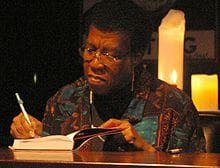
Octavia E. Butler was an American science fiction writer known for her exploration of complex themes such as race, gender, and identity. Her notable works include "Kindred," a time-travel narrative addressing slavery, and the "Patternist" series, which begins with "Mind of My Mind." Other significant titles in her catalog include "Parable of the Talents," "Wild Seed," "Adulthood Rites," and "Bloodchild and Other Stories."
Similar books
- The Handmaid's Tale
Margaret Atwood
4.1 (1.5M) average on GoodreadsFantasyExplores a dystopian society with religious fundamentalism and the oppression of women.
- Dune
Frank Herbert
4.2 (766k) average on GoodreadsFantasyFeatures a messianic figure, a new religion, and humanity's expansion to other planets.
- Harry Potter and the Sorcerer's Stone
J.K. Rowling
4.5 (7M) average on GoodreadsFantasyRescued from a miserable life under the stairs, an orphaned boy discovers he's a wizard destined for a magical school, where he uncovers a dangerous secret tied to the dark wizard who murdered his parents.
- The Hunger Games
Suzanne Collins
4.3 (6.4M) average on GoodreadsFantasyIn a future where children fight to the death on live television, Katniss Everdeen volunteers for the arena, turning a death sentence into a fight for survival and a spark of rebellion.
- 1984
George Orwell
4.2 (3.1M) average on GoodreadsPoliticsIn a future where surveillance and thought control are absolute, a man's search for truth clashes with the Party, showing that hope can be a form of rebellion.
- Divergent
Veronica Roth
4.2 (2.9M) average on GoodreadsFantasyIn a society divided by virtues, a sixteen-year-old's difference from the norm starts a rebellion that threatens her world.






Enjoyed the summary?
A summary gives you the shape of the book. The book itself has the detail, the examples and the voice.
Find Parable of the Talents on AmazonAs an Amazon Associate, BookBrief earns from qualifying purchases. How we're funded