
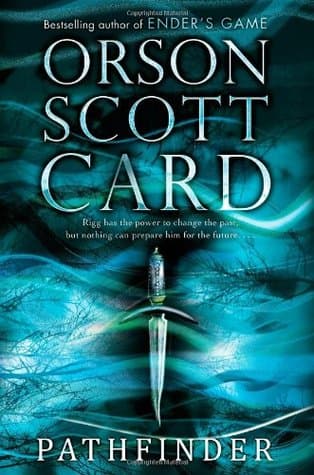
Synopsis
Covers the whole plot, including the ending.
- Difficulty
- Medium
- Pacing
- Variable
- Mood
- Intriguing, Epic, Mysterious, Thought-provoking
- Read it if
- You enjoy complex time-travel narratives, intricate world-building, and a young protagonist with immense, world-altering powers.
- Skip it if
- You prefer simpler plots without extensive lore or find time-travel paradoxes confusing.
Pathfinder Plot Summary
Covers the whole plot, including the ending.
The Death of Father and Rigg's Discovery
Rigg lives a quiet life with his father, learning survival skills and how to 'read' the paths of living things, seeing where they have been. When his father dies unexpectedly, Rigg is heartbroken. Before his death, Father gives Rigg a coded map and instructions to find his sister, Param, and a man named Loaf. Rigg also learns that his father was not his biological parent, and his true origins are a mystery connected to a place called 'Gard.' This discovery shatters Rigg's understanding of his life and sends him on an unexpected journey, forcing him to rely on his developing pathfinding talent and his father's mysterious guidance.
Journey to Loaf and Meeting Param
Following his father's map, Rigg travels through difficult terrain, using his pathfinding ability to avoid dangers and track his way. He eventually finds Loaf, a man living in a hidden settlement. Loaf reveals more about Rigg's past, confirming Rigg is from Gard and has unusual abilities. Here, Rigg also meets Param, his long-lost sister, who has a similar, but different, pathfinding ability. Param is initially cautious but eventually accepts Rigg, and together they begin to uncover the complex details of their shared history and the secrets their father kept.
The Nature of Pathfinding and Time Bending
Loaf and Param help Rigg understand the full extent of his pathfinding ability. Rigg can not only see the past paths of objects and people but also change them, essentially bending time. This discovery is both exciting and frightening, as Rigg grapples with the ethical implications of altering history. Param, on the other hand, can see future paths. They learn that their unique talents are not just for observing but are active forces that can reshape reality. This discovery becomes central to their quest, as they realize their powers are connected to a much larger conflict.
Encountering the Ramaj and the Wall of Knowledge
Rigg and Param encounter the Ramaj, a secretive and powerful group who are also pathfinders, but with different goals and methods. The Ramaj are both a threat and a source of information. They learn about the 'Wall of Knowledge,' a mystical place said to hold the complete history of their people and the origins of their powers. This Wall becomes their main destination, as they believe it holds the answers to who they are, why they have these abilities, and what their future holds. The journey to the Wall is dangerous, as various groups seek to control or destroy it.
Arrival at the Wall and Meeting the Ancients
After a dangerous journey, Rigg and Param finally reach the legendary Wall of Knowledge. It is not just a physical structure but a center of information and power. There, they meet the 'Ancients,' beings with vast knowledge about Gard's history and the true nature of the pathfinders. The Ancients reveal that Gard is not a planet but a colony ship, and that the pathfinders are descendants of its original crew, tasked with maintaining a stable timeline. This revelation shifts their understanding of their world from fantasy to science fiction, giving their powers a technological origin.
The Original Sin and the Time Wars
The Ancients explain the 'Original Sin' – a disaster in Gard's past where a pathfinder misused their abilities, creating a different timeline and causing widespread chaos. This led to the 'Time Wars,' an ongoing conflict between factions of pathfinders trying to either restore the original timeline or exploit the fractured ones for their own benefit. Rigg discovers that his father was deeply involved in this conflict, and that Rigg himself is a critical point, with the potential to either heal or further destabilize the timeline. This knowledge places a huge responsibility on Rigg.
Rigg's Unique Role and the Convergence Point
Rigg learns he is a 'Convergence Point,' a rare person whose unique pathfinding ability allows him to not just see and change individual paths, but to potentially unify different timelines. This makes him incredibly powerful and a target for all groups involved in the Time Wars. One group, led by the ruthless Umbo, wants to control Rigg for their own purposes, while another, the 'Timers,' want to guide him toward restoring the original timeline. Rigg's struggle to understand and control this power becomes central, as he realizes his very existence is key to the universe's fate.
Confrontation with Umbo and the Enemy
Umbo, a powerful and manipulative pathfinder, confronts Rigg and Param. Umbo believes Rigg's power can be used to create a new, 'perfect' timeline under his control. He tries to trick or force Rigg into joining him, using both persuasion and aggression. This confrontation tests Rigg's determination and his understanding of his own abilities. Param, with her ability to see future paths, helps Rigg navigate Umbo's schemes. The encounter is a tense battle of wits and powers, where Rigg must not only defend himself but also protect the integrity of the timelines.
The Timers and the Plan for Restoration
Rigg and Param eventually join the 'Timers,' a group dedicated to undoing the Original Sin and restoring the original, stable timeline. The Timers, led by individuals who have devoted their lives to this cause, explain the complex mechanics of time travel and the immense risks of trying to fix the past. Together, they create a plan that uses Rigg's unique ability as a Convergence Point. This plan is dangerous and requires precise execution, as any mistake could lead to more temporal chaos or even the complete destruction of their reality.
The Final Attempt to Restore the Timeline
Rigg, guided by the Timers and supported by Param, undertakes the mission to restore the fractured timeline. This involves a journey back to the moment of the Original Sin, a critical point where he must use his Convergence Point ability to weave the divergent paths back into a single thread. The process is incredibly demanding, both physically and mentally, as Rigg experiences echoes of countless alternate realities. He faces deep personal sacrifices and moral dilemmas, understanding that his actions will fundamentally change the existence of everyone, including himself and his loved ones.
The Resolution and Lingering Questions
Rigg successfully merges the timelines, bringing some order back to reality. The world is subtly but deeply changed, with some events and people existing differently or not at all. While the immediate danger of temporal collapse is avoided, the act of restoration leaves lingering questions about identity, memory, and the true nature of existence. Rigg, though successful, carries the heavy weight of his actions and the knowledge of what could have been. The ending suggests that while a major conflict is resolved, a pathfinder's journey is never truly over, hinting at future challenges and discoveries.
Pathfinder Characters
Rigg
Protagonist
A young pathfinder with the unique ability to see and manipulate past timelines.
Rigg is initially a naive boy living a sheltered life with his father, unaware of his true heritage or the immense power he possesses. He is observant, resourceful, and deeply loyal. His pathfinding ability allows him to see the 'paths' of all living and non-living things, revealing their history. As the story progresses, he discovers he can not only see but also alter these paths, making him a 'Convergence Point' – a key figure in the Time Wars. He is driven by a desire to understand his past and fulfill his destiny, even when it means facing unimaginable dangers.
Relationships: Father (Adoptive father, mentor, secret keeper); Param (Biological sister, fellow pathfinder, confidante); Loaf (Guardian, mentor, source of information); Umbo (Antagonist, rival pathfinder)
Param
Supporting
Rigg's biological sister, a pathfinder who can see future paths.
Param is Rigg's biological sister, separated from him since birth. She possesses a complementary pathfinding ability, allowing her to see future paths, often in the form of potential outcomes. She is intelligent, cautious, and initially wary of Rigg, but her loyalty grows as they discover their shared heritage. Param often acts as Rigg's moral compass and strategic advisor, helping him understand the implications of his powers and navigate the complex temporal landscape. Her foresight is crucial to their survival and mission.
Relationships: Rigg (Biological brother, fellow pathfinder, close ally); Loaf (Guardian, mentor)
Father
Supporting/Mentioned
Rigg's adoptive father, who trained him and kept secrets about his true origins.
Rigg's adoptive father is a mysterious and enigmatic figure. He raises Rigg in isolation, teaching him survival skills and nurturing his nascent pathfinding abilities, though he conceals the true extent of Rigg's powers and his origins. Before his death, he sets Rigg on his journey with cryptic instructions and a map. Father is revealed to have been deeply involved in the Time Wars and the effort to restore the original timeline, making his parenting decisions a complex blend of protection and preparation for Rigg's destiny. His actions, even in death, continue to guide Rigg.
Relationships: Rigg (Adoptive father, mentor, secret keeper)
Loaf
Supporting
A mentor figure who provides Rigg and Param with crucial information about their past and powers.
Loaf is a knowledgeable and kind man who acts as a guardian and mentor to Rigg and Param. He lives in a hidden settlement and possesses extensive knowledge about the pathfinders, Gard, and the Time Wars. Loaf helps Rigg understand the true nature of his abilities and the history of the fractured timelines. He is a steadfast ally, offering guidance, refuge, and emotional support, filling a parental role for both Rigg and Param after the death of Rigg's father. His wisdom is invaluable in their quest.
Relationships: Rigg (Mentor, guardian); Param (Guardian, mentor)
Umbo
Antagonist
A powerful and manipulative pathfinder who seeks to control Rigg and reshape the timelines for his own gain.
Umbo is a formidable antagonist, a pathfinder with immense power and a dangerous agenda. He is ruthless, intelligent, and charismatic, leading a faction that seeks to exploit the fractured timelines for their own benefit, rather than restore them. Umbo views Rigg's unique ability as a Convergence Point as a tool to be controlled, believing he can create a 'perfect' reality under his dominion. He represents the corrupting influence of power and the ethical dilemmas inherent in temporal manipulation, constantly challenging Rigg's resolve and morality.
Relationships: Rigg (Primary antagonist, rival); Param (Opponent)
The Ancients
Supporting
Mysterious, ancient beings at the Wall of Knowledge who hold the history of Gard and the pathfinders.
The Ancients are the keepers of knowledge at the legendary Wall of Knowledge. They are extremely old, possibly even non-corporeal or existing across multiple timelines, and possess a vast understanding of Gard's true nature as a colony ship, the origins of the pathfinders' powers, and the history of the Time Wars. They serve as expositors, revealing crucial information to Rigg and Param about their heritage and the cosmic stakes of their mission. Their wisdom guides the protagonists towards understanding their true purpose.
Relationships: Rigg (Source of ancient knowledge); Param (Source of ancient knowledge)
The Timers
Supporting
A faction of pathfinders dedicated to restoring the original, stable timeline.
The Timers are a collective of pathfinders who are dedicated to undoing the 'Original Sin' and mending the fractured timelines. They are highly organized, knowledgeable about temporal mechanics, and committed to preserving the integrity of reality. Unlike Umbo's faction, they prioritize stability over personal gain. They ally with Rigg and Param, providing guidance, resources, and a strategic framework for the perilous task of unifying the timelines. They represent the forces of order and preservation in the ongoing Time Wars.
Relationships: Rigg (Allies, collaborators); Param (Allies, collaborators)
Pathfinder Themes
Identity and Destiny
Rigg's journey is about finding out who he is and what his purpose is. He first believes he is a simple boy, but after his father's death and later revelations, he learns he is a pathfinder, a 'Convergence Point' with the power to reshape reality. This theme explores how one's origins and abilities can define their future, even if it is a future they did not choose. Rigg constantly deals with the responsibility of his powers and the expectations placed on him, questioning if he can truly make his own way or if he is simply fulfilling a predetermined role, as seen when he learns about Gard's true nature as a ship and his family line.
“Your father kept you ignorant, Rigg, but he kept you safe. Now the time for safety is over, and the time for knowledge has begun.”
The Burden of Power and Choice
The pathfinders' ability to manipulate time brings immense power, but also a heavy burden of responsibility and ethical issues. Rigg, in particular, must deal with the results of changing the past, understanding that altering one event can affect countless lives and potentially erase entire realities. The story explores the moral complexities of having such power, as characters like Umbo try to use it for selfish reasons, while Rigg and the Timers aim to use it for restoration. Every decision Rigg makes about using his pathfinding ability carries moral weight, such as when he considers reversing a death.
“To see the path is one thing. To change it... that is a power few can wield without destroying themselves, or everyone else.”
The Nature of Time and Reality
The book explores complex philosophical questions about the nature of time. Is time linear, or are there multiple, different timelines? Can the past truly be changed, or just observed? The idea of 'Gard' as a colony ship blurs the lines between fantasy and science fiction, suggesting their 'magical' abilities have a technological origin. The 'Original Sin' and the 'Time Wars' show how fragile reality is and how easily it can be broken, making readers question what is real and what is just a temporary construction. The entire journey to the Wall of Knowledge is a quest to understand these basic principles.
“Every choice creates a path. Every path, a reality. And some paths... they lead to broken worlds.”
Family and Legacy
Rigg's quest begins with the death of his adoptive father and the search for his biological sister, Param. The theme explores different kinds of family – the one he grew up in, and the one he discovers through shared blood and power. His father's legacy, both the knowledge and the secrets he shared, greatly shapes Rigg's journey. The bond between Rigg and Param, formed through shared heritage and unique abilities, becomes a key part of their strength. The story suggests that legacy is not just about inheritance, but about the ongoing impact of past generations on the present and future, as Rigg's ancestors' actions dictate his current mission.
“You are not alone, Rigg. You have a sister. And together, you will find your way.”
Plot Devices & Literary Techniques
Pathfinding Ability
The unique power to see and manipulate the past and future paths of people and objects.
The pathfinding ability is the central plot device. Rigg can see the past paths of all things, while Param can see future paths. This power not only drives the narrative by allowing them to track, avoid dangers, and uncover secrets, but also introduces the core conflict of time manipulation. Rigg's unique capacity as a 'Convergence Point' to unify divergent timelines makes this ability the most powerful force in the story, determining the fate of entire realities. It's both a tool for survival and a source of immense responsibility and moral dilemmas.
The Map and Cryptic Instructions
A mysterious map and verbal instructions left by Rigg's father, guiding his initial journey.
Rigg's father leaves him a cryptic map and a set of instructions before his death. This device acts as the initial catalyst for Rigg's journey, propelling him out of his isolated life and into the wider world. The map and instructions are more than just directions; they are a puzzle that Rigg must solve, slowly revealing the secrets of his past and the true nature of his world. They represent the father's foresight and his attempt to guide Rigg even after his death, ensuring Rigg fulfills his destiny by leading him to key figures like Loaf and Param.
The Wall of Knowledge
A legendary repository of information about Gard, the pathfinders, and the history of the Time Wars.
The Wall of Knowledge serves as a crucial information hub and a narrative goal. It is the destination Rigg and Param seek to understand their origins and the truth about their powers. Upon reaching it, they gain access to the collective history and wisdom of the Ancients, revealing that Gard is a colony ship and that the pathfinders' abilities have a scientific, rather than magical, origin. This device provides essential exposition, shifting the genre and raising the stakes by explaining the 'Original Sin' and the ongoing 'Time Wars', giving context to their entire mission.
Gard (The Colony Ship)
The true nature of their world, revealed to be a massive, ancient colony ship.
The revelation that 'Gard' is not a planet but an ancient colony ship is a major plot twist and a significant plot device. It recontextualizes the entire world-building, shifting the genre from pure fantasy to a blend of fantasy and science fiction. This discovery explains the technological basis for the pathfinders' abilities and the existence of the 'Time Wars,' which are internal conflicts within the ship's temporal systems. It raises questions about their true origins and the purpose of their existence, profoundly impacting Rigg's understanding of his identity and destiny.
Pathfinder Quotes
“It was never the right time to do the right thing. It was always the wrong time to do the right thing. It was always the wrong time to do the right thing, because the cost was always too high.”
“The past is not a prison. The past is a foundation. On it, we build the future.”
“Knowing what you are is only half the battle. Knowing what you can become is the other half.”
“Memory is a funny thing. It can be a gift, or it can be a curse. Sometimes, it's both.”
“The greatest journeys are not about finding new lands, but about seeing with new eyes.”
“Fear is a tool. It can be used to protect you, or it can be used to control you.”
“Sometimes the only way to save someone is to let them go.”
“A lie can travel halfway around the world while the truth is still putting on its shoes.”
“The world isn't always fair, but it's always interesting.”
“We are all connected, like threads in a tapestry. Pull one, and the whole thing shifts.”
“Even in the darkest night, there are stars. You just have to look up.”
“The greatest power is not the ability to destroy, but the ability to create.”
“Every choice you make echoes through time.”
“You can't change the past, but you can change how you remember it.”
Quiz
10 questions on the plot and the characters. Each answer comes with a short explanation.
Question 1
What is Rigg's unique talent that his father kept a secret?
- The ability to speak with animals.
- The ability to see the paths of people's pasts.
- The ability to control the weather.
- The ability to heal any wound.
Show answer
B. The ability to see the paths of people's pasts. Rigg's primary talent, revealed early in the book, is his ability to perceive the past movements and locations of people and objects.
Question 2
What is the name of Rigg's adoptive sister?
- Loaf
- Porey
- Umbo
- Hazel
Show answer
B. Porey Porey is Rigg's adoptive sister, who is crucial to his journey and possesses her own unique abilities.
Question 3
What significant event triggers Rigg's journey and the revelation of his father's secrets?
- He finds a mysterious map.
- His father's death.
- He is attacked by bandits.
- He discovers a hidden treasure.
Show answer
B. His father's death. The death of Rigg's father is the catalyst for the entire plot, as it leads to the unraveling of long-held secrets and Rigg's quest.
Question 4
What is the name of the 'First Pathfinder' who originally created the paths Rigg can see and manipulate?
- Ram
- Umbo
- Loaf
- Param
Show answer
B. Umbo Umbo is the legendary 'First Pathfinder' whose original path-making abilities are central to the novel's lore and Rigg's own powers.
Question 5
What is the primary danger Rigg faces from one of the two factions mentioned in the synopsis?
- They want to imprison him.
- They want him dead.
- They want to steal his talent.
- They want to force him into marriage.
Show answer
B. They want him dead. The synopsis explicitly states that one faction 'wants him dead,' highlighting the severe threat Rigg faces.
Question 6
Rigg discovers he has the power to not only see the past but also to do what?
- Predict the future.
- Communicate with the dead.
- Change the past.
- Create new paths in the present.
Show answer
C. Change the past. A key development in the story is Rigg's realization that his ability extends beyond observation to actively altering past events.
Question 7
What is the name of the world Rigg inhabits, which is implied to be a colony world?
- Earth
- Garden
- Harmony
- Pathos
Show answer
B. Garden Rigg's world is known as Garden, a colony established by the original Pathfinders, which has developed unique characteristics.
Question 8
What is the primary ethical dilemma Rigg faces regarding his ability to change the past?
- Whether he should use it for personal gain.
- The potential for unintended consequences and altering current reality.
- If he should reveal his power to the public.
- How to monetize his unique talent.
Show answer
B. The potential for unintended consequences and altering current reality. The core theme of changing the past involves the significant ethical question of how such alterations might ripple through time and affect the present, a major concern for Rigg.
Question 9
What is the true nature of the 'fences' that divide the different regions and cultures on Rigg's world?
- They are literal physical barriers built by ancient civilizations.
- They are historical divisions created by the First Pathfinders to separate groups who lost their way.
- They are naturally occurring geological formations.
- They are magical barriers erected by powerful mages.
Show answer
B. They are historical divisions created by the First Pathfinders to separate groups who lost their way. The 'fences' are not natural or physical in the traditional sense, but rather historical divisions and boundaries created by Umbo and other Pathfinders to manage the lost descendants.
Question 10
What is the overarching goal of the Pathfinders, including Rigg's father, in relation to the 'lost' people of Garden?
- To conquer and rule them.
- To guide them back to their original 'paths' and potentially reunite humanity.
- To observe them from a distance without intervention.
- To eliminate those who have strayed too far.
Show answer
B. To guide them back to their original 'paths' and potentially reunite humanity. The core mission of the Pathfinders is to correct the historical deviations and guide the scattered populations back to the original, intended paths, aiming for a grand reunification.
Pathfinder FAQ
What is Rigg's unique talent, and how does it manifest early in the book?
Rigg possesses the extraordinary ability to see the 'paths' of every living creature, tracing their past movements and experiences. This talent initially manifests as a visual overlay, allowing him to perceive where a person or animal has been and what they have done, often aiding his father in tracking and understanding their surroundings.
Who are Umbo and Loaf, and what is their initial relationship with Rigg?
Umbo is Rigg's childhood friend, a strong and loyal companion who often accompanies Rigg on his adventures and helps him navigate the forest. Loaf is Rigg's older sister, known for her sharp wit and practical nature, who initially views Rigg's 'pathfinding' as a strange but useful quirk, unaware of its true significance.
What pivotal event triggers Rigg's journey and reveals his father's secrets?
The sudden and mysterious death of Rigg's father, initially attributed to a hunting accident, serves as the catalyst. Following his father's death, Rigg discovers a series of hidden messages and clues, leading him to realize that his father had been keeping profound secrets about Rigg's true parentage and a larger, ancient conflict.
What is the 'Wall' and its significance to Rigg's world?
The 'Wall' is a massive, seemingly impenetrable barrier that divides the known world, separating different civilizations and ecosystems. Its significance is immense as it represents a long-standing mystery and a physical manifestation of the historical schism that underlies Rigg's reality, hinting at a forgotten past and advanced technology.
Who is Param, and what role does she play in Rigg's early quest?
Param is a mysterious and powerful young woman Rigg encounters during his journey, possessing unique abilities related to manipulating matter and energy. She becomes a crucial ally, guiding Rigg with her knowledge of the world's hidden truths and helping him understand the deeper implications of his own powers and destiny.
How does Rigg's ability to 'change' paths differ from merely 'seeing' them?
Initially, Rigg can only passively observe past paths. His ability to 'change' paths evolves into actively altering historical events or creating alternate timelines by manipulating the past. This power is far more dangerous and complex, allowing him to rewrite history and potentially avert or create new realities.
What is the true nature of the 'First World' and its connection to the current one?
The 'First World' is revealed to be Earth, a technologically advanced civilization from which humanity originated. The current world is a colony established by descendants of Earth, and the 'Wall' and the various factions are remnants of a catastrophic event or experiment that led to the current societal structure and the suppression of true history.
Who are the 'Pathfinders' and what is their historical purpose?
The 'Pathfinders' are a lineage of individuals, including Rigg, genetically engineered or uniquely gifted with the ability to perceive and manipulate time and causality. Their historical purpose was to maintain the integrity of timelines or, in some interpretations, to correct deviations from a pre-ordained path, serving as guardians of history.
What is the significance of the 'Resurrection Ships' and how do they relate to the ancient past?
'Resurrection Ships' are ancient, advanced vessels that contain genetic material and technological blueprints from the First World, designed to rebuild civilization after a cataclysm. They represent a forgotten legacy and the potential to restore lost knowledge and power, linking the current world directly to its distant, technologically superior origins.
How does Rigg's isolation and his father's secrecy impact his development of trust?
Rigg's upbringing in relative isolation, coupled with his father's profound secrecy about his true identity and powers, instills in him a deep-seated caution and a struggle to trust. He constantly questions motives and intentions, as his foundational understanding of his own life was built on deliberate omissions, making him wary of new alliances.
Discuss the psychological burden Rigg faces with the power to change the past.
The power to change the past places an immense psychological burden on Rigg, as every decision carries the weight of altering reality and potentially erasing or creating lives. He grapples with the moral implications of playing 'god,' fearing unintended consequences and the potential for a personal timeline paradox, leading to significant anxiety and self-doubt.
How does the revelation of his 'birthright' affect Rigg's sense of identity?
The revelation of his birthright as a Pathfinder and his connection to an ancient lineage shatters Rigg's previous sense of self as a simple forest boy. He struggles to reconcile his humble upbringing with the grand, dangerous destiny thrust upon him, leading to an identity crisis as he tries to integrate these two disparate parts of himself.
Analyze the dynamic between Rigg and his sister, Loaf, particularly after the secrets are revealed.
Initially, Loaf is a protective, somewhat condescending older sister. After the secrets are revealed, their dynamic becomes strained as Loaf struggles to accept Rigg's extraordinary powers and destiny, feeling left behind and questioning her own place. Despite this, her underlying loyalty and care for Rigg remain, albeit complicated by fear and confusion.
Is Rigg a hero by choice or by circumstance? Discuss.
Rigg is largely a hero by circumstance, as his extraordinary powers and hidden lineage are thrust upon him, forcing him into a grand conflict. However, his consistent choices to act morally, protect others, and seek truth, even when facing immense danger and personal cost, demonstrate a strong underlying heroic character, making him a reluctant hero who embraces his role.
What philosophical questions does the existence of the 'First World' and its lost technology raise?
The existence of the 'First World' raises profound questions about humanity's capacity for self-destruction, the cyclical nature of civilization, and the ethics of advanced technology. It prompts reflection on whether humanity is doomed to repeat past mistakes, the value of forgotten knowledge, and the responsibility of preserving history versus creating a new future.
How does the concept of 'paths' serve as a metaphor for destiny versus free will?
The 'paths' serve as a powerful metaphor for the interplay between destiny and free will. While Rigg can see pre-existing paths (destiny), his evolving ability to change them (free will) suggests that fate is not immutable. It implies that while choices have consequences that create paths, individuals possess the agency to deviate from or even rewrite those paths.
Is the 'Wall' primarily a physical barrier or a symbolic one?
The 'Wall' functions as both a physical and profoundly symbolic barrier. Physically, it divides the land and prevents travel. Symbolically, it represents the division of knowledge, the suppression of truth, and the psychological walls humans build to avoid confronting uncomfortable realities about their history and the origins of their world.
What is the primary conflict: good vs. evil, or conflicting ideologies?
The primary conflict is less about clear-cut good vs. evil and more about conflicting ideologies and interpretations of history and humanity's future. Different factions believe they hold the 'correct' path for humanity, whether it's preserving a specific timeline, restoring ancient power, or forging a new way, leading to a nuanced moral landscape.
How does Rigg's journey reflect a coming-of-age narrative?
Rigg's journey is a quintessential coming-of-age narrative. He transitions from an innocent, ignorant boy living a sheltered life to a young man burdened with immense power and responsibility. His quest forces him to confront his identity, make difficult moral choices, learn to trust and lead, and ultimately define his own destiny, maturing significantly in the process.
About the author

Orson Scott Card is an American writer known best for his science fiction works. He is the first and only person to win both a Hugo Award and a Nebula Award in consecutive years, winning both awards for both his novel Ender's Game (1985) and its sequel Speaker for the Dead (1986). A feature film adaptation of Ender's Game, which Card co-produced, was released in 2013. Card also wrote the Locus Fantasy Award-winning series The Tales of Alvin Maker (1987–2003).
Similar books
- Ender's Game
Orson Scott Card
4.3 (1.1M) average on GoodreadsFantasyFeatures a young protagonist with extraordinary abilities facing a world-altering conflict, strong focus on strategy and destiny.
- A Wrinkle in Time
Madeleine L'Engle
4.0 (1.1M) average on GoodreadsFantasyInvolves young characters traveling through space and time to combat a cosmic evil and save loved ones.
- The Name of the Wind
Patrick Rothfuss
4.5 (716k) average on GoodreadsFantasyFeatures a gifted young protagonist discovering his hidden past and immense potential in a richly imagined fantasy world.
- The Hunger Games
Suzanne Collins
4.3 (6.4M) average on GoodreadsFantasyBoth feature young protagonists thrust into extraordinary, world-altering circumstances. The Hunger Games offers a more direct critique of societal structures and power dynamics. Pathfinder distinguishes itself by its intellectual depth and grappling with more abstract, cosmic questions of existence and destiny rather than overt social commentary.
- Harry Potter and the Sorcerer's Stone
J.K. Rowling
4.5 (7M) average on GoodreadsFantasyRescued from a miserable life under the stairs, an orphaned boy discovers he's a wizard destined for a magical school, where he uncovers a dangerous secret tied to the dark wizard who murdered his parents.
- 1984
George Orwell
4.2 (3.1M) average on GoodreadsPoliticsIn a future where surveillance and thought control are absolute, a man's search for truth clashes with the Party, showing that hope can be a form of rebellion.




Enjoyed the summary?
A summary gives you the shape of the book. The book itself has the detail, the examples and the voice.
Find Pathfinder on AmazonAs an Amazon Associate, BookBrief earns from qualifying purchases. How we're funded