
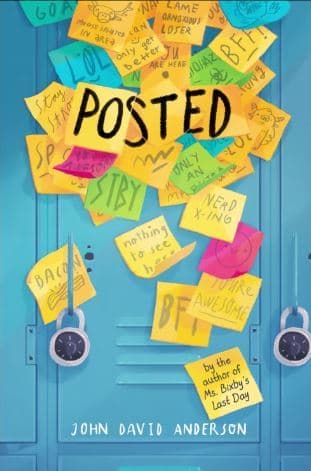
Synopsis
Covers the whole plot, including the ending.
- Difficulty
- Easy
- Pacing
- Moderate
- Mood
- Realistic, Thought-provoking, Social, Slightly Melancholy
- Read it if
- You enjoy realistic middle school dramas about friendship, bullying, and the power of words, with a unique communication device.
- Skip it if
- You prefer fantasy or sci-fi, or stories without realistic portrayals of middle school social struggles.
Posted Plot Summary
Covers the whole plot, including the ending.
The Cell Phone Ban and the Birth of Sticky Notes
Branton Middle School bans cell phones, upsetting students, especially Frost and his friends: Deedee, Wolf, and Bench. These four, close and full of inside jokes, are cut off from their usual communication. Frustrated by the silence and inability to quickly share thoughts, Frost suggests using sticky notes to leave messages in secret spots around the school. The first notes are simple jokes and reminders. This becomes a fun and effective way for the friends to stay connected, starting a new trend that will soon affect the whole school.
Rose's Arrival and the Shifting Dynamics
A new student, Rose, arrives at Branton Middle School. She sits at Frost's lunch table, a spot usually just for him and his three best friends. Rose is quiet, observant, and seems mysterious. Her presence changes the comfortable dynamic of Frost, Deedee, Wolf, and Bench. Frost is curious about Rose, but his friends are less accepting, seeing her as an outsider. This initial tension sets up future conflicts as the friends deal with adding someone new to their group.
The Sticky Note Craze Spreads
The sticky note idea, which started as a private way for Frost's group to talk, quickly spreads through Branton Middle School. Other students see the notes and start using them. Soon, hallways, lockers, and classrooms are covered with sticky notes. Many notes are positive, sharing compliments, jokes, or encouragement. But a darker side appears. Some students use the notes' anonymity to spread gossip, make mean remarks, and post bullying messages. The innocent game becomes a complex social space, showing the best and worst of middle school interactions and creating tension.
The Escalation of the 'Sticky Note War'
What began as a fun communication method becomes what students call the 'Sticky Note War.' Anonymous, mean notes start appearing, targeting individuals with cruel comments about their looks, intelligence, or social standing. The targets are deeply hurt, and the school becomes more tense. Frost and his friends, who started on the positive side, worry about the negative turn. Anonymity protects bullies, making it hard to find them. The emotional cost on students grows, creating suspicion and fear.
Rose's Past and Frost's Growing Connection
As Frost spends more time with Rose, he learns about her past. She transferred to Branton Middle School because she was severely bullied at her previous school, which made her withdrawn and careful. This helps Frost understand Rose's quiet nature and her hesitation to fully join Branton's social life. This shared vulnerability and understanding strengthen their bond, which starts to outweigh his relationships with his old friends. His empathy for Rose grows, making him more protective and sensitive to her feelings.
The Friends' Discontent and Rose's Isolation
The growing closeness between Frost and Rose is noticed by Deedee, Wolf, and Bench. They feel left out and resent Rose joining their group. Their resentment shows in small ways, like excluding Rose from talks or making passive-aggressive comments. Rose, sensitive from past experiences, notices their unwelcoming attitude. Despite Frost's efforts to bridge the gap, his friends' reluctance to accept Rose makes her feel more isolated and unwelcome. This tension strains Frost's friendships and puts him in a hard spot, forcing him to choose between his old friends and his new connection.
Bench's Secret and the Seeds of Division
During the 'Sticky Note War,' Frost learns a shocking truth: his friend, Bench, has been secretly posting some of the mean sticky notes. Bench's actions come from insecurity and a misguided attempt to be 'cool' or fit in with a different group. This discovery deeply hurts Frost, who always believed in his best friends' loyalty and kindness. The revelation creates a significant split in the group, shattering Frost's view of Bench and making the already strained dynamics, especially concerning Rose, more complicated.
The Confrontation and the Fallout
Knowing what Bench did, Frost decides he cannot stay silent. He confronts Bench, expressing his hurt and disappointment. The confrontation is hard and emotional, leading to a heated argument. Bench, at first defensive, eventually admits his involvement, driven by peer pressure and a desire for attention. This painful reckoning exposes the weaknesses in their friendship and forces the group to face the results of their actions. The fallout leaves the friends shaken, questioning their bond and shared values.
Rose's Decision and the Aftermath
Overwhelmed by the 'Sticky Note War,' the bullying, and the uncomfortable social dynamics, Rose decides to leave Branton Middle School. Her departure, though understandable, affects Frost deeply. He feels a sense of failure and regret, realizing he could not protect her or create a welcoming environment. Rose's leaving is a harsh wake-up call for Frost. It makes him examine his own actions, his friendships, and the effect of the sticky note trend. Her absence leaves a void and questions about what could have been.
Reconciliation and Moving Forward
After Rose leaves and Bench's actions are revealed, Frost, Deedee, Wolf, and Bench must face their broken friendship. They begin the slow process of reconciliation. Bench shows real remorse for his part in the bullying, and the others admit their part in allowing the negative atmosphere and isolating Rose. They learn about loyalty, empathy, and the power of words. Their friendship is changed, but they work to rebuild it on honesty and respect. The sticky note trend eventually fades, replaced by a more thoughtful approach to communication and understanding its impact.
Principal Figures
Frost
Protagonist
A thoughtful middle schooler navigating friendship, loyalty, and the impact of words.
Frost is the central protagonist, an observant and introspective middle school student. He is initially a loyal member of a tight-knit quartet, valuing their shared history and inside jokes. He is the one who initiates the sticky note idea. As the story progresses, Frost grapples with the complexities of loyalty when a new girl, Rose, challenges his friend group's dynamics. He struggles to balance his long-standing friendships with his growing empathy and connection to Rose, eventually confronting uncomfortable truths about his friends and himself. He learns the hard way about the power of words and the responsibility that comes with them.
Relationships: Deedee (Best friend, part of his core group); Wolf (Best friend, part of his core group); Bench (Best friend, part of his core group, later source of conflict); Rose (New student, growing romantic interest and source of moral dilemma)
Rose
Supporting
A quiet new student who becomes the catalyst for change and conflict.
Rose is a new student at Branton Middle School, quiet and reserved, carrying the weight of past bullying experiences from her previous school. Her arrival disrupts the established social order, particularly Frost's friend group. She is intelligent and observant but struggles to connect with her new peers due to her past trauma and the unwelcoming atmosphere created by some students. Rose becomes a target of the 'Sticky Note War,' highlighting the destructive power of anonymous words. Her presence forces Frost and his friends to confront their prejudices and the consequences of their actions, ultimately leading her to leave the school.
Relationships: Frost (Friend and potential romantic interest); Deedee, Wolf, Bench (Acquaintances, generally unwelcoming)
Deedee
Supporting
Frost's sharp-witted best friend, initially resistant to change.
Deedee is one of Frost's closest friends, known for her quick wit and strong personality. She is fiercely loyal to their established group and initially the most resistant to Rose's inclusion, viewing her as an intruder. Deedee is outspoken and sometimes critical, but her intentions are often rooted in protecting her friends and their shared history. She struggles to understand Frost's growing connection with Rose and is slow to recognize the harm caused by the 'Sticky Note War.' Her character represents the challenge of accepting new people and adapting to change within a close-knit social circle.
Relationships: Frost (Best friend, part of his core group); Wolf (Best friend, part of his core group); Bench (Best friend, part of his core group)
Wolf
Supporting
Frost's athletic and generally easygoing best friend.
Wolf is another of Frost's best friends, characterized by his athletic build and more laid-back demeanor compared to Deedee. He is generally less vocal about his opinions but is influenced by the group dynamic. Wolf is initially wary of Rose, but his resistance isn't as overt as Deedee's. He represents the quieter members of the group who might go along with the prevailing sentiment without actively contributing to the negativity. His journey involves recognizing the harm caused by the 'Sticky Note War' and understanding the importance of speaking up against injustice, even if it's uncomfortable.
Relationships: Frost (Best friend, part of his core group); Deedee (Best friend, part of his core group); Bench (Best friend, part of his core group)
Bench
Supporting
Frost's insecure best friend who succumbs to peer pressure.
Bench is the fourth member of Frost's core friend group. He is the most insecure of the quartet, often seeking validation and struggling with his own identity. This insecurity makes him susceptible to peer pressure and the desire to fit in with a perceived 'cooler' crowd. He secretly participates in posting mean sticky notes, betraying the trust of his friends and contributing to the negative atmosphere that drives Rose away. His actions serve as a major plot point, exposing the dark side of anonymity and the painful consequences of choosing popularity over kindness. Bench's remorse and subsequent attempts at redemption are crucial to the story's resolution.
Relationships: Frost (Best friend, later source of conflict); Deedee (Best friend, part of his core group); Wolf (Best friend, part of his core group)
Mrs. Higgins
Supporting
The compassionate English teacher who tries to guide her students.
Mrs. Higgins is Frost's English teacher, a perceptive and caring educator. She is aware of the social dynamics and the negative impact of the sticky notes, often trying to subtly guide her students toward empathy and responsible communication. She uses literature and class discussions to encourage critical thinking about words and their power. While she doesn't directly solve the sticky note problem, her presence provides a moral compass and a voice of reason within the school, reminding students of the importance of kindness and the lasting effects of their words. She represents the positive adult influence in the students' lives.
Principal Gable
Supporting
The school principal who implements the cell phone ban.
Principal Gable is the principal of Branton Middle School, responsible for implementing the cell phone ban that kickstarts the entire sticky note phenomenon. She is portrayed as an authority figure who, while perhaps well-intentioned in her policies, struggles to effectively manage the unforeseen consequences of the ban and the subsequent 'Sticky Note War.' Her character represents the institutional response to student behavior, highlighting the challenges administrators face in controlling social dynamics that evolve outside traditional rules.
Marissa
Mentioned
A popular student who represents the 'mean girl' archetype.
Marissa is a popular student at Branton Middle School, often associated with the 'cooler' crowd. She represents the kind of student who might initiate or perpetuate the negative aspects of the 'Sticky Note War,' using her social influence to either directly or indirectly cause harm. While not a central character, her presence and the general 'mean girl' archetype she embodies contribute to the challenging social environment that characters like Rose face and that Bench tries to emulate. She is part of the larger group that creates the pressure for others to conform or act cruelly.
Themes & Insights
The Power of Words
This theme is central to the story, shown by the 'posting' of words on sticky notes. The book shows how words can connect, bring humor, and encourage (like the first notes between Frost and his friends). It also shows how they become weapons, causing emotional pain and social division (the 'Sticky Note War'). The notes' anonymity increases this power, letting cruelty grow. The story emphasizes that words, spoken or written, have lasting effects, impacting self-esteem, friendships, and the school environment, ultimately making Rose leave.
“Words are like a disease. They can make you sick, or they can make you well. They can kill you, or they can save your life.”
Friendship and Loyalty
The novel examines middle school friendships and loyalty. Frost's bond with Deedee, Wolf, and Bench is tested by Rose's arrival and the 'Sticky Note War.' The theme explores challenges of adding new people to groups, the pain of perceived betrayal (Bench's actions), and hard choices to uphold morals over unquestioning loyalty. It shows that true friendship needs honesty, empathy, and courage to point out wrong behavior, even from close friends.
“It was hard to know what to do when your best friend was doing something you knew was wrong. Did being a good friend mean sticking up for them no matter what? Or did it mean telling them they were wrong?”
Identity and Belonging
Characters in 'Posted' deal with their sense of self and belonging. Rose's identity struggles come from past bullying, making her careful and seeking a safe place. Bench's actions come from insecurity and wanting to be 'cool,' leading him to compromise his values for acceptance. Frost also navigates his identity, torn between old friends and his connection with Rose, questioning who he is and wants to be. The sticky notes themselves show students trying to define themselves and others.
“Sometimes it felt like everyone was wearing a costume, trying to be someone they weren't, just to fit in.”
Bullying and Anonymity
The novel addresses bullying, especially through the anonymity of sticky notes. The cell phone ban, ironically, creates a new platform for anonymous harassment. The 'Sticky Note War' shows how anonymity empowers bullies, letting them inflict pain without immediate consequences. This theme explores the impact of bullying on victims like Rose and the moral compromises made by those who participate or allow it. It makes characters and readers face the responsibility that comes with communication, even when identities are hidden.
“The worst part was, you never knew who wrote them. It was like fighting ghosts.”
The Impact of Technology and Communication
While the book starts with a cell phone ban, it is not anti-technology. Instead, it looks at communication's basic nature. The ban makes students find other ways to communicate, leading to sticky notes. This shows that the desire to communicate is natural, but the medium can change a message's impact. The story explores the pros and cons of instant, casual communication versus more thoughtful interaction. It suggests that while technology (or its absence) might change 'how,' the ethical responsibility of 'what' is communicated stays important, no matter the platform.
“It wasn't the phones that were the problem. It was the words.”
Plot Devices & Literary Techniques
The Sticky Notes
A physical manifestation of communication and its dual power.
The sticky notes are the central plot device, serving as a physical stand-in for digital communication. Initially, they are an innocent, creative solution to the cell phone ban, representing connection and camaraderie among Frost's friends. However, as the trend spreads, they transform into a symbol of both positive and negative communication, embodying the power of words to build up or tear down. Their anonymity allows for the escalation of bullying, making them a tangible representation of the 'Sticky Note War' and the moral dilemmas faced by the characters. They literally 'post' the narrative's central conflict throughout the school.
The Cell Phone Ban
The inciting incident that creates the need for alternative communication.
The cell phone ban is the catalyst that sets the entire plot in motion. While seemingly a simple school policy, it inadvertently forces students to invent new ways to communicate, directly leading to the sticky note phenomenon. This device highlights how attempts to control behavior can have unforeseen consequences, and how the fundamental human need for connection will find an outlet. The ban isn't just a rule; it's the pivot point around which the entire social experiment of the sticky notes unfolds, creating the vacuum that the notes fill.
The New Kid (Rose)
A character archetype used to disrupt established dynamics and introduce new perspectives.
Rose, as the new kid, functions as a classic literary device to introduce an external force that challenges the protagonist's world and reveals underlying tensions. Her arrival immediately disrupts Frost's tightly knit friend group, forcing them to confront their insularity and prejudices. Her past experiences with bullying make her particularly vulnerable to the 'Sticky Note War,' thus intensifying the stakes and providing a moral compass for Frost. Her character is crucial for exposing the flaws in the existing social structure and prompting the protagonist's growth and self-reflection.
The 'War' Metaphor
A metaphorical framework to describe the escalating conflict.
The consistent use of the term 'Sticky Note War' by the students and narrator is a significant plot device. It frames the escalating conflict not merely as isolated incidents of bullying, but as a widespread, organized battle of words. This metaphor emphasizes the intensity, pervasiveness, and destructive nature of the anonymous notes, creating a sense of urgency and high stakes. It also highlights how seemingly small acts of meanness can collectively create an environment of fear and animosity, transforming an entire school into a battleground for social dominance.
Posted Quotes
“Words are like seeds. Once you plant them, you can't take them back.”
“Sometimes the bravest thing you can do is hit delete.”
“We're all just trying to find our place in the world, one post at a time.”
“A screen can hide a face, but it can't hide a heart.”
“Likes don't measure worth.”
“The internet has a long memory, but forgiveness doesn't have to.”
“Behind every username is a person with a story.”
“Silence can be louder than a thousand comments.”
“Friendship isn't about who comments first; it's about who shows up.”
“A post can travel the world in seconds, but an apology takes courage.”
“We're all editors of our own stories, even when we mess up the draft.”
“The best filter isn't on your phone; it's in your heart.”
“In a world of trends, be a friend.”
Quiz
10 questions on the plot and the characters. Each answer comes with a short explanation.
Question 1
What event at Branton Middle School prompts Frost and his friends to start using sticky notes as a communication method?
- The school's internet was shut down due to hacking
- Cell phones were banned by the school administration
- A power outage made electronic devices unusable
- The friends wanted to avoid digital surveillance
Show answer
B. Cell phones were banned by the school administration In the book, the ban on cell phones at Branton Middle School directly leads Frost, Deedee, Wolf, and Bench to invent the sticky-note system as an alternative way to communicate throughout the school day.
Question 2
Who are the four main friends in Frost's close circle at the beginning of the story?
- Frost, Deedee, Wolf, and Rose
- Frost, Deedee, Bench, and a teacher
- Frost, Deedee, Wolf, and Bench
- Frost, Wolf, Bench, and a new student
Show answer
C. Frost, Deedee, Wolf, and Bench Frost's initial friend group consists of himself, Deedee, Wolf, and Bench. Rose arrives later and disrupts this dynamic, as noted in the book's description.
Question 3
What is a significant consequence of the sticky-note system spreading throughout the school?
- It leads to improved academic performance
- It results in both kind and cruel notes being left
- It causes the school to install more security cameras
- It makes teachers start using sticky notes too
Show answer
B. It results in both kind and cruel notes being left As the sticky-note trend catches on, it becomes a double-edged sword: while some notes are friendly and supportive, others are mean-spirited and hurtful, escalating tensions among students.
Question 4
How does Frost initially react to Rose joining his lunch table?
- He welcomes her enthusiastically and introduces her to everyone
- He is indifferent and ignores her presence
- He feels that his friend group won't easily accommodate her
- He immediately becomes her best friend
Show answer
C. He feels that his friend group won't easily accommodate her The book describes Rose as not like anyone else at the school, and Frost realizes that his tight-knit circle of friends might struggle to include her, hinting at initial tension or uncertainty.
Question 5
What theme is highlighted by the contrast between kind and cruel sticky notes in the story?
- The importance of academic competition
- The power of words to both hurt and heal
- The benefits of technology-free communication
- The inevitability of growing apart from friends
Show answer
B. The power of words to both hurt and heal The book's opening emphasizes that words can be weapons or gifts, and the sticky-note system embodies this by showing how communication can build up or tear down relationships, central to the story's themes.
Question 6
Why does the sticky-note communication method create mounting pressure for Frost and other students?
- Because it requires them to buy expensive supplies
- Because it leads to a 'sticky-note war' forcing them to choose sides
- Because teachers start grading the notes
- Because it causes physical clutter in the school
Show answer
B. Because it leads to a 'sticky-note war' forcing them to choose sides As the note-passing escalates, it turns into a conflict with opposing factions, putting pressure on students like Frost to align with certain groups, complicating friendships and social dynamics.
Question 7
What does Frost come to realize by the end of the school year, according to the book's description?
- That sticky notes are a temporary fad
- That nothing will ever be the same after this year
- That Rose will transfer to another school
- That cell phones will be unbanned soon
Show answer
B. That nothing will ever be the same after this year The book's summary concludes with Frost understanding that the events of the year—including the sticky-note war and Rose's arrival—will bring permanent changes to his life and friendships.
Question 8
In what way does Rose's character challenge the social dynamics at Branton Middle School?
- She is a top athlete who shifts focus to sports
- She is not like anyone else and disrupts Frost's friend group
- She leads a campaign to ban sticky notes
- She is a teacher's pet who reports on note-passing
Show answer
B. She is not like anyone else and disrupts Frost's friend group Rose's uniqueness and arrival at Frost's table introduce tension, as the established friend group isn't easily adaptable to new members, highlighting themes of inclusion and change.
Question 9
Which of the following best describes the 'sticky-note war' as it escalates in the story?
- A physical fight over note supplies
- A conflict where notes are used to form alliances and attack others
- A competition to create the most artistic notes
- A debate between students and teachers about the note system
Show answer
B. A conflict where notes are used to form alliances and attack others The war involves students using notes to build social factions and target peers, with kind notes supporting friends and cruel ones attacking enemies, mirroring real-world social conflicts in middle school.
Question 10
What broader lesson about communication does the sticky-note system in 'Posted' illustrate?
- That all forms of written communication are inherently harmful
- That face-to-face talk is always better than written notes
- That words have lasting impacts and can change relationships forever
- That banning technology solves all communication problems
Show answer
C. That words have lasting impacts and can change relationships forever The book shows that whether through cell phones or sticky notes, words carry weight—they can forge connections or cause rifts, with effects that persist long after they're shared, a key takeaway from the story.
Posted FAQ
What is 'Posted' by David Anderson about?
'Posted' follows Frost, a middle schooler at Branton Middle School, where cell phones are banned. He and his friends Deedee, Wolf, and Bench start communicating via sticky notes, sparking a school-wide trend. The story explores how words—both kind and cruel—spread through these notes, especially when new girl Rose joins their group, testing friendships and escalating conflicts in a sticky-note war.
Why should I read 'Posted'?
This book offers a relatable look at middle school dynamics, focusing on themes like friendship, bullying, and the power of words. Through the unique sticky-note communication system, it highlights how small actions can have big consequences, making it engaging for young readers navigating similar social challenges.
What is the background/setting of 'Posted'?
The story is set at Branton Middle School, where a cell phone ban forces students to find alternative ways to communicate. This leads to the sticky-note phenomenon, creating a backdrop of hallways, lunch tables, and classrooms filled with notes that drive the plot's conflicts and character interactions.
What are the most memorable quotes from 'Posted'?
Key quotes include Frost reflecting, 'Words aren’t just words. They can be weapons. They can be gifts,' highlighting the book's central theme. Another is when Rose says, 'After this year, nothing will ever be the same,' foreshadowing the lasting impact of the sticky-note war on friendships and school life.
What writing style does David Anderson use in 'Posted'?
Anderson employs a straightforward, accessible narrative style suited for young adults, with vivid descriptions of middle school life. The dialogue and sticky-note excerpts are integrated to show character voices and the spread of messages, making the story immersive and easy to follow.
What minor details add significant meaning in 'Posted'?
The color and placement of sticky notes often symbolize emotions or alliances; for example, kind notes might be in bright colors left in open areas, while cruel ones are hidden or in dark hues. Rose's quiet observations at the lunch table subtly reveal her outsider perspective, adding depth to her character and the group's dynamics.
What are some subtle foreshadowing moments in 'Posted'?
Early notes from anonymous students hint at rising tensions, such as vague threats that later escalate into the sticky-note war. Frost's initial hesitation about including Rose foreshadows the friendship strains, and Bench's competitive nature subtly predicts his role in fueling conflicts over the notes.
What unexpected character connections exist in 'Posted'?
Rose, though new, shares a hidden interest in poetry with Deedee, which later helps bridge gaps in the group. Wolf, often seen as just a jock, secretly contributes thoughtful notes that contrast with his tough exterior, revealing unexpected depth and connections to the note-writing culture.
What are unspoken character motivations in 'Posted'?
Frost is motivated by a fear of losing his close-knit friend group, driving his initial resistance to Rose. Deedee seeks validation through her creative notes, while Bench's competitiveness stems from a desire for social status, leading him to exploit the note system for popularity.
What psychological complexities do characters exhibit in 'Posted'?
Frost grapples with loyalty versus inclusivity, showing internal conflict as he navigates peer pressure. Rose displays resilience and introspection, often masking her feelings to fit in. Wolf balances a tough persona with hidden sensitivity, illustrating the complexity of middle school identity formation.
What are the major emotional turning points in 'Posted'?
Key moments include when a cruel note targets Rose, forcing Frost to choose sides and escalating the war. Another is when Deedee's heartfelt note is misinterpreted, causing a rift in the group. The climax occurs as the sticky-note conflict peaks, leading to confrontations that change friendships forever.
How do relationship dynamics evolve in 'Posted'?
Initially, Frost's group is tight-knit, but Rose's arrival creates tension, especially with Bench. As notes spread, alliances shift; for example, Wolf and Deedee grow closer through shared creativity, while Frost and Rose bond over standing up to bullies, ultimately redefining the group's structure by the end.
Which parts remain ambiguous or open-ended in 'Posted'?
The identity of some anonymous note-writers is never fully revealed, leaving room for interpretation about who started the cruel messages. The future of Frost's friendships after the school year ends is left somewhat open, suggesting ongoing change without clear resolutions.
What are controversial scenes or decisions in 'Posted'?
Frost's decision to initially exclude Rose sparks debate about inclusivity versus protecting existing bonds. The escalation of the sticky-note war, where characters use notes to bully others, raises questions about responsibility and whether the ban on cell phones inadvertently caused more harm.
'Posted' ending explained: how it ends & what it means
The story ends with the sticky-note war cooling down as students reflect on the impact of their words. Frost and his friends, including Rose, have a more nuanced understanding of friendship, acknowledging that change is inevitable. This suggests growth and the lasting lesson that words hold power to both hurt and heal.
About the authors
David Anderson is a fiction author known for his works "Posted" and "Minion." His writing often explores contemporary themes within the fiction genre, engaging readers with relatable narratives and compelling characters. Anderson's contributions to fiction have established him as a voice within the literary community.
John David Anderson is an author known for his contributions to children's and young adult fiction. His notable works include "Posted," which explores themes of friendship and communication in a digital age, and "Minion," a story that delves into the complexities of loyalty and identity. Anderson's writing often resonates with middle-grade readers.
Similar books
- Wonder
R.J. Palacio
4.4 (733k) average on GoodreadsChildren'sExplores themes of acceptance, friendship, and navigating middle school with a unique protagonist.
- Restart
Gordon Korman
4.2 (18k) average on GoodreadsChildren'sDeals with a character getting a 'restart' in middle school, exploring themes of reputation, bullying, and change.
- Harry Potter and the Sorcerer's Stone
J.K. Rowling
4.5 (7M) average on GoodreadsFantasyRescued from a miserable life under the stairs, an orphaned boy discovers he's a wizard destined for a magical school, where he uncovers a dangerous secret tied to the dark wizard who murdered his parents.
- The Hobbit, or There and Back Again
J.R.R. Tolkien
4.3 (2.9M) average on GoodreadsFantasyA comfort-loving hobbit named Bilbo Baggins is whisked away by a mischievous wizard and a band of dwarves on an unexpected journey to reclaim stolen treasure from a fearsome dragon, discovering courage and a magical ring along the way.
- Harry Potter and the Goblet of Fire
J.K. Rowling
4.6 (2.6M) average on GoodreadsFantasyA bewildered Harry Potter, underage and thrust into a deadly Triwizard Tournament, must brave dragons, mermaids, and a resurgent dark magic to survive a year that will forever alter the wizarding world.
- Harry Potter and the Order of the Phoenix
J.K. Rowling
4.5 (2.5M) average on GoodreadsFantasyIn a year of oppressive secrets and the threat of Voldemort, Harry Potter and Dumbledore's Army secretly train for war, shown through Jim Kay and Neil Packer's dark illustrations.






Enjoyed the summary?
A summary gives you the shape of the book. The book itself has the detail, the examples and the voice.
Find Posted on AmazonAs an Amazon Associate, BookBrief earns from qualifying purchases. How we're funded