
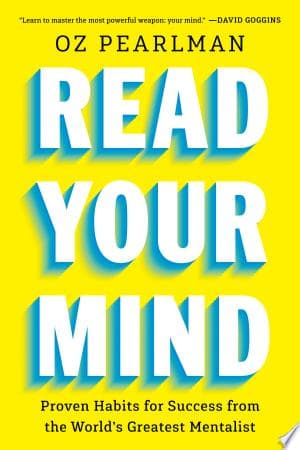
Core Idea
- Difficulty
- Medium
- Read it if
- You want to improve your observational skills, better understand human behavior and psychology, enhance your memory, and cultivate a stronger sense of presence and connection in your interactions.
- Skip it if
- You are looking for a book purely on magic tricks or quick-fix social hacks without a deeper dive into cognitive and emotional intelligence development.
Key Takeaways from Read Your Mind
The Mentalist Mindset
Adopt a mentalist's perspective to unlock hidden potential and influence.
Pearlman says that the ideas behind mentalism—careful observation, understanding human psychology, and mastering perception—are useful not just for magic but for daily success. This way of thinking means being very aware of your own thoughts and feelings, and of others' subtle signals. It means moving from just receiving information to actively understanding and shaping reality. By thinking this way, people can find opportunities, predict problems, and handle social and work interactions well. It is less about 'tricks' and more about gaining a good understanding of human nature and using that knowledge ethically to get desired results. The main idea is that success comes from how you think about interaction and influence, not just what you do.
“You don't need to be a mentalist to create real, lasting change—you just need to think like one.”
In the book: The entire premise of the book, drawing on Pearlman's thirty years of experience captivating audiences, suggests that his 'craft' is built on these psychological insights, not just sleight of hand. His success in entertainment is evidence of the power of applied psychological understanding.
Try this: Start by observing a conversation for 60 seconds, focusing only on the non-verbal cues of the person speaking. What do their hands, eyes, and posture tell you beyond their words? Practice 'active listening' by trying to predict the speaker's next point based on their emotional tone and body language.
Related ideas: mentalist-mindset, perception-mastery, applied-psychology
Mastering Observational Intelligence
Sharpen your ability to 'read' people by decoding subtle cues.
Pearlman stresses that real influence comes from truly understanding others, which starts with careful observation. This is not about mystical mind-reading, but about noticing small expressions, body language, changes in voice, and behavior patterns. By purposely looking for these often-missed signals, you can learn a lot about a person's true feelings, intentions, and reasons. This skill allows for more understanding communication, more convincing arguments, and the ability to predict reactions, which helps shape outcomes better. It is about moving past surface-level interactions to truly connect with and understand the people around you, whether in a negotiation, a social setting, or a leadership role.
“Success starts with understanding people.”
In the book: Pearlman's own career as a mentalist relies heavily on his ability to 'read' audience members and adapt his performance based on their reactions and subtle cues, making his entire profession a testament to observational intelligence.
Try this: When meeting someone new, consciously note three specific non-verbal cues within the first minute (e.g., eye contact consistency, hand gestures, posture). Later, reflect on what those cues might have communicated about their personality or current state.
Related ideas: observational-intelligence, non-verbal-cues, reading-people
The Psychology of Connection
Build authentic relationships by tapping into shared human drives.
Beyond just 'reading' people, Pearlman explores how to build real connections. This means understanding basic human desires for feeling valued, belonging, and being understood. By honestly trying to understand others' views, showing empathy, and finding common ground, you can move past superficial interactions and build trust. This is not about manipulating people, but about creating a situation where people feel seen, heard, and valued. When people feel a strong connection, they are more open to influence, working together, and shared success. This idea is important for everything from personal relationships to professional networking and leadership, as trust is the basis of any important interaction.
“If you want to close deals, build real relationships, and take control of any room, this book is your playbook.”
In the book: The book promises to teach how to 'connect more authentically with others,' implying a methodology rooted in psychological principles of rapport and trust-building, essential for a mentalist's audience engagement.
Try this: In your next conversation, actively listen for a shared interest or value. Once identified, subtly pivot the conversation to explore that commonality, fostering a sense of mutual understanding and connection.
Related ideas: authentic-connection, rapport-building, empathetic-listening
Overcoming Mental Blocks
Identify and dismantle self-doubt, procrastination, and fear.
Pearlman points out that influencing others starts with mastering yourself. The book offers ways to face and overcome common mental barriers like self-doubt, fear of rejection, and putting things off. These mental blocks often come from old thought patterns and limiting beliefs. By understanding where they come from and using mentalist-inspired methods—like changing negative thoughts, imagining success, and breaking down big tasks—people can get rid of these internal problems. This self-awareness and mental toughness are basic. Without first 'reading your own mind' and dealing with its limits, influencing others or reaching goals becomes much harder. It is a key step to reaching your full potential.
“Read Your Mind helps you turn your focus inward, teaching you how to identify and overcome the mental blocks that hold you back, building habits that stick.”
In the book: The book explicitly states it will teach readers to 'overcome rejection, procrastination, and self-doubt,' indicating practical methods are provided for these common internal struggles.
Try this: When facing a daunting task, instead of focusing on the entire project, identify the absolute smallest first step you can take (e.g., 'open the document'). Commit to only that step. This small victory can break the cycle of procrastination.
Related ideas: self-doubt-overcome, procrastination-strategies, mental-resilience
Sharpening Cognitive & Emotional Intelligence
Develop a dual mastery of logic and feeling for holistic understanding.
The book supports developing both thinking intelligence (IQ) and emotional intelligence (EQ). Thinking intelligence involves logical reasoning, solving problems, and memory. Emotional intelligence includes understanding and handling your own feelings, and noticing and influencing the feelings of others. Pearlman's approach suggests that truly mastering influence requires combining both seamlessly. A mentalist, for example, needs to remember complex routines (thinking) and also sense the audience's mood and adjust (emotional). By working on both, people can make better decisions, handle complex social situations more smoothly, and communicate clearly and effectively. This dual intelligence allows for a more complete and detailed understanding of any situation.
“Sharpen your cognitive and emotional intelligence.”
In the book: The explicit mention of sharpening both 'cognitive and emotional intelligence' as a key outcome of the book directly supports this takeaway, highlighting its importance in Pearlman's methodology.
Try this: After an emotionally charged interaction, take five minutes to journal: What emotions did you feel? What emotions did you perceive in the other person? How did these emotions influence the conversation's direction? This builds EQ. For CQ, try memory exercises like recalling a list of 10 items after a single read.
Related ideas: cognitive-intelligence, emotional-intelligence, holistic-understanding
Influence as a Skill, Not a Trick
Learn persuasion as a systematic, ethical process.
Pearlman redefines influence not as a manipulative 'trick' but as a set of learnable 'tools' or methods based on ethical psychological ideas. This view simplifies persuasion, making it accessible and practical for anyone. It involves understanding what drives human behavior—reciprocity, social proof, authority, consistency, liking, and scarcity—and using them thoughtfully and responsibly. The aim is not to force an outcome, but to guide others toward mutually beneficial decisions by presenting information in a convincing and trustworthy way. By seeing influence as a skill, people can systematically improve their ability to negotiate, lead, and work together, making sure their intentions are understood and their impact is positive and lasting.
“Read Your Mind isn’t about tricks—it’s about tools.”
In the book: Mark Cuban's endorsement, stating the book 'isn't about tricks—it's about tools' and is a 'playbook' for closing deals and building relationships, directly supports the idea of influence as a strategic skill set.
Try this: Before your next important conversation (e.g., a proposal, a request), identify one principle of persuasion (e.g., reciprocity by offering help first) and consciously integrate it into your approach.
Related ideas: ethical-persuasion, influence-strategies, human-behavior-levers
Memory as a Foundation for Confidence
Strengthen recall to boost self-assurance and presence.
A good memory is not just for academics; Pearlman highlights its important role in building confidence and improving presence in any interaction. Being able to recall names, faces, past talks, or key facts allows you to engage more deeply, avoid awkward silences, and show genuine attention. For a mentalist, memory is essential for complex routines and audience interaction. For everyday people, better memory means feeling more prepared, clear, and in control, which reduces worry and builds more self-assurance. Practical memory techniques, often used by mentalists, can be adapted to daily life, making social and work situations less stressful and more effective.
“You’ll build confidence, sharpen your memory...”
In the book: The book explicitly states that readers will 'sharpen your memory' as a means to 'build confidence,' directly linking the two concepts.
Try this: Practice the 'Name-Repetition' technique: when introduced to someone, repeat their name immediately ('Nice to meet you, [Name]'), then try to use it naturally once or twice more during the conversation. Visualize their name written on their forehead.
Related ideas: memory-techniques, confidence-building, mental-acuity
The Power of Presence
Command attention and connect deeply by being fully 'in the room.'
Pearlman implicitly teaches that real influence and connection require being fully present. A mentalist cannot perform well if distracted; they must focus completely on their audience and the moment. This applies to everyone: being fully present means actively listening, observing, and engaging without internal distractions or doing multiple things at once. When you are truly focused, you show confidence, authenticity, and respect, which naturally draws others in and makes your words more powerful. It is about reducing mental clutter and maximizing attention to the current interaction, creating a more powerful and memorable experience for everyone involved. This heightened awareness is a key part of good communication and leadership.
“If you want to... take control of any room, this book is your playbook.”
In the book: The ability to 'take control of any room,' as mentioned by Cuban, inherently requires a strong sense of presence and focus, a skill central to a successful mentalist's performance.
Try this: Before entering a meeting or an important conversation, take three deep breaths, consciously releasing any thoughts unrelated to the upcoming interaction. Make eye contact with everyone present within the first minute, acknowledging their presence.
Related ideas: mindful-presence, active-engagement, commanding-attention
Read Your Mind Quotes
“The greatest magic trick you can ever perform is changing your own mind.”
“Your thoughts are not just yours; they are the architects of your reality.”
“Fear is the ultimate illusionist, creating obstacles where none truly exist.”
“To truly read your mind, you must first learn to listen to its whispers, not just its shouts.”
“The only limits that truly bind you are the ones you place upon yourself.”
“Every setback is merely a setup for a greater comeback, if you choose to see it that way.”
“Gratitude is the lens through which ordinary moments become extraordinary experiences.”
“Don't just observe your thoughts; interact with them. Question them. Challenge them.”
“The path to clarity is often paved with the debris of discarded assumptions.”
“Your intuition is a compass, often pointing to truths your logical mind hasn't yet processed.”
“The present moment is your most powerful stage. Don't let past regrets or future worries steal the show.”
“True mental agility isn't about having all the answers, but about being able to adapt to any question.”
“Self-compassion is not a weakness; it's the foundation upon which true resilience is built.”
“The greatest 'aha!' moments often come when you're willing to look at things from an entirely new angle.”
Quiz
10 questions on the main ideas. Each answer comes with a short explanation.
Question 1
According to the book 'Read Your Mind', what is the primary benefit of 'thinking like a mentalist' for creating real, lasting change?
- To learn magic tricks to impress others
- To develop the ability to predict the future
- To identify and overcome mental blocks and build lasting habits
- To become a professional stage performer
Show answer
C. To identify and overcome mental blocks and build lasting habits The book emphasizes that 'thinking like a mentalist' is about turning focus inward to identify and overcome mental blocks and build habits, not about performing magic.
Question 2
David Goggins is quoted in the book's description as saying that 'your mind is the most powerful weapon.' How does Oz Pearlman's book aim to help readers in relation to this statement?
- By teaching readers advanced martial arts techniques
- By sharing tools to help readers master their minds
- By explaining the history of mentalism
- By encouraging readers to avoid using their minds for powerful tasks
Show answer
B. By sharing tools to help readers master their minds The quote from David Goggins highlights the power of the mind, and the book's purpose, as stated, is to share tools to help readers master it.
Question 3
Mark Cuban describes 'Read Your Mind' as a 'playbook' for what specific outcomes?
- Learning card tricks and illusions
- Closing deals, building real relationships, and taking control of any room
- Becoming a successful entrepreneur in the entertainment industry
- Memorizing long sequences of numbers
Show answer
B. Closing deals, building real relationships, and taking control of any room Mark Cuban's endorsement specifically states the book is a playbook for closing deals, building real relationships, and taking control of any room, emphasizing its practical business applications.
Question 4
The book promises to help readers eliminate fears and build confidence. Which of the following is presented as the method for achieving this?
- Hypnosis and subliminal messaging
- Complex psychological therapy sessions
- Simple, easy-to-master strategies learned in minutes
- Extensive physical training and diet regimens
Show answer
C. Simple, easy-to-master strategies learned in minutes The book's description explicitly states that confidence and fear elimination come through 'simple, easy-to-master strategies that can be learned in minutes and applied for a lifetime.'
Question 5
Oz Pearlman draws on over thirty years of experience to share 'ingenious secrets' behind his craft. What is the core nature of these secrets as applied in the book?
- Strictly theatrical performance techniques
- Psychological insights and practical strategies for success
- Ancient philosophical teachings on mindfulness
- Advanced coding and data analysis skills
Show answer
B. Psychological insights and practical strategies for success The description highlights that Oz Pearlman blends 'the intrigue of mentalism with practical strategies for success' and draws on 'psychological insights' from his experience.
Question 6
The book is described as a 'modern twist on How To Win Friends and Influence People'. What specific aspect of its content reflects this comparison?
- Its focus on historical anecdotes about famous leaders
- Its emphasis on mastering the art of influence to read people, win trust, and shape outcomes
- Its detailed instructions for organizing large social events
- Its promotion of celebrity endorsement for personal gain
Show answer
B. Its emphasis on mastering the art of influence to read people, win trust, and shape outcomes The comparison to 'How To Win Friends and Influence People' directly relates to the book's stated aim to 'Master the art of influence to read people, win trust, and shape outcomes,' which are core themes of Dale Carnegie's work.
Question 7
Which of the following mental blocks is 'Read Your Mind' specifically designed to help readers overcome?
- Writer's block, artistic block, and creative block
- Rejection, procrastination, and self-doubt
- Fear of heights, fear of public speaking, and fear of flying
- Mathematical anxiety, language learning difficulties, and spatial reasoning challenges
Show answer
B. Rejection, procrastination, and self-doubt The bulleted list of learning outcomes explicitly includes 'Overcome rejection, procrastination, and self-doubt' as key areas the book addresses.
Question 8
The book suggests that readers will 'sharpen your cognitive and emotional intelligence.' How does this relate to the overall theme of 'thinking like a mentalist'?
- By enabling readers to perform complex mathematical calculations mentally
- By enhancing one's ability to understand and manage both one's own and others' emotions and thought processes, crucial for influence and connection
- By developing photographic memory for trivial details
- By learning to ignore emotional cues to maintain a poker face
Show answer
B. By enhancing one's ability to understand and manage both one's own and others' emotions and thought processes, crucial for influence and connection Sharpening cognitive and emotional intelligence is central to the mentalist's ability to 'read people, win trust, and shape outcomes,' as it involves deep understanding of human thought and emotion for connection and persuasion.
Question 9
Oz Pearlman's background as a 'sought-after entertainer' informs the book's approach. What specific characteristic of his craft is highlighted as being blended with practical strategies for success?
- His expertise in large-scale event management
- His ability to create elaborate stage sets
- The intrigue of mentalism
- His skills in musical composition
Show answer
C. The intrigue of mentalism The description explicitly states the book 'blends the intrigue of mentalism with practical strategies for success,' indicating how his entertainment background is integrated.
Question 10
The book promises to help readers 'tap into the psychology of connection and persuasion.' What does this imply about the nature of the 'tools' offered, beyond simple 'tricks'?
- The tools are primarily about using deceptive tactics to manipulate others.
- The tools involve understanding fundamental human motivations and behaviors to build authentic relationships and influence ethically.
- The tools are purely academic theories without practical application.
- The tools are only effective in one-on-one personal interactions, not in group settings.
Show answer
B. The tools involve understanding fundamental human motivations and behaviors to build authentic relationships and influence ethically. Mark Cuban's quote clarifies, 'Read Your Mind isn’t about tricks—it’s about tools.' Tapping into the 'psychology of connection and persuasion' implies understanding deeper human motivations and behaviors for authentic and ethical influence, rather than simple manipulation.
Read Your Mind FAQ
What is 'Read Your Mind' by Oz Pearlman about?
'Read Your Your Mind' by Oz Pearlman offers a modern twist on classic self-help, blending mentalism's intrigue with practical strategies for personal and professional success. It teaches you to master your mind, build confidence, improve relationships, and overcome mental blocks using simple, easy-to-learn techniques.
Does 'thinking like a mentalist' actually work for everyday success?
Yes, 'thinking like a mentalist' in this context means applying psychological insights and observational skills to understand people, build rapport, and influence outcomes. The book provides tools and habits derived from mentalism that are highly effective for improving communication, persuasion, and self-mastery in daily life.
What is the core concept of 'mastering your mind' as taught in the book?
Mastering your mind, according to Oz Pearlman, involves understanding and overcoming the mental blocks that hold you back, such as self-doubt, procrastination, and fear. It's about developing habits that sharpen your cognitive and emotional intelligence, allowing you to take control of your thoughts and actions.
How is 'Read Your Mind' different from 'How to Win Friends and Influence People'?
While both books focus on influence and relationships, 'Read Your Mind' offers a contemporary approach by integrating insights from mentalism and psychology to provide practical tools for understanding people, building trust, and shaping outcomes. It emphasizes internal mastery and cognitive strategies more directly, in addition to social skills.
Can 'Read Your Mind' help me overcome procrastination and self-doubt?
Absolutely. The book specifically addresses common mental blocks like procrastination and self-doubt, providing practical strategies and habits to identify and overcome them. It guides you in building resilience and developing a mindset that promotes action and self-belief.
What kind of 'tools' does Oz Pearlman share in the book?
Oz Pearlman shares a variety of tools, including techniques for sharpening memory, enhancing observational skills, mastering the art of influence, building authentic connections, and developing emotional intelligence. These are presented as simple, actionable strategies for immediate application.
Is 'Read Your Mind' only for people in sales or entertainment?
No, while the book's principles are highly valuable for sales and entertainment, they are universally applicable. The strategies for building confidence, sharpening memory, connecting with others, and overcoming fears are beneficial for anyone looking to improve their personal relationships, career, and overall well-being.
How can this book help me 'read people' and win trust?
The book delves into the psychology of connection and persuasion, teaching you how to observe subtle cues, understand motivations, and communicate effectively to build rapport and trust. By sharpening your emotional intelligence, you'll gain insights into others' perspectives, enabling you to connect more authentically and influence positively.
What is 'cognitive and emotional intelligence' in the context of this book?
In 'Read Your Mind,' cognitive intelligence refers to sharpening your mental faculties like memory, focus, and problem-solving, while emotional intelligence involves understanding and managing your own emotions and those of others. The book teaches how to leverage both to improve decision-making, relationships, and overall success.
Similar books
- Outliers: The Story of Success
Malcolm Gladwell
4.2 (556k) average on GoodreadsBusinessMalcolm Gladwell argues that true success is not just about individual talent, but about the hidden advantages of culture, opportunity, and unique experiences that shape extraordinary lives.
- The Subtle Art of Not Giving a F*ck: A Counterintuitive Approach to Living a Good Life
Mark Manson
3.9 (530k) average on GoodreadsBusinessEmbrace your flaws and stomach life's lemons, because true happiness isn't about relentless positivity, but about choosing what truly matters to give a f*ck about.
- The 7 Habits of Highly Effective People: Powerful Lessons in Personal Change
Stephen R. Covey
4.1 (524k) average on GoodreadsBusinessThis book presents seven habits that help people live more effective, purposeful lives.
- Blink: The Power of Thinking Without Thinking
Malcolm Gladwell
3.9 (487k) average on GoodreadsBusinessExplore the hidden power of quick judgments and how 'thin-slicing' information helps skilled decision-makers succeed instantly, often without conscious thought.
- Rich Dad, Poor Dad
Robert T. Kiyosaki
4.1 (369k) average on GoodreadsBusinessRobert Kiyosaki explains that financial literacy, owning assets instead of liabilities, and making money work for you are the real ways to build wealth, lessons he learned from his biological 'poor dad' and his best friend's entrepreneurial 'rich dad.'
- Who Moved My Cheese?
Spencer Johnson
3.8 (367k) average on GoodreadsBusinessFour tiny maze-dwellers scramble to adapt when their beloved cheese supply vanishes, revealing a timeless parable about embracing change rather than fearing its inevitable relocation.





Enjoyed the summary?
A summary gives you the shape of the book. The book itself has the detail, the examples and the voice.
Find Read Your Mind on AmazonAs an Amazon Associate, BookBrief earns from qualifying purchases. How we're funded