
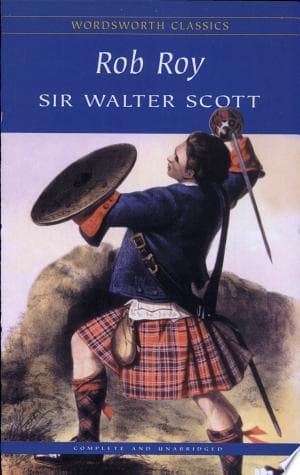
Synopsis
Covers the whole plot, including the ending.
- Difficulty
- Medium
- Pacing
- Moderate
- Mood
- Adventurous, Romantic, Historical, Dramatic
- Read it if
- You enjoy historical adventures set in 18th-century Scotland, featuring outlaws, romance, and family drama.
- Skip it if
- You prefer fast-paced thrillers or dislike classic prose and detailed historical context.
Rob Roy Plot Summary
Covers the whole plot, including the ending.
Frank Osbaldistone's Unwilling Journey North
Francis 'Frank' Osbaldistone, the main character, is a young Englishman who loves poetry and dislikes business. His father, William Osbaldistone, a rich London merchant, disinherits him for not joining the family business. Frank is sent to Osbaldistone Hall in Northumberland, the home of his father's estranged brother, Sir Hildebrand Osbaldistone. On his journey north, Frank meets Andrew Fairservice, a Presbyterian clergyman who becomes his guide. He also has a brief, unsettling meeting with a Highlander, later revealed as Rob Roy MacGregor.
Life at Osbaldistone Hall and Diana Vernon's Influence
At Osbaldistone Hall, Frank finds a household run by his rough uncle, Sir Hildebrand, and his six loud, fox-hunting cousins. The only refined person is Diana Vernon, Sir Hildebrand's beautiful, intelligent, and independent niece. She is a governess and intellectual companion to Frank. Diana, a staunch Catholic and Jacobite, quickly impresses Frank with her wit. She becomes his confidante, warning him about dangers and secrets in the house, especially concerning his cousin, Rashleigh Osbaldistone, who is also there.
Rashleigh's Treachery and the Missing Bills
Frank's cousin, Rashleigh Osbaldistone, a cunning schemer, had been sent by Frank's father to manage the family's finances in London. However, Rashleigh, driven by jealousy and ambition, betrays their trust. He steals a large sum of money in the form of important bills of exchange, which are vital to William Osbaldistone's business. This act of theft threatens to ruin Frank's father and cause financial disaster. Frank feels responsible and guilty, believing his initial refusal to join the business made the family vulnerable.
Journey to Glasgow and Encounter with Rob Roy
Determined to recover the stolen bills and clear his father's name, Frank, with Andrew Fairservice, travels to Glasgow, Scotland, where Rashleigh is thought to have fled. In Glasgow, Frank encounters the city's complex political and social currents. He meets Bailie Nicol Jarvie, a shrewd Glasgow merchant, who becomes an unexpected ally. During this pursuit, Frank formally meets Rob Roy MacGregor, the Highland outlaw, who first appears as a cattle drover but shows himself to be a powerful and influential man, living outside the law but following his own code of honor.
Rob Roy's Intervention and Rashleigh's Schemes
Rob Roy, interested in Frank's situation and perhaps seeing a chance to help himself, takes an interest in Frank's quest. He offers Frank vague advice and promises of help, hinting at his knowledge of the Scottish underworld and his connection to the events. Meanwhile, Rashleigh, having fled to Scotland, is shown to be involved in Jacobite plots, using the stolen money to fund a rebellion against the government. He tries to manipulate events further, including using Diana Vernon in his schemes.
The Jacobite Uprising and Diana's Secrets
Political tensions rise, leading to the 1715 Jacobite Rising, a historical event in the novel. This rebellion directly affects Frank and Diana. It is revealed that Diana is not just Sir Hildebrand's niece, but the daughter of a Jacobite nobleman, and deeply committed to the Stuart cause. Her guardian, Father Vaughan, is a key figure in the conspiracy. Her family's involvement in the uprising, and her own strong beliefs, put her in a difficult position, complicating her relationship with Frank and showing the dangers they both face.
Frank's Capture and Rescue by Rob Roy
During the chaos of the uprising and his pursuit of Rashleigh, Frank is captured by government troops, who suspect him of being a Jacobite supporter due to his connection with Diana and the Osbaldistones. Imprisoned and facing severe punishment, Frank's situation seems hopeless. However, Rob Roy, showing his loyalty and skill, plans a daring rescue. Leading his clan, the MacGregors, Rob Roy ambushes the soldiers, freeing Frank and strengthening their bond. This event shows Rob Roy's power and his role as a protector.
Confrontation in the Highlands and the Bills' Recovery
Frank, guided by Rob Roy, pursues Rashleigh into the Scottish Highlands. A tense confrontation occurs where Rashleigh, cornered, tries to escape with the bills. With Frank's determination and Rob Roy's help, the stolen bills of exchange are finally recovered from Rashleigh. This recovery is a turning point, as it means Frank's father's business can be saved. The scene shows the conflict between Frank's English legal approach and Rob Roy's more direct, often violent, methods of justice in the Highlands.
Rob Roy's Fate and Diana's Departure
Despite helping Frank, Rob Roy remains an outlaw, pursued by the Duke of Montrose and other authorities. He continues to avoid capture, relying on his intelligence and his clan's loyalty, but his future is uncertain. Meanwhile, because of her family's involvement in the failed Jacobite Rising, Diana Vernon must flee Scotland to avoid capture. She says a sad farewell to Frank, unable to openly express her feelings due to her circumstances and religious vows. She leaves for a convent abroad, leaving Frank heartbroken.
Return to Osbaldistone Hall and Resolution
Frank returns to Osbaldistone Hall to find a changed environment. His uncle, Sir Hildebrand, and most of his cousins have died, either in the rebellion or from natural causes, leaving the estate in disarray. Through unexpected revelations, it is discovered that Diana Vernon, as the true heir, had made a will leaving the estate to Frank. With the family business saved and the Osbaldistone estate now his, Frank's future is secure. He takes on his new responsibilities, showing a maturity he lacked earlier, reflecting his growth through hardship.
The Reconciliation and Frank's Inheritance
After the bills are recovered and his father's business stabilizes, Frank fully reconciles with William Osbaldistone. His father, seeing Frank's new maturity, courage, and business sense, acknowledges his son's growth and accepts his choices. With the Osbaldistone family line at the Hall mostly gone, and Diana's generous will, Frank becomes the rightful heir to the Osbaldistone estate. He embraces his role as a responsible landowner, combining his intelligence and poetic sensibility with a practical understanding of his duties, fulfilling the destiny that began with his journey north.
Rob Roy Characters
Francis 'Frank' Osbaldistone
Protagonist
A romantic poet forced to confront the harsh realities of life and family.
Frank is initially presented as a somewhat effete, poetic young man who disdains commerce and longs for a life of intellectual pursuits. He is sensitive, honorable, and prone to romantic idealism. His journey from London to Northumberland and into the Scottish Highlands forces him to mature rapidly, confronting betrayal, danger, and the complexities of human nature. He is driven by a strong sense of duty to his father and a burgeoning love for Diana Vernon, which propels him through many perilous situations.
Relationships: William Osbaldistone (Father-son, initially strained due to differing ambitions, later reconciled.); Diana Vernon (Love interest, intellectual companion, and moral guide.); Rashleigh Osbaldistone (Cousin and primary antagonist, a source of betrayal and conflict.); Rob Roy MacGregor (Unlikely ally and protector, a figure of respect and obligation.)
Rob Roy MacGregor
Supporting/Anti-hero
A charismatic and honorable Highland outlaw, living by his own code.
Rob Roy is a legendary Highland chieftain and outlaw, a man of immense physical presence, shrewd intelligence, and a fierce sense of honor, albeit one that operates outside the conventional law. He is a 'gentleman-freebooter,' renowned for his cattle-lifting and his resistance to the government, yet he is also capable of great loyalty and compassion. He acts as a protector and guide for Frank, often appearing at critical moments to offer assistance, driven by a complex mix of personal interest, Highland justice, and a respect for Frank's integrity. He represents the wild, untamed spirit of the Highlands.
Relationships: Francis Osbaldistone (Unlikely ally and protégé, a relationship built on mutual respect and obligation.); Helen MacGregor (Wife, equally fierce and loyal.); Duke of Montrose (Arch-enemy, representative of the law and government that persecutes him.)
Diana Vernon
Supporting/Love Interest
A spirited, intelligent, and fiercely independent Jacobite heiress.
Diana Vernon is a captivating and complex character. She is beautiful, intelligent, witty, and possesses a strong will and independent spirit that defy the conventions of her time. As a devout Catholic and a staunch Jacobite, she carries the weight of her family's political allegiances and a secret religious vow. She acts as Frank's intellectual equal and moral compass at Osbaldistone Hall, warning him of dangers and offering guidance. Despite her affection for Frank, her duty to her family and her faith prevents her from pursuing a conventional relationship, leading to a poignant sacrifice.
Relationships: Francis Osbaldistone (Love interest and intellectual companion, a deep but ultimately unfulfilled romantic connection.); Sir Hildebrand Osbaldistone (Uncle and guardian, a figure of affection despite their differences.); Rashleigh Osbaldistone (Cousin and manipulative adversary.); Father Vaughan (Guardian and spiritual mentor.)
Rashleigh Osbaldistone
Antagonist
A cunning, malevolent, and ambitious schemer driven by jealousy.
Rashleigh is the primary antagonist of the novel, a younger cousin of Frank Osbaldistone. He is intellectually gifted but morally corrupt, driven by envy, ambition, and a perverse delight in manipulation and destruction. He betrays Frank's father by embezzling funds, aligns himself with Jacobite conspirators, and constantly seeks to undermine Frank and usurp the Osbaldistone inheritance. His character embodies pure villainy and represents the destructive potential of unchecked self-interest and malice.
Relationships: Francis Osbaldistone (Cousin and bitter rival, driven by jealousy and hatred.); Diana Vernon (Object of his manipulative desires, whom he attempts to control and exploit.); William Osbaldistone (Employer whom he betrays.)
Andrew Fairservice
Supporting
A shrewd, self-serving, yet ultimately loyal Scottish servant.
Andrew Fairservice is Frank's eccentric Scottish servant and guide, a Presbyterian gardener from the Osbaldistone estate. He is characterized by his strong Scottish dialect, his shrewd and often cynical observations, his parsimonious nature, and his deep-seated Calvinist beliefs. While often appearing self-serving and cowardly, he possesses a surprising loyalty and an intricate knowledge of Scottish customs and terrain. He provides comic relief but also practical assistance, acting as a foil to Frank's romanticism and offering a grounded, albeit biased, perspective on events.
Relationships: Francis Osbaldistone (Servant and reluctant companion, providing comic relief and practical aid.)
Bailie Nicol Jarvie
Supporting
A pragmatic and shrewd Glasgow merchant, and Rob Roy's kinsman.
Bailie Nicol Jarvie is a respected and prosperous Glasgow magistrate and merchant, known for his common sense, shrewd business acumen, and a deep, albeit sometimes grudging, loyalty to his family, which includes Rob Roy MacGregor. He is a man of the law and order, yet he understands and navigates the complexities of Highland society. He provides crucial assistance to Frank in Glasgow and later in the Highlands, offering both practical advice and a moral compass rooted in Scottish practicality. He represents the burgeoning urban, commercial class in contrast to the feudal Highlands.
Relationships: Francis Osbaldistone (Ally and benefactor, offering practical assistance and guidance.); Rob Roy MacGregor (Cousin, a relationship of complicated loyalty and occasional exasperation.)
William Osbaldistone
Supporting
Frank's stern but ultimately loving merchant father.
William Osbaldistone is a wealthy and respected London merchant, a man of strict principles and a strong belief in the importance of commerce and duty. He initially disinherits Frank for his poetic inclinations, desiring him to follow in the family business. Despite his stern exterior, he deeply loves his son and is ultimately concerned for his welfare and the family's honor. His financial ruin at Rashleigh's hands is the catalyst for much of the plot, and his eventual reconciliation with Frank marks a significant emotional resolution.
Relationships: Francis Osbaldistone (Father-son, a relationship marked by initial conflict and eventual reconciliation.); Rashleigh Osbaldistone (Nephew and employee whom he trusts, only to be betrayed.)
Sir Hildebrand Osbaldistone
Supporting
Frank's boisterous, fox-hunting uncle and head of Osbaldistone Hall.
Sir Hildebrand is the patriarch of Osbaldistone Hall in Northumberland, a rough, unrefined country squire devoted to fox-hunting, drinking, and a boisterous lifestyle. He embodies the declining aristocracy, resistant to change and intellectual pursuits. While not malicious, he is largely oblivious to the intrigues happening under his roof and lacks the refinement or foresight to manage his affairs effectively. He represents a fading era and provides a stark contrast to Frank's more intellectual nature and the cunning of Rashleigh.
Relationships: Francis Osbaldistone (Uncle, host, and a source of cultural contrast.); Diana Vernon (Niece and ward, whom he loves in his own gruff way.)
Rob Roy Themes
Law vs. Justice
The novel explores the tension between formal legal systems and a more personal, often violent, idea of justice. Rob Roy, an outlaw, operates outside the law, yet he follows a strict code of honor and justice, especially in avenging wrongs against his family or those he protects. Frank, initially relying on legal means, learns that in the Highlands, justice often comes through direct action and clan loyalty, as seen when Rob Roy recovers the stolen bills. This theme questions the effectiveness and morality of different forms of justice.
“Show me a man that can follow a cause through with a stout heart, and I will show you a man that I would rather trust than a dozen of your half-hearted, double-faced fellows.”
The Clash of Cultures (English vs. Scottish Highlands)
A main theme is the contrast between England's ordered, commercial, and legal society (represented by Frank and his father) and the wild, feudal, clan-based society of the Scottish Highlands (represented by Rob Roy and his people). Frank's journey is a cultural awakening, as he learns the unfamiliar customs, dialects, and moral codes of Scotland. This clash appears in different approaches to problem-solving, ideas of honor, and political loyalties during the Jacobite Rising, showing the historical tensions between the two nations.
“You are a young man, sir, of an excellent disposition, but your education has been too much among the English; you have not yet learned to distinguish between true honour and false.”
Duty vs. Desire
Many characters struggle with the conflict between personal desires and their duties. Frank first prioritizes his poetry over his duty to join the family business, leading to his disinheritance. Diana Vernon is torn between her love for Frank and her duty to her family's Jacobite cause and religious vows, ultimately choosing the latter. Rob Roy also balances his duty to his clan and his personal vendettas with the dangers of being an outlaw. This theme explores the sacrifices people make for honor, family, and belief.
“I have duties, Mr. Osbaldistone, which are paramount to the feelings of a romantic girl.”
Identity and Transformation
Frank Osbaldistone's journey is one of self-discovery and change. He starts as a somewhat naive, sheltered young man, unsure of his place. His experiences in Northumberland and the Highlands, his encounters with betrayal, danger, and love, force him to lose his youthful idealism and accept responsibility. He changes from a poet into a man of action, able to lead and make difficult decisions, eventually accepting his inheritance and his role as a landowner. His identity is formed through hardship and his interactions with various characters.
“I had been accustomed to a life of quiet and study, and was now thrown into a scene of wild and lawless adventure.”
The Nature of Loyalty and Betrayal
Loyalty, both family and political, and its opposite, betrayal, are central to the story. Rashleigh's betrayal of his family's trust starts the main plot, while Rob Roy's strong loyalty to his clan and his word, even as an outlaw, stands in contrast. Diana's loyalty to her Jacobite cause and her family's secrets dictates her choices. The novel explores the different forms loyalty can take – from Andrew Fairservice's practical loyalty to Rob Roy's and Diana's deep commitment – and the devastating results of its absence.
“There is a gude deal of ill-will about this business, and I am not a man to meddle with other folk’s quarrels.”
Plot Devices & Literary Techniques
The Disinheritance
Frank's father disinherits him, forcing him on a journey that initiates the plot.
This is the inciting incident that propels Frank Osbaldistone from his comfortable, albeit stifling, life in London to the unfamiliar world of Osbaldistone Hall and eventually the Scottish Highlands. By cutting him off financially and sending him away, his father inadvertently sets in motion the chain of events that leads to Frank's maturation, his encounter with Rob Roy, and the recovery of the stolen funds. It acts as a classic 'call to adventure' for the protagonist, forcing him out of his comfort zone and into the heart of the conflict.
The Stolen Bills of Exchange
The financial documents embezzled by Rashleigh serve as the primary MacGuffin.
The stolen bills are the central MacGuffin of the novel, the tangible object that drives Frank's quest and fuels much of the plot's tension. Their recovery is essential for the survival of his father's business and Frank's honor. While the bills themselves are merely financial instruments, they represent much larger stakes: family reputation, financial security, and the consequences of betrayal. The pursuit of these bills forces Frank into dangerous situations and into alliance with Rob Roy, ultimately revealing the deeper political and personal conflicts at play.
The Jacobite Uprising (1715)
A real historical event that serves as a dramatic backdrop and catalyst for character actions.
The 1715 Jacobite Rising is not merely a historical reference but a crucial plot device that intensifies the stakes and provides a dangerous context for the characters' actions. It directly impacts Diana Vernon's fate, reveals her family's allegiances, and places Frank in perilous situations. The rebellion allows for dramatic rescues, captures, and confrontations, highlighting the lawlessness of the Highlands and the political divisions of the era. It provides a grand, historical canvas against which the personal dramas of Frank, Diana, and Rob Roy are played out, making their individual struggles feel part of a larger, epic narrative.
The Mysterious Guardian (Father Vaughan)
A seemingly minor character who holds key information and reveals crucial plot twists.
Father Vaughan, Diana Vernon's guardian, initially appears as a somewhat shadowy and enigmatic figure. He serves as a plot device by holding crucial information about Diana's true identity, her family's Jacobite connections, and the legal intricacies of the Osbaldistone inheritance. His eventual revelations are pivotal in resolving several plot threads, including the true heir to the estate and Diana's future. He embodies the hidden secrets and complex allegiances that permeate the narrative, particularly within the Catholic and Jacobite communities.
Rob Roy Quotes
“For who would not be a Highlander were it but for the sake of the name?”
“There are some things, Osbaldistone, which are not to be trifled with, and of these I hold to be the feelings of a father.”
“I was born a gentleman, and I will die a gentleman.”
“It's a hard world, friend, and a man must be prepared to shift for himself.”
“A man that will not fight for his own hand, deserves to lose the use of it.”
“Custom, which is to society what gravitation is to the universe, has taken a firm hold of the minds of men.”
“There are some men who are born to trouble as the sparks fly upward.”
“The course of human life is like the waves of the sea – sometimes calm, sometimes tempestuous.”
“It is not the fashion of our country to ask questions at our guests.”
“Conscience, my dear friend, is a good monitor, but it is a very bad counsellor in the day of danger.”
“The greatest misfortune that can befall a man, is to want a good name, or to lose it.”
“A man may be honest in his intentions, and yet be a rogue in his dealings.”
“The world is a stage, and all the men and women merely players.”
“There's a gude deal of human natur' in man.”
Quiz
10 questions on the plot and the characters. Each answer comes with a short explanation.
Question 1
What is Frank Osbaldistone's initial destination after leaving London, as commanded by his father?
- The family business in Glasgow
- Osbaldistone Hall in Northumberland
- His uncle's estate in the Highlands
- A remote cottage in the Scottish Borders
Show answer
B. Osbaldistone Hall in Northumberland Frank is sent to his uncle's estate, Osbaldistone Hall, in Northumberland after refusing to join his father's mercantile business.
Question 2
Who is Rashleigh Osbaldistone's primary accomplice in the embezzlement of funds from the Osbaldistone firm?
- Rob Roy MacGregor
- Morris, the English traveller
- Jumie, the Scottish lawyer
- Maconochie, the bailiff
Show answer
D. Maconochie, the bailiff Rashleigh conspires with Maconochie, a corrupt bailiff, to embezzle funds from his uncle's estate and the family firm.
Question 3
What is the true identity of the mysterious 'Mr. Campbell' who frequently aids Frank Osbaldistone?
- A disguised government agent
- Rob Roy MacGregor
- A rival merchant from Glasgow
- A distant relative of the Osbaldistone family
Show answer
B. Rob Roy MacGregor The enigmatic Mr. Campbell is revealed to be Rob Roy MacGregor, using an alias to move more freely.
Question 4
Which historical event forms the backdrop for much of the political tension and conflict in 'Rob Roy'?
- The Glorious Revolution of 1688
- The Jacobite Rising of 1715
- The Act of Union 1707
- The English Civil War
Show answer
B. The Jacobite Rising of 1715 The novel is set during the Jacobite Rising of 1715, which significantly impacts the characters and their loyalties.
Question 5
What is Diana Vernon's relationship to Sir Hildebrand Osbaldistone, Frank's uncle?
- She is his niece by marriage.
- She is his ward and a distant relative.
- She is his illegitimate daughter.
- She is a housekeeper at Osbaldistone Hall.
Show answer
B. She is his ward and a distant relative. Diana Vernon is Sir Hildebrand's ward, entrusted to his care due to her own family's circumstances and her Catholic faith.
Question 6
What is the primary motivation behind Rashleigh Osbaldistone's treachery and desire to ruin his family?
- To gain political power in Scotland
- To avenge a past slight against him by his father
- A deep-seated envy and a desire for personal gain and dominance
- To escape the family's mercantile background
Show answer
C. A deep-seated envy and a desire for personal gain and dominance Rashleigh is driven by profound envy, a thirst for power, and a desire to dismantle the family that he feels has mistreated or undervalued him.
Question 7
How does Rob Roy primarily recover the stolen bills of exchange from Morris after they are first taken?
- He ambushes Morris and his guards on the road.
- He intimidates Morris in a public inn.
- He uses a legal writ to confiscate them.
- He tricks Morris into revealing their location.
Show answer
A. He ambushes Morris and his guards on the road. Rob Roy, with his men, ambushes Morris and the revenue officers on their journey, recovering the stolen bills and punishing Morris.
Question 8
What is the ultimate fate of Rashleigh Osbaldistone?
- He escapes to France and lives in exile.
- He is killed in a duel by Frank Osbaldistone.
- He is killed by Rob Roy MacGregor in a confrontation.
- He is imprisoned for his crimes.
Show answer
C. He is killed by Rob Roy MacGregor in a confrontation. Rashleigh is ultimately killed by Rob Roy MacGregor during a final confrontation, bringing an end to his villainy.
Question 9
The character of Rob Roy embodies the conflict between what two opposing forces in 18th-century Scotland?
- Industry and agriculture
- Lowland law and Highland tradition/clan justice
- Protestantism and Catholicism
- Feudalism and emerging capitalism
Show answer
B. Lowland law and Highland tradition/clan justice Rob Roy represents the clash between the established Lowland legal system and the older, more tribal code of justice prevalent in the Highlands.
Question 10
What specific detail about Diana Vernon's family background prevents her from marrying Frank Osbaldistone for much of the novel?
- Her family's extreme poverty.
- Her father is a known Jacobite conspirator and outlaw.
- She is already secretly married to another man.
- She is bound by a religious vow of celibacy.
Show answer
B. Her father is a known Jacobite conspirator and outlaw. Diana is bound by a vow to her father, Sir Frederick Vernon, an ardent Jacobite and outlaw, that she will not marry a Protestant, which creates a significant obstacle to her relationship with Frank.
Rob Roy FAQ
What is the central conflict that drives Frank Osbaldistone from his home in England to the Scottish Highlands?
Frank Osbaldistone's father, a wealthy London merchant, disowns him for refusing to join the family business. Instead, Frank is sent to the remote Northumberland estate of Osbaldistone Hall, where his uncle and cousins reside, setting in motion the events that lead him north.
Who is Rashleigh Osbaldistone and what role does he play in Frank's initial troubles?
Rashleigh Osbaldistone is Frank's cunning and malevolent cousin, an intellectual but morally corrupt individual. He manipulates the family's financial affairs, absconding with a large sum of money entrusted to him, which forces Frank to pursue him into Scotland to recover the funds and clear his father's name.
How does Rob Roy MacGregor first become involved in Frank Osbaldistone's quest?
Rob Roy, a Highland outlaw and cattle drover, encounters Frank during his pursuit of Rashleigh. Initially appearing as a mysterious and intimidating figure, Rob Roy reveals a complex relationship with the Osbaldistone family due to past debts and allegiances, and he offers Frank cryptic assistance.
What is the significance of Helen MacGregor, Rob Roy's wife, in the narrative?
Helen MacGregor is a fierce and proud Highland woman, deeply devoted to her husband and clan. She embodies the raw, untamed spirit of the Highlands and demonstrates a formidable will, particularly when she confronts her enemies and demands justice for her family's wrongs.
What is the ultimate resolution for Frank Osbaldistone by the end of the novel?
Frank Osbaldistone eventually recovers a portion of his father's money, though not all. He inherits Osbaldistone Hall after the deaths of his uncle and cousins, marrying Diana Vernon and settling into a life of relative peace and prosperity, having matured greatly through his adventures.
What is the true nature of Diana Vernon's connection to the Jacobite cause, and how is it subtly revealed?
Diana Vernon is a devout Catholic and a staunch Jacobite, secretly dedicated to the Stuart cause. Her loyalty is subtly hinted at through her coded conversations, her references to 'the King over the water,' and her eventual departure to join the exiled court, revealing her deep-seated political convictions.
How does the character of Morris serve as a catalyst for revealing Rob Roy's true identity and allegiances?
Morris, a despised government agent, is captured by Rob Roy's men after attempting to betray Frank. His capture and subsequent fate at the hands of Rob Roy not only expose Rob Roy's outlaw status but also highlight his personal code of justice and his deep-seated animosity towards those who serve the English crown.
What is the historical context of the 1715 Jacobite Rising, and how does it underpin the plot without being its main focus?
The 1715 Jacobite Rising provides the turbulent backdrop against which the personal dramas unfold. While not a direct historical account of the rebellion, it explains the political tensions, the divided loyalties, and the lawlessness that allowed figures like Rob Roy to operate and for Rashleigh's schemes to gain traction, influencing the characters' choices and dangers.
Beyond simple villainy, what psychological motivations drive Rashleigh Osbaldistone's malicious actions?
Rashleigh is driven by a profound sense of intellectual superiority and resentment at his perceived lack of opportunity and recognition. His malice stems from a deep-seated envy of Frank's legitimate claim to the estate and a desire to exert control and inflict suffering on those he deems inferior or who stand in his way, fueled by a Machiavellian cunning.
Analyze the psychological impact of Frank's journey from a sheltered English gentleman to an adventurer in the Highlands.
Frank's journey forces him to confront his naiveté and reliance on societal norms. He develops resilience, resourcefulness, and a deeper understanding of human nature, moving from a passive recipient of his father's will to an active participant in his own destiny, ultimately maturing into a more capable and self-aware individual.
How does Diana Vernon's strong will and intelligence contrast with the societal expectations placed upon women of her era?
Diana defies the submissive role expected of women, demonstrating remarkable intellect, wit, and independence. She openly expresses her opinions, engages in political discourse, and actively participates in plans, showcasing a spirit that challenges the patriarchal norms and limited opportunities for women in the early 18th century.
Discuss the psychological concept of 'honor' as it is portrayed by Rob Roy, contrasting it with English legal definitions.
Rob Roy's honor is rooted in Highland clan loyalty, personal vengeance, and a sense of justice that often operates outside English law. He values his word, protects his kin, and avenges wrongs, even if it means resorting to violence or outlawry, presenting a stark contrast to the more formalized, property-based legal honor of the English system.
Is Rob Roy a hero or an outlaw, and how does Scott encourage readers to view him ambiguously?
Rob Roy is presented as an ambiguous figure, a 'noble outlaw.' Scott portrays him with both heroic qualities—courage, loyalty, and a strong sense of personal justice—and the harsh realities of his outlaw life, including violence and a disregard for English law. This ambiguity reflects the complex historical context and the clash of cultures.
How does the novel explore the clash between English law and Highland custom, and which system does it ultimately seem to favor?
The novel vividly portrays the stark contrast between the structured, property-based English legal system and the more fluid, honor-driven Highland customs. Scott doesn't explicitly favor one over the other but highlights the limitations and injustices of both, suggesting that a true sense of justice often lies in the nuanced space between rigid laws and raw tradition.
What is the symbolic significance of Osbaldistone Hall itself, and how does it reflect the changing times?
Osbaldistone Hall symbolizes the decaying old order, a place steeped in tradition but also harboring neglect and moral decay under Sir Hildebrand and his sons. Its eventual inheritance by Frank, who represents a more modern, pragmatic sensibility, signifies a transition towards a new era where ancient traditions must adapt or fade, reflecting the broader societal shifts.
To what extent is Diana Vernon a 'damsel in distress,' or does she subvert this trope?
Diana largely subverts the 'damsel in distress' trope. While her situation is perilous due to her Jacobite sympathies and her guardian's wishes, she is consistently resourceful, intelligent, and proactive in her own defense and in assisting Frank. She makes her own difficult choices, demonstrating agency rather than passive victimhood.
How does the novel use humor, particularly through characters like Bailie Nicol Jarvie, to lighten the darker aspects of the plot?
Bailie Nicol Jarvie provides much-needed comic relief through his pragmatic, often overly cautious nature, his distinctive Glaswegian dialect, and his humorous observations. His presence grounds the fantastical elements and high stakes with down-to-earth humor, offering a counterpoint to the violence and betrayals and making the narrative more engaging and accessible.
About the author

Sir Walter Scott, 1st Baronet, was a Scottish historian, novelist, poet, and playwright. Many of his works remain classics of European and Scottish literature, notably the novels Ivanhoe (1819), Rob Roy (1817), Waverley (1814), Old Mortality (1816), The Heart of Mid-Lothian (1818), and The Bride of Lammermoor (1819), along with the narrative poems Marmion (1808) and The Lady of the Lake (1810). He had a major impact on European and American literature.
Similar books
- Ivanhoe
Walter Scott
3.8 (87k) average on GoodreadsHistorical FictionAnother classic historical romance by Scott with a strong sense of place and adventure.
- Kidnapped
Robert Louis Stevenson
3.8 (58k) average on GoodreadsHistorical FictionFeatures a young protagonist on an adventure through the Scottish Highlands with an outlaw figure.
- The Three Musketeers
Alexandre Dumas
4.1 (274k) average on GoodreadsHistorical FictionA swashbuckling tale of honor, intrigue, and adventure with a memorable cast of characters.
- Waverley
Walter Scott
3.4 (5k) average on GoodreadsHistorical FictionScott's earlier novel, Waverley (1814), shares many thematic and structural similarities with Rob Roy. Both feature an English protagonist (Edward Waverley, Frank Osbaldistone) who is drawn into the Jacobite cause in Scotland and must navigate conflicting loyalties. However, Rob Roy offers a more focused portrayal of a single historical figure and his immediate sphere, whereas Waverley provides a broader panorama of the 1745 rebellion. Rob Roy also delves more deeply into the specifics of financial chicanery and personal revenge, making its plot feel more intensely personal, while Waverley leans more heavily on the romanticized 'last stand' of a culture. As John Sutherland notes in The Oxford Guide to English Literature (2009), both demonstrate Scott's fascination with liminal figures and historical transitions.
- Harry Potter and the Sorcerer's Stone
J.K. Rowling
4.5 (7M) average on GoodreadsFantasyRescued from a miserable life under the stairs, an orphaned boy discovers he's a wizard destined for a magical school, where he uncovers a dangerous secret tied to the dark wizard who murdered his parents.
- The Hunger Games
Suzanne Collins
4.3 (6.4M) average on GoodreadsFantasyIn a future where children fight to the death on live television, Katniss Everdeen volunteers for the arena, turning a death sentence into a fight for survival and a spark of rebellion.


Enjoyed the summary?
A summary gives you the shape of the book. The book itself has the detail, the examples and the voice.
Find Rob Roy on AmazonAs an Amazon Associate, BookBrief earns from qualifying purchases. How we're funded