
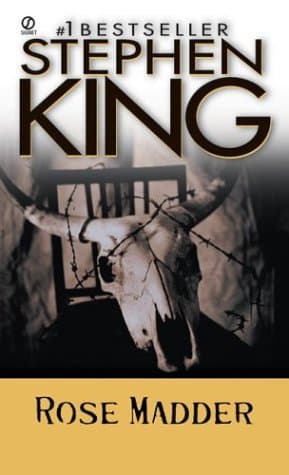
Synopsis
Covers the whole plot, including the ending.
- Difficulty
- Medium
- Pacing
- Variable
- Mood
- Suspenseful, Dark, Empowering, Mystical
- Read it if
- You enjoy psychological thrillers with a supernatural twist, stories of female empowerment and escape from abuse, and Stephen King's signature blend of horror and fantasy.
- Skip it if
- You are sensitive to graphic depictions of domestic violence and psychological abuse, or prefer purely realistic thrillers without fantasy elements.
Rose Madder Plot Summary
Covers the whole plot, including the ending.
The Awakening and Escape
Rosie Daniels has endured fourteen years of physical and psychological abuse from her husband, Norman Daniels, a police detective. One morning, a single drop of blood from Norman's nose lands on her hand. This triggers a sudden, terrifying realization that he will eventually kill her, just as he once beat their unborn child to death. Seizing an opportunity while Norman is asleep, Rosie impulsively packs a small bag, takes Norman's credit card, and flees their home in Junction City, without a clear destination. She travels by bus, making several transfers to obscure her trail, finally arriving in an unfamiliar city, which she later learns is called 'The City.' She checks into a women's shelter under the assumed name 'Rose Smith' to begin a new, anonymous life, haunted by the constant fear of Norman finding her.
A New Life and a Mysterious Painting
In the City, Rosie gets a job as a receptionist at a hotel and finds a small apartment. She begins to build a semblance of normalcy, making a friend named Anna Stevenson at work and starting to regain some independence. One day, while exploring an antique shop, she is drawn to a painting titled 'Rose Madder.' The painting depicts a woman in a rose madder colored toga, standing in a clearing, with a labyrinth in the background and a one-eyed, snarling bull-like creature in the foreground. Rosie feels an intense, magnetic pull towards it, despite its unsettling elements. She uses Norman's credit card for a final, desperate time to purchase the painting, knowing it's a risky move that could expose her location.
The Painting's Secret and a Budding Romance
Rosie discovers that the painting is more than just art; it is a portal to another world. Initially, she can only hear sounds from within it, but eventually, she can step through, finding herself in the very landscape depicted. She meets the woman from the painting, who calls herself Rose Madder, and learns of a quest involving a labyrinth and a sleeping lion. Meanwhile, in her real life, Rosie meets Bill Steiner, a kind and gentle man who owns a pawn shop. They develop a romantic relationship, and Bill becomes a source of comfort and stability, helping Rosie to heal from her past trauma and build confidence. She keeps the painting's true nature a secret from him, fearing he wouldn't believe her or might think she's insane.
Norman's Relentless Pursuit
Back in Junction City, Norman is enraged by Rosie's disappearance and her use of his credit card. His abusive tendencies escalate, and he becomes obsessed with finding her. Using his police contacts, investigative skills, and brutal determination, he meticulously tracks her credit card activity, following a trail of breadcrumbs across the country. He tortures and kills a prostitute who resembles Rosie, believing he is getting closer to his wife. His pursuit becomes a homicidal rampage, fueled by a twisted sense of betrayal and ownership, and he leaves a trail of violence and intimidation in his wake, moving ever closer to the City where Rosie is hiding.
The Oracle and the Labyrinth
Rosie re-enters the painting world, where Rose Madder reveals more about her purpose. Rose Madder is a goddess figure, and her world is a manifestation of Rosie's own repressed anger and strength. Rosie is tasked with a quest: to retrieve a jewel from the sleeping lion in the labyrinth and deliver it to the goddess's temple. This jewel is needed for Rose Madder's full awakening and for Rosie's own empowerment. Rosie navigates the dangerous, surreal landscape, encountering the one-eyed bull-like creature, called the 'Minotaur,' which represents her husband Norman's predatory nature and the trauma he inflicted upon her. The journey is physically and emotionally taxing, pushing Rosie to confront her deepest fears.
Confrontation with the Minotaur
Within the painting, Rosie enters the labyrinth and confronts the Minotaur, a symbolic representation of Norman and his abuse. She uses her wits and a specific phrase given to her by Rose Madder to temporarily subdue the creature, allowing her to reach the sleeping lion. She successfully retrieves the jewel from the lion's paw, completing the first part of her quest. This act of courage and defiance within the painting world empowers Rosie in her real life, strengthening her resolve and helping her to shed some of her victim mentality. The experience changes her, preparing her for the inevitable confrontation with Norman in the real world.
Norman Arrives
Norman finally tracks Rosie to her apartment building. He murders her friend Anna Stevenson, who tries to protect Rosie, and then breaks into Rosie's apartment. He finds Rosie there with Bill Steiner, who is horrified by Norman's appearance and violent demeanor. Norman, filled with a murderous rage, attacks Bill, severely beating him. Rosie, no longer the terrified victim she once was, is forced to confront Norman directly. She realizes that her experiences in the painting have given her a new inner strength, and she must protect Bill and herself from Norman's final, deadly assault. The apartment becomes a battleground for survival.
The Painting's Intervention
In a desperate act, Rosie leads Norman into the painting world. She has the jewel and the knowledge of the painting's true power. Norman, dismissing the painting as a trick, follows her through the portal, his rage blinding him to the danger. Once inside, he is confronted by the Minotaur, which is now fully awake and enraged, a direct manifestation of his own monstrous nature. Rosie, having fulfilled her part of the quest, witnesses as the Minotaur tears Norman apart, ending his reign of terror. Rosie emerges from the painting, leaving Norman's fate sealed within its magical confines, and returns to Bill, who is severely injured but alive.
Aftermath and New Beginnings
After Norman's death in the painting, Rosie takes Bill to the hospital, where he slowly recovers from his injuries. Rosie, now truly free from Norman's abuse, begins to build a new life with Bill. However, the painting's influence isn't entirely gone. The Minotaur, or at least its essence, seems to have followed her, manifesting in subtle ways – a feeling of being watched, a sense of residual darkness. Rosie understands that while Norman is gone, the trauma he inflicted will always be a part of her, but she now has the strength to face it. She sells the painting to a pawn shop owner, hoping to put it behind her.
The Painting's Return and Rosie's Resolution
Years later, Rosie is happily married to Bill and has a daughter, Caroline. She receives a package containing the Rose Madder painting. It seems the painting, or the force within it, has returned to her. Rosie realizes that the painting is not merely an escape but a symbol of her journey, her resilience, and the strength she found within herself. She understands that she can never fully escape her past, but she can integrate it into her present. She accepts the painting, not as a threat, but as a reminder of her power and survival, choosing to keep it in her home, no longer as a portal, but as a symbol of her transformation.
Principal Figures
Rose Daniels (Rosie Smith)
Protagonist
A woman who escapes her abusive husband and finds inner strength.
Rosie is a woman who has endured fourteen years of horrific abuse from her husband, Norman. Initially timid, fearful, and suffering from Stockholm Syndrome, she undergoes a profound transformation throughout the novel. Her decision to flee is a desperate act of self-preservation, but her journey into the painting and her confrontation with Norman forge her into a resilient and empowered individual. She is driven by a deep-seated desire for freedom and safety, which eventually evolves into a desire for justice and peace. Her love for Bill and her future daughter motivates her to fight for a new life.
Relationships: Norman Daniels (Abused wife of Norman); Bill Steiner (Romantic partner and later husband); Anna Stevenson (Friend and colleague at the hotel); Rose Madder (Mystical counterpart and guide within the painting)
Norman Daniels
Antagonist
Rosie's psychopathic and abusive husband, a police detective.
Norman is a police detective with a severe personality disorder, likely narcissistic personality disorder and sociopathy. He is a master manipulator, charming to outsiders but a brutal, sadistic monster behind closed doors. He derives pleasure from tormenting Rosie, both physically and psychologically. His abuse stems from a deep-seated misogyny and a need for absolute control. After Rosie leaves, his anger escalates into a homicidal rage, and he uses his police skills to meticulously track her, leaving a trail of violence and murder in his wake. He represents pure, unadulterated evil.
Relationships: Rose Daniels (Abuser of Rosie, his wife); Anna Stevenson (Victim of Norman's violence)
Bill Steiner
Supporting
Rosie's kind and supportive second husband.
Bill is a gentle and understanding man who owns a pawn shop. He meets Rosie in the City and becomes her romantic partner. He offers Rosie the stability, kindness, and respect she never received from Norman. Bill is patient and accepting, providing a safe space for Rosie to heal and grow. He is initially unaware of the true extent of Rosie's past or the supernatural elements of the painting, but his love for her is unwavering. He stands by her even when confronted by Norman's violence, proving his loyalty and strength.
Relationships: Rose Daniels (Romantic partner and later husband)
Rose Madder
Supporting/Supernatural
The goddess figure within the painting, representing Rosie's inner strength.
Rose Madder is the woman depicted in the painting, a powerful goddess figure who inhabits a parallel world. She is a manifestation of Rosie's repressed anger, strength, and desire for justice. She guides Rosie through the painting's world, entrusting her with a quest to retrieve a jewel and offering cryptic advice. Her world is symbolic, reflecting Rosie's inner turmoil and her journey toward self-empowerment. She embodies a fierce, ancient feminine power that helps Rosie confront and ultimately defeat Norman.
Relationships: Rose Daniels (Mystical guide and alter-ego)
Anna Stevenson
Supporting
Rosie's friend and colleague at the hotel.
Anna is Rosie's first friend in the City, a kind and supportive colleague at the hotel where Rosie works. She represents the normalcy and friendship Rosie longed for after years of isolation. Anna helps Rosie adjust to her new life, offering advice and companionship. Her tragic death at the hands of Norman is a pivotal moment, highlighting the extreme danger Rosie is in and fueling Rosie's resolve to protect herself and others from Norman's violence. Her sacrifice underscores the brutal reality of Norman's pursuit.
Relationships: Rose Daniels (Friend and colleague)
Gert Kinshaw
Supporting
Manager of the women's shelter.
Gert is the no-nonsense but compassionate manager of the women's shelter where Rosie initially stays. She provides Rosie with practical advice and a safe haven, helping her navigate the first steps of her new life. Gert represents the network of support available to abuse victims, offering a lifeline in a time of extreme vulnerability. She is pragmatic and experienced, understanding the complexities and dangers faced by women like Rosie.
Relationships: Rose Daniels (Shelter manager, offering support)
Rob Lefferts
Supporting
Norman's corrupt police colleague.
Rob Lefferts is Norman's former police partner and a corrupt individual who helps Norman in his initial search for Rosie. He exemplifies the toxic masculinity and complicity that can exist within institutions, enabling Norman's behavior. While he doesn't fully understand the depth of Norman's depravity, he aids him out of a sense of misguided loyalty and shared corruption, demonstrating the ease with which Norman can exploit others for his own nefarious purposes.
Relationships: Norman Daniels (Corrupt police colleague)
The Minotaur
Symbolic Antagonist
The bull-headed creature in the painting, symbolizing Norman's abusive nature.
The Minotaur is the one-eyed, bull-headed creature within the Rose Madder painting. It is a direct symbolic representation of Norman Daniels's predatory, violent, and monstrous nature. It guards the labyrinth and terrorizes the painting's world, much as Norman terrorized Rosie's life. Rosie's confrontation with the Minotaur is a metaphorical battle against her abuser and the trauma he inflicted. Its ultimate destruction of Norman within the painting signifies Rosie's final triumph over his psychological hold.
Relationships: Norman Daniels (Symbolic representation of Norman); Rose Daniels (Antagonist within the painting)
Themes & Insights
Abuse and Survival
The central theme involves Rosie's escape from and survival of long-term domestic abuse from her husband, Norman. The novel portrays the physical, psychological, and emotional toll of abuse, but also the resilience of the human spirit. Rosie's journey from victim to survivor, her struggle to reclaim her identity, and her eventual triumph over her abuser are at the core of the narrative. Specific scenes, like the initial escape or Norman's murder of Anna, show the constant threat and the courage required to break free.
“A single drop of blood, no bigger than a punctuation mark, had fallen onto the sheet. And suddenly Rosie knew.”
Empowerment and Self-Discovery
Rosie's journey is one of empowerment and self-discovery. Her interactions within the painting world, particularly with Rose Madder, guide her toward recognizing and embracing her own inner strength. The quest to retrieve the jewel and confront the Minotaur are metaphors for Rosie confronting her own fears and reclaiming her agency. She sheds the identity of 'Norman's wife' and discovers her own voice and power, learning to fight back not just physically, but emotionally and spiritually. This transformation is needed for her to build a new life.
“And she was not Rosie Daniels, the terrified woman who had run away from home fourteen years ago. She was Rose, and she was strong. She was in her own house now.”
The Nature of Evil
The novel explores the chilling nature of evil through the character of Norman Daniels. He is not merely abusive but a psychopathic entity, without empathy, whose malevolence extends beyond Rosie to anyone who crosses his path. King explores how such evil can exist within seemingly normal societal structures (Norman is a police detective) and the insidious ways it can manipulate and destroy lives. The Minotaur in the painting is a symbolic representation of this primal, monstrous evil, showing how Norman's inner darkness manifests.
“He was a man who hated women, and he loved to hurt them. He loved it more than anything else in the world.”
Fantasy vs. Reality
A significant theme is the blurred line between fantasy and reality, particularly through the magical painting. The painting is not merely an escape but a parallel reality that directly impacts Rosie's real life. It provides her with the spiritual tools and courage needed to confront her real-world abuser. This interplay suggests that inner psychological battles can manifest in symbolic, fantastical ways, and that engaging with these inner landscapes can lead to tangible changes in one's external life. The painting is a bridge, where Rosie's inner strength is forged.
“It was just a painting, but it was also a door. And sometimes, a door was a very dangerous thing.”
Memory and Trauma
Rosie's past trauma, particularly the loss of her unborn child due to Norman's violence, constantly haunts her. The novel explores how memory shapes her present fears and actions, and how she gradually processes and overcomes these deeply ingrained psychological wounds. Her journey involves not just escaping Norman, but escaping the mental prison his abuse created. The painting acts as a therapeutic space where she can confront these memories and the pain they represent, allowing her to eventually integrate her past without being defined by it.
“The memory was a bruise, always there, always throbbing, sometimes fading, but never quite gone.”
Plot Devices & Literary Techniques
The Rose Madder Painting
A magical portal to a parallel world that facilitates Rosie's psychological and physical transformation.
The Rose Madder painting is the central magical realism device in the novel. It functions as both a literal portal to a fantastical world and a metaphorical representation of Rosie's subconscious mind and her journey toward self-empowerment. It provides a space where Rosie can confront her trauma and find the strength to face Norman in the real world. The painting's world is a symbolic landscape where Rosie's internal struggles and repressed emotions are externalized, allowing her to interact with them and gain agency. It is the catalyst for her profound transformation and the ultimate instrument of Norman's demise.
The Minotaur
A symbolic beast representing Norman's monstrous, abusive nature.
The Minotaur, the one-eyed, bull-like creature within the painting, is a powerful symbol of Norman Daniels's malevolence and the primal, predatory nature of his abuse. It embodies Rosie's deep-seated fear and the trauma he inflicted upon her. Rosie's confrontations with the Minotaur in the painting are metaphorical battles against her abuser, and its ultimate role in Norman's destruction signifies Rosie's final triumph over his psychological and physical hold. It transforms from a symbol of fear into an instrument of justice.
Assumed Identity (Rose Smith)
A practical and symbolic device for Rosie's escape and new beginning.
Rosie's decision to adopt the name 'Rose Smith' is a crucial plot device that underscores her desperate need for anonymity and a fresh start. Practically, it allows her to hide from Norman. Symbolically, it represents her shedding her old, abused identity as 'Rosie Daniels' and attempting to forge a new, independent self. The journey from 'Rosie Daniels' to 'Rose Smith' and eventually to a fully empowered 'Rose' (or 'Rose Madder') highlights her transformation and the reclamation of her true self, free from Norman's ownership.
The Labyrinth
A symbolic maze within the painting representing Rosie's journey through trauma and self-discovery.
The labyrinth within the Rose Madder painting is a classic literary symbol. It represents Rosie's complex and often terrifying psychological journey through her trauma, fears, and the challenges of self-discovery. Navigating the labyrinth to reach the sleeping lion and retrieve the jewel symbolizes her internal struggle to confront her past, overcome obstacles, and find her inner strength. It's a place of danger and confusion, mirroring the mental state of an abuse survivor, but also a path to eventual clarity and empowerment.
The Drop of Blood
A small detail that acts as a powerful catalyst for Rosie's escape.
The single drop of Norman's blood that falls on Rosie's hand is a seemingly minor detail that serves as a profound catalyst for the entire plot. It's the 'last straw' that shatters Rosie's denial and triggers her realization that Norman will eventually kill her. This small, visceral detail breaks her long-standing Stockholm Syndrome, forcing her to recognize the immediate danger and make the life-altering decision to flee. It represents the point of no return for Rosie, initiating her journey of escape and transformation.
Rose Madder Quotes
“There are no monsters, only people.”
“The past is a wheel. It turns and turns and never stops turning.”
“Sometimes you have to go back to go forward.”
“Love doesn't just sit there, like a stone, it has to be made, like bread; remade all the time, made new.”
“He understood that fear was a tool, and he used it to keep her small.”
“The world was full of magic, but you had to know where to look.”
“Some doors, once opened, can never be closed.”
“She had survived, and that was the first victory.”
“The dead don't stay dead in some places.”
“There are things worse than death, Rose. Things that can steal your soul.”
“He was a disease, a cancer, and she had to cut him out.”
“The painting was a mirror, reflecting not just what was, but what could be.”
“Sometimes the only way out is through.”
“The truth had a way of coming out, no matter how deeply buried.”
Quiz
10 questions on the plot and the characters. Each answer comes with a short explanation.
Question 1
What is the immediate catalyst that makes Rosie realize her husband, Norman, intends to kill her?
- She overhears him making a threatening phone call.
- He physically assaults her more violently than usual.
- A single drop of her own blood lands on his face while he sleeps.
- She finds a hidden weapon in his possession.
Show answer
C. A single drop of her own blood lands on his face while he sleeps. Rosie is roused by a single drop of her own blood, which, upon landing on Norman's face as he sleeps, brings her to the chilling realization that he will eventually kill her, prompting her escape.
Question 2
What item belonging to Norman does Rosie take with her when she flees?
- His service revolver
- His badge
- His credit card
- A large sum of cash he kept hidden
Show answer
C. His credit card When Rosie makes her escape, she takes Norman's credit card, which becomes a crucial tool for her initial survival in a new city.
Question 3
What is the name of the painting Rosie finds in a junk shop?
- The Crimson Lady
- Rose Madder
- The Woman in Red
- Sleeping Beauty
Show answer
B. Rose Madder Rosie finds an odd junk shop painting titled 'Rose Madder,' which plays a central role in the novel's supernatural elements and Rosie's journey.
Question 4
What kind of profession does Norman have, which aids him in tracking Rosie?
- Private Investigator
- FBI Agent
- Corrupt Cop
- Hitman
Show answer
C. Corrupt Cop Norman is described as a 'corrupt cop with a dog's instinct for tracking people,' making him a formidable and dangerous pursuer.
Question 5
Who is Bill Steiner to Rosie in her new life?
- Her landlord
- A coworker she befriends
- A new romantic interest
- The owner of the junk shop
Show answer
C. A new romantic interest In her new life, Rosie meets Bill Steiner, who becomes a romantic interest and a source of support, representing a chance at a healthier relationship.
Question 6
What is the primary theme explored through Rosie's escape and subsequent journey?
- The pursuit of wealth and luxury
- The struggle for independence and survival against abuse
- The search for artistic inspiration
- The complexities of police work
Show answer
B. The struggle for independence and survival against abuse Rosie's entire journey, from her terrifying realization to her escape and attempt to build a new life, centers on her struggle for independence and survival from her abusive husband.
Question 7
How does the painting 'Rose Madder' appear to interact with Rosie?
- It provides her with clues to solve a mystery.
- It serves as a portal to another world or dimension.
- It changes its image to reflect her emotions.
- It allows her to communicate with deceased relatives.
Show answer
B. It serves as a portal to another world or dimension. The painting 'Rose Madder' is not just a piece of art; it 'strangely seems to want her' and functions as a gateway to a mystical, parallel world, a common element in King's fantasy thrillers.
Question 8
What makes Norman's pursuit of Rosie particularly terrifying and effective?
- He hires a team of professional bounty hunters.
- His supernatural abilities allow him to locate her instantly.
- His corrupt police background and obsessive, 'dog's instinct' for tracking.
- He uses advanced satellite tracking technology.
Show answer
C. His corrupt police background and obsessive, 'dog's instinct' for tracking. Norman's effectiveness as a tracker stems from his experience as a corrupt cop, granting him knowledge of methods and resources, combined with an almost animalistic, obsessive 'dog's instinct' that fuels his rage-driven hunt.
Question 9
What is the significance of the title 'Rose Madder' beyond being the name of the painting?
- It's a type of rose that grows only in the town Rosie flees to.
- It refers to a specific shade of red pigment used in art, symbolizing passion and danger.
- It's a code name Rosie uses for her new identity.
- It's the name of a character within the painting itself.
Show answer
B. It refers to a specific shade of red pigment used in art, symbolizing passion and danger. 'Rose Madder' is a real red pigment used by artists. This connects to the painting in the story and subtly hints at themes of passion, danger, and the transformative power of art, especially given the 'rose-maddened' state of Norman.
Question 10
How does Rosie's connection to the 'Rose Madder' painting ultimately serve her in confronting Norman?
- The painting provides her with a hidden weapon.
- It gives her the courage to call the police on him.
- It allows her to lure him into its alternate world for a final confrontation.
- The painting magically makes Norman forget about her.
Show answer
C. It allows her to lure him into its alternate world for a final confrontation. The mystical 'Rose Madder' painting ultimately provides Rosie with a unique means of defense and confrontation, allowing her to draw Norman into its alternate reality where he faces consequences beyond the mundane world.
Rose Madder FAQ
What is Rose Madder about?
Rose Madder tells the story of Rosie Daniels, a woman who flees her abusive husband, Norman, after 14 years of marriage. She builds a new life in a different city, finding love and a mysterious painting that serves as a portal to a mythical world, while Norman, a psychopathic police detective, relentlessly hunts her down.
Why should I read Rose Madder?
You should read Rose Madder for its powerful exploration of domestic abuse survival, the strength of a woman reclaiming her life, and its unique blend of psychological thriller with dark fantasy elements. It offers a cathartic journey as Rosie confronts her past and empowers herself through a fantastical escape.
What is the background/setting of Rose Madder?
The story begins in a small town where Rosie endures years of abuse from her husband, Norman, a corrupt and violent police detective. Rosie then flees to an unnamed city, likely based on King's native Maine, where she attempts to build a new life, finding refuge in a women's shelter and later an apartment, while simultaneously entering the ancient, mythical world depicted in the 'Rose Madder' painting.
What are the most memorable quotes?
While specific quotes aren't provided in the summary, memorable lines often revolve around Rosie's growing self-awareness and defiance, such as her realization that 'he's going to kill her,' or descriptions of Norman's terrifying tracking abilities. King's prose often highlights the internal struggle and the terror of abuse.
What writing style does the author use?
Stephen King employs a dual narrative style, alternating between Rosie's journey of self-discovery and empowerment, and Norman's increasingly deranged and violent pursuit. He uses vivid, often visceral descriptions, blending realistic psychological horror with elements of dark fantasy and myth, characteristic of his unique blend of genres.
What minor details add significant meaning?
The single drop of blood on the sheet that triggers Rosie's escape is a pivotal minor detail, symbolizing the breaking point after years of abuse. Also, the fact that Rosie uses Norman's credit card to escape is significant, as it's a small act of defiance and a practical tool for her newfound freedom, foreshadowing her eventual empowerment.
What are some subtle foreshadowing moments?
Rosie's initial inexplicable attraction to the 'Rose Madder' painting subtly foreshadows its eventual role as a portal and a source of power for her. Norman's 'dog's instinct for tracking people' hints at his relentless and almost supernatural ability to pursue Rosie, setting up the inevitable confrontation.
What unexpected character connections exist?
The most unexpected connection is between Rosie and the mythical figure of Rose Madder within the painting. This ancient, powerful goddess-like entity becomes a guide and a manifestation of Rosie's own repressed strength, allowing her to confront Norman in a fantastical, yet deeply personal, battle.
What are unspoken character motivations?
Norman's unspoken motivation, beyond simple domestic abuse, appears to be a deep-seated need for control and a pathological inability to accept rejection or independence from Rosie. His pursuit is driven by a twisted sense of ownership and a desire to erase any evidence of Rosie's defiance, rather than love.
What psychological complexities do characters exhibit?
Rosie exhibits the complex psychology of a long-term abuse survivor, grappling with fear, learned helplessness, and the slow, arduous process of reclaiming her identity and self-worth. Norman embodies severe psychopathy, characterized by a lack of empathy, manipulative behavior, and escalating violence, often masking his true nature behind a veneer of normalcy.
What are the major emotional turning points?
The major emotional turning point for Rosie is the moment she decides to flee, fueled by the realization that Norman will kill her. Another crucial point is her connection with the 'Rose Madder' painting, which empowers her to confront her trauma and develop the courage to face Norman, both physically and psychologically.
How do relationship dynamics evolve?
Rosie's relationship with Norman devolves from an abusive marriage into a hunter-and-prey dynamic, culminating in a supernatural confrontation. Her relationship with Bill Steiner represents a healthy, supportive partnership, contrasting sharply with her past. Most importantly, her relationship with herself evolves from victim to empowered survivor, largely catalyzed by her interaction with the Rose Madder entity.
Which parts remain ambiguous or open-ended?
The full extent of the 'Rose Madder' world and its connection to other realities or mythologies, beyond its immediate purpose for Rosie, remains somewhat ambiguous. While the immediate threat of Norman is resolved, the long-term implications of Rosie's interaction with the otherworldly painting and her own newfound powers are left open to interpretation.
What are controversial scenes or decisions?
One potentially controversial aspect could be the explicit and prolonged depiction of Norman's brutal violence and Rosie's suffering, which some readers might find disturbing. Another could be the blend of realistic domestic abuse with a fantastical resolution, which might be debated regarding its effectiveness in addressing the serious theme of abuse.
Rose Madder ending explained: how it ends & what it means
The book ends with Rosie using the power of the 'Rose Madder' painting to lure Norman into its mythical world. There, Norman is confronted and ultimately destroyed by the painting's inhabitants, specifically by the monstrous 'tree-man,' representing the ancient, primal justice of the feminine deity. This ending signifies Rosie's ultimate triumph over her abuser, not just in the physical world, but also on a deeply psychological and mythical level, asserting her reclaimed agency and freedom.
About the author

Stephen Edwin King is an American author of horror, supernatural fiction, suspense, crime, science-fiction, and fantasy novels. Described as the "King of Horror", his books have sold more than 350 million copies as of 2006, and many have been adapted into films, television series, miniseries, and comic books. King has published over 65 novels/novellas, including seven under the pen name Richard Bachman, and five non-fiction books. He has also written approximately 200 short stories, most of which have been published in book collections.
Similar books
- Gerald's Game
Stephen King
3.5 (134k) average on GoodreadsThrillerExplores themes of female trauma, escape, and psychological horror with a supernatural edge.
- Big Little Lies
Liane Moriarty
4.3 (748k) average on GoodreadsThrillerFocuses on domestic abuse, female friendships, and a central mystery, though without the fantasy element.
- The Silent Patient
Alex Michaelides
4.1 (507k) average on GoodreadsThrillerFeatures psychological suspense, a strong female protagonist, and a mystery at its core.
- Gone Girl
Gillian Flynn
4.1 (2.3M) average on GoodreadsThrillerWhile both Rose Madder and Gone Girl feature complex portrayals of troubled marriages and a woman's intricate struggle (or revenge), Flynn's novel maintains a psychological thriller framework, eschewing fantasy for a deep dive into human manipulation and dark psychology. Rose Madder's distinctive contribution is its attempt to process the trauma of abuse through a fantastical lens, suggesting a different kind of 'escape' or confrontation.
- Angels & Demons
Dan Brown
3.9 (2.7M) average on GoodreadsThrillerA Harvard symbologist races through Rome's ancient sites, deciphering cryptic clues to unmask the Illuminati and stop a vengeful plot to destroy the Vatican with a stolen antimatter weapon.
- The Girl on the Train
Paula Hawkins
3.9 (2.1M) average on GoodreadsThrillerA woman’s fascination with a seemingly perfect couple she watches from her daily train commute leads her into a dark investigation when she witnesses something that shatters their idyllic image.





Enjoyed the summary?
A summary gives you the shape of the book. The book itself has the detail, the examples and the voice.
Find Rose Madder on AmazonAs an Amazon Associate, BookBrief earns from qualifying purchases. How we're funded