
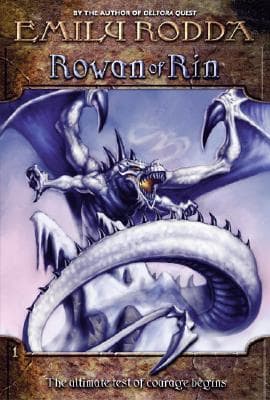
Synopsis
Covers the whole plot, including the ending.
- Difficulty
- Easy
- Pacing
- Moderate
- Mood
- Adventurous, Hopeful, Courageous, Whimsical
- Read it if
- You enjoy classic quest narratives, stories about unlikely heroes, and a blend of adventure and problem-solving, perfect for younger readers transitioning to chapter books.
- Skip it if
- You prefer complex magic systems, morally gray characters, or stories with a fast-paced, action-heavy plot.
Rowan of Rin Plot Summary
Covers the whole plot, including the ending.
The River Dries Up
The peaceful village of Rin, located by a river, wakes to a terrible discovery: the river has stopped flowing. The stream, which provides water for their crops, livestock, and mill, is now a dry, stony bed. Panic spreads among the villagers, as their survival depends on the river. The wise old witch, Sheba, is consulted. Through her cryptic statements and riddles, she says the river's source, the forbidden Mountain, holds the answer. She warns of great danger, saying only the 'bravest heart' can succeed.
The Quest Begins
Led by the strong Jiller, a small group of Rin's most capable adults forms to journey to the Mountain. This group includes Bronden, Val, Lann, Ellis, and Allun. To everyone's surprise, and his own dismay, the timid and physically weak Rowan is chosen by Sheba to go with them, despite his protests. He must carry a map only he can read, a series of riddles and drawings from Sheba, which are important for finding their way through the Mountain's dangers. Reluctantly, Rowan joins the trip.
The Spiders' Web
As the group goes up the Mountain, they face their first obstacle: a large, sticky spiderweb blocking a narrow pass. The web is made of a strange, shimmering material, and they realize it is a trap. Bronden, impatient, tries to cut through it and gets stuck. Rowan, remembering Sheba's first riddle about 'the thing that hides but cannot run,' realizes the web is a warning. He figures out that the solution is to find the 'eye' of the web – a small, almost invisible hole – and slip through it. With his guidance, the group carefully passes, leaving Bronden freed.
The Lake of Fire
Further up the Mountain, the path leads them to a blocked way: a lake of bubbling, molten rock. The heat is strong, and the air shimmers. The group feels hopeless, believing their journey is over. Rowan, however, remembers Sheba's second riddle: 'what burns and bites but has no teeth.' He realizes that the fiery look is an illusion, a trick of the Mountain. He concludes that what they see is not real fire but an optical illusion created by intense heat and certain minerals. With a burst of courage, Rowan steps forward and, to everyone's surprise, walks into the 'fire,' showing it to be only hot ground, not molten rock. The others follow, shaken but safe.
The Pit of Darkness
The next challenge is a deep, dark chasm that seems to go endlessly into the earth, blocking their path. The air is cold and still, and a terrifying silence comes from its depths. Sheba's third riddle comes to Rowan's mind: 'what is always coming, but never arrives.' He understands that the pit is not truly bottomless but an illusion of infinite depth, meant to cause fear and make them give up. He realizes they must overcome their fear and take a leap of faith. Val, usually brave, is frozen by terror. Rowan, despite his own fear, finds a hidden ledge, showing that the pit is not as vast as it appears, allowing them to cross.
The Forest of the Trapped
Beyond the pit, they enter a dense, old forest where the trees seem to whisper and groan. As they go deeper, the group members begin to feel an invisible force pulling at them, holding them in place. One by one, they get stuck, unable to move, as if rooted to the spot. Sheba's fourth riddle, 'what is always broken by a word,' comes to Rowan's mind. He realizes that the forest is a place of silence and despair, and the only way to break the spell is to speak. He tells his trapped companions to shout, to make noise. They hesitate at first but eventually do, and the invisible bonds break, freeing them from the forest's hold.
The Mountain's Peak and the Dragon
Finally, Rowan, now alone after his companions have given in to various illusions and fears, reaches the summit. There, he sees a terrifying sight: a massive, old dragon, its scales like obsidian, lying curled around the river's source, which is dry. The dragon is not breathing fire but looks weak and sick. Sheba's final riddle, 'what has an eye but cannot see,' guides Rowan. He realizes the dragon is blind and has a thorn in its eye, which is causing its pain and, because of that, the river's dryness. The dragon, in its pain, is accidentally blocking the water flow.
Rowan's Act of Courage
Despite his fear of the huge beast, Rowan understands he must help the dragon. He carefully approaches the suffering creature, noticing the large thorn in its eye. Gathering all his courage, he reaches out and, with a quick, firm movement, pulls the thorn from the dragon's eye. The dragon roars in pain, then relief, and turns its head, showing its now clear eye. Immediately, the spring at the mountain's peak gushes water, flowing down the mountain and restoring the river. The dragon, no longer in pain, gently nudges Rowan, a sign of thanks.
The Return and Revelation
As the river begins to flow, Rowan goes down the Mountain. Along the way, he finds his companions, who are now free from the Mountain's illusions and have recovered their senses. They are amazed to see the river flowing and to learn that Rowan, the timid boy, was the one who solved the riddles and saved them all. They realize that their own strengths were not enough against the Mountain's tricks, and that Rowan's intelligence and quiet courage were the true 'bravest heart.' They return to Rin as heroes, with Rowan now recognized for his bravery, and the village saved from disaster.
Rin Restored
The villagers of Rin celebrate as the river returns to its full flow, bringing life back to their dry land. Rowan, once overlooked, is hailed as the hero. Sheba acknowledges his bravery, confirming he had the 'bravest heart' all along. His bravery was not in physical strength or daring, but in his willingness to face his fears, think critically, and show compassion. Rowan, though still quiet, has grown in confidence and self-belief, changed by his journey to the Mountain. Rin thrives again, its future secured by the boy who did not believe he was brave.
Principal Figures
Rowan
Protagonist
A timid, scrawny boy chosen by Sheba to save Rin, despite his own doubts.
Rowan is initially presented as the weakest and most fearful member of the village of Rin. He is small for his age, physically unsuited for manual labor, and prone to anxiety. He believes himself to be a coward and is constantly underestimated by others, including himself. However, he possesses a keen intellect, a strong sense of observation, and a deep well of empathy. His journey up the Mountain forces him to confront his fears, rely on his intelligence to solve riddles, and ultimately discover a profound inner courage he never knew he had. He represents the idea that bravery comes in many forms, not just physical strength.
Relationships: Sheba (mentor/disciple); Jiller (leader of the expedition, initially skeptical but later respectful); Bronden (fellow expedition member, initially dismissive but later admiring)
Sheba
Supporting
The eccentric, wise old witch of Rin who guides the expedition with riddles.
Sheba is an ancient, enigmatic woman who lives on the outskirts of Rin. She is known for her wisdom, her cryptic pronouncements, and her ability to foresee future events through her dreams and visions. Though feared and respected, she is also a pivotal figure in the village, providing guidance when needed. Sheba is the one who insists Rowan join the quest and provides him with the crucial map of riddles, knowing that his unique qualities, not physical strength, are what Rin needs. She acts as a catalyst for Rowan's growth, subtly pushing him towards self-discovery.
Relationships: Rowan (mentor/prophetic guide); Rin Villagers (respected, feared, and consulted elder)
Jiller
Supporting
The strong and respected leader of the Rin expedition to the Mountain.
Jiller is a powerful and capable woman, a natural leader among the people of Rin. She is strong, pragmatic, and initially skeptical of Rowan's inclusion in the dangerous quest. She values physical strength and direct action. Despite her initial doubts about Rowan, she takes her responsibility as leader seriously and tries to protect her group. Her journey up the Mountain forces her to confront the limitations of physical prowess and to recognize the value of different kinds of strength, particularly Rowan's intelligence and quiet courage. She ultimately comes to respect Rowan deeply.
Relationships: Rowan (leader/follower, then respectful equals); Bronden (fellow expedition member, sometimes clashing with her impulsiveness)
Bronden
Supporting
A strong, impulsive woman from Rin, initially dismissive of Rowan.
Bronden is one of Rin's strongest and most formidable women, known for her physical prowess and quick temper. She is proud, impatient, and relies heavily on brute force to solve problems. She openly scoffs at Rowan's presence on the expedition, viewing him as a liability. Throughout the journey, her impulsiveness and reliance on strength often lead her into trouble, requiring Rowan's intervention. Her experiences on the Mountain humble her, as she witnesses Rowan's unique bravery repeatedly save the group. By the end, she develops a profound respect for him.
Relationships: Rowan (initially dismissive, then respectful); Jiller (fellow expedition member, sometimes at odds due to personality differences)
Val
Supporting
A swift and agile member of the expedition, known for his speed.
Val is one of the younger, swifter members of the Rin expedition. He is agile and quick, often scouting ahead. While physically capable, he is susceptible to the Mountain's psychological tricks, particularly fear. He is one of the first to be overwhelmed by the illusion of the bottomless pit, highlighting that even the physically able can be paralyzed by terror. He looks up to Jiller and Bronden, and like them, eventually comes to appreciate Rowan's unique contributions.
Relationships: Rowan (fellow expedition member, later respectful); Jiller (respected leader)
Lann
Supporting
A skilled hunter and tracker from Rin.
Lann is a practical and observant member of the expedition, known for his hunting and tracking skills. He is generally quiet but reliable. He initially shares the group's skepticism about Rowan but is less vocal about it. He is one of the members who falls victim to the Mountain's illusions, showing that even those with keen senses can be deceived. His skills are more suited to the known world of Rin than the magical perils of the Mountain.
Relationships: Rowan (fellow expedition member, eventually respectful); Allun (fellow expedition member)
Ellis
Supporting
A quiet and observant member of the Rin expedition.
Ellis is a quiet and thoughtful member of the expedition, often observing more than speaking. He is not as physically imposing as Bronden or Jiller, but he is steadfast. He is one of the members who gets caught in the 'Forest of the Trapped,' highlighting the psychological toll the Mountain takes on even the most composed individuals. His quiet nature allows him to be more receptive to Rowan's insights than some of the more boisterous members, though he still struggles with the Mountain's illusions.
Relationships: Rowan (fellow expedition member); Jiller (leader)
Allun
Supporting
A reliable and steadfast member of the Rin expedition.
Allun is a dependable and steady member of the expedition. He is not particularly outspoken but contributes his strength and resolve. He is one of the villagers who initially doubts Rowan's ability but is willing to follow Jiller's lead. He experiences the same illusions and fears as the others on the Mountain, which reinforces the universal nature of the challenges they face and the unique quality of Rowan's ability to overcome them. He represents the everyday, hardworking people of Rin.
Relationships: Rowan (fellow expedition member); Lann (fellow expedition member)
The Dragon
Antagonist/Supporting
The ancient, blind guardian of the Mountain's peak and the river's source.
The Dragon is initially presented as the fearsome antagonist, the ultimate obstacle at the Mountain's peak. It is a massive, ancient creature, whose distress is inadvertently causing the river to dry up. However, its true nature is revealed to be one of suffering and blindness due to a deeply lodged thorn. It is not malicious but in pain. Rowan's act of compassion in removing the thorn transforms the dragon from a perceived foe into a grateful, benevolent guardian, ensuring the river's flow and subtly acknowledging Rowan's bravery.
Relationships: Rowan (adversary, then recipient of help)
Themes & Insights
Courage and Self-Belief
The main theme is about courage and Rowan learning he has it. At first, courage means physical strength and daring, like Bronden and Jiller. But the Mountain's challenges show that true bravery is facing fears, using intellect, and showing compassion. Rowan, who thinks he is a coward, repeatedly shows a different, deep kind of courage by solving riddles, stepping into illusions, and helping the dragon. His journey teaches him that bravery is not being fearless, but acting even when afraid.
“Bravest heart will carry on when sleep is death, and hope is gone.”
The Nature of Strength
The book looks at different kinds of strength. The villagers of Rin first value physical strength, skill, and leadership, shown by the expedition members. However, these traditional strengths do not work against the Mountain's magical illusions and psychological traps. Rowan's intellectual strength, his ability to decipher riddles, notice details, and think critically, saves the day. The story shows that true strength is many-sided, including intelligence, empathy, and mental toughness, which can be more powerful than brute force.
“You have the map, Rowan. You must read it.”
Illusion vs. Reality
The Mountain uses illusion, always tricking the expedition with false appearances. The spiderweb, the lake of fire, the bottomless pit, and the silent forest are all designed to trick the senses and cause fear or despair. Rowan's ability to see through these illusions, guided by Sheba's riddles, is key to their progress. This theme shows that things are not always as they seem, and that critical thinking and questioning what you see are important for life's challenges. It also suggests that fear itself can be an illusion, often stronger than the actual danger.
“What burns and bites but has no teeth?”
Community and Interdependence
The drying river crisis forces the community of Rin to work together for survival, showing they depend on each other. While the expedition has individuals, their success depends on each member, especially Rowan. The story shows how different skills and personalities, when combined, can overcome problems. Even though Rowan ends up alone at the peak, his journey is helped by the group's initial support, and his success benefits everyone. The book shows that a community succeeds when it recognizes and values the unique contributions of all its members, even those who seem least capable.
“We must go, or Rin will die.”
Plot Devices & Literary Techniques
Sheba's Riddles
A series of cryptic clues that guide Rowan through the Mountain's perils.
Sheba's riddles are the primary plot device driving Rowan's journey. Each riddle corresponds to a specific obstacle on the Mountain (the spiderweb, the lake of fire, the bottomless pit, the silent forest, and the dragon). They function not just as navigational aids but also as tests of Rowan's intelligence, observation skills, and courage. By deciphering them, Rowan not only solves the immediate problem but also gains deeper insight into the nature of the Mountain's illusions and his own capabilities, ultimately proving his 'bravest heart'.
The Mountain
A living, sentient antagonist that tests the characters' physical and mental limits.
The Mountain itself acts as a powerful, almost sentient antagonist. It is not just a geographical location but a magical entity that actively creates illusions and psychological traps to deter intruders. It challenges the characters' perceptions, preys on their fears, and exposes their weaknesses. The Mountain forces the expedition to confront not only external dangers but also their internal struggles, making it a symbolic representation of life's daunting challenges and the journey of self-discovery.
The Drying River
The inciting incident and symbol of the village's life force.
The drying river serves as the inciting incident that propels the plot forward, creating an urgent crisis for the village of Rin. It is more than just a water source; it symbolizes the very life and survival of the community. Its cessation represents a threat to their entire way of life, emphasizing the high stakes of the expedition. The river's eventual restoration signifies the triumph of courage and intelligence, and the renewal of hope and prosperity for Rin.
Rowan's Map
A physical object holding the key to the Mountain's secrets.
Rowan's map, given to him by Sheba, is not a conventional map with geographical features. Instead, it contains Sheba's cryptic riddles and strange drawings. It is a symbolic representation of Rowan's unique ability to interpret and understand things beyond the obvious. The fact that only Rowan can 'read' it underscores his special role and his intellectual gifts, highlighting that the solution to their problems lies not in brute force but in wisdom and insight.
Rowan of Rin Quotes
“The mountain is a living thing. It has a heart, and a will, and a memory.”
“Fear is a poison. It can kill you as surely as any venom.”
“Strength is not always in the arm that wields the sword.”
“The stream is the lifeblood of Rin. Without it, we are nothing.”
“Sometimes the smallest can see what the largest cannot.”
“We go because we must. There is no other choice for Rin.”
“The bukshah are gentle, but they remember. They remember everything.”
“In the heart of the mountain, truth waits.”
“Courage is not the absence of fear, but the will to go on in spite of it.”
“The map is not the land. It is only a guide.”
“Every step upward is a step away from what we know.”
“Trust the bukshah. They know the way when we do not.”
“The silence of the mountain is louder than any storm.”
“We are all afraid. But together, we are less afraid.”
Quiz
10 questions on the plot and the characters. Each answer comes with a short explanation.
Question 1
What is the main reason Rowan initially joins the journey to the Mountain?
- He wants to prove his bravery to the villagers
- He is chosen by the village leader for his strength
- He is the only one who can read the magical map
- He volunteers to replace his sick father
Show answer
C. He is the only one who can read the magical map Rowan is included in the journey because he is the only person in Rin who can read the ancient map that guides them to the Mountain's source, despite his perceived lack of bravery.
Question 2
What causes the river in Rin to run dry, prompting the journey?
- A drought caused by a spell from the Mountain
- A blockage at the river's source in the Mountain
- Pollution from a neighboring village
- The dragon stealing the water for its lair
Show answer
B. A blockage at the river's source in the Mountain The river stops flowing because something is blocking its source high in the Mountain, threatening Rin's survival and forcing the villagers to investigate.
Question 3
Which of these is NOT one of Rowan's companions on the journey?
- Strong Jonn
- Val the Wise
- Sheba the Seeker
- Allun the Baker
Show answer
C. Sheba the Seeker Sheba the Seeker is not a companion; the group includes Strong Jonn, Val the Wise, Allun the Baker, Marlie, and others, but Sheba is not mentioned in the book's main journey party.
Question 4
What is the significance of the phrase 'sleep is death' during the journey?
- It warns that resting on the Mountain will cause instant death
- It refers to the dragon's hibernation cycle
- It describes the villagers' fear of nightmares
- It is a riddle about the river's flow stopping at night
Show answer
A. It warns that resting on the Mountain will cause instant death The phrase is part of the prophecy guiding the journey, indicating that falling asleep on the Mountain is deadly, which the group discovers through perilous encounters.
Question 5
How does Rowan's perception of bravery change by the end of the book?
- He realizes bravery means physical strength above all
- He learns that bravery is about facing fears and persevering
- He decides bravery is unnecessary if you have cleverness
- He believes only magical creatures can be truly brave
Show answer
B. He learns that bravery is about facing fears and persevering Initially doubting himself, Rowan discovers through the journey that bravery involves overcoming inner fears and continuing despite challenges, not just physical courage.
Question 6
What role does the magical map play in the journey?
- It shows hidden treasures in the Mountain
- It provides clues and warnings about the Mountain's dangers
- It teleports the group to the river's source
- It protects them from the dragon's fire
Show answer
B. It provides clues and warnings about the Mountain's dangers The map, which only Rowan can read, contains cryptic verses that guide the companions through the Mountain's tricks and hazards, such as the 'sleep is death' warning.
Question 7
Which challenge on the Mountain directly tests the companions' ability to resist sleep?
- A field of enchanted flowers that induce drowsiness
- A cave with a sleeping dragon they must sneak past
- A river they must cross without stopping to rest
- A maze that causes confusion and fatigue
Show answer
A. A field of enchanted flowers that induce drowsiness The companions encounter a field of flowers whose scent makes them irresistibly sleepy, forcing them to fight the urge to rest to avoid the deadly consequence warned by the map.
Question 8
What is revealed about the dragon at the Mountain's peak?
- It is a mechanical creature built by ancient villagers
- It is actually a guardian protecting the river's source
- It is an illusion created by the Mountain's magic
- It is a friendly beast that helps Rowan find water
Show answer
B. It is actually a guardian protecting the river's source The dragon is not a malevolent monster but a guardian that ensures the river flows; understanding this helps Rowan resolve the crisis without violence.
Question 9
How does Rowan ultimately solve the problem of the blocked river?
- He fights and slays the dragon to clear the blockage
- He uses a magical spell from the map to unblock it
- He communicates with the dragon to understand and remove the blockage
- He convinces the other villagers to dig a new channel
Show answer
C. He communicates with the dragon to understand and remove the blockage Rowan realizes the dragon is a guardian and, using empathy and courage, interacts with it to discover and fix the blockage, showcasing his growth and the theme of non-violent resolution.
Question 10
What does the prophecy 'Bravest heart will carry on when sleep is death, and hope is gone' primarily symbolize in the story?
- The need for physical endurance in harsh environments
- The importance of hope in overcoming despair
- The idea that true bravery emerges in hopeless situations
- A warning against traveling at night in the Mountain
Show answer
C. The idea that true bravery emerges in hopeless situations The prophecy underscores the book's theme that courage is most tested and revealed when all seems lost, as Rowan demonstrates by persevering despite fear and adversity to save Rin.
Rowan of Rin FAQ
What is 'Rowan of Rin' about?
'Rowan of Rin' follows Rowan, a timid boy who believes he lacks courage, as he joins a perilous quest to save his village. When the river that sustains Rin mysteriously dries up, Rowan and six companions must journey to the forbidden Mountain's source, facing deadly challenges and a dragon at the peak. The story explores themes of bravery, self-discovery, and overcoming fear through Rowan's transformation from a doubter to a hero.
Why should I read 'Rowan of Rin'?
This book is a compelling fantasy adventure that emphasizes inner strength over physical prowess, making it inspiring for young readers. With its fast-paced plot, riddles, and character-driven challenges, it teaches valuable lessons about courage, teamwork, and believing in oneself. Emily Rodda's engaging storytelling and the relatable protagonist Rowan make it a timeless tale for children and young adults.
What is the background/setting of 'Rowan of Rin'?
The story is set in the isolated village of Rin, which relies entirely on a river flowing from the forbidden Mountain for survival. Rin is a tight-knit, traditional community where strength and bravery are highly valued, contrasting with Rowan's perceived weakness. The Mountain itself is a mystical, treacherous environment filled with magical traps, illusions, and the legendary dragon, creating a vivid fantasy backdrop for the quest.
What are the most memorable quotes?
Key quotes include the prophecy 'The bravest heart will carry on when sleep is death, and hope is gone,' which drives the quest's tension. Rowan's realization 'I am not brave, but I can be careful' highlights his unique approach to challenges. Another impactful line is 'The heart sees what the eyes cannot,' underscoring the theme that true courage comes from within, not outward appearances.
What writing style does the author use?
Emily Rodda employs a clear, accessible prose style with vivid descriptions of the Mountain's dangers and Rin's setting. The narrative is fast-paced, blending adventure with psychological depth through Rowan's internal monologues. Rodda uses riddles and symbolic challenges to advance the plot, making it engaging for young readers while exploring themes of fear and bravery in a straightforward yet impactful manner.
What minor details add significant meaning?
Minor details like Rowan's role as a keeper of the bukshah (gentle herd animals) symbolize his nurturing, observant nature, which proves crucial on the quest. The carved symbols on the companions' staffs, which change to reflect their fears, subtly foreshadow each character's challenges. Additionally, the quiet moments where Rowan notices small clues others miss highlight how his perceived weaknesses are actually strengths.
What are some subtle foreshadowing moments?
Early foreshadowing includes Rowan's initial fear of the Mountain and his careful nature, which later helps him solve riddles and avoid traps. The prophecy's mention of 'the bravest heart' hints that bravery isn't about physical strength, aligning with Rowan's eventual role. When characters dismiss Rowan as weak, it subtly sets up his unexpected contributions, such as deciphering the Mountain's illusions through patience and insight.
What unexpected character connections exist?
Unexpected connections include Rowan's relationship with Strong Jonn, who initially seems like a traditional hero but relies on Rowan's cleverness in crises. The dragon, revealed to be a guardian rather than a mere monster, connects to Rin's history and the river's magic, showing that the village's survival depends on understanding rather than conquering the Mountain. These ties emphasize interdependence over individual prowess.
What are unspoken character motivations?
Rowan's unspoken motivation is a deep desire to prove his worth to himself and his village, driven by insecurity rather than arrogance. Strong Jonn is motivated by a need to uphold his reputation as the strongest, masking his own fears. Sheba, the wise woman, is secretly guided by a belief in Rowan's hidden potential, pushing him to grow despite his doubts, reflecting her faith in inner strength over outward bravery.
What psychological complexities do characters exhibit?
Rowan exhibits complexity through his internal conflict between self-doubt and latent courage, shown in his cautious yet determined actions. Strong Jonn struggles with the pressure of being seen as the bravest, leading to moments of vulnerability when faced with the Mountain's psychological traps. The companions collectively reveal how fear manifests differently—through aggression, silence, or denial—adding depth to their interactions and growth.
What are the major emotional turning points?
Major emotional turning points include Rowan's decision to join the quest despite his fear, marking his first step toward bravery. When he solves the riddle of the sleepers, saving his companions, it boosts his confidence and earns their respect. The climax at the dragon's peak, where Rowan uses empathy rather than force, is a profound moment of self-acceptance, transforming his view of courage from physical might to heartfelt action.
How do relationship dynamics evolve?
Relationship dynamics evolve from initial skepticism toward Rowan to mutual reliance, as his unique skills repeatedly save the group. Strong Jonn shifts from dismissing Rowan to valuing his insights, symbolizing a blend of strength and wisdom. The group's unity strengthens through shared trials, moving from individual pride to collective trust, ultimately reflecting that success depends on diverse strengths rather than a single hero's bravery.
Which parts remain ambiguous or open-ended?
Ambiguities include the exact nature of the Mountain's magic and the dragon's origins, left mystical to emphasize wonder over explanation. The prophecy's full meaning—whether 'the bravest heart' refers solely to Rowan or encompasses the group's collective courage—is open to interpretation. Additionally, the future of Rin after the river's restoration is not detailed, allowing readers to imagine how the village and Rowan's role might evolve.
What are controversial scenes or decisions?
Controversial decisions include the villagers' initial choice to send only seven companions, risking their lives on a deadly quest, which some might see as reckless. Rowan's non-violent approach to the dragon, opting for understanding over combat, could be debated as naive versus enlightened. Some readers may question the exclusion of other villagers from the journey, highlighting themes of sacrifice and trust in a select few.
'Rowan of Rin' ending explained: how it ends & what it means
The ending sees Rowan successfully restoring the river by communicating with the dragon, revealing it as a guardian rather than a foe, and the group returns to Rin as heroes. This conclusion means that true bravery involves empathy, intelligence, and self-belief, not just physical strength. It underscores the message that everyone has a 'bravest heart' within, and saving Rin required Rowan's unique qualities, transforming his and the village's understanding of courage.
About the author

Emily Rodda is an Australian author known for her contributions to children's and young adult literature. She is best recognized for her fantasy series, including "Deltora Quest" and "Rowan of Rin," as well as standalone works like "The Key to Rondo" and "The Golden Door." Her storytelling often features imaginative worlds and adventurous plots.
Similar books
- The Hobbit, or There and Back Again
J.R.R. Tolkien
4.3 (2.9M) average on GoodreadsFantasyFeatures an unassuming hero on a perilous quest, facing various obstacles and a dragon.
- A Wrinkle in Time
Madeleine L'Engle
4.0 (1.1M) average on GoodreadsFantasyA young protagonist overcomes personal insecurities to embark on a fantastical journey to save others.
- The Wee Free Men
Terry Pratchett
4.3 (94k) average on GoodreadsFantasyA young, unexpected hero facing mythical creatures and proving bravery in unconventional ways.
- Redwall
Brian Jacques
4.1 (105k) average on GoodreadsFantasyWhile both feature quest narratives with animal protagonists, Redwall emphasizes external bravery, collective action, and overt conflict, whereas Rowan of Rin focuses more on internal, psychological courage and individual growth in the face of fear.
- Harry Potter and the Sorcerer's Stone
J.K. Rowling
4.5 (7M) average on GoodreadsFantasyRescued from a miserable life under the stairs, an orphaned boy discovers he's a wizard destined for a magical school, where he uncovers a dangerous secret tied to the dark wizard who murdered his parents.
- The Hunger Games
Suzanne Collins
4.3 (6.4M) average on GoodreadsFantasyIn a future where children fight to the death on live television, Katniss Everdeen volunteers for the arena, turning a death sentence into a fight for survival and a spark of rebellion.




Enjoyed the summary?
A summary gives you the shape of the book. The book itself has the detail, the examples and the voice.
Find Rowan of Rin on AmazonAs an Amazon Associate, BookBrief earns from qualifying purchases. How we're funded