
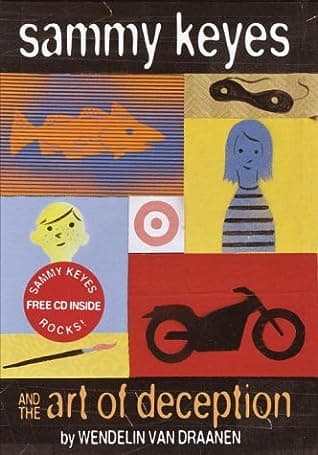
Synopsis
Covers the whole plot, including the ending.
- Difficulty
- Easy
- Pacing
- Fast
- Mood
- Humorous, Suspenseful, Engaging, Clever
- Read it if
- You enjoy spunky, relatable protagonists solving mysteries with humor and heart.
- Skip it if
- You prefer complex, dark thrillers or stories without a clear good vs. evil dynamic.
Sammy Keyes and the Art of Deception Plot Summary
Covers the whole plot, including the ending.
The Art Gallery Reception
Sammy Keyes, with her best friend Marissa, is reluctantly taken to an art gallery reception by her grandmother, Gma Sylvia. Gma Sylvia, a cleaning lady, attends as a guest of her client, Mrs. Gray. Sammy, uncomfortable in her high-tops and disliking the snobby atmosphere, questions the value of a simple orange splot painting priced at $10,000. Her comments draw disapproval from the sophisticated guests, especially the gallery owner, Mr. Belton, and the artist, Antoine Dubois. Despite the awkward start, Sammy notices the social dynamics and the superficiality of the art world.
The Robbery and Sammy's Intervention
During the reception, a masked robber bursts in, holding a gun and demanding the 'Orange Splot' painting. Panic spreads among the guests. Sammy, acting on instinct and her usual disregard for danger, tackles the thief, who drops the painting and flees. Her quick actions prevent the theft and earn her applause from the previously critical art patrons. However, Sammy feels uneasy, noticing the robber seemed more clumsy than threatening, and the incident felt somewhat staged, which sparks her detective instincts.
The Aftermath and Suspicion
After the foiled robbery, Officer Borsch and the police arrive to take statements. Everyone praises Sammy's bravery, but she still feels something is wrong. She observes Mr. Belton, the gallery owner, and Antoine Dubois, the artist, acting suspiciously calm and almost relieved. Sammy notices a faint, familiar scent on the robber's discarded ski mask—a scent she links to her rival, Heather Acosta. This detail, combined with her feeling that the robbery was a setup, leads Sammy to start her own investigation, much to Officer Borsch's annoyance, as he dismisses her ideas.
Investigating Heather and the Orange Splot
Sammy first suspects Heather Acosta, because of the scent on the mask and Heather's past troubles. She follows Heather, trying to connect her to the robbery. At the same time, Sammy becomes fixated on the 'Orange Splot' painting, convinced there is more to it. She researches modern art and Antoine Dubois's techniques, trying to understand why a simple splot could be so valuable and why it was targeted. Her investigation begins to show inconsistencies in the artist's background and the gallery's operations, making her question the art world's honesty.
The Clues in the Gallery
Determined to find the truth, Sammy, with Marissa's hesitant help, sneaks back into the art gallery after hours. They examine the 'Orange Splot' painting, and Sammy, remembering a detail about Dubois's technique, finds a hidden message or symbol within the paint layers. This discovery confirms her suspicion that the painting is not just abstract art but holds a secret. The message, though unclear, points to a larger scheme involving the art and possibly other pieces in the gallery, deepening the mystery and raising the stakes for Sammy.
The Real Con and Forgery
Through her investigation, which includes questioning local art enthusiasts and observing Mr. Belton and Antoine Dubois, Sammy understands the true nature of the crime. She discovers that the 'Orange Splot' and possibly other paintings in the gallery are not genuine artworks but skilled forgeries. The fake robbery was set up to draw attention to the 'Orange Splot,' increasing its perceived value and making it easier to sell to unsuspecting wealthy buyers as part of a money laundering and art fraud scheme. Mr. Belton and Antoine Dubois are the ones behind this deception.
Confronting the Deceivers
With her understanding of the art fraud, Sammy decides to confront Mr. Belton and Antoine Dubois. She uses her observations and knowledge to challenge their stories and expose inconsistencies. She manages to record incriminating conversations or find evidence, like documents or materials related to the forgeries, which clearly link them to the scheme. This confrontation is dangerous, as Belton and Dubois realize Sammy is close to exposing them, but Sammy's quick thinking keeps her one step ahead, even as they try to scare her.
The Second Robbery and Exposure
As Sammy gets closer, Mr. Belton and Antoine Dubois become desperate. They try to stage another 'robbery' or 'accident' to destroy the forged paintings and any remaining evidence. However, Sammy anticipates their move. She alerts Officer Borsch, giving him enough evidence to take her seriously. The police arrive just as Belton and Dubois try to get rid of the forgeries, catching them in the act. The 'Orange Splot' and other fake paintings are recovered, and the extent of their art fraud and money laundering operation is made public.
Resolution and Aftermath
Mr. Belton and Antoine Dubois are arrested, and the art world faces a scandal. Sammy's observations and detective work are finally acknowledged, even by Officer Borsch, who admits her theories were correct. The genuine artist whose work was forged is identified, and steps are taken to recover or compensate for the fraudulent sales. Sammy, though she first disliked art, gains a new, somewhat cynical, appreciation for its complexities and how it can be manipulated. She returns to her normal life, having again shown her talent for solving mysteries, much to Gma Sylvia's pride and Marissa's relief.
New Perspective on Art and Deception
Afterward, Sammy thinks about the experience. She realizes that art, like many things, can be a setting for both beauty and deception. The 'Orange Splot,' once a symbol of pretentious fraud, now represents the hidden meanings and manipulation she uncovered. She learns that value is not always inherent but often created, sometimes dishonestly. This case expands her understanding of human nature, showing her how greed can corrupt even the most refined environments. Sammy, always practical, may not suddenly become an art enthusiast, but she gains a deeper, more critical view of the world, recognizing that deception can take many artful forms.
Sammy Keyes and the Art of Deception Characters
Sammy Keyes
Protagonist
A feisty, observant, and rebellious middle school detective.
Sammy is a thirteen-year-old girl living in a church belfry with her grandmother. She is known for her high-tops, her quick wit, and her uncanny ability to stumble into and solve mysteries. Sammy is fiercely independent, often rebellious against authority, and possesses a strong sense of justice. She is highly observant of details that others miss, and her blunt honesty often gets her into trouble but also serves as a sharp tool for uncovering the truth. Despite her tough exterior, she deeply cares for her friends and grandmother.
Relationships: Gma Sylvia (Granddaughter and caregiver, often at odds but deeply loving); Marissa (Best friend, often reluctant accomplice in Sammy's investigations); Officer Borsch (Skeptical police officer, often annoyed by Sammy but eventually respects her); Heather Acosta (Rival, often a red herring or minor antagonist)
Gma Sylvia
Supporting
Sammy's eccentric and loving grandmother who provides a stable, if unusual, home.
Gma Sylvia is Sammy's primary caregiver, a cleaning lady who lives with Sammy in a church belfry. She is kind-hearted and supportive of Sammy, though often exasperated by her granddaughter's knack for getting into dangerous situations. Gma Sylvia tries to instill proper manners and a sense of responsibility in Sammy, often clashing with Sammy's independent spirit. She represents a grounding force in Sammy's life, providing a sense of home and stability despite their unconventional living arrangement. Her connection to Mrs. Gray is the catalyst for Sammy's involvement in the art world.
Relationships: Sammy Keyes (Grandmother and caregiver); Mrs. Gray (Client and acquaintance)
Marissa
Supporting
Sammy's loyal but often timid best friend.
Marissa is Sammy's best friend, a more cautious and conventional girl who often finds herself reluctantly drawn into Sammy's adventures. She acts as a foil to Sammy's impulsiveness, often expressing concern and trying to rein Sammy in. Despite her fear and apprehension, Marissa is fiercely loyal to Sammy and provides practical assistance or emotional support when needed. She occasionally offers insights that help Sammy, even if she'd rather be anywhere else than solving a mystery.
Relationships: Sammy Keyes (Best friend)
Officer Borsch
Supporting
A police officer who is often skeptical of Sammy's detective work.
Officer Borsch is the local police officer who frequently encounters Sammy during her investigations. He is initially dismissive of her theories and finds her meddling annoying, preferring to rely on conventional police procedures. However, over time, he grudgingly acknowledges Sammy's sharp observational skills and her ability to uncover crucial evidence. He represents the official authority that Sammy often bypasses or challenges, highlighting her independent approach to crime-solving. His character arc involves a slow-burn realization of Sammy's competence.
Relationships: Sammy Keyes (Skeptical authority figure, later a reluctant ally)
Mr. Belton
Antagonist
The sophisticated and deceptive art gallery owner.
Mr. Belton is the smooth-talking, seemingly reputable owner of the art gallery where the initial robbery takes place. He presents himself as a cultured connoisseur of fine art, but beneath his polished exterior lies a cunning and unscrupulous businessman. He is the mastermind behind the art forgery and money laundering scheme, using his gallery as a front. Belton is adept at manipulating appearances and public perception, making him a formidable opponent for Sammy. He is driven by greed and a desire to maintain his luxurious lifestyle.
Relationships: Sammy Keyes (Antagonist, the target of Sammy's investigation); Antoine Dubois (Accomplice in the art fraud)
Antoine Dubois
Antagonist
The 'artist' behind the 'Orange Splot' and a key figure in the forgery scheme.
Antoine Dubois is presented as the avant-garde artist whose 'Orange Splot' painting is the focus of the art reception and the initial robbery. He is arrogant and pretentious, reinforcing the superficiality that Sammy initially despises about the art world. Dubois is, in fact, a skilled forger working in collusion with Mr. Belton. His artistic talent is real, but it is misdirected towards criminal endeavors. He uses his supposed artistic genius to create convincing fakes, playing a crucial role in the money laundering operation.
Relationships: Sammy Keyes (Antagonist); Mr. Belton (Accomplice in the art fraud)
Heather Acosta
Mentioned
Sammy's rival, initially suspected in the robbery.
Heather Acosta is Sammy's long-standing rival, known for her snobbish attitude and occasional troublemaking. While she doesn't play a direct role in the main art fraud, Sammy initially suspects her involvement in the 'robbery' due to a familiar scent on the discarded ski mask. Heather serves as a red herring, diverting Sammy's attention briefly but ultimately proving to be unconnected to the larger, more sophisticated crime. Her presence highlights Sammy's pre-existing rivalries and her tendency to jump to conclusions based on past experiences.
Relationships: Sammy Keyes (Rival)
Mrs. Gray
Supporting
Gma Sylvia's wealthy client and a patron of the arts.
Mrs. Gray is a wealthy socialite and Gma Sylvia's client, whose invitation to the art reception sets the entire plot in motion. She is a patron of the arts, seemingly genuinely interested in the cultural scene, but also somewhat naive to the darker undercurrents within it. She represents the target audience for the fraudulent art, a respectable figure who unknowingly lends credibility to the gallery's operations. Her character highlights the vulnerability of the wealthy elite to sophisticated scams.
Relationships: Gma Sylvia (Employer/client); Sammy Keyes (Acquaintance through Gma Sylvia)
Sammy Keyes and the Art of Deception Themes
Appearance vs. Reality
This theme is key to the mystery, appearing in the deceptive nature of the art world. The 'Orange Splot' painting, first dismissed by Sammy as worthless, is a forgery used in a money laundering scheme. The seemingly reputable gallery owner, Mr. Belton, and the celebrated artist, Antoine Dubois, are criminals. The art reception is a front, designed to give credibility to a fraudulent business. Sammy's journey involves uncovering these layers of pretense to expose the truth beneath the beautiful, curated surfaces, questioning if what is presented as valuable or true actually is.
“Just because something's expensive, doesn't mean it's good.”
The Nature of Value
The novel explores how value is given and seen, especially in art and finance. Sammy first questions the high price of the 'Orange Splot,' showing how subjective artistic valuation often is. The plot then reveals that the painting's perceived value is artificially inflated through fraud, demonstrating how greed can corrupt the idea of worth. The true value, in the end, is not in the painting itself, but in the truth Sammy uncovers and the justice she seeks. The book suggests that real value is often overlooked for superficial or manufactured worth.
“How can a bunch of orange paint be worth ten thousand dollars?”
Deception and Manipulation
Deception drives the plot, from the staged robbery to the art forgery scheme. Mr. Belton and Antoine Dubois are manipulators, using their positions and artistic skills to mislead wealthy patrons and the public. Sammy herself uses deception, sneaking into the gallery and pretending ignorance to get information. The theme examines how people, especially those in power, can use art, status, and perceived authority to manipulate others for personal gain. It highlights the importance of critical thinking and looking past surface impressions to uncover hidden motives.
“Art could be so dangerous.”
Justice and Integrity
Sammy's commitment to justice is a core theme. Despite being dismissed by Officer Borsch and facing intimidation from the criminals, she continues her investigation because she believes in finding the truth and holding wrongdoers accountable. Her integrity contrasts with the dishonesty of the art fraudsters. The theme shows that even a young girl, driven by a strong moral compass, can expose significant corruption and bring about justice, regardless of the perpetrators' social standing. It reinforces the importance of speaking up against injustice.
“I knew it. I just knew something wasn't right.”
Plot Devices & Literary Techniques
Red Herring
A misleading clue or character that distracts the protagonist from the real culprit.
The initial suspicion falling on Heather Acosta due to the scent on the ski mask serves as a red herring. Sammy's long-standing rivalry with Heather and her past troubles make her an obvious, but ultimately incorrect, suspect. This device effectively misdirects both Sammy and the reader, building suspense and allowing the true criminals, Mr. Belton and Antoine Dubois, to operate under less scrutiny for a period. It emphasizes Sammy's need to look beyond her immediate assumptions and dig deeper into the evidence.
Hidden Message/Clue
A subtle detail or message embedded within a seemingly ordinary object.
The hidden message or symbol embedded within the 'Orange Splot' painting itself is a crucial plot device. This detail, which Sammy discovers through careful observation and research into Antoine Dubois's style, transforms the painting from a simple abstract piece into a key piece of evidence. It confirms Sammy's suspicions that the art is not what it seems and provides a tangible link to the larger forgery scheme, allowing her to unravel the complex deception and understand the criminals' methods.
Staged Event
An event deliberately orchestrated to deceive or manipulate.
The initial 'robbery' at the art gallery reception is a prime example of a staged event. It is designed by Mr. Belton and Antoine Dubois not to actually steal the painting, but to draw attention to it, increase its perceived value, and create a narrative that aids their money laundering and forgery scheme. Sammy's intuition that the robbery felt 'fake' is key to her unraveling the larger deception. This device highlights the sophisticated and theatrical nature of the criminals' plot, making the art of deception literal.
Observant Protagonist
The protagonist's keen attention to detail drives the plot and solves the mystery.
Sammy Keyes's defining trait is her exceptional observational skill, which acts as a primary plot device. Her initial questioning of the 'Orange Splot,' her noticing the specific scent on the ski mask, her ability to pick up on the subtle inconsistencies in Belton and Dubois's behavior, and her eventual discovery of the hidden message in the painting are all direct results of her keen eye. Without Sammy's unique ability to notice and connect seemingly minor details, the complex art fraud would have gone undetected, making her observation central to the mystery's resolution.
Sammy Keyes and the Art of Deception Quotes
“The thing about secrets is, they have a way of coming out. Like a stubborn stain on your favorite shirt, you can try to hide it, but eventually, someone's going to notice.”
“Being a detective isn't just about finding clues. It's about seeing what other people miss. It's about putting the pieces together even when they don't seem to fit.”
“Sometimes the biggest lies are hidden in plain sight, disguised as the truth.”
“It's hard to be invisible when you're always asking questions. And even harder when you're wearing bright red sneakers.”
“Adults are weird. They say one thing, mean another, and then get mad when you try to figure out what they really meant.”
“The truth is like a puzzle. Sometimes you have to turn the pieces over a hundred times before you see how they connect.”
“You can't always trust what you see. Especially when someone's trying really hard to make you see something specific.”
“My grandma always says, 'If you're going to stick your nose into other people's business, make sure you've got a good reason.' My reason? Someone's trying to pull a fast one.”
“A good disguise isn't about changing who you are, it's about making people see what they expect to see.”
“It's not enough to just know something. You have to prove it. And proving it, that's the hard part.”
“Sometimes the most ordinary things can hide the most extraordinary secrets.”
“Fear can make people do strange things. And sometimes, it makes them say nothing at all.”
“The world isn't always fair. But that doesn't mean you shouldn't try to make it a little bit fairer.”
“Just because something is complicated doesn't mean it's impossible to figure out. It just means you have to dig deeper.”
Quiz
10 questions on the plot and the characters. Each answer comes with a short explanation.
Question 1
What kind of event is Sammy attending at the beginning of the story where she asks about the '$10,000 orange splot'?
- A school fundraiser
- A fancy reception at an art gallery
- A museum exhibit opening
- A private art auction
Show answer
B. A fancy reception at an art gallery The story begins with Sammy attending a fancy reception at an art gallery, where her outspoken nature is immediately apparent.
Question 2
What does Sammy do that initially makes the art patrons glad she has 'a lot of nerve'?
- She correctly identifies a forgery.
- She tackles a thief during a stickup attempt.
- She critiques the art with surprising insight.
- She exposes a corrupt art dealer.
Show answer
B. She tackles a thief during a stickup attempt. Sammy's 'nerve' is put to good use when she tackles a thief attempting a stickup, turning the patrons' initial disdain into appreciation.
Question 3
What type of footwear does Sammy wear to the fancy art gallery reception?
- Ballet flats
- High heels
- High-tops
- Sandals
Show answer
C. High-tops Sammy's casual choice of high-tops for a fancy reception highlights her unconventional nature and disregard for social norms.
Question 4
According to the description, what is the nature of the 'real crime' Sammy eventually discovers?
- It's a straightforward robbery of a famous painting.
- It's a subtle and 'artful' crime, more complex than a simple stickup.
- It involves a series of minor vandalism acts.
- It's a case of identity theft among the artists.
Show answer
B. It's a subtle and 'artful' crime, more complex than a simple stickup. The description explicitly states that the 'real crime' is 'more subtle, more artful, than anything Sammy's ever seen,' indicating a deeper mystery than the initial stickup.
Question 5
What is one of Sammy Keyes' defining character traits, as suggested by her actions at the gallery and the book's title?
- She is shy and reserved.
- She is overly concerned with fitting in.
- She is bold and has 'a lot of nerve'.
- She is easily intimidated by authority figures.
Show answer
C. She is bold and has 'a lot of nerve'. The text repeatedly mentions Sammy having 'a lot of nerve,' demonstrating her boldness and willingness to question things, even in formal settings.
Question 6
The title 'Sammy Keyes and the Art of Deception' implies a central theme related to:
- The beauty of visual arts.
- The importance of honesty in all situations.
- The misleading appearances and hidden truths, especially within the art world.
- The techniques used to create art.
Show answer
C. The misleading appearances and hidden truths, especially within the art world. The phrase 'Art of Deception' directly points to the theme of misleading appearances and hidden truths, often associated with mystery novels, and in this case, specifically within the art context.
Question 7
What additional content is included with this edition of the book?
- A poster and stickers.
- A free CD with an interview, a reading, and a song.
- An exclusive bonus chapter.
- A link to an online game.
Show answer
B. A free CD with an interview, a reading, and a song. The last paragraph explicitly states, 'This edition also includes a free cd including an interview with Wendelin, a reading from 'Sammy Keyes and the Search for Snake Eyes,' and 'The Sammy Keyes Song.'
Question 8
How does the initial reaction of the art patrons to Sammy change after she stops the thief?
- They remain indifferent to her.
- Their 'eyebrows rise' and 'noses turn up' even more.
- They become grateful for her 'nerve', though the description hints this might not be entirely genuine.
- They immediately offer her a job as security.
Show answer
C. They become grateful for her 'nerve', though the description hints this might not be entirely genuine. Initially, their 'eyebrows rise. Noses turn up.' but after she tackles the thief, 'Now the patrons of the arts are glad she has a lot of nerve. Or are they?' This last question implies a potential shift in their true feelings.
Question 9
The phrase 'She had no idea art could be so dangerous. . .' suggests what about Sammy's prior understanding of art?
- She previously viewed art as inherently evil.
- She likely saw art as merely decorative or perhaps boring, not involving real-world peril.
- She was already an expert in art history and its dangers.
- She believed art was only for the wealthy and privileged.
Show answer
B. She likely saw art as merely decorative or perhaps boring, not involving real-world peril. This line implies a significant revelation for Sammy, suggesting her previous understanding of art did not encompass the potential for danger or complex criminal activity, likely seeing it as a more benign or aesthetic pursuit.
Question 10
What is the primary genre of 'Sammy Keyes and the Art of Deception'?
- Fantasy
- Romance
- Mystery
- Science Fiction
Show answer
C. Mystery The description clearly labels the book as 'Mystery' and details Sammy's involvement in uncovering a 'real crime' and 'deception,' which are hallmarks of the genre.
Sammy Keyes and the Art of Deception FAQ
What is the central mystery Sammy Keyes investigates in 'The Art of Deception'?
Sammy initially thwarts a stick-up attempt at an art gallery reception, but the deeper mystery revolves around a sophisticated art forgery ring. She uncovers that the stick-up was a diversion for a more elaborate scheme involving swapping genuine artwork with fakes, particularly focusing on the expensive 'orange splot' painting.
Who is the primary antagonist Sammy uncovers in this book?
The primary antagonist turns out to be Mrs. Hilgraves, the seemingly respectable owner of the art gallery. She orchestrates the forgery and replacement of valuable paintings, using the 'stick-up' as a smokescreen to facilitate her illicit activities and avoid suspicion.
What role does the 'orange splot' painting play in the plot?
The 'orange splot' painting, initially dismissed by Sammy as overpriced, is central to the forgery scheme. It's one of the key pieces targeted for replacement with a fake, and its perceived value and abstract nature make the deception harder to spot, highlighting the subjective nature of art appraisal.
How does Sammy's grandmother, Gussie, contribute to the story?
Gussie's presence at the fancy art reception initially embarrasses Sammy, but her down-to-earth perspective and occasional quips provide comic relief and a grounding influence. She also indirectly helps Sammy observe details about the gallery patrons and the overall atmosphere, which proves useful in the investigation.
What is the significance of Sammy wearing high-tops to the reception?
Sammy's high-tops symbolize her outsider status and her reluctance to conform to the formal, often pretentious, art world. They highlight her practical, no-nonsense personality, contrasting with the sophisticated facade of the gallery attendees and setting her apart as an observer rather than a participant in the deception.
Are there any clues early in the book that hint at Mrs. Hilgraves' involvement?
Subtle clues include Mrs. Hilgraves' overly calm demeanor during the initial stick-up, her seemingly convenient presence near the targeted paintings, and her quick dismissal of the 'thief' as a lone amateur. Her eagerness to move past the incident without thorough investigation could also be seen as suspicious in retrospect.
How does the 'stick-up' incident serve as a distraction for the real crime?
The stick-up creates chaos and panic, drawing everyone's attention away from the subtle act of swapping paintings. While patrons are focused on the overt threat, the real criminals, under Mrs. Hilgraves' direction, are able to quietly replace genuine artworks with expertly crafted forgeries during the confusion.
Is there a specific detail about the artwork or gallery that helps Sammy piece together the forgery?
Sammy notices a slight discrepancy in the frame or the hanging of a particular painting after the 'stick-up' that wasn't there before. This small detail, combined with her earlier observation of the paintings, leads her to suspect that the art itself has been tampered with, not just the gallery's security.
How does Sammy's impulsiveness both help and hinder her investigation?
Sammy's impulsiveness allows her to quickly tackle the initial 'thief' and question obvious discrepancies, driving the plot forward. However, it can also lead her into dangerous situations or cause her to jump to conclusions, requiring her to re-evaluate her theories and gather more evidence carefully.
What does Sammy's initial reaction to the 'orange splot' reveal about her character?
Her blunt questioning of the 'orange splot's' value showcases Sammy's honesty, lack of pretense, and practical nature. It also highlights her youthful skepticism towards the often-subjective and sometimes inflated world of high art, contrasting with the adults around her who pretend to understand or appreciate it.
How does the theme of 'deception' manifest beyond the art forgery itself?
Deception extends to the social facade of the art world, where people pretend to understand or appreciate art for status, and to Mrs. Hilgraves' double life as a respected gallery owner and a criminal mastermind. It also touches upon the way appearances can be misleading, both in art and in people.
What psychological impact does Sammy's constant exposure to adult crime have on her?
Sammy's repeated encounters with adult crime, like the art forgery, force her to mature quickly and develop a keen sense of observation and skepticism. While it sharpens her detective skills, it also exposes her to the darker side of human nature, potentially making her more wary and less trusting of adults.
Is the book suggesting that art itself can be a form of deception?
The book certainly plays with the idea that the perceived value and meaning of art can be manipulated or based on subjective interpretation, which can be a form of deception. The 'orange splot' exemplifies how something seemingly simple can command a high price, and how easily a fake can pass for real if the audience is willing to believe.
What broader message about integrity or honesty might the book be conveying through Sammy's actions?
Through Sammy's unwavering pursuit of truth, despite social pressures and the sophisticated nature of the crime, the book emphasizes the importance of integrity and honesty. It suggests that questioning what seems 'right' and standing up against deception, even when it's subtle, is crucial for justice.
Could the 'Art of Deception' title refer to more than just the forgery, perhaps the social dynamics of the art world?
Absolutely. The title cleverly points to the literal art forgery, but also to the 'art' of social deception prevalent in the gallery. Patrons engage in a performance of sophistication and appreciation, often valuing art based on price or prestige rather than genuine connection, creating a layer of social pretense.
How does this particular mystery challenge Sammy more than previous cases?
This case challenges Sammy because the crime is far more subtle and intellectual than previous ones, involving sophisticated forgery rather than overt theft. She has to delve into the nuances of art appraisal and human psychology, making it a more complex and 'artful' deception that requires deeper analytical skills.
What is the significance of the inclusion of an interview and reading on the accompanying CD?
The CD adds an immersive element, allowing readers to connect with the author and the 'Sammy Keyes' world beyond the book. The interview provides insight into Wendelin Van Draanen's creative process, while the reading offers a different sensory experience of the story, enhancing the overall engagement with the series.
About the author

Wendelin Van Draanen is an American author known for her works of children's and young adult fiction. Her notable books include "Flipped," "The Running Dream," and several titles in the "Sammy Keyes" series, such as "Sammy Keyes and the Sisters of Mercy" and "Sammy Keyes and the Skeleton Man." Her stories often explore themes of friendship, resilience, and self-discovery.
Similar books
- Chasing Vermeer
Blue Balliett
3.7 (28k) average on GoodreadsChildren'sFeatures young protagonists solving an art-related mystery with a clever, puzzle-like plot.
- From the Mixed-Up Files of Mrs. Basil E. Frankweiler
E.L. Konigsburg
4.2 (189k) average on GoodreadsChildren'sInvolves children uncovering secrets and mysteries within an art museum setting.
- The Westing Game
Ellen Raskin
4.0 (165k) average on GoodreadsChildren's'The Westing Game' is a classic middle-grade mystery known for its intricate puzzle and diverse cast of characters. While both books present a complex web of clues and deception, Raskin's novel is arguably more sophisticated in its plotting and character interconnections, requiring readers to actively piece together a much larger, more convoluted puzzle. Van Draanen's mystery, while engaging, is more linear and focused on Sammy's direct investigation. 'The Westing Game' also explores themes of identity and inheritance more profoundly, while 'Sammy Keyes' focuses on the immediate criminal act and its resolution.
- Harry Potter and the Sorcerer's Stone
J.K. Rowling
4.5 (7M) average on GoodreadsFantasyRescued from a miserable life under the stairs, an orphaned boy discovers he's a wizard destined for a magical school, where he uncovers a dangerous secret tied to the dark wizard who murdered his parents.
- The Hobbit, or There and Back Again
J.R.R. Tolkien
4.3 (2.9M) average on GoodreadsFantasyA comfort-loving hobbit named Bilbo Baggins is whisked away by a mischievous wizard and a band of dwarves on an unexpected journey to reclaim stolen treasure from a fearsome dragon, discovering courage and a magical ring along the way.
- Harry Potter and the Goblet of Fire
J.K. Rowling
4.6 (2.6M) average on GoodreadsFantasyA bewildered Harry Potter, underage and thrust into a deadly Triwizard Tournament, must brave dragons, mermaids, and a resurgent dark magic to survive a year that will forever alter the wizarding world.



Enjoyed the summary?
A summary gives you the shape of the book. The book itself has the detail, the examples and the voice.
Find Sammy Keyes and the Art of Deception on AmazonAs an Amazon Associate, BookBrief earns from qualifying purchases. How we're funded