
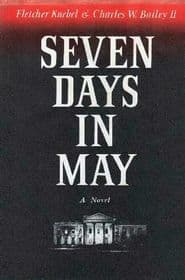
Synopsis
Covers the whole plot, including the ending.
- Difficulty
- Medium
- Pacing
- Moderate
- Mood
- Suspenseful, Tense, Thought-provoking, Serious
- Read it if
- You enjoy classic political thrillers with high stakes, intricate plots, and moral dilemmas, especially if you're fascinated by themes of military power vs. civilian control.
- Skip it if
- You prefer fast-paced action over political maneuvering and detailed procedural investigations, or if you're looking for a story with clear-cut heroes and villains.
Seven Days In May Plot Summary
Covers the whole plot, including the ending.
The Discovery of ECOMCON
On a Sunday morning, Colonel Jiggs Casey, a Marine Corps intelligence officer, is on duty at the Pentagon's Joint Chiefs of Staff 'war room.' He notices an unusual order for ECOMCON, a nationwide military readiness exercise, to be held at a remote airbase in Texas called Site Y. The exercise is led by General James Mattoon Scott, the Chairman of the Joint Chiefs. Casey finds it strange that the exercise is scheduled for a Sunday and involves only specific units, raising his suspicions. He also learns of a heavily guarded, secret training facility in Texas, which further concerns him about the true purpose behind these activities.
Initial Skepticism and Growing Doubt
Casey, troubled by the ECOMCON order and the secrecy around Site Y, discusses his concerns with his friend and colleague, Colonel Henderson. Henderson dismisses Casey's fears, attributing them to overwork. However, Casey's unease persists. He begins to track General Scott's movements and the details of ECOMCON, noting the unusual secrecy and the high-level personnel involved. His growing suspicion that something is wrong, possibly treasonous, begins to weigh on him, forcing him to consider the implications of what he might be uncovering.
Confronting the President
Despite his apprehension, Casey decides he must inform President Jordan Lyman. He secures a private meeting and presents his fragmented evidence and suspicions about General Scott's activities and ECOMCON. President Lyman, weary from political battles and facing low approval ratings, is skeptical. He finds it almost impossible to believe that his own military, particularly the revered General Scott, would plot against the government. Lyman dismisses Casey's concerns, but Casey's earnestness plants a tiny seed of doubt.
The President's Investigation Begins
Haunted by Casey's report, President Lyman cannot shake the feeling that something might be wrong. He decides to start a covert investigation. He enlists his most trusted advisors: Presidential Press Secretary Paul Girard, Senator Raymond Clark, and his old friend, Treasury Secretary Christopher Todd. They are tasked with discreetly gathering information on General Scott, Site Y, and the ECOMCON exercise. Lyman knows that any direct inquiry could alert the conspirators, so secrecy is important as they race against the clock to uncover the truth.
Site Y and the 'Emergency' Broadcast
Paul Girard, disguised, manages to get near Site Y. He observes the intense security and the unusual activities at the base. He overhears a rehearsal of a broadcast that sounds like a proclamation of martial law, declaring an emergency and suspending civil liberties. The broadcast mentions the President's 'incapacity' and the military's 'temporary' takeover. This discovery provides the first concrete evidence that Casey's suspicions are not unfounded, confirming the existence of a plot to seize control of the government under the guise of a national emergency.
The General's Motivation and Public Support
As the investigation progresses, President Lyman begins to understand General Scott's motivations. Scott, a decorated military leader, disapproves of Lyman's recent nuclear disarmament treaty with the Soviet Union, seeing it as a betrayal of national security. Scott has gained public support, using his popularity to undermine the President's authority. Lyman realizes that Scott sees himself as a patriot saving the country from a weak leader, believing that a military takeover is necessary to restore America's strength.
The Attempted Kidnapping of Fred Prentice
Fred Prentice, a former general and a critic of General Scott, is identified as a witness who could expose the plot. As Senator Clark tries to contact Prentice, conspirators try to kidnap him, but Prentice escapes, though injured. This incident provides further proof of the plot's existence and the ruthlessness of its participants. It also shows that the conspirators know they are being investigated and are willing to use extreme measures to silence anyone who might expose them, raising the stakes of Lyman's counter-operation.
The Confrontation with General Scott
With mounting evidence, President Lyman confronts General Scott in a tense, private meeting. Lyman presents the evidence he has gathered, but Scott denies everything, portraying himself as a loyal officer and the President as paranoid. Scott hints at dissatisfaction with Lyman's leadership within the military and among the populace. The confrontation reveals Scott's conviction in his cause and his belief that he is acting for the good of the nation, making it clear that he will not back down.
The Crisis Escalates: Nuclear Threat
As the deadline for ECOMCON approaches, President Lyman's team uncovers the most terrifying aspect of the plot: General Scott intends to seize control of the nation's nuclear arsenal. This revelation elevates the crisis from a coup to a potential global catastrophe, as Scott's control of nuclear weapons could lead to an international incident or even war. Lyman realizes he must act decisively and quickly to prevent Scott from gaining control of these devastating weapons, understanding the danger posed by the general's ideology and power.
The Counter-Move and Exposure
President Lyman, unable to directly arrest Scott without risking civil war, devises a plan. He leaks details of Scott's plot to a trusted journalist, ensuring the story will break just before ECOMCON is set to begin. This public exposure creates a political firestorm, forcing Scott's co-conspirators to choose between loyalty to Scott and their careers. The public outcry and the fracturing of support among the military leadership neutralize the coup, as the plot relies on secrecy and the perception of legitimacy.
The Failure of the Coup
With the plot exposed, General Scott's plan begins to crumble. Key military leaders, realizing the gravity of their involvement and facing public scrutiny, withdraw their support. The ECOMCON exercise is undermined as units fail to comply with orders, and the coordinated takeover falls apart. Scott's inner circle begins to desert him, leaving him isolated and his scheme in ruins. The military coup is averted, not through direct confrontation, but through the strategic exposure of its details.
Aftermath and Reflection
In the aftermath, President Lyman reflects on the 'seven days in May.' While the coup is thwarted, the experience leaves him shaken by how fragile democratic institutions are and the constant vigilance required to protect them. General Scott and his primary co-conspirators are quietly arrested and dealt with, avoiding a public spectacle that could further destabilize the nation. Lyman understands that the threat of extremism, even from within, remains a constant danger, and he emerges from the ordeal with a renewed sense of purpose for the democratic process.
Principal Figures
President Jordan Lyman
Protagonist
The embattled, principled President of the United States.
President Jordan Lyman is a thoughtful, intelligent, and deeply principled man, but also a politically embattled leader. He faces low approval ratings due to his unpopular nuclear disarmament treaty with the Soviet Union. He is initially reluctant to believe in a military coup but, once convinced, acts with quiet determination and cunning to protect democracy. His strength lies in his moral compass and his ability to inspire loyalty in his closest advisors, rather than in overt displays of power. He is a man who trusts in the institutions of government, making the betrayal by his own military all the more devastating.
Relationships: Colonel Jiggs Casey (Reluctant informant and catalyst for the investigation.); General James Mattoon Scott (Ideological and political adversary, leader of the coup.); Paul Girard (Trusted Press Secretary and key investigator.); Senator Raymond Clark (Loyal political ally and investigator.)
General James Mattoon Scott
Antagonist
The charismatic and ambitious Chairman of the Joint Chiefs of Staff.
General James Mattoon Scott is a brilliant, highly decorated, and immensely popular military leader. He is charismatic, intelligent, and deeply patriotic, but also dangerously arrogant and convinced of his own moral superiority. Scott genuinely believes President Lyman's policies are ruining the country and sees himself as a savior, not a traitor. His conviction is absolute, making him a formidable opponent. He commands immense loyalty from his subordinates and has cultivated a significant public following, which he intends to leverage for his coup.
Relationships: President Jordan Lyman (Political and ideological opponent, target of the coup.); Colonel Jiggs Casey (Unwitting discoverer of his plot.); General Barney Rutkowski (Loyal co-conspirator and military commander.)
Colonel Jiggs Casey
Supporting
The Marine Corps intelligence officer who uncovers the plot.
Colonel Martin 'Jiggs' Casey is an astute and conscientious Marine Corps intelligence officer. He is detail-oriented, observant, and possesses a strong sense of duty, which compels him to act on his suspicions, even when they seem unbelievable. Casey is not a political animal; he is a professional soldier who believes in the chain of command and the sanctity of the Constitution. His initial reluctance to believe in a coup, followed by his courage to report it, makes him the unlikely hero who sets the events in motion. He is driven by integrity and loyalty to the nation above any individual.
Relationships: President Jordan Lyman (The President he informs and ultimately helps save.); General James Mattoon Scott (The general whose plot he uncovers.); Colonel Henderson (Friend and initial confidant who dismisses his concerns.)
Paul Girard
Supporting
The President's loyal Press Secretary and key investigator.
Paul Girard is President Lyman's trusted Press Secretary, known for his sharp intellect, discretion, and unwavering loyalty. He is a pragmatic and resourceful individual, skilled in information gathering and public relations. When tasked with investigating the coup, Girard demonstrates courage and ingenuity, undertaking a dangerous undercover mission to Site Y. He is instrumental in gathering the crucial evidence that convinces Lyman of the plot's reality. Girard represents the civilian intelligence arm of the President's counter-operation, highlighting the blend of political and investigative skills needed to combat the military threat.
Relationships: President Jordan Lyman (Loyal subordinate and trusted advisor.); Senator Raymond Clark (Collaborator in the investigation.)
Senator Raymond Clark
Supporting
The President's loyal friend and investigative ally.
Senator Raymond Clark is a seasoned politician, a trusted friend of President Lyman, and a man of integrity. He is pragmatic, cautious, but ultimately fiercely loyal to the President and the Constitution. Clark uses his political connections and experience to discreetly gather information and contact potential witnesses, even facing personal danger. He serves as a crucial link between the White House and the broader political landscape, helping Lyman navigate the delicate balance of exposing the plot without triggering a civil war. His calm demeanor and strategic thinking are vital to the President's efforts.
Relationships: President Jordan Lyman (Close personal friend and political ally.); Paul Girard (Collaborator in the investigation.)
Christopher Todd
Supporting
The Treasury Secretary and an old friend of President Lyman.
Christopher Todd is the Secretary of the Treasury and a long-standing, trusted friend of President Lyman. He is a calm, analytical, and discreet individual. While not directly involved in the physical investigation, Todd provides essential counsel and support to the President, offering a level-headed perspective during a time of extreme stress. His presence underscores the deep bonds of trust Lyman relies upon and the quiet strength of the civilian government in the face of military threat. Todd represents the steadfast, unwavering support that Lyman needs to carry out his difficult task.
Relationships: President Jordan Lyman (Close personal friend and trusted advisor.)
General Barney Rutkowski
Supporting
General Scott's loyal co-conspirator.
General Barney Rutkowski is a high-ranking military officer and one of General Scott's most dedicated co-conspirators. He is a career soldier, loyal to Scott's vision and convinced of the necessity of the coup. Rutkowski is more of a follower than a leader, executing Scott's plans with efficiency and without question. He represents the segment of the military that is willing to subvert civilian authority out of what they perceive as patriotism. His role highlights the hierarchical nature of military loyalty that Scott exploits.
Relationships: General James Mattoon Scott (Loyal subordinate and co-conspirator.)
Fred Prentice
Mentioned
A former general and critic of Scott, targeted by the conspirators.
Fred Prentice is a retired general who had previously expressed public criticism of General Scott. He represents a potential loose end for the conspirators and a valuable witness for President Lyman's investigation. His attempted kidnapping by Scott's men serves as a chilling confirmation of the plot's existence and the lengths the conspirators are willing to go to maintain secrecy. Though he plays a minor role, his survival and the attempt on his life are crucial turning points in the President's understanding of the danger.
Relationships: General James Mattoon Scott (Public critic and target.); Senator Raymond Clark (Contacted by Clark as a potential witness.)
Themes & Insights
The Fragility of Democracy
The novel explores how easily democratic institutions can be undermined, even from within, by those who believe they are acting for the greater good. The plot's existence, led by a popular military hero like General Scott, shows how vulnerable civilian rule is to perceived weakness or disagreement. President Lyman's struggle to counter the coup without open conflict underscores the delicate balance required to preserve democracy. Its strength is not just in laws but in the continued faith and vigilance of its citizens. The constant threat of a military takeover, even in a stable nation, is a warning.
“'Democracy is a very fragile thing, Jiggs. It can be broken, and it can be taken away. And it can be taken away by people who believe they are saving it.'”
Duty vs. Loyalty
A main theme is the conflict between loyalty to an individual or idea and loyalty to the Constitution and government. Colonel Casey shows this when he reports his suspicions about General Scott, despite Scott being a revered figure and Casey's superior. Similarly, the military officers involved in the coup believe their loyalty to General Scott and their vision of national strength is more important than their duty to the elected President. The novel makes characters, and readers, confront where true allegiance should lie when these values conflict.
“'My duty is to the Constitution, sir. Not to any man, not to any general, and not even to any President, if he violates it.'”
The Danger of Charisma and Authoritarianism
General Scott's charisma and popularity are key to his ability to plan the coup. The novel shows how a magnetic leader, especially one seen as strong, can gain widespread support and use public dissatisfaction to undermine democratic processes. Scott's authoritarian tendencies, masked by patriotism, reveal the power of a strongman figure in times of perceived national weakness. The book warns against blindly following charismatic leaders, even those with noble intentions, when they disregard established checks and balances.
“'He commands loyalty, Jiggs. Not just from his officers, but from the public. He's what they want – a strong man.'”
The Power of Information and Secrecy
Information, its control, and its release are central to both the coup and its prevention. General Scott's plot relies on secrecy and manipulating information to create a narrative of presidential incompetence. Conversely, President Lyman's counter-operation depends on covert intelligence gathering and the strategic release of information to expose the plot. The novel highlights how critical intelligence is in a political thriller, showing that knowledge is power, and its use can either destroy or preserve a government. The race against time to uncover and publicize the truth drives the plot.
“'In this game, Jiggs, knowledge is everything. And if they know we know, it changes the game entirely.'”
Plot Devices & Literary Techniques
The Ticking Clock
The seven-day timeframe driving the narrative tension.
The entire narrative is framed by the 'seven days in May' countdown, creating immense suspense and urgency. The deadline for General Scott's ECOMCON exercise, which is the cover for the coup, provides a relentless pressure on President Lyman and his team. Each passing day brings the nation closer to the brink, forcing characters to make quick decisions and take significant risks. This device effectively heightens the stakes and maintains a high level of tension throughout the story, making the reader constantly aware of the impending crisis.
The Unlikely Whistleblower
Colonel Casey, an ordinary officer, stumbles upon and exposes the extraordinary plot.
Colonel Jiggs Casey serves as the classic 'unlikely whistleblower' archetype. He is not a political operative or a high-ranking official with direct access to power, but a diligent Marine intelligence officer who simply notices inconsistencies. His initial skepticism and reluctance to believe in such a grand conspiracy make his eventual decision to report it all the more courageous and believable. This device grounds the extraordinary plot in the perspective of an ordinary, principled individual, making the threat feel more real and relatable.
The Shadowy 'Site Y'
A secret, remote military base as the epicenter of the conspiracy.
Site Y functions as a classic 'shadowy location' device, representing the hidden, illicit activities of the conspirators. Its remote location in Texas, the intense secrecy surrounding it, and the unusual exercises conducted there immediately signal that something sinister is afoot. The mystery of Site Y piques curiosity and provides a concrete, tangible target for President Lyman's investigation. It serves as the physical manifestation of the hidden threat, adding to the thriller's atmosphere and providing a focal point for the early stages of the investigation.
The 'Good Guy' Antagonist
General Scott, a revered national hero, as the leader of the coup.
General James Mattoon Scott embodies the 'good guy' antagonist. He is not a cartoonishly evil villain but a highly respected, charismatic, and genuinely patriotic military leader. His belief that he is saving the country, rather than destroying it, makes him a complex and formidable opponent. This device increases the moral ambiguity and tension of the story, as President Lyman must confront someone who is widely admired, making the decision to expose him incredibly difficult and risky. It highlights that threats to democracy can come from unexpected, seemingly virtuous sources.
Seven Days In May Quotes
“There was no sound in the room now save the low hum of the air conditioner and the steady, rhythmic beat of the President's heart.”
“The price of liberty is eternal vigilance, and sometimes, the price of vigilance is a heavy heart.”
“The military mind, once set on a course, is like a battleship: slow to turn, but irresistible once it gains momentum.”
“It's a strange thing, isn't it? To be afraid of your own army.”
“Patriotism is the last refuge of a scoundrel, but sometimes, it's also the first refuge of a patriot.”
“Power corrupts, and absolute power corrupts absolutely. But what about absolute virtue?”
“Democracy is not a spectator sport, gentlemen. It's a full-contact game.”
“The greatest weapon in a democracy is not a bomb, but a ballot.”
“Sometimes the greatest danger isn't from outside, but from within.”
“History would judge him, he knew. But first, he had to make history.”
“The silence in the room was heavier than any words.”
“The truth, like a persistent virus, always finds a way to surface.”
“He felt like a man walking a tightrope, with the abyss of civil war on one side and the chasm of surrender on the other.”
“A general's duty is to protect his country, not to run it.”
Quiz
10 questions on the plot and the characters. Each answer comes with a short explanation.
Question 1
Which character first stumbles upon the military plot to overthrow the government?
- General James Mattoon Scott
- President Jordan Lyman
- Colonel 'Jiggs' Casey
- Paul Girard
Show answer
C. Colonel 'Jiggs' Casey Colonel 'Jiggs' Casey is the Marine who accidentally discovers the plot led by General Scott.
Question 2
What is the primary motivation of General James Mattoon Scott and his co-conspirators for planning the coup?
- To gain personal wealth and power
- They believe President Lyman is ruining the country and is too soft on communism.
- To prevent an imminent nuclear war
- To establish a military dictatorship for global domination
Show answer
B. They believe President Lyman is ruining the country and is too soft on communism. General Scott and his allies believe President Lyman's policies are weakening the nation, leading them to plan the coup out of a misguided sense of patriotism.
Question 3
How many days does President Lyman have to stop the military coup once he is convinced of its existence?
- Three days
- Five days
- Seven days
- Ten days
Show answer
C. Seven days The title of the book, 'Seven Days in May,' directly refers to the critical timeframe President Lyman has to thwart the plot.
Question 4
What is the name of the secret military base where the coup plotters are organizing their forces and communications?
- Camp David
- Joint Security Agency (JSA) Headquarters
- Site Y
- Fort Bragg
Show answer
C. Site Y Colonel Casey's investigation leads him to discover the secret base known as 'Site Y' where the coup is being orchestrated.
Question 5
Which of the following describes President Jordan Lyman's initial reaction when Colonel Casey first informs him of the potential coup?
- Immediate belief and swift action
- Disbelief and skepticism, considering it an absurd accusation.
- Fear and panic, leading to indecision
- Anger at Casey for wasting his time
Show answer
B. Disbelief and skepticism, considering it an absurd accusation. President Lyman finds it difficult to believe that his trusted military leaders would betray the country, initially dismissing Casey's claims as far-fetched.
Question 6
What key piece of evidence does President Lyman's team use to try and discredit or expose General Scott?
- A confession from one of Scott's co-conspirators
- Evidence of Scott's illicit financial dealings
- A compromising letter from Scott to a foreign ambassador
- A recording of Scott's plans during a clandestine meeting
Show answer
D. A recording of Scott's plans during a clandestine meeting The President's team works to obtain a recording of General Scott's plans, which is crucial in confirming the plot and confronting him.
Question 7
What is the significant political event that precedes and arguably fuels General Scott's discontent with President Lyman's administration?
- A controversial tax reform bill
- A disarmament treaty with the Soviet Union.
- The President's decision to withdraw troops from an overseas conflict
- A scandal involving the President's personal life
Show answer
B. A disarmament treaty with the Soviet Union. General Scott and his supporters are vehemently opposed to President Lyman's recent nuclear disarmament treaty with the Soviets, viewing it as a sign of weakness and a betrayal of national security.
Question 8
Beyond the direct coup, what is General Scott's proposed 'Plan B' for taking control if the direct military takeover fails?
- To incite a public uprising through propaganda and media manipulation.
- To assassinate President Lyman and key cabinet members.
- To appeal directly to the Supreme Court for a change in leadership.
- To flee the country and establish a government-in-exile.
Show answer
A. To incite a public uprising through propaganda and media manipulation. Scott's backup plan involves using the media and public opinion to generate enough opposition to President Lyman to force his resignation, making it appear as a popular movement.
Question 9
What moral dilemma does President Lyman face regarding how to handle General Scott and the conspirators once the plot is confirmed?
- Whether to execute them immediately or offer them clemency.
- Whether to expose the plot publicly, risking civil unrest, or to deal with it covertly, risking future attempts.
- Whether to allow the coup to proceed and then counter-attack, or to preemptively strike.
- Whether to seek international intervention or handle it as a purely domestic affair.
Show answer
B. Whether to expose the plot publicly, risking civil unrest, or to deal with it covertly, risking future attempts. Lyman grapples with the choice of exposing the deep divisions within the military and potentially sparking widespread panic, or trying to neutralize the threat quietly to maintain public trust in the institutions.
Question 10
The novel's story is said to have been influenced by the political activities of which real-life general after he resigned from the military?
- General Douglas MacArthur
- General Curtis LeMay
- General Edwin A. Walker
- General George S. Patton
Show answer
C. General Edwin A. Walker The novel was reportedly influenced by the right-wing anti-Communist political activities of General Edwin A. Walker after his military resignation, as mentioned in the book's description.
Seven Days In May FAQ
What is the core premise of 'Seven Days In May'?
The novel 'Seven Days In May' centers on a secret military plot, led by the charismatic General James M. Scott, to overthrow the democratically elected President Jordan Lyman. The plot is uncovered by accident by Colonel Jiggs Casey, who then races against time to expose the conspiracy before the military can seize control of the U.S. government.
Who are the primary antagonists and protagonists in the story?
The primary antagonist is General James M. Scott, Chairman of the Joint Chiefs of Staff, who orchestrates the coup. The protagonists are President Jordan Lyman, struggling to believe and then counter the plot, and Colonel Martin 'Jiggs' Casey, the Marine officer who discovers the conspiracy and brings it to the President's attention.
What event triggers the discovery of the plot by Colonel Casey?
Colonel Jiggs Casey, a Marine attached to the Joint Chiefs, notices an unusual broadcast from a secret military base, Site Y, which should be inactive. His investigation into this anomaly, specifically the timing and content of the broadcast, leads him to uncover the first clues of General Scott's seditious plan.
What is General Scott's primary motivation for attempting the coup?
General Scott believes President Lyman is weak and indecisive, particularly concerning foreign policy and nuclear disarmament, which Scott sees as jeopardizing national security and American values. He genuinely believes that a military takeover is necessary to 'save' the country from what he perceives as the President's ruinous policies.
How does President Lyman initially react to Casey's accusations?
President Lyman is initially skeptical and disbelieving, finding it almost impossible to fathom that General Scott, a highly respected military figure, would betray his oath. He struggles with the enormity of the accusation, fearing both the truth of the plot and the potential for unfounded panic if Casey is wrong.
What role does the 'truth serum' incident play in confirming the plot?
The 'truth serum' incident involves Colonel Casey's interrogation of Colonel Henderson, a key conspirator. Under the influence, Henderson reveals crucial details about the plot, including the involvement of other high-ranking officers and the timeline of the coup, providing undeniable evidence to President Lyman.
How does the author subtly hint at the broader support for General Scott's ideology?
The author suggests broader support by depicting the widespread public admiration for General Scott and the strong anti-President Lyman sentiment among certain segments of the population. This public discontent, fueled by media and political rhetoric, creates an environment where Scott's actions, though extreme, might find a sympathetic audience.
What is the significance of the character of Senator Prentice in the narrative?
Senator Prentice is a former military colleague of President Lyman and a trusted advisor, who initially helps investigate the conspiracy. His loyalty and support are crucial in providing Lyman with an external, credible voice to validate Casey's claims and to strategize against the military coup.
How does President Lyman attempt to dismantle the conspiracy without resorting to military force?
President Lyman primarily uses political maneuvering and strategic exposure to dismantle the plot. He confronts key conspirators with evidence, isolates General Scott from his allies, and leverages public opinion and the integrity of the democratic process to expose the sedition and restore order without bloodshed.
What psychological pressures does Colonel Casey face throughout the investigation?
Colonel Casey faces immense psychological pressure, including disbelief from superiors, threats to his career, and the constant danger to his life. He struggles with the weight of exposing a national hero and the potential for catastrophic failure, all while maintaining his personal integrity and loyalty to the Constitution.
How does the novel explore the concept of duty versus personal conviction?
The novel explores this through characters like General Scott, who believes his conviction to 'save' the country supersedes his duty to the President, and Colonel Casey, whose duty to the Constitution compels him to act against a revered general. President Lyman grapples with his duty to protect democracy despite personal friendships.
What is the ultimate fate of General Scott at the end of the novel?
General Scott's coup attempt is ultimately foiled, and he is disgraced. While he faces no immediate public trial or execution, his career is destroyed, and he is stripped of his command and influence, effectively ending his public life and any further threat he might pose.
How does the book's ending reflect on the resilience of American democracy?
The book's ending suggests the resilience of American democracy, as the plot is thwarted by the actions of loyal individuals and the system itself. It highlights the importance of checks and balances and the commitment of key figures to constitutional principles, even in the face of extreme internal threats.
What is the significance of the book being published during the Cold War era?
Published in 1962, during the height of the Cold War and the Cuban Missile Crisis, the book tapped into contemporary fears of both external communist threats and internal instability. It explored anxieties about military power, presidential authority, and the potential for extreme measures in the name of national security, making it highly relevant to its time.
How does President Lyman's leadership style evolve during the crisis?
President Lyman's leadership evolves from initial skepticism and a desire for peaceful resolution to a more decisive and proactive stance. He learns to trust his instincts and the loyalty of his team, ultimately demonstrating firm resolve in protecting the presidency and the democratic process, even if it means confronting his own military.
What role do the media and public opinion play in the unfolding events?
The media and public opinion are crucial, as General Scott leverages them to build support for his ideology and undermine President Lyman. Conversely, Lyman must carefully manage public perception to expose the plot without inciting panic or giving Scott's sympathizers an advantage, highlighting the power of information warfare.
Does the novel suggest any long-term consequences for the military-civilian relationship after the plot is exposed?
While the immediate crisis is averted, the novel implies a lasting tension and a heightened awareness of the delicate balance between military authority and civilian control. It suggests that such an event would necessitate a re-evaluation of trust and oversight, reinforcing the need for vigilance in maintaining democratic principles within the armed forces.
How does the novel's depiction of General Scott challenge traditional notions of heroism?
The novel challenges traditional heroism by portraying General Scott as a brilliant, charismatic figure who is also deeply flawed and misguided, believing his anti-democratic actions are for the greater good. It forces readers to question how admirable qualities can be perverted when combined with extreme ideology and a disregard for constitutional order.
Similar books
- The Manchurian Candidate
Richard Condon
4.1 (23k) average on GoodreadsPoliticsExplores political conspiracy and psychological manipulation during the Cold War.
- Executive Orders
Tom Clancy
4.1 (46k) average on GoodreadsPoliticsFeatures a detailed look at presidential decision-making and government operations during a national crisis.
- A Flag for Sunrise
Robert Stone
3.9 (915) average on GoodreadsLiterary FictionRobert Stone's A Flag for Sunrise (1981) also delves into political intrigue and foreign intervention, but from a significantly different perspective. While Seven Days in May centers on a domestic threat to American democracy from its own military, Stone's novel explores American involvement in a fictional Central American revolution, examining the moral ambiguities of intelligence operations, religious zealotry, and political idealism in a foreign land. Knebel's narrative is taut and focused on the immediate crisis of preventing a coup, whereas Stone's is more sprawling, introspective, and concerned with the psychological toll and moral compromises of individuals caught in geopolitical conflicts. Knebel offers a clear good-versus-evil dynamic; Stone presents a world of grayer morality and more fractured motivations, reflecting a post-Vietnam shift in American political fiction.
- 1984
George Orwell
4.2 (3.1M) average on GoodreadsPoliticsIn a future where surveillance and thought control are absolute, a man's search for truth clashes with the Party, showing that hope can be a form of rebellion.
- Animal Farm
George Orwell
4.0 (2.7M) average on GoodreadsPoliticsA farm animals' rebellion against humans turns into a pig-led dictatorship, showing how power corrupts and revolutionary ideals are betrayed.
- Freakonomics: A Rogue Economist Explores the Hidden Side of Everything
Steven D. Levitt
4.0 (709k) average on GoodreadsBusinessThis book uses economic principles to reveal the surprising incentives behind everything from drug dealing and real estate to cheating teachers and the decline of crime.



Enjoyed the summary?
A summary gives you the shape of the book. The book itself has the detail, the examples and the voice.
Find Seven Days In May on AmazonAs an Amazon Associate, BookBrief earns from qualifying purchases. How we're funded