

Estimated read time: 11 min read
One Sentence Summary
A mistaken identity mess leads to comedic chaos in this classic play.
Table of Contents
In need of a concise ‘She Stoops to Conquer’ summary? This classic comedy by Oliver Goldsmith brings to life the chaos of mistaken identity and the quirks of seeking love. The central faux pas of a gentleman confusing a family home for an inn ignites a chain of comical situations and romantic pursuits. Our summary will walk you through the high jinks and central figures of Goldsmith’s play without spoiling the laughter that lies ahead.
Key Takeaways
- Oliver Goldsmith’s ‘She Stoops to Conquer’ is a classic 18th-century comedy that challenged the sentimental comedy of the era, adding depth to the genre with humor, social commentary, and exploration of societal norms and class distinctions.
- The play unfolds over five acts with a plot centered on mistaken identities and social deceptions, resulting in humorous situations that underline the themes of love, marriage, social stratification, and the contrasts between urban and rural living.
- ‘She Stoops to Conquer’ has significantly impacted theater and literature by introducing a new wave of ‘laughing comedy’, with its influence still visible in modern works, despite critiques of the play’s datedness and lack of realism.
Overview of She Stoops to Conquer

Penned by the acclaimed Anglo-Irish author, Oliver Goldsmith wrote “She Stoops to Conquer,” a comedic gem from the late 18th century. The play humorously explores social norms, class differentiations, and the pursuit of love, providing a unique window into the societal dynamics of the time. Goldsmith’s departure from the prevailing sentimental comedy of his era to a style reminiscent of Shakespeare and Renaissance comedy earned the play rave reviews and significant profits, securing its place as the most successful play of the season at Covent Garden theatre.
The plot of “She Stoops to Conquer” centers around:
- The Hardcastle family and their prospective son-in-law, Charles Marlow
- A series of comedic circumstances that ensue after Marlow is misled into thinking that the Hardcastle’s residence is an inn, leading to a multitude of humorous misunderstandings and providing the backbone for the play’s plot
- The predicament of Constance, whose inheritance is controlled by Mrs. Hardcastle until she enters into marriage
- The favored choice for her spouse is Mrs. Hardcastle’s son, Tony Lumpkin
- The unfolding events of the play disrupt this predetermined arrangement.
Plot Breakdown: She Stoops to Conquer
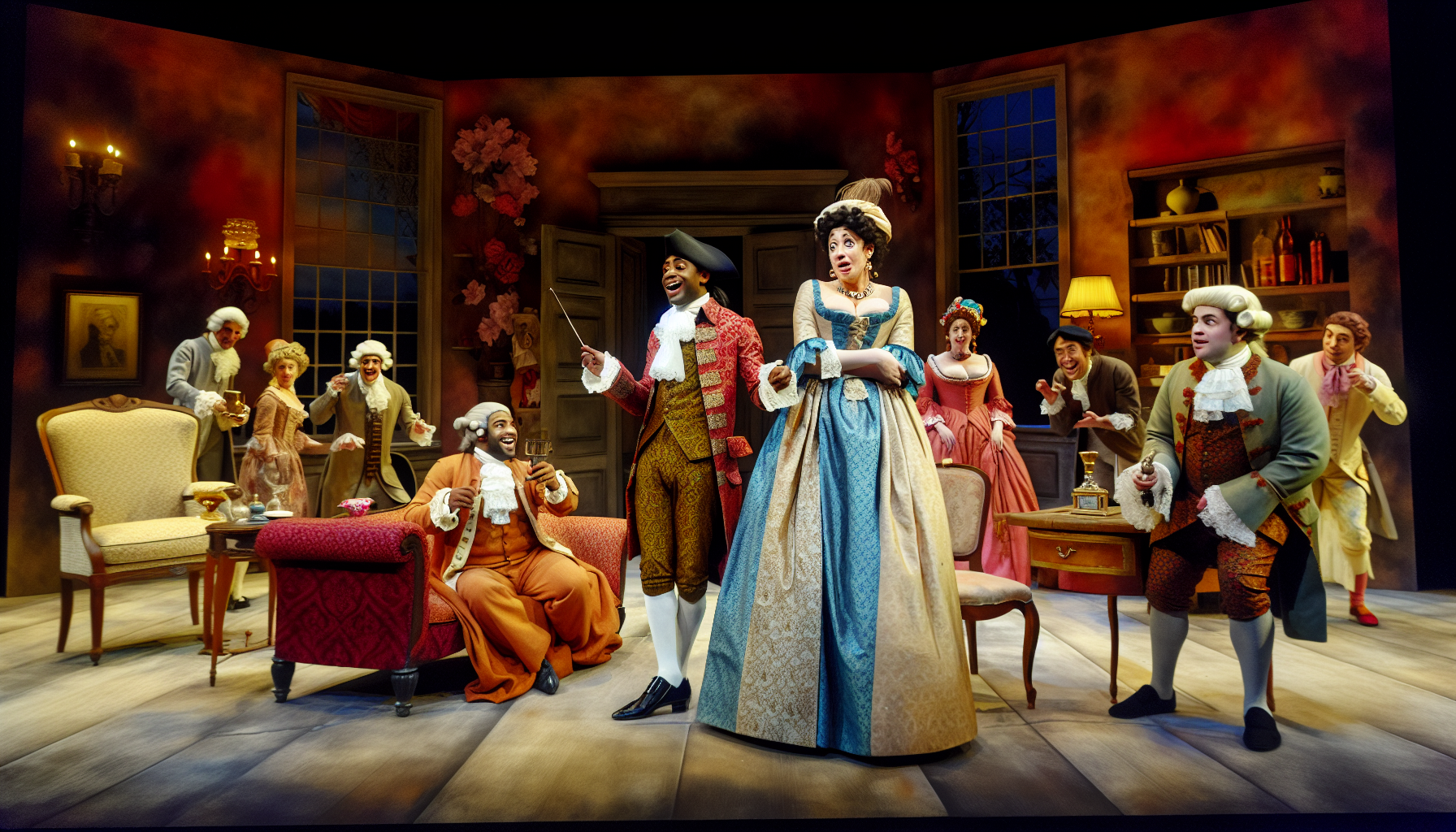
We’ll further explore the intricate world of Goldsmith’s “She Stoops to Conquer.” The play unfolds over five acts, depicting the lives of the Hardcastle family and their endeavors to arrange advantageous marriages. This theme is explored in depth throughout the unfolding narrative. The plot is rife with misunderstandings and deceptions, providing a delightful blend of humor and intrigue that keeps audiences engaged from beginning to end.
Act 1
The opening act lays the groundwork for the unfolding drama. We are introduced to the Hardcastle family, their daughter Kate, and their prospective son-in-law, Marlow. The act also establishes the central conflict of the play, highlighting the contrast between city and country life. This conflict is further emphasized when Marlow and Hastings arrive at Hardcastle’s house, mistaking it for an inn, setting the stage for the comedic circumstances that follow.
The countryside visit by Marlow and Hastings isn’t just a simple shift in location. They arrive at Hardcastle’s house with the intention of seeking marriage partners, thereby connecting their individual quests with the overarching contrast between urban and rural lifestyles. Their mistaken belief that they are at an inn rather than the Hardcastle’s residence sets the stage for a series of humorous misunderstandings.
Act 2
Act 2 sees the plot intensify with mistaken identities contributing to the satire of social disparity. Tony Lumpkin, a character known for his pranks, misleads Marlow and Hastings into believing they are at an inn rather than the Hardcastle’s residence. This simple deception gives rise to a plethora of amusing incidents, including:
- Marlow mistaking Hardcastle for the innkeeper and treating him rudely
- Hastings mistaking Hardcastle’s daughter, Kate, for the barmaid and flirting with her
- Marlow’s awkward and bumbling attempts to woo Kate, thinking she is a servant
These incidents highlight the disparities between the upper and lower classes and add to the comedic elements of the play.
The comedy in the play encompasses:
- Mrs. Hardcastle’s yearning for London fashion
- Diggory’s attempt to suppress his laughter at Hardcastle’s story
- Tony’s deception causing Marlow to appear ill-mannered and boorish
These elements further complicate the relationships in the play.
Act 3
Transitioning into Act 3, the characters strive to manage the confusion stemming from their misapprehensions. Kate adopts a plain dress and assumes the role of a barmaid, engaging with Marlow under the guise of a lower social status. Unbeknownst to him, Kate’s goal is to expose Marlow’s true character.
However, the misconceptions escalate as Hardcastle perceives Marlow’s impoliteness as a reflection of the detrimental impact of the French on young English gentlemen. The act concludes with Hardcastle resolving to expel Marlow from the premises within the hour, complicating the situation for Constance Neville, who wishes to marry Hastings.
Act 4
Act 4 sees the confusion escalating to its zenith. Characters confront one another, and hidden truths begin to unravel. The misunderstandings culminate in the revelation that Marlow’s father is Mr. Hardcastle, adding another layer of complexity to the already intricate narrative.
Despite initially planning to elope in Act 4, Marlow changes his mind and opts not to elope with Kate. Meanwhile, Constance finds herself in a perplexing situation as she appears to be engaged to two men. This act serves as the climax of the play, setting the stage for the resolution in Act 5.
Act 5
Act 5 witnesses the restoration of order with the resolution of numerous conflicts and misunderstandings. Kate and Marlow decide to marry after Hardcastle assures Marlow that they will all laugh at the past events, despite Marlow’s initial denial of any intention to marry Kate.
Tony Lumpkin, too, contributes to the resolution by pretending that a highwayman is present, prompting the return of Mrs. Hardcastle and Constance. His decision not to marry Constance allows her to pursue a relationship with George Hastings, helping to unravel the romantic entanglements of the play.
Major Themes in She Stoops to Conquer
Beyond its comedic surface, “She Stoops to Conquer” explores themes like love and marriage, urban versus rural life, social stratification, and the significance of appearances. The theme of love and marriage holds significance as it explores courtship, challenges in relationships, and the concept of challenging societal conventions for the sake of love.
The contrast between city and country life and the theme of social class are key aspects of the play. The characters’ decisions and perceptions of each other are heavily influenced by their social class.
The theme of the significance of appearances is depicted through the exploration of appearance versus reality, wherein characters’ physical appearances and social positions frequently deceive, resulting in comedic situations.
In-Depth Character Analysis
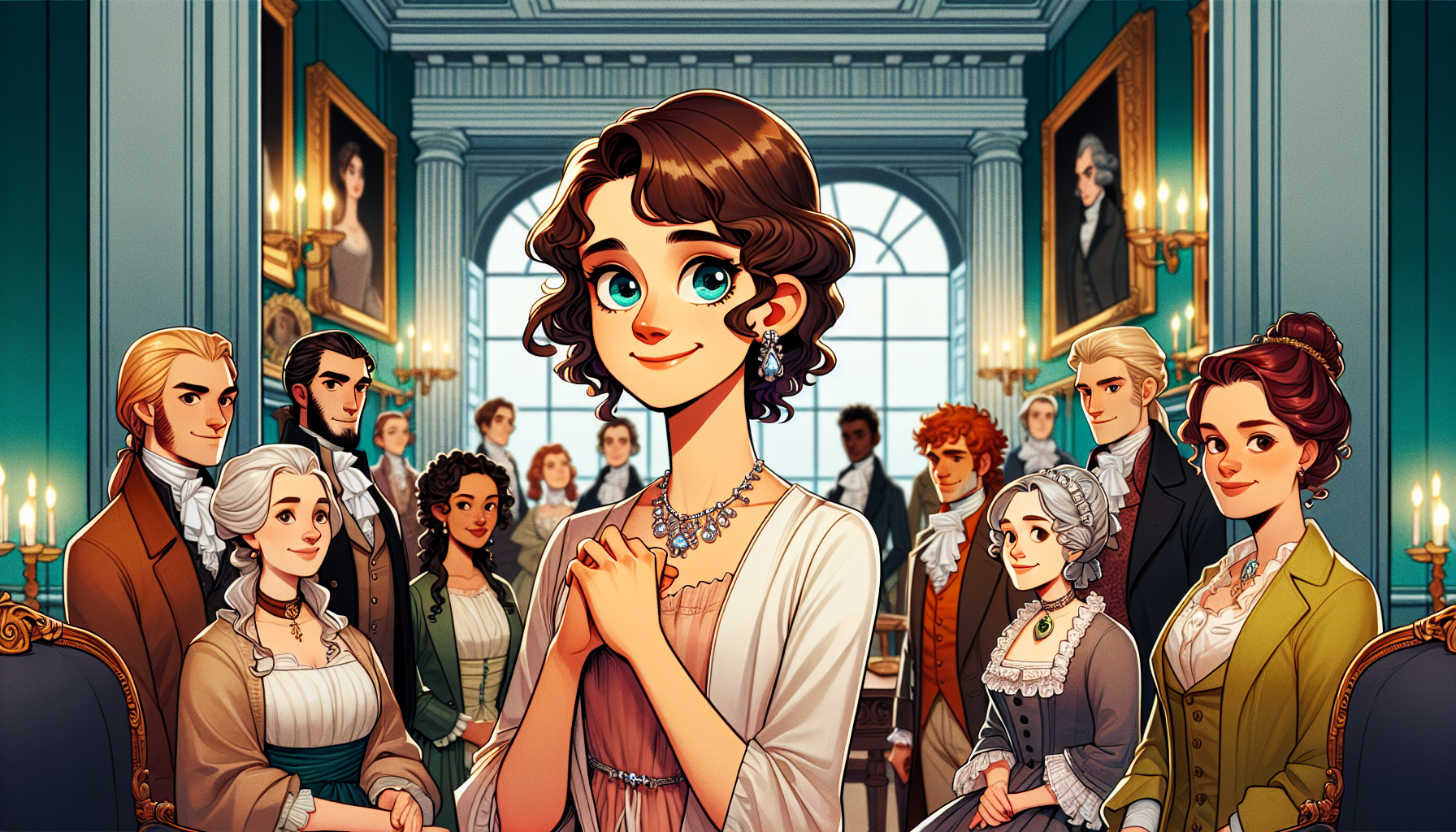
The characters in “She Stoops to Conquer” are complex, each with their unique motivations, strengths, and weaknesses. We’ll further examine the characters of Kate Hardcastle, Charles Marlow, and Tony Lumpkin, to comprehend their roles in the narrative and their contribution to the play’s themes and humor.
Kate Hardcastle
A central character in the play, Miss Kate Hardcastle stands out as:
- the intelligent and amiable daughter of the Hardcastle family
- driven by her aspiration to impress Marlow and gain his affection
- portrayed as intelligent, good-humored, sensible, and appreciative of those around her
Kate’s preferred pastimes include entertaining guests and wearing elegant silk dresses. However, she is not afraid to don a plain dress when trying to win the affection of Marlow, showcasing her resourcefulness and determination.
Charles Marlow
An attractive young man of high social standing, Young Marlow, also known as Sir Charles Marlow, however, displays pronounced nervousness around women of his social standing or higher. His shyness leads to awkwardness and hesitancy in his interactions with potential marriage partners, a trait that is quite surprising for someone like sir charles marlow.
In contrast to his reserved demeanor around women of higher social status, Marlow displays confidence when interacting with lower-class women. His interactions with his social inferiors often lack respect or consideration, highlighting the class distinctions prevalent in society at the time.
Tony Lumpkin
Tony Lumpkin, Mrs. Hardcastle’s son from a previous marriage, stands out as an exceptional character in the play. Known for his love of drinking, horseback riding, and gambling, Tony is a mischievous yet endearing character whose actions ultimately contribute to the play’s favorable conclusion. While some may wonder if anyone would ever marry Tony, his unique personality and charm make him an unforgettable figure in the story.
Tony’s pranks, including his major one where he misleads Marlow and Hastings into believing they are at an inn, add vitality to the narrative and contribute to the progression of the plot. In the realm of Tony plays, his playful essence and cleverness have been replicated by subsequent playwrights, solidifying his place as a beloved character in English literature.
Memorable Quotes from She Stoops to Conquer
The play “She Stoops to Conquer” is rich in memorable quotes that underscore its wit, humor, and thematic exploration. One such quote, “Let school-masters puzzle their brain, With grammar, and nonsense, and learning; Good liquor, I stoutly maintain, Gives genius a better …,” emphasizes the theme of love in the play.
Other quotes provide valuable insights into the characters’ personalities. For instance, Marlow’s quote, “Pardon me madam. I was always willing to be amused. The folly of most people is rather an object of mirth than uneasiness,” highlights his disposition towards others’ folly.
Miss Hardcastle’s comment, “By heaven, she weeps. This is the first mark of tenderness I ever had from a modest woman, and it touches me,” reveals her capacity for tenderness and emotional depth.
Language and Literary Devices in She Stoops to Conquer
The language and literary techniques used in “She Stoops to Conquer” accentuate its themes while amplifying its comedic impact. The play’s use of metaphor and simile, coupled with the characters’ formal and elevated language, contributes to its comedic tone and underscores its themes of societal expectations and class distinctions.
Employing dramatic irony, where the audience knows more than the characters, the play adds layers of comedy and complexity. Further, the juxtaposition of verse and prose in the play amplifies the comedic effect by establishing a humorous differentiation between the upper-class characters, who frequently communicate in verse, and the lower-class characters, who generally use prose.
The Impact and Legacy of She Stoops to Conquer
“She Stoops to Conquer” has made an indelible mark on theater. It reshaped the comedic structure from the conventional sentimental approach to incorporating farcical and satirical elements. Oliver Goldsmith’s play played a pivotal role in ushering in a new form of ‘laughing comedy,’ departing from the previously prevalent sentimental style.
The play’s influence extends beyond the theater. Its incorporation of practical jokes, misunderstandings, and mistaken identities has been imitated by subsequent playwrights. Despite criticisms concerning its lack of realism and outdated comedic conventions, “She Stoops to Conquer” continues to resonate with modern audiences, ensuring its relevance and legacy in English literature.
Summary
Delving into the world of “She Stoops to Conquer,” we’ve explored the depth and complexities of this classic 18th-century comedy. From its engaging plot and memorable characters to its exploration of themes such as love, class, and societal expectations, Oliver Goldsmith’s play continues to captivate audiences with its unique blend of humor, wit, and social commentary. As we leave the world of “She Stoops to Conquer,” we carry with us a deeper appreciation for the enduring power of laughter and the timeless appeal of Goldsmith’s comedic masterpiece.
She Stoops to Conquer FAQ
What is 'She Stoops to Conquer' about?
'She Stoops to Conquer' is a play written by Oliver Goldsmith. It is a comedy that tells the story of a wealthy countryman, Mr. Hardcastle, and his efforts to arrange the marriage of his daughter, Kate, to the son of his old friend, Sir Charles Marlow. The play revolves around mistaken identities, misunderstandings, and humorous situations.
Who wrote 'She Stoops to Conquer'?
Oliver Goldsmith wrote 'She Stoops to Conquer'. He was an Irish playwright and novelist, known for his witty and satirical writing style.
When was 'She Stoops to Conquer' first performed?
'She Stoops to Conquer' was first performed in 1773. It had its premiere at Covent Garden Theatre in London.
Is 'She Stoops to Conquer' a comedy?
Yes, 'She Stoops to Conquer' is a comedy. It is often considered one of the greatest comedies of the 18th century, known for its clever dialogue, farcical situations, and amusing characters.
Are there any film adaptations of 'She Stoops to Conquer'?
Yes, there have been several film adaptations of 'She Stoops to Conquer'. One notable adaptation is the 1914 silent film directed by Sidney Olcott. Additionally, there have been television adaptations and stage productions of the play.
What are some memorable characters from 'She Stoops to Conquer'?
Some memorable characters from 'She Stoops to Conquer' include Mr. Hardcastle, Kate Hardcastle, Tony Lumpkin, Mrs. Hardcastle, and Marlow. Each character brings their own comedic elements to the play.
Is 'She Stoops to Conquer' still performed today?
Yes, 'She Stoops to Conquer' is still performed today. It continues to be a popular choice for theater companies and is often appreciated for its timeless humor and engaging plot.
Does 'She Stoops to Conquer' have any underlying themes?
Yes, 'She Stoops to Conquer' explores themes of class, social conventions, and the nature of true love. It satirizes the divide between urban and rural society, highlighting the absurdity of artificial manners and societal expectations.


