
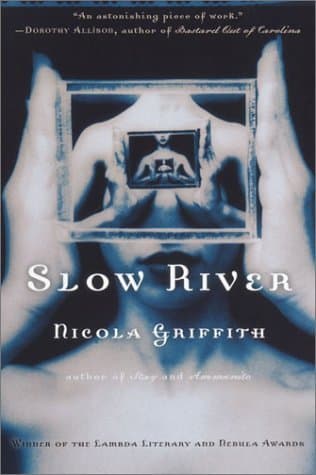
Synopsis
Covers the whole plot, including the ending.
- Difficulty
- Medium
- Pacing
- Variable
- Mood
- Introspective, Gritty, Suspenseful, Thought-provoking
- Read it if
- You enjoy complex, character-driven science fiction with a strong focus on identity, survival, and moral ambiguity, set in a near-future world.
- Skip it if
- You prefer fast-paced action thrillers or clear-cut heroes and villains, or find non-linear narratives frustrating.
Slow River Plot Summary
Covers the whole plot, including the ending.
The Awakening
Lore Van Oesterling wakes up in a filthy alley, disoriented and in pain. She is naked, with a deep gash on her back. Her identity implant, essential for recognition in her society, is gone. Rain washes over her, and she feels a profound sense of loss. Her privileged upbringing has not prepared her for this brutal reality. A scavenger woman, Spanner, finds Lore and, despite initial distrust, takes her to a squalid squat. Spanner, a skilled thief, begins to tend to Lore's wounds, marking Lore's forced entry into a life outside the privileged world she once knew.
Life with Spanner
Under Spanner's guidance, Lore learns the harsh realities of life on the fringes. Spanner teaches her to steal, blend in, create and discard identities, and survive without her past privileges. Lore's initial disgust at these activities slowly turns into acceptance, then competence. She becomes skilled at manipulating systems, crafting fake identities, and navigating the criminal underworld. Their relationship is complex, with dependence, resentment, and a strange intimacy. Spanner provides Lore with a new, dangerous existence, shielding her from authorities and her past, but also trapping her in a cycle of deception.
The Van Oesterling Enigma
Flashbacks to Lore's past life as Lore Van Oesterling, daughter of the powerful Van Oesterling corporation head, Paul Van Oesterling, are interspersed with her present struggles. These memories show immense wealth, advanced technology, and strict social rules. Lore remembers her structured education, her arranged marriage to her cousin, and the suffocating expectations placed on her as an heir. She recalls a life of intellectual pursuits, scientific research, and limited personal freedom. These glimpses into her past highlight the contrast with her current life and begin to reveal why she wants to escape, even if she cannot yet fully explain it.
The Heist and the Betrayal
Lore and Spanner plan and execute a major heist, targeting valuable data or physical assets. Lore's intelligence and Spanner's street smarts make them a formidable team, allowing them to navigate complex security systems and outwit their targets. However, the operation is tense. Lore resents Spanner's manipulative control, and Spanner resents Lore's lingering connection to her past and her intellectual superiority. The heist's success is overshadowed by a growing rift between them, ending in an argument that exposes the deep mistrust and conflicting desires in their relationship. Lore begins to realize she cannot remain with Spanner indefinitely.
A Glimmer of Hope
While sifting through discarded identity chips and data, Lore finds information about a deceased woman whose identity she could plausibly assume. This discovery gives Lore a renewed sense of purpose. The idea of adopting a legitimate, though stolen, identity offers a way out of the constant deception and criminality of her life with Spanner. It represents a chance to rebuild a life not defined by her past as a Van Oesterling or her present as a criminal. This newfound hope pushes Lore to consider leaving Spanner and forging a truly independent path, even if it means confronting her own moral compromises.
The Break
Lore finally decides to leave Spanner. She confronts Spanner, explaining her desire for a life free from constant deception and manipulation. Spanner, feeling betrayed, reacts with anger, hurt, and possessiveness. Their emotional confrontation is intense, showing their complex and dysfunctional bond. Despite Spanner's protests, Lore remains resolute. She understands that to truly reclaim herself, she must cut ties with the life Spanner represents, even if it means facing the world alone. This break is a crucial moment in Lore's journey towards self-discovery.
Becoming 'Lore'
Lore successfully adopts the identity of a deceased woman, meticulously fabricating a backstory and integrating herself into society under this new persona. She secures a legitimate job, finds a modest apartment, and begins to build a life free from constant fear and crime. This period brings a profound sense of liberation, but also requires constant vigilance to maintain the deception. She grapples with the ethical implications of her actions, but the stability and relative normalcy she achieves are a powerful draw. She carefully studies her new identity, embodying the deceased woman's traits and memories to avoid detection, slowly shedding the habits of her criminal past.
The Return of Spanner
Just as Lore begins to feel secure in her new life, Spanner reappears. Spanner, resourceful and understanding Lore's vulnerabilities, tracks her down. Spanner does not threaten to expose Lore immediately but proposes a final, high-stakes collaboration. This proposition forces Lore to confront the lingering threads of her past and Spanner's undeniable influence. Spanner's return tests Lore's resolve and her commitment to her new identity, bringing back the fear and moral ambiguity she thought she had escaped. Spanner's offer is a trap, but also potentially a key to something Lore still needs.
Confronting the Past
As Lore engages with Spanner, details of her Van Oesterling past resurface more urgently. She learns that her family is still searching for her, and that unresolved issues connect to her disappearance and the corporation's activities. These revelations force Lore to acknowledge that she cannot fully escape her origins, and that her family's power and influence still pose a significant threat. She realizes that true freedom requires confronting, rather than simply fleeing, the legacy of her name and the circumstances that led to her original kidnapping. The past is not just a memory, but an active force.
The Final Game
Lore reluctantly agrees to Spanner's final plan, recognizing that it offers a path to definitively resolve both her connection to Spanner and her family's lingering presence. The plan is intricate and dangerous, requiring both Lore's intelligence and Spanner's street smarts. It involves directly engaging with her family's corporate empire, potentially exposing their secrets or leveraging their resources. This collaboration is a tense dance between the two women, marked by their complex history of dependence and antagonism. Lore understands that this is her last chance to truly break free, but it demands confronting the very people who defined her early life.
The Truth Revealed
Working with Spanner, Lore investigates the mysteries surrounding her kidnapping. She uncovers layers of corporate intrigue, family secrets, and the true motivations behind her abduction and abandonment. The investigation reveals a shocking truth about her family's involvement, or complicity, in the events that led to her being left for dead. She learns about political maneuvering, technological espionage, and the ruthless pursuit of power that defined her family's world. This new understanding reshapes her perception of her past and her place within the Van Oesterling dynasty, forcing her to re-evaluate everything she thought she knew.
Reckoning and Reunion
Armed with the truth, Lore confronts her family, particularly her father, Paul Van Oesterling. The confrontation is emotionally charged, as Lore demands answers and accountability. She asserts her newfound independence and intelligence, no longer the naive heiress but a woman shaped by hardship. She also finds a way to make peace with the different parts of her identity: the privileged Lore, the criminal survivor, and the woman she has become. This final confrontation allows her to integrate her past and present, creating a cohesive sense of self. It is a painful but necessary step towards genuine freedom and self-acceptance, no longer defined by others' expectations.
A New Beginning
Having confronted her family and untangled her past, Lore is finally free to forge her own path. She has navigated the treacherous waters of her privileged upbringing and the brutal underworld, emerging as a resilient and self-possessed individual. While the ending is not 'happy' in a conventional sense, it signifies a profound sense of autonomy and self-determination. Lore has learned to integrate her various experiences and identities, using her intelligence and adaptability to create a future that is truly her own, unburdened by her family's expectations or Spanner's manipulative hold. She embraces the slow river of life, charting her own course.
Principal Figures
Lore Van Oesterling
Protagonist
A brilliant but sheltered heiress who is forced to reinvent herself after a traumatic kidnapping.
Lore is initially portrayed as a highly intelligent, scientifically minded woman from an ultra-privileged background. She is analytical and observant but naive about the harsh realities of the world outside her family's corporate bubble. Her arranged marriage and controlled upbringing stifled her personal freedom and self-expression. After her kidnapping and the loss of her identity, she is forced to confront her sheltered existence and develop survival instincts she never knew she possessed. She struggles with moral compromises but ultimately seeks authenticity and control over her own life.
Relationships: Spanner (Volatile, co-dependent partnership; mentor/mentee, captor/captive, lover); Paul Van Oesterling (Distant, controlling father; source of her privilege and ultimate betrayal); Margo (Arranged marriage partner/cousin; a symbol of her constrained past)
Spanner
Antagonist/Supporting
A cunning, predatory scavenger who becomes Lore's reluctant protector and manipulator.
Spanner is a street-smart, pragmatic survivor from the underbelly of society. She is a skilled thief, adept at navigating the criminal world and exploiting its systems. Her past is hinted at as harsh and unforgiving, making her cynical and distrustful, yet she possesses a strange loyalty and a capacity for care, albeit a possessive one. Spanner is driven by survival and a desire for control, often using her intelligence to manipulate situations and people, including Lore. She represents the stark contrast to Lore's privileged past and acts as both a rescuer and a jailer.
Relationships: Lore Van Oesterling (Volatile, co-dependent partnership; mentor/mentee, captor/captive, lover)
Paul Van Oesterling
Supporting
Lore's powerful and controlling father, head of the Van Oesterling corporation.
Paul Van Oesterling is the patriarch of the influential Van Oesterling family, a figure of immense power and wealth. He is a shrewd businessman, driven by the expansion and protection of his corporate empire. His relationship with Lore is distant and transactional, viewing her more as an asset or an heir to be groomed than a daughter. He embodies the cold, calculated nature of the elite world Lore came from, and his actions are often motivated by corporate interests and the maintenance of his family's status, even at the expense of personal relationships or morality.
Relationships: Lore Van Oesterling (Distant, controlling father; source of her privilege and ultimate betrayal)
Margo
Mentioned
Lore's cousin and arranged marriage partner, a symbol of her confined past.
Margo is Lore's cousin and the person she was expected to marry, a common practice within the Van Oesterling family to consolidate power and lineage. She represents the predetermined path Lore was on before her kidnapping. While not a fully developed character, Margo symbolizes the expectations, duties, and lack of personal choice that defined Lore's life as a Van Oesterling heir. Her presence in Lore's flashbacks highlights the suffocating nature of Lore's former life and provides a stark contrast to the freedom Lore seeks.
Relationships: Lore Van Oesterling (Arranged marriage partner/cousin; a symbol of her constrained past)
The Kidnappers
Mentioned
The shadowy figures who abducted Lore and left her for dead.
The kidnappers are initially an anonymous threat, the catalyst for Lore's transformation. Their motivations are gradually revealed to be tied to corporate espionage and political machinations, highlighting the dangerous undercurrents even in Lore's seemingly secure world. They represent the unseen forces that can disrupt even the most privileged lives and serve as a reminder of the vulnerability Lore experiences after losing her identity. Their actions are not just a random act of violence but a calculated move within a larger power struggle.
Relationships: Lore Van Oesterling (Victim/perpetrators of her initial trauma)
Themes & Insights
Identity and Reinvention
The novel explores identity, especially how it is shaped by external forces (family, society, technology) and how it can be rebuilt through choice and survival. Lore's journey from a privileged heiress with a technologically enforced identity to an anonymous scavenger, and then to a woman who crafts her own persona, highlights the fluid nature of self. The removal of her identity implant forces her to confront who she truly is without societal labels, as seen in her struggles to remember her past and her decision to 'steal' a new life, ultimately choosing to integrate her various selves rather than discard them. This theme is central to her transformation.
“She was nobody, and she had to hide.”
Freedom vs. Control
Slow River examines the tension between individual freedom and various forms of control: familial, societal, technological, and interpersonal. Lore's initial life is one of privilege but also strict control – her education, marriage, and public persona are dictated by her family. Her 'freedom' with Spanner is a different kind of control, based on manipulation and co-dependence. The novel questions what true freedom means and whether it can ever be fully achieved without confronting the past. Lore's ultimate goal is to achieve autonomy, free from her family's dictates and Spanner's possessiveness, as evidenced by her deliberate choice to build a new life, even if it is initially based on deception.
“The cost of her newfound freedom was crime and deception, and she paid it over and over again, until she had become someone she loathed.”
The Nature of Family and Loyalty
The book explores the complex and often destructive nature of family, particularly within powerful, corporate dynasties. The Van Oesterling family is a network of loyalty driven by power, wealth, and genetic lineage, rather than genuine affection. Lore's father, Paul, embodies this, viewing his daughter as an asset. The betrayal Lore experiences from those connected to her family shows that loyalty can be conditional and self-serving. In contrast, her volatile relationship with Spanner, though manipulative, also contains a strange, fierce loyalty born of shared survival, forcing Lore to question the definitions of family and allegiance. The story explores whether blood ties automatically mean genuine care.
“Only by confronting her family, her past, and her own demons could Lore meld together who she had once been, who she had become, and the person she intended to be...”
Social Stratification and Inequality
The stark contrast between Lore's two lives—the opulent, technologically advanced world of the Van Oesterlings and the squalid, dangerous existence of Spanner and the scavengers—highlights extreme social stratification. The novel critiques a society where identity is tied to implants and wealth, and where those without such markers are relegated to the fringes, forced into criminality to survive. The ease with which Lore's identity can be erased, and the difficulty of reclaiming legitimate status, speaks to the rigid class structures and the immense power disparity. This theme is constantly present as Lore navigates both worlds, seeing the corruption and suffering in both extremes.
“She had been the daughter of one of the world's most powerful families...and now she was nobody.”
Plot Devices & Literary Techniques
Identity Implant
A technological device that serves as a person's legal and social identity.
The identity implant is a crucial piece of technology that defines a person's existence in Lore's society. Its removal at the beginning of the story immediately strips Lore of her legal identity, social status, and access to her past. It acts as a concrete symbol of her loss and the central challenge of her journey: to regain or redefine her identity. The implant also highlights the societal reliance on technology for self-definition and the vulnerability that reliance creates, as its absence renders a person 'nobody' in the eyes of the system.
Flashbacks
Interspersed memories of Lore's past life as a Van Oesterling.
Flashbacks are used throughout the novel to gradually reveal Lore's privileged and constrained past. These fragmented memories are juxtaposed with her present struggles, providing context for her character and the world she came from. They serve to build suspense around the circumstances of her kidnapping and the nature of her family, slowly piecing together the events that led to her present state. This device allows the reader to understand the stark contrast between her two lives and the internal conflict she experiences as she tries to reconcile them.
The Slow River Metaphor
A symbolic representation of life's unpredictable flow and the gradual process of change.
The 'slow river' serves as a central metaphor for Lore's journey of self-discovery and transformation. It suggests that life is a continuous, often unpredictable, current that carries individuals along, forcing adaptation and evolution. The 'slow' aspect implies that change and healing are not instantaneous but gradual processes, requiring patience and resilience. It reflects Lore's acceptance of her past, present, and future as interconnected, flowing elements of her identity, rather than distinct, separate entities. The river symbolizes the inevitable movement through life's challenges and the eventual arrival at a new, integrated self.
The Gash on Lore's Back
A physical wound that symbolizes Lore's trauma and the mark of her new beginning.
The foot-long gash on Lore's back is a potent physical symbol. It represents the brutal trauma of her kidnapping and abandonment, a literal wound from her past that she carries throughout the story. More than just an injury, it's a permanent scar that serves as a constant reminder of what she lost and what she survived. It also marks her transition from her former life to her new, harsh reality, a physical manifestation of her forced reinvention and the pain inherent in that process. The healing of the wound mirrors her psychological recovery and integration of her experiences.
Slow River Quotes
“It was the only way she could think of to describe the feeling of being alive, of being herself, whole and intact, after so long of being broken.”
“The past was not a country she could return to, only a landscape she could observe from a distance.”
“You don't just wake up one day and decide to be a different person. You wake up and you work at it.”
“The quiet hum of the data stream was a lullaby, a constant reassurance that the world, however broken, was still connected.”
“There was a kind of freedom in having nothing left to lose.”
“Information was power, and in this world, power was survival.”
“She had survived, not because she was strong, but because she was stubborn.”
“The truth was a shifting thing, always just out of reach, always just a little different depending on who was telling it.”
“Sometimes, the only way to move forward was to burn the bridges behind you.”
“The city breathed around her, a living, complex organism of concrete and data.”
“She learned to listen to the silences, to the things not said, for they often held more meaning than the words.”
“Every choice had a ripple effect, spreading out into the future, changing everything.”
“Home wasn't a place, it was a feeling, a state of being safe and known.”
“The greatest prison was the one you built yourself, from fear and regret.”
Quiz
10 questions on the plot and the characters. Each answer comes with a short explanation.
Question 1
What was Lore Van Oesterling's initial condition when she awoke in the alley?
- She was fully clothed but disoriented.
- She was naked, bleeding from a gash, and her identity implant was gone.
- She had a broken leg and mild amnesia.
- She was tied up but otherwise unharmed.
Show answer
B. She was naked, bleeding from a gash, and her identity implant was gone. The text states, 'She was naked, a foot-long gash in her back was still bleeding, and her identity implant was gone.'
Question 2
Who is Spanner in relation to Lore after she escapes?
- A police officer assigned to her case.
- Her estranged sibling who helps her.
- A predator and thief who takes her in and teaches her to hide.
- One of the kidnappers who left her in the alley.
Show answer
C. A predator and thief who takes her in and teaches her to hide. The text describes Spanner as 'predator and thief, who took her in, cared for her wound, and taught her how to reinvent herself again and again.'
Question 3
What is the primary consequence Lore faces for her newfound freedom with Spanner?
- She becomes a renowned hacker.
- She gains immense wealth and power.
- She engages in crime and deception, becoming someone she loathes.
- She is constantly pursued by her family.
Show answer
C. She engages in crime and deception, becoming someone she loathes. The synopsis states, 'the cost of her newfound freedom was crime and deception, and she paid it over and over again, until she had become someone she loathed.'
Question 4
What specific item did Lore lose that signified her identity and connection to her powerful family?
- Her family crest ring.
- Her identity implant.
- A data chip containing her family's secrets.
- Her personal vehicle's key.
Show answer
B. Her identity implant. The text explicitly mentions, 'her identity implant was gone,' signifying her loss of official identity.
Question 5
What is Lore's ultimate goal for a new future, requiring Spanner's help?
- To overthrow her family's corporation.
- To become a powerful criminal mastermind.
- To steal the identity implant of a dead woman and create a new life.
- To expose her kidnappers to the authorities.
Show answer
C. To steal the identity implant of a dead woman and create a new life. Lore's choice is 'stealing the identity implant of a dead woman, taking over her life, and creating a new future.'
Question 6
What is the complex relationship dynamic between Lore and Spanner when Lore considers leaving?
- Spanner is her loyal subordinate, always willing to help.
- Spanner needs Lore and hates her, and always has a price.
- They are in a loving, committed relationship.
- Spanner is Lore's therapist helping her deal with trauma.
Show answer
B. Spanner needs Lore and hates her, and always has a price. The text describes Spanner as 'who needed her and hated her, and who always had a price.'
Question 7
The narrative suggests Lore's journey involves reconciling three aspects of herself. What are they?
- Her physical strength, mental agility, and emotional resilience.
- Her past self, her current self (with Spanner), and her desired future self.
- Her public persona, her private thoughts, and her hidden fears.
- Her criminal record, her fake identities, and her true name.
Show answer
B. Her past self, her current self (with Spanner), and her desired future self. The text states, 'Only by confronting her family, her past, and her own demons could Lore meld together who she had once been, who she had become, and the person she intended to be.'
Question 8
What is the 'price of being a Van Oesterling' that Lore still has to pay, even after escaping her past?
- She must maintain a certain level of wealth to avoid detection.
- She must continue to work for her family in secret.
- She must confront her family, her past, and her own demons.
- She is obligated to take revenge on her kidnappers.
Show answer
C. She must confront her family, her past, and her own demons. The text concludes, 'there was still the price of being a Van Oesterling to be paid. Only by confronting her family, her past, and her own demons could Lore meld together who she had once been, who she had become, and the person she intended to be...'
Question 9
What is the central internal conflict Lore faces regarding her identity and choices?
- Whether to pursue a career in law enforcement or continue as a criminal.
- The struggle between staying in the shadows with Spanner versus finding herself by creating a new identity.
- Deciding which of her family members to trust with her secret.
- Her desire for vengeance versus her need for forgiveness.
Show answer
B. The struggle between staying in the shadows with Spanner versus finding herself by creating a new identity. The text poses the choice: 'She could stay in the shadows, stay with Spanner...and risk losing herself forever. Or she could leave Spanner and find herself again by becoming someone else.'
Question 10
Lore's initial condition (naked, bleeding, identity implant gone) most strongly symbolizes what about her immediate situation?
- Her extreme vulnerability and complete loss of status and self.
- Her hidden strength and resilience that will soon emerge.
- Her deep desire to be free from physical constraints.
- Her past life as an athlete and a fighter.
Show answer
A. Her extreme vulnerability and complete loss of status and self. Being naked, wounded, and stripped of her identity implant symbolizes a complete loss of her previous life, status, and protection, leaving her utterly vulnerable and a 'nobody.'
Slow River FAQ
What is the central premise of 'Slow River'?
'Slow River' follows Lore Van Oesterling, the pampered daughter of a powerful family, who wakes up in an alley with amnesia, her identity implant gone, and a severe injury. She is forced to abandon her privileged past and learn to survive in the criminal underworld with the help of Spanner, a enigmatic thief, as she tries to evade both her family and her kidnappers.
Who is Spanner and what role does she play in Lore's journey?
Spanner is a skilled predator and thief who finds Lore after her escape and takes her in. She becomes Lore's mentor, teaching her survival skills, how to forge identities, and navigate the criminal underbelly. While she cares for Lore, their relationship is complex, marked by dependence, manipulation, and a deep-seated resentment from Spanner.
What prompts Lore to consider leaving Spanner and her new life of crime?
Lore realizes that the life she's built with Spanner, though providing safety and freedom from her past, is turning her into someone she despises. The constant deception and criminal acts are eroding her sense of self, leading her to seek a way to reclaim her identity and create a future beyond the shadows.
What is the 'price of being a Van Oesterling' that Lore ultimately has to pay?
The 'price' refers to the unresolved conflicts and dark secrets associated with her powerful family, including the circumstances of her kidnapping and the expectations placed upon her. To truly move forward, Lore must confront her family, understand their role in her past, and reconcile her former self with her present experiences.
How does the 'identity implant' function as a key plot device and thematic element?
The identity implant is crucial as its loss strips Lore of her legal existence, forcing her into anonymity and crime. Thematically, it represents the external definition of self, and Lore's journey becomes about creating an internal identity rather than relying on a digital one, culminating in her choice to steal a new implant.
What is the significance of the title 'Slow River'?
The title 'Slow River' metaphorically represents Lore's gradual, often painful, journey of self-discovery and transformation. Like a river, her life flows through different landscapes, slowly eroding old identities and shaping new ones, eventually finding its own course despite obstacles and changes in direction.
Are there any clues early on that hint at the complex nature of Lore's relationship with her family, beyond simple wealth?
Yes, subtle hints suggest Lore's privileged life was also restrictive, implying a lack of genuine connection or emotional freedom despite her material comfort. Her initial disorientation upon losing her identity might also reflect a deeper disconnect from her 'Van Oesterling' persona even before the kidnapping.
How does the narrative structure, with its shifts between past and present, contribute to the mystery?
The alternating timelines gradually reveal Lore's past as a Van Oesterling and her present life with Spanner, creating suspense around her kidnapping and the family's secrets. This fragmented revelation mirrors Lore's own struggle to piece together her identity and understand the events that led to her escape.
What is the underlying motivation for Spanner's 'price' for helping Lore one last time?
Spanner's price isn't solely monetary; it's deeply emotional and psychological. She likely seeks to maintain control over Lore, to hurt her for the perceived abandonment, or perhaps to force Lore to acknowledge their shared past and the profound impact they've had on each other, stemming from a complex mix of love and resentment.
How does Lore's amnesia at the beginning affect her psychological development throughout the story?
Lore's initial amnesia is a blank slate, allowing her to be completely reshaped by Spanner and the criminal world. It forces her to build a new identity from scratch, but also creates a profound yearning to understand her origins, which drives her eventual confrontation with her past and her family.
Analyze the psychological dynamic between Lore and Spanner. Is it purely predatory, or is there genuine affection?
The dynamic is a complex blend of both. Spanner is undeniably predatory, exploiting Lore's vulnerability and dependence. However, there's also genuine affection and perhaps even love, albeit twisted, in Spanner's protective instincts and the deep bond forged through shared trauma and survival. Lore, in turn, feels both gratitude and resentment.
How does Lore's transformation from pampered heiress to street-smart survivor impact her sense of morality?
Lore's transformation forces her to compromise her previous morality, engaging in crime and deception to survive. This leads to internal conflict and self-loathing, yet it also grants her a more nuanced understanding of survival and justice outside the rigid framework of her former privileged life. She grapples with the 'ends justifying the means'.
What psychological challenges does Lore face in trying to 'meld together who she had once been, who she had become, and the person she intended to be'?
Lore faces the challenge of integrating conflicting identities: the naive heiress, the hardened criminal, and the hopeful individual seeking autonomy. This requires reconciling her past trauma, accepting the morally ambiguous choices she made, and forgiving herself, all while forging a coherent sense of self that embraces her entire journey.
Is Spanner a villain, a savior, or something more ambiguous?
Spanner is highly ambiguous. She acts as a savior by literally rescuing Lore and teaching her to survive, but she also exploits and manipulates Lore, making her a complex, morally grey figure. Her actions are driven by a mix of self-interest, protection, and a deep-seated emotional connection that blurs the lines of heroism and villainy.
Does Lore ever truly escape the influence of her Van Oesterling past, or does it permanently shape her future choices?
Lore never fully escapes her past; instead, she integrates it. The Van Oesterling legacy, with its power and inherent risks, profoundly shapes her, but her journey allows her to choose how that legacy influences her. She moves from being defined by it to actively shaping her response to it, forging a new path that acknowledges her origins without being entirely bound by them.
What is the novel's commentary on identity in a technologically advanced society?
The novel suggests that while technology like identity implants can define one's legal and social existence, true identity is far more complex and internal. Lore's journey highlights the vulnerability of externally imposed identities and champions the resilience of the human spirit to forge a self beyond digital records or societal expectations, even through crime and deception.
How does the concept of 'freedom' evolve for Lore throughout the story?
Initially, freedom for Lore means escaping her kidnappers and her suffocating family life, even if it leads to a life of crime. Later, she realizes true freedom isn't just physical escape but also psychological autonomy – the ability to choose her own path, define her own morality, and integrate her past without being consumed by it, even if it means confronting difficult truths.
What is the ultimate resolution of Lore and Spanner's relationship? Is there closure?
The resolution of their relationship is complex and not necessarily neat. While Lore moves towards reclaiming her independent identity, her bond with Spanner leaves an indelible mark. The novel implies a lasting impact and a form of closure that acknowledges their shared history and its transformative power, even if their paths diverge, rather than a clean break.
About the author

Nicola Griffith is a British author known for her contributions to fiction. Her notable work, "Slow River," explores themes of identity and belonging. Griffith's writing often incorporates elements of science fiction and fantasy, reflecting her diverse literary interests.
Similar books
- The Road
Cormac McCarthy
4.0 (716k) average on GoodreadsScience FictionFeatures a gritty, survivalist narrative with a focus on character endurance against harsh circumstances.
- Neuromancer
William Gibson
3.9 (262k) average on GoodreadsFantasyA seminal cyberpunk novel with themes of identity, technology, and criminal underworlds.
- The Dispossessed
Ursula K. Le Guin
4.2 (88k) average on GoodreadsPoliticsBoth novels are deeply philosophical and character-driven, exploring complex societal structures. However, Slow River maintains a tighter focus on the individual's journey of personal agency and recovery from trauma, whereas The Dispossessed often uses its protagonists (Shevek) as a lens to explore broader political ideologies and utopian/dystopian societal experiments. Griffith's narrative is more intensely personal.
- Angels & Demons
Dan Brown
3.9 (2.7M) average on GoodreadsThrillerA Harvard symbologist races through Rome's ancient sites, deciphering cryptic clues to unmask the Illuminati and stop a vengeful plot to destroy the Vatican with a stolen antimatter weapon.
- Gone Girl
Gillian Flynn
4.1 (2.3M) average on GoodreadsThrillerA wife's sudden disappearance on her fifth anniversary reveals a web of lies and psychological warfare, exposing the secrets within a seemingly perfect marriage.
- The Girl on the Train
Paula Hawkins
3.9 (2.1M) average on GoodreadsThrillerA woman’s fascination with a seemingly perfect couple she watches from her daily train commute leads her into a dark investigation when she witnesses something that shatters their idyllic image.





Enjoyed the summary?
A summary gives you the shape of the book. The book itself has the detail, the examples and the voice.
Find Slow River on AmazonAs an Amazon Associate, BookBrief earns from qualifying purchases. How we're funded