
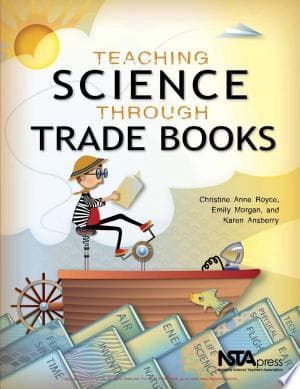
Core Idea
- Difficulty
- Easy
- Read it if
- You are a K-8 science educator looking to enrich your curriculum with engaging, narrative-driven resources beyond the textbook, or if you want practical strategies for integrating literacy and science.
- Skip it if
- You are a high school or college-level science instructor, or if you are solely interested in advanced pedagogical theory without practical, hands-on lesson integration ideas.
Key Takeaways from Teaching Science Through Trade Books
Beyond the Textbook
Trade books offer a richer, more engaging path to scientific understanding than traditional textbooks alone.
The book argues that textbooks are essential but rarely make students truly engaged or remember things long-term. The authors point out that few people fondly recall a science textbook from childhood. This does not dismiss textbooks but urges teachers to add trade books. Trade books—children's fiction and non-fiction—can change science education by making it relatable, story-based, and emotionally impactful. They provide context, introduce ideas through accessible stories, and spark curiosity in ways a dry textbook often cannot. This method acknowledges that learning works best when it is enjoyable and connected to real-world experiences or good stories.
“'What was your favorite book as a child?' In more than 10 years of facilitating workshops, we have never heard anyone reply, 'My fourth-grade science textbook.' Clearly, textbooks have an important place in the science classroom, but using trade books to supplement a textbook can greatly enrich students' experience.”
In the book: The authors' anecdote about workshop participants never naming a science textbook as a childhood favorite, contrasting it with the likely positive responses for trade books.
Try this: Integrate at least one trade book into each science unit. Before introducing a new concept via textbook, use a relevant trade book to build background knowledge, pique interest, and establish a real-world connection. For example, read a story about space exploration before discussing planetary motion.
Related ideas: trade-books, student-engagement, curiosity-driven-learning
The Power of Narrative
Stories embedded in trade books make abstract scientific concepts tangible and memorable for young learners.
Science ideas, especially for elementary students, can be very abstract. Trade books help by weaving science into engaging stories or presenting facts through relatable characters and situations. A story about a seed growing into a plant, for example, makes photosynthesis and life cycles much clearer and more memorable than a textbook diagram and description. This storytelling approach not only helps understanding but also builds empathy and a stronger connection to the subject. It uses children's natural interest in stories, turning potentially dry information into an exciting discovery.
“By using children's books to pique students' interest, you can combine science teaching with reading instruction in an engaging and effective way.”
In the book: The book's emphasis on using 'children's books to pique students' interest' and the examples like 'Measuring Penny' which use a story to explore measurement concepts.
Try this: When teaching a new science topic, select a trade book that tells a story or presents information in a narrative format related to the concept. Encourage students to discuss the story's characters, plot, and how it connects to the scientific ideas being studied. For example, use 'I Took a Walk' to explore ecosystems and observation.
Related ideas: narrative-learning, concept-acquisition, storytelling-in-education
Integrated Learning
Combining science and reading instruction through trade books creates a synergistic and efficient learning experience.
A powerful part of this method is its ability to teach science content and reading comprehension skills at the same time. Instead of treating these as separate subjects, trade books allow teachers to teach both within a single, meaningful context. Students practice reading, vocabulary, fluency, and comprehension strategies while learning about science. This integration is important in today's busy classrooms, offering an efficient way to cover multiple standards. It also reinforces that science is not isolated but deeply connected to reading, communication, and critical thinking.
“By using children's books to pique students' interest, you can combine science teaching with reading instruction in an engaging and effective way.”
In the book: The book's core premise of 'combining science teaching with reading instruction' and its mention of 'strong curricular connections'.
Try this: Select trade books that are appropriate for students' reading levels and align with science objectives. Incorporate pre-reading activities (e.g., predicting, vocabulary building), during-reading strategies (e.g., questioning, summarizing), and post-reading discussions (e.g., analyzing scientific concepts, making connections) into science lessons.
Related ideas: cross-curricular, literacy-skills, science-literacy
Inquiry-Oriented Activities
Trade books serve as springboards for hands-on, investigative science activities that promote critical thinking.
The book does not just suggest reading a story; it stresses using trade books as a starting point for inquiry-based learning. After reading a book, students are encouraged to ask questions, form hypotheses, and do experiments. A book about weather, for instance, might lead students to observe and record local weather patterns, or design a simple rain gauge. This approach shifts from passively receiving information to actively investigating, building scientific habits of mind. It teaches students how to think like scientists, rather than just what scientists know, aligning with modern education standards that prioritize deep understanding and critical inquiry.
“All activities are Standards-based and inquiry-oriented.”
In the book: The explicit statement that 'All activities are Standards-based and inquiry-oriented,' and the structure of the lessons highlighting two targeted activities per book.
Try this: After reading a trade book, facilitate a discussion that generates student questions related to the book's science content. Guide students in designing and conducting simple investigations or experiments to answer these questions. For example, after 'How Tall, How Short, How Far Away?', have students measure and compare objects in the classroom using various non-standard and standard units.
Related ideas: inquiry-based-learning, scientific-investigation, critical-thinking
Differentiated Instruction
The K-3 and 4-6 activity differentiation ensures appropriate challenges for diverse student age groups.
A key strength of this resource is its practical approach to differentiation. Recognizing the big differences between a kindergartner and a sixth grader, each lesson offers two distinct activities suited for specific age groups (K-3 and 4-6). This design ensures the content is accessible and appropriately challenging for all students. It prevents frustration for younger learners while offering enough complexity and depth for older ones. This structured differentiation makes the book very useful for teachers in multi-grade settings or those adjusting lessons for varied student needs in one classroom, promoting fair access to engaging science education.
“each lesson highlights two trade books and offers two targeted activities, one for K-3 and one for grades 4-6.”
In the book: The clear organizational structure where 'each lesson highlights two trade books and offers two targeted activities, one for K-3 and one for grades 4-6.'
Try this: When planning a lesson, always refer to the specific K-3 or 4-6 activity provided in the book, or use them as models to design your own age-appropriate extensions. For younger students, focus on concrete experiences and observations; for older students, introduce more abstract concepts, data analysis, and experimental design.
Related ideas: differentiation, age-appropriateness, pedagogical-strategies
Contextualizing Science
Trade books place scientific concepts within relatable contexts, making them more meaningful and less abstract.
Often, science in textbooks feels separate from students' lives. Trade books excel at giving science ideas a 'whole new context.' Whether it is a story about a child exploring their backyard ('Secret Place') or a book about how different animals adapt, these stories connect abstract ideas to real, relatable situations. This contextualization makes science feel less like isolated facts and more like an important part of the world around them. When students see how science applies to everyday life or to compelling stories, they become more motivated to learn, and their understanding becomes deeper and stronger, building a lasting appreciation for science.
“the featured books will help your students put science in a whole new context.”
In the book: The statement that 'the featured books will help your students put science in a whole new context,' and examples like 'I Took a Walk' and 'Secret Place' which imply real-world exploration.
Try this: Before starting a science unit, brainstorm with students about how the topic might relate to their daily lives or experiences. Then, introduce a trade book that explicitly connects the science concept to a real-world context or a fictional scenario they can relate to. Encourage discussions about these connections.
Related ideas: relevance-in-education, real-world-connections, meaningful-learning
Curated & Updated Resources
The book offers a vetted collection of high-quality trade books and refreshed lessons, saving educators valuable time.
For busy teachers, a pre-vetted, high-quality resource is very valuable. The authors, experienced educators, have carefully chosen 50 'favorite' trade books and updated their lessons. This selection saves a lot of time, removing the need for teachers to search through countless books for good ones or to create activities themselves. The included student activity pages further simplify lesson planning. This practical, ready-to-teach format ensures that teachers can immediately use engaging, standards-aligned lessons, making it easy and efficient to add trade books to science instruction—a real help for busy educators.
“column authors Christine Royce, Emily Morgan, and Karen Ansberry selected 50 of their favorites, updated the lessons, and added student activity pages, making it easier than ever to teach fundamental science concepts through high-quality fiction and nonfiction children's books.”
In the book: The mention that the authors 'selected 50 of their favorites, updated the lessons, and added student activity pages, making it easier than ever to teach fundamental science concepts'.
Try this: Utilize the specific book recommendations and ready-to-use activities provided in the text. Instead of starting from scratch, adapt the provided lessons to fit your classroom's specific needs and resources, knowing that the core content and activities are already aligned and effective.
Related ideas: teacher-resources, lesson-planning, curriculum-design
Fostering Lasting Impressions
Engaging trade books create memorable learning experiences that students will recall long after the lesson ends.
The main goal of education is not just remembering information for a short time but lasting understanding and appreciation. The book's core idea—that textbooks are rarely remembered fondly—highlights how trade books can create lasting memories. When science is taught through a captivating story or a hands-on activity sparked by a good book, it uses emotional and cognitive paths that lead to deeper retention. These memorable experiences can build a lifelong love for science, turning students from passive learners into curious, engaged individuals who 'just may remember' these lessons 'always.' This is the true measure of effective teaching.
“books your students just may remember, always.”
In the book: The powerful concluding phrase in the introduction: 'books your students just may remember, always.'
Try this: Actively solicit student feedback after using trade books and related activities. Ask them what they remember from the book and the science concept it introduced, and observe their enthusiasm. This feedback can help reinforce the value of this approach and guide future book selections.
Related ideas: memory-retention, lifelong-learning, educational-impact
Accessible Science for All
High-quality children's literature makes complex scientific ideas approachable for a broad range of learners.
Trade books naturally simplify and clarify complex science topics without making them too basic. Children's book authors are skilled at breaking down complex ideas into understandable, engaging text and pictures. This accessibility is key for reaching diverse students, including those who may struggle with traditional academic texts or have different learning styles. By presenting 'fundamental science concepts' in an accessible, visually rich format, trade books lower barriers to understanding, ensuring more students can engage with and grasp science. This makes science education available to everyone, turning it into an exciting journey for every child.
“making it easier than ever to teach fundamental science concepts through high-quality fiction and nonfiction children's books.”
In the book: The claim that the book makes 'it easier than ever to teach fundamental science concepts through high-quality fiction and nonfiction children's books.'
Try this: When selecting trade books, consider the variety of reading levels and background knowledge within your classroom. Utilize the visual elements and simplified language of trade books to explain challenging concepts, pausing to discuss illustrations and key vocabulary with all students.
Related ideas: equity-in-education, learning-styles, science-accessibility
Teaching Science Through Trade Books Quotes
“Trade books provide an authentic context for students to learn science concepts by connecting them to real-world phenomena and applications.”
“The integration of literacy strategies with science content is not a luxury, but a necessity for deep understanding.”
“Good science teaching involves more than just presenting facts; it requires cultivating curiosity and critical thinking.”
“When students are engaged with a compelling narrative, they are more likely to internalize complex scientific ideas.”
“Trade books can serve as a powerful springboard for inquiry-based investigations, prompting students to ask questions and seek answers.”
“Differentiating instruction becomes more manageable when a variety of trade books are available to meet diverse student needs and interests.”
“The careful selection of high-quality trade books is paramount to ensuring accurate and age-appropriate scientific information.”
“Connecting science concepts to students' prior knowledge and experiences through relatable stories fosters deeper and more lasting learning.”
“Beyond content, trade books can also model the process of scientific discovery and the nature of science itself.”
“Misconceptions can be effectively addressed and corrected when students encounter alternative explanations in engaging, well-written trade books.”
“The collaborative discussions sparked by reading a common trade book can significantly enhance students' scientific discourse skills.”
“Trade books offer a window into the lives and work of scientists, humanizing science and making it more accessible.”
“Assessment in science can be enriched by incorporating responses to trade books, allowing for a more authentic demonstration of understanding.”
“Integrating technology with trade books can create dynamic learning experiences, from virtual field trips to interactive simulations.”
Quiz
10 questions on the main ideas. Each answer comes with a short explanation.
Question 1
According to the provided text, what is a primary benefit of using trade books to supplement science textbooks?
- Trade books are cheaper than textbooks.
- Trade books can greatly enrich students' science experience.
- Trade books replace the need for textbooks entirely.
- Trade books are only suitable for advanced science topics.
Show answer
B. Trade books can greatly enrich students' science experience. The text explicitly states that 'using trade books to supplement a textbook can greatly enrich students' experience.'
Question 2
The book 'Teaching Science Through Trade Books' is based on the same concept as which popular NSTA journal columns and series?
- Science in the Classroom and Young Scientists
- Science and Children columns and Picture-Perfect Science Lessons series
- Elementary Science Activities and Science for All
- NSTA Reports and Journal of College Science Teaching
Show answer
B. Science and Children columns and Picture-Perfect Science Lessons series The text states, 'If you like the popular 'Teaching Science Through Trade Books' columns in NSTA's journal Science and Children, or if you've become enamored of the award-winning Picture-Perfect Science Lessons series, you'll love this new collection.'
Question 3
What is the primary goal of combining science teaching with reading instruction using children's books, as described in the text?
- To reduce the amount of time spent on science lessons.
- To replace traditional reading classes with science content.
- To pique students' interest in an engaging and effective way.
- To focus solely on improving reading scores without science context.
Show answer
C. To pique students' interest in an engaging and effective way. The text explains, 'By using children's books to pique students' interest, you can combine science teaching with reading instruction in an engaging and effective way.'
Question 4
How many favorite trade books were selected by the authors Christine Royce, Emily Morgan, and Karen Ansberry for this new collection?
- 25
- 50
- 75
- 100
Show answer
B. 50 The text explicitly states: 'In this volume, column authors Christine Royce, Emily Morgan, and Karen Ansberry selected 50 of their favorites...'
Question 5
What specific additions were made to the selected lessons in this new collection compared to the original columns?
- New illustrations and updated science facts.
- Author interviews and glossary terms.
- Updated the lessons and added student activity pages.
- Digital versions of the books and online quizzes.
Show answer
C. Updated the lessons and added student activity pages. The text notes that the authors 'selected 50 of their favorites, updated the lessons, and added student activity pages, making it easier than ever to teach fundamental science concepts.'
Question 6
For each lesson in 'Teaching Science Through Trade Books,' how many trade books are highlighted and how many targeted activities are offered?
- One trade book and one activity.
- Two trade books and two activities.
- Three trade books and three activities.
- One trade book and two activities.
Show answer
B. Two trade books and two activities. The text specifies: 'Just as with the original columns, each lesson highlights two trade books and offers two targeted activities, one for K-3 and one for grades 4-6.'
Question 7
What are the grade level breakdowns for the two targeted activities offered in each lesson?
- One for PreK-2 and one for grades 3-5.
- One for K-3 and one for grades 4-6.
- One for grades 1-4 and one for grades 5-8.
- One for grades 2-5 and one for grades 6-9.
Show answer
B. One for K-3 and one for grades 4-6. The text states: 'each lesson highlights two trade books and offers two targeted activities, one for K-3 and one for grades 4-6.'
Question 8
The introduction recounts that in over 10 years of workshops, the facilitators never heard a specific reply to the question 'What was your favorite book as a child?' What was that specific reply?
- 'My fifth-grade history book.'
- 'My fourth-grade science textbook.'
- 'My first-grade picture book.'
- 'My high school novel.'
Show answer
B. 'My fourth-grade science textbook.' The text quotes, 'In more than 10 years of facilitating workshops, we have never heard anyone reply, 'My fourth-grade science textbook.'' This highlights the premise for using more engaging trade books.
Question 9
What two key characteristics describe all the activities presented in 'Teaching Science Through Trade Books'?
- Budget-friendly and technology-integrated.
- Standards-based and inquiry-oriented.
- Teacher-led and memorization-focused.
- Project-based and digitally accessible.
Show answer
B. Standards-based and inquiry-oriented. The text explicitly states: 'All activities are Standards-based and inquiry-oriented.'
Question 10
The book 'Teaching Science Through Trade Books' aims to provide an ideal way to combine what two elements for educators?
- Complex scientific theories and advanced mathematical problems.
- Well-structured, ready-to-teach lessons with strong curricular connections and books students will remember.
- Experimental design protocols and peer-reviewed journal articles.
- Traditional lecture formats and standardized testing preparation.
Show answer
B. Well-structured, ready-to-teach lessons with strong curricular connections and books students will remember. The final sentence states: 'Teaching Science Through Trade Books offers an ideal way to combine well-structured, ready-to-teach lessons—with strong curricular connections—and books your students just may remember, always.'
Teaching Science Through Trade Books FAQ
What is 'Teaching Science Through Trade Books' about?
This book provides educators with 50 ready-to-use lessons that integrate science teaching with reading instruction, using high-quality children's fiction and nonfiction trade books to make science concepts more engaging and memorable for students.
Does teaching science with trade books actually work better than just textbooks?
While textbooks have their place, using trade books can significantly enrich students' learning experience by piquing their interest and providing science concepts in a more relatable and engaging context, often leading to better retention and understanding.
What are 'trade books' in the context of science education?
Trade books refer to children's books, both fiction and nonfiction, that are published for a general audience and sold in bookstores. In this context, they are used as tools to introduce and explore scientific concepts in an engaging way, unlike traditional textbooks.
How is this book different from the 'Picture-Perfect Science Lessons' series?
'Teaching Science Through Trade Books' is based on the same time-saving concept and is authored by some of the same popular columnists. This volume specifically compiles 50 updated favorite lessons from their columns, adding student activity pages for convenience.
Who are the target grades for the lessons in this book?
Each lesson in the book includes two targeted activities, one designed for students in grades K-3 and another for students in grades 4-6, making it suitable for a broad elementary school audience.
Are the activities in 'Teaching Science Through Trade Books' aligned with educational standards?
Yes, all the activities presented in the book are standards-based and inquiry-oriented, ensuring they meet current educational guidelines and promote active learning.
What kind of children's books are featured in the lessons?
The book features a diverse selection of high-quality fiction and nonfiction children's books, such as 'Measuring Penny,' 'How Tall, How Short, How Far Away?', 'I Took a Walk,' and 'Secret Place,' to put science in a new context for students.
Does this book help combine reading instruction with science teaching?
Absolutely. The core concept of the book is to effectively combine science teaching with reading instruction by using engaging children's books to introduce scientific ideas, thereby enhancing literacy skills alongside scientific understanding.
About the author

Christine Anne Royce is an accomplished author and educator specializing in science education. Her notable work, 'Teaching Science Through Trade Books,' provides practical strategies for integrating literature into science classrooms. Royce holds a Ph.D. and has extensive experience as a professor and researcher in science education, making her a trusted voice in the field.
Similar books
- Freakonomics: A Rogue Economist Explores the Hidden Side of Everything
Steven D. Levitt
4.0 (709k) average on GoodreadsBusinessThis book uses economic principles to reveal the surprising incentives behind everything from drug dealing and real estate to cheating teachers and the decline of crime.
- The Tipping Point: How Little Things Can Make a Big Difference
Malcolm Gladwell
4.0 (690k) average on GoodreadsBusinessMalcolm Gladwell explains how small, targeted actions can start widespread changes in trends, behaviors, and ideas.
- The Immortal Life of Henrietta Lacks
Rebecca Skloot
4.1 (587k) average on GoodreadsBiographyA poor Southern tobacco farmer's unwitting contribution of 'immortal' cells starts a journey through scientific breakthroughs, medical ethics, and her family's decades-long fight for recognition and understanding.
- Outliers: The Story of Success
Malcolm Gladwell
4.2 (556k) average on GoodreadsBusinessMalcolm Gladwell argues that true success is not just about individual talent, but about the hidden advantages of culture, opportunity, and unique experiences that shape extraordinary lives.
- Sapiens: A Brief History of Humankind
Yuval Noah Harari
4.4 (502k) average on GoodreadsPsychologySapiens tells the story of Homo sapiens, showing how our ability to create shared fictions helped us go from an ordinary ape to the planet's main species, changing Earth and our future.
- Blink: The Power of Thinking Without Thinking
Malcolm Gladwell
3.9 (487k) average on GoodreadsBusinessExplore the hidden power of quick judgments and how 'thin-slicing' information helps skilled decision-makers succeed instantly, often without conscious thought.




Enjoyed the summary?
A summary gives you the shape of the book. The book itself has the detail, the examples and the voice.
Find Teaching Science Through Trade Books on AmazonAs an Amazon Associate, BookBrief earns from qualifying purchases. How we're funded