
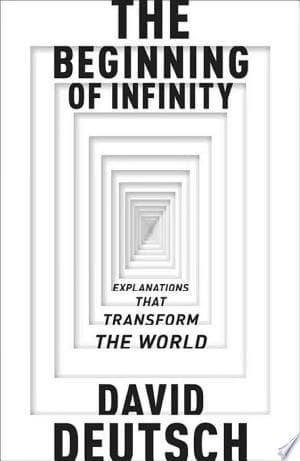
Core Idea
- Difficulty
- Hard
- Read it if
- You are fascinated by fundamental questions about knowledge, reality, progress, and the potential of human reason, and enjoy challenging philosophical and scientific arguments.
- Skip it if
- You prefer practical self-help or straightforward historical narratives, or find highly abstract philosophical and quantum physics discussions daunting.
Key Takeaways from The Beginning of Infinity
The Primacy of Good Explanations
Progress isn't about predictions, but about explanations that are hard to vary.
Deutsch states that the basis of all human progress, from scientific understanding to moral development, is the creation and improvement of 'good explanations.' Unlike simple predictions, a good explanation is difficult to change while still explaining what it claims to. This 'hard to vary' rule is important because it means deep understanding, not just surface observation. When we look for good explanations, we are not just gathering facts; we are building a coherent, strong, and often surprising understanding of reality. This is what makes science different from other types of knowledge and drives all real progress, allowing us to solve problems and create new knowledge endlessly.
“All progress, both theoretical and practical, has resulted from the quest for good explanations.”
In the book: Deutsch contrasts the predictive power of ancient myths (e.g., predicting the sun's rising) with the explanatory power of scientific theories (e.g., heliocentric model explaining planetary motion). The former can predict but offers no deep understanding; the latter explains why things happen, making it robust against variation.
Try this: When evaluating information or attempting to solve a problem, don't just look for what works or predicts. Seek the underlying 'why.' Ask: 'What is the simplest, most robust explanation for this phenomenon? Can I change any part of this explanation without breaking its ability to account for the facts?' This critical approach fosters deeper understanding and more effective solutions.
Related ideas: good-explanation, hard-to-vary, scientific-method, problem-solving
The Infinity of Knowledge Creation
Our capacity to create knowledge is unbounded, making infinite progress not just possible, but inevitable.
A main point of the book is that humanity's ability to create knowledge is endless. Deutsch rejects the idea of a 'final theory' or a limit to what we can understand. He believes every good explanation leads to new problems and new areas of study, creating a continuous chain of discovery and improvement. This endless capacity comes from our unique ability to generate explanatory knowledge, which lets us go beyond our biological and environmental limits. The universe, being understandable, offers an endless frontier for our minds to explore, making 'the beginning of infinity' a literal description of our current state.
“The universe is comprehensible, and our ability to create knowledge is unbounded.”
In the book: Deutsch frequently references the historical trajectory of science, where each major breakthrough (e.g., Newtonian physics, quantum mechanics) did not end inquiry but instead revealed deeper layers of reality and new problems to solve.
Try this: Embrace the mindset that no problem is fundamentally insoluble and no understanding is truly complete. When faced with a perceived limit, consider it an opportunity for further knowledge creation. Foster curiosity and the pursuit of 'what next?' rather than 'what's the end?' in all aspects of life, from personal learning to professional innovation.
Related ideas: knowledge-creation, infinite-progress, comprehensibility-of-universe, optimism
Optimism as an Epistemological Stance
Optimism is not wishful thinking, but a rational belief that all problems are solvable.
Deutsch redefines optimism as a rational, knowledge-based position, not just a personality trait. True optimism, he argues, is the belief that all problems are solvable, given enough knowledge and cleverness. This does not mean problems are easy or that solutions are guaranteed without effort. Instead, it means there are no fundamental, unbeatable barriers to progress. Pessimism, by contrast, is the belief that some problems are simply beyond our ability to solve, leading to stagnation. Deutsch's optimism is a call to action, a demand to seek out and create the knowledge needed to overcome any challenge, rather than passively accepting limits.
“Optimism is the theory that all failures are due to insufficient knowledge.”
In the book: He cites historical examples where seemingly insurmountable problems (e.g., disease, famine, illiteracy) were eventually overcome through the creation of new knowledge and technology.
Try this: Adopt a problem-solving mindset that assumes a solution exists, even if it's not immediately apparent. When encountering a challenge, reframe it not as an impossible barrier, but as a knowledge gap to be filled. Actively seek out or create the necessary knowledge to address the problem, rather than succumbing to despair or inaction.
Related ideas: optimism, problem-solvability, epistemology, progress
The Universal Reach of Computation
The universe is a quantum computer, and universal computation underpins all physical processes.
Using his background in quantum computing, Deutsch expands on the idea that the universe itself works like a computer. He argues that the laws of physics are like algorithms, and physical reality can be seen as a universal quantum computer. This view suggests that anything physically possible can, in theory, be simulated or processed by a universal computer, with enough resources. This has important implications for understanding the limits and possibilities of what can be known, created, and engineered. It raises computing from a mere tool to a basic part of reality, linking information, physics, and knowledge creation.
“The laws of physics are computational.”
In the book: Deutsch pioneered the field of quantum computation and the concept of the Universal Quantum Computer. He uses the example of the 'Turing Principle' extended to the quantum realm, suggesting that any physically possible computation can be performed by a universal quantum computer.
Try this: Recognize the deep computational nature of reality. When designing systems, solving complex problems, or even thinking about the limits of what's possible, consider the underlying computational processes. This perspective can inspire new approaches in fields from artificial intelligence to materials science, by recognizing the universe's inherent 'programmability.'
Related ideas: quantum-computation, universal-computer, physics, information-theory
The Multiverse and the Nature of Reality
The Many-Worlds Interpretation of quantum mechanics is not just plausible, but essential for good explanations.
Deutsch strongly supports the Many-Worlds Interpretation (MWI) of quantum mechanics. He argues it is not just one way to understand quantum phenomena, but the most straightforward and explanatory. Unlike other interpretations that involve wave function collapse, MWI suggests that every quantum measurement causes the universe to split into multiple parallel realities, each showing a different outcome. For Deutsch, this is not an arbitrary philosophical leap, but a necessary result of the underlying physics, offering a 'hard to vary' explanation for quantum strangeness. It is a bold claim that expands our understanding of reality far beyond a single timeline.
“The Many-Worlds Interpretation is not just a way of interpreting quantum theory; it is quantum theory.”
In the book: He explains how quantum phenomena like interference patterns (e.g., in the double-slit experiment) are best explained by the existence of 'other universes' where alternative outcomes occur, influencing the probabilities observed in our own. The 'collapse' theories are, to Deutsch, ad-hoc and less explanatory.
Try this: While not directly actionable in daily life, embracing the MWI encourages a radical openness to counter-intuitive scientific theories. It teaches us to prioritize explanatory power and parsimony even when explanations challenge our common sense. It's a lesson in intellectual humility and the willingness to accept that reality might be far stranger and richer than we instinctively perceive.
Related ideas: many-worlds-interpretation, quantum-mechanics, multiverse, reality
The Evolution of Explanations (Memes)
Knowledge, like genes, evolves through variation and selection, driving cultural and intellectual progress.
Deutsch extends the idea of evolution beyond biology, applying it to ideas and explanations. He suggests that knowledge, in the form of 'memes' (ideas, theories, practices), evolves in a way similar to natural selection. New ideas are created (variation), tested against reality and existing knowledge (selection), and those that are 'good explanations' (suitable, hard to vary) survive and spread. This evolutionary view of knowledge explains how human cultures and scientific understanding advance. It shows that progress is not straight or predetermined, but a dynamic, repeating process of correcting errors and improving, constantly adapting to new problems and information.
“The growth of knowledge is an evolutionary process.”
In the book: He draws parallels between the evolution of biological species and the evolution of scientific theories, showing how earlier, less explanatory theories (like Ptolemaic astronomy) are replaced by better ones (Copernican, then Keplerian, then Newtonian), each a 'fitter' explanation that solves more problems and is harder to vary.
Try this: Approach your own ideas and beliefs with an evolutionary mindset. Actively seek out criticism and evidence that could falsify or improve your current explanations. Don't cling to ideas merely because they are familiar; be willing to let 'fitter' explanations replace them. Foster environments that encourage intellectual variation and rigorous critical evaluation.
Related ideas: evolutionary-epistemology, memes, knowledge-evolution, falsification
The Moral Imperative of Progress
Progress is not just technological, but fundamentally moral, driving us towards universal values.
Deutsch argues that progress is not limited to science and technology; it also applies deeply to morality and human values. He sees moral growth as an ongoing process of creating better explanations for how we should live, moving from arbitrary rules towards universal principles that are 'hard to vary' and truly solve problems of human suffering and injustice. This means rejecting fixed moral codes and accepting that our moral understanding, like our scientific understanding, can and must get better. For Deutsch, seeking better explanations is a moral duty, leading to a future where human well-being is maximized and suffering minimized.
“Progress is not just possible, but morally obligatory.”
In the book: He traces the historical progression of moral ideas, from the acceptance of slavery and feudalism to the rise of human rights and democracy, arguing that these shifts represent genuine moral progress driven by better explanations about human dignity and societal well-being.
Try this: Critically examine your own moral assumptions and those of your society. Ask: 'Is this moral rule a good explanation for how humans should interact? Is it hard to vary? Does it solve problems or create them?' Be open to moral progress and actively contribute to the creation of better, more universal ethical frameworks, rather than passively accepting existing norms.
Related ideas: moral-progress, universal-values, ethics, enlightenment
Against Stagnation and Catastrophism
The biggest threat to humanity is not external limits, but the internal failure to create knowledge.
Deutsch strongly opposes theories about limits to growth, environmental disaster predictions, and any philosophy that suggests humanity is fated for stagnation or collapse due to outside factors. He maintains that all perceived 'limits' — resource scarcity, pollution, overpopulation — are simply problems waiting for solutions, which will come through creating new knowledge. The real danger, he argues, lies not in the universe's constraints, but in human institutions or beliefs that stop knowledge creation, such as authoritarianism, pessimism, or rigid doctrines. Our endless potential is threatened only by our own failure to use it.
“The only fundamental limit to progress is the knowledge we fail to create.”
In the book: He critiques Malthusian predictions and other 'doomsday' scenarios, showing how historical progress has consistently overcome such perceived limits through technological and scientific innovation (e.g., green revolution, renewable energy).
Try this: Reject narratives of inevitable decline or inherent limits. When faced with a global crisis, focus on how knowledge can be created to solve it, rather than accepting it as an unsolvable fate. Advocate for open inquiry, critical thinking, and institutions that foster creativity and problem-solving, rather than those that impose limits or dogma.
Related ideas: anti-catastrophism, limits-to-growth, knowledge-suppression, innovation
The Nature of Creative Thought
Creativity is the unique human capacity to generate new, good explanations from scratch.
For Deutsch, creativity is not just about combining existing ideas or making new arrangements; it is the ability to generate entirely new, good explanations where none existed before. This drives all progress, from scientific breakthroughs to artistic innovation. It is a distinctly human ability, setting us apart from algorithms or animals. This creative process is unpredictable and cannot be fully automated or reduced to a formula, as it involves intuitive leaps and critical evaluation of new ideas. Understanding creativity as the core of knowledge creation is essential for creating environments that maximize human potential.
“Creativity is about creating new explanations, not just new predictions or arrangements.”
In the book: He contrasts the output of AI (e.g., generative algorithms) with true human creativity. While AI can produce novel combinations, it doesn't generate *explanatory* knowledge in the same way a human scientist formulates a new theory to explain observed phenomena.
Try this: Value and cultivate genuine creativity in yourself and others. Encourage deep, critical thinking that aims for understanding ('why?') rather than just superficial novelty ('what?'). Provide space for exploration, error, and the generation of radically new ideas, recognizing that true creativity often defies predictable processes and requires a willingness to challenge existing paradigms.
Related ideas: creativity, human-uniqueness, explanation-generation, innovation
The Beginning, Not the End
Humanity is still at the very outset of its journey towards infinite knowledge and control.
The book's title summarizes its main message: despite all our achievements, humanity is only at the very start of its potential. Deutsch argues that most knowledge, understanding, and control over the universe is still undiscovered. This view is very optimistic, suggesting that the greatest discoveries and advancements are yet to come. It is a call to avoid complacency, to recognize the huge, unused potential in our ability to create knowledge, and to actively choose a future of endless progress rather than giving in to stagnation or self-imposed limits. The journey has just begun, and its possibilities are limitless.
“We are at the beginning of infinity. Our future, if we choose it, is one of infinite progress.”
In the book: Deutsch continually refers to the vastness of the universe and the relatively tiny fraction of it we currently understand or control, emphasizing that our current knowledge is but a speck compared to what is knowable and achievable.
Try this: Maintain a long-term, expansive view of human potential. Don't be limited by current technological or scientific understanding. Invest in fundamental research, education, and the free exchange of ideas. Cultivate a mindset of continuous improvement and exploration, seeing every solved problem as a stepping stone to greater challenges and achievements.
Related ideas: infinite-future, human-potential, long-term-thinking, exploration
The Beginning of Infinity Quotes
“All progress, all problem-solving, depends on people taking the initiative to change things, and that means being able to think of better ways and then being allowed to make them happen.”
“Good explanations are hard to vary.”
“The quest for good explanations is the beginning of infinity.”
“What is true of physical reality is also true of abstract reality: all knowledge is created by conjecture and criticism.”
“Problems are soluble, and the means of solving them is to create new knowledge.”
“The universe is comprehensible, and comprehensible by us.”
“Optimism is the theory that all failures are due to insufficient knowledge.”
“Without the capacity for error, there is no capacity for knowledge.”
“There are no limits to the problems that can be solved if the right knowledge is brought to bear on them.”
“The growth of knowledge is the only possible engine of progress.”
“Creativity is not merely a matter of having new ideas; it is a matter of having new ideas that are good explanations.”
“An explanation is a statement about what is there, what it does, and why.”
“The reach of explanations is, literally, infinite.”
“The universe is not only stranger than we imagine, it is stranger than we can imagine.”
Quiz
10 questions on the main ideas. Each answer comes with a short explanation.
Question 1
According to David Deutsch, what is the fundamental characteristic that distinguishes human knowledge from other forms of information or patterns in the universe?
- Its ability to be stored and transmitted genetically.
- Its capacity for infinite growth through good explanations.
- Its reliance on empirical observation alone.
- Its perfect and unchanging nature.
Show answer
B. Its capacity for infinite growth through good explanations. Deutsch argues that human knowledge is unique because it consists of good explanations, which are conjectures that are hard to vary and have explanatory power. This allows for infinite progress and growth in understanding, a central theme of the book.
Question 2
What concept does Deutsch introduce to illustrate the unbounded nature of progress and the potential for new knowledge, even when faced with seemingly insurmountable problems?
- The Turing Machine's Halting Problem.
- The Infinity Hotel.
- The Multiverse Hypothesis.
- The Principle of Least Action.
Show answer
B. The Infinity Hotel. The Infinity Hotel is used as an analogy to demonstrate how even a seemingly full system (like a hotel with infinitely many rooms) can always accommodate more, symbolizing the infinite potential for new knowledge and problem-solving.
Question 3
Which philosopher is cited by David Deutsch as a major influence on his understanding of scientific progress through conjecture and refutation?
- Thomas Kuhn
- Immanuel Kant
- Karl Popper
- Bertrand Russell
Show answer
C. Karl Popper The book explicitly mentions Karl Popper as Deutsch's greatest hero, whose philosophy of science—emphasizing the importance of falsifiability and the growth of knowledge through conjecture and refutation—forms a cornerstone of Deutsch's arguments.
Question 4
Deutsch argues that 'bad philosophy' often leads to what he calls 'pessimism' by promoting the idea that:
- All problems are inherently solvable given enough resources.
- There are fundamental limits to human knowledge and progress.
- Technological advancement inevitably leads to moral decay.
- The universe is fundamentally unknowable.
Show answer
B. There are fundamental limits to human knowledge and progress. A core argument in the book is that 'pessimism' (or static societies) arises from bad philosophy that posits inherent, insuperable limits to what can be known or achieved, thus stifling the search for new explanations and progress.
Question 5
What is Deutsch's primary criticism of 'instrumentalism' in science?
- It overemphasizes the role of mathematical models.
- It fails to seek good explanations and focuses only on prediction.
- It disregards the importance of experimental verification.
- It promotes an overly optimistic view of scientific capabilities.
Show answer
B. It fails to seek good explanations and focuses only on prediction. Deutsch strongly criticizes instrumentalism for valuing theories merely as tools for prediction or control, rather than as attempts to provide true and deep explanations of reality. He argues that the pursuit of explanation is what drives genuine scientific progress.
Question 6
When discussing the nature of creativity, Deutsch emphasizes that it is primarily about:
- Random trial and error.
- The generation of new knowledge and good explanations.
- Recombining existing ideas in novel ways.
- Strict adherence to established methodologies.
Show answer
B. The generation of new knowledge and good explanations. For Deutsch, creativity is not just about novelty, but specifically about the generation of new, explanatory knowledge—solving problems by creating good explanations that were not previously known or understood.
Question 7
Deutsch argues that the 'principle of optimism' is justified because:
- Humanity has always overcome its challenges in the past.
- All problems are solvable, given the right knowledge.
- The universe is inherently benevolent towards intelligent life.
- Technological singularity is an inevitable future.
Show answer
B. All problems are solvable, given the right knowledge. Deutsch's principle of optimism states that all problems are solvable, given the right knowledge. This is a core tenet of the book, contrasting with various forms of pessimism that posit inherent limits to problem-solving.
Question 8
Deutsch's 'Theory of Everything' (TOE) is distinct from many physicists' TOEs because it aims to explain:
- Only the fundamental forces of nature.
- The entire physical universe, including the emergence of mind and knowledge.
- The quantum mechanics of gravity.
- The origin of the Big Bang.
Show answer
B. The entire physical universe, including the emergence of mind and knowledge. Deutsch's vision of a 'Theory of Everything' is far broader than the typical physicist's, encompassing not just the fundamental laws of physics but also the principles governing computation, evolution, epistemology, and the emergence of knowledge and mind, seeing them all as interconnected explanations of reality.
Question 9
What does Deutsch consider to be the primary driver of progress in both science and morality?
- The accumulation of empirical data.
- The creation of good explanations.
- Social consensus and tradition.
- Divine revelation.
Show answer
B. The creation of good explanations. Throughout the book, Deutsch consistently argues that progress in all fields, including science, morality, and politics, stems from the creation and improvement of 'good explanations'—theories that are hard to vary and have explanatory power.
Question 10
Deutsch argues that the 'multiverse' (or many-worlds interpretation of quantum mechanics) is not merely an interpretation but a necessary component of a good explanation because:
- It is the most aesthetically pleasing theory.
- It provides the deepest and most parsimonious explanation for quantum phenomena without arbitrary postulates.
- It has been directly observed through experiments.
- It simplifies the mathematical equations of quantum theory.
Show answer
B. It provides the deepest and most parsimonious explanation for quantum phenomena without arbitrary postulates. Deutsch is a strong advocate for the many-worlds interpretation, arguing that it is not just one way of looking at quantum mechanics but the best available explanation because it explains quantum phenomena without adding arbitrary rules (like wave function collapse) and provides a more coherent, unified account of reality.
The Beginning of Infinity FAQ
What is the central idea of 'The Beginning of Infinity'?
The book argues that human progress, driven by the creation of good explanations, is not limited and can continue infinitely. It posits that all problems are solvable given the right knowledge and resources, making the universe open-ended for growth and discovery.
What is a 'good explanation' according to David Deutsch?
A good explanation is one that is hard to vary, meaning it makes specific predictions and can be tested and potentially refuted. It's not just a description of events, but an underlying theory that explains why things happen and can be used to solve problems.
Does 'The Beginning of Infinity' claim that all problems are currently solvable?
No, the book argues that all problems are solvable *in principle*, given sufficient knowledge and resources. It emphasizes that our current understanding is only the beginning, and future knowledge will enable us to overcome challenges that seem insurmountable today.
How does David Deutsch's view of progress differ from common pessimistic outlooks?
Deutsch strongly advocates for optimism, viewing problems as opportunities for creating new knowledge rather than inherent limitations. He contrasts with pessimistic views that foresee an inevitable end to progress, whether through resource depletion, catastrophe, or the completion of all discovery.
What is the role of creativity in the 'Beginning of Infinity' framework?
Creativity is presented as the fundamental engine of progress, enabling the generation of new explanations and theories that solve problems and expand our understanding. It's the uniquely human capacity to imagine and discover knowledge that doesn't yet exist.
How does quantum physics relate to the themes in the book?
Deutsch, a pioneer in quantum computation, uses quantum physics as a prime example of a fundamental theory that provides deep explanations and enables powerful new technologies. It illustrates the power of good explanations to reveal the true nature of reality and drive progress.
Is 'The Beginning of Infinity' a science book or a philosophy book?
It is both. Deutsch seamlessly weaves together scientific insights, particularly from physics and computation, with profound philosophical arguments about epistemology, optimism, and the nature of knowledge. It blurs traditional disciplinary lines to present a unified worldview.
How is 'The Beginning of Infinity' different from other books on human progress or futurism?
Unlike many books that focus on predictions or specific technological advancements, Deutsch's work provides a foundational theory of progress itself, emphasizing the infinite potential of knowledge creation. It offers a unique philosophical framework rooted in universal explanations, rather than just extrapolating current trends.
About the author

David Deutsch is a physicist and author known for his groundbreaking work in quantum computation and quantum mechanics. His book, "The Beginning of Infinity: Explanations That Transform the World," explores the nature of progress and the potential of the human mind. Deutsch is a professor at the University of Oxford and a recipient of the prestigious Turing Award.
Similar books
- Sapiens: A Brief History of Humankind
Yuval Noah Harari
4.4 (502k) average on GoodreadsPsychologyOffers a grand narrative of human progress and knowledge, though with a different philosophical underpinning.
- Freakonomics: A Rogue Economist Explores the Hidden Side of Everything
Steven D. Levitt
4.0 (709k) average on GoodreadsBusinessThis book uses economic principles to reveal the surprising incentives behind everything from drug dealing and real estate to cheating teachers and the decline of crime.
- The Tipping Point: How Little Things Can Make a Big Difference
Malcolm Gladwell
4.0 (690k) average on GoodreadsBusinessMalcolm Gladwell explains how small, targeted actions can start widespread changes in trends, behaviors, and ideas.
- The Immortal Life of Henrietta Lacks
Rebecca Skloot
4.1 (587k) average on GoodreadsBiographyA poor Southern tobacco farmer's unwitting contribution of 'immortal' cells starts a journey through scientific breakthroughs, medical ethics, and her family's decades-long fight for recognition and understanding.
- Outliers: The Story of Success
Malcolm Gladwell
4.2 (556k) average on GoodreadsBusinessMalcolm Gladwell argues that true success is not just about individual talent, but about the hidden advantages of culture, opportunity, and unique experiences that shape extraordinary lives.
- Blink: The Power of Thinking Without Thinking
Malcolm Gladwell
3.9 (487k) average on GoodreadsBusinessExplore the hidden power of quick judgments and how 'thin-slicing' information helps skilled decision-makers succeed instantly, often without conscious thought.





Enjoyed the summary?
A summary gives you the shape of the book. The book itself has the detail, the examples and the voice.
Find The Beginning of Infinity on AmazonAs an Amazon Associate, BookBrief earns from qualifying purchases. How we're funded