
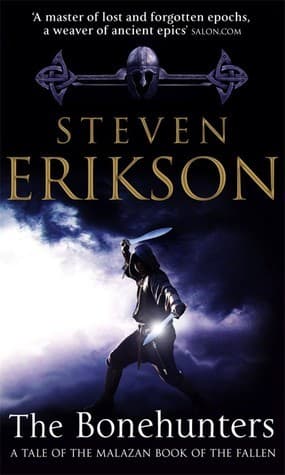
Synopsis
Covers the whole plot, including the ending.
- Difficulty
- Hard
- Pacing
- Variable
- Mood
- Epic, Dark, Philosophical, Tragic, Grand
- Read it if
- You crave an incredibly dense, multi-layered epic fantasy with a vast cast of characters, morally grey themes, and brutal, visceral combat.
- Skip it if
- You prefer straightforward narratives, clear protagonists, or don't enjoy investing significant time in a single, complex book.
The Bonehunters Plot Summary
Covers the whole plot, including the ending.
The Siege of Y'Ghatan
The Malazan 14th Army, led by High Fist Sengar and Adjunct Tavore Paran, approaches Y'Ghatan, the last rebel stronghold led by Leoman of the Flails. The city is grim for Malazans, as it was where Dassem Ultor died and the Empire suffered a huge defeat. The army, tired from the campaign, is worried about the coming siege. Tavore, seemingly distant, leads with firm resolve, while her officers, like Captain Kindly and Sergeant Hellian, deal with troop morale and the city's dark history. Unknown to most, the Claw, led by Pearl, are also there, pursuing their own goals.
The Arrival of the Bonehunters
Fiddler, Kalam, Apsalar, and Cutter arrive at Y'Ghatan, drawn by their own paths. Fiddler, now a sapper in the 14th Army, reunites with old Bridgeburner comrades in Tavore's forces. Kalam, on a mission for Empress Laseen, watches the siege, his loyalty always tested. Apsalar, driven by her own mysterious goals and Cotillion's lingering influence, guides Cutter, who struggles with his identity as a killer. Their presence adds layers of intrigue and personal stakes to the situation, as they face war's harsh realities and the manipulative forces at work.
The Fire in the City
During the siege, Leoman of the Flails uses a devastating tactic: setting Y'Ghatan on fire with oil-soaked streets. The Malazan forces, trapped in the burning city, fight for survival against both the flames and the remaining rebels. Fiddler and his sappers help create escape routes and protect comrades. Many Malazan soldiers die in the fire, and the retreat becomes a desperate, chaotic escape. Tavore's resolve is tested as she sees her army decimated, while Leoman and his remaining followers escape the burning city, leaving destruction behind.
The Journey to the Glass Desert
After the disastrous siege of Y'Ghatan, the weakened 14th Army, now called the Bonehunters, begins a hard march across the Glass Desert, chasing Leoman. The harsh environment, exhaustion, and low supplies push the soldiers to their limits. Tavore's leadership is questioned by her tired troops, though her resolve remains. Leoman, despite his Y'Ghatan victory, also struggles, his forces depleted and his belief wavering. The chase becomes a test of endurance and will, with both sides suffering heavy losses in the desolate land.
Heboric's Pilgrimage and the Jade Giants
Heboric Ghost Hands, with Mappo Runt and Icarium, goes on a journey to the Refugium to cleanse himself of the Crippled God's influence and retrieve his old companion's soul. Their journey is dangerous, as they meet the destructive Jade Giants, celestial beings drawn to the Crippled God's presence. Heboric struggles with his past and his cursed hands, while Mappo continues watching over Icarium, whose suppressed rage threatens to erupt. Their path links with the larger conflict around the Crippled God, showing the cosmic stakes involved.
The Battle of the Glass Desert
Leoman of the Flails, trapped and desperate, decides to make a final stand against the chasing Bonehunters in the Glass Desert. The battle is fierce, fought in the harsh terrain. The Bonehunters, though battered, fight with renewed determination, driven by loyalty to Tavore and a desire for revenge. Leoman, despite his fanaticism, shows signs of weariness and doubt. The conflict is a brutal display of attrition, with both sides suffering heavy casualties. Leoman is defeated, but his sacrifice shows the pointlessness and cost of the rebellion.
Arrival at the Refugium
Heboric, Mappo, and Icarium reach the Refugium, a hidden realm of ancient races and powerful beings. Here, Heboric seeks to face the Crippled God's lingering influence and find spiritual release. They meet various mysterious figures, including the Forkrul Assail, who guard the Refugium. Icarium's true nature as a T'lan Imass is revealed, and his immense power becomes a main concern. Mappo's long-held secret, his role in stopping Icarium from unleashing his destructive fury, comes to light, leading to a painful confrontation between the two friends.
The Crippled God's Influence
The Crippled God's influence spreads beyond the Glass Desert, appearing as a sickness affecting mortals and gods. His entry into the Malazan pantheon creates a split among the gods, forcing them to choose sides in a coming cosmic war. We see his growing power and the suffering he endures, which in turn feeds his malice. The effects of his presence are felt by characters like Heboric, who is deeply tied to his fate, and through the increasingly erratic behavior of various ascendants. The story stresses the catastrophic potential of his suffering.
Tavore's True Mission
As the Bonehunters continue their journey, Tavore Paran's true mission slowly becomes clear. Her actions, at first seen as cold and distant, are shown to be part of a larger, more secret goal, planned by figures like Laseen and possibly the Empress herself. Crushing the Seven Cities rebellion was only a first step. Her firm focus, the seemingly suicidal nature of her initial orders, and her willingness to sacrifice her soldiers point to a goal beyond normal warfare. The implications of this hidden agenda raise questions about loyalty, sacrifice, and the true nature of power in the Malazan Empire.
Karsa Orlong's Journey
Karsa Orlong, the Toblakai warrior, continues his brutal and philosophical journey, seeking to define his own freedom and challenge the gods. He travels through various lands, meeting different cultures and facing his changing understanding of justice and power. His interactions with other characters, including Samar Dev, make him think about his past actions and the results of his immense strength. Karsa's story often contrasts with the larger conflicts, showing individual agency and the fight against outside control, whether mortal or divine. His path is one of strong self-assertion and a refusal to be a pawn in anyone's game.
The Return to Seven Cities and the Whirlwind
The Bonehunters, after their difficult journey, return to the damaged lands of Seven Cities. The region is still recovering from the rebellion and the Whirlwind Goddess's devastating influence. They encounter pockets of resistance, desperate survivors, and the lingering spiritual effects of the conflict. The return forces the soldiers to face the true cost of their victory and the desolation left behind. This part stresses the cyclical nature of conflict and the ongoing suffering of the land and its people, even after the 'war' has officially ended. The past echoes through the present, shaping their future.
Kalam's Mission and the Claw
Kalam's mission to assassinate Empress Laseen, an order from a secret faction, becomes more complex. He meets agents of the Claw, the Empress's elite assassins, who are themselves divided in their loyalties. His journey involves navigating complex political networks and facing former comrades. Kalam's inner struggle between his past as a Bridgeburner and his current role as an assassin for hire is central to his story. The narrative reveals the deep conspiracies within the Malazan Empire and the morally ambiguous nature of those who hold power, forcing Kalam to make hard choices about whom he truly serves.
The Forsaken and the Jaghut
Ancient and powerful beings, long asleep or hidden, begin to stir and are drawn into the growing cosmic war. The Forsaken, powerful Ascendants tied to the Crippled God, appear and use their influence, often with terrible results. Jaghut figures, known for their great power and isolation, also appear, some as allies, others as enemies. Their involvement shows the vastness of the Malazan world and the deep history that supports current events. These encounters often provide important details about magic, ascendance, and the ancient conflicts that still shape the present.
The Betrayal of Mappo
Mappo Runt's heartbreaking secret is finally revealed: he was told by the Trell to stop Icarium from remembering his past and unleashing his destructive power. This betrayal, born of desperate love and a desire to protect the world, comes out during their time in the Refugium. Icarium, realizing the extent of Mappo's deception, is devastated. The confrontation between them is emotional, showing their deep bond and the painful choices Mappo had to make. This revelation shatters their friendship, leaving both characters broken and alone.
The Crippled God's Release
The plans of various gods and ascendants, combined with the suffering of the Crippled God, lead to his chains weakening significantly. This event signals a major shift in the cosmic balance, as the possibility of his full, uncontrolled power being unleashed on the mortal world becomes a terrifying reality. The implications are catastrophic, promising an unprecedented war among the gods and a reshaping of existence. This moment sets the stage for future conflicts, stressing the grave danger posed by the Crippled God's suffering and the desperate measures needed to contain him.
Principal Figures
Tavore Paran
Protagonist
The enigmatic Adjunct of the Malazan 14th Army, leading her troops with an inscrutable purpose.
Tavore Paran is the cold, seemingly detached Adjunct of the Malazan 14th Army. She is a woman of immense resolve, driven by a hidden agenda that transcends the immediate military objectives. Her motives are often opaque, leading to speculation and distrust among her own soldiers. Despite her perceived aloofness, she cares deeply for her army, even as she leads them into seemingly impossible situations. Her leadership is characterized by a relentless determination and a willingness to make difficult, often morally ambiguous, choices for what she believes is a greater good.
Relationships: Felisin Paran (Estranged sister, whom she believes she failed.); Ganoes Paran (Brother, Commander of the Malazan Bridgeburners.); High Fist Sengar (Her commanding officer, though she often holds the de facto command.); Fiddler (A respected sapper and former Bridgeburner, whom she trusts.)
Fiddler (Strings)
Protagonist
A veteran Malazan sapper, haunted by the past but fiercely loyal to his comrades.
Fiddler, formerly Strings, is a seasoned Malazan sapper and one of the last remaining Bridgeburners. He is a pragmatic, compassionate, and deeply empathetic soldier, often carrying the emotional burden of his comrades' suffering. Despite his weariness from years of war, he remains fiercely loyal and resourceful, always looking out for his fellow soldiers. Fiddler is a quiet leader, earning respect through his actions and his unwavering commitment to survival. He is a keen observer of human nature and the broader political landscape, often providing a grounded perspective amidst the chaos.
Relationships: Kalam (Long-standing friend and former Bridgeburner comrade.); Hedge (Deceased sapper friend and mentor, whose memory he carries.); Gesler (Fellow veteran and friend from the Bridgeburners.); Tavore Paran (His commander, whom he respects despite her enigmatic nature.)
Kalam Mekhar
Protagonist
A master assassin and former Bridgeburner, torn between loyalties to the Empress and his friends.
Kalam Mekhar is a formidable Malazan Claw assassin, a former Bridgeburner, and a master of stealth and combat. He is a man of deep convictions and conflicted loyalties, often caught between his personal code of honor and the demands of his missions. Kalam possesses a grim sense of humor and a pragmatic outlook, but beneath his hardened exterior lies a profound sense of justice and compassion for the innocent. His journey is marked by a constant struggle against the corrupting influence of power and a desire to protect those he cares about, even if it means operating in the shadows.
Relationships: Fiddler (Best friend and former Bridgeburner comrade.); Apsalar (A complex, often ambiguous alliance built on shared past and mutual respect.); Cutter (A young man he feels responsible for, offering guidance and protection.); Empress Laseen (His target, but also a figure whose complex motives he begins to understand.)
Apsalar
Supporting
A young woman possessed by the spirit of a goddess, seeking her own path and battling inner demons.
Apsalar is a young woman whose body was once possessed by the goddess Cotillion, leaving her with extraordinary skills and fragmented memories. She is quiet, observant, and possesses a deadly proficiency in combat. Apsalar struggles with her identity, torn between the remnants of Cotillion's influence and her own emerging self. Her journey is one of self-discovery and a quest for agency, as she seeks to understand her past and forge her own destiny, often with a detached, almost ethereal quality. She is fiercely protective of Cutter and possesses a keen, intuitive understanding of the world around her.
Relationships: Cutter (A close companion and protector, with a complex, almost familial bond.); Kalam (An uneasy alliance, based on shared history and mutual respect.); Cotillion (The god who once possessed her, whose skills and memories she retains.)
Cutter (Ambassador)
Supporting
A young thief turned assassin, struggling with his identity and the weight of his actions.
Cutter, formerly Ambassador, is a young man who has been drawn into the violent world of assassins. He is skilled with knives but deeply conflicted about his role as a killer. Cutter is emotionally vulnerable, often plagued by guilt and self-doubt, especially regarding his past actions. He seeks to find meaning and purpose in his life, often clinging to Apsalar for guidance and stability. His journey is one of maturation, as he grapples with the harsh realities of the world and attempts to reconcile his past with his desire for a better future, often feeling like a pawn in larger games.
Relationships: Apsalar (A close companion and object of his affection, whom he deeply admires.); Kalam (A mentor figure, though he struggles with Kalam's methods.); Crokus (His former identity, which he attempts to shed.)
Heboric Ghost Hands
Supporting
A former historian and priest of Fener, cursed with the Crippled God's influence and seeking redemption.
Heboric Ghost Hands is a former imperial historian and priest of Fener, now cursed with the Crippled God's influence on his hands. He is a man burdened by guilt, regret, and the weight of his past. Heboric is intelligent and deeply knowledgeable about ancient history and the gods, but often struggles with his own spiritual and physical afflictions. His journey is a pilgrimage towards redemption and a desperate attempt to free himself from the Crippled God's grasp, often leading him into dangerous and profound encounters with ascendants and ancient beings. He is a reluctant participant in the larger cosmic drama.
Relationships: Mappo Runt (A loyal companion and protector during his pilgrimage.); Icarium (A powerful and dangerous entity he travels with, whose nature he seeks to understand.); Fener (His former patron god, whose abandonment he still feels.)
Mappo Runt
Supporting
A Trell guardian, bound by an ancient oath to protect Icarium from himself.
Mappo Runt is a loyal and long-suffering Trell, bound by an ancient oath to protect his friend Icarium from unleashing his destructive rage. He is a compassionate and deeply devoted figure, constantly burdened by the secret of his mission. Mappo is physically imposing but possesses a gentle nature, driven by love and a sense of duty. His life is defined by his vigil over Icarium, and he is willing to make immense personal sacrifices to prevent a catastrophe. His internal conflict between friendship and duty is a central theme of his character.
Relationships: Icarium (His best friend and the subject of his lifelong guardianship, a bond built on love and painful deception.); Heboric (A fellow traveler and confidante during their pilgrimage.)
Icarium
Supporting
An ancient, amnesiac Jaghut/T'lan Imass, whose suppressed memories hold immense destructive power.
Icarium is an ancient and immensely powerful being, a hybrid of Jaghut and T'lan Imass, suffering from a self-imposed amnesia regarding his destructive past. He is a quiet, contemplative figure, driven by a desire to understand his own history and the nature of time. Beneath his calm exterior lies a terrifying, raw power that, when unleashed, can devastate entire civilizations. Mappo's constant vigilance is aimed at preventing this catastrophic awakening. Icarium is a tragic figure, cursed by his own strength and the inability to escape his past, yet he possesses a profound sense of honor and a desire for peace.
Relationships: Mappo Runt (His closest companion and protector, whose betrayal deeply wounds him.); Heboric (A traveling companion, whose knowledge of history intrigues him.); K'rul (An ancient god who has observed and sometimes intervened in his life.)
Leoman of the Flails
Antagonist
The fanatical leader of the last Seven Cities rebel force, driven by conviction and desperation.
Leoman of the Flails is the last major leader of the Seven Cities rebellion, a charismatic and fanatical warrior. He is driven by a deep-seated hatred for the Malazan Empire and an unwavering belief in the cause of liberation. Despite his brutality and ruthlessness in war, he is not entirely without honor, and his actions are often born of desperation and a desire to protect his people. Leoman is a tragic figure, fighting a losing battle against overwhelming odds, and his journey reflects the futility and immense cost of rebellion against a powerful empire. He is a master of guerilla tactics and inspires fierce loyalty in his followers.
Relationships: Sha'ik (deceased) (His former leader and inspiration for the rebellion.); Tavore Paran (His primary adversary, whom he clashes with in a deadly game of cat and mouse.)
Karsa Orlong
Supporting
A formidable Toblakai warrior, forging his own path and challenging the gods.
Karsa Orlong is a towering Toblakai warrior of immense strength and unwavering will. He is driven by a fierce sense of self-determination and a desire to challenge the established order, be it mortal or divine. Karsa adheres to his own brutal code of honor, which often clashes with the conventions of other cultures. He is on a journey of self-discovery, seeking to understand the meaning of freedom and his place in the world. Despite his violent nature, he possesses a nascent philosophical depth, constantly questioning the narratives imposed upon him by others. He is a force of nature, impossible to ignore.
Relationships: Samar Dev (A reluctant companion and intellectual foil, who challenges his worldview.); Leoman of the Flails (An unexpected ally for a time, whose cause he briefly supports.); The Crippled God (A force he instinctively opposes, refusing to be a pawn.)
Themes & Insights
The Burden of Command and Sacrifice
The novel explores the heavy psychological and moral burdens on leaders, especially Tavore Paran. Her distant yet committed command style forces her to make decisions that cause great suffering and loss, such as the catastrophic siege of Y'Ghatan. This theme questions the idea of 'necessary' sacrifice in war and the ethical compromises needed to reach a larger, often unknown, goal. The cost of leadership is not just strategic, but deeply personal, affecting those who hold it.
“Compassion was a weapon, and in this war, the Adjunct had chosen not to wield it.”
The Nature of Loyalty and Betrayal
Loyalty is a complex and often changing idea in 'The Bonehunters.' Characters like Kalam and Fiddler struggle with their allegiances to the Malazan Empire, their comrades, and their own codes. The most moving exploration of this theme comes with Mappo's long-held betrayal of Icarium, driven by love and a desperate wish to protect the world. This betrayal highlights the painful choices people make when faced with conflicting loyalties and the devastating impact of such deceptions on even the strongest bonds. The novel asks if loyalty to an ideal or a greater good can justify personal betrayal.
“Love was not a thing to be measured, but a thing to be suffered.”
The Cost of War and Trauma
The novel vividly shows war's brutal and dehumanizing effects, especially through the Malazan 14th Army, the 'Bonehunters.' The siege of Y'Ghatan, the march across the Glass Desert, and constant losses leave soldiers physically and psychologically scarred. Characters like Fiddler carry the weight of past losses and the trauma of seeing terrible events. The story does not shy away from the grim realities of combat, showing how it wears down morale, forces desperate actions, and leaves lasting scars on people and the land, emphasizing the futility and endless suffering in conflict.
“War was a feast for crows, and men were the meat.”
Divine Intervention and Mortal Agency
The presence of powerful gods and ascendants in the Malazan world constantly blurs the lines between fate and free will. The Crippled God's growing influence and the split among the gods directly affect mortal lives, yet characters like Karsa Orlong boldly assert their own agency, refusing to be pawns. Heboric's struggle with the Crippled God's curse and Tavore's seemingly divinely-guided mission highlight the intricate dance between divine plans and mortal choices. The novel explores whether mortals can truly make their own destiny or if they are ultimately subject to the whims of higher powers, and the consequences of challenging those powers.
“The gods were not to be trusted. Their games were their own, and mortals were but pieces upon their board.”
Identity and Transformation
Many characters in 'The Bonehunters' are changing and struggling with their identities. Cutter, once Ambassador, grapples with his role as an assassin and seeks a new purpose. Apsalar sheds the remnants of Cotillion's possession, striving to define herself. Even Karsa Orlong, despite his strength, is on a journey of self-discovery, questioning his Toblakai heritage and the meaning of true freedom. These personal quests for identity often happen amid the chaos of war and the influence of powerful external forces, showing the resilience of the human spirit in shaping one's own destiny.
“We are all of us, in the end, nothing more than the sum of our choices.”
Plot Devices & Literary Techniques
The Crippled God's Influence
A pervasive, destructive cosmic force that drives much of the overarching narrative.
The Crippled God's presence in the Malazan pantheon acts as a central catalyst for the unfolding cosmic conflict. His suffering and the efforts to either appease or exploit him directly impact mortals and gods alike. His influence manifests as a corrupting force, a source of immense power, and a symbol of cosmic injustice. This device creates a sense of impending doom and raises the stakes for every character, as his eventual release or containment could determine the fate of existence. His suffering is a literal weapon, poisoning the world and driving the narrative towards a climactic confrontation.
The Forkrul Assail
An ancient, enigmatic race dedicated to 'justice,' whose interventions are often brutal and absolute.
The Forkrul Assail serve as an ancient, powerful, and morally ambiguous force. Their rigid adherence to their own concept of 'justice' makes them unpredictable and terrifying. Their presence often signals a fundamental shift in power dynamics or the arrival of catastrophic judgment. This device introduces a philosophical challenge to conventional morality and highlights the dangers of absolute, uncompromising ideals. Their re-emergence from the Refugium emphasizes the deep history of the Malazan world and the awakening of ancient powers that transcend mortal understanding, further complicating the struggle against the Crippled God.
The Warrens/Holds
Magical dimensions and pathways used for travel, power, and the domains of gods.
The Warrens and Holds are essential magical dimensions that facilitate travel, provide sources of magical power, and serve as the domains for various gods and ascendants. They function as a narrative device for rapid movement across vast distances, unexpected encounters, and the manifestation of divine power. Their often perilous nature adds a layer of danger to travel and exploration. The manipulation and control of these warrens are central to both military strategy and magical combat, shaping the possibilities and limitations of characters and events within the Malazan world. They are a constant reminder of the magical underpinnings of reality.
The Bridgeburners' Legacy
The lingering impact and moral compass of a legendary, almost mythical Malazan unit.
The legacy of the Bridgeburners, a legendary Malazan army unit, serves as a powerful moral compass and a source of both pride and trauma for characters like Fiddler and Kalam. Their reputation for camaraderie, resilience, and a certain anti-authoritarian spirit shapes the actions and loyalties of many. This device provides a consistent theme of loyalty, brotherhood, and the enduring impact of past sacrifices. It also highlights the contrast between the ideals of the Bridgeburners and the harsh realities of the current Malazan Empire, influencing how characters perceive their duty and their place in the world.
The Jade Giants
Colossal celestial beings, physical manifestations of the Crippled God's influence and suffering.
The Jade Giants are massive, silent celestial bodies that descend upon the world, acting as a direct, physical manifestation of the Crippled God's suffering and his corrupting influence. They are a sign of impending cosmic catastrophe and a potent symbol of the immense, overwhelming power at play. As a plot device, they introduce an element of awe and terror, forcing characters to confront forces beyond their comprehension. Their destructive impact on the landscape and their connection to Heboric's pilgrimage underscore the direct, tangible threat posed by the Crippled God's pain to the mortal realm.
The Bonehunters Quotes
“Children are dying. The world is bleeding. And you stand here, talking of honour?”
“There are no easy answers. Only choices. And some of those choices will break you.”
“History is written by the survivors, and so it is that the dead are always wrong.”
“Compassion is a weapon, and it is wielded by the strong.”
“The price of peace is not paid in gold, but in blood and tears.”
“We are all just moments, caught between the past and the future, trying to make sense of the now.”
“Hope is a dangerous thing. It can drive men to madness, or to greatness.”
“Sometimes, the only way to save someone is to let them go.”
“The world is not fair, and it never will be. But that does not mean we should stop fighting for what is right.”
“Fear is a choice. And so is courage.”
“To forget is to betray. To remember is to suffer.”
“There is no such thing as a clean war. Only degrees of filth.”
“The gods are not kind. They are merely powerful.”
“Every step taken, every word spoken, echoes into eternity.”
Quiz
10 questions on the plot and the characters. Each answer comes with a short explanation.
Question 1
Which Malazan Army is tasked with laying siege to Y'Ghatan, where Leoman of the Flails and the last rebel force are holed up?
- The Malaz 2nd Army
- The Malaz 14th Army
- The Malaz 7th Army
- The Malaz 10th Army
Show answer
B. The Malaz 14th Army The Malaz 14th Army is specifically mentioned as the battle-weary force uneasy about the siege of Y'Ghatan.
Question 2
Who is the fanatical commander of the last rebel force in Y'Ghatan?
- Sha'ik
- Dassem Ultor
- Leoman of the Flails
- Karsa Orlong
Show answer
C. Leoman of the Flails Leoman of the Flails is identified as the fanatical commander of the last rebel force in Y'Ghatan.
Question 3
Which Empire's greatest champion was slain in Y'Ghatan, making the city a place of foreboding for the Malazans?
- Kellanved
- Empress Laseen
- Dassem Ultor
- Dancer
Show answer
C. Dassem Ultor Dassem Ultor is mentioned as the Empire's greatest champion who was slain in Y'Ghatan.
Question 4
What significant event has occurred in the pantheon, causing a schism and changing the 'ground-rules' for the gods?
- The Elder Gods have returned to power.
- The Crippled God has been granted a place in the pantheon.
- A new Elder Race has emerged.
- The Malazan Empire has conquered a new realm.
Show answer
B. The Crippled God has been granted a place in the pantheon. The text states that 'The Crippled God has been granted a place in the pantheon, a schism threatens and sides must be chosen.'
Question 5
Which character, once a thief, is now described as a killer?
- Heboric Ghost Hands
- Apsalar
- Cutter
- Karsa Orlong
Show answer
C. Cutter Cutter is explicitly described as 'once a thief now a killer' in the character list.
Question 6
Which two ancient wanderers are mentioned as searching for a fate they might fashion with their own hands?
- Heboric and Apsalar
- Karsa Orlong and Cutter
- Icarium and Mappo
- Sha'ik and Leoman
Show answer
C. Icarium and Mappo Icarium and Mappo are grouped together as the 'two ancient wanderers' searching for their own fate.
Question 7
What is the ultimate prize in the 'war in the heavens' that is about to begin?
- The control of the Malazan Empire.
- The lives of all mortals.
- Nothing less than existence itself.
- The power of the Crippled God.
Show answer
C. Nothing less than existence itself. The text dramatically concludes by stating the prize is 'Nothing less than existence itself'.
Question 8
Beyond the immediate conflict in Y'Ghatan, what is the nature of the 'far greater conflict' whose agents have made their opening moves?
- A renewed rebellion in Seven Cities.
- A war between the Malazan Empire and another mortal empire.
- A schism and war among the gods in the pantheon.
- An invasion by an extra-dimensional entity.
Show answer
C. A schism and war among the gods in the pantheon. The 'far greater conflict' is explicitly linked to the Crippled God's place in the pantheon, a looming schism, and 'war in the heavens'.
Question 9
What is the primary reason the Malaz 14th Army is uneasy about besieging Y'Ghatan?
- They are outnumbered by Leoman's forces.
- The city's defenses are considered impregnable.
- It is where Dassem Ultor was slain and much Malazan blood was spilled previously.
- They lack sufficient siege weaponry.
Show answer
C. It is where Dassem Ultor was slain and much Malazan blood was spilled previously. The text states the 14th Army is uneasy because 'it was here that the Empire's greatest champion Dassem Ultor was slain and a tide of Malazan blood spilled'.
Question 10
What is the overarching theme regarding the gods' involvement in mortal affairs, as suggested by the phrase 'If only the gods would leave them alone. But now that knives have been unsheathed, the gods are disinclined to be kind'?
- The gods are benevolent and protective of mortals.
- The gods are indifferent to the fate of mortals.
- The gods are actively interfering and potentially hostile, making mortal self-determination difficult.
- Mortals can easily manipulate the gods for their own ends.
Show answer
C. The gods are actively interfering and potentially hostile, making mortal self-determination difficult. The quote directly implies that the gods are now actively involved and 'disinclined to be kind', contrasting with the mortals' desire to be left alone, thus highlighting the theme of divine interference hindering mortal will.
The Bonehunters FAQ
What is the primary conflict facing the Malazan 14th Army at the beginning of 'The Bonehunters'?
The Malazan 14th Army is tasked with besieging Y'Ghatan, a notoriously ancient and well-defended city. This city holds a grim significance for the Malazans, as it was the site where Dassem Ultor, the Empire's greatest champion, was slain, making the prospect of renewed bloodshed there particularly unsettling for the battle-weary troops.
Who is Leoman of the Flails, and what is his role in Y'Ghatan?
Leoman of the Flails is the fanatical commander of the last remaining rebel force from the Seven Cities Rebellion. He has fortified his forces within Y'Ghatan, leading the defense against the Malazan 14th Army. His command represents the final, desperate stand of the rebellion after Sha'ik's death.
How does the death of Dassem Ultor at Y'Ghatan affect the Malazan soldiers' morale?
The death of Dassem Ultor at Y'Ghatan casts a long shadow over the Malazan soldiers, making them uneasy about the impending siege. It symbolizes a place of immense Malazan loss and sacrifice, fueling a sense of foreboding and dread among the troops who are already battle-weary from the Seven Cities Rebellion.
What larger cosmic conflict is hinted at, and how does it involve The Crippled God?
A far greater conflict is brewing in the heavens, centered around The Crippled God, who has been granted a place in the pantheon. This event causes a schism among the gods, forcing them to choose sides and irrevocably changing the 'ground-rules' of their existence. The first blood of this divine war is expected to be spilled in the mortal world.
Which returning characters are highlighted, and what are their individual quests?
Key returning characters include Heboric Ghost Hands, the possessed Apsalar, Cutter (now a killer), and Karsa Orlong. Additionally, the ancient wanderers Icarium and Mappo are also mentioned, each striving to forge their own fate and will, often against the meddling of the gods.
What is the significance of the 'smell of death' associated with Y'Ghatan?
The 'smell of death' in Y'Ghatan is a potent atmospheric detail that foreshadows the bloodshed and tragedy to come. It's a sensory reminder of its past as a place where Malazan blood was spilled and Dassem Ultor died, reinforcing the city's ominous reputation and the unease of the Malazan 14th Army.
How does the concept of 'knives unsheathed' relate to the gods' involvement in the mortal world?
'Knives unsheathed' signifies that the gods have moved beyond passive observation or subtle manipulation. With the cosmic schism and The Crippled God's ascendancy, they are now actively engaging in direct and often violent interference in the mortal world, indicating a more aggressive and less benevolent stance.
What is the implied 'prize' in the 'war in the heavens'?
The implied 'prize' in the war in the heavens is nothing less than 'existence itself.' This suggests that the conflict among the gods is not just about power or territory, but about the very fabric of reality, the fate of the mortal world, and perhaps even the continued existence of the pantheon itself.
How does the Malazan 14th Army's 'battle-weary' state influence their approach to the Y'Ghatan siege?
Their battle-weary state makes the Malazan 14th Army particularly vulnerable to the psychological weight of Y'Ghatan's history. This weariness likely translates into a cautious, perhaps even reluctant, approach to the siege, potentially leading to hesitations or a heightened sense of dread compared to a fresh, unburdened army.
What psychological impact might the presence of 'fanatical command' from Leoman have on the Malazan forces?
Leoman's 'fanatical command' suggests an opponent willing to fight to the last, making the siege even more brutal and costly. This fanaticism could instill a sense of grim determination in the Malazans, knowing they face an unyielding enemy, but also potentially deepen their despair at the prospect of such a bloody confrontation.
How might the personal quests of characters like Heboric, Apsalar, and Cutter reflect a broader theme of free will vs. divine intervention?
The individual quests of these characters, each 'searching for such a fate as they might fashion with their own hands, guided by their own will,' directly contrast with the gods' increasing interference. This highlights a central psychological struggle: can mortals truly forge their own destiny when powerful divine entities are actively 'unsheathing knives' in their world?
What is the significance of Icarium and Mappo's ancient wanderings in the context of the unfolding divine conflict?
As ancient wanderers, Icarium and Mappo possess immense historical knowledge and experience with the gods and their machinations. Their continued search for fate amidst renewed divine conflict suggests a deeper understanding of the cyclical nature of these struggles, and perhaps a unique perspective on how to navigate or even defy them.
How does the description of 'The Bonehunters' as a 'stunning new chapter' in a 'fantasy classic in the making' set expectations for its narrative scope and impact?
This description sets high expectations for the novel's narrative scope, implying that it significantly advances the overarching plot of the 'Malazan Book of the Fallen.' It suggests the book will be crucial in defining the series' legacy, promising a grand, impactful story that contributes to its status as a foundational work in the fantasy genre.
What does the phrase 'the gods are disinclined to be kind' imply about their evolving nature and relationship with mortals?
This phrase implies a significant shift in the gods' disposition, moving away from any perceived benevolence or detached observation. It suggests they are now actively hostile or indifferent to mortal suffering, indicating a more direct, aggressive, and potentially destructive involvement in the mortal world due to their own cosmic war.
How does the crushing of the Seven Cities Rebellion and Sha'ik's death set the stage for a new kind of conflict in 'The Bonehunters'?
The crushing of the Seven Cities Rebellion and Sha'ik's death effectively concludes one major conflict, clearing the narrative stage. This allows the story to pivot to a 'far greater conflict' involving the gods, shifting the focus from mortal rebellions to a cosmic war, with Y'Ghatan serving as a final, bloody bridge between the two.
In what ways might the characters' desire to 'fashion their own hands' and be 'guided by their own will' be challenged by the escalating divine conflict?
The escalating divine conflict directly threatens the characters' autonomy. As gods 'unsheath knives,' their individual wills and self-fashioned destinies become increasingly vulnerable to divine manipulation, collateral damage, or direct intervention, forcing them into roles or struggles they did not choose. This creates a central tension between mortal agency and cosmic power.
What is the significance of the Malazan 14th Army being the specific force sent to Y'Ghatan?
The Malazan 14th Army's deployment to Y'Ghatan is significant because they are already battle-weary from the Seven Cities Rebellion, amplifying the challenge. This choice might reflect their resilience, or perhaps a deliberate, grim assignment to a unit that has already endured immense hardship, setting a tone of weary determination for the siege.
How does the 'schism' among the gods affect the concept of divine power and its exercise?
The 'schism' among the gods fundamentally alters the exercise of divine power by fragmenting the pantheon. Instead of a unified or loosely aligned front, gods are now choosing sides, leading to direct confrontations and potentially inconsistent or conflicting divine interventions, making their actions more unpredictable and dangerous for mortals.
About the author

Steven Erikson is a Canadian author known for his epic fantasy series, "Malazan Book of the Fallen." His notable works include "Deadhouse Gates," "House of Chains," "Midnight Tides," "The Bonehunters," "Toll the Hounds," and "Dust of Dreams." Erikson's writing is characterized by its complex narratives and extensive world-building.
Similar books
- The Way of Kings
Brandon Sanderson
4.6 (305k) average on GoodreadsFantasyFeatures a large scope, multiple POVs, and a vast, intricate world.
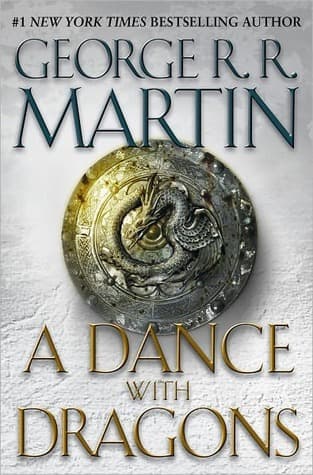
- A Dance with Dragons
George R.R. Martin
4.3 (556k) average on GoodreadsFantasyKnown for its large cast, political intrigue, and morally ambiguous characters in a dark fantasy setting.
- Harry Potter and the Sorcerer's Stone
J.K. Rowling
4.5 (7M) average on GoodreadsFantasyRescued from a miserable life under the stairs, an orphaned boy discovers he's a wizard destined for a magical school, where he uncovers a dangerous secret tied to the dark wizard who murdered his parents.
- The Hunger Games
Suzanne Collins
4.3 (6.4M) average on GoodreadsFantasyIn a future where children fight to the death on live television, Katniss Everdeen volunteers for the arena, turning a death sentence into a fight for survival and a spark of rebellion.
- 1984
George Orwell
4.2 (3.1M) average on GoodreadsPoliticsIn a future where surveillance and thought control are absolute, a man's search for truth clashes with the Party, showing that hope can be a form of rebellion.
- Divergent
Veronica Roth
4.2 (2.9M) average on GoodreadsFantasyIn a society divided by virtues, a sixteen-year-old's difference from the norm starts a rebellion that threatens her world.





Enjoyed the summary?
A summary gives you the shape of the book. The book itself has the detail, the examples and the voice.
Find The Bonehunters on AmazonAs an Amazon Associate, BookBrief earns from qualifying purchases. How we're funded