
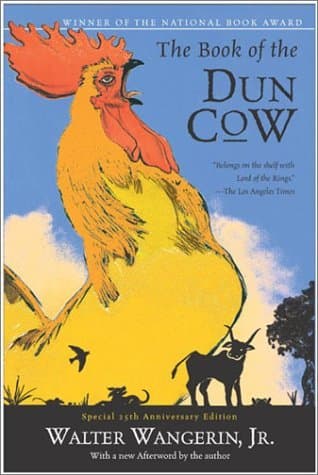
Synopsis
Covers the whole plot, including the ending.
- Difficulty
- Medium
- Pacing
- Moderate
- Mood
- Allegorical, Profound, Melancholy, Hopeful, Spiritual
- Read it if
- You enjoy allegorical fantasy with deep spiritual themes, anthropomorphic animals, and a classic good-vs-evil narrative.
- Skip it if
- You prefer lighthearted fantasy without heavy themes of sacrifice and despair, or are not interested in allegorical storytelling.
The Book of the Dun Cow Plot Summary
Covers the whole plot, including the ending.
Chauntecleer's Burden and the First Signs of Trouble
Chauntecleer, the aging Rooster, is the Keeper of the animals in a peaceful, sun-centered world. He feels the weight of his job, constantly worrying about his flock, which includes the Dun Cow, a peaceful, maternal figure, and her calf, Mondo. Chauntecleer has prophetic dreams of a terrible evil, an ancient monster named Wyrm, stirring beneath the earth. He tries to tell his wife, Pertelote, but she often dismisses his fears. The other animals, like the Dog, the Cat, and the Raven, live without knowing about the coming threat. Chauntecleer senses a growing unease in the world, a subtle shift that means danger, but he has trouble explaining it to his happy community.
Wyrm's Awakening and the Arrival of Cockatrice
Wyrm, the ancient evil imprisoned deep within the earth, begins to awaken. His stirring causes tremors and an unexplained chill that Chauntecleer feels strongly. Soon after, a monstrous creature called Cockatrice, a serpentine beast with a rooster's head, comes out of the earth. Cockatrice announces Wyrm's return, and he immediately starts causing fear among the animals. He is a creature of pure evil, able to kill with a glance and spread corruption. The animals, who lived in harmony, are terrified by this new, unknown evil. Chauntecleer, recognizing the creature from his dreams, understands that his worst fears are coming true.
The Dun Cow's Prophecy and the Journey to the North
The Dun Cow, a creature of spiritual power and gentleness, senses the true nature of Cockatrice and the awakening of Wyrm. She tells Chauntecleer that the only hope lies with her ancient mate, the Dun Bull, who lives in the far North. She explains that the Dun Bull is a powerful warrior, a 'Keeper' like Chauntecleer, but of a different, more fighting kind. The Dun Cow, despite her deep love for her calf, Mondo, decides to send him on a dangerous journey to find his father. She tells Mondo how important his mission is and the urgent need for the Dun Bull's help against the rising darkness, giving him a 'key' for his journey.
Mondo's Perilous Quest and Encounter with the Basilisk
Mondo, a young and inexperienced calf, begins his journey to the North. He faces many challenges, including dangerous lands and the constant threat of Wyrm's growing influence. Along the way, he meets the Basilisk, another of Wyrm's monstrous offspring, a creature even more terrifying than Cockatrice, with a deadly gaze. Mondo, guided by instinct and his mother's purpose, manages to escape the Basilisk, though he is deeply shaken. This journey changes Mondo from an innocent calf into a more resilient and determined individual, forcing him to face the harsh realities of the world and the evil of Wyrm.
Cockatrice's Reign of Terror and the Animals' Despair
Back in Chauntecleer's kingdom, Cockatrice continues his attacks. He preys on the animals' fears, spreading despair and mistrust. He demands tribute, forcing the animals to offer their food and even their young. The peaceful community is broken, and the animals, including the Dog, the Cat, and the Raven, are paralyzed by fear. Chauntecleer, despite his own terror, tries to rally them, but his words often fail. He feels the great burden of his failure to protect his flock and struggles with his faith in the face of such overwhelming evil. Pertelote, while supportive, often has trouble understanding the depth of his spiritual battle.
Mondo Reaches the Dun Bull and the Revelation of the Keepers
After a long and difficult journey, Mondo finally reaches the desolate Northern lands and finds his father, the Dun Bull. The Dun Bull is a formidable, stoic warrior, hardened by centuries of watching. He recognizes the 'key' Mondo carries and understands the urgency of the situation. The Dun Bull tells Mondo the ancient history of the world and the role of the Keepers – himself, the Dun Cow, and Chauntecleer – in maintaining the balance against Wyrm. He explains that Wyrm is an ancient, chaotic evil, and that their task is to contain him. The Dun Bull agrees to return with Mondo to face Wyrm, knowing the great sacrifice it will demand.
The Dun Bull's Return and the Battle with Cockatrice
The Dun Bull, with Mondo, returns to Chauntecleer's kingdom, bringing a glimmer of hope to the despairing animals. His imposing presence and resolve inspire a renewed, though cautious, sense of courage. A direct fight with Cockatrice becomes certain. The Dun Bull, a creature of great strength and ancient wisdom, fights Cockatrice in a fierce and brutal battle. The fight is a display of raw power against insidious evil, and the Dun Bull, despite his might, finds Cockatrice to be a cunning and dangerous opponent. The other animals watch, terrified but hopeful, as their champion fights for their survival.
The Dun Bull's Sacrifice and Wyrm's Full Emergence
The Dun Bull, in a climactic and devastating struggle, manages to defeat Cockatrice, crushing the monster. However, the victory comes at a terrible cost. Cockatrice inflicts a mortal wound upon the Dun Bull, poisoning him. As the Dun Bull dies, his protective powers weaken, and the earth itself begins to crack open. Wyrm, no longer just stirring, fully emerges from his prison. He is a creature of unimaginable size and evil, a serpentine beast of pure chaos. His appearance casts a shadow of utter despair over the world, signaling the ultimate fight that Chauntecleer and the Dun Cow had long feared.
Chauntecleer's Despair and the Dun Cow's Ultimate Sacrifice
With Wyrm fully unleashed and the Dun Bull dead, Chauntecleer falls into deep despair. He feels defeated, his faith shaken, and his ability to protect his flock seems lost. The animals are terrified, scattered by Wyrm's destructive presence. It is then that the Dun Cow, showing pure, sacrificial love, steps forward. Realizing that Wyrm is a creature of endless hunger and that only a perfect sacrifice can satisfy him, she offers herself. In an act of selflessness, the Dun Cow allows Wyrm to consume her, believing that her pure essence might satisfy or even change the evil.
The Transformation and the New Beginning
The Dun Cow's sacrifice has a profound and unexpected effect. Instead of simply being consumed, her pure, loving essence begins to change Wyrm from within. The monstrous, chaotic Wyrm is not destroyed but is changed, becoming the earth itself, a fertile, life-giving force rather than a destructive one. His immense power now sustains the world. The world is reborn, but it is a different world. The sun continues to circle the earth, but the animals can no longer speak, having lost their unique, spiritual connection to the world and each other. Chauntecleer, though grieving the loss of his friends and the old world, understands the great sacrifice and the new, quiet peace that has been achieved, becoming a silent guardian of this changed reality.
The Book of the Dun Cow Characters
Chauntecleer
Protagonist
The aging Rooster, leader and spiritual guardian of the animals.
Chauntecleer is the central figure, a deeply introspective and anxious Rooster burdened by the responsibility of his flock. He is the 'Keeper' of the animals, constantly worrying about their safety and plagued by prophetic dreams of Wyrm. He struggles with self-doubt and the isolation of his unique spiritual awareness. His journey is one of faith, leadership, and ultimately, acceptance of sacrifice. He embodies the intellectual and spiritual struggle against evil, seeking to understand and protect rather than merely fight.
Relationships: Pertelote (Wife, often dismissive of his deepest fears); Dun Cow (Spiritual confidante and fellow Keeper); Dun Bull (Fellow Keeper, a stark contrast in temperament)
The Dun Cow
Supporting
A gentle, maternal figure of immense spiritual power and sacrifice.
The Dun Cow is a creature of profound love, peace, and spiritual insight. She is the mother of Mondo and the ancient mate of the Dun Bull. She possesses a deep, intuitive understanding of the world's spiritual balance and the nature of Wyrm. Her role is one of ultimate sacrifice, offering herself to transform Wyrm and save the world. She represents unconditional love and the power of selfless giving, embodying a gentle but immense spiritual strength that ultimately triumphs over chaos.
Relationships: Mondo (Son, whom she sends on a quest); Dun Bull (Ancient mate, a warrior counterpart); Chauntecleer (Spiritual ally and friend)
Wyrm
Antagonist
The ancient, primordial evil imprisoned beneath the earth.
Wyrm is the central antagonist, an ancient, cosmic force of chaos, destruction, and insatiable hunger. He is not merely a monster but a primordial evil, a force that existed before creation and seeks to undo it. His awakening causes widespread terror and corruption. Wyrm represents the raw, untamed, destructive power of the universe, a force that cannot be simply defeated but must be transformed or contained. He is the ultimate test of faith and love for the Keepers and the animals.
Relationships: Cockatrice (Minion, an extension of his will); Basilisk (Minion, another manifestation of his evil)
Mondo
Supporting
The Dun Cow's calf, sent on a perilous quest to find his father.
Mondo is the young, innocent calf of the Dun Cow and Dun Bull. He is thrust into a terrifying world when his mother sends him on a quest to find his father. His journey is one of maturation, as he faces dangers like the Basilisk and learns courage and perseverance. Mondo represents innocence confronted by evil, and his quest serves as a pivotal plot device, bringing the Dun Bull into the conflict. He is a testament to the idea that even the smallest and most vulnerable can play a crucial role.
Relationships: Dun Cow (Mother, who sends him on his mission); Dun Bull (Father, whom he seeks)
The Dun Bull
Supporting
The ancient warrior and mate of the Dun Cow, a powerful Keeper of the North.
The Dun Bull is a formidable, stoic, and ancient warrior, the male counterpart to the Dun Cow. He resides in the desolate North, a 'Keeper' of a different temperament than Chauntecleer – one focused on physical strength and ancient vigilance against evil. He is a tragic hero, returning to fight Wyrm's minions and sacrificing himself in the process. He embodies strength, duty, and the willingness to fight a losing battle for the sake of others, a stark contrast to Chauntecleer's more contemplative nature.
Relationships: Dun Cow (Ancient mate, his spiritual counterpart); Mondo (Son, who brings him back to the world); Chauntecleer (Fellow Keeper, with whom he shares a burden)
Cockatrice
Antagonist
Wyrm's monstrous minion, spreading terror and corruption.
Cockatrice is the first of Wyrm's direct manifestations to emerge, a serpentine creature with a rooster's head, capable of killing with a glance. He is a harbinger of Wyrm's full awakening and serves as the immediate antagonist for Chauntecleer's community. Cockatrice embodies petty cruelty, fear-mongering, and the insidious corruption that precedes ultimate evil. His presence forces the animals to confront the reality of Wyrm's threat and tests Chauntecleer's leadership.
Relationships: Wyrm (Creator/master); Chauntecleer (Primary target of his torment)
Pertelote
Supporting
Chauntecleer's wife, often pragmatic and less prone to his anxieties.
Pertelote is Chauntecleer's wife, a loving but often exasperated hen. She represents the more grounded, practical aspects of life, often trying to soothe Chauntecleer's anxieties and dismiss his prophetic dreams as mere worries. While she cares deeply for him, she struggles to fully comprehend the spiritual burden he carries. Her character highlights Chauntecleer's isolation in his unique spiritual awareness and provides a contrast to his existential dread.
Relationships: Chauntecleer (Husband)
Dog
Supporting
A loyal but fearful member of Chauntecleer's flock.
The Dog is a faithful member of Chauntecleer's community, embodying loyalty and simple courage. He is one of the animals who experiences the growing terror of Cockatrice and Wyrm. While initially brave, he, like the others, succumbs to fear and despair under the monster's reign. His character represents the ordinary animal's struggle against overwhelming evil and the impact of fear on a once-peaceful community.
Relationships: Chauntecleer (Leader and friend)
Cat
Supporting
A cunning and observant, yet fearful, member of the community.
The Cat is another member of Chauntecleer's flock, characterized by her cunning and watchful nature. She, too, is deeply affected by the arrival of Cockatrice and the fear he instills. The Cat often observes the unfolding events with a mix of fear and an almost detached assessment, highlighting the different ways animals react to extreme danger. Her fear is palpable, and she represents the breakdown of the established order.
Relationships: Chauntecleer (Leader)
Raven
Supporting
A wise and ancient bird, a witness to the unfolding events.
The Raven is an older, more observant bird in Chauntecleer's community, often speaking in riddles or with an air of ancient knowledge. He seems to have a deeper, though perhaps less direct, understanding of the world's spiritual undercurrents than most animals, aside from Chauntecleer and the Dun Cow. He acts as a witness and occasional commentator, his pronouncements adding a layer of foreboding and ancient wisdom to the narrative.
Relationships: Chauntecleer (Fellow animal, though with a different perspective)
The Book of the Dun Cow Themes
Good vs. Evil and the Nature of Evil
The central theme explores the conflict between good and evil, shown by the Keepers (Chauntecleer, Dun Cow, Dun Bull) and Wyrm. The book looks at the nature of evil, portraying Wyrm not just as a villain but as a primordial, chaotic force that existed before creation. It suggests that evil is not always defeated by force but can be changed through love and sacrifice. The struggle is not just physical but spiritual, as Chauntecleer deals with the despair Wyrm's presence brings.
“For the world, which was made, was made in order to keep Wyrm bound.”
Sacrifice and Redemption Through Love
Sacrifice is a theme, ending with the Dun Cow's act. The Dun Bull sacrifices his life in battle, but the Dun Cow's selfless offering of herself to Wyrm truly changes the evil. This act shows the power of unconditional love to redeem and transform even the most ancient and destructive forces. It suggests that true victory over evil may not come through destruction, but through a radical act of self-giving that changes the very nature of the adversary, leading to a new, though changed, world.
“For the Dun Cow, in her purity and love, was the only one who could truly feed the hunger of Wyrm.”
Leadership and the Burden of Responsibility
Chauntecleer's character shows the theme of leadership and its great burden. He is the 'Keeper' of his flock, constantly worried about their well-being and burdened by the knowledge of coming doom. His leadership is not about power but about spiritual guardianship and protection, often leading to isolation and self-doubt. The story explores the weight of knowing a terrible truth and the struggle to inspire hope in the face of despair, showing the personal cost of true leadership.
“He was the Keeper. He had to keep them safe. But he could not.”
Loss of Innocence and a Changed World
The book explores the theme of loss of innocence, both for characters like Mondo and for the world itself. The once-peaceful, talking animal kingdom is broken by Wyrm's emergence. While a new world is created through sacrifice, it is a world where animals no longer speak and a certain primordial innocence is lost. This theme reflects a transition from a mythical, spiritually connected past to a more ordinary, silent present, suggesting that even acts of salvation come with profound and irreversible changes.
“And the animals no longer spoke, for the world had been remade, and their old tongues were gone.”
Faith and Despair
Faith and despair are present throughout Chauntecleer's journey. He struggles with keeping his faith when facing evil and the apparent pointlessness of his efforts. Cockatrice's arrival and Wyrm's full emergence push him to the brink of despair. The story suggests that faith is not the absence of doubt or fear, but the ability to continue despite them, and that ultimate hope can come from the deepest acts of selfless love, even when all seems lost.
“And Chauntecleer, the Keeper, felt the despair like a stone in his gizzard.”
Plot Devices & Literary Techniques
Prophetic Dreams
Chauntecleer's recurring dreams foreshadow Wyrm's awakening.
Chauntecleer is plagued by vivid, terrifying dreams of Wyrm stirring beneath the earth. These dreams serve as a crucial plot device, foreshadowing the impending danger and establishing Chauntecleer's unique spiritual sensitivity and the burden of his role as Keeper. They create a sense of foreboding and allow the reader to share in Chauntecleer's anxiety, building tension before the physical manifestation of evil. The dreams also highlight his isolation, as others often dismiss them.
The Keepers
An ancient lineage of guardians tasked with containing Wyrm.
The concept of the 'Keepers' (Chauntecleer, the Dun Cow, and the Dun Bull) is a central plot device that defines the protagonists' roles and the world's mythology. It establishes an ancient order and a predetermined struggle against Wyrm. Each Keeper embodies a different aspect of guardianship – spiritual, maternal love, and warrior strength – suggesting that multiple facets are needed to confront ultimate evil. This device provides a framework for the narrative and gives historical depth to the conflict.
The Journey/Quest
Mondo's arduous journey to find the Dun Bull.
Mondo's quest to the North to find his father, the Dun Bull, serves as a classic heroic journey. It allows for the introduction of other manifestations of Wyrm's evil (like the Basilisk) and facilitates Mondo's character development from an innocent calf to a more resilient individual. This device expands the scope of the world, brings a crucial ally into the conflict, and heightens the sense of urgency and peril as the narrative shifts between Mondo's progress and the growing terror in Chauntecleer's kingdom.
Symbolism of the Animals
Animals representing different archetypes and aspects of humanity/spirituality.
The animals in the book are not merely characters but carry significant symbolic weight. Chauntecleer (the Rooster) symbolizes vigilance, pride, and spiritual leadership. The Dun Cow embodies maternal love, sacrifice, and divine purity. The Dun Bull represents ancient strength, duty, and warrior spirit. Wyrm symbolizes primordial chaos and evil. This device enriches the narrative, allowing the story to explore complex theological and philosophical themes through accessible, archetypal figures, making the fantasy resonate on a deeper level.
Transformation of Evil
Wyrm's metamorphosis into the earth itself.
The transformation of Wyrm from a destructive entity into the life-giving earth is a unique and powerful plot device. Instead of a straightforward defeat, Wyrm is transmuted by the Dun Cow's sacrifice. This challenges conventional notions of good triumphing over evil, suggesting that pure love can redeem and redirect even the most fundamental forces of chaos. It results in a new creation, albeit one with significant changes, providing a profound and bittersweet resolution to the cosmic conflict.
The Book of the Dun Cow Quotes
“The world is not a safe place to live in. It never was, and it never will be.”
“We are not here to be safe. We are here to be brave.”
“The Dun Cow is the memory of God in the world.”
“Evil is not a thing; it is the absence of a thing.”
“To be a rooster is to crow. To crow is to announce the dawn.”
“Love is the only thing that can drive out fear.”
“The world is full of wonder, but also full of terror.”
“We must fight not because we hate what is in front of us, but because we love what is behind us.”
“In the end, it is not the strength of our bodies, but the strength of our spirits that will save us.”
“The night is darkest just before the dawn, but the dawn always comes.”
“To know the light, one must first have known the darkness.”
“Every creature has a song to sing, a part to play in the great symphony of life.”
“The greatest battles are fought within the soul.”
“Faith is not the absence of doubt, but the courage to act in spite of it.”
Quiz
10 questions on the plot and the characters. Each answer comes with a short explanation.
Question 1
What is the name of the rooster who rules over the animal kingdom in the book?
- Cockatrice
- Chauntecleer
- Chanticleer
- Cockadoodle
Show answer
B. Chauntecleer Chauntecleer is the rooster ruler of the animal kingdom, a central character who leads the animals in their struggle against Wyrm.
Question 2
What ancient evil is imprisoned beneath the earth that the animals unknowingly guard?
- The Dragon
- The Serpent
- Wyrm
- The Beast
Show answer
C. Wyrm Wyrm is the monster of evil long imprisoned beneath the earth, and the animals are its Keepers, though they are unaware of this role until it begins to break free.
Question 3
In what era is the story set, according to the book's description?
- A time when animals could not speak
- A time when the sun turned around the earth
- A modern-day setting
- A post-apocalyptic future
Show answer
B. A time when the sun turned around the earth The story is set in a fantastical past when the sun turned around the earth and animals could speak, creating a mythic and allegorical backdrop.
Question 4
What is the primary role of the animals in relation to Wyrm?
- They are its creators
- They are its worshippers
- They are its Keepers
- They are its prey
Show answer
C. They are its Keepers The animals are the Keepers of Wyrm, tasked with guarding its imprisonment, though this knowledge is hidden from them until the plot unfolds.
Question 5
Which of these best describes the initial state of Chauntecleer's kingdom?
- Constantly at war
- More or less peaceful
- Completely chaotic
- Under human control
Show answer
B. More or less peaceful Chauntecleer's kingdom is described as 'more or less peaceful' at the start, setting the stage for the disruption caused by Wyrm's escape.
Question 6
What major event triggers the central conflict of the story?
- A drought affecting the animals
- Wyrm breaking free from imprisonment
- Chauntecleer's death
- The arrival of human hunters
Show answer
B. Wyrm breaking free from imprisonment The central conflict arises when Wyrm, imprisoned beneath the earth, begins to break free, threatening the animal kingdom and revealing their role as Keepers.
Question 7
How does the book blend elements of fantasy and spirituality?
- Through scientific explanations of animal speech
- By depicting animals in a purely realistic setting
- Through allegorical themes of good vs. evil and guardianship
- By focusing on human characters as main protagonists
Show answer
C. Through allegorical themes of good vs. evil and guardianship The book uses fantasy elements like speaking animals and a mythic setting to explore spiritual themes such as the battle between good and evil, duty, and redemption.
Question 8
What is implied about the animals' awareness of their role as Keepers at the story's beginning?
- They are fully aware and trained for it
- They have forgotten it over time
- They are completely unaware
- They actively deny it
Show answer
C. They are completely unaware The animals are completely unaware that they are the Keepers of Wyrm; this ignorance adds to the tension as Wyrm begins to escape and they must confront this hidden truth.
Question 9
Which literary genre is NOT primarily associated with 'The Book of the Dun Cow' based on the description?
- Fantasy
- Spirituality
- Young Adult
- Historical Fiction
Show answer
D. Historical Fiction While the book incorporates fantasy, spirituality, and Young Adult elements, it is not primarily historical fiction; its setting is a mythic, allegorical past rather than a documented historical period.
Question 10
What does the imprisonment of Wyrm symbolize in the broader thematic context of the book?
- The inevitability of natural disasters
- The hidden nature of evil and the responsibility to confront it
- The superiority of animals over humans
- The importance of scientific progress
Show answer
B. The hidden nature of evil and the responsibility to confront it Wyrm's imprisonment symbolizes the latent presence of evil in the world and the moral duty of characters (like the animals as Keepers) to guard against and confront it, reflecting spiritual and ethical themes.
The Book of the Dun Cow FAQ
What is 'The Book of the Dun Cow' about?
The novel follows Chauntecleer the Rooster, who rules a peaceful animal kingdom where the sun revolves around the earth. Unbeknownst to the animals, they are the Keepers of Wyrm, an ancient evil entity imprisoned underground. When Wyrm begins breaking free, Chauntecleer must lead his community—including the Dun Cow, Mundo Cani Dog, and Pertelote the Hen—in a spiritual battle against cosmic darkness.
Why should I read 'The Book of the Dun Cow'?
It's a unique blend of animal fable, epic fantasy, and Christian allegory that explores profound themes of good versus evil, sacrifice, and leadership. Wangerin's rich storytelling creates a mythic world where roosters crow prayers and dogs embody loyalty, offering both thrilling adventure and deep spiritual reflection.
What is the background/setting of 'The Book of the Dun Cow'?
The story occurs in a mythic pre-modern era where animals speak and maintain human-like societies. Chauntecleer's coop serves as the central kingdom, with surrounding territories including the treacherous land where Cockatrice emerges. The cosmic setting features a geocentric universe where celestial movements reflect spiritual realities.
What are the most memorable quotes?
Key quotes include Chauntecleer's prayerful crowing ('Christe eleison'), the Dun Cow's mysterious pronouncements about cosmic balance, and Mundo Cani's loyal declaration 'I am your dog.' Pertelote's wisdom—'We are keepers of one another'—encapsulates the novel's theme of communal responsibility.
What writing style does the author use?
Wangerin employs a lyrical, almost biblical prose style with rich symbolism and allegorical depth. The narrative blends animal fable conventions with epic tragedy, using formal dialogue for animals while maintaining emotional realism. Descriptions of cosmic events carry mythic weight.
What minor details add significant meaning?
The precise timing of Chauntecleer's crows corresponds to canonical hours of prayer, transforming rooster behavior into spiritual discipline. Mundo Cani's constant shadow-following symbolizes devoted service, while the Dun Cow's single tear at key moments represents divine sorrow over creation's brokenness.
What are some subtle foreshadowing moments?
Early descriptions of earth tremors hint at Wyrm's stirrings beneath. Chauntecleer's nightmares of dark tunnels preview his underground confrontation. The Dun Cow's initial reluctance to intervene suggests the coming crisis requires animal agency rather than direct divine intervention.
What unexpected character connections exist?
Cockatrice—Wyrm's monstrous offspring—mirrors Chauntecleer's own pride and potential for corruption. Mundo Cani's seemingly simple devotion contrasts with Chauntecleer's complex leadership, creating a foil relationship. The Dun Cow's mysterious nature connects animal, human, and divine realms.
What are unspoken character motivations?
Chauntecleer's rigid leadership stems from deep insecurity about his worthiness. Mundo Cani's loyalty masks survivor's guilt from past tragedies. Pertelote's practical wisdom conceals her fear of Chauntecleer's spiritual isolation. Even Wyrm's evil arises from twisted desire for recognition rather than mere destruction.
What psychological complexities do characters exhibit?
Chauntecleer embodies the tension between noble responsibility and prideful arrogance. Mundo Cani demonstrates how trauma can manifest as either debilitating grief or transformative compassion. Pertelote balances emotional support with necessary confrontation, while Cockatrice represents pure id unleashed from moral constraints.
What are the major emotional turning points?
Chauntecleer's humiliation after losing a crowing contest breaks his pride. The death of Wee Widow Mouse forces communal mourning. Mundo Cani's sacrifice during the final battle transforms grief into redemption. The Dun Cow's departure leaves animals with mature responsibility rather than childlike dependence.
How do relationship dynamics evolve?
Chauntecleer and Pertelote's relationship grows from practical partnership to deep spiritual companionship. Mundo Cani transitions from outsider to essential community member through sacrificial acts. The animals' relationship with the Dun Cow shifts from seeing her as magical protector to recognizing her as guide toward self-reliance.
Which parts remain ambiguous or open-ended?
The Dun Cow's exact nature—whether divine being, cosmic force, or collective ideal—is never fully explained. Wyrm's ultimate fate after being re-imprisoned remains uncertain. The story's placement in cosmic history (before human dominance) invites speculation about its connection to human spiritual narratives.
What are controversial scenes or decisions?
Chauntecleer's initial refusal to believe Wyrm's threat endangers the community. The violent confrontation with Cockatrice raises questions about necessary force versus pacifism. Some readers debate whether Mundo Cani's sacrificial death represents noble redemption or tragic waste.
'The Book of the Dun Cow' ending explained: how it ends & what it means
After Wyrm is re-imprisoned through communal sacrifice, the Dun Cow departs, leaving the animals to maintain their hard-won peace independently. Chauntecleer continues leading but with humbler wisdom. The ending suggests evil is contained but not eradicated, requiring ongoing vigilance and that spiritual maturity means operating without obvious divine intervention.
What is the significance of the geocentric universe?
The sun revolving around earth reflects a pre-modern worldview where creation centers on moral drama rather than scientific reality. This setting emphasizes that spiritual truths transcend physical laws, positioning the animals' battle as cosmically significant rather than merely local.
How does animal symbolism function in the story?
Roosters traditionally herald dawn, making Chauntecleer's crows spiritual announcements. Dogs symbolize loyalty in Mundo Cani. The Dun Cow combines bovine patience with mysterious grace. Cockatrice—part rooster, part serpent—represents corrupted creation. Each animal embodies both natural traits and spiritual archetypes.
What role does community play versus individual heroism?
While Chauntecleer appears as protagonist, victory requires collective effort: Pertelote's wisdom, Mundo Cani's sacrifice, minor characters' support, and even former enemies' cooperation. The novel critiques solitary heroism, showing that evil is too vast for any individual to confront alone.
How does the novel handle the problem of evil?
Wyrm represents evil as both external force (monster underground) and internal temptation (pride in Chauntecleer, despair in Mundo Cani). The solution involves acknowledging evil's reality while refusing to be defined by it—through prayer, community, and sacrificial love rather than mere force.
About the author

Walter Wangerin Jr. was an American author known for his contributions to fiction, particularly in the realm of fantasy and spirituality. His notable work, The Book of the Dun Cow, explores themes of good versus evil through an allegorical tale featuring anthropomorphic animals. Wangerin's writing often reflects his deep Christian faith and has garnered attention for its imaginative storytelling.
Similar books
- Watership Down
Richard Adams
4.1 (434k) average on GoodreadsFantasyFeatures anthropomorphic animals facing existential threats with allegorical undertones.
- The Last Unicorn
Peter S. Beagle
4.3 (8k) average on GoodreadsFantasyA poignant fantasy journey with mythical creatures and a sense of impending loss.
- Jonathan Livingston Seagull
Richard Bach
3.8 (202k) average on GoodreadsFantasyA short, allegorical tale exploring spiritual themes through an animal protagonist.
- A Wizard of Earthsea
Ursula K. Le Guin
4.0 (241k) average on GoodreadsFantasyWhile both are fantasy with spiritual undertones, Le Guin's work explores moral ambiguity and the 'shadow self' with greater psychological depth and nuance, focusing more on internal struggle and personal responsibility, whereas Wangerin's conflict is more overtly allegorical and divinely influenced.
- Harry Potter and the Sorcerer's Stone
J.K. Rowling
4.5 (7M) average on GoodreadsFantasyRescued from a miserable life under the stairs, an orphaned boy discovers he's a wizard destined for a magical school, where he uncovers a dangerous secret tied to the dark wizard who murdered his parents.
- The Hunger Games
Suzanne Collins
4.3 (6.4M) average on GoodreadsFantasyIn a future where children fight to the death on live television, Katniss Everdeen volunteers for the arena, turning a death sentence into a fight for survival and a spark of rebellion.




Enjoyed the summary?
A summary gives you the shape of the book. The book itself has the detail, the examples and the voice.
Find The Book of the Dun Cow on AmazonAs an Amazon Associate, BookBrief earns from qualifying purchases. How we're funded