
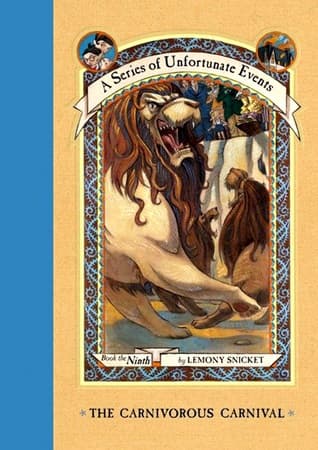
Synopsis
Covers the whole plot, including the ending.
- Difficulty
- Easy
- Pacing
- Moderate
- Mood
- Melancholy, Absurd, Mysterious, Witty
- Read it if
- You enjoy dark humor, wordplay, and a quirky, episodic adventure with clever children outwitting incompetent villains.
- Skip it if
- You prefer clear-cut resolutions, optimistic stories, or dislike recurring themes of misfortune and injustice.
The Carnivorous Carnival Plot Summary
Covers the whole plot, including the ending.
The Road to Caligari Carnival
After escaping Esme and Jerome Squalor in a runaway caravan, the Baudelaire orphans—Violet, Klaus, and Sunny—are left on a deserted road. They avoid being hit by a truck driven by Hugo, who, with Kevin and Colette, are 'freaks' on their way to the Caligari Carnival. The Baudelaires need a safe place and want to find V.F.D. information, so they decide to pretend to be freaks to get in and avoid Count Olaf. They create characters: Beverly and Elliot (a two-headed person) for Violet and Klaus, and a wolf baby for Sunny, hoping to fit in with the carnival's performers.
Arrival at Caligari Carnival
At the Caligari Carnival, the Baudelaires meet Madame Lulu, a fortune-teller who claims to know past and future secrets. She gives readings from a tent using a crystal ball and many index cards. The orphans are assigned to the 'House of Freaks,' joining Hugo, Kevin, and Colette in the show. They learn about the carnival's schedule and that the main attraction is a lion pit. The Baudelaires also discover that the Hook-Handed Man, one of Count Olaf's henchmen, is already working at the carnival, making their disguise even more important for their safety.
Madame Lulu's Prophecies and Olaf's Arrival
The Baudelaires visit Madame Lulu, hoping for clues about V.F.D. and their parents. Lulu is vague, offering only cryptic statements. She mentions a 'survivor' of the fire that destroyed the Baudelaire mansion, making the orphans think one of their parents might be alive. Soon after, Count Olaf and his theater group arrive at the carnival, disguised as a ringmaster and assistants. Olaf immediately takes control of the carnival. He announces a new, more dangerous act where one of the 'freaks' will be fed to the lions, creating a scary atmosphere for the Baudelaires.
The Lion Pit and the Search for Clues
Violet, Klaus, and Sunny realize they must investigate the lion pit, believing it might hold a clue about the survivor or V.F.D. While Violet and Klaus try to understand Madame Lulu's index card system in her tent, Sunny, disguised as Chabo the Wolf Baby, is forced into Olaf's cruel acts. The orphans learn the lion pit is truly dangerous. They suspect Olaf plans to use the lions to get rid of someone, possibly them or another V.F.D. member. The Hook-Handed Man, working for Olaf, watches everyone closely, making their investigation risky.
Madame Lulu's True Identity and the Plan
Klaus discovers Madame Lulu is not a true seer but uses a large collection of V.F.D. documents for her 'prophecies,' often twisting information. He realizes her index cards contain important V.F.D. secrets and possibly the survivor's location. The Baudelaires learn Lulu is a former V.F.D. member who left and now uses her knowledge for her own benefit. They plan: while Sunny distracts Olaf during the lion show, Violet and Klaus will sneak into Lulu's tent to get a specific map they believe holds the key to the survivor's whereabouts. The map is rumored to point to the last safe place for V.F.D. volunteers.
The Lion Pit Showdown
Count Olaf announces that a blindfolded volunteer will throw a dart to choose which 'freak' will be fed to the lions. The Hook-Handed Man manipulates the dart to land on Hugo, Kevin, or Colette. As the chosen 'freak' is about to be pushed into the pit, Sunny bites Olaf's leg, creating a distraction. This unexpected act causes chaos among the carnival-goers and Olaf's group. While the crowd is distracted, the Baudelaires hope to get the map from Madame Lulu's tent, but the situation quickly becomes a dangerous free-for-all.
The Collapse of Madame Lulu's Tent
During the commotion from Sunny's diversion, a struggle happens near Madame Lulu's tent. The tent collapses, revealing its contents. Among the scattered index cards and old items, Violet and Klaus spot the map they've been searching for. It is a detailed, coded map that seems to point towards a mountain range. However, the map is incomplete and hard to read. Madame Lulu, trapped under the debris, reveals more about V.F.D.'s history and the split within the organization, stressing the map's importance for both sides of the V.F.D. conflict.
The Fate of Madame Lulu
As Madame Lulu lies hurt, Count Olaf confronts her. Selfishly, she offers to tell Olaf the survivor's location if he spares her. However, before she can finish, Olaf's henchmen accidentally push her into the lion pit during a struggle. Her death leaves the Baudelaires with only a partial understanding of the map and the survivor's location. With Olaf's group closing in and the lions still a threat, the orphans realize they must escape the carnival immediately, taking the incomplete map as their only hope for finding the survivor and understanding V.F.D.
Escape from the Carnival
The carnival, already in chaos, catches fire, possibly by accident or arson. Amidst the flames and panic, the Baudelaires, with Hugo, Kevin, and Colette, make a desperate run for freedom. Count Olaf and his henchmen chase them, determined to capture the orphans and the map. The Baudelaires use their cleverness to create diversions and overcome obstacles, moving through the burning tents and escaping the villains. They leave the carnival behind, a fiery reminder of the danger they barely escaped, carrying the fragmented map and the burden of Madame Lulu's death.
The Incomplete Map and a New Direction
Having escaped the burning Caligari Carnival, the Baudelaire orphans are again on the run, but now with a clue: the incomplete map from Madame Lulu's tent. They study the cryptic markings and realize it points towards the Mortmain Mountains, a dangerous, remote area. Despite the risks, they decide to follow this lead, believing it is their best chance to find the survivor of the Baudelaire fire and learn more V.F.D. secrets. The journey ahead will be challenging, but the hope of finding a family member drives them.
Principal Figures
Violet Baudelaire
Protagonist
The eldest Baudelaire, an inventive and resourceful inventor.
Violet is the eldest Baudelaire orphan, known for her exceptional talent in inventing and problem-solving. When deep in thought, she ties her hair back with a ribbon. She is fiercely protective of her younger siblings, Klaus and Sunny, and often devises ingenious contraptions or plans to get them out of perilous situations. Her intelligence and quick thinking are crucial for the orphans' survival against Count Olaf's schemes. She constantly seeks practical solutions to their seemingly insurmountable problems.
Relationships: Klaus Baudelaire (Younger brother, intellectual partner); Sunny Baudelaire (Younger sister, she cares for and protects her); Count Olaf (Arch-nemesis, she constantly thwarts his plans)
Klaus Baudelaire
Protagonist
The middle Baudelaire, a prodigious reader and researcher.
Klaus is the middle Baudelaire child, distinguished by his love for books and his photographic memory. He can recall vast amounts of information from his readings, making him the family's primary researcher and strategist. He often uncovers crucial details from books and documents that help the Baudelaires understand their predicaments and devise escape plans. His intellectual curiosity drives him to seek answers, particularly regarding V.F.D. and the mystery surrounding his parents' death. He is a loyal and brave brother.
Relationships: Violet Baudelaire (Older sister, often works with her to solve problems); Sunny Baudelaire (Younger sister, he cares for and protects her); Count Olaf (Antagonist, he tries to outsmart him)
Sunny Baudelaire
Protagonist
The youngest Baudelaire, with unusually sharp teeth and a growing vocabulary.
Sunny is the infant of the Baudelaire family. Initially communicating in a series of babbles that only her siblings can understand, her vocabulary expands throughout the series. She possesses unusually sharp teeth, which she uses for biting, climbing, and sometimes even as tools. Despite her age, Sunny is remarkably brave, intelligent, and often contributes to the orphans' escape plans with her unique abilities. Her innocence and small size often make her underestimated by their enemies, which she sometimes uses to her advantage.
Relationships: Violet Baudelaire (Older sister, she is protected and cared for by her); Klaus Baudelaire (Older brother, he is protected and cared for by him); Count Olaf (Antagonist, she often physically thwarts his plans)
Count Olaf
Antagonist
The relentless villain pursuing the Baudelaire fortune.
Count Olaf is the primary antagonist of the series, a greedy and cruel actor who relentlessly pursues the Baudelaire fortune. He is recognizable by his unibrow, a tattoo of an eye on his ankle, and his constantly shifting disguises. Olaf is cunning, manipulative, and utterly devoid of empathy, willing to commit any crime, including murder, to get his hands on the orphans' inheritance. His theatrical background often influences his elaborate, albeit flawed, schemes. He is often accompanied by his equally villainous theater troupe.
Relationships: Baudelaire Orphans (Arch-enemy, he seeks to steal their inheritance); Esme Squalor (Accomplice/girlfriend, they share a villainous bond); Hook-Handed Man (Henchman, loyal follower)
Madame Lulu
Supporting
The enigmatic fortune-teller of Caligari Carnival.
Madame Lulu is the mysterious and seemingly omniscient fortune-teller at the Caligari Carnival. She claims to know everything about everyone, using a crystal ball and a vast collection of index cards to give her 'prophecies.' However, she is later revealed to be a former V.F.D. member who defected and uses her knowledge, derived from stolen V.F.D. documents, for personal gain and to maintain her facade. She is indecisive and often gives ambiguous advice, reluctant to fully commit to either side of the V.F.D. schism. Her true motivations are complex and self-serving.
Relationships: Baudelaire Orphans (Source of cryptic information, unwilling ally); Count Olaf (She tries to appease and manipulate him for her own survival)
Hook-Handed Man
Supporting
One of Count Olaf's loyal and intimidating henchmen.
The Hook-Handed Man is one of Count Olaf's most loyal and frequently appearing henchmen. He is characterized by his two prosthetic hooks where his hands should be, which he uses with surprising dexterity. He is physically imposing and often acts as Olaf's enforcer, carrying out his more brutal commands. While not particularly intelligent, his unwavering loyalty and intimidating presence make him a constant threat to the Baudelaire orphans. He is often the one to directly confront the children or carry out the physical aspects of Olaf's schemes.
Relationships: Count Olaf (Loyal henchman and enforcer); Baudelaire Orphans (Antagonist, he directly threatens them)
Hugo, Kevin, and Colette
Supporting
The 'freaks' of Caligari Carnival.
Hugo, Kevin, and Colette are three 'freaks' who work at the Caligari Carnival. Hugo is a hunchback, Kevin is ambidextrous (able to use both hands equally well), and Colette is a contortionist. They are kind to the Baudelaires, who pose as their fellow freaks. They are somewhat naive and easily intimidated by Count Olaf, but they show compassion towards the orphans. Their lives are defined by their perceived 'uniqueness,' which the carnival exploits for entertainment. They represent the marginalized and vulnerable members of society.
Relationships: Baudelaire Orphans (Fellow 'freaks,' they offer camaraderie and some protection)
Themes & Insights
The Nature of Truth and Deception
This theme is important in 'The Carnivorous Carnival,' shown through Madame Lulu. She is a 'fortune-teller' without real powers, who instead uses information from her V.F.D. files. Her 'prophecies' are vague and often self-serving, showing how easily people can be tricked by partial truths or unclear promises. The Baudelaires themselves must wear disguises and use deception to survive in the carnival, blurring the lines between honesty and necessary tricks. The carnival, by its nature, relies on illusion and spectacle, making it a fitting place for this theme.
“A fortune-teller is not a person who can see the future; a fortune-teller is a person who makes money by telling people what they want to hear.”
The Marginalization of the 'Other'
The Caligari Carnival is a small example of how society treats those seen as 'different.' The 'freaks'—Hugo, Kevin, Colette, and the disguised Baudelaires—are used for public entertainment. Their unique qualities, like a hunchback, ambidexterity, or contortionism, are sensationalized instead of understood. Count Olaf's cruelty makes this worse, as he sees them as disposable for his gruesome entertainment, leading to his plan to feed one to the lions. This theme criticizes how society often excludes and mistreats people who do not fit typical norms.
“People are often afraid of what they do not understand.”
The Weight of Secrets and Knowledge
The idea of secrets and the weight of knowledge is explored through Madame Lulu's V.F.D. index cards. Her collection is a large, unorganized store of information that, while possibly valuable, is also dangerous and easily misused. Klaus's discovery of her methods shows that knowledge, without context or honesty, can be twisted or lead to bad outcomes. The Baudelaires constantly seek knowledge about V.F.D. and their parents, but each piece of information they find often brings more questions and greater danger, showing that truth can be a double-edged sword.
“A secret is not something you keep from others, it is something you keep from yourself.”
The Search for Family and Belonging
Despite being in constant danger, the Baudelaires' main goal is to find a safe home and connect to their past. Madame Lulu's hint about a 'survivor' sparks hope that one of their parents might still be alive, strengthening their resolve to understand the map. Even within the carnival, they seek a sense of belonging among the other 'freaks,' finding a temporary, fragile community. This theme highlights the orphans' deep emotional need for family and stability amid their chaotic and lonely lives, and their willingness to face any danger for that hope.
“It is a curious thing, the need for family, even a family that has been taken away from you.”
Plot Devices & Literary Techniques
The Incomplete Map
A fragmented guide to the survivor's location and V.F.D. secrets.
The incomplete map, retrieved from Madame Lulu's tent, serves as a crucial MacGuffin and a symbol of the Baudelaires' ongoing quest. It represents both hope and frustration, as it offers a potential path to the survivor but is riddled with missing pieces and cryptic markings. This device propels the plot forward by giving the orphans a new, albeit vague, destination. Its incompleteness ensures that the mystery of V.F.D. and the survivor's whereabouts remains unsolved, forcing the Baudelaires into further perilous adventures while also demonstrating that not all answers are easily found.
Madame Lulu's Crystal Ball and Index Cards
A false oracle powered by stolen V.F.D. intelligence.
Madame Lulu's crystal ball and her vast collection of index cards are a clever plot device that initially misleads both the characters and the reader. The crystal ball is merely a prop, while the index cards are revealed to be a disorganized archive of V.F.D. intelligence. This device highlights the theme of truth versus deception, demonstrating how information can be misused and manipulated. It also provides a mechanism for the Baudelaires to uncover crucial, albeit fragmented, details about V.F.D. and the survivor, while simultaneously exposing Lulu's ambiguous allegiance and moral compromises.
The Lion Pit
A deadly spectacle used by Count Olaf for murder and intimidation.
The lion pit is a harrowing plot device that creates immediate and visceral danger for the Baudelaires and the other 'freaks.' It serves as a literal death trap and a symbol of Count Olaf's escalating cruelty and disregard for human life. The threat of being thrown into the pit drives much of the tension and forces the Baudelaires to act decisively. It also serves as the climax of the carnival setting, leading to Madame Lulu's demise and the subsequent escape of the orphans, effectively closing this chapter of their journey with a brutal and unforgettable event.
The 'Freak' Disguises
The Baudelaires' temporary identities to infiltrate the carnival.
The Baudelaire orphans' disguises as 'freaks' (Beverly and Elliot, the two-headed person, and Chabo the Wolf Baby) are a classic plot device in the series. These disguises allow them to infiltrate the Caligari Carnival and observe Count Olaf's actions from within, providing a temporary shield from immediate recognition. However, the disguises also place them in greater danger, as they become targets of Olaf's cruel 'entertainment.' This device explores themes of identity, marginalization, and the necessity of deception for survival, while also showcasing the orphans' adaptability and resourcefulness.
The Carnivorous Carnival Quotes
“There are many, many people in the world, and while one of the things that makes us individuals is our own particular list of fears, we aren't usually afraid of all the same things.”
“No matter who you are, no matter where you live, and no matter how many people are chasing you, you're going to have to make some compromises.”
“It is a legal fact that when someone says 'I object!' in a courtroom, it means that the person who is speaking thinks that something is wrong with the way the trial is proceeding.”
“It is a curious thing, but you have to be careful when you're making a joke, especially if it's about someone else.”
“It is a sad but true fact that sometimes the most important things are not the things that are most easily seen.”
“The world is a vast and complicated place, and there are many people in it who are not what they seem.”
“You can always tell a lot about a person by the way they treat those who they believe are beneath them.”
“It is often the case that when one is in a great deal of trouble, one finds oneself in an even greater deal of trouble.”
“The saying 'Curiosity killed the cat' is a good one, but it is often misunderstood.”
“Just because something is traditional doesn't mean it's right.”
“Sometimes, the only way to get through something terrible is to pretend that it's not happening, or that it's happening to someone else.”
“It is a rare and precious thing to find someone who understands you, even if they don't agree with you.”
“The human mind is a mysterious and complicated thing, and it often does not behave in the way we expect it to.”
“There are some things that cannot be unseen, and some things that cannot be unheard.”
“It is a unfortunate truth that when you are in a difficult situation, it is often difficult to tell who your friends are.”
Quiz
10 questions on the plot and the characters. Each answer comes with a short explanation.
Question 1
Which of the following items is NOT explicitly mentioned by Lemony Snicket in his introduction as an 'unnerving ingredient' of the story?
- A confusing map
- An ambidextrous person
- A rusty nail
- Chabo the Wolf Baby
Show answer
C. A rusty nail Lemony Snicket mentions a confusing map, an ambidextrous person, an unruly crowd, a wooden plank, and Chabo the Wolf Baby as unnerving ingredients. A rusty nail is not listed.
Question 2
What disguise do the Baudelaire orphans adopt to infiltrate the Caligari Carnival?
- Fortune tellers
- Freak show performers
- Carnival barkers
- Lion tamers
Show answer
B. Freak show performers The Baudelaire orphans disguise themselves as 'freaks' to get into the carnival: Violet as a two-headed person, Klaus as a wolf-boy, and Sunny as a a person with hands where her feet should be.
Question 3
Who is the owner and ringmaster of the Caligari Carnival?
- Count Olaf
- Madame Lulu
- Kevin
- Jacques Snicket
Show answer
B. Madame Lulu Madame Lulu is the mysterious fortune teller who owns and operates the Caligari Carnival.
Question 4
What is Madame Lulu's true identity, or rather, her previous role related to the V.F.D.?
- She was a librarian for the V.F.D.
- She was an oracle who used her crystal ball to tell the future.
- She was a member of the V.F.D. who used her crystal ball to provide information, not predict the future.
- She was a spy who infiltrated Count Olaf's troupe.
Show answer
C. She was a member of the V.F.D. who used her crystal ball to provide information, not predict the future. Madame Lulu was once a member of the V.F.D. who used her crystal ball (a large, reflective globe) to gather and transmit information, not to genuinely predict the future.
Question 5
What significant piece of information do the Baudelaires hope to gain from Madame Lulu?
- The location of their parents.
- The whereabouts of the Quagmire triplets.
- The secret hideout of Count Olaf.
- The meaning of the V.F.D. motto.
Show answer
B. The whereabouts of the Quagmire triplets. The Baudelaires hope to learn the location of the Quagmire triplets, who they believe are also at the carnival or have been there recently.
Question 6
Which of Count Olaf's henchpersons is described as ambidextrous?
- The Hook-Handed Man
- The Bald Man with the Long Nose
- Kevin
- The White-Faced Women
Show answer
C. Kevin Kevin, one of Count Olaf's new henchmen from the carnival, is noted for being ambidextrous, able to use both hands with equal skill.
Question 7
What is the ultimate fate of Madame Lulu and her crystal ball?
- She escapes with the Baudelaires, taking her crystal ball with her.
- She is pushed into the lion pit, and her crystal ball shatters.
- She is revealed to be a V.F.D. member and helps the Baudelaires.
- She joins Count Olaf's troupe willingly, bringing her crystal ball.
Show answer
B. She is pushed into the lion pit, and her crystal ball shatters. During a struggle, Madame Lulu is accidentally pushed into the pit of hungry lions by Count Olaf's henchmen, and her crystal ball falls in and shatters.
Question 8
The theme of 'truth versus deception' is prominent in this book. How does Madame Lulu embody this theme?
- She always tells the truth, even when it's painful.
- She claims to tell the future but only uses her crystal ball for information gathering, representing the blurred lines between genuine insight and manipulation.
- She is honest about her past but lies about her present intentions.
- She deceives Count Olaf by pretending to be on his side.
Show answer
B. She claims to tell the future but only uses her crystal ball for information gathering, representing the blurred lines between genuine insight and manipulation. Madame Lulu represents the ambiguity of truth; she offers 'fortunes' that are often vague or based on collected information rather than actual foresight, blurring the line between helpful knowledge and outright deception.
Question 9
What is the significance of the 'incredibly handsome man' and the 'incredibly beautiful woman' mentioned in the context of Madame Lulu's tent?
- They are the Baudelaire parents, who were hiding at the carnival.
- They are the parents of the Quagmire triplets, who Madame Lulu had seen.
- They are members of the V.F.D. who left a message for the Baudelaires.
- They are a red herring, meant to distract the orphans.
Show answer
B. They are the parents of the Quagmire triplets, who Madame Lulu had seen. Madame Lulu mentions seeing an 'incredibly handsome man' and an 'incredibly beautiful woman' who were looking for their children, implying they were the Quagmire parents, not the Baudelaire parents.
Question 10
At the end of 'The Carnivorous Carnival,' the Baudelaire orphans make a difficult decision that further complicates their journey. What is it?
- They decide to split up and search for the Quagmires separately.
- They decide to join Count Olaf's troupe to stay close to him.
- They decide to follow Count Olaf's caravan, leaving the Quagmires behind in the lion pit, which they believe is the only way to find answers.
- They decide to return to Mr. Poe for help, abandoning their search.
Show answer
C. They decide to follow Count Olaf's caravan, leaving the Quagmires behind in the lion pit, which they believe is the only way to find answers. The Baudelaires, believing the Quagmires are already dead in the lion pit, make the grim decision to follow Count Olaf's caravan as it leaves the carnival, hoping to find answers about the V.F.D. and their parents.
The Carnivorous Carnival FAQ
What is the basic premise of 'The Carnivorous Carnival'?
The Baudelaire orphans, Violet, Klaus, and Sunny, disguise themselves as 'freaks' to infiltrate Caligari Carnival, believing one of their parents might be alive and hiding there. They are searching for answers about V.F.D. and their family's past while trying to evade Count Olaf and his troupe.
Who are the main antagonists the Baudelaires face in this book?
Count Olaf and his villainous troupe are the primary antagonists, disguised as carnival workers. Olaf specifically poses as a fortune-teller named Madame Lulu, using her crystal ball to manipulate the carnival-goers and search for the Baudelaires.
What significant discovery do the Baudelaires make about their parents?
The Baudelaires discover a coded message hidden in a photograph indicating that one of their parents might have survived the fire and is potentially at the Last Safe Place. This fuels their hope and motivates their continued search.
What role does Esmé Squalor play in the carnival's operations?
Esmé Squalor, Count Olaf's girlfriend, takes on the role of the carnival's fashion consultant, ensuring everyone, especially the 'freaks,' adheres to her absurdly 'in' fashion trends, which often involve uncomfortable and impractical attire.
How do the Baudelaires end up working as 'freaks' at Caligari Carnival?
To get inside the carnival and avoid detection by Count Olaf, Violet disguises herself as a two-headed person, Klaus as a person with a beard (using a fake one), and Sunny as a wolf baby named Chabo, allowing them to blend in with the other 'freaks.'
What is the significance of the 'confusing map' mentioned in the dedication?
The 'confusing map' refers to Madame Lulu's tent and the surrounding carnival grounds. It represents the Baudelaires' initial disorientation and the circuitous path they must take to uncover information about V.F.D. and their parents.
Who is the 'ambidextrous person' and what is their importance?
The 'ambidextrous person' is Madame Lulu, who is revealed to be Olivia Caliban. Her ambidexterity allows her to write notes with both hands, a skill that is later used to decipher a V.F.D. code, hinting at her past involvement with the organization.
What is the true nature of Madame Lulu's crystal ball?
Madame Lulu's crystal ball is not magical; it's a collection of V.F.D. documents, files, and intelligence gathered over the years. It contains genuine information but is often misinterpreted or deliberately obscured by Lulu for various reasons.
How does the 'wooden plank' contribute to the plot's climax?
The 'wooden plank' is part of the House of Freaks, a dangerous attraction at the carnival. It becomes a crucial element during the climax when the Baudelaires, Count Olaf, and his associates are trapped on a collapsing section, leading to tragic falls.
How do the Baudelaires cope with the emotional toll of their disguises?
The Baudelaires struggle with the psychological burden of their disguises, particularly Sunny, who is forced to act like a wild animal as Chabo the Wolf Baby. They find strength in their mutual support and their shared goal of uncovering the truth.
What does Count Olaf's reliance on Madame Lulu's 'predictions' reveal about him?
Count Olaf's dependence on Madame Lulu's 'predictions,' despite his skepticism, highlights his underlying superstition and his desperation for an easy path to the Baudelaire fortune. It shows a flaw in his otherwise ruthless and calculating personality.
How does the theme of 'seeing what you want to see' manifest in the carnival setting?
The carnival embodies this theme through Madame Lulu's 'predictions' and the audience's willingness to believe them. People project their hopes and fears onto her vague pronouncements, reflecting their own desires rather than genuine foresight.
What psychological impact do the other 'freaks' have on the Baudelaires?
The other 'freaks' initially cause the Baudelaires discomfort due to their unusual appearances and the way they are exploited. However, the orphans eventually recognize their shared humanity and the unfairness of their situation, fostering a sense of empathy.
Is Madame Lulu a truly villainous character, or is her role more ambiguous?
Madame Lulu's role is ambiguous. While she aids Count Olaf, she also possesses valuable V.F.D. information and seems conflicted about her choices. Her ultimate fate suggests she was a complex character caught between opposing forces.
What is the significance of the 'unruly crowd' in the context of the story's themes?
The 'unruly crowd' represents the easily manipulated public, swayed by sensationalism and gossip, much like the readers of The Daily Punctilio. It highlights how misinformation and mob mentality can lead to unjust outcomes and endanger innocent people.
What does the ending of the book, particularly the cliffhanger, imply about the Baudelaires' future?
The ending, with the Baudelaires escaping in a caravan and the fate of some characters left uncertain, implies their journey will continue to be perilous and solitary. It reinforces the idea that they are increasingly isolated from adult help and must rely solely on themselves.
How does the carnival setting serve as a metaphor for the Baudelaires' lives?
The carnival, with its illusions, disguises, and underlying dangers, serves as a metaphor for the Baudelaires' lives. They are constantly performing roles, facing bizarre and threatening situations, and searching for truth amidst a world of deception.
What is the symbolic meaning of 'Chabo the Wolf Baby'?
'Chabo the Wolf Baby' symbolizes the Baudelaires' forced regression and loss of identity. Sunny, the youngest, is stripped of her individuality and forced to act feral, reflecting the dehumanizing experiences the orphans endure.
About the author
Lemony Snicket is the pen name of author Daniel Handler, known for his children's books featuring dark humor and whimsical storytelling. His series "A Series of Unfortunate Events" includes titles such as The Bad Beginning, The Reptile Room, The Wide Window, The Miserable Mill, The Austere Academy, and The Ersatz Elevator, which follow the misadventures of the Baudelaire orphans. Snicket's work has garnered a significant following and has been adapted into various media, including films and television.
Similar books
- Coraline
Neil Gaiman
4.0 (23k) average on GoodreadsFantasyDark, whimsical, and features children navigating a strange, dangerous world.
- Miss Peregrine's Home for Peculiar Children
Ransom Riggs
3.9 (977k) average on GoodreadsFantasyInvolves peculiar characters, a sense of mystery, and a unique, slightly unsettling atmosphere.
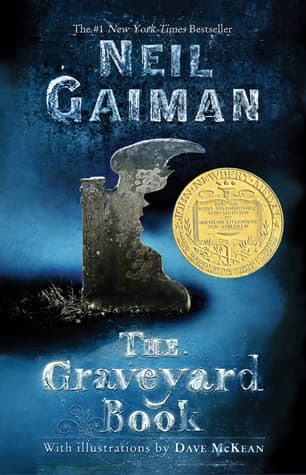
- The Graveyard Book
Neil Gaiman
4.1 (438k) average on GoodreadsFantasyWhile both books feature young protagonists in unusual, often macabre, settings and deal with themes of chosen family and impending danger, Gaiman's 'The Graveyard Book' offers a more hopeful, albeit bittersweet, tone. Bod Owens's journey to self-discovery is less about constant escape and more about understanding his unique place in the world, contrasting with the Baudelaires' relentless pursuit of safety and truth in a world that constantly denies them both. Gaiman's prose is often more lyrical and overtly fantastical, whereas Snicket maintains a dry, ironic distance.
- Harry Potter and the Sorcerer's Stone
J.K. Rowling
4.5 (7M) average on GoodreadsFantasyRescued from a miserable life under the stairs, an orphaned boy discovers he's a wizard destined for a magical school, where he uncovers a dangerous secret tied to the dark wizard who murdered his parents.
- The Hunger Games
Suzanne Collins
4.3 (6.4M) average on GoodreadsFantasyIn a future where children fight to the death on live television, Katniss Everdeen volunteers for the arena, turning a death sentence into a fight for survival and a spark of rebellion.
- 1984
George Orwell
4.2 (3.1M) average on GoodreadsPoliticsIn a future where surveillance and thought control are absolute, a man's search for truth clashes with the Party, showing that hope can be a form of rebellion.





Enjoyed the summary?
A summary gives you the shape of the book. The book itself has the detail, the examples and the voice.
Find The Carnivorous Carnival on AmazonAs an Amazon Associate, BookBrief earns from qualifying purchases. How we're funded