
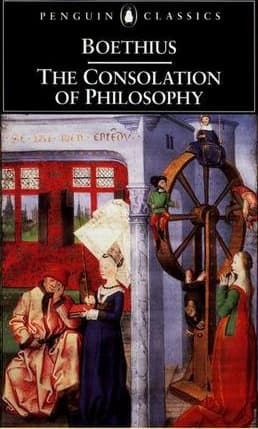
Core Idea
- Difficulty
- Medium
- Read it if
- You are grappling with suffering, injustice, or the meaning of life, and seek a classical philosophical perspective on finding solace and understanding in adversity. Also, if you are interested in the historical bridge between classical philosophy and early Christian thought.
- Skip it if
- You prefer modern, secular philosophy, or are looking for a light, easily digestible read without dense theological and metaphysical arguments.
Key Takeaways from The Consolation of Philosophy
Fortune's Wheel Turns Indifferently
True happiness cannot be found in external goods, which are inherently fleeting.
Boethius, through Lady Philosophy, argues that seeking external things like wealth, power, fame, and pleasure is pointless. These are gifts from Fortune, an arbitrary and changeable force, and thus temporary. To base one's happiness on them means setting oneself up for suffering when they are lost. True happiness, she says, must be an internal state, independent of external changes. The mistake is in giving lasting value to what is only temporary. By understanding Fortune's indifference and the impermanence of its gifts, one can detach from their appeal and start the journey toward genuine, stable contentment.
“If you are striving for true wealth, you must look not for what is possessed but for what can be neither lost nor taken away.”
In the book: Lady Philosophy's initial argument against Boethius's despair over his lost wealth, status, and freedom, where she meticulously deconstructs the inherent flaws and limitations of each external good, demonstrating how they fail to provide lasting satisfaction or security.
Try this: Cultivate an internal locus of control by regularly reflecting on what truly brings lasting contentment versus what merely provides fleeting gratification. Practice gratitude for what you have, but recognize its impermanence, fostering a detachment from material possessions and external validation.
Related ideas: external-goods, fortune's-wheel, impermanence
Suffering as a Catalyst for Wisdom
Adversity, while painful, can strip away illusions and reveal deeper truths.
Boethius's own imprisonment and upcoming execution are the catalysts for his philosophical awakening. Lady Philosophy states that suffering, rather than being only punishment, can be a powerful teacher. Prosperity often makes people complacent and hides the true nature of reality, making them dependent on external comforts and superficial relationships. Hardship, conversely, forces one to face basic questions, reevaluate values, and tell true friends from temporary companions. It is in deep despair that Boethius must turn inward and seek comfort in reason and philosophy, leading to a deep change in his understanding of happiness and the divine. The pain, therefore, is not meaningless but has a purpose, guiding him toward understanding.
“Adversity has the effect of eliciting talents which in prosperous circumstances would have lain dormant.”
In the book: Boethius's personal narrative throughout the book, detailing his fall from grace and the subsequent introspection that leads him to question the very foundations of his previous happiness. Lady Philosophy consistently reframes his misfortune as an opportunity for spiritual growth.
Try this: When facing personal setbacks or suffering, consciously seek the lessons within the experience. Journal about the challenges, identifying illusions that have been shattered and new perspectives gained. View difficult periods as opportunities for growth and self-discovery rather than mere punishment.
Related ideas: adversity, suffering, wisdom, introspection
The Supremacy of Divine Providence
An ordered universe is governed by a benevolent, all-knowing God, even if it appears chaotic.
A main idea of Boethius's consolation is the firm belief in a divine, providential order governing the universe. Lady Philosophy carefully argues against the idea of a chaotic or malevolent cosmos, stating that all events, even those that seem unjust or cruel, ultimately serve a higher, benevolent purpose within God's plan. This divine will, she explains, is not a tyrannical force but an expression of supreme goodness that guides everything toward its proper end. Understanding this order provides great comfort, as it means no suffering is ultimately meaningless and no injustice goes unaddressed in the larger scheme. It allows Boethius to reconcile his personal tragedy with his faith in a just God.
“There is, then, a rudder by which the universe is governed, and it is God's goodness.”
In the book: Lady Philosophy's extended explanation of providence and fate, distinguishing between God's eternal, unified plan (providence) and the temporal, unfolding sequence of events (fate). She uses analogies of a skilled craftsman or a ship's rudder to illustrate God's guiding hand.
Try this: When confronted with seemingly random or unjust events, try to reframe them within a larger, purposeful context. Cultivate faith in an underlying order, even if its immediate manifestation is unclear. This isn't passive acceptance but a trust in a benevolent, overarching structure.
Related ideas: divine-providence, fate, cosmic-order, benevolence
True Good is God Itself
Ultimate happiness and the highest good are found in union with the divine.
Building on the concept of divine will, Lady Philosophy leads Boethius to realize that the highest good, which all beings naturally seek, is the same as God. All good things in the world—wealth, power, pleasure, fame—are simply imperfect reflections or parts of this ultimate good. When pursued alone, they lead to dissatisfaction. True and perfect happiness, therefore, can only be achieved by aligning oneself with, and ultimately participating in, the divine essence. This is not merely a theological point but a philosophical one: the very nature of 'good' itself points to a single, perfect source. By recognizing this, one can redirect their desires from temporary earthly pursuits to the eternal and unchanging source of all goodness.
“Since God is the highest good, and since everything that is good is good because it participates in God, it follows that everything good is God.”
In the book: The philosophical argument where Lady Philosophy systematically demonstrates that all lesser goods, when pursued to their logical conclusion, ultimately lead back to a singular, perfect good, which she identifies as God. This is a crucial step in Boethius's intellectual journey.
Try this: Reflect on your deepest desires and motivations. Are you pursuing fragmented 'goods' or seeking the ultimate source from which all good flows? Engage in practices that foster spiritual connection or philosophical contemplation of ultimate truths, redirecting your internal compass towards the highest good.
Related ideas: supreme-good, divine-essence, ultimate-happiness, teleology
The Problem of Evil Reconciled
Evil is not a substantive force but a privation of good, lacking true being.
One of the most complex philosophical challenges for Boethius is reconciling the existence of evil and the prosperity of the wicked with a benevolent, all-powerful God. Lady Philosophy resolves this by arguing that evil is not a positive entity or a force with its own power, but rather a lack or absence of good. Just as darkness is the absence of light, evil is the absence of goodness, and therefore lacks true being or substance. The wicked, by straying from the good, lessen their own being and power, ultimately becoming less than human. This view allows Boethius to understand that evil cannot truly win over good, as it is inherently weak and self-defeating, and that wrongdoers ultimately harm themselves more than their victims.
“Evil is nothing. It has no being. For if it had being, it could not be evil.”
In the book: Lady Philosophy's detailed explanation of evil as a 'privation of good' (privatio boni), a concept that would become highly influential in medieval theology. She argues that the wicked are actually weaker and more miserable than the just, even if they appear powerful.
Try this: Instead of focusing on battling 'evil' as an external force, focus on cultivating and increasing 'good' within yourself and your sphere of influence. Recognize that destructive behaviors often stem from a lack or distortion of good, rather than an inherent 'badness' of being.
Related ideas: problem-of-evil, privation-of-good, metaphysics-of-evil, goodness
True Power Lies in Virtue
The virtuous are always powerful, and the wicked are always weak.
This seemingly surprising claim is a core principle of Boethius's consolation. Lady Philosophy states that true power is not found in external authority, wealth, or physical strength, but in moral integrity and virtue. The wicked, despite their apparent dominance, are fundamentally weak because they lack self-control, are slaves to their passions, and are constantly driven by endless desires. Their actions, being deviations from the good, are ultimately ineffective in achieving true happiness or lasting success. Conversely, the virtuous, by aligning their will with the good, have an inner strength and self-sufficiency that cannot be diminished by external circumstances, making them truly powerful regardless of their worldly status. This new definition of power offers deep comfort to the unjustly persecuted.
“For the good are always powerful, and the wicked always weak.”
In the book: Lady Philosophy's argument that the wicked, even if they achieve worldly success, are effectively 'punished' by their own vices and their separation from the good. She also points out that the wicked cannot truly achieve what they desire, as their desires are misdirected.
Try this: Focus on cultivating inner virtues like justice, temperance, prudence, and fortitude. Recognize that genuine influence and resilience come from moral strength and integrity, not from external trappings of power. Prioritize character development over the pursuit of status.
Related ideas: virtue, moral-strength, inner-power, wickedness
Fate and Free Will Reconciled
God's foreknowledge does not negate human freedom; it is a different mode of knowing.
Perhaps the most complex philosophical problem Boethius addresses is reconciling divine foreknowledge with human free will. If God knows all future events, including our choices, are our choices truly free, or are they predetermined? Lady Philosophy offers a brilliant solution: God's knowledge is not temporal like human knowledge. God exists outside of time, in an eternal present. Therefore, God 'sees' all events—past, present, and future—as simultaneously happening in His eternal present. His foreknowledge is not a cause of our actions, but rather a direct understanding of them as they freely unfold. Our freedom remains intact because our choices are genuinely ours in the temporal sequence, even though God eternally perceives them. This distinction is vital for maintaining both divine omnipotence and human moral responsibility.
“For the present moment, if you consider it, is known to God not as a future event but as a present one.”
In the book: Lady Philosophy's detailed analogy of God's eternal perspective being like looking down from a high peak and seeing all travelers on a road simultaneously, whereas a traveler on the road only sees what is immediately before and behind them. This illustrates the difference between temporal and eternal cognition.
Try this: Embrace personal responsibility for your choices, understanding that your actions are genuinely free, even within a divinely ordered universe. Don't use divine foreknowledge as an excuse for inaction or moral complacency. Act with awareness that your choices have real consequences.
Related ideas: free-will, divine-foreknowledge, eternity, temporal-knowledge, determinism
The Soul's Return to Its Source
Philosophy guides the soul back to its divine origin, offering ultimate peace.
The entire dialogue is a therapeutic process, with Lady Philosophy acting as a doctor for Boethius's struggling soul. His initial despair comes from forgetting his true nature and the divine order. Through logic, poetic verse, and compassionate guidance, Philosophy systematically clears his mind of false beliefs and worldly attachments. The ultimate goal is to restore his spiritual health, allowing his soul to remember its inherent connection to the divine good. This return to the source is not just intellectual agreement but a deep existential reorientation that brings inner peace and true happiness, transcending his difficult circumstances. It is a journey of self-discovery leading to union with the ultimate truth.
“Philosophy is the medicine of the soul.”
In the book: The entire structure of the book, which progresses from Boethius's initial lament and 'illness' to his gradual recovery and enlightenment through Lady Philosophy's teachings, culminating in his acceptance and understanding of his situation.
Try this: Engage in regular philosophical inquiry and self-reflection as a form of 'soul medicine.' Actively question your assumptions, confront your fears, and seek intellectual and spiritual growth to align your inner self with higher truths and find profound inner peace.
Related ideas: soul's-journey, enlightenment, spiritual-healing, self-discovery, divine-union
The Consolation of Philosophy Quotes
“If then you look upon the things of this world, considering them as they are, you will see that they are nothing.”
“All fortune is good fortune; for it either provides a discipline, or a remedy for a disease.”
“For every man's fortune is in his own hands.”
“For what else is it to fly from good but to follow evil?”
“No one is so completely happy that he is not afflicted by some anxiety.”
“For reason is the only thing that distinguishes man from beast.”
“The greatest part of man's happiness consists in a good conscience.”
“For if there is a God, whence come evils? If there is not a God, whence come goods?”
“What is it, then, that can truly be said to be good? That which is in itself good, and for its own sake good.”
“For what is more unhappy than a man who has lost his liberty?”
“For nothing is more wretched than a man who has ceased to be himself.”
“For the whole course of human life is a perpetual struggle between reason and passion.”
“There is nothing that can hinder the omnipotence of God.”
“No man is so wise as to be free from all error.”
“For what is more precious than time?”
Quiz
10 questions on the main ideas. Each answer comes with a short explanation.
Question 1
Which Roman emperor was Boethius serving when he was imprisoned and subsequently wrote 'The Consolation of Philosophy'?
- Augustus
- Theodoric
- Nero
- Justinian
Show answer
B. Theodoric Boethius was an eminent public figure under the Gothic emperor Theodoric, who later imprisoned him.
Question 2
What is the primary literary form of 'The Consolation of Philosophy'?
- An epic poem
- A series of letters
- A dialogue of alternating prose and verse
- A historical chronicle
Show answer
C. A dialogue of alternating prose and verse The book is described as 'a dialogue of alternating prose and verse between the ailing prisoner and his 'nurse' Philosophy.'
Question 3
According to Lady Philosophy, what is the ultimate good and source of true happiness?
- Wealth and political power
- Pleasure and sensual gratification
- God, who is identified with perfect Goodness and Happiness
- Fame and reputation
Show answer
C. God, who is identified with perfect Goodness and Happiness Lady Philosophy consistently guides Boethius to understand that true happiness is found in God, the ultimate Good, not in fickle earthly fortunes.
Question 4
How does Lady Philosophy explain the nature of Fortune's wheel to Boethius?
- Fortune is inherently evil and always seeks to harm humanity.
- Fortune is a neutral force that randomly bestows good and bad, but its gifts are ultimately transient and external to true happiness.
- Fortune is a reward for virtuous actions and a punishment for vices.
- Fortune is an illusion and does not truly exist.
Show answer
B. Fortune is a neutral force that randomly bestows good and bad, but its gifts are ultimately transient and external to true happiness. Philosophy teaches Boethius that Fortune's gifts (wealth, power, fame) are external and fleeting, thus not contributing to true, internal happiness. Her turning wheel represents its capricious nature.
Question 5
What is the primary reason Boethius initially laments his fate at the beginning of the book?
- He misses his family and friends.
- He believes he has been unjustly accused and deprived of his former high status and material comforts.
- He fears his impending execution.
- He is suffering from a physical illness.
Show answer
B. He believes he has been unjustly accused and deprived of his former high status and material comforts. Boethius's initial despair stems from his fall from grace, the loss of his reputation, wealth, and freedom, which he perceives as an unjust reversal of fortune.
Question 6
Lady Philosophy argues that evil men, despite their apparent success, are ultimately powerless and unhappy because:
- They will eventually be caught and punished by human law.
- They fail to achieve their true end, which is goodness, and thus strip themselves of their humanity.
- Their wealth and power are always taken from them by others.
- They are constantly in fear of divine retribution.
Show answer
B. They fail to achieve their true end, which is goodness, and thus strip themselves of their humanity. Philosophy asserts that since all men desire good, those who pursue evil fail to achieve their true desire and thus effectively cease to be truly human, becoming beast-like.
Question 7
How does Lady Philosophy reconcile divine foreknowledge with human free will?
- She argues that divine foreknowledge completely negates human free will, making all actions predetermined.
- She explains that God's knowledge is not a cause of future events, but rather a simultaneous apprehension of all time from an eternal present, which does not compel human choices.
- She suggests that God chooses not to know certain future events to preserve human free will.
- She concludes that free will is an illusion created by human perception.
Show answer
B. She explains that God's knowledge is not a cause of future events, but rather a simultaneous apprehension of all time from an eternal present, which does not compel human choices. This is one of the most complex arguments in the book. Philosophy resolves the paradox by explaining God's eternal present, where all time is simultaneously 'now' for Him, meaning His knowledge is not predictive in a way that forces human action.
Question 8
Which of the following historical figures were influenced by 'The Consolation of Philosophy'?
- Plato and Aristotle
- Chaucer and Dante
- Shakespeare and Milton
- Voltaire and Rousseau
Show answer
B. Chaucer and Dante The introductory text explicitly states that Boethius's ideas 'were influential on the thought of Chaucer and Dante.'
Question 9
What does Lady Philosophy identify as the most effective remedy for Boethius's despair and 'sickness'?
- Recalling his past glories and achievements.
- Focusing on the transient nature of worldly goods and the pursuit of true, internal good.
- Engaging in political activism from his prison cell.
- Seeking revenge against his accusers.
Show answer
B. Focusing on the transient nature of worldly goods and the pursuit of true, internal good. Her entire instruction aims to shift Boethius's focus from external misfortunes to internal virtue and the unchanging Good, which is the source of true happiness.
Question 10
How does Lady Philosophy define 'Providence' versus 'Fate' in the context of divine governance?
- Providence is the divine plan itself, existing in the mind of God, while Fate is the execution of that plan in the temporal world through a chain of causes.
- Providence refers to random chance, and Fate is the predetermined outcome.
- They are synonymous terms and interchangeable.
- Providence relates to human actions, and Fate relates to natural phenomena.
Show answer
A. Providence is the divine plan itself, existing in the mind of God, while Fate is the execution of that plan in the temporal world through a chain of causes. Philosophy distinguishes between Providence as the simple and stable divine plan in God's mind, and Fate as the unfolding of that plan through a series of causes and effects in the temporal world.
The Consolation of Philosophy FAQ
What is 'The Consolation of Philosophy' about?
'The Consolation of Philosophy' is a philosophical dialogue written by Boethius while imprisoned and awaiting execution. It explores themes of fortune, happiness, good and evil, fate, and free will through a conversation between Boethius and Lady Philosophy.
Who was Boethius and why did he write this book?
Boethius was a high-ranking Roman official and scholar under King Theodoric. He wrote 'The Consolation of Philosophy' during his imprisonment after being accused of treason, using philosophical inquiry to find solace and understanding in the face of his impending death.
What is the main concept of Lady Philosophy's argument regarding fortune?
Lady Philosophy teaches that fortune is inherently fickle and external, and true happiness cannot be found in its gifts or losses. She argues that one should seek inner contentment and virtue, which are beyond fortune's reach.
Does 'The Consolation of Philosophy' offer practical advice for dealing with adversity?
Yes, while deeply philosophical, the book offers a framework for understanding and transcending personal suffering by re-evaluating the nature of good, evil, and happiness. It encourages readers to find resilience through intellectual and spiritual reflection.
How does Boethius's 'Consolation' differ from purely religious texts offering comfort?
While Boethius was a Christian, 'The Consolation' primarily draws upon classical Greek philosophy, rather than explicit Christian theology, to provide comfort and understanding. It seeks universal truths through reason, making it accessible to a wider audience regardless of specific religious beliefs.
What is the Boethian concept of 'Providence' versus 'Fate'?
Boethius distinguishes Providence as the divine plan, existing in the mind of God, while Fate is the unfolding of that plan in time through a chain of causes and effects. Providence is simple and unified, while Fate is complex and temporal.
How did 'The Consolation of Philosophy' influence medieval thinkers like Chaucer and Dante?
'The Consolation' was one of the most widely read and translated books of the Middle Ages, profoundly influencing medieval thought on free will, fortune, and divine providence. Its ideas can be seen reflected in the themes and structures of works by Chaucer and Dante, among many others.
Does the book ultimately provide Boethius with true consolation?
Yes, through his dialogue with Lady Philosophy, Boethius gradually moves from despair and bitterness to a state of understanding and acceptance. He achieves intellectual and spiritual health, finding peace even in the face of his unjust condemnation.
About the author

Anicius Manlius Severinus Boethius was a Roman senator and philosopher active in the early 6th century CE. He is best known for his seminal work, 'The Consolation of Philosophy,' written while imprisoned. This philosophical text explores themes of fate, free will, and divine providence, and has profoundly influenced Western thought for centuries.
Similar books
- Meditations
Marcus Aurelius
4.2 (124k) average on GoodreadsLeadershipBoth offer personal philosophical reflections on finding inner peace and virtue amidst life's challenges, from a position of power or adversity.
- Confessions
Augustine of Hippo
4.1 (13k) average on GoodreadsThrillerA foundational work of Western thought that blends autobiography, philosophy, and theology, exploring personal suffering and the search for God.
- The Diary of a Young Girl
Anne Frank
4.2 (2.7M) average on GoodreadsBiographyDuring the Nazi occupation, a teenage girl's diary, written from a secret annex, shares observations on humanity, hope, and the wait for freedom.
- Night
Elie Wiesel
4.3 (970k) average on GoodreadsBiographyIn the darkness of Auschwitz and Buchenwald, a teenage Elie Wiesel faces the extermination of his family, the loss of his faith, and the lasting scars of humanity's deepest cruelty.
- Steve Jobs
Walter Isaacson
4.1 (957k) average on GoodreadsBusinessSteve Jobs was a visionary who fused creativity and technology to revolutionize six industries and shape our digital world.
- Unbroken: A World War II Story of Survival, Resilience and Redemption
Laura Hillenbrand
4.4 (767k) average on GoodreadsBiographyLouis Zamperini's incredible World War II odyssey transforms him from a rebellious youth and Olympic runner into a survivor of a plane crash, shark-infested waters, and brutal Japanese POW camps, only to find redemption through forgiveness.




Enjoyed the summary?
A summary gives you the shape of the book. The book itself has the detail, the examples and the voice.
Find The Consolation of Philosophy on AmazonAs an Amazon Associate, BookBrief earns from qualifying purchases. How we're funded