
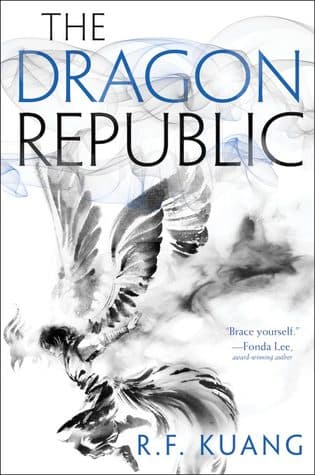
Synopsis
Covers the whole plot, including the ending.
- Difficulty
- Hard
- Pacing
- Fast
- Mood
- Dark, Brutal, Intense, Desperate, Vengeful
- Read it if
- You enjoy grimdark military fantasy, stories with morally ambiguous protagonists, and retellings of 20th-century Chinese history infused with magic and gods.
- Skip it if
- You prefer lighthearted fantasy, clear-cut heroes and villains, or struggle with graphic depictions of war, addiction, and political betrayal.
The Dragon Republic Plot Summary
Covers the whole plot, including the ending.
Fleeing the Aftermath and a Desperate Alliance
After destroying Sinegard with the Phoenix, Rin is an outcast, hunted by the Hesperians and feared by her own people. She is addicted to opium, trying to quiet the Phoenix's urges and the trauma of her actions. With Kitay, who worries about her drug use, she finds safety in the southern provinces. Their journey leads them to the Dragon Republic, a new movement led by the Dragon Warlord, Sanzang. Sanzang offers Rin a place in his army, seeing her as a powerful weapon against Empress Su Daji and the growing Hesperian influence. Rin, wanting revenge against Su Daji and still wanting to protect Nikan, reluctantly accepts, despite her distrust of Sanzang's reasons and her own struggles with the Phoenix.
The Campaign for the South and the Hesperian Threat
Rin joins the Dragon Republic's campaign to gain power in the southern provinces. She commands troops alongside Nezha, who also joined Sanzang's cause after his father died. Their first victories are quick, but they soon meet the Hesperian military, who are helping the Empress's loyalists. Rin sees the clear reality of Hesperian weapons – advanced rifles, cannons, and steamships – which make traditional Nikanese warfare useless. She struggles to adapt, often using the Phoenix's power, which worries Kitay and Nezha. The Hesperians, led by Master Vaisra and the missionary June, also bring their own beliefs, trying to convert Nikanese to their monotheistic faith, which makes the political situation more complex.
The Siege of Mugen and a Desperate Sacrifice
The Dragon Republic's advance ends with the siege of Mugen, a port city defended by a strong Hesperian fleet. Rin and Nezha lead the attack, but the Hesperian navy is too powerful. The Republic's forces suffer many losses. Desperate to break the stalemate, Rin, under the influence of opium and the Phoenix's whispers, decides to use its full power. She channels immense destructive energy, destroying the Hesperian fleet and causing widespread damage. While they win, the act leaves Rin deeply traumatized and separates her further from Kitay, who sees her descent into violence. Nezha is also horrified by the scale of her power and the cost of their victory.
The Fall of the Empress and Sanzang's True Intentions
After the victory at Mugen, the Dragon Republic marches on the capital, Chulu. Empress Su Daji, weakened by southern losses and betrayal, is quickly overthrown. Rin finally confronts Su Daji, but her long-awaited revenge feels empty. With the Empress removed, Sanzang shows his true plans: not just to restore Nikan, but to end the imperial system entirely and create a meritocratic Republic, an idea from Hesperian ideals. He starts taking apart old power structures and making reforms, which surprises and worries many, including Rin, who had imagined a different future for Nikan. Kitay, however, is cautiously hopeful about the Republic's potential for good.
The Republic's Internal Strife and Rin's Growing Distrust
As Sanzang's Republic takes hold, Rin sees its darker side. The 'meritocratic' system often favors the educated elite, many of whom have Hesperian education or sympathies, while common people and traditional Nikanese values are ignored. Sanzang's reliance on Hesperian advisors and technology grows, and he starts persecuting those who practice shamanism or old customs, seeing them as superstitious barriers to progress. Rin, still haunted by the Phoenix and struggling with her opium addiction, grows more disappointed with Sanzang's methods. She sees him as another tyrant, though one who speaks of freedom and progress. Her distrust of him deepens, fueled by Kitay's warnings and her own observations of injustice.
The Northern Warlords and a Divided Nation
Sanzang's Republic faces strong opposition from the northern warlords, who refuse to accept his authority and see his reforms as an attack on Nikanese tradition. Rin is again called to lead troops, fighting against former allies and her own people. The conflict is brutal, marked by guerrilla warfare and the Republic's superior, Hesperian-supplied military. Rin feels increasingly alone, torn between her loyalty to Kitay and Nezha, her duty to Nikan, and her growing moral objections to Sanzang's rule. The Phoenix, always present, continues to demand blood, making Rin's choices difficult as she navigates the complex political and moral situation.
The Betrayal of Nezha and the Cost of Power
Nezha, initially a strong supporter of Sanzang and the Republic, starts to question the Warlord's increasingly authoritarian rule and his disregard for Nikanese heritage. His family's history and his own principles conflict with Sanzang's Hesperian-influenced policies. This internal conflict ends with Nezha trying to betray Sanzang, or at least undermine his power, to guide the Republic toward a more balanced path. Rin, discovering Nezha's actions, is forced into a tragic confrontation with her former friend. Their clash is emotional and physically damaging, showing the deep ideological divisions within Nikan and the personal sacrifices demanded by war and politics. The result changes both characters deeply.
The Hesperian Ultimatum and the Republic's Vulnerability
Master Vaisra, the Hesperian diplomat, reveals the true reason for Hesperia's involvement in Nikan. Their help to Sanzang was not selfless; it was a planned move to gain control of Nikanese resources and set up a puppet government. Hesperia issues an ultimatum, demanding economic concessions and political influence that would effectively turn Nikan into a Hesperian colony. Sanzang, despite his initial idealism, finds himself trapped, his Republic dependent on Hesperian technology and military support. This revelation destroys Rin's last hopes in Sanzang's vision and confirms her belief that Nikan must fight for its true independence, even if it means fighting against former allies.
Rin's Defiance and the Phoenix's Reawakening
Faced with the Hesperian threat and Sanzang's involvement, Rin makes a clear choice: she will not be a tool for any group. She rejects both the Hesperian colonizers and Sanzang's flawed Republic. Seeing that Nikan's survival depends on a force that can stand against the technologically superior Hesperians, Rin fully embraces the power of the Phoenix, overcoming her fear and addiction. This decision marks a complete change, as she lets go of her personal demons to become a weapon for Nikan's freedom. She understands that the path ahead will involve great destruction and personal sacrifice, but she is ready to pay any price for her country's freedom.
A New Path: War Against All
Having fully committed to the Phoenix, Rin starts to gather those who still believe in a truly independent Nikan. She collects remaining shamans, disappointed soldiers, and common people who resent both Hesperian interference and Sanzang's perceived betrayal. Rin realizes that true liberation means fighting not just the Hesperians, but also Sanzang's Republic, which has become a tool of foreign powers. The stage is set for an even greater, more brutal conflict, where Rin, using the terrifying power of the Phoenix, will lead Nikan into a desperate fight for its independence against a world that wants to control it. Her journey of vengeance has become a war for national survival, with Rin as its destructive, unforgiving champion.
The Dragon Republic Characters
Rin (Fang Runin)
Protagonist
Shaman warrior, haunted by the Phoenix, seeking vengeance and Nikan's liberation.
Rin is a young woman from the Rooster Province, now a powerful shaman and the vessel for the Phoenix god. Haunted by her actions at Sinegard and addicted to opium, she struggles with the Phoenix's destructive urges and her own guilt. Initially driven by vengeance against Su Daji, her journey in 'The Dragon Republic' sees her grapple with the complexities of war, politics, and morality. She is fiercely loyal to Nikan, but her methods are often brutal and uncompromising. Her internal conflict between her humanity and the god within her is central to her character.
Relationships: Kitay (Confidant, moral compass, unrequited love); Nezha (Former rival, reluctant ally, complicated friend, eventual enemy); Sanzang (Dragon Warlord) (Initial ally, then disillusioned leader, eventual enemy); The Phoenix (Inhabiting god, source of power and torment)
Kitay (Kitay Muhan)
Supporting
Rin's intellectual confidant and moral anchor.
Kitay is Rin's intellectual and emotional anchor, a former student of Sinegard and the son of a powerful general. He is highly intelligent, pragmatic, and deeply concerned for Rin's well-being and moral choices. He opposes her reliance on the Phoenix and her opium addiction, constantly urging her towards more strategic and less destructive solutions. Kitay represents the more rational, humane side of the Nikanese resistance, often clashing with Rin's more brutal instincts. He is a crucial sounding board for Rin and a voice of reason amidst the chaos.
Relationships: Rin (Confidant, moral compass, unrequited love); Sanzang (Dragon Warlord) (Initially supportive, then questioning of his methods)
Nezha (Nezha Li)
Supporting
Former rival, now an officer in the Dragon Republic, grappling with his family's legacy.
Nezha is a skilled warrior and strategist, initially Rin's rival at Sinegard. After his family's downfall, he joins the Dragon Republic, seeking to restore his honor and serve Nikan. He is a complex character, torn between his aristocratic upbringing, his loyalty to the Republic, and his evolving understanding of justice. He initially supports Sanzang's vision but grows disillusioned with the Warlord's Hesperian leanings and authoritarianism. Nezha represents the traditional Nikanese elite struggling to adapt to a changing world, and his relationship with Rin is marked by both camaraderie and deep ideological conflict.
Relationships: Rin (Former rival, reluctant ally, complicated friend, eventual enemy); Sanzang (Dragon Warlord) (Initial ally, then disillusioned and rebellious subordinate)
Sanzang (The Dragon Warlord)
Antagonist
Charismatic leader of the Dragon Republic, aiming to modernize Nikan.
Sanzang is the enigmatic and charismatic leader of the Dragon Republic, a movement dedicated to overthrowing the Empress and establishing a new, modernized Nikan. He is a visionary, inspired by Hesperian ideals of democracy and meritocracy, and possesses a keen understanding of military strategy and propaganda. While initially presented as a liberator, his true intentions and methods prove to be more authoritarian and self-serving. He is pragmatic to a fault, willing to make alliances with Hesperia and suppress traditional Nikanese culture in pursuit of his vision, making him an increasingly complex and morally ambiguous figure.
Relationships: Rin (Initial ally, then disillusioned leader, eventual enemy); Kitay (Leader, respected by Kitay initially); Nezha (Commander, then target of Nezha's rebellion)
The Phoenix
Mentioned
A fiery, destructive god inhabiting Rin, representing raw power and vengeance.
The Phoenix is one of the Nikanese pantheon, a powerful, destructive fire god that inhabits Rin. It is a source of immense power but also a constant temptation towards violence and despair. The Phoenix represents Rin's capacity for destruction, her vengeful impulses, and the raw, untamed spiritual power of Nikan. Its influence is a constant internal struggle for Rin, pushing her to commit increasingly horrific acts while offering the means to achieve impossible victories. It is both a curse and a weapon, embodying the devastating cost of shamanic power.
Relationships: Rin (Inhabiting god, source of power and torment)
Su Daji (The Empress)
Antagonist
The Empress of Nikan, overthrown by the Dragon Republic.
Su Daji is the cunning and ruthless Empress of Nikan, whose betrayal of the country to the Mugenese sparked the Third Poppy War and Rin's quest for vengeance. Though her physical presence in 'The Dragon Republic' is limited, her shadow looms large over the narrative. She represents the corrupt and decadent old regime that Sanzang seeks to dismantle. Her actions in the previous book continue to fuel Rin's rage, even after her eventual downfall, symbolizing the deep-seated grievances that drive the Nikanese conflicts.
Relationships: Rin (Target of vengeance); Sanzang (Dragon Warlord) (Political enemy, overthrown by him)
Master Vaisra
Supporting
Enigmatic Hesperian diplomat, orchestrating Hesperia's influence in Nikan.
Master Vaisra is a shrewd and calculating Hesperian diplomat and advisor to Sanzang. He represents Hesperia's imperialistic ambitions in Nikan, subtly manipulating political events to serve his nation's interests. He is a master of soft power, using economic aid, technological superiority, and ideological influence to gain control, rather than overt military conquest. Vaisra embodies the insidious nature of foreign intervention and the threat of cultural and economic colonization, becoming a major antagonist through his machinations.
Relationships: Sanzang (Dragon Warlord) (Advisor, manipulator); Rin (Political adversary)
June
Supporting
Hesperian missionary and military officer, representing Hesperian cultural influence.
June is a Hesperian missionary and military officer who often accompanies Master Vaisra. She represents the Hesperian cultural and religious influence in Nikan, attempting to convert Nikanese to their monotheistic faith. She is a zealous and often condescending figure, convinced of the superiority of Hesperian ways. Her presence highlights the clash between traditional Nikanese beliefs and the encroaching Hesperian ideology, further complicating the struggle for Nikan's identity and sovereignty. She often serves as a direct foil to Rin's shamanic power.
Relationships: Master Vaisra (Colleague, subordinate); Rin (Ideological and military opponent)
The Dragon Republic Themes
The Corrupting Nature of Power and Vengeance
Rin's journey shows how power, especially divine and destructive, can corrupt. Her use of the Phoenix, first for revenge against Su Daji, slowly changes her into something less human. Her opium addiction is a symbol of her attempt to control this power, but it ultimately fails. This theme also applies to Sanzang, whose initial ideals for a Republic are warped by his pursuit of power, leading him to authoritarianism and compromise with Hesperia. The book always questions if any victory is worth the moral cost.
“Perhaps the gods were not merciful. Perhaps they were just. Perhaps they were just cruel.”
Colonialism and Imperialism
A main theme is the deceptive nature of Hesperian colonialism. Unlike the Mugenese, who invade with force, Hesperia uses 'soft power' – offering technology, economic aid, and a new religion, all while slowly weakening Nikan's independence and culture. Master Vaisra's manipulations and Sanzang's reliance on Hesperian support show how foreign influence can be more dangerous than open invasion, leading to a loss of identity and self-determination. The fight against Hesperia becomes a fight for Nikan's very essence.
“They didn't want to conquer Nikan. They wanted Nikan to conquer itself, for them.”
Identity and Belonging in a Changing World
Characters struggle with their identity in a Nikan that is changing greatly. Rin, a peasant girl turned shaman, struggles with her humanity versus the Phoenix, and her place in a world that fears her. Nezha, an aristocrat, must balance his family's history with the Republic's new order. Sanzang tries to create a new Nikanese identity based on Hesperian ideals, alienating those who hold to tradition. The conflict between old Nikanese ways and new Hesperian influences makes characters question who they are and where their loyalties lie.
“What was Nikan, if not its gods? What was Nikan, if not its history?”
The Cost of War and Revolution
The book clearly shows the terrible human cost of long conflict. Beyond the battlefield, characters suffer from trauma, addiction, and moral compromise. Rin's opium use is a direct result of the terrible acts she commits. The revolution, while promising freedom, brings widespread destruction, famine, and internal conflict. Sanzang's Republic, meant to be a symbol of hope, quickly becomes authoritarian and violent, showing that even a 'just' war can lead to unintended and horrific results, and that revolution often destroys its own leaders.
“War was not a game. It was a meat grinder, and everyone went in.”
Moral Ambiguity and Shades of Grey
There are no clear heroes or villains in 'The Dragon Republic.' Rin, while fighting for Nikan, commits terrible acts. Sanzang, despite his vision for a better Nikan, becomes a tyrant. Nezha's attempts at reform lead to betrayal. Even the Hesperians, though colonialist, genuinely believe they are bringing progress. The story consistently makes characters and readers face difficult choices and the lack of easy answers, showing that good intentions can lead to disaster, and that survival often requires morally difficult actions.
“There were no good men in war. There were only winners and losers.”
Plot Devices & Literary Techniques
The Phoenix (Shamanism)
A magical system and source of immense, destructive power.
Shamanism, specifically Rin's connection to the Phoenix, serves as the primary magical system and a potent plot device. It grants Rin destructive capabilities far beyond conventional warfare, allowing her to turn the tide of impossible battles. However, it comes at a great cost: the Phoenix's power is addictive, psychologically tormenting, and morally corrupting. It represents the raw, ancient power of Nikan, contrasting sharply with the Hesperian's technological might, and forces Rin to confront the ethical implications of wielding such devastating force.
Opium Addiction
A symbol of Rin's trauma and an attempt to suppress her powers.
Rin's opium addiction is a crucial plot device, serving as both a coping mechanism for her trauma and a physical manifestation of her struggle to control the Phoenix. The drug dulls her senses and suppresses the god's urges, but it also weakens her and makes her vulnerable. It highlights her internal conflict and her desperate attempt to cling to her humanity in the face of overwhelming power and guilt. The addiction also mirrors the broader theme of Nikan's vulnerability to foreign influences, as opium is often associated with colonial exploitation.
Hesperian Technology (Guns, Steamships)
A force for modernization and a symbol of foreign dominance.
Hesperian technology, including advanced firearms, cannons, and steamships, acts as a significant plot device by creating a stark power imbalance in Nikan. It renders traditional Nikanese warfare obsolete and forces the Dragon Republic to adapt or perish. This technological superiority is a key tool for Hesperian influence, allowing them to exert control without direct military occupation. It symbolizes the threat of modernization without sovereignty and the challenge Nikan faces in preserving its identity against a technologically advanced colonizer.
The Dragon Republic Ideology
A political philosophy promoting modernization, clashing with tradition.
Sanzang's Dragon Republic, with its Hesperian-inspired ideals of democracy, meritocracy, and modernization, functions as a central plot device. It provides the initial motivation for many characters, including Rin and Nezha, to fight against the old imperial order. However, as the story progresses, the Republic's ideology is revealed to be flawed and authoritarian, suppressing traditional Nikanese culture and relying on foreign powers. This ideological conflict creates deep divisions within Nikan and forces characters to choose between different visions for their country's future.
The Northern Warlords
Representing traditional Nikanese resistance and decentralized power.
The Northern Warlords serve as a plot device to illustrate the fragmented nature of Nikanese power and the resistance to Sanzang's centralized Republic. They represent the more traditional, conservative elements of Nikanese society who reject Hesperian influence and the radical changes proposed by Sanzang. Their ongoing resistance forces the Dragon Republic to fight on multiple fronts, highlighting the internal divisions within Nikan and complicating the struggle for national unity and independence against foreign powers.
The Dragon Republic Quotes
“War doesn't determine who is right. War determines who remains.”
“Power is not control at all—power is strength, and giving that strength to others.”
“The only way to win a war is to become something worse than your enemy.”
“History is written by the survivors.”
“You cannot build a republic on a foundation of corpses.”
“Fear is a tool. The moment you become scared is the moment you stop thinking.”
“Sometimes the only way to stay sane is to go a little mad.”
“Loyalty is a currency, and everyone has a price.”
“The gods are not kind. They are hungry, and they eat what we feed them.”
“You can't change the world without getting your hands dirty.”
“Hope is a fragile thing, but it's the only thing stronger than fear.”
“The line between monster and hero depends on who is telling the story.”
“Power corrupts, but so does powerlessness.”
Quiz
10 questions on the plot and the characters. Each answer comes with a short explanation.
Question 1
What is Rin's primary motivation for joining the Dragon Warlord's forces at the beginning of the book?
- To escape her opium addiction and find a new purpose
- To get revenge on the Empress who betrayed Nikan
- To learn more about the Phoenix's power and control it better
- To help establish a true democratic republic in Nikan
Show answer
B. To get revenge on the Empress who betrayed Nikan Rin's driving force is vengeance against the Empress Su Daji, who allied with the Mugen Federation during the Third Poppy War, leading to massive betrayal and suffering in Nikan. While she struggles with addiction and the Phoenix, revenge is her stated primary reason for joining the Dragon Warlord.
Question 2
Which character leads the Dragon Army and initially presents himself as wanting to create a democratic republic?
- Jiang Ziya
- Yin Vaisra
- Nezha
- Kitay
Show answer
B. Yin Vaisra Yin Vaisra, known as the Dragon Warlord, is the leader of the Dragon Army who recruits Rin with promises of overthrowing the Empress and establishing the Dragon Republic. However, his true motivations become increasingly questionable as the story progresses.
Question 3
What major atrocity is Rin haunted by from the end of the Third Poppy War?
- Betraying her comrades at Sinegard Academy
- Assassinating the Mugen Federation's leadership
- Using the Phoenix's power to burn the entire island of Speer
- Poisoning the Nikara water supply to kill Mugen soldiers
Show answer
C. Using the Phoenix's power to burn the entire island of Speer At the climax of The Poppy War, Rin channeled the Phoenix's power to incinerate the entire island of Speer, killing everyone on it including Mugen forces and Speerly survivors. This genocide haunts her throughout The Dragon Republic, contributing to her trauma and opium addiction.
Question 4
Why does Rin become increasingly isolated from her allies as the story progresses?
- They discover she's secretly working for the Empress
- Her opium addiction makes her unreliable in battle
- Her willingness to sacrifice anything for Nikan and vengeance leads to morally questionable decisions
- The Phoenix forces her to attack her own friends
Show answer
C. Her willingness to sacrifice anything for Nikan and vengeance leads to morally questionable decisions Rin's uncompromising dedication to her goals—revenge against the Empress and protecting Nikan—leads her to make increasingly ruthless choices that alienate allies like Kitay and Nezha. This isolation drives her further toward reliance on the Phoenix's destructive power.
Question 5
What is the Dragon Warlord's true relationship to Nezha?
- They are master and apprentice in military strategy
- They are political rivals competing for control of the Dragon Army
- They are father and son
- They are former classmates from Sinegard Academy
Show answer
C. They are father and son Yin Vaisra is revealed to be Nezha's father, a fact that becomes significant as family loyalties and political ambitions clash throughout the narrative. This relationship creates complex dynamics between Nezha, Rin, and the Dragon Warlord's plans.
Question 6
What key realization does Rin have about the Dragon Warlord's plans for the new republic?
- He intends to establish a constitutional monarchy with himself as king
- His 'democratic' rhetoric masks his true goal of establishing a military dictatorship
- He plans to surrender Nikan to foreign powers in exchange for wealth
- He wants to abolish all shamans and religious practices in Nikan
Show answer
B. His 'democratic' rhetoric masks his true goal of establishing a military dictatorship As Rin works with the Dragon Army, she gradually realizes that Yin Vaisra's talk of democracy and republicanism is largely propaganda. His true aim is to replace the Empress with his own authoritarian rule, using the war as a means to consolidate power.
Question 7
How does the book explore the theme of addiction through Rin's character?
- Primarily as a medical condition that requires treatment from healers
- As both a literal opium addiction and a metaphorical addiction to power and vengeance
- As a temporary phase she quickly overcomes through willpower
- As something that only affects her physical health, not her decisions
Show answer
B. As both a literal opium addiction and a metaphorical addiction to power and vengeance Rin's opium addiction parallels her psychological dependencies: her need for the Phoenix's power, her obsession with vengeance, and her identity as a weapon of war. The book portrays addiction as multifaceted, affecting her relationships, judgment, and sense of self throughout the narrative.
Question 8
What strategic advantage does the Dragon Army gain by controlling Golyn Niis?
- Access to ancient shamanic artifacts buried there
- Control over Nikan's primary opium production region
- A fortified position with natural defenses against the Empress's forces
- Command of the main river system for transportation and supply lines
Show answer
D. Command of the main river system for transportation and supply lines Golyn Niis sits at a crucial confluence of rivers, giving whoever controls it command over central Nikan's waterways. This provides the Dragon Army with significant logistical advantages for moving troops and supplies, which is vital for their campaign against the Empress.
Question 9
Which historical period of China does The Dragon Republic primarily parallel in its depiction of warlord conflicts and political upheaval?
- The Ming Dynasty's collapse in the 17th century
- The Warlord Era following the fall of the Qing Dynasty in early 20th century China
- The Cultural Revolution of the 1960s-70s
- The Three Kingdoms period of the 3rd century
Show answer
B. The Warlord Era following the fall of the Qing Dynasty in early 20th century China Like The Poppy War, The Dragon Republic draws heavily from 20th-century Chinese history. The fragmentation of Nikan under competing warlords (like Yin Vaisra) mirrors the Warlord Era (1916-1928) when regional military leaders vied for control after the Qing Dynasty's collapse, with democratic ideals often serving as cover for authoritarian ambitions.
Question 10
What crucial choice does Rin face regarding the Phoenix's power toward the book's climax?
- Whether to permanently sever her connection to the Phoenix to save her soul
- Whether to use the Phoenix to destroy the Dragon Army instead of the Empress's forces
- Whether to embrace the Phoenix completely as her only remaining tool for achieving her goals, despite its costs
- Whether to transfer the Phoenix's power to Kitay to protect him from harm
Show answer
C. Whether to embrace the Phoenix completely as her only remaining tool for achieving her goals, despite its costs As Rin becomes increasingly isolated and desperate, she must decide whether to fully surrender to the Phoenix's destructive power—accepting that it may consume her and cause further atrocities—in order to pursue her vengeance and protect Nikan. This dilemma represents the central conflict of her character arc in this installment.
The Dragon Republic FAQ
What is 'The Dragon Republic' about?
The novel follows Rin, a shaman haunted by her actions in the Third Poppy War, as she joins the Dragon Warlord's campaign to overthrow the Empress and establish a new republic in Nikan. While seeking revenge and redemption, Rin grapples with opium addiction, the destructive influence of her god the Phoenix, and the moral compromises of war.
Why should I read 'The Dragon Republic'?
This sequel deepens the complex themes of war, trauma, and power from 'The Poppy War,' with Rin's psychological unraveling and the political machinations of the Dragon Warlord creating a gripping narrative. It blends historical parallels to 20th-century China with fantasy elements like shamanic gods, offering a brutal yet thought-provoking exploration of vengeance and ideology.
What is the background/setting of 'The Dragon Republic'?
Set in the war-torn nation of Nikan after the Third Poppy War, the story unfolds across military campaigns, opium dens, and political strongholds. The world mirrors early 20th-century China, with factions like the Empress's regime and the Dragon Warlord's forces vying for control, all while shamans draw power from vengeful gods.
What are the most memorable quotes?
Key quotes include Rin's reflection, 'War didn't determine who was right. War determined who remained,' highlighting the novel's moral ambiguity, and the Dragon Warlord's assertion, 'The only way to change a system is from within,' which foreshadows his manipulative ambitions. These lines underscore themes of power and sacrifice.
What writing style does the author use?
R.F. Kuang employs a visceral, fast-paced prose that blends graphic battle scenes with introspective moments, reflecting Rin's fractured psyche. The narrative shifts between military strategy and emotional depth, using historical allegory to critique imperialism and revolution, all while maintaining a dark, immersive tone.
What minor details add significant meaning?
Rin's recurring opium use symbolizes her escape from guilt and the Phoenix's influence, mirroring Nikan's colonial exploitation. The Dragon Warlord's subtle references to 'order' and 'stability' early on hint at his authoritarian leanings, undermining his democratic facade and foreshadowing the novel's tragic twists.
What are some subtle foreshadowing moments?
The Phoenix's whispers to Rin, such as 'Burn them all,' foreshadow her descent into uncontrollable violence. Kitay's growing disillusionment with the Dragon Warlord's methods hints at the eventual betrayal, while mentions of the Empress's hidden alliances subtly reveal her resilience long before the climax.
What unexpected character connections exist?
Rin discovers that the Dragon Warlord has secret ties to the Empress through past political maneuvers, complicating his rebellion. Additionally, minor characters like Tutor Feyrik have hidden links to the Cike, Rin's former unit, emphasizing the interconnected web of loyalty and betrayal in Nikan's conflicts.
What are unspoken character motivations?
Rin's drive for revenge masks a deeper need for absolution from her war crimes, while the Dragon Warlord's democratic rhetoric conceals a desire for personal power akin to the Empress's. Kitay's support for Rin stems from unspoken guilt over surviving the Poppy War, fueling his strategic but emotionally fraught loyalty.
What psychological complexities do characters exhibit?
Rin battles PTSD and addiction, her identity fracturing between soldier and weapon of the Phoenix. The Dragon Warlord displays narcissistic traits, manipulating ideals to mask his ambition, while Kitay embodies the conflict between intellect and morality, struggling to reconcile friendship with the horrors of war.
What are the major emotional turning points?
Key moments include Rin's realization that the Dragon Warlord is exploiting her for the Phoenix's power, shattering her trust, and her decision to embrace the god's fury during the siege of Arlong, accepting her own monstrosity. Kitay's confrontation with Rin over her escalating violence marks a rupture in their bond.
How do relationship dynamics evolve?
Rin and Kitay's friendship strains under the weight of Rin's reliance on the Phoenix and Kitay's ethical doubts. Rin's alliance with the Dragon Warlord shifts from hopeful collaboration to bitter disillusionment as his true motives emerge, while her connection to the Phoenix deepens into a toxic symbiosis.
Which parts remain ambiguous or open-ended?
The fate of the Empress and the long-term stability of Nikan are left uncertain, as is whether Rin can ever escape the Phoenix's influence. The morality of Rin's actions—such as destroying Arlong—is debated without clear resolution, leaving readers to ponder the costs of revolution and vengeance.
What are controversial scenes or decisions?
Rin's use of the Phoenix to massacre civilians in Arlong sparks debate over whether it's a necessary evil or sheer atrocity. The Dragon Warlord's betrayal and his manipulation of democratic ideals raise questions about the ethics of revolution, with some viewing him as a pragmatic leader and others as a tyrant.
'The Dragon Republic' ending explained: how it ends & what it means
The novel ends with Rin defeating the Dragon Warlord but losing Kitay's trust and fully yielding to the Phoenix, leaving her isolated and consumed by power. This suggests that her quest for revenge has corrupted her, with Nikan's future uncertain—implying that cycles of violence may continue despite regime change.
What historical parallels are woven into the story?
The plot mirrors early 20th-century Chinese history, with the Dragon Warlord's rise echoing warlord conflicts, the Empress representing corrupt dynastic rule, and the republic ideal reflecting revolutionary movements. Opium addiction and colonial exploitation critique real-world imperialism, grounding the fantasy in poignant historical critique.
About the author

R.F. Kuang is a contemporary author known for her work in speculative fiction. She is the author of "The Poppy War," a military fantasy inspired by Chinese history, and its sequel, "The Dragon Republic," which continues the story of its protagonist amidst the turmoil of war and power. Kuang's writing often explores themes of trauma, identity, and the consequences of conflict.
Similar books
- The Poppy War
R.F. Kuang
4.0 (46k) average on GoodreadsFantasyDirect prequel, essential for understanding the characters and world.
- A Clash of Kings
George R.R. Martin
4.4 (788k) average on GoodreadsFantasyWhile both explore political intrigue and moral ambiguity in war, Kuang's work has more explicit and direct historical parallels, particularly to non-Western history, offering a distinct cultural lens. Martin's world is a broader fantasy pastiche, whereas Kuang's is a more focused historical allegory.
- Before They Are Hanged
Joe Abercrombie
4.3 (115k) average on GoodreadsFantasyBoth share a grimdark aesthetic and morally compromised characters. However, Kuang delves deeper into the societal and historical forces shaping her characters' choices and the psychological toll of war and power, rather than solely focusing on individual cynicism and anti-heroes. Kuang's magic system and its costs are also more central to the protagonist's internal conflict.
- Harry Potter and the Sorcerer's Stone
J.K. Rowling
4.5 (7M) average on GoodreadsFantasyRescued from a miserable life under the stairs, an orphaned boy discovers he's a wizard destined for a magical school, where he uncovers a dangerous secret tied to the dark wizard who murdered his parents.
- The Hunger Games
Suzanne Collins
4.3 (6.4M) average on GoodreadsFantasyIn a future where children fight to the death on live television, Katniss Everdeen volunteers for the arena, turning a death sentence into a fight for survival and a spark of rebellion.
- 1984
George Orwell
4.2 (3.1M) average on GoodreadsPoliticsIn a future where surveillance and thought control are absolute, a man's search for truth clashes with the Party, showing that hope can be a form of rebellion.




Enjoyed the summary?
A summary gives you the shape of the book. The book itself has the detail, the examples and the voice.
Find The Dragon Republic on AmazonAs an Amazon Associate, BookBrief earns from qualifying purchases. How we're funded