
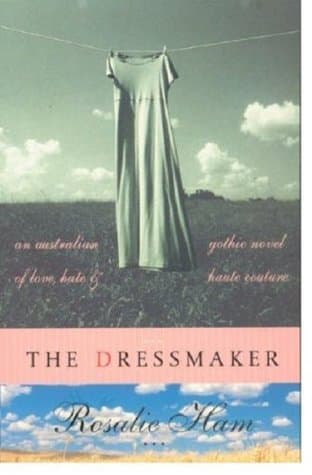
Synopsis
Covers the whole plot, including the ending.
- Difficulty
- Medium
- Pacing
- Moderate
- Mood
- Darkly Humorous, Satirical, Vengeful, Atmospheric, Tragic
- Read it if
- You enjoy dark humor, stories of revenge, and a strong sense of place, with a backdrop of 1950s fashion.
- Skip it if
- You prefer lighthearted stories, or are sensitive to themes of cruelty, small-town prejudice, and tragic events.
The Dressmaker Plot Summary
Covers the whole plot, including the ending.
Return to Dungatar
Myrtle 'Tilly' Dunnage, a sophisticated dressmaker, returns to the remote Australian town of Dungatar after twenty years abroad, mostly in Parisian haute couture houses. She comes back to care for her ailing, eccentric mother, Molly, known as 'Mad Molly' by the townspeople, who lives in a dilapidated house on a hill. Tilly was banished from Dungatar as a child after being accused of murdering Stewart Pettyman, the son of the town's prominent councilor. Her return stirs up resentment and fear among the townspeople, who eye her with suspicion and hostility, believing her to be cursed or a murderer.
The Power of Fashion
Despite the town's initial animosity, Tilly's talent for dressmaking soon becomes clear. Her first client is Gertrude Pratt, a plain woman who wants a dress for the local dance to impress William Beaumont. Tilly creates a stunning green gown that transforms Gertrude, making her the belle of the ball and catching William's eye. This success sparks a trend, and other women, including the snobbish Elsbeth Beaumont and the manipulative Mona, begin to seek out Tilly's services. Her creations not only change their appearances but also give them new confidence, slowly chipping away at the town's prejudice against her.
A Budding Romance and Unlikely Friendship
Amidst the town's hostility, Tilly forms a friendship with Sergeant Farrat, the local policeman, who secretly loves fabrics and fashion. He becomes her confidante and a source of local information. More significantly, Tilly develops a romantic relationship with Teddy McSwiney, a kind and handsome local football hero whose family is also seen as outcasts. Teddy, unlike the others, sees Tilly for who she is and genuinely cares for her. Their blossoming romance offers Tilly a sense of belonging and happiness she hasn't known, and he encourages her to confront her past.
Unearthing the Past
Wanting to understand her past and clear her name, Tilly investigates the circumstances surrounding Stewart Pettyman's death. She has fragmented memories of the incident, as she was a child at the time. Sergeant Farrat, with his access to official records and local gossip, helps her piece together the events. The townspeople, particularly the Pettyman family and their allies, resist any re-examination of the past, reinforcing the idea that Tilly was solely responsible. This search for truth becomes a central motivation for Tilly, intertwining with her desire for revenge.
Molly's Decline and Revelation
Molly's health worsens, made worse by her eccentric lifestyle and the town's ostracization. Before her death, Molly begins to regain some clarity and reveals important information to Tilly. She confesses that she knew Tilly's father's identity and that many townspeople harbored dark secrets and hypocrisies. Molly's fragmented revelations about the past, particularly surrounding Stewart Pettyman's death, fuel Tilly's growing understanding of the injustice she suffered and Dungatar's collective guilt. Her death leaves Tilly feeling more alone but also more determined in her mission.
Tragedy Strikes Teddy
Just as Tilly begins to find happiness and a sense of belonging with Teddy McSwiney, tragedy strikes. Teddy, trying to prove his love and trust by jumping into a silo of sorghum, a feat he had done many times before, suffocates. His death devastates Tilly, shattering her hopes for a future in Dungatar. The town, instead of offering solace, blames Tilly again, viewing her as cursed. This senseless loss, coupled with the continued animosity and the unresolved mystery of her past, pushes Tilly over the edge, turning her earlier desire for justice into a burning need for revenge.
The Master Plan Unfurls
Following Teddy's death, Tilly's demeanor shifts from wanting reconciliation to a cold, calculated pursuit of vengeance. She meticulously plans her retribution, using her dressmaking skills as her main tool. She continues to make stunning dresses for the townswomen, but now with a subtle, manipulative twist, often designed to expose their hypocrisies or contribute to their downfall. She uses her knowledge of their secrets, gathered from Molly and Sergeant Farrat, to strategically target those who wronged her, particularly the Pettyman family and their allies. Her revenge is not just about justice but about making them pay for their collective cruelty.
The Eisteddfod and Exposure
The annual Dungatar Eisteddfod becomes the stage for much of Tilly's revenge. Many townswomen, dressed in Tilly's latest creations, participate in the competition. However, Tilly subtly manipulates events, ensuring that the dresses, while beautiful, also contribute to the humiliation of their wearers. For example, she designs a dress for Mona that leads to her public downfall. The competition exposes the pettiness, vanity, and rivalries among the townspeople, highlighting their true characters beneath their respectable appearances. Tilly observes their reactions with detached satisfaction.
Sergeant Farrat's Transformation and Demise
Sergeant Farrat, encouraged by Tilly, begins to openly embrace his love for women's clothing, especially luxurious fabrics. Tilly makes him a beautiful red velvet gown, which he secretly wears. During the climax of the Eisteddfod, while the town is distracted, Farrat, in his red gown, tries to move the large, unstable stage set for the performance. In a tragic accident, the set collapses, killing him instantly. His death is another blow to Tilly, as he was one of her few true allies, and it shows Dungatar's harsh, unforgiving nature, even for those who try to find beauty and authenticity.
The Truth Revealed and Final Act
With the help of Sergeant Farrat's posthumous notes and her own recovered memories, Tilly finally remembers the full truth: Stewart Pettyman, a sadistic child, had sexually assaulted her. In self-defense, she pushed him, and he fell, hitting his head on a barrel and dying. The town, led by his powerful parents, covered up his true nature and blamed Tilly. Armed with this knowledge and fueled by grief and anger, Tilly sets her ultimate plan in motion. She orchestrates a final, spectacular act of revenge, setting fire to Dungatar after ensuring most of the townspeople are at the football grand final, leaving them with nothing but the ashes of their hypocrisy and cruelty.
The Dressmaker Characters
Myrtle 'Tilly' Dunnage
Protagonist
A skilled Parisian dressmaker returning to her hometown to care for her mother and seek justice/revenge.
Tilly is an enigmatic and beautiful woman, hardened by a traumatic past and years of ostracism. She possesses an extraordinary talent for haute couture, which she uses as both a tool for connection and a weapon for revenge. Initially, she seeks to understand her past and clear her name, hoping for acceptance. However, after repeated injustices and personal tragedies, particularly Teddy's death, her desire for reconciliation transforms into a cold, calculated resolve for vengeance. She is fiercely independent, intelligent, and deeply wounded, yet capable of immense kindness and formidable wrath.
Relationships: Molly Dunnage (Daughter, caregiver, seeking answers about their shared past.); Sergeant Farrat (Confidante, friend, and ally in uncovering the truth.); Teddy McSwiney (Love interest, source of happiness and acceptance.); Gertrude Pratt/Pratt-Beaumont (Client, initially a symbol of Tilly's positive impact, later a victim of her subtle manipulations.); Evan Pettyman (Father and primary target of revenge for his past actions and cover-up.)
Molly Dunnage
Supporting
Tilly's eccentric, ailing mother, known as 'Mad Molly,' who holds secrets about Dungatar's past.
Molly is Tilly's mother, a reclusive and mentally unstable woman living in squalor on the outskirts of Dungatar. She is an outcast, shunned and ridiculed by the townspeople, reflecting Tilly's own status. Molly's 'madness' often manifests as fragmented memories and erratic behavior, but beneath it lies a deep understanding of the town's hypocrisy and the truth about Tilly's past. Her decline and eventual death serve as a catalyst for Tilly's deeper investigation and subsequent shift towards revenge. Despite her difficulties, she possesses a fierce, if unconventional, love for Tilly.
Relationships: Tilly Dunnage (Mother, dependent on Tilly's care, shares a complex and often strained bond due to their shared past and Molly's illness.); Evan Pettyman (Former lover and father of Tilly, whom Molly despises for his actions.)
Teddy McSwiney
Supporting
A kind and handsome local football star who falls in love with Tilly.
Teddy is one of the few genuinely good-hearted individuals in Dungatar. He is handsome, popular with the children, and a talented footballer, but his family is also viewed as disreputable by the town's elite. Unlike others, he is not prejudiced against Tilly and sees beyond her past, offering her love, acceptance, and a glimpse of a normal life. His unwavering support and belief in Tilly provide her with a brief period of happiness and hope. His tragic, accidental death is a pivotal moment, shattering Tilly's chance at a future and solidifying her path to revenge.
Relationships: Tilly Dunnage (Love interest, source of unconditional love and support.); The McSwiney Family (His family, also considered outcasts by the town.)
Sergeant Farrat
Supporting
The town's kind-hearted policeman with a secret passion for fabrics and fashion.
Sergeant Farrat is a gentle and somewhat effeminate policeman who serves as Tilly's primary confidante and ally. He is observant and holds a deep understanding of the town's dynamics and its inhabitants' secrets, which he subtly shares with Tilly. Farrat harbors a secret passion for beautiful fabrics and women's clothing, a desire that Tilly encourages him to express. His friendship offers Tilly a rare sense of trust and understanding in Dungatar. His tragic death, while trying to help at the Eisteddfod, removes one of Tilly's last remaining allies and adds to her sense of loss and isolation.
Relationships: Tilly Dunnage (Confidante and friend, sharing an understanding of beauty and secrets.); The townspeople (Their nominal protector, but often overlooked and underestimated by them.)
Gertrude Pratt (later Pratt-Beaumont)
Supporting
A plain, ambitious young woman who uses Tilly's dresses to climb the social ladder.
Gertrude Pratt is initially a shy and unassuming young woman, desperate to escape her mundane life and marry into the prominent Beaumont family. She is Tilly's first significant client, and the stunning green dress Tilly creates for her transforms her appearance and confidence, enabling her to win William Beaumont's affection and marry him. Gertrude embodies the transformative power of Tilly's fashion. However, as she gains social standing, she becomes increasingly snobbish, hypocritical, and eventually turns against Tilly, becoming another target of her subtle manipulations.
Relationships: Tilly Dunnage (Client turned rival/target of revenge.); William Beaumont (Husband, whom she married for social advancement.)
Evan Pettyman
Antagonist
The corrupt and powerful town councillor, father of Stewart, and a key figure in Tilly's past trauma.
Evan Pettyman is a wealthy and influential town councillor, a pillar of the Dungatar community, but beneath his respectable facade lies a cruel and predatory man. He is the father of Stewart, the boy Tilly was accused of murdering, and is instrumental in Tilly's banishment and the cover-up of his son's true nature. He is revealed to be Tilly's biological father and a serial abuser, having sexually assaulted Tilly as a child and many other women in town. He represents the deep-seated corruption and hypocrisy of Dungatar, making him a primary target for Tilly's revenge.
Relationships: Tilly Dunnage (Biological father and abuser, target of her ultimate revenge.); Marigold Pettyman (Wife, whom he routinely abuses and gaslights.); Stewart Pettyman (Son, whose death he covered up and whose true nature he protected.)
Marigold Pettyman
Supporting
Evan Pettyman's frail and drug-addicted wife, haunted by her son's death and her husband's abuse.
Marigold Pettyman is the fragile and often incapacitated wife of Evan Pettyman. She is perpetually sedated by her husband, who uses her addiction to control her and suppress her memories. Marigold is deeply traumatized by the death of her son, Stewart, and lives in a state of perpetual grief and confusion. She is a victim of Evan's abuse, both physical and psychological. Tilly eventually uses her dressmaking skills to help Marigold find clarity and expose Evan's cruelty, making her an unwitting participant in Tilly's revenge.
Relationships: Evan Pettyman (Abused wife, controlled by his manipulation and drugs.); Tilly Dunnage (Client who helps her regain clarity and exposes her husband.); Stewart Pettyman (Deceased son, whose memory deeply affects her.)
William Beaumont
Supporting
The eligible bachelor of Dungatar, who marries Gertrude Pratt.
William Beaumont is the most eligible bachelor in Dungatar, belonging to one of the town's prominent families. He is initially drawn to Gertrude Pratt after her transformation by Tilly's dress. He is somewhat weak-willed and easily influenced by his mother, Elsbeth, and the social pressures of the town. His marriage to Gertrude is a symbol of social climbing and the superficiality of Dungatar's elite. He embodies the general lack of courage and independent thought prevalent in the town, ultimately becoming another pawn in Tilly's larger scheme.
Relationships: Gertrude Pratt-Beaumont (Husband, influenced by her ambitions.); Elsbeth Beaumont (Son, heavily influenced by his domineering mother.)
The Dressmaker Themes
Revenge and Justice
The main theme is Tilly's quest for retribution against the town that wronged her. Initially, she seeks justice and to clear her name, but after Teddy's death and continued animosity, her goal shifts to calculated revenge. The novel explores the blurred lines between these concepts, questioning whether Tilly's destructive actions are a righteous reclaiming of power or a descent into cruelty mirroring her tormentors. Her final act of burning Dungatar shows this theme, a scorched-earth policy of retribution for decades of injustice, malice, and personal loss. It highlights the destructive nature of unchecked anger but also the catharsis of reclaiming agency.
“Pain will no longer be a punishment, but a memory, then a gift.”
Transformation and Identity
Tilly's dresses transform the women of Dungatar, both externally and internally. Gertrude Pratt's change from plain to glamorous, securing her marriage, is a prime example. The theme also explores deeper identity. Tilly herself changes from a hopeful outsider to a vengeful architect of destruction. Sergeant Farrat's embrace of his true identity through Tilly's encouragement highlights the liberating aspect of self-acceptance. The dresses act as a metaphor for identity, showing how it can be fabricated, concealed, or revealed, and how external changes can reflect or mask internal truths. The transformations are not always positive, often revealing the wearer's underlying vanity or hypocrisy.
“They couldn’t be themselves in public, so they were someone else.”
Hypocrisy and Prejudice
Dungatar is a town full of hypocrisy and prejudice. The seemingly respectable citizens, particularly the Pettyman family, hide dark secrets, engage in illicit affairs, and spread cruel gossip, all while pretending to be morally superior. Tilly and Molly are branded as outcasts and murderers, while the true perpetrators of abuse and injustice remain unpunished and respected. The town's collective memory is selective, conveniently forgetting their own involvement in Tilly's suffering. This theme shows the destructive power of small-town mentality, where fear of the 'other' and a rigid social hierarchy lead to systemic injustice and cruelty. Tilly's revenge is, in part, a response to this widespread hypocrisy.
“Everyone knew everything about everyone but no one ever dobbed anyone in.”
The Power of Fashion
Fashion is not just a backdrop but a powerful force and a character itself. Tilly's haute couture dresses are instruments of power, able to elevate social status, ignite desire, and even help with revenge. The garments act as a catalyst for change within the town, drawing out hidden desires and exposing underlying insecurities. They provide a way for Tilly to gain access and influence, even among those who despise her. The dresses symbolize transformation, allure, and control, showing how external appearance can change perception and reality, and how art can be used as a tool for manipulation or liberation.
“With a bolt of fabric, a sharp pair of scissors and a sewing machine, Tilly could transform lives.”
Plot Devices & Literary Techniques
The Outsider Protagonist
Tilly's status as an outcast allows her unique perspective and freedom of action.
Tilly's role as an outsider, banished from Dungatar as a child and returning as a sophisticated stranger, is crucial. It allows her to observe the town's hypocrisy and cruelty with a detached, critical eye, unburdened by loyalty to its social norms. This outsider status also fuels her motivation for revenge, as she has nothing to lose and no social standing to protect. Her unique perspective, combined with her Parisian fashion skills, makes her an unpredictable and powerful force, capable of disrupting the established order and enacting justice (or revenge) from the fringes.
The Unreliable Narrator (Memory Gaps)
Tilly's fragmented memories of Stewart Pettyman's death create suspense and drive her investigation.
Tilly's inability to fully recall the events surrounding Stewart Pettyman's death serves as a significant plot device. These memory gaps create suspense, making both Tilly and the reader question her guilt and the true nature of the incident. Her quest to recover these lost memories propels much of the narrative, leading her to confront the townspeople and piece together the truth. The eventual recovery of her memories, revealing Stewart's predatory nature and her self-defense, is a pivotal moment that justifies her subsequent vengeful actions and shifts the reader's perception of her culpability.
Symbolism of Dresses/Fashion
The dresses represent transformation, power, and the superficiality of appearance.
The dresses Tilly creates are more than just garments; they are powerful symbols. They represent transformation, as seen in Gertrude Pratt's social ascent. They symbolize power, giving the wearer confidence and influence. They also highlight the superficiality and hypocrisy of Dungatar, as the women use the dresses to project an image of respectability while harboring dark secrets. Ultimately, the dresses become instruments of Tilly's revenge, subtly designed to expose flaws, create social upheaval, and lead to the downfall of her enemies. They are a weaponized art form, reflecting the beauty and danger Tilly herself embodies.
The Isolated Small Town
Dungatar's isolation fosters gossip, prejudice, and a rigid social hierarchy.
The setting of Dungatar, a small, isolated, and insular Australian town, is a crucial plot device. Its remoteness contributes to the townspeople's narrow-mindedness, their reliance on gossip, and their intense prejudice against outsiders like Tilly and Molly. The lack of external influence allows a rigid, unforgiving social hierarchy to flourish, where secrets are tightly kept, and injustices are easily perpetuated and covered up. This isolation intensifies the drama and the impact of Tilly's return and subsequent revenge, as there is no escape from the collective judgment or the consequences of her actions.
The Dressmaker Quotes
“She was a dressmaker, not a magician.”
“A dress can change a woman's life.”
“Everyone knew everything about everyone, but no one ever said a word.”
“Pain will always find you, but you can choose to make it useful.”
“They had never seen anything like it. It was like watching a butterfly emerge from a chrysalis.”
“Sometimes you have to burn it all down to start again.”
“Dungatar was a place of secrets, whispered behind cupped hands and drawn curtains.”
“She dressed as if she was going to a party, even if it was only to the general store.”
“The past is a monster that devours the present.”
“There's no justice in the world, only consequences.”
“Love is a dangerous thing in a small town.”
“She had come back to clear her name, but instead, she had only stirred the pot.”
“The clothes were a shield, a disguise, a declaration.”
“Revenge is a dish best served with exquisite tailoring.”
Quiz
10 questions on the plot and the characters. Each answer comes with a short explanation.
Question 1
Why was Tilly Dunnage initially banished from Dungatar as a child?
- She stole money from the local shopkeeper.
- She was accused of murdering a schoolmate, Stewart Pettyman.
- She ran away from home multiple times.
- She had an affair with a married man.
Show answer
B. She was accused of murdering a schoolmate, Stewart Pettyman. Tilly was banished after being accused of causing the death of Stewart Pettyman, the son of the town's most prominent family.
Question 2
What is Sergeant Farrat's secret passion that Tilly discovers?
- Collecting rare stamps
- Playing the violin
- Designing and wearing women's clothing
- Breeding exotic birds
Show answer
C. Designing and wearing women's clothing Tilly discovers Sergeant Farrat's hidden passion for fabrics and women's fashion, as he secretly enjoys dressing up.
Question 3
What is the name of Tilly's ailing mother?
- Molly Dunnage
- Betty Dunnage
- Agnes Dunnage
- Peggy Dunnage
Show answer
A. Molly Dunnage Tilly returns to Dungatar to check on her mother, Molly Dunnage, who is initially quite reclusive and unwell.
Question 4
Which character is Tilly's primary romantic interest in Dungatar?
- William Beaumont
- Teddy McSwiney
- Sergeant Farrat
- Percival Almanac
Show answer
B. Teddy McSwiney Tilly develops a romance with Teddy McSwiney, the local football star, whose family is also somewhat ostracized.
Question 5
How does Teddy McSwiney tragically die?
- He is poisoned by a jealous townsperson.
- He drowns in a grain silo while trying to impress Tilly.
- He is killed in a car accident.
- He commits suicide after being rejected by Tilly.
Show answer
B. He drowns in a grain silo while trying to impress Tilly. Teddy tragically dies by falling into a grain silo and suffocating, after attempting to prove his love and strength to Tilly.
Question 6
What is the primary theme explored through Tilly's use of her dressmaking skills in Dungatar?
- The power of fashion to unite communities.
- The corrupting influence of wealth and status.
- Revenge, transformation, and the superficiality of appearances.
- The importance of forgiveness and moving on from the past.
Show answer
C. Revenge, transformation, and the superficiality of appearances. Tilly uses her dressmaking to both transform the women of Dungatar and to subtly exact her revenge, highlighting themes of superficiality and the desire for retribution.
Question 7
Who is Elsbeth Beaumont, and what is her relationship to Tilly?
- She is Tilly's estranged aunt who lives in the neighboring town.
- She is the town's schoolteacher and a childhood friend of Tilly's.
- She is a wealthy, snobbish woman who initially rejects Tilly but later seeks her services.
- She is the local librarian who helps Tilly research her past.
Show answer
C. She is a wealthy, snobbish woman who initially rejects Tilly but later seeks her services. Elsbeth Beaumont represents the town's upper crust; she is initially disdainful of Tilly but eventually succumbs to the allure of her dresses.
Question 8
What is the ultimate act of revenge Tilly carries out against the town of Dungatar?
- She exposes all their secrets in a public letter.
- She burns down the entire town after the fashion parade.
- She leaves town with all their money and possessions.
- She frames the town's mayor for a crime he didn't commit.
Show answer
B. She burns down the entire town after the fashion parade. After the town's hypocrisy and cruelty become unbearable, Tilly meticulously sets fire to Dungatar, leaving it in ashes as she departs.
Question 9
What role does the 'curse' play in the town's perception of Tilly and her mother?
- It is a genuine supernatural affliction that causes misfortune.
- It is a superstitious belief used by the townspeople to justify their ostracization of Tilly and Molly.
- It is a misunderstanding about a rare genetic illness in their family.
- It is a lie spread by Tilly herself to keep people away.
Show answer
B. It is a superstitious belief used by the townspeople to justify their ostracization of Tilly and Molly. The 'curse' is a manifestation of the town's prejudice and superstition, a convenient narrative to blame Tilly and Molly for any misfortune and to justify their cruel treatment.
Question 10
Who ultimately reveals the truth about Stewart Pettyman's death to Tilly?
- Sergeant Farrat, after a long investigation.
- Molly Dunnage, Tilly's mother, when her memory returns.
- Teddy McSwiney, from a secret diary.
- Gertrude Pratt, in a moment of drunken confession.
Show answer
B. Molly Dunnage, Tilly's mother, when her memory returns. Molly, Tilly's mother, eventually reveals that she was the one who pushed Stewart Pettyman, not Tilly, and that he died after hitting his head.
The Dressmaker FAQ
What brings Tilly Dunnage back to Dungatar after two decades away?
Tilly returns to Dungatar primarily to care for her ailing and eccentric mother, Molly Dunnage, who is living in squalor. Her initial intention is to check on Molly and then leave, but she ultimately decides to stay, driven by a complex mix of duty, unresolved past trauma, and a burgeoning plan for revenge.
How does Tilly Dunnage initially gain acceptance or influence in the judgmental town of Dungatar?
Tilly leverages her exceptional dressmaking skills, honed in Parisian couture houses, to win over the townswomen. Her exquisite and transformative designs, which bring a touch of glamour and sophistication to the isolated town, prove irresistible to the prim and fashion-starved residents, despite their deep-seated prejudices against her.
Who is Teddy McSwiney and what is his relationship with Tilly?
Teddy McSwiney is the local football star in Dungatar and a member of another outcast family, the McSwineys. He develops a genuine romantic interest in Tilly, seeing past the town's gossip and her troubled past. Their relationship offers Tilly a rare glimpse of love and acceptance, becoming a significant emotional anchor for her.
What is the central conflict or 'darker design' Tilly pursues in Dungatar?
Tilly's central conflict revolves around seeking revenge on the townspeople who wronged her and contributed to her childhood banishment and the death of Stewart Pettyman. She meticulously plans to expose their hypocrisy, manipulate their desires, and ultimately exact retribution for the injustices she and her mother suffered.
What role does Sergeant Farrat play in Tilly's life and the town's dynamics?
Sergeant Farrat is the town's only policeman and a surprising ally to Tilly, harboring a secret passion for fabrics and fashion. He offers her friendship and a degree of protection, often turning a blind eye to the town's more malicious activities. His internal struggle between upholding the law and his personal fascinations adds a layer of dark humor and moral ambiguity.
What is the significance of the 'curse' or 'bad luck' associated with Tilly and Molly?
The 'curse' is largely a social construct perpetuated by the townspeople to justify their ostracization of Tilly and Molly. It stems from the mysterious death of Stewart Pettyman, for which Tilly was blamed. This label allows the town to project their own moral failings and superstitions onto the two women, reinforcing their outcast status.
How does the town's geography or setting contribute to the novel's atmosphere and plot?
Dungatar's isolation and small-town nature amplify its insularity, gossip, and the claustrophobic feeling for Tilly. The dusty, desolate landscape contrasts sharply with the vibrant, sophisticated dresses Tilly creates, highlighting the town's provincialism and the dramatic impact of her return. This setting fosters a hotbed for secrets and grudges.
What historical context of 1950s Australia is subtly present in the novel?
The novel subtly reflects the social conservatism, rigid class structures, and moral hypocrisy prevalent in rural Australia during the 1950s. The town's resistance to change, its judgmental attitudes towards unconventional women like Tilly and Molly, and the limited opportunities for personal expression are all indicative of the era.
What is the true story behind Stewart Pettyman's death, and how does it impact Tilly?
Stewart Pettyman's death was an accident, where he fell and broke his neck after bullying Tilly. While Tilly was blamed and exiled, she was not directly responsible. The trauma of being falsely accused and banished for this event shapes her entire life, fueling her resentment and her eventual quest for revenge against those who condemned her.
How does Tilly's fashion become a tool for psychological manipulation?
Tilly's dresses are not just garments; they are psychological weapons. She uses them to expose the townswomen's vanity, insecurity, and desire for status. By transforming their appearances, she temporarily grants them confidence and envy, only to subtly highlight their inner ugliness and set the stage for their eventual downfall, making them complicit in her scheme.
Discuss the psychological impact of Tilly's childhood trauma and banishment on her adult personality.
Tilly's childhood trauma, including the false accusation of murder and her subsequent banishment, leaves her with deep emotional scars. She develops a guarded, stoic exterior, often suppressing her true feelings. This trauma fuels her determination for revenge but also makes her vulnerable to genuine affection, as seen in her relationship with Teddy.
How does Molly Dunnage's eccentric behavior serve as a coping mechanism or a form of rebellion?
Molly's apparent madness and eccentric behavior are complex. They can be interpreted as a coping mechanism for the trauma of her past, including her relationship with Evan Pettyman and the town's ostracization. It is also a form of passive rebellion against the stifling conformity of Dungatar, allowing her to exist outside its judgmental rules.
Analyze the collective psychology of the townspeople of Dungatar.
The townspeople of Dungatar exhibit a collective psychology marked by hypocrisy, gossip, envy, and a rigid adherence to social norms. They are quick to judge and ostracize outsiders, yet secretly harbor their own vices and insecurities. Their fear of difference and their desire for social standing make them susceptible to Tilly's manipulations.
Is Tilly's revenge ultimately satisfying or does it come at too high a cost?
This is debatable. While Tilly successfully exposes the town's hypocrisy and exacts a spectacular form of retribution, her journey is marked by significant personal loss, particularly the death of Teddy McSwiney. The novel leaves the reader to ponder whether the satisfaction of revenge outweighs the emotional toll and the destruction left in its wake.
How does the novel use haute couture as a metaphor?
Haute couture serves as a powerful metaphor for transformation, illusion, and the superficiality of appearances. Tilly's dresses can transform a person's outward image, but they cannot change their inner character. The beautiful garments highlight the ugliness of the town's prejudices and the discrepancy between outward presentation and inner moral corruption.
What is the moral ambiguity surrounding Tilly's actions, particularly her final act of revenge?
Tilly's actions are morally ambiguous because while her desire for justice is understandable given her past, her methods involve manipulation, destruction, and a degree of cruelty. Her final act, burning down the town, is undeniably extreme, forcing the reader to question whether the ends justify the means and if she truly rises above the very malice she seeks to punish.
Does the book portray Tilly as a hero, an anti-hero, or something else entirely?
Tilly is best described as an anti-hero. She possesses admirable skills and suffers immense injustice, garnering reader sympathy. However, her motivations are driven by revenge, and her methods are often morally questionable and destructive. She challenges conventional heroism by operating outside societal norms and seeking retribution rather than forgiveness.
How does the novel critique small-town mentality and social conformity?
The novel sharply critiques small-town mentality by exposing its inherent hypocrisy, insularity, and cruelty. The residents of Dungatar prioritize appearances and gossip over genuine compassion, leading to the ostracization of anyone who deviates from their narrow norms. It highlights how social conformity can stifle individuality and foster a breeding ground for malice.
Similar books
- The Book Thief
Markus Zusak
4.4 (1.8M) average on GoodreadsHistorical FictionExplores a unique perspective in a small, isolated community during a challenging historical period, with elements of dark humor and tragedy.
- Chocolat
Joanne Harris
4.0 (113k) average on GoodreadsFantasyFeatures an enigmatic woman who arrives in a conservative French village, challenging its norms and stirring up dormant passions and prejudices, with a touch of magical realism.
- The Secret Life of Bees
Sue Monk Kidd
4.1 (1.1M) average on GoodreadsHistorical FictionWhile both novels feature a young woman returning to or finding solace in a unique community (Tilly to Dungatar, Lily to the Boatwright home) and grappling with a traumatic past, 'The Secret Life of Bees' maintains a more consistent tone of hopeful discovery and gentle healing. Ham's 'The Dressmaker' leans heavily into dark comedy and overt revenge, contrasting with Kidd's focus on spiritual awakening and surrogate family. Both explore themes of female community and confronting historical wrongs, but Ham's approach is far more cynical and confrontational regarding justice.
- Atonement
Ian McEwan
4.4 (70) average on Goodreads'Atonement' and 'The Dressmaker' both delve into the lasting repercussions of a single, devastating lie or misunderstanding. However, McEwan's novel is a profound meditation on guilt, memory, and the subjective nature of truth, told with a meticulous literary craft and a tragic, somber tone. Ham's 'The Dressmaker,' while also dealing with past injustices, approaches its narrative with a more theatrical, almost gothic sensibility, employing humor and sartorial extravagance as key elements. McEwan's focus is on the internal torment and the author's power over narrative, whereas Ham's is on external, dramatic retribution and the societal impact of prejudice.
- To Kill a Mockingbird
Harper Lee
4.3 (4.5M) average on GoodreadsHistorical FictionIn the 1930s Jim Crow South, Harper Lee writes about racial injustice, moral growth, and the quiet courage of a lawyer father, Atticus Finch, as seen through his young daughter's eyes.
- The Great Gatsby
F. Scott Fitzgerald
3.9 (3.8M) average on GoodreadsHistorical FictionIn the opulent Roaring Twenties, a mysterious millionaire's lavish parties hide his desperate, tragic pursuit of a lost love, exposing the emptiness within the American Dream.






Enjoyed the summary?
A summary gives you the shape of the book. The book itself has the detail, the examples and the voice.
Find The Dressmaker on AmazonAs an Amazon Associate, BookBrief earns from qualifying purchases. How we're funded