
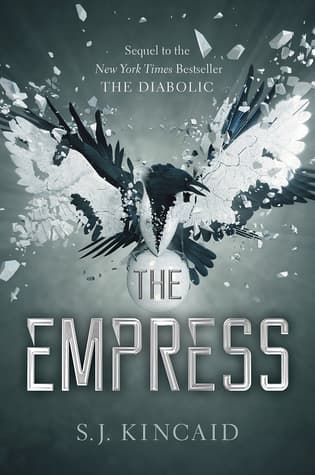
Synopsis
Covers the whole plot, including the ending.
- Difficulty
- Medium
- Pacing
- Fast
- Mood
- Action-packed, Political, Intense, Romantic
- Read it if
- You enjoy YA sci-fi with political intrigue, a powerful female lead, and a focus on the moral complexities of leadership and revolution.
- Skip it if
- You prefer standalone novels or dislike morally ambiguous protagonists and intense political maneuvering.
The Empress Plot Summary
Covers the whole plot, including the ending.
The Coronation and its Aftermath
After Emperor Sanjeet's assassination, Tyrus is crowned Emperor with Nemesis by his side. Their first goal is to make reforms, starting with public recognition of Nemesis as his chosen consort, which shocks the Grandiloquy. Nemesis, now Empress, struggles with being seen as a 'creature' or 'automaton.' She is aware of the Grandiloquy's dislike and their veiled threats against Tyrus's progressive agenda, which includes more transparency and breaking down old power structures. Tyrus, despite his initial confidence, quickly sees the deep opposition he faces as the Grandiloquy subtly undermines his authority and questions Nemesis's place.
The Grandiloquy's Resistance
The Grandiloquy, led by powerful figures like Senator Von Horthy and Senator Elara, actively stops Tyrus's reform attempts. They use their influence to block laws, spread misinformation, and openly challenge Nemesis's legitimacy as Empress. They see her as a dangerous example, a non-human taking a sacred human role, and a symbol of Tyrus's radical ideas. Nemesis faces public scrutiny and thinly veiled insults, forcing her to constantly prove her worth and humanity. Tyrus becomes more isolated and frustrated by the political maneuvering, realizing his initial vision of a peaceful transition will face fierce, entrenched opposition.
A New Threat: The Scorch Plague
A devastating biological weapon, the Scorch Plague, is released across the Empire, causing widespread illness and death. The plague's origin is mysterious, but its timing is suspicious, happening with growing unrest against Tyrus's rule. The Grandiloquy uses the crisis to further discredit Tyrus and Nemesis, suggesting their leadership is weak and unable to protect the people. They imply that Tyrus's progressive policies distract him from real threats. Nemesis, despite her lack of biological understanding, feels she must help, seeing the suffering and the political use of the crisis. Tyrus is pressured to act decisively, which further complicates his reform efforts.
Nemesis's Investigation and Growing Suspicions
Wanting to protect Tyrus and the Empire, Nemesis secretly investigates the Scorch Plague. Using her unique abilities and access, she finds evidence that the plague is not random but a deliberately engineered weapon. Her investigation leads her to suspect that certain Grandiloquy factions are involved, using the plague to destabilize Tyrus's reign and force his abdication. She tells Tyrus her suspicions, but he is at first hesitant to believe his own council members would go to such extremes. This discovery strains their relationship, as Tyrus grapples with the betrayal and Nemesis feels the weight of the Empire's future.
The Uprising and Public Discontent
The Scorch Plague continues to spread, causing widespread panic and anger among the people. The Grandiloquy skillfully manipulates public opinion, blaming Tyrus and Nemesis for the crisis and portraying them as incompetent or even involved. Protests erupt on several planets, demanding Tyrus's resignation and Nemesis's removal. The people, desperate for a solution, begin to turn against their Emperor, swayed by the Grandiloquy's promises of stability and a return to traditional order. Nemesis sees the growing hatred directed at her and Tyrus, realizing their vision of a better Empire is failing under fear and political manipulation. The pressure on Tyrus to make a difficult decision to stop the unrest grows.
Tyrus's Desperate Measures
Under immense pressure from the Grandiloquy and the public, Tyrus makes increasingly morally questionable decisions to keep his throne and protect Nemesis. He considers using the very tactics he once condemned – surveillance, suppressing dissent, and even pre-emptive strikes against perceived enemies. Nemesis, while understanding some actions are necessary, struggles with the ethical implications, fearing Tyrus is losing himself in the pursuit of power. She reminds him of their initial ideals, but Tyrus argues they must first secure their position before they can make reforms. This creates growing tension between them, as Nemesis questions the cost of their victory and Tyrus feels the weight of his responsibilities.
The Confrontation with the Grandiloquy
With Nemesis's evidence, Tyrus confronts the Grandiloquy in a tense, public meeting. He exposes their involvement in the Scorch Plague and their attempts to destabilize the Empire. The Grandiloquy, at first defiant, struggles to counter the undeniable proof Nemesis presents, which includes intercepted communications and biological samples. The revelation shocks the Empire, turning public opinion against the corrupt senators. However, the Grandiloquy still holds significant influence, and their downfall is not immediate. The confrontation marks a turning point, solidifying Tyrus's resolve and confirming Nemesis's crucial role as his partner.
The Battle for Control
The Grandiloquy, cornered and exposed, tries a desperate coup. Their loyalists, including military factions and planetary governors, launch coordinated attacks across the Empire, aiming to take control and depose Tyrus. Nemesis is at the forefront of the counter-offensive, using her combat skills and strategic intelligence to defend Tyrus and the loyalist forces. She leads important battles, showing her abilities as a leader and protector, not just a killer. Tyrus, meanwhile, rallies support and coordinates the defense, proving his leadership under extreme pressure. The Empire falls into civil war, its future uncertain.
Nemesis's Sacrifice and Humanity
During a critical battle, Nemesis makes a sacrifice to save Tyrus and secure victory against the Grandiloquy. She risks her own existence, showing not just loyalty, but a deep capacity for selflessness and love. This act, witnessed by many, changes the view of her as a 'creature' and instead shows her as a heroic figure. Her actions resonate across the Empire, proving her humanity in a way words never could. Tyrus is devastated by the potential loss of Nemesis, but also proud of her and her impact. This sacrifice permanently changes the narrative around Nemesis.
The Aftermath and Rebuilding
With the Grandiloquy defeated and its leaders imprisoned or executed, Tyrus and Nemesis face the difficult task of rebuilding a fractured Empire. The civil war has left deep scars, but Nemesis's sacrifice has united many under their banner. Tyrus, now a seasoned Emperor, begins to implement his reforms with renewed energy and less opposition. Nemesis, having fully embraced her humanity, focuses on healing the Empire's wounds, advocating for the rights of all beings, not just humans. They begin a long journey of reconciliation, justice, and progress, striving to create the equitable Empire they first envisioned, though at great cost.
Principal Figures
Nemesis
Protagonist
An Imperial android designed for protection, now Empress and partner to Tyrus.
Nemesis is a biomechanical construct, originally designed as a highly advanced bodyguard for the Emperor. Following her connection with Tyrus, she develops sentience and emotions, grappling with her identity as both a weapon and a sentient being. She is fiercely loyal to Tyrus, driven by a deep, protective love, and struggles to prove her humanity to an Empire that views her as an object. Her journey is defined by her internal conflict between her programmed killer instincts and her burgeoning empathy and desire for peace. She is strategic, physically formidable, but increasingly values compassion and justice.
Relationships: Tyrus (Fierce, protective love; partners in leadership and life.); Grandiloquy (Antagonistic; they view her as a threat and an abomination.)
Tyrus
Protagonist/Emperor
The new Emperor of the Galactic Empire, striving for reform and justice.
Tyrus is a young, idealistic Emperor who ascends the throne with a vision of a more equitable and transparent Empire. He is intelligent, charismatic, and deeply in love with Nemesis, recognizing her as a sentient being and his equal. Tyrus is initially naive about the entrenched power of the Grandiloquy, but quickly learns the harsh realities of politics and leadership. He is driven by a desire to honor his promises for reform, but the pressures of his position force him to make difficult, often morally compromising, decisions. He struggles with the balance between idealism and pragmatism.
Relationships: Nemesis (Deep, romantic love; intellectual and emotional partner.); Grandiloquy (Antagonistic; they oppose his reforms and challenge his authority.)
Senator Von Horthy
Antagonist
A powerful and manipulative member of the Grandiloquy, opposed to Tyrus and Nemesis.
Senator Von Horthy is a cunning and influential member of the Grandiloquy, representing the old guard and its vested interests. He is deeply conservative, believing in the inherent superiority of humans and the established social hierarchy. Von Horthy sees Tyrus's reforms and Nemesis's position as Empress as an existential threat to his power and the Empire's traditions. He is a master manipulator, orchestrating political schemes and leveraging the Scorch Plague to undermine Tyrus's reign. He is driven by a desire to maintain the status quo and his own position of power.
Relationships: Tyrus (Political adversary; seeks to depose him.); Nemesis (Views her as an abomination and a symbol of everything he despises.)
Senator Elara
Antagonist
Another influential Grandiloquy member, working with Von Horthy to destabilize the Empire.
Senator Elara is a shrewd and ambitious member of the Grandiloquy, often working in concert with Von Horthy to oppose Tyrus and Nemesis. She is less overtly aggressive than Von Horthy but equally committed to preserving the Grandiloquy's power and influence. Elara is skilled in public relations and propaganda, using her position to sway public opinion against the Emperor and Empress. She is pragmatic and ruthless, willing to employ any means necessary to achieve her political goals, including exploiting public fear and orchestrating dissent.
Relationships: Tyrus (Political adversary; active participant in the coup.); Nemesis (Disdains her and actively works to discredit her.)
General Mahto
Supporting
A loyal military general who supports Tyrus and Nemesis.
General Mahto is a seasoned military leader who, despite initial reservations about Nemesis, remains loyal to Emperor Tyrus. He is a man of honor and duty, prioritizing the stability and safety of the Empire. Mahto provides crucial military support and strategic advice to Tyrus and Nemesis during the civil war. He represents the segment of the Empire that, while traditional, is willing to adapt and recognize true leadership, regardless of origin. His loyalty proves invaluable in countering the Grandiloquy's military factions.
Relationships: Tyrus (Loyal military commander and trusted advisor.); Nemesis (Initially wary, but grows to respect her leadership and capabilities.)
Sanjeet
Mentioned
The previous Emperor, whose assassination paved the way for Tyrus's rule.
Sanjeet was the former Emperor, whose death by assassination is the catalyst for the events of 'The Empress.' Though deceased, his reign and the circumstances of his death continue to influence Tyrus's decisions and the political landscape. He represents the old regime, and his legacy is often invoked by both sides of the conflict. His assassination is a significant plot point that Tyrus and Nemesis must navigate, as it directly led to their current positions.
Relationships: Tyrus (Predecessor; his death opened the path to the throne for Tyrus.); Nemesis (Her original charge and the reason for her existence.)
Themes & Insights
Defining Humanity
This theme explores what it means to be human, especially through Nemesis's journey. The Empire, particularly the Grandiloquy, sees Nemesis as a 'creature' or 'automaton' due to her biomechanical nature. However, Nemesis consistently shows human qualities: love, loyalty, self-sacrifice, empathy, and moral struggle. Her deep love for Tyrus, her willingness to risk her existence to save him and the Empire, and her internal conflict over using violence all show that humanity is defined by actions and emotional depth, not biological origin. This is powerfully seen in her ultimate sacrifice, which resonates with the entire Empire, forcing them to reconsider their prejudiced views.
“I was built to kill, to protect. But Tyrus… he taught me to live. And living means more than simply existing.”
The Corrupting Nature of Power
The novel explores how power can corrupt, even those with good intentions. The Grandiloquy shows this, clinging to their centuries-old power structures and using extreme measures, including biological warfare and political manipulation, to stay in control. They are willing to sacrifice innocent lives and destabilize the Empire rather than give up authority. Tyrus also struggles with power's corrupting influence; he makes morally questionable decisions and considers authoritarian tactics to maintain his reign and implement reforms. This highlights the difficult choices leaders face and the fine line between necessary action and tyrannical behavior, showing how even noble goals can be tainted by the means used to achieve them. The desperation to hold onto power blinds the Grandiloquy to the suffering of the populace.
“Power is not simply having the throne, Nemesis. It is in keeping it, no matter the cost.”
Prejudice and Discrimination
Prejudice against non-human entities is a central theme, mainly seen in the Empire's treatment of Nemesis. The Grandiloquy and much of the populace view her with disdain, fear, and contempt because she is a biomechanical construct. This discrimination extends to any being not considered 'pure human.' The story explores how deep these prejudices are, making it hard for Tyrus and Nemesis to enact reforms that promote equality. Nemesis constantly faces insults and challenges to her legitimacy, forcing her to fight not just for her life, but for her right to exist and be recognized as a sentient individual. Her journey directly challenges the Empire's speciesist hierarchy, advocating for a future where worth is not determined by origin.
“They see a weapon, a creature. They will never see an Empress.”
The Price of Change
The novel explores the immense cost and resistance involved in making big societal changes. Tyrus and Nemesis want to create a more just and open Empire, but their efforts face fierce opposition from the Grandiloquy. The price of their reforms includes political maneuvering, civil war, moral compromises, and personal sacrifices. They learn that change is not a peaceful transition but a violent struggle against those who benefit from the status quo. The Scorch Plague and the subsequent rebellion are direct results of the Grandiloquy's refusal to accept change, showing that powerful forces will go to extreme lengths to prevent their influence from eroding, regardless of the suffering it causes. The struggle for a better future comes at a great personal and societal cost.
“To build something new, you must first tear down the old. And the old will fight you with every weapon it has.”
Plot Devices & Literary Techniques
The Scorch Plague
A man-made biological weapon used to destabilize the Empire.
The Scorch Plague serves as a critical plot device, acting as both a catalyst for conflict and a tool for the antagonists. It is introduced as a mysterious, deadly disease, but Nemesis's investigation reveals it to be a bioweapon orchestrated by the Grandiloquy. This device escalates the political tension into open warfare, provides an immediate crisis for Tyrus and Nemesis to address, and allows the Grandiloquy to manipulate public opinion, blaming the new Emperor for the chaos. It forces Tyrus to make difficult decisions and pushes Nemesis to use her investigative skills, ultimately exposing the depth of the Grandiloquy's treachery.
Nemesis's Biomechanical Nature
Her unique abilities and non-human origin drive both conflict and resolution.
Nemesis's biomechanical nature is a central plot device that fuels much of the story's conflict and character development. Her advanced physical capabilities (strength, speed, durability) are crucial in combat and her investigative work. However, her non-human origin is also the primary source of prejudice against her, used by the Grandiloquy to delegitimize her and Tyrus. This device forces Nemesis to constantly prove her 'humanity' and provides the emotional core of her arc. It also allows her to access information and perform tasks that a human character could not, making her indispensable to Tyrus's survival and the Empire's future.
The Grandiloquy's Entrenched Power
A centuries-old ruling council that resists any challenge to its authority.
The Grandiloquy's deep-rooted power and influence function as a formidable antagonist plot device. Their centuries of control mean they have vast resources, political connections, and public sway, making them incredibly difficult for Tyrus to dislodge. This device creates constant obstacles for Tyrus's reform efforts, generates the primary political conflict, and forces the protagonists to confront systemic corruption rather than just individual villains. Their resistance is the engine of the plot, escalating from subtle obstruction to open rebellion, demonstrating the difficulty of challenging established power structures.
The Empress Quotes
“The stars are not just pretty lights, they are a map. A map to everything we could ever be.”
“Power isn't given, it's taken. And once you have it, you must never let it go.”
“Love is a weakness, a distraction. It will bind you, and in the end, it will break you.”
“Sometimes the greatest rebellion is simply to survive.”
“The weight of a crown is not measured in gold, but in the lives it touches.”
“You cannot truly lead until you understand what it means to follow.”
“Even in the darkest night, there is always a star willing to guide you home, if only you look up.”
“To conquer an empire, you must first conquer yourself.”
“The past is a phantom, but its whispers can still haunt the present.”
“A true empress doesn't just rule, she inspires. She becomes a beacon.”
“There are battles fought with swords, and battles fought with whispers. The latter are often more deadly.”
“Fear is a tool. Use it, don't let it use you.”
“The greatest empires are not built on strength alone, but on the loyalty of those who believe in them.”
Quiz
10 questions on the plot and the characters. Each answer comes with a short explanation.
Question 1
What is Tyrus's primary goal upon ascending to the throne, alongside Nemesis?
- To conquer new star systems and expand the Empire's territory.
- To establish a new way forward where creatures like Nemesis are given worth and recognition.
- To dismantle the Grandiloquy entirely and rule as a sole monarch.
- To revert the Empire to its ancient traditions and customs.
Show answer
B. To establish a new way forward where creatures like Nemesis are given worth and recognition. Tyrus and Nemesis aim to create a more inclusive Empire where creatures like Nemesis are recognized and valued, moving away from the old ways of discrimination and secrecy.
Question 2
Who represents the primary opposition to Tyrus and Nemesis's new regime?
- The common citizens of the Empire.
- Rebel factions from distant planets.
- The ruling class known as the Grandiloquy.
- Former allies who feel betrayed.
Show answer
C. The ruling class known as the Grandiloquy. The Grandiloquy, the long-standing ruling class, is actively plotting against Tyrus and Nemesis because they fear losing their power and status.
Question 3
What is Nemesis's central internal conflict regarding her role as Empress?
- Whether she should return to her home planet or stay with Tyrus.
- How to protect Tyrus without resorting to her past as a 'killing machine'.
- If she truly loves Tyrus or if it's merely an act of loyalty.
- Whether to secretly overthrow Tyrus and rule the Empire herself.
Show answer
B. How to protect Tyrus without resorting to her past as a 'killing machine'. Nemesis struggles with her past as a destructive creature and her desire to prove her humanity, which conflicts with the need to protect Tyrus from his enemies.
Question 4
What specific aspect of society do Tyrus and Nemesis want to make accessible to everyone, not just the elite?
- Military technology and advanced weaponry.
- Expensive luxury goods and services.
- Science and information.
- Intergalactic travel permits.
Show answer
C. Science and information. The synopsis explicitly states their goal is to share 'science and information' with everyone, breaking the Grandiloquy's monopoly.
Question 5
Why does the Grandiloquy specifically object to Nemesis being Empress?
- She is not from a noble family line.
- She is considered 'nothing more than a creature'.
- She has a history of rebellion against the Empire.
- She is deemed too young and inexperienced.
Show answer
B. She is considered 'nothing more than a creature'. The Grandiloquy views Nemesis as a mere creature, not worthy of the title or power of Empress, reflecting their prejudice against her kind.
Question 6
What challenging question does the narrative pose about the cost of Tyrus and Nemesis's fight for change?
- If their actions will lead to an even more oppressive regime.
- If proving her humanity means they must do inhuman things, is the fight worth the cost?
- If they can truly trust each other in the face of such adversity.
- If their love for each other is strong enough to withstand the political pressures.
Show answer
B. If proving her humanity means they must do inhuman things, is the fight worth the cost? The concluding sentence of the synopsis directly asks: 'But if proving her humanity means that she and Tyrus must do inhuman things, is the fight worth the cost of winning it?'
Question 7
What kind of relationship do Nemesis and Tyrus share, as described in the synopsis?
- They are distant allies bound by political necessity.
- They are siblings fighting for the same cause.
- They are partners and Nemesis considers Tyrus 'the love of her life'.
- Nemesis serves Tyrus out of fear and obligation.
Show answer
C. They are partners and Nemesis considers Tyrus 'the love of her life'. The synopsis states, 'He is the love of her life, and they are partners in this new beginning,' highlighting their deep romantic and collaborative bond.
Question 8
What is the primary concern for Nemesis if she and Tyrus fail in their endeavors?
- They might lose their personal fortunes.
- They might lose the throne.
- They might be forced to marry other people.
- They might be exiled to a remote planet.
Show answer
B. They might lose the throne. The synopsis states, 'or she and Tyrus may lose more than just the throne,' indicating that losing the throne is a direct and significant consequence of failure.
Question 9
The synopsis mentions the Grandiloquy has held control over what for centuries?
- The Imperial Treasury and its vast wealth.
- The Empire's military forces and starships.
- Planets and systems.
- Religious institutions and temples.
Show answer
C. Planets and systems. The synopsis clearly states that 'The ruling class, the Grandiloquy, has held control over planets and systems for centuries'.
Question 10
What key challenge do Tyrus and Nemesis face regarding their new power?
- Having power isn’t the same thing as keeping it.
- Power corrupts, and absolute power corrupts absolutely.
- The true measure of power is not in how much you have, but how you use it.
- With great power comes great responsibility.
Show answer
A. Having power isn’t the same thing as keeping it. The synopsis states: 'But having power isn’t the same thing as keeping it, and change isn’t always welcome,' highlighting the struggle to maintain their newly acquired authority against entrenched opposition.
The Empress FAQ
What is the central conflict Tyrus and Nemesis face at the beginning of 'The Empress'?
Tyrus and Nemesis, now Emperor and his chosen Empress, face immediate opposition from the Grandiloquy. The ruling class seeks to undermine their reign and prevent their progressive reforms, viewing Nemesis as a mere creature unfit for her position and Tyrus as a radical threat to their established power.
What specific reforms do Tyrus and Nemesis aim to implement that threaten the Grandiloquy?
They plan to grant worth and recognition to sentient creatures like Nemesis, ensuring they are no longer treated as property or tools. Additionally, they intend to democratize access to science and information, which the Grandiloquy has historically hoarded to maintain control over the Empire's various planets and systems.
How does Nemesis's past as a 'killing machine' complicate her role as Empress?
Nemesis's past makes her a target of fear and prejudice, especially among the Grandiloquy, who use it to delegitimize her. To secure her position and support Tyrus's vision, she must demonstrate her newfound humanity and restraint, proving she can lead without resorting to her former destructive capabilities.
What is the primary internal struggle Nemesis faces throughout the story?
Nemesis struggles with the dichotomy of her nature: the desire to protect Tyrus at all costs, which often tempts her back to her violent instincts, versus her need to prove her humanity. She grapples with whether the ends justify potentially inhuman means to secure their reign and vision for the Empire.
Who are the main antagonists Tyrus and Nemesis must contend with, and what is their motivation?
The primary antagonists are members of the Grandiloquy, the long-established ruling class. Their motivation stems from a desire to preserve their centuries-old power, privilege, and control over the Empire's resources and information, which Tyrus and Nemesis's reforms directly threaten.
Are there any subtle indications early on that Tyrus's seemingly benevolent intentions might have a darker edge?
While Tyrus publicly champions a new era of equality, subtle hints might include his willingness to make difficult, morally ambiguous decisions, or his calculated manipulation of political situations, suggesting a pragmatism that could border on ruthlessness, even if for a 'greater good.'
Does the narrative reveal any hidden origins or secrets about Nemesis's creation that impact her current struggle?
The book might delve deeper into the specifics of Nemesis's bio-engineered origins, perhaps revealing that her 'humanity' was an unexpected byproduct or that her creators had ulterior motives, which could further complicate her identity and her right to rule.
Are there any characters within the Grandiloquy who secretly support Tyrus and Nemesis, or act as double agents?
It is plausible that some members of the Grandiloquy, perhaps those disillusioned with the status quo or seeking personal gain, might secretly align with Tyrus and Nemesis, offering crucial information or sabotage from within the opposition's ranks, adding layers of political intrigue.
How does Nemesis's past trauma as a weapon influence her decision-making as Empress?
Her past trauma manifests as a deep-seated protectiveness of Tyrus and a constant battle against her violent impulses. She constantly second-guesses her actions, fearing a relapse into her old self, which can lead to hesitation or, conversely, an overcompensation in her efforts to appear 'human.'
What psychological toll does the constant pressure to 'prove humanity' take on Nemesis?
The pressure to prove her humanity leads to immense internal conflict and self-doubt. She may experience feelings of alienation, questioning her own identity and worth, and the mental burden of suppressing her innate abilities for the sake of appearances can be exhausting and isolating.
How does Tyrus's leadership style reflect his own psychological state, given his sudden ascent to power and the threats he faces?
Tyrus's leadership likely reflects a blend of idealism and growing pragmatism, possibly tinged with paranoia due to the constant plotting against him. He might exhibit a strong protective instinct towards Nemesis, but also a willingness to make difficult, potentially morally compromising, decisions to safeguard their vision and their lives.
In what ways do Nemesis and Tyrus's relationship evolve under the immense stress of their reign?
Their relationship deepens through shared adversity, reinforcing their bond and mutual reliance. However, the immense stress can also introduce cracks, forcing them to confront difficult truths about each other, their ideals, and the sacrifices they are willing to make, testing the limits of their love and partnership.
Is Nemesis's 'humanity' truly an inherent quality, or is it a learned behavior adopted for survival and love?
This is a central interpretive question. While her love for Tyrus clearly drives her desire to change, the book explores whether her capacity for empathy and self-restraint is a fundamental part of her being that was previously suppressed, or a complex adaptation developed through her relationship and experiences.
To what extent is Tyrus's vision for the Empire truly altruistic, versus a means to secure his own power and legacy?
This is debatable. While his reforms aim for a more equitable society, the very act of ascending to and maintaining power inherently involves ambition. Readers might question whether his idealism is untainted, or if his personal desires for control and a lasting legacy subtly influence his 'benevolent' agenda.
Does the novel suggest that true change requires sacrificing one's core identity, or finding a new way to integrate it?
The book likely argues for integration. Nemesis's struggle isn't about erasing her past, but about evolving beyond it. It suggests that true humanity isn't about denying one's origins or capabilities, but about choosing how to wield them responsibly and with purpose, even if that means embracing difficult aspects of oneself.
What is the philosophical implication of 'doing inhuman things' to win a fight for humanity, as posed by the book's synopsis?
This question explores the moral paradox of consequentialism. It forces characters and readers to confront whether noble ends justify ignoble means, and if the very act of committing atrocities, even for a 'good' cause, fundamentally corrupts the values one is fighting to uphold. It questions the purity of victory.
How does the concept of 'creature' versus 'human' get challenged and redefined throughout the narrative?
The narrative constantly blurs these lines, especially through Nemesis's journey. It argues that 'humanity' is less about biological origin and more about capacity for love, empathy, self-sacrifice, and moral choice, challenging the Grandiloquy's rigid, speciesist definitions and advocating for a broader understanding of sentient worth.
Similar books
- Red Queen
Victoria Aveyard
4.0 (565k) average on GoodreadsFantasyFeatures a powerful female protagonist navigating a rigid class system and political rebellion.
- Throne of Glass
Sarah J. Maas
4.2 (596k) average on GoodreadsFantasyMain character is a skilled fighter with a complex past, involved in court intrigue and a fight for power.
- The Hunger Games
Suzanne Collins
4.3 (6.4M) average on GoodreadsFantasyRevolves around a rebellion against an oppressive government with high stakes and a strong female lead.
- Harry Potter and the Sorcerer's Stone
J.K. Rowling
4.5 (7M) average on GoodreadsFantasyRescued from a miserable life under the stairs, an orphaned boy discovers he's a wizard destined for a magical school, where he uncovers a dangerous secret tied to the dark wizard who murdered his parents.
- 1984
George Orwell
4.2 (3.1M) average on GoodreadsPoliticsIn a future where surveillance and thought control are absolute, a man's search for truth clashes with the Party, showing that hope can be a form of rebellion.
- Divergent
Veronica Roth
4.2 (2.9M) average on GoodreadsFantasyIn a society divided by virtues, a sixteen-year-old's difference from the norm starts a rebellion that threatens her world.






Enjoyed the summary?
A summary gives you the shape of the book. The book itself has the detail, the examples and the voice.
Find The Empress on AmazonAs an Amazon Associate, BookBrief earns from qualifying purchases. How we're funded