

Synopsis
Covers the whole plot, including the ending.
- Difficulty
- Medium
- Pacing
- Moderate
- Mood
- Thought-provoking, Critical, Stark, Ironic
- Read it if
- You enjoy thought-provoking parables, plays that challenge societal norms, or works exploring ethical dilemmas in a capitalist world.
- Skip it if
- You prefer straightforward narratives with clear moral resolutions, or dislike plays with an overtly didactic tone.
The Good Woman of Setzuan Plot Summary
Covers the whole plot, including the ending.
The Gods' Arrival in Setzuan
The play starts with Wong, a water seller, waiting for three Gods. Rumor says they are looking for a good person on Earth. Wong, often poor and exploited, hopes their visit will bring change. When the Gods arrive, tired from their search in other cities, people ignore them. Most refuse them lodging, claiming poverty or no space. Only Shen Teh, a kind prostitute, takes them in, offering her small home and food. The Gods are relieved and call her the 'good woman of Setzuan.' They give her money to leave her profession and live a good life.
Shen Teh's Tobacco Shop
With the Gods' money, Shen Teh buys a small tobacco shop, hoping to live a good and generous life. However, her kindness quickly hurts her. Relatives, friends, and strangers immediately come to her, asking for lodging, food, and money. They take advantage of her good nature. The carpenter, the unemployed, the struggling family—all see Shen Teh as a endless source of help. She cannot refuse anyone, and her new business quickly nearly fails as she gives away more than she earns. Her attempts to be good meet constant exploitation, pushing her to despair.
The Creation of Shui Ta
Overwhelmed and about to lose her shop, Shen Teh realizes that pure goodness cannot last in Setzuan. She invents a new identity: a strict, practical, and ruthless male cousin named Shui Ta. Wearing a mask and a man's suit, Shen Teh becomes Shui Ta. This persona can make the hard, practical decisions Shen Teh cannot. Shui Ta immediately evicts the freeloaders, bargains hard with suppliers, and collects debts, saving the tobacco shop from ruin. This change allows Shen Teh to protect her business and herself from constant exploitation, but it costs her natural kindness.
Shen Teh's Love for Yang Sun
As Shen Teh, she falls deeply in love with Yang Sun, an unemployed pilot who dreams of flying again but lacks money. Despite his apparent selfishness, Shen Teh is drawn to him, seeing hope. She is willing to give up everything for his dreams, even her shop. Shui Ta, however, sees Yang Sun's manipulative nature and tries to protect Shen Teh from him. The conflict between Shen Teh's loving heart and Shui Ta's practical mind becomes central as Shen Teh considers selling her shop to help Yang Sun buy a pilot's license, a decision Shui Ta strongly opposes.
The Failed Wedding
Shen Teh, blinded by love, agrees to sell her shop to fund Yang Sun's pilot job in Peking. A wedding is planned, but Yang Sun's true intentions appear. He insists on getting the money before the wedding, making it clear he only cares about the funds, not Shen Teh. Shui Ta, sensing disaster, tries to stop it. Yang Sun, focused only on money, does not even wait for the bride. The wedding fails when Shen Teh (as Shui Ta) refuses to give over the money without a firm commitment. Yang Sun, angry, leaves, humiliating Shen Teh and showing his heartlessness to the community.
Shui Ta's Business Ventures
After the failed wedding, Shen Teh relies more on her Shui Ta identity. Shui Ta, now fully in charge, turns the small tobacco shop into a successful tobacco factory. This expansion employs many of Setzuan's poor, including Yang Sun, who, despite his past, gets a supervisory role. Shui Ta runs the factory with ruthless efficiency, prioritizing profit and output. While the business grows and creates jobs, workers face harsh conditions and long hours. The factory's success is built on the same exploitative ideas Shen Teh first tried to escape, showing the contradiction of 'goodness' in a capitalist society.
Shen Teh's Pregnancy and Shui Ta's Growing Dominance
Shen Teh discovers she is pregnant with Yang Sun's child. This makes her even more dependent on Shui Ta, as she needs to protect her unborn child from Setzuan's harsh life. Shui Ta's appearances become more frequent and longer, as he takes on running the factory and managing growing demands. The line between Shen Teh and Shui Ta blurs, and Shen Teh finds it harder to return to her kind self. The pressure of providing for her child forces her to accept Shui Ta's cold practicality, fearing her child would suffer if she remained purely Shen Teh.
The Disappearance of Shen Teh
As Shui Ta's business grows, Shen Teh is seen less often. Her long absence raises suspicions among the townspeople, especially after a rumor spreads that Shui Ta murdered his cousin to gain full control of the factory. The townspeople, led by Wong, demand an investigation. Yang Sun, now working for Shui Ta, also suspects something and wants to know what happened to Shen Teh. Eventually, Shui Ta is accused of wrongdoing and brought before a makeshift court, where the three Gods, disguised as judges, oversee the proceedings, unaware they are judging the very person they once tried to help.
Shui Ta's Confession
During the trial, evidence against Shui Ta grows. The townspeople accuse him of cruelty and exploitation, detailing harsh factory conditions and Shen Teh's disappearance. Cornered, Shui Ta dramatically reveals his true identity: he tears off his mask and suit, showing himself to be Shen Teh. She confesses she created Shui Ta out of necessity, to survive and protect herself and her unborn child in a world where goodness is constantly exploited. She explains that she could not be good to others without being cruel to herself, and that helping some meant being ruthless with others.
The Gods' Judgment and Departure
The Gods are shocked by Shen Teh's revelation. They acknowledge her goodness but cannot reconcile it with her harsh reality. They praise her efforts to be good but offer no practical solution to her problem. They preach that the world must change for goodness to thrive, but they offer no way to achieve this change. Unable to provide an answer or change the conditions that forced Shen Teh to create Shui Ta, the Gods return to the heavens, leaving Shen Teh alone with her impossible choice and the ongoing struggle to survive while trying to stay human. The play ends with the audience thinking about the systemic issues that stop goodness from flourishing.
Principal Figures
Shen Teh
Protagonist
A kind-hearted prostitute who struggles to maintain her goodness in a cruel world.
Shen Teh is the central figure, a young woman living in the impoverished city of Setzuan. Initially a prostitute, she is inherently kind, compassionate, and generous, often to her own detriment. Her primary motivation is to be good and to help others, a desire reinforced by the Gods' validation. She is naive and vulnerable to exploitation, which forces her to adopt a cunning alter ego. Her inner conflict stems from her desire to live virtuously while facing the harsh realities of survival in a capitalist society.
Relationships: The Three Gods (Recipients of her initial kindness, later her judges and benefactors.); Shui Ta (Her male alter ego, a necessary invention for survival.); Wong (A struggling water seller who observes and reports on her actions.); Yang Sun (Her manipulative lover, an unemployed pilot.)
Shui Ta
Alter Ego/Supporting
Shen Teh's ruthless and pragmatic male cousin, created to protect her business and herself.
Shui Ta is the persona Shen Teh adopts to navigate the cutthroat world of Setzuan. He is stern, calculating, and unsentimental, making the tough business decisions Shen Teh cannot. He protects her from exploitation, expands her tobacco shop into a successful factory, and ensures her financial survival. Shui Ta represents the necessary evil, the practical, often cruel, face of capitalism and self-preservation. While he enables survival, he embodies the very qualities that Shen Teh, in her 'good' form, despises, creating a deep internal conflict.
Relationships: Shen Teh (His true identity; he is her creation and protector.); Yang Sun (His rival for Shen Teh's affection and a target of his pragmatic decisions.); The Townspeople (His employees and the community he both exploits and provides for.)
The Three Gods
Supporting/Antagonists (unwittingly)
Divine beings searching for a good person, who ultimately offer no practical solutions.
The Three Gods are celestial beings on a quest to find at least one truly good person on Earth to justify their existence and maintain their faith in humanity. They are well-meaning but detached, naive, and ultimately ineffectual. They reward Shen Teh for her kindness but fail to understand the systemic forces that prevent her from sustaining that goodness. They represent an abstract, idealistic morality that cannot cope with the harsh realities of the material world. Their inability to offer a concrete solution to Shen Teh's dilemma highlights the play's critique of religious or moralistic answers to socio-economic problems.
Relationships: Shen Teh (Their 'good woman' whom they reward and later judge.); Wong (Their guide and the one who reports on Shen Teh's plight.)
Wong
Supporting
A struggling water seller and the Gods' loyal, yet often exploited, informant.
Wong is a poor and often exploited water seller who serves as a recurring character and a narrator-like figure. He is the first to meet the Gods and remains a witness to Shen Teh's struggles and transformations. He is a sympathetic character, representing the common man who suffers under the prevailing social conditions. Wong is genuinely concerned for Shen Teh's well-being and is often the one to report her plight to the Gods, hoping for divine intervention. He symbolizes the hope for justice and the constant disappointment when it fails to materialize.
Relationships: The Three Gods (Their loyal servant and informant.); Shen Teh (A friend and observer of her struggles.)
Yang Sun
Antagonist
An unemployed pilot who exploits Shen Teh's kindness for his own ambitions.
Yang Sun is an unemployed pilot with dreams of flying again. He is charming but ultimately selfish, opportunistic, and manipulative. He preys on Shen Teh's good nature and love, seeing her only as a means to achieve his ambitions, particularly buying a pilot's license. He represents the corrupting influence of ambition and the exploitation of personal relationships for economic gain. Despite his flaws, Shen Teh genuinely loves him, making his betrayal all the more painful and driving her further into the persona of Shui Ta.
Relationships: Shen Teh (Her lover, whom he exploits.); Shui Ta (His employer and rival, whom he resents but eventually works for.)
Mrs. Shin
Supporting
Shen Teh's former landlady, a shrewd and often predatory neighbor.
Mrs. Shin is Shen Teh's former landlady and a persistent presence in her life. She is a pragmatic and often opportunistic character, representing the petty greed and self-interest of the common people in Setzuan. She is quick to exploit Shen Teh's generosity but also respects Shui Ta's business acumen. Mrs. Shin embodies the survival instincts of the poor, who are forced to be cunning and sometimes cruel to get by. She is not inherently evil, but a product of her environment, always looking for an advantage.
Relationships: Shen Teh (Her former landlady and a frequent exploiter.); Shui Ta (A neighbor who respects his business prowess.)
The Carpenter
Supporting
One of the many townspeople who exploit Shen Teh's kindness.
The Carpenter is one of the first individuals to impose upon Shen Teh's generosity, demanding payment for shelves he built for her shop, even though they were initially offered as a gift. He represents the opportunism and lack of gratitude among the townspeople who take advantage of Shen Teh's good nature. His actions highlight how quickly kindness can be exploited and how difficult it is for a genuinely good person to thrive in a society where everyone is looking out for themselves.
Relationships: Shen Teh (His benefactor whom he exploits.); Shui Ta (The one who eventually forces him to pay his debts or work.)
The Family (Nephew, Niece, etc.)
Supporting
Shen Teh's demanding relatives who become freeloaders in her shop.
Shen Teh's various relatives—her nephew, niece, and others—descend upon her shop as soon as she acquires it. They are depicted as lazy, demanding, and entitled, immediately taking advantage of her generosity by occupying her living space and consuming her resources without contributing. They represent the parasitic nature of some members of society, who are quick to exploit a good person. Their presence drives Shen Teh to create Shui Ta, as they are a primary drain on her nascent business and a direct threat to her survival.
Relationships: Shen Teh (Their generous relative whom they exploit.); Shui Ta (The one who evicts and controls them.)
Themes & Insights
The Impossibility of Goodness in a Corrupt World
This is the play's main idea. Shen Teh's first attempts to live a purely good and generous life quickly lead to her being taken advantage of and losing her money. The play suggests that in a society driven by greed, pure goodness is not only impossible to maintain but also actively punished. Creating Shui Ta is a direct result of this, showing that survival often means sacrificing one's morals. The Gods' inability to find a solution supports this idea, suggesting that individual virtue cannot fix systemic societal problems. For example, Shen Teh's shop is immediately filled with freeloaders the moment she opens it, showing how her kindness is instantly exploited.
“How can I be good when everything is so expensive?”
The Split Self and Dual Identity
The split self is shown by Shen Teh creating Shui Ta. This dual identity highlights the internal struggle between morality and practicality, compassion and ruthlessness. Shen Teh's 'good' self is weak and exploited, while Shui Ta's 'bad' self is strong and practical, able to survive and even succeed. This split suggests that a complete, moral self cannot exist in a flawed society; one must adopt different roles for different demands. The blurring lines between Shen Teh and Shui Ta show the psychological cost of this division. The change from Shen Teh to Shui Ta is a physical representation of this internal split.
“To be good to some, I must be evil to others.”
Critique of Capitalism and Social Injustice
Brecht uses Setzuan to criticize the unfairness of a capitalist system. Poverty, exploitation, and the struggle to survive force people to act selfishly and often cruelly. The play shows how economic pressures corrupt human nature, turning people into exploiters or the exploited. The Gods' command to 'be good' is an empty phrase when faced with the conditions that make goodness impossible. Shui Ta's successful factory, built on harsh labor practices, shows how 'success' in this system often comes at the cost of human dignity, pointing to systemic issues rather than individual moral failures.
“The gods' decrees are beautiful, but they don't help much in Setzuan.”
The Role of the Gods and Divine Indifference
The Three Gods represent an abstract, detached morality or religion that ultimately cannot solve real-world problems. They preach goodness but offer no practical way for it to thrive in a corrupt world. Their inability to solve Shen Teh's problem, and their retreat, criticizes divine indifference or the inadequacy of spiritual solutions for material problems. They symbolize the failure of idealistic principles when faced with harsh realities, leaving humanity to deal with its own impossible choices. Their departure at the end leaves Shen Teh, and the audience, with no easy answers.
“We cannot interfere with your economic affairs.”
Love as a Force for Both Good and Destruction
Shen Teh's love for Yang Sun is a strong emotion, at first inspiring hope and sacrifice. However, this love also makes her vulnerable to exploitation, almost leading to her ruin. Yang Sun's manipulative use of her affection shows how love can be twisted for selfish ends in a world where survival is most important. The play suggests that even genuine emotion can become a weakness in a ruthless society, forcing Shen Teh to suppress her loving self (as Shen Teh) and rely on Shui Ta's cynical practicality to protect her and her future child from more heartbreak and exploitation.
“I want to be a good woman. And I want to love.”
Plot Devices & Literary Techniques
Alienation Effect (Verfremdungseffekt)
Brechtian technique to make the familiar seem strange and encourage critical thought.
This device is central to Brecht's epic theatre. In 'The Good Woman of Setzuan,' it is achieved through various means: the episodic structure, direct address to the audience (like Wong's narrations), songs that comment on the action rather than advance it, and the explicit use of Shen Teh's transformation into Shui Ta (often involving visible costume changes on stage). The audience is not meant to empathize blindly with Shen Teh but rather to critically analyze the social conditions that force her impossible choices. This prevents emotional immersion and encourages intellectual engagement with the play's themes, particularly the critique of capitalism.
The Parable/Allegory
The entire play functions as a moral and political allegory.
The play itself is a parable, using the specific story of Shen Teh in Setzuan to illustrate universal truths about goodness, survival, and societal corruption. Setzuan is not a real place but a symbolic setting representing any capitalist society. The Gods are allegorical figures representing abstract morality or religion. Shen Teh and Shui Ta represent the conflicting demands placed on an individual. This allegorical structure allows Brecht to explore complex philosophical and political ideas in a simplified, yet profound, narrative, inviting the audience to draw broader conclusions about human nature and social systems beyond the specific plot.
The Deus ex Machina (subverted)
The Gods' intervention initially provides a solution but ultimately fails to resolve the core conflict.
The arrival of the Three Gods and their gift of money to Shen Teh initially appears to be a classic 'deus ex machina' – a divine intervention that solves the protagonist's problem. However, Brecht subverts this device. The Gods' 'solution' is superficial; the money only exposes Shen Teh to greater exploitation, and their moralizing offers no practical guidance for living virtuously in a corrupt world. Their final departure, leaving Shen Teh with her dilemma unresolved, highlights the inadequacy of external, miraculous solutions for deep-seated social problems, thereby critiquing the very concept of divine intervention as a true fix.
Dramatic Irony
The audience is aware of Shen Teh's dual identity, while most characters are not.
A significant element of dramatic irony is present throughout the play, as the audience is privy to Shen Teh's secret identity as Shui Ta, while the other characters (except perhaps Wong, who suspects) remain oblivious. This creates tension and allows the audience to understand the full extent of Shen Teh's struggle and the impossible choices she faces. When characters praise Shui Ta's shrewdness or condemn his cruelty, the audience understands these are facets of Shen Teh's necessary survival mechanism, deepening the critique of a society that demands such a split.
The Good Woman of Setzuan Quotes
“How can I be good when everything is so expensive?”
“To be good and yet to live!”
“The gods are silent. Their light is gone.”
“My cousin, he is the one who does the dirty work. I am the good one.”
“I need my cousin. I am not wicked enough.”
“The world is not good, so why should I be good?”
“What kind of world is it where a good deed makes you poorer?”
“The rich are good, but the poor are bad. That's how it is.”
“Only when you are rich can you afford to be good.”
“We are not gods, we cannot change the world.”
“How can you keep a shop and be good?”
“Pity is poison. It poisons the one who gives it and the one who takes it.”
“All that glitters is not gold, but all that glitters is not necessarily bad.”
“The times are bad, but man is good.”
Quiz
10 questions on the plot and the characters. Each answer comes with a short explanation.
Question 1
Why do the Gods come to Setzuan?
- To find a place to rest and enjoy themselves.
- To find a good person who lives according to their commandments.
- To announce a new era of prosperity for the city.
- To punish the wicked inhabitants of the city.
Show answer
B. To find a good person who lives according to their commandments. The Gods explicitly state their mission is to find a good person who can live a life worthy of human dignity and their commandments, as they are losing faith in humanity.
Question 2
What profession does Shen Teh initially have that makes it difficult for her to be 'good'?
- She is a beggar.
- She is a factory worker.
- She is a prostitute.
- She is a small shop owner.
Show answer
C. She is a prostitute. Shen Teh is a prostitute when the Gods first encounter her, which immediately puts her in a morally ambiguous position in society and makes it challenging to maintain her 'goodness'.
Question 3
What gift do the Gods give Shen Teh, which she uses to start a new life?
- A large sum of money.
- A piece of land to build a house.
- A letter of recommendation to a wealthy merchant.
- A magical amulet that grants wishes.
Show answer
A. A large sum of money. The Gods give Shen Teh 1,000 silver dollars, which she uses to buy a small tobacco shop, hoping to live an honest and good life.
Question 4
Who is Shui Ta?
- Shen Teh's cousin, invented to handle the harsh realities of business.
- Shen Teh's former lover, who reappears to help her.
- A ruthless landlord who exploits Shen Teh.
- One of the three Gods in disguise, observing Shen Teh.
Show answer
A. Shen Teh's cousin, invented to handle the harsh realities of business. Shui Ta is Shen Teh's alter ego, a fictional male cousin she invents and impersonates to deal with the cruel, exploitative demands of business and society, which her 'good' nature cannot handle.
Question 5
What is the primary thematic conflict explored through Shen Teh's dual identity as Shui Ta?
- The struggle between love and duty.
- The difficulty of being good in a world that demands ruthlessness for survival.
- The conflict between tradition and modernity.
- The impact of war on ordinary citizens.
Show answer
B. The difficulty of being good in a world that demands ruthlessness for survival. The core theme is the impossibility of maintaining personal goodness and generosity in a capitalist society where survival often requires exploitation and ruthlessness. Shen Teh needs Shui Ta to be 'bad' so she can afford to be 'good'.
Question 6
What is Wang's role in the play?
- He is Shen Teh's romantic interest and eventual husband.
- He is the water seller who guides the Gods and reports on Shen Teh's actions.
- He is a corrupt police officer who extorts money from Shen Teh.
- He is a wealthy businessman who tries to buy Shen Teh's shop.
Show answer
B. He is the water seller who guides the Gods and reports on Shen Teh's actions. Wang, the water seller, is the first character the Gods meet and acts as their guide and informant throughout the play, consistently reporting on Shen Teh's struggles and 'good' deeds.
Question 7
How does Shen Teh's relationship with the unemployed aviator, Yang Sun, complicate her life?
- He encourages her to become more ruthless in business.
- He genuinely loves her but is too poor to support her.
- He is primarily interested in her money to further his own ambitions, leading her to make sacrifices.
- He warns her about the dangers of her alter ego, Shui Ta.
Show answer
C. He is primarily interested in her money to further his own ambitions, leading her to make sacrifices. Yang Sun is manipulative and primarily interested in Shen Teh's perceived wealth (or the money she might acquire) to bribe his way into an aviator's job. This leads Shen Teh to pledge her shop and make significant sacrifices for him.
Question 8
What is the ultimate 'judgment' or conclusion reached by the Gods regarding Shen Teh's situation?
- They declare Setzuan a lost cause and leave without a solution.
- They praise her for her goodness and provide her with more money.
- They admit they have no practical solution for her dilemma and return to their inaction, leaving her in her predicament.
- They transform her into a permanently 'good' person, removing her need for Shui Ta.
Show answer
C. They admit they have no practical solution for her dilemma and return to their inaction, leaving her in her predicament. In the end, after Shen Teh reveals her dual identity, the Gods are unable to offer a concrete solution to her problem. They are pleased she found a way to survive but offer no practical guidance for how a good person can live well in a corrupt world, leaving her to continue her struggle.
Question 9
Brecht's use of the 'alienation effect' (Verfremdungseffekt) is evident in the play. Which of the following best exemplifies this technique?
- The audience's complete emotional identification with Shen Teh's struggles.
- The direct address to the audience by characters and the unresolved ending that forces critical thought.
- The realistic portrayal of the city of Setzuan and its inhabitants.
- The use of elaborate sets and costumes to create an immersive experience.
Show answer
B. The direct address to the audience by characters and the unresolved ending that forces critical thought. The alienation effect aims to prevent emotional identification and encourage critical thought. The play's non-naturalistic elements, like characters speaking directly to the audience, the episodic structure, and especially the unresolved ending, force the audience to reflect on societal issues rather than simply empathize.
Question 10
What does the play ultimately suggest about the nature of 'goodness' in a capitalist or exploitative society?
- Goodness is an inherent human trait that will always triumph.
- True goodness requires divine intervention and miracles.
- Goodness is nearly impossible to maintain without severe personal sacrifice or by adopting 'bad' traits for survival.
- Society naturally rewards good behavior and punishes the wicked.
Show answer
C. Goodness is nearly impossible to maintain without severe personal sacrifice or by adopting 'bad' traits for survival. The play strongly argues that in a society driven by economic necessity and self-interest, pure goodness is not sustainable. Shen Teh must become Shui Ta to protect herself and her ability to perform good deeds, highlighting the inherent conflict between individual morality and societal structures.
The Good Woman of Setzuan FAQ
What is the central premise of 'The Good Woman of Setzuan'?
The play centers on three gods who descend to Setzuan to find a truly 'good' person. They encounter Shen Teh, a kind-hearted prostitute, who is the only one willing to offer them shelter. They reward her with money, expecting her to continue her good deeds.
Who is Shen Teh, and what is her initial situation?
Shen Teh is a poor but compassionate prostitute in Setzuan. She struggles to survive, often exploited by others, but maintains a fundamental goodness that impresses the gods. Her initial situation highlights the extreme poverty and social pressures she faces.
How does Shen Teh acquire the tobacco shop, and what does it symbolize?
The gods give Shen Teh 1,000 silver dollars, which she uses to buy a small tobacco shop. This shop symbolizes her chance at a new, respectable life and an opportunity to practice goodness on a larger scale, free from the immediate pressures of survival.
Who is Shui Ta, and why does Shen Teh create this alter ego?
Shui Ta is Shen Teh's ruthless male cousin, a fictional character she invents and impersonates. She creates Shui Ta to protect herself and her business from the parasitic demands of her neighbors and to make pragmatic, often harsh, decisions that her 'good' self cannot.
What is the ultimate dilemma Shen Teh faces regarding her dual identity?
Shen Teh is torn between her inherent desire to be good and the harsh realities of a capitalist society that punishes kindness. She finds that to survive and succeed, she must periodically abandon her compassionate self and embody the ruthless pragmatism of Shui Ta.
What is the significance of the gods' repeated appearances and their final verdict?
The gods' appearances highlight their detached, almost naive understanding of human morality. Their final verdict, leaving Shen Teh with her dilemma unresolved, underscores Brecht's critique that individual goodness is unsustainable without systemic societal change.
How does the character of Yang Sun challenge Shen Teh's ideals?
Yang Sun is an unemployed pilot whom Shen Teh falls in love with. He is manipulative and opportunistic, exploiting her generosity and love for his own gain, particularly for money to secure a pilot's job. He forces Shen Teh to confront the vulnerability of her good nature.
What is the role of the 'interludes' or songs in the play?
The songs and interludes often break the fourth wall, directly addressing the audience and commenting on the play's themes. They serve to distance the audience, encouraging critical thought rather than emotional immersion, a key element of Brecht's epic theatre.
How does the ending, with the gods' ascension, contribute to the play's message?
The gods' hasty ascension, leaving Shen Teh in her predicament, emphasizes their inability or unwillingness to solve humanity's moral crisis. It suggests that divine intervention is not the answer and places the burden of change squarely on human society.
Analyze Shen Teh's psychological struggle between altruism and self-preservation.
Shen Teh's mind is a battleground between her innate empathy and the learned necessity for self-protection. Her creation of Shui Ta is a psychological defense mechanism, allowing her to compartmentalize her morality and engage in behaviors she finds abhorrent but essential for survival.
How does the play depict the psychological impact of poverty and social pressure?
The play vividly illustrates how poverty forces individuals into morally compromising situations and erodes their capacity for consistent goodness. Shen Teh's transformation into Shui Ta is a direct consequence of the relentless demands and exploitation she faces from her community.
What psychological toll does impersonating Shui Ta take on Shen Teh?
The constant switching between identities creates immense psychological strain for Shen Teh. She expresses weariness and disgust with her alter ego, indicating a loss of inner peace and a profound sense of alienation from her true self, highlighting the cost of survival.
How does the play suggest that 'goodness' is a luxury in a flawed society?
The play strongly argues that genuine, consistent goodness is nearly impossible for individuals to sustain when basic needs are unmet and societal structures reward exploitation. Shen Teh's struggles demonstrate that poverty makes altruism a dangerous and often self-destructive endeavor.
Is 'The Good Woman of Setzuan' a critique of human nature or societal structure?
It is primarily a critique of societal structure. While individual characters exhibit flaws, the play argues that these flaws are exacerbated, if not caused, by an economic system that makes goodness impractical and rewards self-interest. Brecht implies human nature could flourish differently in a just society.
What is the significance of the play's setting in 'Communist China' (Setzuan)?
The setting in 'Setzuan' (a fictionalized China) allows Brecht to comment on universal themes of capitalism and morality without directly criticizing his contemporary Western societies. It creates a sense of detachment, allowing the audience to focus on the socio-economic principles rather than specific political regimes.
How does the play challenge traditional notions of heroism and morality?
The play subverts traditional heroism by showing that pure goodness is not effective or sustainable in a corrupt world. Shen Teh's 'heroism' lies in her adaptability and survival, even if it requires morally ambiguous actions, challenging the audience to redefine what it means to be 'good' in such circumstances.
What is Brecht's main message about achieving a 'good' society?
Brecht's main message is that a truly 'good' society requires fundamental structural change, not just individual acts of kindness. He implies that until the economic and social conditions are altered, individuals like Shen Teh will always be forced to choose between self-preservation and altruism, making consistent goodness impossible.
About the author
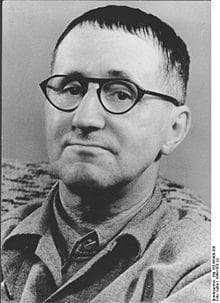
Bertolt Brecht was a highly influential German playwright, poet, and theatre director. He is best known for his epic theatre style, which aimed to provoke critical thought rather than emotional identification. His notable works include "The Threepenny Opera," "Mother Courage and Her Children," and "The Good Woman of Setzuan."
Similar books
- Animal Farm
George Orwell
4.0 (2.7M) average on GoodreadsPoliticsA political allegory that uses animal characters to critique power structures and the corruption of ideals.
- Death of a Salesman
Arthur Miller
3.5 (186k) average on GoodreadsFictionArthur Miller's Death of a Salesman also critiques the American Dream and the pressures of capitalism, but through the lens of psychological realism and tragedy. Unlike Brecht's Verfremdungseffekt, Miller encourages deep emotional identification with Willy Loman, exploring his internal struggles and the devastating personal consequences of societal failure. While both plays expose systemic flaws, The Good Woman distances the audience to prompt intellectual analysis of the system itself, whereas Death of a Salesman draws them in to feel the human cost, making Miller's approach more emotionally visceral and less overtly didactic than Brecht's.
- Nineteen Eighty-Four
George Orwell
4.2 (5.5M) average on GoodreadsFictionWinston Smith dreams of truth and rebellion in a world where Big Brother watches all, but he confronts the terrifying power of a regime that controls not just actions, but thoughts.
- The Frozen River
Ariel Lawhon
4.4 (600k) average on GoodreadsFictionIn 1789 Maine, a heroic midwife's diary helps her expose a murder and get justice in a town that wants to silence her.
- A Man Called Ove
Fredrik Backman
4.4 (569k) average on GoodreadsFictionA stubborn widower, who lives by strict rules, finds his quiet world changed by a lively new family next door, making him face his past and find happiness in human connection.
- The Art of Racing in the Rain
Garth Stein
4.2 (452k) average on GoodreadsFictionThrough the eyes of Enzo, a wise and observant dog, a race car driver's family navigates a journey of love, loss, and resilience, learning that life's most important lessons often come in the curves, not just on the straightaways.






Enjoyed the summary?
A summary gives you the shape of the book. The book itself has the detail, the examples and the voice.
Find The Good Woman of Setzuan on AmazonAs an Amazon Associate, BookBrief earns from qualifying purchases. How we're funded