
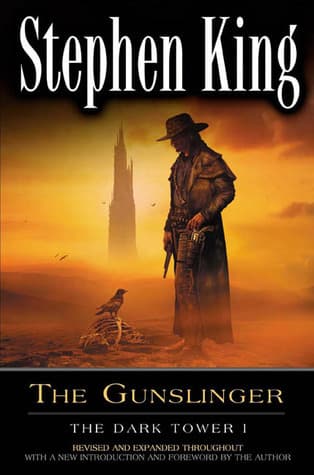
Synopsis
Covers the whole plot, including the ending.
- Difficulty
- Medium
- Pacing
- Variable
- Mood
- Bleak, Mystical, Philosophical, Haunting, Dreamlike
- Read it if
- You enjoy dark, philosophical westerns blended with fantasy and a sense of existential dread, and are looking for the beginning of a long, epic quest.
- Skip it if
- You prefer fast-paced, action-driven plots with clear resolutions, or are put off by morally ambiguous protagonists and surreal, often confusing narratives.
The Gunslinger Plot Summary
Covers the whole plot, including the ending.
The Gunslinger Pursues the Man in Black Across the Desert
Roland Deschain, the last gunslinger, chases the Man in Black across a huge, burned desert. He has one goal, the Tower, and believes the Man in Black has important answers. Roland's journey is hard, with extreme heat, thirst, and memories of his past. He finds an empty way station, a remnant of a forgotten world, where he meets an old man named Brown and his raven, Zoltan. Roland stays with Brown for a while, sharing stories and resting before continuing his chase. The desert stretches endlessly before him, showing his solitary quest.
The Encounter at the Way Station and the Boy from Earth
Continuing his journey, Roland arrives at another way station, truly abandoned except for the skeletons of its former residents. Here, he finds a young boy named Jake Chambers. Jake, scared and confused, says he is from New York City in another world and died after being pushed into traffic. Roland, curious and sensing Jake's connection to his quest, takes the boy with him. Jake explains his memories are broken and that the Man in Black was involved in his arrival, making Roland believe more that Jake is a key part of his puzzle. Their bond starts to form in the empty land.
The Oracle and the Whispers of the Past
Roland and Jake travel to an old, desolate place called the Golgotha, where a mysterious 'oracle' is said to live. This oracle is a demonic being in a stone circle, speaking in riddles and showing glimpses of the future and past. Roland talks with the oracle, seeking information about the Man in Black and the Tower. The oracle's words are vague, hinting at Roland's fate and the sacrifices he will make. During this meeting, Roland also has clear memories of his youth in Gilead, his gunslinger training, and the tragic events that led to his world's collapse, adding to his past burdens.
The Town of Tull and the Gunslinger's Reckoning
Roland and Jake arrive at the strange, isolated town of Tull. The townspeople, led by the fanatical Preacher Sykes and influenced by the Man in Black, are hostile. Roland meets Alice, a bartender, who is under the Man in Black's control. The Man in Black has tricked the townspeople into thinking Roland is a demon. A violent fight begins when the townspeople, in a rage, attack Roland. He uses his gunslinger skills, leading to a brutal and tragic killing of almost everyone in town. This shows his deadly ability and the Man in Black's destructive power.
The Mountains and the Slow Climb
After the killing in Tull, Roland and Jake continue their journey, now facing the difficult mountains. The climb is slow and hard, testing their strength. Jake, still bothered by his past and the violence he saw, struggles to keep up, but Roland urges him on, knowing they must make progress. During this climb, Roland shares more about his world and his gunslinger past, making their bond stronger. The harsh environment reflects their inner struggles, with the vast, tall peaks showing the huge task ahead.
The Unveiling of Roland's Past in the Underworld
As they travel through an underground passage beneath the mountains, Roland tells Jake his full, sad story. He recounts his youth in Gilead, his early gunslinger test, the betrayal by Marten Broadcloak (the Man in Black's disguise), and Marten's affair with Roland's mother. He describes the plot that led to Gilead's fall and the end of his gunslinger order. This confession shows Roland's deep personal pain and what drives his quest for revenge and the Tower. Jake listens, horrified but understanding the weight of Roland's past.
The Ordeal of the Slow Mutants
Inside the dark, winding tunnels under the mountains, Roland and Jake meet the terrifying Slow Mutants. These grotesque, deformed creatures are remnants of an old time, made monstrous by radiation or some ancient disease. Roland, with his gunslinger reflexes, protects Jake, killing the creatures quickly. The encounter is a scary test of survival, showing the dangers of their world and the constant threat they face. It also makes Jake rely more on Roland and shows the gunslinger's strong commitment to their shared journey, even in the most horrifying situations.
The Trap and Jake's Sacrifice
Coming out of the tunnels, Roland and Jake find themselves at a dangerous gorge with a shaky, old railway handcar. The Man in Black has set a trap: Roland can save Jake, or he can keep chasing. The Man in Black speaks to Roland from across the gorge, giving him a cruel choice. As they cross the gorge, Jake starts to fall. Roland, driven by his single goal of the Tower and the Man in Black, makes a terrible choice, letting Jake fall to his death. This act, of sacrifice or abandonment, deeply affects Roland, but he believes it is necessary for his ultimate aim.
The Confrontation with the Man in Black
After Jake's death, Roland continues his chase, finally catching the Man in Black at a desolate, ancient circle of standing stones. The Man in Black, whose real name is Walter o'Dim, reveals himself as a powerful sorcerer and a servant of a greater evil. He is not just a target but a guide, controlling Roland's fate. The confrontation is not violent but a battle of wills and words, a psychological duel where the Man in Black reveals broken truths and prophecies, preparing Roland for the next part of his journey.
The Oracle of Prophecy and Roland's Future
During their meeting, the Man in Black forces Roland into a deep trance, showing him a vision of the universe, the Beam, and the Dark Tower at its center. He reveals that Roland is stuck in an endless cycle, destined to chase the Tower repeatedly, always failing at the last step. He shows Roland a glimpse of his future companions and the challenges ahead, including doors to other worlds. The Man in Black then puts Roland into a deep, dreamless sleep that lasts ten years. When Roland wakes, the Man in Black is gone, leaving only the bones of a prophet and a single card—the Hanged Man—a mysterious clue for the gunslinger's continued quest.
The Awakening and the Journey Renewed
Roland wakes from his ten-year sleep, confused but with stronger determination. The world has subtly changed around him, yet his goal remains the same. The prophet's bones and the Hanged Man card are the only physical proof of his encounter with the Man in Black. He understands that his journey is far from over and that the Man in Black has simply set him on a new path, with new challenges and allies waiting for him. Roland, the last gunslinger, restarts his quest, heading east towards the sea, driven by the distant promise of the Dark Tower and the answers it holds.
The Gunslinger Characters
Roland Deschain
Protagonist
The last gunslinger, driven by his quest for the Dark Tower.
Roland is a grim, solitary figure, the last gunslinger of a fallen world. He is utterly dedicated to his quest for the Dark Tower, a mythical nexus of all realities. His past is haunted by the downfall of Gilead and the loss of his loved ones, particularly Susan Delgado, and the betrayal of Marten. He possesses an unwavering resolve, incredible skill with his revolvers, and a deep, often ruthless pragmatism. Despite his hardened exterior, he carries immense emotional scars. His devotion to the Tower often overrides all other considerations, leading to tragic choices.
Relationships: Jake Chambers (reluctant mentor and surrogate father figure, eventually sacrificed); Man in Black (Walter) (nemesis and enigmatic guide); Brown (brief, solitary companionship); Alice (brief, tragic encounter, under the Man in Black's influence)
Jake Chambers
Supporting
A boy from another world, inexplicably linked to Roland's quest.
Jake is a young boy from New York City who inexplicably dies and finds himself in Roland's desolate world. He is intelligent, observant, and initially terrified but quickly forms a deep bond with Roland. He represents a connection to Roland's lost humanity and innocence. Jake's memories are fractured, but he recalls being pushed into traffic by a man who looked like the Man in Black. His presence forces Roland to confront his own sense of responsibility and compassion, making his eventual sacrifice all the more tragic.
Relationships: Roland Deschain (student and surrogate son, deeply reliant on him); Man in Black (Walter) (the one who orchestrated his arrival and death in his own world)
The Man in Black (Walter o'Dim/Marten Broadcloak)
Antagonist
Roland's elusive, sorcerous nemesis and enigmatic guide.
The Man in Black is Roland's primary antagonist, a powerful sorcerer, and a servant of the Crimson King. He is a master manipulator, capable of influencing entire towns and individuals. He is known by many names, including Marten Broadcloak, who was responsible for the downfall of Gilead and Roland's personal tragedies. He is not merely an enemy but also an enigmatic guide, revealing prophecies and setting Roland on specific paths. His ultimate goal is to prevent Roland from reaching the Dark Tower, or perhaps to ensure he reaches it in a way that serves his master.
Relationships: Roland Deschain (ancient enemy, manipulator, and reluctant guide); Jake Chambers (orchestrator of his arrival in Roland's world); Alice (manipulated pawn)
Brown
Supporting
An isolated desert dweller who offers Roland brief respite.
Brown is an old, solitary man Roland encounters early in his journey. He lives in a remote way station with only his raven, Zoltan, for company. He is a pragmatic survivor of the desolate landscape, seemingly unaffected by the strangeness of Roland's world. He offers Roland food, water, and shelter, and they share quiet companionship for a brief period. Brown represents the isolated humanity that still exists in Roland's dying world, a stark contrast to the violence and chaos Roland often encounters. He serves as a temporary anchor for Roland before the gunslinger continues his relentless pursuit.
Relationships: Roland Deschain (brief, quiet host and guest); Zoltan (pet raven)
Alice
Supporting
A bartender in Tull, tragically caught in the Man in Black's web.
Alice is a bartender in the town of Tull, a woman who has been subtly manipulated and driven to madness by the Man in Black's influence. She is a tragic figure, initially drawn to Roland but ultimately turning against him due to the pervasive evil that has infected her town. Her descent into hysteria and her role in the town's attack on Roland highlight the Man in Black's power to corrupt and destroy. Her death in the ensuing massacre is a grim reminder of the collateral damage in Roland's quest.
Relationships: Roland Deschain (brief, ill-fated attraction); Man in Black (Walter) (manipulated pawn)
Preacher Sykes
Supporting
The fanatical leader of the town of Tull, swayed by the Man in Black.
Preacher Sykes is the religious leader of Tull, a fanatical and easily manipulated figure. He is instrumental in turning the townspeople against Roland, fueled by the Man in Black's insidious influence. His sermons and pronouncements whip the town into a frenzy, leading to the violent confrontation with Roland. Sykes represents the dangers of uncritical faith and the ease with which a community can be corrupted by a malevolent force. His actions directly lead to the tragic massacre in Tull.
Relationships: Roland Deschain (antagonistic, inciting violence against him); Man in Black (Walter) (unwitting pawn, manipulated by him)
Zoltan
Mentioned
Brown's intelligent and observant pet raven.
Zoltan is Brown's pet raven, a constant companion to the old man in his isolated way station. He is portrayed as intelligent and observant, seemingly understanding more than a normal bird. He often mimics sounds and watches Roland with an unnerving intensity. Zoltan serves as a symbol of the enduring, if strange, life in Roland's dying world and adds to the eerie atmosphere of Brown's dwelling. His presence emphasizes the solitude of Brown's existence and the brief, almost animalistic, connection Roland experiences there.
Relationships: Brown (loyal pet and companion)
Cuthbert Allgood
Mentioned
Roland's childhood friend and fellow gunslinger.
Cuthbert is a character from Roland's past, appearing in Roland's flashbacks. He was Roland's childhood friend and fellow gunslinger-in-training in Gilead. Cuthbert was known for his quick wit and playful nature, often serving as a foil to Roland's more serious demeanor. His memory represents the lost innocence and camaraderie of Roland's youth before the world 'moved on.' The recollection of Cuthbert highlights the depth of Roland's personal losses and the profound isolation he now experiences.
Relationships: Roland Deschain (childhood friend and fellow gunslinger)
Susan Delgado
Mentioned
Roland's lost love, a tragic figure from his youth.
Susan Delgado is Roland's great love from his youth, a beautiful and tragic figure from the town of Mejis. Her story, though only glimpsed in flashbacks in this book, is central to Roland's emotional landscape. She was sacrificed by the town elders and ultimately burned at the stake, an event that profoundly shaped Roland's hardened personality and his understanding of loss and injustice. Her memory is a source of deep pain and regret for Roland, a constant reminder of what he lost and the cost of his gunslinger path.
Relationships: Roland Deschain (first and greatest love)
The Gunslinger Themes
Obsession and Destiny
Roland's chase of the Dark Tower drives the whole story, almost to an obsession. He gives up everything and everyone, including Jake, for his quest. The Man in Black's predictions suggest Roland is in a cycle, fated to repeat his journey. This theme looks at the line between purpose and destructive fixation, and whether Roland truly has free will or is just a piece in a larger, predetermined game. The Tower is an ultimate, almost sacred, goal that controls Roland's every move.
“The man in black fled across the desert, and the gunslinger followed.”
Loss and Memory
The book is full of Roland's memories of a lost world—Gilead, his fellow gunslingers, and his love, Susan Delgado. These memories are often painful, coming back as Roland travels through the empty land, which itself shows loss and decay. Jake's death adds to Roland's burden of loss, showing the sacrifices he makes and the people he leaves behind. This theme explores how the past shapes the present, and how memory can both drive and haunt the main character.
“Go then, there are other worlds than these.”
The Price of Survival and Morality
Roland's world is harsh, and his survival often comes with a high moral cost. The killing in Tull and, more importantly, his choice to let Jake fall, show the brutal decisions he must make to reach his goal. This theme questions what heroism is and whether the 'end justifies the means.' Roland survives, but his methods are often ruthless, blurring the lines between good and evil. The book makes the reader face the moral impact of Roland's actions and the bleak truth of his dying world.
“The world had moved on.”
The Nature of Reality and Alternate Dimensions
Jake's presence, a boy from 'New York City' in another world, introduces the idea of multiple realities and parallel universes. The Man in Black's predictions expand on this, hinting at the Beams and the Dark Tower as the center of all realities. This theme explores how fluid existence is and the idea that Roland's world is just one of many. It sets up the larger universe of the series, suggesting that the borders between worlds are thin and that events in one can greatly affect another.
“He knew he was from another world entirely; he could feel it in his bones.”
Isolation and Companionship
Roland starts his journey alone. His brief meetings with Brown show how isolated he is. However, Jake's unexpected arrival creates a hesitant companionship that challenges Roland's chosen solitude. While Roland eventually sacrifices Jake, the relationship temporarily gives him a human connection and a sense of responsibility he had long hidden. This theme explores the human need for connection even in the most desolate situations, and the pain of losing it.
“He thought of himself as a lone wolf, but the boy had become a part of his pack.”
Plot Devices & Literary Techniques
The Dark Tower
The ultimate, enigmatic goal of Roland's quest.
The Dark Tower functions as the ultimate MacGuffin and the central driving force of the entire series. Its true nature is unknown at this stage, but it is implied to be the nexus of all realities. Roland's obsession with reaching it dictates all his actions, making him sacrifice everything else. It represents a promise of answers, redemption, or perhaps just an end to his quest. Its mystery fuels the narrative and motivates Roland's relentless pursuit across the dying world, giving his journey a profound, almost religious, significance.
Flashbacks and Internal Monologue
Reveals Roland's tragic past and internal struggles.
The narrative frequently uses flashbacks to reveal Roland's traumatic past, particularly his youth in Gilead, his gunslinger training, and the loss of Susan Delgado and his world. These are often triggered by his environment or conversations. Coupled with his internal monologues, these devices provide crucial exposition, developing Roland's character by showing the origins of his hardened demeanor and his driving motivations. They immerse the reader in Roland's psyche and the history of his fallen world, explaining the weight of his quest.
The Man in Black's Prophecies and Manipulations
Foreshadows future events and guides Roland's path.
The Man in Black serves as a master manipulator and a source of cryptic prophecies. His influence is felt even when he is absent, subtly guiding events (like in Tull) and setting traps. His direct confrontation with Roland at the end of the book involves visions and revelations about Roland's future, the nature of the Tower, and the cycle he is trapped in. This device not only provides exposition but also establishes the larger mythology of the series and foreshadows the challenges and companions Roland will encounter, linking him to a grander destiny.
The Dying World
A desolate, post-apocalyptic setting reflecting Roland's internal state.
Roland inhabits a desolate, post-apocalyptic world that is 'moving on'—decaying, depopulated, and filled with relics of a forgotten, more advanced civilization. This setting is not merely a backdrop but a character in itself, mirroring Roland's internal desolation and the loss he carries. The barren landscapes, abandoned towns, and mutated creatures emphasize the stakes of Roland's quest and the urgency of reaching the Tower. It creates an atmosphere of pervasive decay and melancholy, underscoring the themes of loss and survival.
The Gunslinger Quotes
“The man in black fled across the desert, and the gunslinger followed.”
“Go then. There are other worlds than these.”
“I do not aim with my hand; he who aims with his hand has forgotten the face of his father. I aim with my eye.”
“The world has moved on.”
“Death, but not for you, gunslinger. Never for you.”
“You are the world's last adventurer. The last crusader.”
“Time is the thief of memory.”
“The greatest mystery the universe offers is not life but size.”
“I kill with my heart, motherfucker.”
“There will be water if God wills it.”
“The desert was the apotheosis of all deserts, huge, standing to the sky for what looked like eternity in all directions.”
“He was a romantic, he supposed; if so, it was the romanticism of the knife.”
“The gunslinger had no idea what the word 'magic' meant, but he knew what the word 'death' meant, and he liked it better.”
“You see? Size defeats us.”
Quiz
10 questions on the plot and the characters. Each answer comes with a short explanation.
Question 1
What is the primary goal of Roland, the Gunslinger, in this book?
- To find and destroy the Crimson King
- To capture the Man in Black and learn about the Dark Tower
- To rebuild the fallen kingdom of Gilead
- To rescue Jake from the clutches of the Man in Black
Show answer
B. To capture the Man in Black and learn about the Dark Tower Roland's main quest in 'The Gunslinger' is to pursue and capture the Man in Black (Walter o'Dim) to gain information about the Dark Tower, which is central to the series.
Question 2
How does Jake Chambers initially enter Roland's world?
- He is summoned by a magical portal created by the Man in Black
- He is pulled through from Earth after being killed by a car in 1977 New York
- He is born into Roland's world as a reincarnation of an ancient gunslinger
- He stumbles through a dimensional rift while exploring a cave
Show answer
B. He is pulled through from Earth after being killed by a car in 1977 New York Jake is killed in a car accident in 1977 New York and is drawn into Roland's world, where he becomes a key companion in the gunslinger's journey.
Question 3
What significant event occurs in the town of Tull?
- Roland forms an alliance with the townspeople to fight bandits
- Jake is kidnapped by the Man in Black and held for ransom
- Roland is forced to kill all the townspeople after they are turned against him by the Man in Black
- Alice betrays Roland and joins forces with the Man in Black
Show answer
C. Roland is forced to kill all the townspeople after they are turned against him by the Man in Black In Tull, the Man in Black manipulates the townspeople, including Alice, into attacking Roland, leading to a massacre where Roland kills everyone to survive.
Question 4
Why does Roland ultimately let Jake fall to his death in the mountain tunnel?
- He believes Jake is a trap set by the Man in Black and must be sacrificed
- He chooses to save himself and continue his pursuit of the Man in Black over saving Jake
- Jake voluntarily jumps to distract the slow mutants attacking them
- Roland is knocked unconscious and unable to prevent the fall
Show answer
B. He chooses to save himself and continue his pursuit of the Man in Black over saving Jake Faced with a choice between saving Jake and catching the Man in Black, Roland prioritizes his quest, demonstrating his ruthless dedication and the theme of sacrifice.
Question 5
What role does Alice primarily play in the story?
- She is a wise mentor who guides Roland on his path to the Dark Tower
- She is a love interest for Roland who helps him in Tull before being killed
- She is a spy for the Man in Black who betrays Roland at every turn
- She is a magical being who grants Roland visions of the future
Show answer
B. She is a love interest for Roland who helps him in Tull before being killed Alice is a bartender in Tull who becomes romantically involved with Roland but is manipulated by the Man in Black and killed during the town massacre.
Question 6
What does the Man in Black reveal to Roland during their palaver at the end of the book?
- That Roland must abandon his quest to save his own soul
- The exact location of the Dark Tower and how to reach it
- That the universe is held together by the Dark Tower and Roland's fate is tied to it
- That Jake is actually Roland's son from a previous life
Show answer
C. That the universe is held together by the Dark Tower and Roland's fate is tied to it In their final conversation, the Man in Black uses a tarot reading to show Roland that the Dark Tower is the nexus of all universes and that Roland's destiny is intertwined with it.
Question 7
How does the setting of Roland's world reflect themes in the book?
- It is a utopian society that highlights Roland's isolation as a gunslinger
- It is a technologically advanced world that contrasts with Roland's old-fashioned ways
- It is a decaying, parallel version of Earth that mirrors themes of desolation and the blurring of reality
- It is a purely fantasy realm with no connection to our own world
Show answer
C. It is a decaying, parallel version of Earth that mirrors themes of desolation and the blurring of reality Roland's world is described as 'moving on'—a post-apocalyptic version of Earth that echoes our own decay, emphasizing themes of loss, reality distortion, and existential pursuit.
Question 8
What is the significance of the phrase 'The man in black fled across the desert, and the gunslinger followed'?
- It is a random opening line with no deeper meaning in the story
- It summarizes the entire plot of the book and sets up Roland's relentless pursuit
- It is a prophecy told to Roland by his father before Gilead fell
- It is a message left by the Man in Black to taunt Roland
Show answer
B. It summarizes the entire plot of the book and sets up Roland's relentless pursuit This iconic opening line encapsulates the core narrative of Roland chasing the Man in Black, establishing the quest-driven plot and Roland's determined character from the start.
Question 9
In the context of the book, what does Roland's recurring dream about the Dark Tower symbolize?
- His fear of failure and abandonment by his fellow gunslingers
- His subconscious desire to return to a normal life in Gilead
- His obsession and destiny tied to the Tower as a unifying force of existence
- A warning from the Man in Black to give up his quest
Show answer
C. His obsession and destiny tied to the Tower as a unifying force of existence Roland's dreams of the Dark Tower represent his deep, often destructive obsession with reaching it, reflecting themes of fate, purpose, and the cost of pursuit in a crumbling world.
Question 10
Which detail from Jake's life on Earth is crucial to his interactions with Roland?
- He was a skilled pianist, which helps him entertain Roland during their journey
- He attended a private school called Piper School, and his 'key' memory involves a test paper with the word 'nineteen'
- He was a runaway who hated his parents, making him eager to stay in Roland's world
- He worked as a newspaper delivery boy, giving him knowledge of the Man in Black's movements
Show answer
B. He attended a private school called Piper School, and his 'key' memory involves a test paper with the word 'nineteen' Jake's memory of a test paper with 'nineteen' at Piper School is a recurring motif that hints at deeper connections to the Dark Tower mythos, influencing his bond with Roland and the story's mystical elements.
The Gunslinger FAQ
What is 'The Gunslinger' about?
The novel follows Roland Deschain, the last gunslinger from the fallen kingdom of Gilead, as he relentlessly pursues the mysterious Man in Black across a desolate, post-apocalyptic world. Along his journey, he encounters Alice, a woman from the town of Tull, and forms a bond with Jake Chambers, a boy from 1970s New York who has been pulled into Roland's reality. The story blends elements of fantasy, western, and horror as Roland confronts moral dilemmas and supernatural forces.
Why should I read 'The Gunslinger'?
It serves as the foundational entry to Stephen King's epic Dark Tower series, introducing the enigmatic protagonist Roland and the unique, genre-blending world of Mid-World. The book's haunting atmosphere, philosophical undertones, and cryptic storytelling create a compelling narrative that explores themes of obsession, destiny, and the blurred lines between good and evil, setting the stage for the sprawling saga that follows.
What is the background/setting of 'The Gunslinger'?
The story is set in Mid-World, a desolate, decaying realm that has 'moved on' from a once-great civilization, with remnants of advanced technology scattered among primitive landscapes. Roland's journey takes him through barren deserts, the ghost town of Tull, and ancient mountains, all while hinting at connections to alternate realities like 1970s Earth, where Jake originates. This setting mirrors our own world's decline, adding a layer of allegorical depth.
What are the most memorable quotes?
Key quotes include Roland's mantra, 'I do not aim with my hand; he who aims with his hand has forgotten the face of his father. I aim with my eye,' reflecting gunslinger discipline, and the Man in Black's cryptic line, 'Go then, there are other worlds than these,' which hints at the multiverse theme. Another is Jake's haunting realization, 'There are demons in the earth... and in the sky,' underscoring the world's pervasive darkness.
What writing style does the author use?
Stephen King employs a sparse, lyrical prose that blends western grit with dreamlike surrealism, creating an atmospheric and episodic narrative. The style is often cryptic and philosophical, with vivid imagery and fragmented storytelling that mirrors Roland's fragmented memories and the world's decay. This approach immerses readers in a sense of existential dread and mystery, characteristic of the series' dark fantasy tone.
What minor details add significant meaning?
Small details like the horn of Eld missing from Roland's possession, which becomes a recurring symbol of loss and regret in later books, and the number 19 appearing subtly (e.g., in Jake's memories) foreshadow its importance in the series. The slow mutants in the tunnels represent the world's decay, and Roland's limited ammunition highlights his dwindling resources, emphasizing his desperation and isolation.
What are some subtle foreshadowing moments?
The Man in Black's tarot card reading for Roland foreshadows key events, such as the Tower and the Lady of Shadows (who appears in later books). Jake's death and resurrection in the mountains hint at the cyclical nature of Roland's quest. Additionally, Roland's dream of the Dark Tower early in the novel sets up the overarching goal of the series, while his cold decision-making foreshadows his morally ambiguous path.
What unexpected character connections exist?
Jake Chambers is revealed to have died in 1977 New York before appearing in Mid-World, linking Roland's world to Earth through supernatural means. The Man in Black is later identified as Walter o'Dim, a recurring antagonist with ties to other Stephen King novels. Alice's brief role in Tull connects to the town's corruption by the Man in Black, showing how ordinary people are ensnared in Roland's larger conflict.
What are unspoken character motivations?
Roland's obsession with the Dark Tower and the Man in Black is driven by a deep-seated need for redemption and purpose after the fall of Gilead, though he rarely voices this. Jake clings to Roland as a father figure, seeking stability in a terrifying world, while the Man in Black manipulates events to test Roland's resolve, possibly to shape him for a larger cosmic role. Alice's attraction to Roland masks her desperation to escape Tull's bleakness.
What psychological complexities do characters exhibit?
Roland embodies a stoic, determined exterior but grapples with guilt over past failures, such as sacrificing Jake, revealing a conflict between duty and humanity. Jake displays trauma from his death and displacement, struggling with fear and loyalty. The Man in Black exhibits a manipulative, almost playful cruelty, using psychological games to probe Roland's weaknesses, suggesting a deeper interest in Roland's journey beyond mere antagonism.
What are the major emotional turning points?
Roland's decision to let Jake fall to his death in the mountains is a pivotal moment, showcasing his ruthless commitment to his quest over personal connection. Jake's death and subsequent reappearance in Roland's dreams haunt him, deepening his inner turmoil. The final confrontation with the Man in Black on the beach, where Roland is told he must continue his journey alone, leaves him emotionally isolated and determined.
How do relationship dynamics evolve?
Roland and Jake's relationship shifts from initial distrust to a surrogate father-son bond, which is tragically severed when Roland sacrifices Jake. Roland's interaction with Alice is brief but intense, highlighting his ability to inspire loyalty and his emotional detachment. The Man in Black serves as a dark mentor, pushing Roland toward greater ruthlessness, while Roland's solitude is reinforced as he loses each connection, emphasizing his lonely path.
Which parts remain ambiguous or open-ended?
The true nature of the Dark Tower and its purpose is left mysterious, with only vague hints about its role in holding reality together. The Man in Black's motives and identity are not fully explained, leaving his role as antagonist or catalyst unclear. The ending, where Roland begins his climb up the Tower, is deliberately open, setting up the series' continuation without resolving his ultimate fate or the world's salvation.
What are controversial scenes or decisions?
Roland's choice to let Jake die to catch the Man in Black sparks debate over whether it represents necessary sacrifice or moral failure. The massacre in Tull, where Roland kills the entire town after they are corrupted, raises questions about his methods and the line between justice and brutality. Some readers find the surreal, non-linear narrative confusing, while others appreciate its dreamlike quality as a key to the book's themes.
'The Gunslinger' ending explained: how it ends & what it means
The novel ends with Roland reaching the base of the Dark Tower after his confrontation with the Man in Black, who reveals that Roland must continue his journey alone and that the Tower holds answers to his quest. This conclusion symbolizes Roland's unwavering obsession and the beginning of his true challenge, implying that his pursuit is both a physical and spiritual journey. It sets the stage for the series' exploration of destiny, redemption, and the cost of obsession.
About the author

Stephen Edwin King is an American author of horror, supernatural fiction, suspense, crime, science-fiction, and fantasy novels. Described as the "King of Horror", his books have sold more than 350 million copies as of 2006, and many have been adapted into films, television series, miniseries, and comic books. King has published over 65 novels/novellas, including seven under the pen name Richard Bachman, and five non-fiction books. He has also written approximately 200 short stories, most of which have been published in book collections.
Similar books
- Blood Meridian
Cormac McCarthy
4.2 (227k) average on GoodreadsFictionShares a bleak, violent, and philosophical western setting with a relentless protagonist.
- The Road
Cormac McCarthy
4.0 (716k) average on GoodreadsScience FictionFeatures a desolate, post-apocalyptic landscape and a journey of survival with deep emotional undertones.
- American Gods
Neil Gaiman
4.1 (758k) average on GoodreadsFantasyBlends mythology, fantasy, and a road trip narrative across a mysterious version of America.
- Angels & Demons
Dan Brown
3.9 (2.7M) average on GoodreadsThrillerA Harvard symbologist races through Rome's ancient sites, deciphering cryptic clues to unmask the Illuminati and stop a vengeful plot to destroy the Vatican with a stolen antimatter weapon.
- Gone Girl
Gillian Flynn
4.1 (2.3M) average on GoodreadsThrillerA wife's sudden disappearance on her fifth anniversary reveals a web of lies and psychological warfare, exposing the secrets within a seemingly perfect marriage.
- The Girl on the Train
Paula Hawkins
3.9 (2.1M) average on GoodreadsThrillerA woman’s fascination with a seemingly perfect couple she watches from her daily train commute leads her into a dark investigation when she witnesses something that shatters their idyllic image.





Enjoyed the summary?
A summary gives you the shape of the book. The book itself has the detail, the examples and the voice.
Find The Gunslinger on AmazonAs an Amazon Associate, BookBrief earns from qualifying purchases. How we're funded