
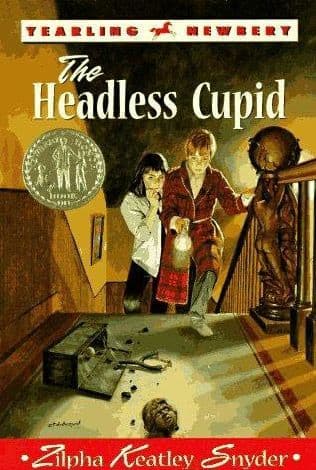
Synopsis
Covers the whole plot, including the ending.
- Difficulty
- Easy
- Pacing
- Moderate
- Mood
- Mysterious, Playful, Slightly Spooky, Whimsical
- Read it if
- You enjoy classic children's mysteries with a touch of the supernatural and themes of family dynamics.
- Skip it if
- You prefer high-stakes, fast-paced thrillers or don't enjoy stories with a focus on childhood perspectives and lighthearted spooky elements.
The Headless Cupid Plot Summary
Covers the whole plot, including the ending.
A New Home and a New Sister
The four Stanley children—David, Janie, Blair, and Esther—and their father, Mr. Stanley, move into a large, old Victorian house in California. The house, full of strange corners and a troubling history, immediately captures and unsettles them. Their new stepmother, Molly, and her daughter, Amanda, soon join them. Amanda, a year older than David, is introduced as a serious student of the occult, which first amuses and later worries the Stanleys. She arrives with an air of mystery, carrying a black bag of odd items, and quickly makes it clear she believes in the supernatural, setting a unique tone for their new blended family life.
The Introduction to the Occult
Amanda quickly shows her knowledge of the occult. She says she is a practicing witch, or a serious student of witchcraft, focusing on old symbols, rituals, and summoning spirits. She impresses and slightly frightens the younger children, Janie, Blair, and Esther, with her detailed explanations and seemingly real artifacts. David, the most skeptical Stanley, tries to stay rational but feels increasingly drawn into Amanda's world. Amanda's arrival changes the old house from just a new home into a possible place of supernatural activity, challenging the children's ideas about reality.
First Rituals and Strange Occurrences
Amanda decides to hold a séance in the house to test its spiritual energy. She sets up a ritual in the attic, with candles, strange symbols, and an attempt to contact spirits. During the séance, the children experience small but unexplained things: a sudden draft, flickering lights, and unsettling noises. While David blames these on natural causes or Amanda's tricks, the younger children are truly scared. These events, though minor, start to create doubt and fear, making the children wonder if Amanda's claims about the supernatural might be true, and if the old house itself is really haunted.
The Headless Cupid Mystery
While looking around the house, the children find a wooden cupid statue on the main stairway, its head cut off. This leads to the retelling of an old family story: the house was once haunted by a mischievous poltergeist named 'Ignatius' who was responsible for the cupid's decapitation years ago. This story, first dismissed as a quaint tale, becomes more significant with Amanda's arrival and the recent strange events. The headless cupid becomes a clear sign of the house's alleged haunting, and the children start to wonder if Ignatius has returned, or if Amanda is somehow connected to the strange events.
Escalating Pranks and Suspicion
After the séance and the headless cupid story, a series of increasingly strange and unsettling events happen in the house. Objects move on their own, strange noises come from empty rooms, and small, unexplained 'pranks' occur. A favorite toy disappears, a picture is turned upside down, and other minor disturbances disrupt the family's peace. The Stanley children, especially David, suspect Amanda, believing she is causing these events to show her powers or just to amuse herself. They try to catch her, but Amanda always seems to have an alibi, or the 'prank' is too subtle to clearly link to her.
The Ouija Board Session
To further investigate the house's spiritual activity, Amanda decides to use a Ouija board. She gathers the children, and during the session, the planchette moves, spelling out cryptic messages that seem to confirm a spirit is present. The messages are vague but unsettling, hinting at danger and a bad presence. David tries to prove the session is fake, suspecting Amanda is moving the board, but even he is briefly unnerved by the precise, if unclear, responses. The Ouija board session greatly increases the tension and fear among the children, making a real haunting seem more likely.
The Disappearance of the Talisman
Amanda has a special protective charm, a small, carved wooden figure she says wards off evil spirits. She is very attached to it and believes it protects her. One day, the charm mysteriously disappears from her room. Its loss deeply upsets Amanda, as she feels unprotected without it. The disappearance of this important item further increases the children's worries. It suggests that if a spirit is active in the house, it is powerful enough to get past Amanda's defenses, or that the 'prankster' is becoming more daring and personal in their attacks.
A Near-Accident and a Revelation
A potentially dangerous incident happens when a heavy object nearly falls on one of the younger children, seemingly without reason. This event is more serious than previous 'pranks' and makes David rethink his firm belief that Amanda is just playing tricks. He starts to wonder if something genuinely supernatural is happening, or if someone else is involved. The near-accident changes the children's view from mere annoyance and suspicion of Amanda to real fear for their safety, making them more urgently need to understand the source of the disturbances.
The Trap and the Confession
Determined to find the truth, David sets a trap. He carefully arranges objects to show if someone was moving them. His plan works, and he catches Janie, his younger sister, in the act of faking one of the 'hauntings.' Janie confesses that she has been causing all the strange events, imitating the ghost stories and Amanda's witchcraft, partly out of mischief and partly to impress Amanda and make the old house more exciting. This revelation explains many of the 'supernatural' events that had puzzled the family.
The Real Ghost and the Resolution
With Janie's confession, the mystery of the 'haunting' seems solved. However, Amanda still believes that some of the earlier, more subtle events were real. Further investigation by the children, now working together, leads to the discovery of a hidden room or passageway inside the old house. Inside, they find proof of a very old, small, and harmless animal—perhaps a squirrel or a bird—that has been living within the walls, occasionally knocking objects or making noises. This natural explanation accounts for the truly unexplainable events, leaving Janie responsible for the more deliberate 'pranks' and confirming that the house's 'ghost' was just a natural phenomenon. The family finds a new understanding and peace in their old, quirky home.
The Headless Cupid Characters
David Stanley
Protagonist
The eldest Stanley child, a rational skeptic who seeks logical explanations.
David is around twelve years old, the eldest of the Stanley children, and initially the most resistant to Amanda's claims of witchcraft. He is intelligent, analytical, and prides himself on his logical thinking, often trying to debunk Amanda's supernatural theories with scientific explanations. Despite his skepticism, he is also curious and protective of his younger siblings. His journey involves grappling with his own beliefs as he confronts seemingly inexplicable events, ultimately leading him to a deeper understanding of both the supernatural and human nature. He is driven by a desire for truth and order.
Relationships: Janie Stanley (Younger sister, initially a source of frustration, later a co-conspirator in solving the mystery.); Amanda (Stepsister, initial antagonist due to conflicting worldviews, later a friend and fellow investigator.); Blair and Esther Stanley (Younger siblings, whom he feels responsible for protecting.)
Amanda
Supporting Character / Catalyst
David's stepsister, a serious student of the occult and catalyst for the story's events.
Amanda is a year older than David and has a distinctive, intense personality. She is deeply engrossed in the study of witchcraft, ancient rituals, and the supernatural, which she approaches with academic seriousness rather than mere childish play. She is intelligent, articulate, and often speaks in a sophisticated, slightly dramatic manner. Her conviction in the unseen world challenges the Stanleys' conventional views and ignites the mystery of the house. Despite her mysterious demeanor, she is not malicious and genuinely believes in the forces she studies, making her a compelling and enigmatic figure.
Relationships: David Stanley (Stepsibling, intellectual rival turned collaborator.); Janie Stanley (Stepsister, whom she unknowingly inspires.); Molly Stanley (Mother, with whom she shares a close bond.)
Janie Stanley
Supporting Character / Antagonist (initially)
The imaginative and mischievous middle Stanley child who orchestrates many of the 'hauntings.'
Janie is one of the younger Stanley children, lively, imaginative, and prone to mischief. She is captivated by Amanda's stories of witchcraft and spirits, and her desire for excitement and attention leads her to secretly orchestrate many of the strange occurrences in the house. She is clever and resourceful, managing to evade detection for a significant portion of the story. Janie represents the innocent yet potent power of imagination and the desire to make life more interesting, even if it involves a little deception. Her actions drive much of the plot's mystery.
Relationships: David Stanley (Older brother, whom she tries to outwit.); Amanda (Stepsister, her idol and inspiration for mischief.); Blair and Esther Stanley (Younger siblings, whom she sometimes involves in her schemes.)
Blair Stanley
Supporting Character
One of the younger Stanley children, easily influenced and often scared.
Blair is a sensitive and somewhat timid younger child. He is easily frightened by the strange occurrences in the house and Amanda's tales of the supernatural. He often looks to David for reassurance and protection. Blair's reactions serve to highlight the increasing tension and fear within the household, acting as a barometer for the group's collective anxiety. He is less analytical than David and more prone to believing in the fantastic, making him a relatable character for younger readers experiencing the mystery.
Relationships: David Stanley (Older brother, a source of comfort and protection.); Janie Stanley (Sister, whose antics sometimes frighten him.)
Esther Stanley
Supporting Character
The youngest Stanley child, observant and innocently participating in the events.
Esther is the youngest of the Stanley children. She is quite observant for her age, often noticing small details that others miss, though she doesn't always understand their significance. Her innocence makes her both vulnerable to the scares and an unwitting participant in some of the 'hauntings.' She provides a child's perspective on the unfolding mystery, often reacting with simple wonder or fear. Her presence adds to the family dynamic and highlights the impact of the strange events on the youngest members of the household.
Relationships: David Stanley (Older brother, whom she looks up to.); Janie Stanley (Sister, whose games she sometimes joins.)
Mr. Stanley
Supporting Character
The children's father, a kind but somewhat oblivious parent.
Mr. Stanley is the children's father and Molly's new husband. He is a kind and well-meaning parent, but often preoccupied with his work or adjusting to his new family life. He tends to dismiss the children's concerns about ghosts and witchcraft as childish imagination, not fully grasping the depth of their anxieties. His role is primarily to provide a stable parental presence, though he is not actively involved in solving the mystery. His benevolent but somewhat detached nature allows the children the freedom to investigate the strange occurrences on their own.
Relationships: David, Janie, Blair, Esther Stanley (His children.); Molly Stanley (His new wife.)
Molly Stanley
Supporting Character
Amanda's mother and the Stanley children's new stepmother.
Molly is Amanda's mother and Mr. Stanley's new wife. She is generally supportive and understanding, especially of Amanda's unusual interests, but she also tries to maintain a sense of normalcy in the blended household. Like Mr. Stanley, she isn't deeply involved in the children's investigation of the supernatural, often attributing strange events to the quirks of an old house or childish games. She strives to create a harmonious family environment and is often seen mediating between the children or managing the household.
Relationships: Amanda (Her daughter, whom she understands and supports.); Mr. Stanley (Her new husband.); David, Janie, Blair, Esther Stanley (Her new stepchildren.)
The Headless Cupid Themes
Skepticism vs. Belief
The novel explores the tension between rational thinking and belief in the supernatural. David, the main character, represents skepticism, always looking for logical explanations for strange events. In contrast, Amanda represents strong belief in the occult, seeing every event through a spiritual lens. The story challenges both views, first making David question his rationality as unexplained events increase, and finally showing that some 'supernatural' events have natural causes, while others are human tricks. This theme highlights the complexities of perception and the human need to understand the unknown, as seen in David's struggle during the Ouija board session and his eventual acceptance of some mysteries.
“There are more things in heaven and earth, Horatio, / Than are dreamt of in your philosophy.”
The Power of Imagination and Suggestion
This theme is central to the mystery, showing how imagination, combined with suggestion, can create a strong illusion of the supernatural. Janie's confession reveals that many of the 'hauntings' were her own carefully planned pranks, inspired by Amanda's stories and the house's spooky atmosphere. The children's fear and belief in ghosts, fueled by Amanda's rituals and the story of Ignatius, make them vulnerable to these tricks. This shows how easily people can be convinced of supernatural events when their minds are ready for it, as shown by the collective fear during the séance and the Ouija board session, even when the events are ordinary.
“It was all just—just games. I just wanted to make things exciting.”
Family and Integration
At its heart, the story is about a new blended family coming together. The Stanley children and Amanda, along with their parents, must learn to live together in a new, old house. The 'haunting' helps them overcome initial suspicions, misunderstandings, and personality clashes. Through the shared experience of fear and investigation, they learn to communicate, trust, and ultimately form bonds. The mystery's resolution brings them closer, changing them from separate individuals into a united family. This is especially clear in how David and Amanda, initially at odds, learn to cooperate and respect each other's views.
“It was a good thing, she thought, to have a mystery to solve. It kept them all together.”
The Nature of Fear
The novel explores different kinds of fear: fear of the unknown, fear of bad forces, and fear of being tricked. The children experience real terror during the more intense 'hauntings,' even David, the skeptic. The story shows how fear can be manipulated (by Janie) and how it can be a strong, almost tangible force. Ultimately, solving the mystery allows them to face and understand the sources of their fear, telling the difference between real threats and harmless things. The headless cupid itself symbolizes this fear, a clear representation of the house's unsettling past.
“The house had a way of whispering things, of making you feel as if you weren’t quite alone.”
Plot Devices & Literary Techniques
The Haunted House Trope
The old Victorian house serves as both setting and a character, fueling the mystery.
The old Victorian house is more than just a setting; it's a central element that immediately establishes an atmosphere of mystery and potential dread. Its nooks, crannies, and unsettling history, including the legend of 'Ignatius' and the headless cupid, provide fertile ground for both genuine and fabricated supernatural occurrences. The house's age and quirks allow for plausible explanations for some strange sounds and movements, while also providing a perfect backdrop for a supposed poltergeist. This device effectively creates an immersive, suspenseful environment.
Red Herring
Amanda's occult practices and intense belief misdirect the audience from the true culprit.
Amanda's character, with her deep interest in witchcraft and her dramatic rituals, acts as a significant red herring. Her presence and actions immediately make her the prime suspect for the 'haunting' in the eyes of David and the reader. Her knowledge of the occult provides a seemingly logical explanation for the strange events, diverting attention away from the real, more mundane source of the disturbances. This device effectively builds suspense and misdirection, making the eventual reveal of Janie as the prankster more surprising and impactful.
Symbolism of the Headless Cupid
A physical object that represents the house's past and the central mystery.
The headless wooden cupid statue on the stairway is a powerful symbolic object. It immediately introduces the idea of a past haunting and a specific, inexplicable event within the house. The missing head symbolizes the incompleteness and unsettling nature of the house's history, and it serves as a tangible piece of evidence for the legendary poltergeist. It becomes a focal point for the children's fears and investigations, a constant reminder of the mystery they are trying to solve, and connects the present events to the house's storied past.
Unreliable Narrator (Child's Perspective)
The events are filtered through David's skeptical but ultimately fallible perspective.
While not strictly an unreliable narrator in the sense of deliberate deception, the story is largely experienced through David's perspective, which is colored by his skepticism and his age. His attempts to rationalize everything initially blind him to the truth, both the mischief of Janie and the benign natural causes of some events. This device allows the author to play with the reader's perceptions, making them question what is real and what is imagined, much like David himself. It also emphasizes the challenges of understanding complex situations from a limited viewpoint.
The Headless Cupid Quotes
“There are things in this house that are not of this world.”
“It was just a game. A game we played on ourselves.”
“Witchcraft isn't something you learn from books. It's something you feel.”
“Sometimes the things you're most afraid of are the things that aren't real at all.”
“This house has secrets. Old secrets. And they don't like to be disturbed.”
“You can't just pretend things into existence, even if you want to.”
“Being brave isn't about not being scared. It's about doing what you have to do even when you are.”
“Every old house has a story, if you just listen for it.”
“It was easier to believe in ghosts than to believe in themselves.”
“The past isn't always gone. Sometimes it just waits.”
“You can't solve every mystery with logic. Some things just are.”
“Sometimes what you find isn't what you were looking for, but it's what you needed.”
“The greatest magic is sometimes just understanding.”
“It was a strange feeling, to have something you believed in so strongly just... evaporate.”
Quiz
10 questions on the plot and the characters. Each answer comes with a short explanation.
Question 1
What is the name of the new stepsister who claims to study witchcraft?
- Melanie
- Amanda
- Prudence
- Beatrice
Show answer
B. Amanda The new stepsister's name is Amanda, and she is the one who introduces the Stanley children to the concept of witchcraft.
Question 2
What object on the stairway was historically associated with the ghost in the Stanley's house?
- A porcelain doll
- A grandfather clock
- A wooden cupid
- An antique mirror
Show answer
C. A wooden cupid The legend of the house's haunting involves a ghost that cut off the head of a wooden cupid on the stairway.
Question 3
Which of the Stanley children is the youngest and often the most frightened by the strange occurrences?
- David
- Blossom
- Janice
- Esther
Show answer
D. Esther Esther is the youngest of the Stanley children and is particularly susceptible to fear and the influence of the 'haunting'.
Question 4
What is the primary motivation for Amanda to initially stage the 'supernatural' events?
- To genuinely scare the Stanley children.
- To test the Stanley children's belief in the supernatural.
- To add excitement and interest to her new home and family.
- To prove her witchcraft abilities are real.
Show answer
C. To add excitement and interest to her new home and family. Amanda, feeling bored and seeking attention in her new environment, initially stages the events to make things more exciting.
Question 5
What specific item does Amanda use to try and 'bewitch' the Stanley children's dog, Fido?
- A string of beads
- A piece of raw meat
- A lock of hair
- A silver charm
Show answer
D. A silver charm Amanda uses a silver charm as part of her 'spell' to try and control Fido, claiming it's a powerful artifact.
Question 6
What is the name of the Stanley family's old house?
- The Willow Creek Manor
- The Headless House
- The Stanley Residence
- The house is not given a specific name in the book.
Show answer
D. The house is not given a specific name in the book. While the book focuses on the house, it is consistently referred to as 'their old house' or 'the Stanley house' and is not given a unique proper name.
Question 7
What is the crucial piece of evidence that makes the children suspect the haunting is real, not Amanda's doing?
- A book on genuine witchcraft found in the attic.
- A diary entry from a previous owner detailing supernatural events.
- An old newspaper article about the headless cupid legend.
- A visit from a psychic who confirms a presence.
Show answer
B. A diary entry from a previous owner detailing supernatural events. The discovery of an old diary belonging to a previous inhabitant, Prudence, detailing her experiences with the ghost, is what shifts the children's belief towards a genuine haunting.
Question 8
What is the ultimate resolution regarding the 'ghost' that was haunting the house?
- The ghost is appeased by a ritual performed by Amanda.
- The children realize the ghost was a figment of their collective imagination.
- It is revealed that the 'ghost' was actually a combination of Amanda's pranks and natural house noises.
- The 'ghost' is revealed to be Prudence, the former inhabitant, who was never a ghost but an eccentric old woman.
Show answer
D. The 'ghost' is revealed to be Prudence, the former inhabitant, who was never a ghost but an eccentric old woman. The 'ghost' is eventually revealed to be Prudence, the eccentric former resident, who was still alive and living secretly in the house, causing the disturbances.
Question 9
What literary award did 'The Headless Cupid' receive?
- Caldecott Medal
- Newbery Medal
- Newbery Honor Book
- National Book Award
Show answer
C. Newbery Honor Book The book is a Newbery Honor Book, recognized for its distinguished contribution to American literature for children.
Question 10
Beyond the mystery, what is a significant theme explored through the relationship between Amanda and the Stanley children?
- The dangers of occult practices.
- The importance of strict parental supervision.
- The challenges and eventual acceptance in blending families.
- The historical accuracy of local legends.
Show answer
C. The challenges and eventual acceptance in blending families. A central theme is the integration of Amanda into the Stanley family, highlighting the initial friction, misunderstandings, and eventual bonding that occurs in a blended family.
The Headless Cupid FAQ
What is the central premise of 'The Headless Cupid'?
The story centers on the four Stanley children – David, Janie, Susan, and Blair – as they adjust to their new stepsister, Amanda. Amanda's fascination with witchcraft and the subsequent strange occurrences in their old Victorian house lead them to suspect her, until they uncover a local legend about a genuine haunting.
Who are the four Stanley children, and what are their personalities?
David is the eldest, practical, and initially skeptical. Janie is imaginative and easily drawn into Amanda's world. Susan is the youngest girl, often anxious and easily frightened. Blair is the youngest, a curious and observant toddler who often sees things others miss.
What role does Amanda play in the initial mystery?
Amanda introduces the concept of witchcraft, performing rituals and sharing books on the occult. Her secretive behavior and the immediate onset of bizarre events – like objects moving and strange noises – lead the Stanley children, particularly David, to believe she is orchestrating the 'haunting' to impress or scare them.
What is the significance of the 'headless cupid' mentioned in the title?
The headless cupid is a physical artifact in the Stanley's old house, a wooden statue on the newel post whose head was supposedly severed by a ghost many years ago. It serves as a tangible link to the house's past and the historical haunting legend, providing a potential alternative explanation for the strange events.
How do the children initially react to Amanda's claims of witchcraft?
Initially, the younger children, Janie and Susan, are intrigued and a bit scared but eager to participate in Amanda's rituals. David, however, is highly skeptical and dismissive, convinced that Amanda is either playing tricks or is genuinely deluded, and he tries to debunk her claims.
What specific 'supernatural' events occur in the house that baffle the children?
The children experience objects moving on their own, strange scratching noises in the walls, books falling from shelves, and the mysterious appearance of a 'ghost' in the attic. These events are initially attributed to Amanda's 'magic' or later to the historical ghost.
What is the historical legend surrounding the house and the original haunting?
The house was once owned by a family whose daughter, Lucy, was supposedly tormented by a poltergeist. This ghost was blamed for various disturbances, including the beheading of the wooden cupid, and was believed to be connected to Lucy's own suppressed anger and rebellion.
How does the discovery of Lucy's diary or journals impact the children's investigation?
While not a diary, the children discover an old scrap of paper with a drawing that matches the symbol of the 'ghost' they've been seeing. This clue, combined with old town records and stories, helps them piece together the details of the original haunting and Lucy's story, leading them closer to the truth.
What is the true identity of the 'ghost' that has been causing disturbances?
The 'ghost' is revealed to be Amanda's pet crow, a highly intelligent and mischievous bird named Barnaby. Barnaby was trained by Amanda to perform various tricks, such as moving objects and making noises, which she used to create the illusion of supernatural activity.
How does Blair, the youngest child, contribute to solving the mystery?
Blair, being too young to be influenced by the older children's theories, observes things objectively. He repeatedly mentions seeing 'the bird' or 'the black bird,' which the older children initially dismiss. His innocent observations ultimately provide the crucial clue to Barnaby's involvement.
How does Amanda's interest in witchcraft reflect her psychological state as a new stepsister?
Amanda's intense focus on witchcraft can be interpreted as a coping mechanism. As a new stepsister, she feels like an outsider and uses witchcraft to assert her individuality, gain attention, and create a sense of power or control in an unfamiliar environment, perhaps masking her own insecurities about fitting in.
What psychological journey do the Stanley children undergo regarding their belief in the supernatural?
The Stanley children move from initial skepticism (David) or eager belief (Janie, Susan) in Amanda's witchcraft, through a phase of genuine fear of a real ghost, to ultimately understanding that the 'supernatural' events have a logical, if mischievous, explanation. This journey reflects their growth in critical thinking and understanding human behavior.
How does the dynamic between David and Amanda evolve throughout the story?
Initially, David is antagonistic and suspicious of Amanda, seeing her as a troublemaker. As they work together to solve the mystery of the 'ghost,' their dynamic shifts. They develop a grudging respect and eventually a bond, moving past their initial friction to become more accepting stepsiblings.
What does the children's fascination with the 'ghost' tell us about the human need for mystery or excitement?
The children's escalating engagement with the 'ghost' hunt, despite their fears, highlights a universal human desire for excitement and the unknown. It shows how the allure of a mystery, even a frightening one, can draw people in and provide a distraction or a sense of purpose.
Is Amanda's use of her pet crow to simulate a haunting an act of malicious deception or something else?
It leans more towards a misguided attempt to create excitement and gain attention rather than malicious deception. Amanda, feeling like an outsider, used Barnaby's tricks to impress her new stepsiblings and perhaps to test their reactions, not intending to cause genuine distress, although that was a consequence.
What message does the book convey about the power of belief and skepticism?
The book illustrates how easily belief in the supernatural can take hold, especially when fueled by a desire for explanation or excitement. It also champions healthy skepticism, showing how critical thinking and observation, even from a young child like Blair, can uncover rational explanations behind seemingly inexplicable events.
How does the resolution of the mystery affect the relationship between Amanda and her new family?
The resolution, where Amanda confesses and Barnaby is revealed, allows for honesty and understanding. While there's an initial period of frustration and perhaps disappointment, it ultimately paves the way for a more authentic and trusting relationship between Amanda and her stepsiblings, as they begin to accept each other's quirks.
Could the historical haunting by Lucy have been a similar trick, implying a cyclical pattern of behavior?
Yes, the book subtly suggests this possibility. The details of Lucy's 'poltergeist' activity mirror Amanda's 'haunting' remarkably closely. This parallel implies that Lucy, perhaps feeling similar pressures or a desire for attention, might have also orchestrated her 'ghost' using clever tricks, rather than genuinely being tormented by a supernatural entity.
Similar books
- From the Mixed-Up Files of Mrs. Basil E. Frankweiler
E.L. Konigsburg
4.2 (189k) average on GoodreadsChildren'sA Newbery-winning children's mystery driven by curious children and a unique setting, focusing on discovery.
- Wait Till Helen Comes
Mary Downing Hahn
4.1 (20k) average on GoodreadsFantasyInvolves stepsiblings, a move to an old house, and encounters with a ghost, though this one is more genuinely frightening.
- The Westing Game
Ellen Raskin
4.0 (165k) average on GoodreadsChildren'sRaskin's book is a pure intellectual mystery, relying entirely on human deduction, puzzles, and character interactions to solve a complex inheritance game, with no supernatural elements. Snyder's work differs significantly by using the allure of the occult as a central narrative device to build suspense and explore themes of belief, even if the ultimate resolution is non-supernatural.
- Harry Potter and the Sorcerer's Stone
J.K. Rowling
4.5 (7M) average on GoodreadsFantasyRescued from a miserable life under the stairs, an orphaned boy discovers he's a wizard destined for a magical school, where he uncovers a dangerous secret tied to the dark wizard who murdered his parents.
- The Hunger Games
Suzanne Collins
4.3 (6.4M) average on GoodreadsFantasyIn a future where children fight to the death on live television, Katniss Everdeen volunteers for the arena, turning a death sentence into a fight for survival and a spark of rebellion.
- 1984
George Orwell
4.2 (3.1M) average on GoodreadsPoliticsIn a future where surveillance and thought control are absolute, a man's search for truth clashes with the Party, showing that hope can be a form of rebellion.



Enjoyed the summary?
A summary gives you the shape of the book. The book itself has the detail, the examples and the voice.
Find The Headless Cupid on AmazonAs an Amazon Associate, BookBrief earns from qualifying purchases. How we're funded