
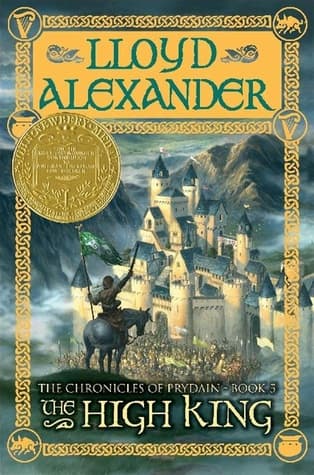
Synopsis
Covers the whole plot, including the ending.
- Difficulty
- Easy
- Pacing
- Moderate
- Mood
- Epic, Heroic, Bittersweet, Adventurous
- Read it if
- You love classic quest narratives, coming-of-age stories, and high fantasy epics with a strong moral core.
- Skip it if
- You prefer grimdark fantasy or stories with ambiguous heroes and anti-heroes.
The High King Plot Summary
Covers the whole plot, including the ending.
The Quest for Dyrnwyn
The story begins with news that the ancient sword Dyrnwyn, made by the elves and given to King Smoit of Mona, has been stolen. Arawn, the Death-Lord, is the thief and now holds the weapon from his fortress, Mount Dragon. Prince Gwydion, Taran, Assistant Pig-Keeper, along with Fflewddur Fflam, Gurgi, and Princess Eilonwy, decide they must get the sword back. They first seek advice from Dallben, the old enchanter, who warns them of the great danger but gives them his wisdom and good wishes for their journey. They know that Dyrnwyn in Arawn's hands means ruin for Prydain.
Journey Through the Marshes of Morva
Following Dallben's unclear advice, Taran and his friends travel to the Marshes of Morva, a lonely and dangerous place. There, they look for Orddu, Orwen, and Orgoch, three old and strange enchantresses who have great knowledge and power. The hags, in their usual mysterious way, say that Dyrnwyn cannot just be taken; it must be won. They also speak of the Black Crochan, a cauldron that can bring the dead back to life, which Arawn also wants. The hags, in exchange for a small item from Eilonwy, offer a riddle and a piece of advice, hinting at the true nature of their quest and the sacrifices needed.
The Cauldron-Born and the Dark Fortress
As Taran's group continues its journey, they start to see more direct proof of Arawn's growing power. They witness the terrifying sight of the Cauldron-Born, Arawn's undead warriors, made from the Black Crochan, marching across the land. These silent, unyielding soldiers spread fear and ruin everywhere. The friends have several small fights and narrow escapes, showing how serious a threat Arawn is. They realize the size of the war they are entering and the many lives at risk. Gwydion, always thinking ahead, begins to plan how to unite Prydain's free lords against the coming darkness.
Gathering the Free Commots
Gwydion, with Taran, travels across Prydain, trying to unite the different independent commots and kingdoms against Arawn. They visit King Smoit of Mona, who, despite his loud talk, promises his forces. They also seek out the Free Commots, who have long been independent. Taran's reputation as a leader and his real care for the common people help convince many. However, not everyone is easily persuaded, and some lords are slow to join a seemingly losing fight against the Death-Lord's large army. Forming a united front proves difficult, showing the divisions within Prydain.
The Fall of Caer Cadarn
Despite efforts to unite Prydain, Arawn's forces keep advancing. The friends witness the terrible fall of Caer Cadarn, an important stronghold. This event strongly reminds them of Arawn's great power and his army's cruelty. The loss of Caer Cadarn discourages some of the allied forces and makes their mission seem even more urgent. Taran and Gwydion understand that they cannot lose any more ground and that a direct fight with Arawn at Mount Dragon is certain, even if it means great loss.
The March to Mount Dragon
With a strong, though smaller, army finally gathered, Gwydion and Taran lead Prydain's forces on a long, hard march towards Mount Dragon, Arawn's unyielding fortress. The journey is full of danger, including surprise attacks by Arawn's patrols and harsh winter weather. Along the way, Taran's leadership skills grow as he makes tough choices and inspires his troops. The mood is one of grim resolve, as every soldier knows they are marching towards a battle for Prydain's very spirit. The fate of their world rests on them.
Siege and Sacrifice
Prydain's army attacks Mount Dragon. The battle is fierce and bloody, with many losses on both sides. Many brave warriors fall, including some of Taran's close friends. Fflewddur Fflam, despite his exaggerated stories, fights bravely, and Gurgi shows unexpected courage. The fighting is desperate, as Arawn's Cauldron-Born and other dark creatures defend their master's fortress with fierce loyalty. Taran, using the ancient sword Commot, finds himself in the thick of the fight, leading by example and inspiring his remaining forces to push on against overwhelming odds.
Confrontation with Achren
During the chaotic attack on Mount Dragon, Taran gets separated from Gwydion and confronts the enchantress Achren, Arawn's former queen and a powerful sorceress. Achren, a complex and vengeful character, reveals more about Arawn's power and Prydain's history. She tests Taran, not with physical fighting, but with mind games and temptations of power. Taran, using his natural goodness and resolve, resists her dark influence. This meeting is a key test of his character, showing his strong dedication to his friends and to Prydain.
The Chamber of Dyrnwyn
Taran finally reaches the deepest part of Mount Dragon, where Arawn waits, holding the stolen Dyrnwyn. The confrontation is epic, a clash between good and evil. Arawn, confident in his power, taunts Taran. Taran, though less powerful, fights with a true hero's courage. Through cleverness and sheer will, Taran manages to disarm Arawn, taking back Dyrnwyn. However, the sword, when Taran holds it, burns with an intense, cleansing fire, almost consuming him, showing its great power and the weight it carries.
Arawn's Defeat and the End of Evil
With Dyrnwyn back in good hands, Arawn's power starts to fade. The Death-Lord, weakened and desperate, tries a last, destructive act. However, Taran, with his friends' help and Dyrnwyn's hidden power, defeats Arawn for good. Arawn's defeat sends shockwaves through Prydain, causing Mount Dragon to crumble. The victory is hard-won, and many lives have been lost, leaving a mixed feeling to the triumph. The long rule of evil is over, but Prydain is scarred and changed forever.
The Choice of a Lifetime
After Arawn's defeat, the ancient Fair Folk, the Children of Don, appear to Taran. They offer him a choice: to join them in the Summer Country, to live forever, free from the sorrows and work of mortal life, and to wield Dyrnwyn as a High King among them. This is the greatest reward for his heroism. Taran is tempted by the idea of immortality and endless peace, especially after the great suffering he has seen. He struggles with this big decision, torn between the promise of a perfect life and his deep connection to the mortal world of Prydain.
The High King of Prydain
In a moment of clear thought, Taran makes his decision. He turns down the offer of immortality and a life among the Fair Folk. He chooses instead to stay mortal, to rebuild Prydain, and to rule as its High King, accepting the difficulties and joys of a human life. He realizes that true kingship is not about power or endless life, but about service and love for his people. Eilonwy, Gurgi, and Fflewddur also choose to stay mortal. Taran's decision shows him to be the true High King, not by birth, but by his wisdom, kindness, and selflessness. He begins the hard work of healing his war-torn land.
The High King Characters
Taran
Protagonist
Assistant Pig-Keeper turned High King of Prydain.
Taran begins as an impetuous and often insecure Assistant Pig-Keeper at Caer Dallben, dreaming of glory. Throughout the series, he matures significantly, learning humility, responsibility, and the true meaning of heroism. He is driven by a deep sense of justice and compassion for the common folk, often putting their well-being above his own desires. He possesses an innate goodness and a strong moral compass.
Relationships: Gwydion (mentor and friend); Eilonwy (love interest and trusted companion); Gurgi (loyal companion and friend); Fflewddur Fflam (fellow adventurer and friend); Dallben (guardian and wise counsel)
Eilonwy
Supporting
Princess of Llyr and Taran's spirited companion.
Eilonwy is a fiery, independent, and often outspoken princess with a strong will and a talent for powerful enchantments, though she sometimes struggles to control them. She is fiercely loyal to Taran and her friends, providing both emotional support and practical assistance. Her directness and occasional bluntness are balanced by her deep affection and courage. She often carries her magical bauble, which provides light and occasional bursts of uncontrolled power.
Relationships: Taran (love interest and trusted companion); Achren (ancestor and former captor)
Gwydion
Supporting
Prince of Don and a wise warrior-lord.
Prince Gwydion is a noble and powerful warrior, a strategic military leader, and a wise mentor to Taran. He is calm, courageous, and possesses immense knowledge of the history and lore of Prydain. He represents the traditional heroism and leadership of the royal line of Don, yet he is also capable of great empathy and understanding. He is dedicated to defeating Arawn and protecting Prydain, often putting himself in harm's way.
Relationships: Taran (mentor and friend); Dallben (ally and fellow guardian of Prydain)
Gurgi
Supporting
A furry, apple-loving creature of the forest.
Gurgi is a shaggy, timid, and often comical creature who speaks in rhyming couplets, expressing his fears and desires for "crunchings and munchings." Despite his initial cowardice, Gurgi is fiercely loyal to Taran and consistently demonstrates unexpected bravery when his friends are in danger. He provides comic relief but also serves as a poignant reminder of the innocent, vulnerable creatures of Prydain that Taran fights to protect.
Relationships: Taran (master and closest friend)
Fflewddur Fflam
Supporting
A bard with a magical harp that breaks a string when he exaggerates.
Fflewddur is a wandering bard and a minor king, known for his exaggerated tales and his magical harp, which snaps a string whenever he lies or overstates the truth. He is good-hearted, often boastful but ultimately brave, and provides much-needed levity and music to the company. His adventures often involve him getting into scrapes, but he always rises to the occasion when it truly matters, showing surprising courage.
Relationships: Taran (fellow adventurer and friend)
Dallben
Supporting
The ancient enchanter of Caer Dallben.
Dallben is an ancient, immensely powerful, and wise enchanter who serves as Taran's guardian and mentor. He possesses vast knowledge of Prydain's history, magic, and destiny. He is often cryptic but always guides Taran towards wisdom and self-discovery. He represents ancient wisdom and the deep, hidden forces of good in Prydain, preferring to let events unfold rather than directly interfere, trusting Taran to find his own path.
Relationships: Taran (guardian and mentor); Gwydion (ally and fellow guardian of Prydain); Orddu, Orwen, Orgoch (ancient colleagues/rivals in magic)
Arawn
Antagonist
The Death-Lord, ultimate evil of Prydain.
Arawn is the embodiment of evil in Prydain, the Death-Lord who rules from Mount Dragon. He seeks to conquer all of Prydain, turning living beings into his undead Cauldron-Born. He is cunning, cruel, and relentlessly ambitious, driven by a desire for absolute power. He has stolen Dyrnwyn and wields the Black Crochan, making him the most formidable foe Taran and his allies have ever faced. He represents the ultimate threat to life and freedom.
Relationships: Achren (former queen and unwilling ally)
Achren
Supporting
The ancient, powerful, and vengeful enchantress.
Achren is a formidable enchantress, once the queen of Prydain and Arawn's teacher, now his unwilling and resentful subordinate. She is immensely powerful in magic, manipulative, and driven by a thirst for power and a desire for revenge against Arawn, who usurped her. Her motives are complex; she is neither wholly good nor wholly evil, often acting out of self-interest but sometimes showing a flicker of admiration for Taran's purity. She is a descendant of the ancient rulers of Prydain.
Relationships: Arawn (former student/lover, now rival/enemy); Eilonwy (ancestor of Eilonwy)
Orddu, Orwen, Orgoch
Supporting
The three ancient, enigmatic hags of Morva.
These three ancient enchantresses live in the Marshes of Morva. They are incredibly old, immensely powerful, and possess vast knowledge, but they are also whimsical, greedy, and speak in riddles. They operate outside the typical alignment of good and evil, concerned more with their own interests and ancient traditions. They are the original owners of the Black Crochan and often demand a price for their wisdom, but their guidance is invaluable, even if obscure.
Relationships: Dallben (ancient colleagues/rivals in magic)
King Smoit
Supporting
The boisterous King of Mona.
King Smoit is a large, jovial, and somewhat blustery king who rules the island kingdom of Mona. He is proud of his warriors and his realm, and initially hesitant to join the larger war against Arawn. However, he is ultimately honorable and loyal to Prydain, and when convinced of the dire threat, he pledges his strong forces to Gwydion's army. He represents the independent, somewhat provincial, but ultimately reliable rulers of Prydain.
Relationships: Gwydion (ally and fellow king)
The High King Themes
The Nature of Kingship and Leadership
The novel explores what it means to be a true leader and king. Taran, an Assistant Pig-Keeper, rises not through birth or power, but through his kindness, courage, and willingness to sacrifice for his people. His choice to stay mortal and rebuild Prydain, rather than accepting immortality, shows the selfless service a true ruler needs. This idea is set against Arawn's cruel rule, based on fear, and Gwydion's traditional, noble leadership, showing different kinds of authority. Taran's story shows that kingship is earned through character, not status.
“I am not a hero. I have been a fool and a coward and a clumsy lout. I have stumbled and blundered, and I have caused more trouble than I have solved. I have learned to my sorrow that the world is not a place where one can always do as one pleases, nor where one can always have what one desires. But I have also learned that it is a place where one can always choose to do what is right, and that is a choice that is always worth making.”
Sacrifice and Selflessness
Throughout the story, characters face hard choices that require personal sacrifice for the greater good. Taran's final decision to give up immortality and the peace of the Summer Country to rebuild war-torn Prydain is the clearest example. Many minor characters also make sacrifices, some with their lives, for the cause. Gurgi's moments of unexpected bravery and Fflewddur's willingness to fight despite his fears also highlight this theme. The novel suggests that true heroism is not about gaining fame, but about giving of oneself for others, and that victory often comes at a high personal cost.
“The strongest heart is the one that can give itself away.”
Coming of Age and Identity
Taran's journey is a coming-of-age story. He starts as an unsure boy wanting adventure and a noble background, feeling out of place as an Assistant Pig-Keeper. Through his struggles, friends, and the heavy duties placed on him, he loses his youthful doubts and finds his true self. He learns that his worth is not based on his parents, but on his actions, his choices, and his character. His final decision confirms his understanding of who he is and his purpose, embracing his identity as a mortal leader of Prydain.
“It is not by the sword that a king rules, but by the heart.”
The Enduring Power of Good vs. Evil
The main conflict of 'The High King' is the struggle between good, shown by Taran and his allies, and the evil of Arawn. The novel looks at the destructive nature of unchecked power and the corrupting effect of darkness, as seen in Arawn's creation of the Cauldron-Born and his wish to enslave Prydain. On the other hand, it celebrates the strength of hope, courage, and friendship when facing great odds. Arawn's defeat means good triumphs over darkness, but it also acknowledges that evil, in different forms, can always return, making vigilance important. The struggle is ongoing, but good, through sacrifice, can win.
“Evil does not die. It sleeps, and wakes, and sleeps again. But it may be defeated.”
The Weight of Destiny and Free Will
The story explores the connection between destiny and free will. Prophecies and old stories often hint at Taran's future role, suggesting a set path. However, Taran consistently uses his free will, making choices that define his character and shape his destiny. His decision to refuse immortality, for example, is a strong act of free will that goes against what might have been seen as a 'fated' reward. The story suggests that while situations may be set, how one reacts to them and the choices one makes are what truly create a hero's path.
“The threads of a man's life are woven not by fate, but by his own hands.”
Plot Devices & Literary Techniques
The Sword Dyrnwyn
A magical sword that burns those unworthy to wield it.
Dyrnwyn is a powerful, ancient sword forged by the elves of the Summer Country. It is a symbol of true kingship and immense power, burning anyone who grasps it without being worthy. Its theft by Arawn sets the entire plot in motion, serving as the MacGuffin that drives the initial quest. It represents the ultimate weapon against Arawn, but also a test of character for anyone who would wield it, embodying the idea that true power comes with great responsibility and purity of heart. Its fiery nature symbolizes purification and judgment.
The Black Crochan (Cauldron-Born)
A magical cauldron that creates an army of undead warriors.
The Black Crochan is an ancient, evil cauldron that has the power to raise the dead, transforming them into the terrifying, implacable Cauldron-Born. These undead warriors form the bulk of Arawn's army, making him nearly invincible. The Crochan represents the ultimate destructive power of evil and the perversion of life. Its existence forces the heroes to confront not just Arawn, but the very concept of death and undeath, raising the stakes considerably. Its eventual destruction is crucial to Arawn's defeat.
Fflewddur's Harp
A magical harp whose strings break when its owner exaggerates.
Fflewddur's harp is a unique magical instrument that serves as a comedic and character-revealing plot device. Its strings snap whenever Fflewddur stretches the truth or exaggerates, forcing him (and the reader) to confront his tendency towards embellishment. It provides moments of levity but also highlights Fflewddur's journey towards more genuine bravery and less reliance on boastful tales. It subtly reinforces the theme of truth and honesty, even in a fantastical world.
Dallben's Prophecies/Riddles
Cryptic advice from the enchanter that guides the heroes.
Dallben often speaks in riddles or offers cryptic advice rather than direct instructions. These prophecies and hints serve as plot drivers, pushing the characters towards certain locations or encounters without revealing the full picture. This device allows the characters to learn and grow through experience and interpretation, rather than simply being told what to do. It reinforces Dallben's role as a wise but hands-off mentor, trusting Taran to find his own way and understand the deeper meanings of his journey.
The High King Quotes
“For the things you alone can do, I alone can give you strength.”
“All or nothing, Taran of Caer Dallben. All or nothing at all.”
“Is it not better to be a small king than a large nothing?”
“You may be a hero, Taran, but you're still a boy.”
“The greatest treasure is not gold, nor jewels, nor even the greatest power, but the love of those you hold dear.”
“Each of us must make his own choices, and each of us must live with the consequences.”
“It is not what you are, but what you do, that makes you a hero.”
“The most difficult journeys are those we make within ourselves.”
“A true king does not seek power, but accepts the burden of it.”
“Even the smallest creature can change the course of destiny.”
“There are some things that cannot be undone, however much we may wish it.”
“The price of glory is often paid in sorrow.”
“To wear a crown is to serve, not to command.”
“The truest strength lies not in the sword, but in the heart.”
Quiz
10 questions on the plot and the characters. Each answer comes with a short explanation.
Question 1
Which powerful weapon falls into the hands of Arawn-Death-Lord at the beginning of 'The High King'?
- The Black Cauldron
- The Sword of Dyrnwyn
- The Harp of Fflewddur Fflam
- The Spear of Lluagor
Show answer
B. The Sword of Dyrnwyn The Sword of Dyrnwyn, the most powerful weapon in Prydain, is stolen by Arawn, setting the main conflict in motion.
Question 2
What is Taran's original title at Caer Dallben before he embarks on the quest to defeat Arawn?
- Prince of Prydain
- Assistant Pig-Keeper
- Chief Warrior
- Royal Bard
Show answer
B. Assistant Pig-Keeper Taran begins his journey as the humble Assistant Pig-Keeper, a detail that highlights his growth throughout the series.
Question 3
Who is the evil enchantress that Taran confronts alongside Arawn at Mount Dragon?
- Morda
- Orddu
- Achren
- Kaw
Show answer
C. Achren Achren, a powerful and ancient enchantress, is a key antagonist who confronts Taran at Arawn's stronghold.
Question 4
What significant decision is Taran forced to make during the final confrontation with Arawn and Achren at Mount Dragon?
- To abandon his friends to save himself
- To sacrifice the Sword of Dyrnwyn for the good of Prydain
- To accept Arawn's offer of immortality
- To marry Princess Eilonwy immediately
Show answer
B. To sacrifice the Sword of Dyrnwyn for the good of Prydain In the climax, Taran chooses to cast the Sword of Dyrnwyn into the Black Cauldron, recognizing that true power lies not in weapons but in the hearts of people and the sacrifice for a greater good.
Question 5
Which of the following characters does NOT join Taran and Gwydion's army on their march against Arawn?
- Fflewddur Fflam
- Dallben
- Gurgi
- Coll
Show answer
B. Dallben Dallben, the ancient enchanter, remains at Caer Dallben, providing guidance and wisdom but not joining the physical march to Mount Dragon.
Question 6
The journey to Mount Dragon is described as a 'winter expedition.' What does this setting primarily emphasize about the quest?
- The beauty of the Prydain landscape
- The ease and speed of travel for the army
- The harshness, danger, and endurance required for the heroes
- The plentiful resources available for the journey
Show answer
C. The harshness, danger, and endurance required for the heroes The 'winter expedition' highlights the extreme difficulties, privation, and the sheer endurance required by Taran and his companions to reach Arawn's stronghold.
Question 7
What is the ultimate fate of Arawn-Death-Lord at the conclusion of 'The High King'?
- He is imprisoned in the Black Cauldron
- He escapes to another realm
- He is utterly destroyed and his power is broken
- He is transformed into a mortal man
Show answer
C. He is utterly destroyed and his power is broken Arawn-Death-Lord is completely vanquished and his power over Prydain is broken, leading to the end of his reign of terror.
Question 8
What significant personal sacrifice does Taran make that allows the rest of his companions to ascend to the Summer Country?
- He gives up his title as High King
- He chooses to remain in Prydain as a mortal king
- He sacrifices his life in battle
- He relinquishes his love for Eilonwy
Show answer
B. He chooses to remain in Prydain as a mortal king Taran, having become the High King, chooses to remain in Prydain as a mortal ruler, allowing his companions who are of the Fair Folk to depart for the Summer Country, a profound act of self-sacrifice for his people.
Question 9
The theme of 'true kingship' is central to 'The High King'. How does Taran ultimately demonstrate this quality, beyond simply wielding power?
- By proving his noble lineage through ancient artifacts
- By commanding the largest army in Prydain's history
- By choosing service, sacrifice, and the welfare of his people over personal glory or immortal power
- By defeating all his rivals in single combat
Show answer
C. By choosing service, sacrifice, and the welfare of his people over personal glory or immortal power Taran's kingship is defined not by birthright or might, but by his willingness to serve, to sacrifice personal desires for the good of Prydain, and to embrace the responsibilities of a mortal ruler.
Question 10
What is the significance of the phrase 'The sons of Don shall return to the Summer Country' in the context of the book's ending?
- It signifies the beginning of a new war in Prydain
- It marks the departure of the Fair Folk from the mortal realm of Prydain
- It is a prophecy of Arawn's eventual return
- It refers to the establishment of a new kingdom
Show answer
B. It marks the departure of the Fair Folk from the mortal realm of Prydain This phrase signifies the departure of the ancient, magical beings (the Fair Folk, including Gwydion, Eilonwy, and others) from Prydain, leaving it to be ruled by mortals like Taran, thus ushering in a new era.
The High King FAQ
What is the central conflict driving the plot of 'The High King'?
The central conflict is the final war against Arawn, the Death-Lord, who has seized the sword Dyrnwyn and aims to conquer Prydain. Taran, the Assistant Pig-Keeper, must lead the united free folk of Prydain, alongside Prince Gwydion, in a desperate struggle to defeat Arawn and restore peace to the land.
Who is Taran and what is his role in the story?
Taran is the protagonist, an Assistant Pig-Keeper from Caer Dallben, who has matured throughout the Chronicles of Prydain. In 'The High King,' he is no longer a boy seeking glory but a leader who must unite the disparate peoples of Prydain and make difficult choices, ultimately leading the army against Arawn.
What is the significance of the sword Dyrnwyn in this final book?
Dyrnwyn is the most powerful magical sword in Prydain, capable of bursting into flame and granting immense power. Its theft by Arawn early in the book signifies the dire threat facing the kingdom, as it places the ultimate weapon in the hands of the ultimate evil, making the final confrontation even more perilous.
Who are some of the key allies Taran gathers for the war effort?
Taran's key allies include his long-standing companions: the bard Fflewddur Fflam, the giant Gurgi, the Princess Eilonwy, and the dwarf Doli. They are joined by various free folk of Prydain, including the men of the Free Commots, the warriors of the Lords of Prydain, and even the Fair Folk, all united against Arawn.
What is the ultimate fate of Prydain and its inhabitants at the end of the book?
Prydain is transformed at the end, as the Sons of Don and the other magical beings depart for the Summer Country, leaving the land to mortals. Taran chooses to remain and rule as the High King of a mortal Prydain, ushering in a new era for the kingdom, free from ancient magic but also from ancient evils.
How does Achren's role evolve from previous books, and what is her ultimate fate?
Achren, once a powerful and malevolent enchantress, shows a flicker of humanity and regret in 'The High King,' particularly in her interactions with Taran and her defiance of Arawn. She ultimately sacrifices herself, turning against Arawn in the climactic battle, demonstrating a complex arc beyond simple villainy.
What is the significance of the sacrifice made by certain characters, like Gwydion or Coll?
Many characters make sacrifices, but Gwydion's willingness to face Arawn and Coll's earlier self-sacrifice highlight the theme of selfless courage. These acts are not about personal glory but about protecting Prydain and its future, inspiring Taran and demonstrating the true cost of heroism.
What is the true nature of Arawn's power and his connection to the beginning of Prydain?
Arawn's power stems from ancient, primal evil and his absorption of the life force of others. He is revealed to be the source of many of Prydain's woes, having once been a Lord of the Summer Country who chose to embrace darkness, making him an embodiment of corruption that must be completely eradicated.
How does Taran's psychological journey from 'Assistant Pig-Keeper' to 'High King' culminate in this book?
Taran's journey culminates in him fully embracing selflessness and responsibility. He sheds his youthful desires for fame and learns to value the lives of others above his own ambition. His ultimate decision to remain in Prydain, rather than go to the Summer Country, showcases his profound maturity and dedication to his people.
What internal struggles does Princess Eilonwy face during the war, and how does she overcome them?
Eilonwy struggles with her own magical abilities, the loss of her identity as a true princess, and the overwhelming danger of the war. She overcomes these by embracing her inner strength, providing vital support and courage to Taran, and ultimately accepting her destiny alongside him, demonstrating resilience and loyalty.
How does the pressure of leadership affect Taran's decision-making and his emotional state?
The pressure of leadership weighs heavily on Taran, forcing him to make grim choices that result in loss and sacrifice. He experiences moments of doubt and despair, but his commitment to his friends and Prydain, along with their unwavering support, allows him to maintain resolve and push forward despite the emotional toll.
What is the psychological impact of the separation between the mortal and immortal realms at the end?
The separation creates a bittersweet sense of loss and new beginnings. For Taran and Eilonwy, it means choosing a mortal future and accepting the absence of ancient magic and friends like Fflewddur and Doli. Psychologically, it represents an embrace of self-reliance and the human capacity to build a future without divine intervention.
Is Taran's choice to remain in Prydain and become High King a triumph or a sacrifice?
Taran's choice is arguably both a triumph and a sacrifice. It is a triumph because he fulfills his destiny and brings peace to Prydain, but it is a sacrifice because he relinquishes the chance to join his companions and the Fair Folk in the idyllic Summer Country, choosing instead a life of mortal responsibility.
What is the symbolic meaning of the departure of the Sons of Don and the magical beings to the Summer Country?
The departure symbolizes the end of an age of myth and magic, making way for a human-centric era. It suggests that humanity must now forge its own destiny, free from ancient powers but also without their guidance. It can be interpreted as a coming-of-age for Prydain itself, transitioning from childhood to maturity.
How does the final confrontation with Arawn challenge traditional notions of good versus evil in children's literature?
The confrontation challenges traditional notions by showing that evil isn't just defeated by a magical sword, but by courage, sacrifice, and unity. Achren's final act of defiance against Arawn also complicates the black-and-white morality, suggesting that even the most evil characters can have moments of redemption or complex motivations.
Does the ending suggest a cyclical nature of conflict, or a definitive end to evil in Prydain?
The ending suggests a definitive end to the ancient, magical evil of Arawn and the Lords of the Summer Country. While new conflicts may arise, the departure of the magical beings implies that Prydain will face new, more human challenges, rather than a resurgence of the same primordial evil, marking a true turning point.
What is the significance of the role of the humble and often overlooked characters, like Gurgi or Doli, in the ultimate victory?
Characters like Gurgi and Doli, despite their humble origins or grumbling natures, prove indispensable through their unwavering loyalty and unique skills. Gurgi's courage and Doli's stealth are crucial in key moments, highlighting that heroism comes in many forms and that every member of the fellowship contributes to the ultimate victory.
How does the book explore the theme of identity, particularly for Taran and Eilonwy?
Taran's identity shifts from an 'Assistant Pig-Keeper' longing for glory to a High King accepting responsibility, defining himself through service rather than lineage. Eilonwy grapples with her magical heritage and the loss of her former status, ultimately finding her true self as Taran's partner and a Queen, embracing her unique strengths.
About the author

Lloyd Alexander was an American author known for his contributions to children's and young adult literature. His notable works include "The Black Cauldron," "The High King," "Taran Wanderer," "The Iron Ring," and "The Remarkable Journey of Prince Jen," which often explore themes of adventure and heroism. Alexander received the Newbery Medal for "The High King," recognizing its significance in children's literature.
Similar books
- The Hobbit, or There and Back Again
J.R.R. Tolkien
4.3 (2.9M) average on GoodreadsFantasyClassic children's fantasy with a reluctant hero on a grand quest against evil.
- A Wizard of Earthsea
Ursula K. Le Guin
4.0 (241k) average on GoodreadsFantasyExplores themes of coming-of-age, responsibility, and confronting inner darkness in a magical world.
- The Last Unicorn
Peter S. Beagle
4.3 (8k) average on GoodreadsFantasyWhimsical yet profound fantasy with a sense of impending doom and a quest for what is lost.
- Harry Potter and the Sorcerer's Stone
J.K. Rowling
4.5 (7M) average on GoodreadsFantasyRescued from a miserable life under the stairs, an orphaned boy discovers he's a wizard destined for a magical school, where he uncovers a dangerous secret tied to the dark wizard who murdered his parents.
- The Hunger Games
Suzanne Collins
4.3 (6.4M) average on GoodreadsFantasyIn a future where children fight to the death on live television, Katniss Everdeen volunteers for the arena, turning a death sentence into a fight for survival and a spark of rebellion.
- 1984
George Orwell
4.2 (3.1M) average on GoodreadsPoliticsIn a future where surveillance and thought control are absolute, a man's search for truth clashes with the Party, showing that hope can be a form of rebellion.






Enjoyed the summary?
A summary gives you the shape of the book. The book itself has the detail, the examples and the voice.
Find The High King on AmazonAs an Amazon Associate, BookBrief earns from qualifying purchases. How we're funded