“It was a gorgeous day, the kind that made you want to go for a walk, but not necessarily a hike.”
— Opening sentence of the book, setting a slightly ironic tone.

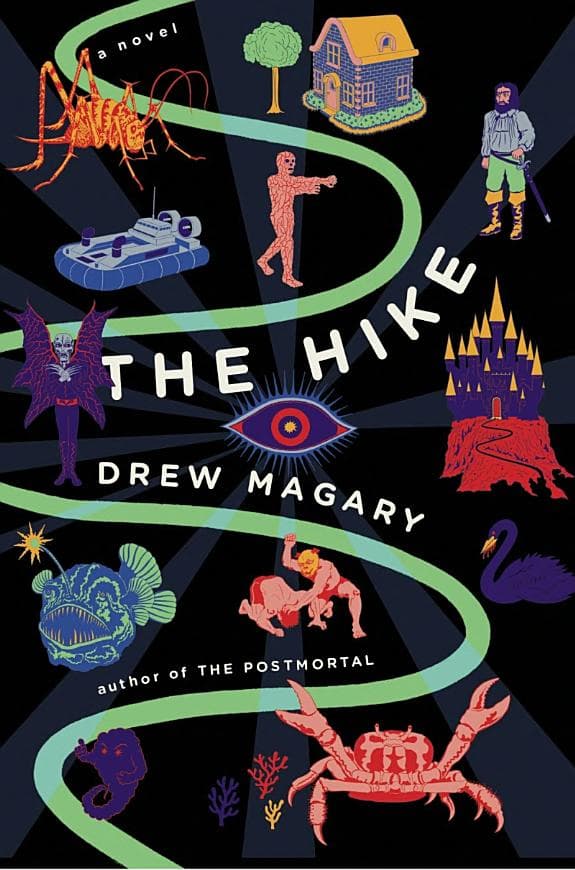
Drew Magary (2016)
Goodreads Rating
3.96/ 5(34,585 reviews)
Genre
General
Summary Read
9 min
Book Length
600 min
Sign in to track this book
A suburban dad's casual hike turns into a surreal, high-stakes odyssey through a fantasy world filled with giants, demons, and magical crustaceans as he fights to return to his family.
Ask anything about The Hike and get instant answers grounded in the summary.
Ben, a suburban family man, is on a business trip in rural Pennsylvania. With some free time before a dinner meeting, he decides to take a short hike behind his hotel. The path quickly becomes confusing and overgrown, diverging from what he expected. He tries to turn back but finds the way he came is blocked or has disappeared. A mysterious voice, later identified as 'The Producer,' tells him he is now on 'The Path' and must continue forward. Ben's initial frustration turns to growing alarm as the environment becomes increasingly surreal and hostile. This is the start of his involuntary journey.
Forced to continue, Ben quickly encounters the bizarre and dangerous inhabitants of The Path. He faces giant, carnivorous grasshoppers, grotesque, human-like creatures called 'The Cleaners,' and other monstrous entities. He learns that death on The Path is often permanent, and survival requires constant vigilance and adaptation. He also discovers strange artifacts and potions, seemingly left for his use, hinting at a larger, unseen force orchestrating his journey. The initial shock gives way to a grim determination as Ben realizes the seriousness of his situation and that returning home is impossible.
Ben's loneliness and despair are somewhat lessened when he encounters a talking crab named Crab. Crab is foul-mouthed, cynical, but surprisingly knowledgeable about The Path and its mechanics. He explains that Ben is not the first to be on The Path and that many others have tried to find 'The Producer,' the enigmatic creator of this world, believing he holds the key to escape. Crab provides survival advice and helps Ben navigate the increasingly treacherous landscape, offering companionship and information about the strange rules governing their reality.
Ben and Crab eventually stumble upon a strange, ramshackle village inhabited by other individuals who have also found themselves on The Path. These 'hikers' come from various times and places, each with their own story of how they arrived. The village offers a temporary break but is also fraught with its own dangers and internal politics. Ben learns more about the diverse challenges and creatures that exist on The Path through their shared experiences. He starts to piece together information about the Producer and his ultimate goal: to find a way off The Path and back to his family.
Within the village, Ben is forced to participate in a deadly gladiatorial arena, a common event designed by The Producer to test the hikers. He must fight against other creatures and even other hikers to survive. These trials are designed to break the spirit and reveal character. Ben's resilience and his desire to return to his family push him through these brutal encounters. His victories earn him respect among some of the villagers and solidify his resolve, showing his increasing adaptability to The Path's harsh realities.
Continuing their journey, Ben and Crab leave the village and venture into a vast, decaying city inhabited by colossal, human-like giants. These giants are largely indifferent to the smaller hikers but can be incredibly dangerous if provoked. Navigating the city is a harrowing experience, requiring stealth and quick thinking to avoid being crushed or becoming an accidental meal. This section of The Path emphasizes the sheer scale and alien nature of the world Ben is traversing, further highlighting his vulnerability and the constant threat he faces.
As Ben gets closer to the rumored location of The Producer, the challenges shift from physical combat to puzzles and mind games. He encounters areas that defy logic and physics, forcing him to think creatively and apply the strange 'rules' he has learned about The Path. These challenges test his intelligence, perception, and even his sanity. The atmosphere becomes increasingly surreal and unsettling, indicating that he is entering the heart of The Producer's domain and nearing the ultimate confrontation.
Ben finally reaches The Producer's chamber, a place that is both mundane and utterly alien. The Producer reveals himself not as a god-like entity, but as a bored, cosmic game designer. He explains that The Path is an elaborate, ever-evolving game created for his amusement, and Ben is merely one of his many 'players.' This revelation is devastating, stripping away any sense of higher purpose or grand design. Ben's quest for answers culminates in the bitter truth that his suffering is merely entertainment for a detached, powerful being.
The Producer offers Ben a way out: a chance to return to his family, but with a catch. The exact nature of the choice is morally complex, forcing Ben to weigh his desire for home against the lives or freedom of others on The Path. This moment tests Ben's core values and his humanity. The decision he makes is a profound one, showing his growth and the sacrifices he is willing to make, even in the face of overwhelming despair and the cynical nature of The Producer's game.
Ben's journey concludes, and he finds himself back in his own world, but irrevocably changed. The experience on The Path has left deep scars, both physical and psychological. He struggles to reconcile the mundane reality of his suburban life with the cosmic horrors and lessons he endured. The ending leaves an ambiguous but powerful impression, suggesting that while he has returned, a part of him will forever remain on The Path, and his perception of reality has been permanently altered by the ordeal.
The Protagonist
Ben transforms from a fearful, ordinary man into a hardened survivor who makes profound sacrifices, retaining his humanity despite the dehumanizing nature of The Path.
The Supporting
Crab remains largely static in personality but deepens his bond with Ben, demonstrating loyalty and even sacrifice, evolving from a mere informant to a true friend.
The Antagonist
The Producer's character is revealed rather than developed, serving as the ultimate, indifferent force behind Ben's ordeal.
The Supporting
The Cleaners serve as a consistent environmental threat, their purpose and nature remaining static.
The Supporting
The Giants are a static environmental feature, representing the overwhelming scale of The Path.
The Supporting
Ben's family serves as a static motivator, their image driving his entire journey.
The novel explores the idea that life, or at least Ben's ordeal, is ultimately without inherent meaning or purpose, orchestrated by a detached, indifferent force. The Producer's revelation that The Path is merely a game for his amusement strips away any grander design, forcing Ben to confront the arbitrary nature of his suffering. This theme highlights the human struggle to find meaning in a universe that may not provide any, and the resilience required to persevere despite this existential void.
“"The Path wasn't a test. It wasn't a punishment. It was just... a thing. A game. And I was just a piece."”
Despite facing unimaginable horrors, constant danger, and the crushing weight of an indifferent universe, Ben consistently chooses to move forward. His unwavering desire to return to his family fuels an incredible capacity for survival, adaptation, and even compassion. This theme celebrates individual tenacity to endure extreme adversity, find strength in unexpected places, and maintain core values even when everything around them is designed to break them down. It is about the power of hope and purpose.
“"He was still Ben. He was still a husband and a father. And he would get home."”
Ben's entire journey is driven by his desperate longing for home and his family. The concept of 'home' goes beyond a physical location, becoming a symbol of safety, love, and identity that he fights to reclaim. The Path, in contrast, is the ultimate 'un-home' – a place of constant displacement and alienation. The novel explores what it means to be truly lost and the psychological impact of being severed from one's roots. It also emphasizes the powerful pull of where one truly belongs.
“"Home wasn't a place. It was the people you loved, and the feeling that came with them."”
From the moment Ben steps onto The Path, he loses all control over his destiny. His choices are limited, his environment is constantly shifting, and his very existence is dictated by an unseen entity. This theme explores the human desire for agency versus the reality that much of life is beyond our influence. The novel suggests that while we may not control the grand narrative, we can still choose how we react, adapt, and maintain our integrity within the confines of our circumstances.
“"You don't get to choose the path, Ben. You only get to choose how you walk it."”
A surreal, ever-changing, inescapable landscape
The Path is more than just a setting; it's a living, evolving entity and the central plot device. It acts as a character in its own right, constantly presenting new challenges, creatures, and environments. Its rules are arbitrary and often defy logic, reflecting the whimsical yet dangerous nature of The Producer. The Path serves to isolate Ben, test his limits, and force his transformation, pushing him further and further away from his normal life and into the realm of the surreal and perilous.
The overarching, cosmic game orchestrating Ben's journey
The concept of Ben's journey being an elaborate 'game' for The Producer's amusement is a central plot device. This device provides a meta-narrative framework, explaining the arbitrary dangers, the convenient power-ups, and the ultimate lack of traditional villainous motivation. It heightens the theme of absurdity and the illusion of control, as Ben's struggles are revealed to be mere entertainment. This device also allows for the integration of video game-like elements into the narrative, from health potions to boss battles.
Blending the mundane with the fantastical and dreamlike
The novel heavily employs magical realism and surrealism, where talking crabs, giant insects, and shifting landscapes are presented with a matter-of-fact tone. This device blurs the lines between reality and fantasy, making Ben's journey feel both grounded in his human experience and utterly fantastical. It allows the author to explore profound themes through absurd scenarios, creating a unique tone that is both humorous and deeply unsettling, challenging the reader's perception of what is possible.
Ben's unwavering goal to return to his family
While 'The Way Home' is a tangible desire for Ben, it functions as a MacGuffin in the sense that its specific mechanics are less important than its role in driving the plot and Ben's character arc. The elusive nature of returning home forces Ben to engage with The Path's challenges, seek out The Producer, and make difficult choices. It provides a clear, powerful motivation that propels the narrative forward, even when the means to achieve it are unclear or constantly shifting.
“It was a gorgeous day, the kind that made you want to go for a walk, but not necessarily a hike.”
— Opening sentence of the book, setting a slightly ironic tone.
“He thought about his wife, about his kids, about his job, about the life he was trying to build, and none of it felt quite real.”
— Ben's internal monologue as he begins the hike, reflecting on his life.
“The woods were beautiful, yes, but they were also indifferent. They didn't care if he lived or died.”
— Ben's growing unease and realization of his vulnerability in the wilderness.
“He was a grown man, a father, a husband, and yet he felt like a lost child.”
— Ben's feeling of helplessness and regression as the hike becomes more challenging.
“The magic wasn't in the destination, it was in the journey, the struggle, the sheer act of putting one foot in front of the other.”
— A moment of epiphany for Ben as he confronts the difficulties of the hike.
“He wasn't sure what he was looking for, but he knew he wouldn't find it if he turned back.”
— Ben's determination to continue despite the unknown.
“The further he went, the more he shed the layers of his old life.”
— Metaphorical shedding of Ben's former self as he progresses on the hike.
“He realized that sometimes, the only way to find yourself is to get completely lost.”
— A key realization about the nature of self-discovery.
“The mountain was a metaphor for all the things he had to climb in his life.”
— Ben's interpretation of the physical challenge as a representation of life's obstacles.
“He had to confront the darkness within himself before he could appreciate the light.”
— Ben's internal struggle and the need for introspection.
“The real test wasn't the physical exertion, but the mental fortitude required to keep going.”
— Highlighting the psychological aspect of the hike.
“He learned that strength wasn't about never falling, but about getting back up every time you did.”
— A lesson learned about resilience.
“He didn't know if he would ever be the same man who started the hike, and that was okay.”
— Acceptance of change and the uncertainty of the future.
“The woods had given him a gift, a chance to start over, a chance to be someone new.”
— The transformative experience of the hike.
Ready to see how well you understood this book? Take our interactive quiz with 10 questions.
Support the author — grab the full book.
As an Amazon Associate, BookBrief earns from qualifying purchases, at no extra cost to you. How we're funded.