
Synopsis
Covers the whole plot, including the ending.
- Difficulty
- Medium
- Pacing
- Fast
- Mood
- Suspenseful, Dark, Intense, Gripping
- Read it if
- You enjoy intense cat-and-mouse thrillers with a strong female lead and forensic detail.
- Skip it if
- You prefer less dark themes or find the manipulation of a parent's grief too disturbing.
The Killing Game Plot Summary
Covers the whole plot, including the ending.
The Talladega Falls Discovery
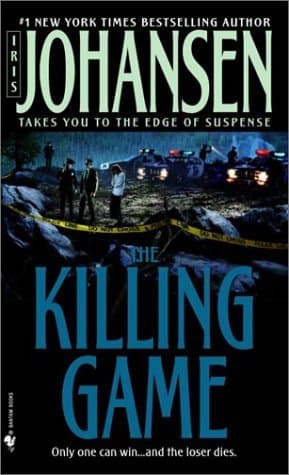
Forensic sculptor Eve Duncan, still haunted by the unsolved murder of her daughter Bonnie, receives a call from her friend and colleague, Joe Quinn. Nine skeletons have been discovered on a bluff overlooking Talladega Falls in Georgia. The local authorities, including Sheriff Ben Salter, are overwhelmed and request Eve's expertise for identification. The discovery immediately triggers Eve's deepest fears and hopes. It raises the possibility that one of these might be Bonnie's remains, or that the case could somehow be connected to her daughter's disappearance. Despite the emotional toll, Eve feels compelled to go, driven by her professional duty and the desperate, lingering hope for closure regarding Bonnie.
The First Reconstruction and a Chilling Message
Upon arriving at Talladega Falls, Eve begins the process of reconstructing the first skull. She soon receives an anonymous package containing a drawing: a sketch of the reconstructed face she is working on, along with a taunting message implying the killer knows her intimately and is playing a game. This immediately changes the case from a routine identification to a personal and terrifying confrontation. Joe Quinn and Detective Scarletti, who is also investigating the case, become concerned for Eve's safety, realizing she is being specifically targeted by a dangerous individual.
Jane MacGuire's Arrival and the Killer's Ultimatum
Eve's adopted daughter, Jane MacGuire, a psychic and artist, arrives unexpectedly, sensing Eve is in danger. Her presence brings both comfort and increased worry for Eve. Shortly after, Eve receives another package, this one containing a lock of Bonnie's hair—proof that the killer has been involved in Bonnie's disappearance and death. The accompanying note explicitly states the killer's rules: Eve must identify all nine skeletons alone, without police interference, or Jane will be the next victim. This ultimatum forces Eve into a desperate race against time, torn between her professional integrity and the need to protect Jane.
Unraveling the Victims' Identities
Working under pressure and the constant threat to Jane, Eve continues her forensic reconstructions. She identifies the first few victims as young women, all around the same age, missing for varying lengths of time. Each identification brings grief for the families and a deeper understanding of the killer's methods. Joe Quinn and Scarletti, though kept at arm's length by Eve's adherence to the killer's rules, try to work discreetly in the background, cross-referencing missing persons reports and searching for any common links between the victims. Eve realizes the killer is deliberately orchestrating her pain and forcing her to confront the specter of Bonnie with each new face.
The Killer's Identity Begins to Emerge
As Eve identifies more victims, clues begin to emerge about their lives and connections. Jane, using her psychic abilities, also starts to pick up on fragmented images and emotions related to the killer and the victims. The killer's communications become more frequent and personal, revealing an obsession with Eve and a detailed knowledge of her past, particularly her grief over Bonnie. Through forensic evidence, Jane's insights, and the killer's taunts, a profile starts to form, pointing towards an intelligent, manipulative, and disturbed individual with a personal vendetta against Eve.
The Trap is Sprung
After Eve identifies the eighth victim, the killer sends a final, cryptic message, instructing her to meet him alone at a remote, abandoned cabin deep in the woods near Talladega Falls. He implies that the final skeleton, perhaps Bonnie's, awaits her there, along with the answers she seeks. Despite Joe and Scarletti's pleas for her not to go, Eve, driven by the need to protect Jane and her own desire for closure regarding Bonnie, complies. She knows it's a trap, but she feels she has no choice, convinced this is the only way to end the killer's game.
Confrontation at the Cabin
Eve arrives at the isolated cabin to find Sheriff Ben Salter waiting for her. He reveals himself as the killer, a man consumed by a vengeful obsession stemming from a past grievance involving Eve's father. Salter confesses to the murders of the nine women, explaining his game was designed to inflict maximum emotional pain on Eve. He then reveals the horror: he was the one who killed Bonnie years ago, and her remains are indeed the ninth skeleton he has been forcing Eve to identify. The revelation shatters Eve, confirming her worst fears while also providing a chilling, brutal form of closure.
A Desperate Struggle for Survival
Ben Salter, having confessed, moves to kill Eve, intending to make her the tenth victim. A brutal struggle ensues in the cabin. Eve, though not physically dominant, is fueled by rage and the desire to avenge Bonnie and protect Jane. Just as Salter gains the upper hand, Jane, having followed Eve despite being told to stay behind, bursts into the cabin. Her sudden appearance, coupled with her raw psychic energy, momentarily distracts Salter, giving Eve a crucial opening to fight back with renewed ferocity. Joe Quinn and Scarletti, who had been tracking Eve, are also closing in.
The Final Showdown and Salter's Demise
The struggle intensifies, with Jane's presence adding chaos. Just as Salter is about to overpower Eve again, Joe Quinn and Detective Scarletti burst into the cabin, having followed Eve's trail. A tense standoff erupts, with Salter refusing to surrender. In the chaos, Salter makes a final desperate move, attempting to harm Jane, but Joe Quinn intervenes, and Salter is killed in the confrontation. His reign of terror ends, but the emotional scars on Eve and Jane are deep.
Aftermath and Lingering Scars
With Salter dead and the immediate threat neutralized, the full weight of what has happened settles on Eve. The ninth skeleton is indeed Bonnie's, finally bringing a physical end to years of uncertainty. While the closure is agonizing, it allows Eve to begin the long process of grieving and healing. Joe Quinn and Jane remain by her side, offering support. The case of the Talladega Falls victims is closed, but the emotional wounds from Salter's game and the revelation about Bonnie's fate will forever change Eve, leaving her with a painful truth to carry forward.
The Killing Game Characters
Eve Duncan
Protagonist
A world-renowned forensic sculptor haunted by her daughter's murder.
Eve Duncan is a brilliant forensic sculptor whose life has been irrevocably shaped by the unsolved murder of her seven-year-old daughter, Bonnie. This tragedy drives her professional work, as she dedicates herself to giving identities back to the unknown dead, often hoping to find closure for others that she has been denied. She is fiercely intelligent, resilient, and deeply empathetic, yet carries immense emotional pain and guilt. Her love for her adopted daughter, Jane, is paramount, making her vulnerable to the killer's manipulations.
Relationships: Bonnie Duncan (Deceased daughter, her murder is Eve's primary trauma.); Joe Quinn (Close friend, former lover, and protector.); Jane MacGuire (Adopted daughter, psychic, Eve's emotional anchor.); Ben Salter (Antagonist, the killer with a personal vendetta against Eve.)
Joe Quinn
Supporting
Eve's loyal friend, protector, and former lover.
Joe Quinn is a former FBI agent and Eve's steadfast friend and protector. He is deeply devoted to Eve and Jane, often putting their safety above his own. Joe is intelligent, resourceful, and possesses a strong moral compass. He struggles with his inability to protect Bonnie years ago and is determined not to let Eve or Jane come to harm. His calm demeanor and strategic thinking provide a crucial counterbalance to Eve's emotional intensity, especially when she is under extreme duress.
Relationships: Eve Duncan (Close friend, former lover, protective bond.); Jane MacGuire (Adopted father figure, protective bond.)
Jane MacGuire
Supporting
Eve's adopted daughter with powerful psychic abilities.
Jane MacGuire is Eve's adopted daughter, a young woman with extraordinary, often frightening, psychic abilities. She can 'see' and 'feel' the emotions and events surrounding people and objects, which makes her both a valuable asset in investigations and a significant vulnerability. Jane is fiercely independent, artistic, and deeply intuitive. Her bond with Eve is profound, and she is willing to put herself in danger to protect her mother. Her powers often manifest as intense visions or feelings, providing fragmented but crucial clues.
Relationships: Eve Duncan (Adopted mother, deep emotional and psychic bond.); Joe Quinn (Father figure, protective bond.)
Ben Salter
Antagonist
The vengeful Sheriff and serial killer targeting Eve.
Ben Salter is initially presented as the seemingly helpful local sheriff of Talladega Falls, but is soon revealed to be the cunning and sadistic serial killer. He harbors a deep-seated, twisted vendetta against Eve Duncan, stemming from a past grievance involving her father. Salter is highly intelligent, manipulative, and meticulously plans his 'game' to inflict maximum psychological torture on Eve, using her daughter Bonnie's murder as his ultimate weapon. He is utterly devoid of empathy, driven by a desire for revenge and control.
Relationships: Eve Duncan (Target of his vengeful obsession and sadistic game.); Bonnie Duncan (His past victim, used as a tool to torment Eve.)
Detective Scarletti
Supporting
A dedicated detective assisting in the investigation.
Detective Scarletti is a diligent and observant local detective assigned to the Talladega Falls case. He is initially skeptical of Eve's involvement and the unusual circumstances but quickly recognizes her expertise and the gravity of the situation. Scarletti is committed to justice and works tirelessly to uncover the truth, even when Eve's actions are constrained by the killer's demands. He forms a working alliance with Joe Quinn, providing police resources and a grounded perspective to the increasingly personal investigation.
Relationships: Eve Duncan (Professional colleague, initially wary, then trusting.); Joe Quinn (Collaborative investigative partner.)
Bonnie Duncan
Mentioned
Eve's deceased daughter, whose murder fuels Eve's actions.
Bonnie Duncan is Eve's seven-year-old daughter, whose unsolved murder years ago is the central trauma in Eve's life. Though she only appears in flashbacks and as a memory, Bonnie's presence is profoundly felt throughout the novel. Her body was never found, leaving Eve in a perpetual state of grief and desperate hope for closure. The killer's use of Bonnie's death as a tool to torment Eve makes her the ultimate victim and the driving force behind Eve's determination.
Relationships: Eve Duncan (Daughter, source of Eve's profound grief and motivation.); Ben Salter (Her killer.)
Eve's Father (unnamed)
Mentioned
Figure from Eve's past, central to the killer's motive.
Eve's father is a figure from her past whose actions or decisions, though not explicitly detailed, are revealed to be the root cause of Ben Salter's deep-seated vendetta against Eve. He is not a character in the present narrative but serves as the catalyst for the entire 'killing game.' His past connection to Salter provides the antagonist with his twisted justification for tormenting Eve, linking the present horror to a long-forgotten or unresolved conflict.
Relationships: Eve Duncan (Father, his actions indirectly cause her suffering.); Ben Salter (His past adversary, the source of Salter's grievance.)
The Killing Game Themes
Grief and the Quest for Closure
The novel explores the pain of unresolved grief, particularly through Eve's decade-long struggle with Bonnie's disappearance. The discovery of the skeletons at Talladega Falls reignites Eve's desperate hope for closure, even as it forces her to confront the possibility of Bonnie's death. The killer's game exploits this vulnerability, dangling the truth about Bonnie as the ultimate prize. The eventual identification of Bonnie's remains, while devastating, finally provides Eve with a brutal, yet necessary, end to her prolonged agony, allowing her to begin the process of true mourning. This theme emphasizes that closure, even when painful, is vital for healing.
“She had lived with the ghost of Bonnie for so long, a silent companion in her every waking moment. Now, the ghost might finally have a body, and with it, the agonizing truth.”
The Nature of Obsession and Revenge
The core conflict of the novel is driven by Ben Salter's obsession with Eve and his planned revenge. His vendetta, rooted in an old grievance involving Eve's father, has festered for years, ending in a game designed to inflict maximum psychological torture. Salter's actions show how obsession can twist a person's morality, leading them to commit heinous acts. He doesn't just want to kill Eve; he wants to break her, forcing her to relive her deepest pain and despair, highlighting the destructive nature of unchecked vengeance.
“He didn't want her dead. Not yet. He wanted her to suffer, to truly understand the depths of his own pain.”
Maternal Love and Sacrifice
Eve's maternal love for both Bonnie and Jane is a central driving force. Her love for Bonnie, even in death, fuels her forensic work and her search for truth. Her love for Jane becomes her greatest vulnerability and her greatest strength. When the killer threatens Jane, Eve is willing to sacrifice everything—her safety, her professional ethics, and even her life—to protect her adopted daughter. This theme shows the instinct of a mother to shield her child from harm, demonstrating the lengths she will go to ensure their survival, even against overwhelming odds.
“She would walk into hell if it meant Jane would be safe. There was no question, no hesitation.”
The Power of Intuition and Psychic Abilities
Jane MacGuire's psychic abilities play a role, acting as a counterpoint to Eve's scientific methods. While Eve relies on tangible forensic evidence, Jane's intuition provides fragmented but vital insights into the killer's mindset and the victims' experiences. Her 'feelings' and visions often guide Eve when logic falters, such as sensing Eve's danger or picking up on clues about the killer's personality. This theme explores the idea that truth can be accessed through non-traditional means, suggesting that some mysteries extend beyond scientific explanation and into the realm of the intuitive.
“The whispers were getting louder, the images clearer. She could feel his anger, his cold, calculating joy.”
Plot Devices & Literary Techniques
The Forensic Reconstruction
Eve's skill used as a tool for the killer's game.
The forensic reconstruction of skulls is not just a plot element but a central plot device. It is Eve's unique skill that draws her into the case, and it becomes the very mechanism through which the killer tortures her. Each skull Eve reconstructs forces her to face the potential of Bonnie's face, making the process a personal torment rather than a detached scientific exercise. The killer's game hinges on Eve's ability and emotional connection to her work, turning her professional strength into her greatest vulnerability and a countdown to his ultimate revelation.
The Taunting Messages and Deliveries
The killer's direct communication to Eve, escalating the psychological warfare.
The anonymous packages and messages sent by the killer serve as a crucial plot device, driving the narrative forward and intensifying the psychological suspense. These communications are not merely clues; they are direct challenges and taunts, escalating the killer's game and dictating Eve's actions. The delivery of Bonnie's hair is the ultimate manipulative device, confirming the killer's intimate involvement in Eve's past and forcing her to comply with his rules, effectively isolating her and raising the stakes to an unbearable level.
The Impending Deadline/Ultimatum
The threat to Jane, forcing Eve's compliance.
The killer's ultimatum regarding Jane MacGuire acts as a powerful plot device, creating immediate urgency and forcing Eve into a solitary, desperate mission. The threat to Jane's life establishes a clear, high-stakes deadline that prohibits police involvement and compels Eve to play by the killer's rules. This device effectively isolates Eve, heightens the emotional tension, and removes conventional investigative support, pushing her to her limits and making her eventual confrontation with the killer all the more personal and perilous.
The Killing Game Quotes
“There are no rules in a killing game, Eve. Only the hunter and the hunted.”
“Every secret has a price, and some prices are paid in blood.”
“Sometimes the monster you seek is the one you least expect.”
“Love doesn't make you weak, it makes you vulnerable. And sometimes, that's the most dangerous thing of all.”
“The past is never truly buried. It always finds a way to claw its way back to the surface.”
“Trust is a luxury we can rarely afford.”
“Even in the darkest places, there is always a flicker of hope, if you're willing to fight for it.”
“The truth can set you free, but first, it might destroy everything you hold dear.”
“Some battles are fought not with fists or guns, but with wits and sheer will.”
“A predator always returns to the scene of the hunt, even if it's just in their mind.”
“You can't outrun your demons, Eve. You have to face them.”
“The line between hunter and hunted can blur so easily.”
“Sometimes, the only way to save someone is to risk everything.”
“Silence can be more terrifying than any scream.”
Quiz
10 questions on the plot and the characters. Each answer comes with a short explanation.
Question 1
What is Eve Duncan's profession?
- Police Detective
- Forensic Sculptor
- FBI Profiler
- Medical Examiner
Show answer
B. Forensic Sculptor The book explicitly states Eve Duncan is one of the nation's top forensic sculptors.
Question 2
What significant personal tragedy drives Eve Duncan?
- Her husband's disappearance
- The unsolved murder of her sister
- The murder of her daughter, Bonnie, whose body was never found
- A career-ending accident
Show answer
C. The murder of her daughter, Bonnie, whose body was never found The killer knows the pain Eve feels for her murdered daughter, Bonnie, whose body has never been found, which is a central motivation for her actions.
Question 3
Where are the nine skeletons unearthed that draw Eve's attention?
- A remote cave in the Rocky Mountains
- A deserted island off the coast of Florida
- A bluff near Georgia's Talladega Falls
- An abandoned mine in Nevada
Show answer
C. A bluff near Georgia's Talladega Falls The nine skeletons are unearthed on a bluff near Georgia's Talladega Falls, which is where Eve is tempted to believe one might be her daughter.
Question 4
What is the killer's primary goal in his 'sadistic game' with Eve Duncan?
- To frame Eve for a series of murders
- To force Eve to retire from her profession
- To claim Eve's life as his prize
- To make Eve identify all nine skeletons
Show answer
C. To claim Eve's life as his prize The text states the killer 'won't stop playing until he claims the prize he wants most: Eve's life.'
Question 5
How does the killer intend to ensure Eve complies with his demands?
- By threatening her professional reputation
- By holding her best friend hostage
- By using an 'ace in the hole'
- By publicly shaming her
Show answer
C. By using an 'ace in the hole' The killer 'will use his ace in the hole to make sure she complies,' indicating a specific leverage point.
Question 6
What specific temptation does the killer use to draw Eve into his game regarding the unearthed skeletons?
- The promise of fame if she solves the case
- The belief that one of the skeletons might be her daughter's
- A large monetary reward for identification
- The chance to work with a renowned archaeologist
Show answer
B. The belief that one of the skeletons might be her daughter's The killer knows 'she won't be able to resist the temptation of believing that one of those skeletons might be her daughter's.'
Question 7
What aspect of Eve's past does the killer exploit to manipulate her?
- Her professional rivalries
- Her financial struggles
- Her unresolved grief and hope for her murdered daughter
- Her secret criminal history
Show answer
C. Her unresolved grief and hope for her murdered daughter The killer 'knows the pain she feels for her murdered daughter, Bonnie, whose body has never been found,' and uses this to draw her into his game.
Question 8
What is the killer's overall approach to engaging Eve Duncan?
- He wants to work with her to solve a different case.
- He wants Eve 'one on one,' implying a personal, isolated confrontation.
- He seeks to expose her past mistakes publicly.
- He sends her anonymous tips to help her investigate.
Show answer
B. He wants Eve 'one on one,' implying a personal, isolated confrontation. The killer 'wants Eve one on one,' indicating his desire for a direct, isolated, and personal confrontation.
Question 9
What is implied about the killer's knowledge of Eve Duncan?
- He is a casual acquaintance from her past.
- He has extensively researched her professional techniques.
- He knows her 'all too well,' suggesting a deep, intimate understanding of her vulnerabilities and history.
- He is a former colleague seeking revenge.
Show answer
C. He knows her 'all too well,' suggesting a deep, intimate understanding of her vulnerabilities and history. The text states 'The killer knows Eve Duncan all too well,' implying a profound and unsettling understanding of her personal life and weaknesses.
Question 10
The title 'The Killing Game' refers to what central element of the plot?
- A literal game played by children in the story.
- The killer's calculated and manipulative scheme to torment and ultimately kill Eve Duncan.
- A historical event involving a deadly competition.
- A psychological experiment gone wrong.
Show answer
B. The killer's calculated and manipulative scheme to torment and ultimately kill Eve Duncan. The summary repeatedly refers to the killer's actions as a 'sadistic game' and that he 'won't stop playing until he claims the prize he wants most: Eve's life,' directly linking the title to his deadly scheme.
The Killing Game FAQ
What is the central premise of 'The Killing Game'?
'The Killing Game' centers on forensic sculptor Eve Duncan, who is lured into a deadly game by a serial killer. The killer, who knows Eve's personal tragedy of her daughter Bonnie's disappearance, manipulates her by planting nine skeletons near Talladega Falls, implying one might be Bonnie, to force Eve into a one-on-one confrontation.
Who is the primary antagonist in the story and what is his motivation?
The primary antagonist is a sadistic serial killer whose main motivation is to torment and ultimately kill Eve Duncan. He meticulously plans his game, exploiting Eve's deepest pain—the loss of her daughter Bonnie—to ensure she participates and faces him directly.
How does the discovery of the nine skeletons drive the plot forward?
The discovery of the nine skeletons is the catalyst for the entire plot, as it directly targets Eve's vulnerability. The killer orchestrates this discovery specifically to make Eve believe Bonnie might be among the remains, compelling her to get involved and play his twisted game.
What role does Eve Duncan's profession as a forensic sculptor play in the narrative?
Eve's profession as a forensic sculptor is crucial because it makes her uniquely qualified to identify the remains, and also makes her a target. The killer specifically leverages her expertise and her personal connection to unidentified bodies to draw her into his trap, knowing she won't be able to resist the urge to identify the victims.
Is the search for Bonnie's body a new element in this book, or does it connect to Eve's past?
The search for Bonnie's body is a long-standing, unresolved tragedy in Eve Duncan's life, a core element of her character in previous books. In 'The Killing Game,' the killer exploits this existing pain, using the possibility of finding Bonnie's remains to manipulate Eve into his deadly game.
Are there any subtle clues about the killer's identity or background embedded early in the story?
The killer's intimate knowledge of Eve's personal life, particularly details about Bonnie's disappearance and Eve's pain, subtly suggests a past connection or extensive surveillance. His precise manipulation of events implies a meticulous planner with a deep-seated obsession, hinting at a background that allowed such detailed preparation.
How does the killer manage to stay one step ahead of Eve and law enforcement throughout the game?
The killer stays ahead by anticipating Eve's emotional reactions and professional instincts, and by setting up elaborate traps and diversions. He uses his knowledge of her past and her daughter's case to predict her moves, ensuring she follows his pre-ordained path while keeping law enforcement distracted or misdirected.
Are there any characters introduced who initially seem innocuous but later reveal a deeper connection to the killer or his plan?
The narrative often introduces seemingly minor characters or situations that later prove to be carefully orchestrated by the killer. These individuals or events serve as pawns or misdirections, subtly guiding Eve into the killer's traps while obscuring his true identity and ultimate goal.
What specific psychological vulnerabilities of Eve Duncan does the killer exploit?
The killer primarily exploits Eve's profound grief and guilt over Bonnie's disappearance, and her desperate hope for closure. He also targets her professional compulsion to give names to the nameless, knowing she cannot resist the urge to identify the nine skeletons, especially if one could be Bonnie.
How does the 'game' format affect Eve's psychological state and decision-making?
The 'game' format pushes Eve to the brink, creating immense psychological pressure. It forces her into desperate, often isolated decisions, as she feels she must play by the killer's rules to save lives or find answers, often overriding rational judgment and increasing her emotional vulnerability.
What psychological impact does the killer's focus on Bonnie's case have on Eve's perception of her past trauma?
The killer's focus on Bonnie's case reopens Eve's past trauma with brutal intensity, forcing her to relive the pain and uncertainty. It makes her question every past decision and interaction related to Bonnie, blurring the lines between her professional duty and her deeply personal grief.
How does the killer's desire for 'Eve's life' go beyond mere murder and into a deeper psychological motive?
The killer's desire for 'Eve's life' isn't just about physical murder; it's about psychological annihilation. He aims to strip her of her hope, her sanity, and her will to live through torment and manipulation, making her death a culmination of profound psychological destruction rather than just a physical act.
Is the killer's ultimate goal truly just Eve's life, or is there a broader message he intends to convey through his actions?
While the killer explicitly targets Eve's life, his methods suggest a broader, more sadistic message. He might be aiming to prove his intellectual superiority, highlight the futility of justice, or simply revel in the power of inflicting extreme suffering, making Eve a symbol for his grander, twisted statement.
How does the book explore the theme of a mother's relentless pursuit of her child, even against overwhelming odds?
The book deeply explores a mother's relentless pursuit by showing Eve's willingness to face extreme danger, defy authorities, and endure immense psychological torture. Her drive to find answers about Bonnie, or at least identify the remains, transcends fear and logic, portraying a primal maternal instinct.
What is the significance of the Talladega Falls setting in the context of the killer's game?
The Talladega Falls setting, with its remote bluff and potentially hidden graves, provides a desolate and isolated backdrop that enhances the killer's sense of control. Its natural, rugged beauty contrasts sharply with the horror of the buried remains, amplifying the sinister nature of the 'game' and Eve's vulnerability.
Could the killer be interpreted as a dark reflection of Eve's own obsession with the dead and the past?
The killer could be interpreted as a dark reflection of Eve, mirroring her intense focus on the past and the deceased. While Eve seeks justice and closure, the killer perverts this obsession, using the dead to inflict pain and control, suggesting a twisted parallel in their respective fixations.
Does the novel suggest that Eve's personal pain makes her a more effective forensic sculptor, or does it hinder her?
The novel suggests Eve's personal pain, specifically Bonnie's disappearance, both enhances and hinders her. It gives her a unique empathy for victims, driving her dedication, but also makes her intensely vulnerable to manipulation, blurring professional boundaries and sometimes compromising her objectivity.
How does the book balance the thriller/mystery elements with the underlying romance angle?
The book primarily focuses on the thriller and mystery, with the romance acting as a secondary, supportive element. The romantic relationship often provides emotional grounding for Eve amidst the chaos and danger, offering moments of respite and a source of strength, without overshadowing the core suspense plot.
Similar books
- The Bone Collector
Jeffery Deaver
4.2 (158k) average on GoodreadsThrillerFeatures a brilliant forensic expert battling a serial killer in a race against time.
- Silent Scream
Angela Marsons
4.0 (31k) average on GoodreadsThrillerInvolves a female detective dealing with personal trauma while hunting a brutal killer.
- Kiss the Girls
James Patterson
4.0 (313k) average on GoodreadsThrillerProtagonist hunts a serial killer who targets women, with a focus on psychological manipulation.
- Gone Girl
Gillian Flynn
4.1 (2.3M) average on GoodreadsThrillerWhile The Killing Game focuses on external threats and a clear hero/villain dynamic, Gone Girl delves into deep psychological manipulation, unreliable narration, and societal critiques. Flynn's work offers more nuanced character studies and morally ambiguous situations, whereas Johansen prioritizes action and a more straightforward resolution.
- The Likeness
Tana French
4.0 (126k) average on GoodreadsThrillerThe Likeness explores psychological depth, atmosphere, and the lingering effects of past events with a slower, more introspective pace. Johansen's The Killing Game is significantly faster-paced, with a greater emphasis on immediate physical threat and romantic tension, rather than the intricate psychological landscapes and character development found in French's Dublin Murder Squad series.
- Angels & Demons
Dan Brown
3.9 (2.7M) average on GoodreadsThrillerA Harvard symbologist races through Rome's ancient sites, deciphering cryptic clues to unmask the Illuminati and stop a vengeful plot to destroy the Vatican with a stolen antimatter weapon.





Enjoyed the summary?
A summary gives you the shape of the book. The book itself has the detail, the examples and the voice.
Find The Killing Game on AmazonAs an Amazon Associate, BookBrief earns from qualifying purchases. How we're funded